Page 217 www.ijiras.com | Email: [email protected]
Development Of ICT Training Management Models For Effective
Administration Of ICT Capacity Building Programmes In
Nigeria’s Higher Educational Institutions
G.O Daramola
Research Scholar, Computer Resource Centre, Federal University of Technology, Akure, Nigeria
I. INTRODUCTION
Information and Communication technology (ICT) has become, within a very short time, one of the basic building blocks of modern society. Many countries now regard understanding ICT and mastering the basic skills and concepts of ICT as part of the core of education, alongside reading, writing and numeracy. Thus, the need to fully integrate ICT into all aspects of teaching, learning and Research is no longer a matter of choice for higher institutions in Nigeria. Improving the quality of education and training is a critical issue, particularly at a time of educational expansion. ICTs can enhance the quality of education in several ways: by increasing learner’s motivation and engagement, by facilitating the acquisition of basic skills, and by enhancing teacher training.
ICTs are also transformational tools which, when used appropriately, can promote the shift to a learner-centered environment. A basic understanding of ICT in education is vital in keeping abreast of rapidly changing technologies. ICT
applied to education enhances the delivery and access to knowledge, and improves the curriculum. It also produces richer learning outcomes compared to education without ICT. It encourages critical thinking and offers unlimited means of achieving educational goals. The key thing is not in ICT itself, but, in understanding ICT and effectively employing it in the delivery of knowledge and reaching goals in less time. ICT is therefore used as a means but not as an end.
Four major approaches have been identified (UNESCO, 2002) for effectively employing ICT in education. They are the emerging, applying, infusing and transforming approaches that constitute ICT optimization stages in education. Sometimes, ICT employed in education does not reach expected goals, or at times introduces some type of complicated educational reform. Student and teachers of educational institutions can lose focus of the essentials and get distracted by rapidly changing technologies. This usually results when students and teachers have not yet understood the technologies; the role ICT plays; where, how and what technology to use. When the meaning of ICT and its unlimited Abstract: Information Communication Technology (ICT) is fast gaining ground in Nigeria’s Higher Educational Institutions. The ever increasing demand for training and Research in the field of Information and Communication Technology (ICT) has necessitated the need for higher institutions in Nigeria to implement ICT training and capacity building programmes that will enhance manpower development. Therefore, the need to effectively deliver qualitative ICT-focused programmes cannot be overemphasized. This study searches a broad base of literature to establish the enormous role of ICT research centres in nation building. Above all, it attempts to develop ICT training models that is expected to showcase the best practices that will help higher institutions in Nigeria to effectively implement and manage ICT training and capacity building programmes in the their training and research centres, so as to meet desired objectives in line with the Information Technology Policy of the Federal Government of Nigeria.
Page 218 www.ijiras.com | Email: [email protected] offer to education are understood, then, rapidly changing
technologies are not seen as overwhelming issues, but, enablers to more critical thinking and problem solving in education. Optimizing the use of ICT in education would depend on understanding ICT; when, how and where to use ICT and what technology to use
II. ROLES OF ICT TRAINING AND RESEARCH CENTRES IN NATION BUILDING
High level skills are developed through a combination of training and applied research activities. ICT training and Research centres are thus established in Higher institutions to produce world class ICT professionals who will be able to exercise capability and expertise in the use and application of information and communications technologies.
ICT training and research centres in higher institutions therefore play enormous role in nation building through applied research, training and development in the major technology domains of ICTs. The increasing demand for training and research in the information and communication sectors poises great challenge to all ICT training and research centres to position them effectively in the global economy while meeting the needs of a developing country in an underdeveloped continent.
The following should therefore be the goal, focus, responsibilities, objectives and contribution of 21st century ICT centres to human capacity building and national development.
Indigenous ICT training centres should endeavor to become a national and regional centre of excellence in Electronics and Information Communication Technology (ICT) training of International Standards. ICT centres should thus project ICT as an enabler, an accelerator and a tool for increasing productivity.
ICT Centres should specialize in Qualitative training and delivery of ICT short courses like, Basic Computer literacy programmes in office productivity tools (Word, Excel, PowerPoint, Access, Internet Explorer, Windows), and advanced computer literacy like networking, graphic and website design, system administration and programming.
The ICT training classrooms of ICT centres should be fortified with modern computers, high-speed internet connection, state of the art equipment, infrastructure and highly qualified instructors.
ICT Centres should promote the availability and adaptability of ICT technologies by the society, so as to alleviate poverty and promote sustainable development through capacity building ICT training programmes.
The overall goal of ICT Training and Research Centres should be to pursue cutting-edge applied research, development and training in ICT, aimed at nurturing sustainable development and at bridging the digital divide to bring about a 'digital unite'.
With the potential that the ICT offers, the ICT Training and Research Centres should primarily address the gap that exists between the developed and the developing
world in ICT applications, and explore technical solutions to narrow the 'digital divide'.
III. LITERATURE REVIEW OF EXISTING MODELS FOR TRAINING AND IMPROVING PERFORMANCE In most cases, designing a new system involves incorporating the requirements or specifications and the results of the system models into the design of the new system. The primary goal here is thus to create a conceptual model of the training management system. A modern structured analysis technique such as those advocated by Jeffrey, et al (1998) is adopted. This form of analysis has been defined as “a process-centered technique that is used to model business requirements for a system. The models are structured pictures that illustrate the processes, inputs, outputs and files required to respond to business events. Design models are thus conceptualized to develop solutions to needs and requirements that remain relatively stable over time. (Jan, et al., 2006)
Training management model is a practical human resource benchmarking model and assessment tool for enhancing training effectiveness (Leslie, 2004). Faced with the task of developing a training management system that needed to accommodate continuously changing requirements over its fielded lifetime, there is the need to develop a model and the mechanisms it contains for accommodating change.
A. THE ISD MODEL
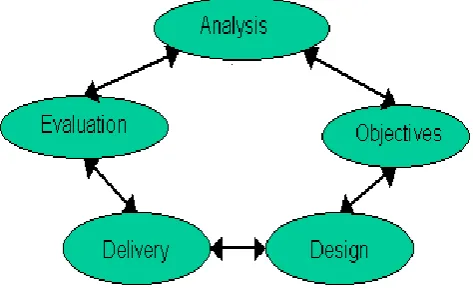
The ISD model is a model for training and improving performance, it is called Instructional Systems Development model. The model consists of five phases, usually described as analysis, objectives, design, delivery and evaluation. The phases interrelate and form a continuous cycle as shown below (Marie, 1999).
Figure 1: Pictorial Representation of ISD MODEL (Adapted from Model for training and improving Performance, Marie, 1999)
B. 70/20/10MODEL
Page 219 www.ijiras.com | Email: [email protected] employees of a company should utilize their time in the
following ratio:
70% of time should be dedicated to core business tasks.
20% of time should be dedicated to projects related to the core business.
10% of time should be dedicated to projects unrelated to the core business.
C. 70/20/10 MODEL IN EDUCATION
The 70/20/10 Model is also used as a Learning and Development model, according to the Princeton University Learning Process (Morgan et al, 2007).
70% of learning and development takes place from real-life and on-the-job experiences, tasks, and problem solving. This is the most important aspect of any learning and development plan. For example, the real learning from a skill acquired in a training program, or from feedback, takes place back on the job when the skill or feedback is applied to a real situation.
20% comes from feedback and from observing and working with role models.
10% of learning and development comes from formal training.
D. KIRKPATRICK MODEL FOR EVALUATING
TRAINING EFFECTIVENESS
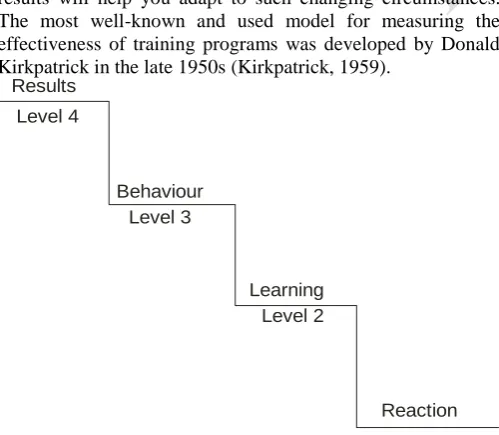
Measuring the effectiveness of training programs consumes valuable time and resources. Having a well-structured measuring system in place to measure results can help in enhancing the success of the training programmes. What was a successful training program yesterday may not be a cost-effective program tomorrow. Being able to measure results will help you adapt to such changing circumstances. The most well-known and used model for measuring the effectiveness of training programs was developed by Donald Kirkpatrick in the late 1950s (Kirkpatrick, 1959).
Results
Behaviour
Learning
Reaction Level 4
Level 2 Level 3
Level 1 Figure 2: Kirkpatrick Model for Evaluating Effectiveness of
Training Programmes
IV. METHODOLOGY FOR IMPLEMENTATION The ISD Model, the 70/20/10 Model, and the Kirkpatrick Model are used as basic reference for implementing the ICT Training Models developed in this work.
A. IMPLEMENTATION OF THE ISD MODEL FOR ICT TRAINING
The ISD model is a best practice model necessary to improve ICT training and increase efficiency of the delivery of the training programmes. The model consists of five phases, usually described as analysis, objectives, design, delivery and evaluation (Marie, 1999). A diagram showing the ISD Model in ICT training is presented in Fig 1. The implementation of the five phases of the ISD model is shown in Fig 3 and it is explained as follows.
a. ANALYSIS OF THE ICT TRAINING NEEDS
Analysis, also called needs assessment, is about pinpointing the gap between the present situation and what the situation ought to be. Experienced trainers enter the ISD cycle at the needs analysis phase, starting with the design of an instrument (needs assessment tool) to collect and interpret data concerning performance at the individual, group or organizational levels. Assessment tools can be surveys, questionnaires, observations, interviews or a combination of investigations. Smaller organizations may use the more informal tools of observations and interviews but they need to document the assessment process so it becomes an integral part of the ISD cycle and can be used as a foundation for both the evaluation and objectives phases.
b. OBJECTIVES OF THE ICT TRAINING
PROGRAMME
Analysis determines who needs ICT training and what skills or performance improvements are indicated. Objectives set the parameters for the instructional design and help achieve the appropriate learning outcomes. Trainers often use the SMART acronym for objectives: specific, measurable, achievable, realistic and time-bound. An example of a well stated objective is "Read and input 11- and 12-digit account numbers, at 80 numbers per minute with an error rate of less than 1%." General statements like "Learn Windows 98" or "Understand how to use Shepard's" are poor objectives because the objectives are too vague.
c. DESIGN OF THE ICT TRAINING PROGRAMMES
Page 220 www.ijiras.com | Email: [email protected] and assume that everyone learns best by listening when in fact
more people learn best by seeing and doing. Some alternatives to the lecture are demonstrations, hands-on, discussion, exercises, and simulations.
d. QUALITATIVE DELIVERY OF THE ICT TRAINING
PROGRAMMES
Delivery is about implementing the instructional design. It involves a number of presentation and human relations skills: learning people's names, varying communication styles, establishing credibility, keeping a sense of humor, varying the pace, keeping on schedule, not being thrown by the unexpected changes in the facility or equipment. Most trainers use an instructor's manual, to keep on schedule, sequence the events correctly and organize topics. The instructor's manual includes all the materials distributed to the learners plus instructional annotations.
e. EVALUATION OF THE EFFECTIVENESS OF THE
ICT TRAINING
The evaluation phase actually begins with needs assessment. Evaluations done by the learners at the end of the ICT training, evaluate how the learners feel about the learning experience but it is too early for them to know how the training will affect their job performance. Sometimes people are trained and go back to the job only to find that the work environment does not include key equipment or systems to implement the training. Evaluations are frequently considered a form of needs assessment.
Figure 3: implementation of ICT Training using ISD Model
B. IMPLEMENTATION OF THE 70/20/10 MODEL FOR ICT TRAINING
The 70/20/10 Model can also be used in ICT Training and Development management. The model can be adopted by training and Learning Managers, Human Resource Managers, organizational Development managers, Performance Improvement Managers, Training Coordinators. etc. to cultivate innovation and increase the efficiency in ICT Training administration and delivery. The 70/20/10 Model when adopted for ICT Training and Development will help in enhancing the qualitative delivery of ICT training and efficient utilization of training resources such as time, money, machine. In working with and reflecting on training best practice, three core processes within an effective training function have
been identified. These three processes each serve to contribute to the achievement of the training function’s core mission.
The three core processes that serve to achieve this mission are:
Training Administration
Training Program Development and Delivery
Training Strategy and Planning
Our evolutionary approach then is to use the 70/20/10 model to develop these three core processes in a structured and planned way that makes best use of the training resources. The approach helps to make sense of the core processes and provides guidance on the magnitude of resources to be given to each activity so as to achieve the training best practice. For maximization of the use and management of any training resource (Max Tr) 70% of the resource should be allotted to effective delivery of the ICT training programmes and improving the quality of the training programmes. 20% of the resources should be concentrated on getting the basic administrative processes defined and practiced rigorously i.e administrative aspect of the training programmes, and 10% should be allotted to strategizing, measuring and evaluating the attainment of the set objectives. The training resource could be time, money, machine etc. This is illustrated using the diagram shown in Fig 4 below.
Figure 4: Allocation of Training Resource Chart The application of the mathematical model of 70/20/10 as shown in Fig 4 can also be explained as follows: if 100 units of a particular training resource are to be utilized, 70 units of the resource should be allotted to effective delivery of the ICT training programmes and improving the quality of the training programmes. 20 units of the resources should be concentrated on getting the basic administrative processes defined and practiced rigorously i.e administrative aspect of the training programmes, and 10 units should be allotted to strategizing, measuring and evaluating the attainment of the set objectives. The training resource could be time, money, machine etc. C. IMPLEMENTATION OF THE KIRKPATRICK
MODEL FOR ICT TRAINING
Page 221 www.ijiras.com | Email: [email protected] LEVEL 1 (REACTION)
Completed participant feedback questionnaire
Informal comments from participants
Focus group sessions with participants
LEVEL 2 (LEARNING)
Pre- and post-test scores
On-the-job assessments
Supervisor reports
LEVEL 3 (BEHAVIOR)
Completed self-assessment questionnaire
On-the-job observation
Reports from customers, peers and participant’s guardian.
LEVEL 4 (RESULTS)
Financial reports
Quality inspections
V. CONCLUSION AND RECOMMENDATIONS The existence of a robust ICT training management model which necessitated this study will be highly beneficial for higher institutions in Nigeria. It will help to foster excellence in the management of the day-to-day ICT training activities. Above all, it will help to implement the best training contents and activities needed to optimize resources and time. The implementation of ICT Training management model proposed in this work is therefore recommended for use in the
management of ICT training for all ICT Training centres in Nigeria’s higher educational institution and every other indigenous ICT training centres in Nigeria.
REFERENCES
[1] Jan L. Plass and Mark W. Salisbury, (2006) A living systems design model for web based knowledge management systems.
[2] Jeffrey L. Whitten and Lonnie D Bentley (1998) Systems Analysis and Design Methods, 4th ed. (Boston: McGraw-Hill, 1998), p. 122.
[3] John B. (2005), the 70 percent solution, Eric Schmidt golden rules for managing innovation, Adapted from Business 2.0 Magazine.
[4] Kirkpatrick, D. L. (1959) Evaluating Training Programs, 2nd ed., Berrett Koehler, San Francisco.
[5] Leslie, A (2004) Training management model and assessment guide.
[6] Marie W, (1999) Model for training and improving Performance. International society for performance improvement journal.
[7] Morgan, M., Robert W., Michael M. (2007) Princeton University Learning Process. The Career Architect Development Planner 3rd edition. Princeton University Printing press.