Page 151 www.ijiras.com | Email: [email protected]
Cooperative Learning Strategy: Effective Student-Centered
Intervention To Enhance Performance And Knowledge Retention
James Kwabena Osei
Eric Appiah-Twumasi
Tutor, Sciences Department, Berekum College of Education, Berekum, Ghana
I. INTRODUCTION
Instructional method which is right for a particular lesson depends on many factors such as the age and cognitive development of the students, what the students already know, and what they need to know to succeed in the subject, the subject matter, students interest and the objective of the lesson(Kizlik, 2016). Kizlik (2016) further added that other factors are time, space, materials and resources available, and the kind of interaction between students in the classroom.
One learning strategy that can enhance learners’ understanding and retention is cooperative instructional learning. This strategy is completely different from the self-centered learning, which focuses mainly on individual learners’ learning independently. Cooperative learning is a successful instructional strategy in which small groups, each with students of diverse ability levels use a variety of learning activities to improve student learning experiences (Arra, Antonio, & Antonio, 2011).
According to Wendy (2005), cooperative learning is the umbrella term for a variety of educational approaches
involving joint intellectual efforts by students, or students and teachers together. It requires a small number of students to work together on a common task, supporting and encouraging one another to improve their learning through interdependence and cooperation with one another (Larry & Hartman, 2002).
The current dimension of teaching may be seen as a bi-polar process, between the teacher and the students. Teachers in this classroom interaction are to be seen as facilitators, and coaches, a person who assists students to learn for themselves. Students are likely to be put in groups, all doing something different, some doing practical tasks, some writing, some not even in the room but in another part of the building using specialized equipment or looking up something in the library. All of the students might well be at different stages in their learning and in consequence, the learning is individualized to suit the learners individual requirements and abilities (Boison, Fosu &Mensah, 2009). The importance of this is that students become active in the teaching and learning processes instead of being passive as in the case of the traditional view of teaching.
Abstract: The study examined the effect of cooperative learning strategy on teacher trainees’ performance and retention of science concepts. This study employed Classroom Action Research with pretest, posttest and delayed test, using level hundred (100) teacher trainees (n=50) from Berekum College of Education, Ghana. Instruments known as Achievement test and Delayed test were used to gather data for the study. Mean, standard deviation, percentage and normalized gains were used to answer the research questions, while independent sample t-test was used to test the hypothesis. The results revealed that, cooperative learning strategy is an effective learning intervention to increase students’ performance and retention knowledge. There was no gender difference in the delayed test with regard to the retention for the sample used for the current study. Generally, the current study confirms the numerous benefits of using cooperative learning strategy to promote performance and retention of knowledge. Based on the results obtained, it was therefore recommended that teachers must be encouraged to use the cooperative learning strategy to teach science at the College of Education.
Keywords: Cooperative Learning Strategy, Academic Performance, Gender, Retention
Page 152 www.ijiras.com | Email: [email protected] According to Douglas and Jaquit (2009), student-centered
learning (also called child-centered learning) is an approach to education focusing on the needs of the students rather than those involved in the educational process such as teachers and administrators. This approach has many implications for the design of the curriculum, the course content, and the interactivity of courses. For example, student-centered methods have repeatedly been shown to be superior to the traditional teacher-centered approaches to instruction (Felder & Brent, 2007). The authors concluded that student-centered lessons promote short-term mastery, long-term retention, or depth of understanding of course material, acquisition of critical thinking or creative problem-solving skills, formation of positive attitudes toward the subject being taught, or level of confidence in knowledge or skills.
RESEARCH OBJECTIVES
The objectives of this quantitative study were to investigate the effects of cooperative learning strategies on teacher trainees’ performance in integrated science concepts. The researchers attempted to determine the extent to which teacher trainees retain learnt concepts in integrated science as a result of the implementation of cooperative learning strategy in the College of Education. Moreover, the researchers attempted to test if there is any gender difference in the ability to retain concepts when both sex were instructed using the cooperative learning strategy.
Based on the above matter, the researchers addressed the following specific research questions and hypothesis, which will guide this research:
RESEARCH QUESTIONS
What are the effects of cooperative learning strategy on students’ performance in science concepts?
To what extent does cooperative learning strategy increases students’ retention of learnt concepts?
Is there difference in retention of learnt concepts between male and female students instructed with cooperative learning strategy?
HYPOTHESIS
H01: Is there any difference in retention of learnt concepts between male and female students instructed with cooperative learning strategy
II. THEORETICAL UNDERPINNING OF COOPERATIVE LEARNING
Dat-Tran (2013) stated that the theoretical roots of cooperative learning are social interdependence theory, cognitive development perspective, social learning theory, and constructivist learning theory. However, this research adopts social learning theory as its theoretical basis.
A. SOCIAL LEARNING THEORY
Albert Bandura introduced social learning theory to integrate behavioural and cognitive learning theories by taking into considerations how imitable behaviour is affected by cognitive constructs, such as attention, retention, production and motivation. Bandura (1977), the founder of social learning theory, acknowledged that much learning occurs by observing, modeling and imitating models. Schunk (2007) also stated that social learning theory places human behaviour within a framework of three reciprocal interactions. These are person, behaviour and environment. Schunk further noted that the major premise of social learning theory is that learners can improve their knowledge and retention by observing and modeling the desired behaviour, attitudes and reactions of others, and human thought processes are central to understanding personality.
In the context of social learning theory, most learning take place in a social environment, in which learners obtain knowledge, rules, skills, strategies, beliefs, and attitudes by observing others. In the social learning theory, reciprocal interaction among the students’ personal factors, environmental variables, and behaviours are significant constructs found in the cooperative learning (Schunk, 2007; Johnson, Daigle & Rustamov, 2010).
B. EMPIRICAL EVIDENCE OF COOPERATIVE
LEARNING
Reviews and meta-analytic studies conducted on cooperative learning strategy, supports the effectiveness of cooperative learning on students’ academic achievement and long-term achievement, as well as knowledge retention. Analyses of some of them are presented below:
Dat-Tran (2014) investigated the effect of cooperative learning strategy on students’ academic achievement and retention of 110 first-year primary education students toward the psychology subject over the eight weeks of instruction at An Giang University. In this study, the students were divided into two matched groups of 55 to be taught by the same lecturer. In the experimental group, cooperative learning was employed, while in the control group, lecture-based teaching was used. The results showed that after approximately 8 weeks students who were instructed using cooperative learning achieved significantly higher scores on the achievement and knowledge retention posttests than did students who were instructed using lecture-based teaching.
Page 153 www.ijiras.com | Email: [email protected] sex and method, ability and method and among method, sex
and ability on achievement.
Some studies reported that cooperative learning also fosters greater retention of learning, as indicated by students’ results on delayed achievement tests. For example, Sousa (2006) reports the average percentage of learning material retention after 24 hours when students were taught by different teaching methods. Sousa indicates that there is retention of 50% of material learned in the discussion group, 75% as a result of requests for students to study through practice, and 90% when students teach others. In addition, Moore (2008) reports studies showing that a blend of ‘telling’ and ‘showing’ techniques results in greater retention (65%) after three days. It is therefore argued that the best way to learn something effectively is to prepare to teach it. Sousa (2006) concluded that, whoever explains to others learn something
An impressive study lasting 4 weeks was conducted by Tanel and Erol (2008) in which the effectiveness of the jigsaw learning method and conventional teaching method were compared on achievement and retention in a Physics course in a University in Turkey. The experimental group was instructed using jigsaw technique and the control group was instructed traditionally. At the end of the treatment, a posttest was administered, while the delay-test was administered 4 weeks after the treatment. The posttest and delay test mean scores of the jigsaw group were significantly higher (p<.05) than those of the control group. Results from the t-tests indicated that there were significant differences (p<.001) on the posttest scores (ES = 1.24) and the delayed-test achievement scores (ES = 1.96). They further added that, the experimental group had greater achievement and long-term achievement than those in the control group. They concluded that, posttest scores and delay test scores for each group shows that four weeks after the experiment the students in the experimental group retained nearly 98% of their knowledge on the delay test whereas those in the control group retained nearly 80 percent.
Sahin (2010) used a pretest and posttest design to investigate the effects of Jigsaw III on achievement, and retention, of 71 Turkish sixth-grade students in a Turkish course over a 6-week period. Results from the t-tests indicated that students in the jigsaw group outscored on the achievement test (p <.001) those in the traditional lecture-based learning group (ES = 0.86).The jigsaw group also had greater long-term achievement on the delay test (p <.05) than those in the control group (ES = 0.69).
Ghana’s aim to achieve an enhanced status in science and technological development, where the production of finished products would characterize the economy, leading to reduction of the unemployment rate can only be achieved by producing qualified and competent science teachers who will teach science at all levels of educational circles, including the basic level of education.
To achieve the above stated target, conscious efforts are constantly made to train qualified science teachers for the job. Consequently, it is mandatory for all teacher-trainees in the Colleges of Education in Ghana to pass all prescribed science courses before they can graduate. However, teacher-trainees performances in Integrated Science courses have been relatively low and the yearly withdrawal of majority of
teacher-trainees is as a results of their poor performance in science courses.
However, studies show that cooperative learning strategies have the potential to improve upon students’ performance in any science subject including integrated science (Ho & Boo, 2007; Akinbobola, 2009; Igboanugo, 2013; Tran-Van, 2014). This informed the Researchers to use cooperative leaning strategy with the mind to improve upon students’ performance in integrated science.
III. RESEARCH DESIGN
This study employed Classroom Action Research with pretest, posttest and delayed using level hundred (100) teacher trainees (n=50) from Berekum College of Education, Ghana. A convenience sampling was used to select sample for the study. This sampling procedure allowed the participants in the study to be selected based on their performance in the End first Semester examination. The sample consisted males (n=25) and females (n=25)
Ten (10) small mixed ability and heterogeneous (i.e. male and female) grouping were formed. There were five (5) members in each small group formed. These groups were maintained throughout the seven weeks of the treatment period. They were instructed using cooperative learning strategies.
A. RESEARCH INSTRUMENTS
An achievement test which included 20 item questions focused on the teacher trainees’ knowledge of the Integrated Science Course (FDC 124) for Colleges of Education and delayed test which consist of 20 items questions were the main instruments for the study. These tests covered all aspects of the FDC124 course (i.e. Biology, Chemistry, Physics and Agriculture). All questions were presented in a multiple-choice format. Each item had four alternative multiple-choices for the correct answer. It was used to assess teacher trainees’ knowledge before the treatment, and measure students’ achievement and their knowledge retention after the treatment. The maximum score for the knowledge component of the achievement test was 20.
B. TEST VALIDITY
The content validity of this test was checked and revised by two Integrated Science Tutors at Berekum College of Education. The test was piloted with second year (n = 20) who had taken the same course the year before. Reliabilities of 0.72 and 0.76 for the achievement test and delayed test respectively were established using Cronbach’s Alpha. These values were above the generally accepted value of 0.70 for social sciences. Therefore, the tests have good reliability and discriminatory power.
Page 154 www.ijiras.com | Email: [email protected] C. INTERVENTION PHASE
After all the preparations, it was time to apply the intervention. Throughout the intervention phase the students played active role. Some of their roles at this point were for them to work together or cooperate with each other through listening to one another, questioning one another, keeping records of their work and the progress, as well as assuming personal responsibility of being involved in the group. The steps involved in the intervention phase are shown in Table 1.0.
PHASE TEACHER / STUDENTS
ACTIVITIES Phase-1
Teacher clarified objectives Teacher went over objectives
for the lesson and established learning target(s)
Phase-2
Teacher presented information and/or materials
Teacher presented lesson in the form of lecture, illustrations, and discussion on
each week’s activities reflecting the teaching notes to
group members
Phase-3
Evaluation/assessment
Teacher gave end of lesson quizzes/ assignments and exercises after every lesson to
the groups.
Phase-4
Supervision
The teacher supervised students to answer the
questions.
Phase-5
Evaluation/assessment
Teacher assessed each member’s performance. marked, graded and did correction with students
Phase-6
Conclusion
Teacher concluded the lesson by summing up the main points using Number Head Together cooperative learning
technique
Table 1.0: Intervention Phase Processes
D. DATA ANALYSIS PROCEDURE
Data analysis was carried out step by step from the beginning of the study to the end of the study. The collected data was then analysed quantitatively. The results from the achievement test were analysed using S.P.S.S., version 16.0 for Windows and Microsoft Excel. According to Awanta and Asiedu-Addo (2008), the Statistical Package for Social Science (S.P.S.S.) is by far one of the best known and widely used softwares for statistical analysis of social data in educational research. Descriptive statistics, t- test and Cronbach’s reliability test were conducted on the data. Descriptive statistics such as mean, standard deviation and percentages were carried out to measure the effects of cooperative learning strategies achievement and retention of learnt concepts in integrated science.
Average normalized gain was also used to examine the extent of impact of cooperative learning strategy on students understanding of concepts. Hake defined the average normilised gain as <g> =
20
post pre
pre
, where the
brackets indicate class averages. According to Mckagan, Sayre and Madsen (2016), average normilised gain measure is commonly used to describe the amount students learned divided by the amount they could have learned.
Also gender differences attributed to the use of cooperative learning was also analysed using t-test assuming equal variances. The accepted p<.05 level of probability was used as the basis to report whether significant differences between the performance and retention of knowledge between males and females instructed using cooperative learning strategy and tested using the delayed test.
IV. ANALYSIS OF RESULTS
ANALYSIS WITH RESPECT TO RESEARCH QUESTION ONE
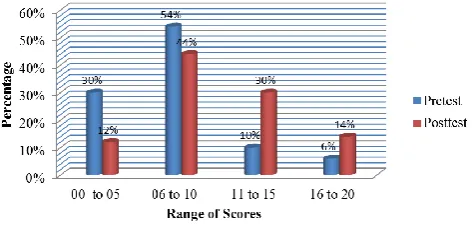
The effect of cooperative learning on students’ performance in science concepts were determined using total scores and its relative percentage of the pretest and posttest scores of the students performance in the Achievement Test. Table 2.0 shows the range of scores, total scores and percentage of the students in the Achievement Test conducted before and after the introduction of the intervention.
PRETEST POSTTEST
RANGE OF
SCORES TOTAL % TOTAL %
16- 20 3 6 7 14
11-15 5 10 15 30
06-10 27 54 22 44
00-05 15 30 6 12
∑ 50 100% 50 100%
Table 2.0: Percentage of Students’ Performance in the Pretest and Posttest
Based on Table 2.0, it can be noted that, the total students who scored between 16-20 in the pretest rose from 3(6%) to 7 (14%) in the posttest. Also, students who scored between 11- 15 in the pretest rose from 5(10%) to 15(30%) in the posttest. However, students who scored between 06-10 in the pretest decreased from 27(54%) to 22(44%) in the posttest. Moreover, students who scored between 00-05 in the pretest decreased from 15(30%) to 6(12%) in the posttest.
To make it easier for comparison, the improvement of the students’ performance in the pretest and the posttest are plotted in the bar chart in Figure 1.0
Page 155 www.ijiras.com | Email: [email protected] These results as presented in the Table 2.0 revealed that
students taught using cooperative learning strategy performed better in the posttest achievement test than the pretest achievement test.
ANALYSIS WITH RESPECT TO RESEARCH QUESTION TWO
The effects of cooperative learning strategy on students’ ability to retain concepts were determined using descriptive statistics of the delayed test compared to the pretest and posttest scores of the students. Table 3.0 shows the mean, standard deviation and normalized gain conducted before and after the introduction of the interventions
Test N Mean SD <g>
Pretest 50 7.78 3.45 ---
Posttest 50 12.66 3.27 0.40
Delayed test 50 13.00 2.78 0.43
Table 3.0: Descriptive Statistics for Pretest, Posttest and Delayed test
Table 3.0 shows that students who participated in the study had pretest, posttest and delayed test performance mean scores of 7.78, 12.66, and 13.00 respectively and standard deviations of 3.45, 3.27 and 2.78 respectively. Table 3.0 also show the delayed test normalised gain of 0.43 compared to the posttest normalized gain of 0.40. The results indicate that, there has not been much deviation of performance of the posttest results and the delayed test results of the students. This indicates that, the students still retained the concepts taught after one month of teaching the concepts using cooperative learning strategy.
ANALYSIS WITH RESPECT TO RESEARCH QUESTION THREE
To find out the difference in the performance of males and females in the delayed test, descriptive statistics were computed and used to determine the gender difference. Table 4.0 shows the minimum score, maximum score, mean, and standard deviation of the males and females in the delayed test after using cooperative learning strategy to the students.
Gender N Min Max Mean SD
Male 25 5 16 11.64 3.01
Female 25 4 17 12.22 3.63
Table 4.0: Delayed test Descriptive Statistics for Gender
Table 4.0 shows that the males delayed mean scores is 11.64 (SD = 3.01). Also, the females delayed mean scores of 12.22 (SD = 3.63). The results revealed that the females performed slightly better than their male counterparts in the delayed test. However, the relatively smaller standard deviation of the male (SD=3.01) shows that the mean scores of the males in the delayed test are closely mean score of 11.64 compared to the females standard deviation of (SD=3.63) which shows that, the mean scores of the females are relatively dispersed from the mean scores of 12.22.
To find out if significant difference existed between the males and the females in the delayed test on retention, reference was made to Table 5.0 where a non-significant
difference was found between the delayed test scores of male
and female students used for the study [t= (48) -0.27, p=0.78]. Hypothesis was therefore, retained.
Gender N Mean SD Df t-value p-value Male 25 11.64 3.01 48 -0.27 0.78* Female 25 12.22 3.63
* not significant
Table 5.0: Inferential Statistics for Gender Mean Score on Retention
V. DISCUSSION OF RESULTS
The purpose of this study was to examine the effects of the use of cooperative learning teaching strategy on students’ performance and retention of science concepts after students had been instructed using cooperative learning strategy. The treatment; Cooperative learning strategy, was found to have significant effect on the students’ performance in the test instrument used. Students after being exposed to cooperative learning strategy performed relative better in posttest test compared to the pretest test results administered to the same students
The higher level of performance observed in the cooperative learning based instruction agrees with the findings of a study conducted by Ajaja and Eravwoke (2010) that tested the effect of cooperative learning on students’ performance. Ajaja and Eravwoke (2010) reported that there was a significant higher achievement test scores of students in cooperative learning group than those in traditional classroom, a significant higher attitude scores of students in cooperative learning group than those in traditional classroom and significant higher achievement test scores of all students of varying abilities in cooperative group than those in traditional group. The findings with regard to research one is in congruent with results of (Tanel and Erol, 2008; Shain, 2010; Dat-Tran, 2014) whose reported higher levels achievements when students were instructed using cooperative learning strategy.
With regards to knowledge retention of concepts after instructing using cooperative learning strategy, the results showed positive effect. Calculated normalized gain of 0.43 for the delayed test compared with 0.40 normalized gain of posttest shows that students still retained the concepts after one month of instructing students using cooperative learning strategy. The findings on retention with regards to research question two agrees with Sousa (2006). Sousa (2006) reports that, the average percentage of learning material retained after 24 hours when students were taught by different teaching methods. Sousa indicates that there is retention of 50% of material learned in the discussion group, 75% as a result of requests for students to study through practice, and 90% when students teach others. The results is also in agreement with Moore (2008), Tanel and Erol (2008) and Dat-Tran (2014) who examined effects of cooperative learning strategy and reported high levels of retention of knowledge after students were instructed using different forms of cooperative learning strategy.
Page 156 www.ijiras.com | Email: [email protected] females slightly performed better in the delayed test with
mean score of 12.22 (SD=3.63) compared to their male counterpart mean score of 11.64 (SD= 3.01)
VI. CONCLUSION
Based on the findings it was concluded that cooperative learning strategy is an effective teaching intervention to enhance students’ performance and retention of knowledge of learnt concepts in science. The findings have equally lent weight to the campaign of shifting from traditional ways of teaching to embrace the bi-polar nature of teaching method such as cooperative learning strategy. Importance of this is that students become active in the teaching and learning processes; with its associated benefits as highlighted by the results of the present study.
VII. RECOMMENDATION
Additional studies and analysis could be helpful to obtain a complete vision of cooperative learning strategy for teacher trainees’ and invest more empirical research studies about teaching and learning strategies using cooperative learning strategy at the Colleges of Education in Ghana.
Moreover, teacher trainees should be empowered by their tutors to assume responsibility for their own studies while the tutors become facilitators or coaches in the teaching and learning processes. This can be done when tutors adopt instructional strategy which is bi-polar in nature such as cooperative learning strategy.
REFERENCES
[1] Ajaja, B., & Eravwoke, O. (2010). Effects of Cooperative Learning Strategy on Junior Secondary Students Achievement In Integrated Science. Electronic Journal of Science Education, 14(1), 1-18.
[2] Arra, C., Antonio, M., & Antonio, M. J. (2011). Students' Preferences for Cooperative Learning Instructional Approaches: Considerations for College Teachers. Journal of Research in Education, 21(115), 114-121.
[3] Awanta, E. K., & Aseidu-Addo, S. (2008). Essential Statistical Technique in Research: For University in Education. Accra: Salt "N" Light Publication.
[4] Bandura, A. (1977). Social Learning Theory (3rd ed). Cliffs, NJ: Prentice Hall Regebt.
[5] Boison, G. A., Fosu, W., & Mensah, A. (2009). Philiosophical Basis for Teaching and Learning. Winneba: Institude for Edacational Development and Extension, UEW.
[6] Dat-Tran, V. (2014). The Effects of Cooperative Learning on the Academic Achievement and Knowledge Retention. International Journal of Higher Education, 3(2), 131-140. [7] Dat-Tran, V. (2013). Theoretical Perspective Underlying
the Application of Cooperative Learning in Classroom. International Journal of Higher Education, 2(4), 101-115. [8] Felder, R. M., & Brent, R. (2007). Cooperative Learning.
In P. Mabrouk, Active Learning: Models from the Analytic Sciences (pp. 34-54). Washington, D. C: American Chemical Society.
[9] Felder, R., & Brent, R. (2009). Active Learning: An Introduction. ASQ Higher, 4(5).
[10] Johnson, D., Daigle, P., & Rustamov, I. (2010). Bandura's Learning Theory Applied to a"How-to". Expository Writing Piece. Retrieved June 21, 2017, from Http://uhaweb.harfort.edu/SMITHJOHN/EDT66/EDTHFI NALDEC132010%B1%D.pdf
[11] Kizlik, B. (2016). Instructional method information: Part
1. Retrieved June 23, 2017, from
http://www.adprima.com
[12] Laary, Z., & Hartman, R. (2002). Cooperative Learning in Secondary Schools Mathematics Classroom: Discussion Theory and Contemporary Research. Adolescent Learning and Development Education, 0500A, 1-6.
[13] Mckagan, S., Sayre, E., & Madsen, A. (2016). Nornilized gain: What is it and when should I use it?. Retrieved June 23, 2017, from http://www.physport.org/recommendati ons/ Entry.cfm?ID=93334
[14] Moore, K. D. (2008). Effective instructional strategies: From theory to practice. Thousand Oaks, CA: Sage Publication.
[15] Sahin, A. (2010). Effects of Jigsaw III technique on achievement in written expression. Retrieved June 23, 2017, from http://dx.doi.org/10.1007/s
[16] Schunk, D. H. (2007). Learning Theories: An Educational Perspective. Upper Saddle River, NJ: Pearson Education. [17] Sousa, D. A. (2006). How the Brain Works. Heatherton,
Vic: Hawker Brownlow Education.
[18] Tanel, Z., & Erol, M. (2008). Effects of Cooperative Learning on Instructing Magnetism: An Analysis of Experimental Teaching Sequence. American Journal of Physics and Education, 2(2), 124-136.