John K. McNamara
Simon Fraser University
and
Jim Wagner
Brock University
Implicit and Explicit Awareness of a Phonics
Rule in the Word Recognition of Students With
and Without Learning Disabilities
This study investigates the ability of students with and without learning disabilities to learn
a phonics rule implicitly and the ability of these students to report accurately about the rule
verbally. Many researchers have argued that implicit learning denotes a form of learning that
occurs without intention and results in adequate performance, but is not available to
consciousness and so not verbalizable (Reber, 1993). Others have suggested that this
in-ability to verbalize may not be as definite as originally thought (Ericsson & Simon, 1993).
This study examined the implicit learning and explicit knowledge capabilities of students
between the ages of 10 and 12 with and without learning disabilities. Students acquired
knowledge implicitly about the pronunciation of pseudowords that were governed by one of
two phonics rules. They were then asked to verbalize explicitly about the acquired knowledge.
Results indicate that implicit knowledge capabilities for all students were not significantly
different. However, there were significant differences between students with and without
learning disabilities on explicit knowledge scores.
Cette etude analyse la capacite d'eleves avec et sans difficultes d'apprentissage ä apprendre de
fagon implicite une regle de la methode phonetique et ensuite d'en parier de jagon adequate.
Plusieurs chercheurs maintiennent que Vapprentissage implicite constitue une forme
d'ap-prentissage qui s'acquiert involontairement, qui entraine une performance adequate, mais
dont on ne peut etre conscient et qu'on ne peut pas decrire (Reber, 1993). D'autres recherches
proposent que cette incapacity ä verbaliser nest pas aussi nette qu'on Vavait cru (Ericsson &
Simon, 1993). Les sujets de cette etude sur Vapprentissage implicite et sur les capacites
explicites etaient des eleves ages d'entre 10 et 12 ans et qui avaient ou non des difficultes
d'apprentissage. Les eleves ont acquis, de fagon implicite, des connaissances sur la
pronuncia-tion de logatomes regie par une de deux regies de la methode phonetique. Par la suite, on leur
a demanded'expliciter les connaissances qu'ilsavaient acquises. Les resultats indiquent que
la difference dans la capacite d'acquerir des connaissances implicites n'etait pas significative
d'un eleve a Vautre. Par contre, la difference dans la capacite d'enoncer des connaissances
explicites etait significative entre les eleves avec des difficultes d'apprentissage et ceux qui
n'en presentaient pas.
Introduction
Psychologists have for many years examined the ability to verbalize about our
internal states. Many of the educational practices in school today involve
John McNamara is a doctoral student. His research interests include executive processing,
cognitive development, and an interactionist approach to learning disabilities.
Jim Wagner is an associate professor and Director of the Reading Clinic. His research interests
include reading and language development, dyslexia, and communication disorders.
J.K. McNamara and J. Wagner
activities w h e r e students m u s t learn a n d then verbalize about c o m p l e x phe-n o m e phe-n a . V e r b a l i z a t i o phe-n ephe-ntails the use of laphe-nguage, w h i c h has m a phe-n y subsys-tems that incorporate s o u n d s , letter-sound relationships, g r a m m a r , semantics, a n d v o c a b u l a r y . C o m m u n i c a t i n g t h r o u g h one's language entails k n o w i n g the right w a y to say s o m e t h i n g o n a particular occasion i n o r d e r to a c c o m p l i s h a specific p u r p o s e (Gleason, 1985). In other w o r d s , k n o w i n g the language means k n o w i n g its p h o n o l o g y , m o r p h o l o g y , syntax, a n d semantics, as w e l l as its rules for use. T h i s c o m p l e x process becomes e v e n m o r e difficult as students progress t h r o u g h elementary s c h o o l a n d are i n u n d a t e d w i t h a constant battery of n e w w o r d s a n d w o r d families. N a g y a n d A n d e r s o n (1984) estimated that p r i n t e d s c h o o l E n g l i s h contains a p p r o x i m a t e l y 88,500 w o r d families. F u r t h e r m o r e , it is estimated that the average grade 5 student has encountered a p p r o x i m a t e l y 10,000 n e w r e a d i n g w o r d s per year. O n e question that f o l l o w s is: H o w c a n a student l e a r n so m a n y w o r d s ? T h i s question becomes e v e n m o r e c o m p l e x i n the case of a student w i t h l e a r n i n g disabilities ( L D ) .
L e a r n i n g of l a n g u a g e c a n take place i m p l i c i t l y or explicitly. I m p l i c i t learn-i n g learn-is a c q u learn-i s learn-i t learn-i o n of k n o w l e d g e about the u n d e r l y learn-i n g structure of a s t learn-i m u l u s e n v i r o n m e n t b y a process that takes place w i t h o u t conscious operations ( D u l a n y , C a r l s o n , & D e w e y , 1984; W i n t e r & Reber, 1994). This is a process w h e r e b y k n o w l e d g e of structured s t i m u l u s d o m a i n s is a c q u i r e d largely i n d e p e n d e n t of conscious operations a n d largely i n d e p e n d e n t of explicit k n o w -ledge of b o t h the process of acquisition a n d the k n o w l e d g e base that is a c q u i r e d . O n the other h a n d , explicit l e a r n i n g is a m o r e conscious operation w h e r e the i n d i v i d u a l m a k e s a n d tests hypotheses i n a search for structure.
O f relevance to the present s t u d y is the question that once i n f o r m a t i o n is learned, h o w accurately c a n students v e r b a l l y report o n internal states a n d social or c o g n i t i v e skills? F u r t h e r m o r e , does this ability to report v e r b a l l y differ i n students w i t h L D ? T o date f e w researchers have e x a m i n e d this latter ques-tion. H o w e v e r , i n relation to the first, m a n y researchers argue that h u m a n s have n o m o r e p r i v i l e g e d access to their internal states or the causes of their b e h a v i o r t h a n has a n observer (Berry & Broadbent, 1987; L e w i c k i , H i l l , & Bizot, 1988; N i s b e t t & W i l s o n , 1977). T h i s is often referred to as a dissociation between i m p l i c i t a n d explicit k n o w l e d g e . I m p l i c i t k n o w l e d g e refers to k n o w l e d g e that is not accessible to consciousness a n d cannot be v e r b a l l y reported, whereas explicit k n o w l e d g e refers to k n o w l e d g e that is accessible to consciousness a n d can be v e r b a l l y reported. The dissociation is u s u a l l y f o u n d i n a discrepancy b e t w e e n task p e r f o r m a n c e a n d the ability to verbalize about w h a t has been d o n e . H o w e v e r , others s u c h as E r i c s s o n a n d S i m o n (1993) counter this a r g u -m e n t b y stating that a l t h o u g h so-meti-mes internal states are not accessible to consciousness, there are m a n y situations i n w h i c h a v e r b a l report can be trusted.
Implicit and Explicit Awareness: A Theoretical Framework
e v o l v e to a degree that a l l o w s a d v a n c e d phonetic rules to be u n d e r s t o o d . F u r t h e r m o r e , as students b e c o m e s k i l l e d i n u n d e r s t a n d i n g a letter-sound cor-respondence, they m a y transfer this k n o w l e d g e to a n o v e l e x e m p l a r of the i n i t i a l w o r d . T h i s transfer of k n o w l e d g e m a y be beneficial i n that it m a y reduce the a m o u n t of cognitive processing i n i t i a l l y r e q u i r e d to u n d e r s t a n d the n o v e l e x e m p l a r , thus i n c r e a s i n g processing efficiency, freeing cognitive space that m a y n o w be u s e d f o r a m o r e a d v a n c e d cognitive task (i.e., c o m p r e h e n s i o n or v e r b a l i z a t i o n ) . M a n y t r a d i t i o n a l approaches to teaching letter-sound cor-respondences treat t h e m as l e a r n i n g that i n v o l v e s explicitly a n d consciously i d e n t i f y i n g the letter-sound correspondences as a pattern or a rule. H o w e v e r , i n i t i a l lettersound correspondences m a y be e n c o d e d at a n i m p l i c i t u n c o n -scious l e v e l d u r i n g w o r d recognition. In fact, m a n y s i g h t - w o r d or w h o l e - w o r d i n s t r u c t i o n a l approaches often leave the letter-sound relationships i n w o r d s at a n i m p l i c i t l e v e l . A l t h o u g h i m p l i c i t , this l e a r n i n g m a y also result i n transfer of the k n o w l e d g e to n o v e l exemplars i n w o r d recognition ( V a n O r d e n , P e n n i n g t o n , & Stone, 1990). A s students i m p l i c i t l y learn a n d d e v e l o p a n u n d e r -s t a n d i n g of the letter--sound corre-spondence, they al-so m a y b e g i n to d e v e l o p a conscious explicit awareness of the correspondence (Berry, 1994; S m i t h , 1994; Stanley, M a t h e w s , Buss, & K o t l e r - C o p e , 1989). T h i s conscious awareness m a y be the result of the learner's attempt to construct a m o d e l of the u n d e r l y i n g i m p l i c i t p r o c e s s i n g rule, a n d this m o d e l m a y be based o n those fragments of i m p l i c i t p r o c e s s i n g that are salient e n o u g h to be m a d e conscious (Berry, 1994; B e r r y & Broadbent, 1988; Broadbent & F i t z g e r a l d , 1986). C o n s c i o u s rule descriptions m a y also d e p e n d o n the metalinguistic language capabilities the student c a n b r i n g to bear i n order to describe h i s or her i m p l i c i t processing rule ( K a r a n t h & Suchitra, 1993). W e believe that students b o t h w i t h a n d w i t h o u t L D s h o u l d s h o w some evidence of i m p l i c i t letter-sound correspondence a n d p h o n i c s rule a c q u i s i t i o n i n their ability to read n e w exemplars of the rule. H o w e v e r , w e also expect that students w i t h o u t L D w i l l o u t p e r f o r m students w i t h L D i n this i m p l i c i t rule a c q u i s i t i o n process. T h e reasoning b e h i n d this expectation is e x a m i n e d i n the f o l l o w i n g section.
J.K. McNamara and J. Wagner
i n f o r m a t i o n that is active i n short-term m e m o r y ( S T M ) a n d stored i n a v e r b a l code, this is referred to as L e v e l 1 v e r b a l i z a t i o n . T h i s type of v e r b a l i z a t i o n occurs as the task is b e i n g c o m p l e t e d a n d the i n f o r m a t i o n is focused o n i n S T M . W h e n this occurs, n o interfering variables enter the equation, a n d so v e r b a l i z a -t i o n is accura-te a n d of-ten comple-te. A n e x a m p l e of -this is a -t h i n k - a l o u d proce-d u r e . L e v e l 2 c o n c u r r e n t v e r b a l i z a t i o n refers to the v e r b a l i z a t i o n of i n f o r m a t i o n that is not o r i g i n a l l y available i n a v e r b a l code. A s this occurs the i n f o r m a t i o n m u s t be r e c o d e d into a v e r b a l code so that it m a y be v e r b a l i z e d . In f o l l o w i n g the a s s u m p t i o n s of the i n f o r m a t i o n processing theoretical frame-w o r k , frame-w h e n i n f o r m a t i o n i n S T M is not v e r b a l l y e n c o d e d , m a k i n g a v e r b a l report requires the c o r r e s p o n d i n g v e r b a l representations of the i n f o r m a t i o n to be constructed. T h i s r e c o d i n g process w i l l m a k e at least m o d e s t d e m a n d s o n p r o c e s s i n g capacity a n d processing time. This means that some relevant i n f o r -m a t i o n -m a y be lost, -m a k i n g v e r b a l i z a t i o n d i f f i c u l t a n d possibly inaccurate.
A second m e t h o d of v e r b a l i z a t i o n is referred to as retrospective v e r b a l i z a -tion. The c u r r e n t research incorporates this m e t h o d of v e r b a l i z a t i o n because m a n y current e d u c a t i o n a l practices elicit verbal reports after the initial ex-p o s u r e to the i n f o r m a t i o n . Retrosex-pective v e r b a l i z a t i o n is the m o s t general tyex-pe of v e r b a l i z a t i o n , i n w h i c h students are asked to report e v e r y t h i n g they c a n r e m e m b e r about the c o g n i t i v e process s t u d i e d . If the subject is asked i m m e d i -ately after p e r f o r m i n g the process, this m o d e l predicts that some p r e v i o u s l y processed i n f o r m a t i o n w i l l still be i n S T M , p e r m i t t i n g some v e r b a l i z a t i o n . H o w e v e r , i n m a n y retrospective situations, i n f o r m a t i o n m u s t be retrieved f r o m l o n g - t e r m m e m o r y ( L T M ) . This m a y be problematic i n that retrieval m a y not o n l y fail to access the p r e v i o u s l y processed i n f o r m a t i o n , b u t m a y o n occasion access i n f o r m a t i o n that is c o n f u s e d w i t h the events b e i n g q u e r i e d .
In s u m , this m o d e l of v e r b a l i z a t i o n assumes that o n l y i n f o r m a t i o n i n focal attention c a n be v e r b a l i z e d (Ericsson & S i m o n , 1993). In accordance w i t h this m o d e l , three causes of the lack of or incomplete v e r b a l i z a t i o n are predicted. First, the a p p r o p r i a t e i n f o r m a t i o n m a y not be accurately retrieved f r o m L T M , hence not stored i n S T M a n d consequently not accessible for verbal report. Second, the i n f o r m a t i o n initially processed i n S T M m a y not be a p p r o p r i a t e l y stored i n L T M a n d hence cannot be retrieved. T h i r d , the i n f o r m a t i o n available i n S T M at the t i m e of the report m a y not be accurately reported.
Students with Learning Disabilities
M e m o r y p r o c e s s i n g is also a significant cognitive f u n c t i o n that contributes to the difficulties experienced b y students w i t h L D . O f p a r t i c u l a r i m p o r t a n c e to this s t u d y is the concept of w o r k i n g m e m o r y ( W M ) . B a d d e l e y a n d H i t c h (1974) a n d later B a d d e l e y (1986) suggested that the processes attributed to W M reflect a m u l t i - p r o c e s s activity i n w h i c h processing capacities are allocated over a v a r i e t y of systems. W M is a d y n a m i c system that emphasizes b o t h processing a n d storage. Its capacity is l i m i t e d a n d c o n s i d e r e d to reside i n the l i m i t a t i o n s of s i m u l t a n e o u s l y s a t i s f y i n g b o t h the p r o c e s s i n g a n d storage d e m a n d s that a g i v e n task i m p o s e s ( D a n e m a n & Carpenter, 1980). T h e central executive c o m -p o n e n t of W M regulates a n d controls i n f o r m a t i o n flow w i t h i n the m e m o r y system, the retrieval of i n f o r m a t i o n f r o m L T M , a n d the p r o c e s s i n g a n d storage of i n f o r m a t i o n . T h e p r o c e s s i n g resources u s e d b y the central executive have l i m i t e d capacity.
Verbal Reports and Students With Learning Disabilities
Retrospective v e r b a l i z a t i o n about cognitive processes, a m e t h o d o l o g y often i n c o r p o r a t e d into the elementary classroom, m a y be a successful m e t h o d of e l i c i t i n g v e r b a l reports if it occurs i m m e d i a t e l y after the initial l e a r n i n g session. H o w e v e r , e v e n if this does occur, this m e t h o d m a y be p r o b l e m a t i c for students w i t h L D , w h o m a y have particular difficulties i n v e r b a l i z i n g about their c o g n i -tive processes d u e to specific cogni-tive difficulties that m a y i m p a i r the v e r y i n f o r m a t i o n p r o c e s s i n g system that acts as a f r a m e w o r k for this m o d e l of v e r b a l i z a t i o n .
In k e e p i n g w i t h the m o d a l m o d e l of i n f o r m a t i o n processing ( A t k i n s o n & S h i f f r i n , 1968), the rate of decay of i n f o r m a t i o n i n S T M can be b r o u g h t u n d e r the c o n t r o l of the i n d i v i d u a l . F o r e x a m p l e , if a student rehearses i n f o r m a t i o n b y repeating it s u b v o c a l l y , the rate of decay m a y decrease. Tactics s u c h as rehears-al are c o n t r o l processes g o v e r n e d b y the centrrehears-al executive c o m p o n e n t that h e l p i n f o r m a t i o n to stay i n S T M . Students w i t h L D , w h o experience deficits i n W M capacity or processing, m a y be less aware of the a p p r o p r i a t e tactics that act as s u c h c o n t r o l processes i n S T M ( W o n g , 1982). S w a n s o n (1993) f o u n d that stu-dents w i t h L D rarely u s e d an a p p r o p r i a t e o r g a n i z a t i o n a l tactic w h e n they w e r e r e q u i r e d to rehearse i n f o r m a t i o n . It m a y be that the i n a b i l i t y of students w i t h L D to e m p l o y rehearsal tactics does not reflect a n i n a b i l i t y to rehearse. Rather, it reflects the failure to p r o d u c e the a p p r o p r i a t e tactics s p o n t a n e o u s l y . Re-search suggests that this i n t u r n m a y be the outcome of d e v e l o p m e n t a l lag, i n that students w i t h L D m a y be d e l a y e d i n their p r o d u c t i o n of the a p p r o p r i a t e rehearsal tactics (Stanovich, 1988; Tarver, H a l l a h a n , K a u f m a n , & B a l l , 1976).
Retrospective v e r b a l i z a t i o n is also reliant o n the ability to retrieve i n f o r m a -t i o n f r o m L T M . T h i s re-trieval process is cer-tainly fallible, b u -t p a r -t i c u l a r l y for students w i t h L D . R e t r i e v a l p r o b l e m s have been f o u n d to be p r i m a r y sources of i n d i v i d u a l difference i n L T M p e r f o r m a n c e (Swanson, A s h b a k e r , & Lee, 1996). W o n g (1982) f o u n d that students w i t h L D tend to select less efficient retrieval strategies, c o n d u c t a less exhaustive search for retrieval cues, a n d lack self c h e c k i n g s k i l l s i n the selection of retrieval cues.
J.K. McNamara and J. Wagner
H i t c h , 1974). T h e executive c o m p o n e n t of W M coordinates a n d orchestrates a s t u d e n t ' s c o g n i t i v e processes. V e r b a l i z a t i o n requires the m o v e m e n t of infor-m a t i o n f r o infor-m L T M to S T M . W M infor-m a y be the c o infor-m p o n e n t that coordinates this m o v e m e n t of i n f o r m a t i o n . S w a n s o n et al. (1996) f o u n d that students w i t h L D experience d i f f i c u l t i e s r e c a l l i n g i n f o r m a t i o n f r o m L T M p a r t i c u l a r l y w h e n p r o c e s s i n g d e m a n d s are h i g h . A s d e m a n d s decrease, recall becomes less dif-ficult. C u r r e n t research i n this area tends to s u p p o r t the n o t i o n that W M difficulties are related to deficits i n executive p r o c e s s i n g (Swanson, 1998). F u r t h e r m o r e , a l t h o u g h not p r e v i o u s l y e x a m i n e d , executive p r o c e s s i n g deficits m a y c o n t r i b u t e to the cause of inaccurate or i n c o m p l e t e v e r b a l reports i n students w i t h L D .
In s u m , students w i t h L D experience difficulties i n m a n y areas of i n f o r m a -t i o n p r o c e s s i n g . T h e a b i l i -t y -to v e r b a l i z e is grea-tly d e p e n d e n -t o n -this processing s y s t e m , so it w a s p r e d i c t e d that students w i t h L D w o u l d s h o w p o o r perfor-m a n c e i n their a b i l i t y to v e r b a l i z e about their cognitive processes.
The Present Study
In the present s t u d y w e c o m p a r e d i m p l i c i t l e a r n i n g a n d the v e r b a l reports of students w i t h a n d w i t h o u t L D . Specifically, w e m e a s u r e d students' ability to l e a r n i m p l i c i t l y a p h o n i c s rule f o l l o w e d b y a measurement of their ability to v e r b a l i z e their o w n c o g n i t i v e processes i n l e a r n i n g this rule. A p h o n i c s rule p a r a d i g m w a s u s e d because as students progress t h r o u g h elementary grades t h e y are consistently e x p o s e d to n e w rules that g o v e r n language. L e a r n i n g a n e w p h o n i c s r u l e requires students to assimilate a n d a c c o m m o d a t e n o v e l i n f o r m a t i o n . T h e c o g n i t i v e processes i n v o l v e d i n this activity i n c l u d e m a n y of the processes p r e v i o u s l y described i n the i n f o r m a t i o n processing m o d e l of m e m o r y .
F u r t h e r m o r e , v e r b a l reports w e r e elicited t h r o u g h a role-reversed teaching technique. T h i s technique is one that is r e c o m m e n d e d b y earlier researchers (Stanley et a l . , 1989). W e believe that the dissociation between i m p l i c i t a n d e x p l i c i t k n o w l e d g e of c o g n i t i v e processes m a y not be as great as suspected w h e n better measures of v e r b a l i z a t i o n are u s e d . M a n y researchers have att e m p att e d atto o b att a i n v e r b a l i z a att i o n scores att h r o u g h atthe use of a w r i att att e n q u e s att i o n -naire. S u c h techniques are often unsuccessful a n d m a y be p o o r predictors of v e r b a l k n o w l e d g e . A l l o w i n g students to verbalize b y g i v i n g i n s t r u c t i o n to a n a i v e subject m a y be a m o r e advantageous m e t h o d of e l i c i t i n g v e r b a l reports. M a t h e w s et a l . (1989) described a teach-aloud p r o c e d u r e w h e r e participants w e r e a s k e d to g i v e v e r b a l instructions to someone else i n order that they p e r f o r m the task. T h i s p r o c e d u r e p r o v i d e s an o p p o r t u n i t y for students to m a k e overt their competence i n c o m p l e t i n g the task, at the same time r e v e a l i n g the c o g n i t i v e processes that they m a y have e m p l o y e d .
A s m e n t i o n e d above, the role-reversed teaching technique w a s e m p l o y e d i m m e d i a t e l y after the i n i t i a l l e a r n i n g session. A retrospective v e r b a l i z a t i o n t e c h n i q u e is c o m m o n l y u s e d i n m a n y classrooms. H o w e v e r , i n order to ensure that i n f o r m a t i o n is not lost f r o m S T M , this technique w a s e m p l o y e d i m m e d i -ately after the i n i t i a l task.
some d i s s o c i a t i o n between w h a t w a s i m p l i c i t l y learned a n d w h a t c o u l d be v e r b a l i z e d i n students b o t h w i t h a n d w i t h o u t L D . This result w a s expected because the v e r b a l reports w e r e elicited i n retrospect a n d the retrieval process that students m u s t use m a y be fallible. Second, it w a s h y p o t h e s i z e d that stu-dents w i t h o u t L D w o u l d have m o r e complete a n d correct verbal reports than w o u l d students w i t h L D . T h i s p r e d i c t i o n is based o n the a s s u m p t i o n that students w i t h L D m a y have specific i n f o r m a t i o n processing difficulties that m a y affect their ability to retrieve the a p p r o p r i a t e i n f o r m a t i o n to be v e r b a l i z e d . T h i r d , it w a s h y p o t h e s i z e d that the process of a t t e m p t i n g to teach someone else a p h o n i c s rule w o u l d facilitate a further u n d e r s t a n d i n g of the initial phonics rule. T h i s p r e d i c t i o n w a s based o n the a s s u m p t i o n that i n order to teach the p h o n i c s rule to a n a i v e subject, students m u s t reflect o n their o w n u n d e r s t a n d i n g of the m a t e r i a l . This reflection s h o u l d elicit deep processing of the i n f o r m a -t i o n , w h i c h m a y consolida-te a n d e x p a n d -their ini-tial u n d e r s -t a n d i n g of -the p h o n i c s rule.
Method Participants
.J.K. McNamara and j. Wagner
Because r e a d i n g a b i l i t y is a n i n d e p e n d e n t variable i n this experiment, it w a s d e c i d e d that a single r e a d i n g grade score variable w o u l d enable r e a d i n g level to be e x a m i n e d as a single entity. In accordance w i t h the s t a n d a r d i z e d proce-d u r e s of the W o o proce-d c o c k J o h n s o n Testing M a n u a l , the W o r proce-d A t t a c k score a n proce-d the W o r d Identification score w e r e c o m b i n e d to f o r m an o v e r a l l R e a d i n g score. A w i t h i n - g r o u p p a i r e d samples t-test i n d i c a t e d n o significant difference be-t w e e n W o r d A be-t be-t a c k scores a n d W o r d Idenbe-tificabe-tion scores, L D Pos f ( l , l l ) = 0.0277, p=.876; L D N e g f ( l , l l ) = 0.1018, p=.812; N A Pos, ¢(1,11)= 1.9234, p=.645. T h e W o r d A t t a c k a n d W o r d Identification scores w e r e recorded i n d i v i d u a l l y , b u t w e r e then c o m b i n e d i n o r d e r to indicate a r e a d i n g grade score for each student. In o r d e r to obtain a r e a d i n g grade score, all students w e r e a d m i n i s t e r e d the W o o d c o c k J o h n s o n W o r d A t t a c k a n d W o r k Identification s u b -tests. Results of these subtests are s h o w n i n Table 1.
The Phonics Rule
In this s t u d y students w e r e e xp o s e d to sentences that contained p s e u d o w o r d s that w e r e g o v e r n e d b y one of t w o p h o n i c s rules.
Rule 1 E a c h p s e u d o w o r d contained an initial consonant. T h i s consonant c o u l d be a n y letter i n the alphabet (C, В, T, S, etc.). T h i s w a s f o l l o w e d b y a v o w e l d i g r a p h , a l w a y s an ai (Cai, Tai, Sai, Vai, etc.). The v o w e l d i g r a p h w a s f o l l o w e d b y a second single consonant. A g a i n , this consonant c o u l d be any letter i n the alphabet (Cait, Saiv, Tais, etc.). This i n t u r n w a s f o l l o w e d b y a single v o w e l . In the case of R u l e 1, this v o w e l w a s a l w a y s an a (Caita, Taisa, Saiva, etc.). T h e p s e u d o w o r d w a s then c o m p l e t e d w i t h a single consonant. T h i s consonant w a s a l w a y s a n r (Caitar, T a i v a r , Saivar, etc.). In accordance w i t h this, each p s e u d o w o r d h a d t w o syllables. P s e u d o w o r d s that c o n f o r m e d to R u l e 1 w e r e p r o n o u n c e d u s i n g basic phonetic p r i n c i p l e s . H o w e v e r , the first d i g r a p h (ai) w a s p r o n o u n c e d as a short ai s o u n d , as i n the w o r d said. T h u s this rule w a s characterized as f o l l o w s : if the v o w e l letter i n the second syllable of the p s e u d o w o r d w a s an a the v o w e l d i g r a p h of the first syllable w a s p r o n o u n c e d as a short ai (said).
Rule 2. E a c h of these p s e u d o w o r d s also contained an initial consonant. T h i s consonant c o u l d be a n y letter i n the alphabet (B, D , K , M , etc.). T h i s w a s f o l l o w e d b y a v o w e l d i g r a p h , a l w a y s an ai (Bai, Tai, Kai, Vai, etc.). T h e v o w e l d i g r a p h w a s f o l l o w e d b y a second consonant d i g r a p h . T h i s consonant w a s a basic yh, sh, th, or ch b l e n d (Caith, Saiph, Taich, Bais/i, etc.). T h i s i n t u r n w a s f o l l o w e d b y a single v o w e l . In the case of R u l e 2, this v o w e l was a l w a y s a n e (Caiphe, Taithe, Saithe, etc.). T h e p s e u d o w o r d w a s c o m p l e t e d w i t h a single
Table 1
Word Attack, Word Identification and Reading Grade Means and Standard Deviations (SD).
Word Attack Word Identification Reading Grade Score
Mean SD Mean SD Mean SD
consonant, a l w a y s a n r (Caither, Taisher, Saipher, etc.). P s e u d o w o r d s that c o n f o r m e d to R u l e 2 w e r e also p r o n o u n c e d u s i n g basic phonetic p r i n c i p l e s . H o w e v e r , the first d i g r a p h (ai) w a s p r o n o u n c e d as a l o n g ai s o u n d as i n the w o r d paid. T h i s rule c a n be characterized as f o l l o w s : if the v o w e l letter i n the second s y l l a b l e of the p s e u d o w o r d w a s a n e the first v o w e l d i g r a p h w a s p r o n o u n c e d as a l o n g ai (paid).
A l l p s e u d o w o r d s w e r e a l w a y s f o u n d i n the f o r m of a p r o p e r n a m e ( M r . or M r s . C a i s a r ) . T h i s w a s d o n e i n o r d e r to m a k e the p s e u d o w o r d s as m e a n i n g f u l as possible. It is i m p o r t a n t to note that the c h i l d r e n i n the s t u d y h a d n o trouble treating the p s e u d o w o r d s as surnames set i n sentence contexts.
It is also i m p o r t a n t to note that these rules were m o r e c o m p l e x than the average p h o n i c s rule. N o r m a l l y , p r o n u n c i a t i o n of a v o w e l d i g r a p h is n o t c o n d i t i o n a l i z e d o n a f o l l o w i n g suffix. H o w e v e r , b y constructing the phonics rule so that the p r o n u n c i a t i o n of the target letters w a s a f u n c t i o n of the f o l l o w -i n g letters er or ar, -it can be a r g u e d that the rule w a s m a d e m o r e sal-ient, but at the s a m e t i m e u n f a m i l i a r . T h i s was i m p o r t a n t as it is d i f f i c u l t to f i n d a phonics rule that is c o m p l e t e l y n e w to every student, p a r t i c u l a r l y i n the age g r o u p that w a s tested. T h u s the construction of a rule of this nature controlled as m u c h as possible for p r e v i o u s l e a r n i n g experience w i t h the v o w e l d i g r a p h ai. O f course, w e realize that n o s u c h rules exist i n o u r language. Nevertheless, it s h o u l d be n o t e d that the p r o n u n c i a t i o n of ai i n said a n d paid is i n fact c o n d i t i o n a l i z e d o n the s u r r o u n d i n g letter context.
Procedure
T h e e x p e r i m e n t w a s d i v i d e d into f o u r phases: Phase 1, the i m p l i c i t rule acquisi-t i o n phase; Phase 2, acquisi-the isolaacquisi-ted i m p l i c i acquisi-t acquisi-tesacquisi-ting phase; Phase 3, acquisi-the role reversed teaching phase; a n d Phase 4, the posttest of the phonics rule k n o w -ledge. Before starting Phase 1 of the testing, each student w a s a d m i n i s t e r e d the W o o d c o c k W o r d A n a l y s i s Test a n d the W o o d c o c k W o r k Identification Test. These tests w e r e d e s i g n e d to g i v e a n accurate r e a d i n g grade score f o r each student. T h i s w a s necessary to c o m p a r e i m p l i c i t a n d explicit functions between r e a d i n g age m a t c h e d g r o u p s . Testing took place i n the schools, u s u a l l y i n the resource r o o m o r the l i b r a r y . E a c h student w a s tested i n d i v i d u a l l y for a p p r o x -i m a t e l y one h o u r .
J-.K. McNamara and /. Wagner
not place h i g h d e c o d i n g d e m a n d s o n any of the students. F o r the i n t r o d u c t i o n set, the researcher r e a d each sentence, p r o n o u n c i n g the p s e u d o w o r d correctly. T h e student w a s t h e n a s k e d to repeat the sentence. The researcher corrected the student if the p s e u d o w o r d w a s p r o n o u n c e d incorrectly. T h i s c o n t i n u e d u n t i l all 12 sentences of the i n t r o d u c t i o n set w e r e read. A t n o time d u r i n g this phase w a s the student t o l d the r u l e . T h e y w e r e s i m p l y asked to read the sentence a n d w o r d s they h e a r d a n d g i v e corrective feedback.
Students w e r e then e x p o s e d to a second s i m i l a r set of 12 sentences. A g a i n , this set c o n t a i n e d 12 sentences, 6 of the 12 c o n t a i n i n g a p h o n i c s rule 1 p s e u d o -w o r d a n d 6 c o n t a i n i n g a p h o n i c s rule 2 p s e u d o -w o r d . T h e difference here -w a s that students w e r e a s k e d to read each sentence o n their o w n . A f t e r r e a d i n g each sentence, students w e r e g i v e n feedback o n w h e t h e r they h a d p r o n o u n c e d the p s e u d o w o r d correctly. If the students p r o n o u n c e d the w o r d correctly, they w e r e t o l d to c o n t i n u e o n to the next sentence. O n the other h a n d , if the students p r o n o u n c e d the p s e u d o w o r d incorrectly, they w e r e g i v e n the correct p r o n u n -c i a t i o n a n d a s k e d to read the next senten-ce. W h e n the students h a d r e a d 12 sentences they h a d c o m p l e t e d one trial. T h e y w e r e then asked to read sentences i n trial 2, w h i c h c o n t a i n e d 12 m o r e sentences, each c o n t a i n i n g a p h o n i c s rule 1 or p h o n i c s rule 2 p s e u d o w o r d . Students c o n t i n u e d to read t h r o u g h sets of sentence a p p r o p r i a t e l y labeled trial 1, trial 2, trial 3, a n d so forth. T h i s c o n -t i n u e d u n -t i l s-tuden-ts h a d reached cri-terion, w h i c h w a s d e f i n e d as s-tuden-ts r e a d i n g t h r o u g h t w o consecutive trials p r o n o u n c i n g the p s e u d o w o r d i n 10 of the 12 sentences correctly. A g a i n , at n o time d u r i n g this phase w e r e students t o l d the p a r t i c u l a r s of the rule. T h i s e n s u r e d that if l e a r n i n g d i d i n fact occur, it o c c u r r e d i m p l i c i t l y . O n c e the student reached criterion, the first phase w a s c o m p l e t e . T r i a l s a n d errors to criterion w e r e recorded.
Phase 2. Phase 2 consisted of a test of i m p l i c i t k n o w l e d g e . T h i s test w a s a d m i n i s t e r e d a p p r o x i m a t e l y 10 m i n u t e s after Phase 1. A l l three g r o u p s w e r e a d m i n i s t e r e d t w o tests of i m p l i c i t k n o w l e d g e . T h e first contained 12 sentences s i m i l a r to those the students experienced d u r i n g Phase 1. The second contained 12 isolated p s e u d o w o r d s . T h e first test m e a s u r e d the i m p l i c i t k n o w l e d g e that each student a c q u i r e d d u r i n g Phases 1 a n d 2. T h e second test m e a s u r e d w h e t h e r the context of the sentence p l a y e d a role i n the i m p l i c i t l e a r n i n g of the p s e u d o w o r d .
Phase 3. Phase 3 i n v o l v e d the role-reversed teaching technique. This w a s a measure of students' ability to verbalize about internal states p e r t a i n i n g to the p h o n i c s r u l e . O n l y L D P o s a n d N A P o s were i n v o l v e d i n the role-reversed teaching phase. L D N e g w a s e x c l u d e d i n o r d e r to test the t h i r d hypothesis of the s t u d y . H o w e v e r , i n o r d e r to control for practice effects, L D N e g w a s e x p o s e d to the target sentences. T h e students i n this g r o u p w e r e s i m p l y asked to q u i e t l y r e a d the sentences to themselves for the a p p r o x i m a t e d u r a t i o n of the v e r b a l i z a t i o n session (approx. 15 minutes).
classmate or schoolmate m a y infringe o n the p r i v a c y that w a s e n s u r e d to each of the students p a r t i c i p a t i n g i n this s t u d y .
In this phase students w e r e g i v e n a set of 12 sentences a n d asked to e x p l a i n h o w to p r o n o u n c e the p s e u d o w o r d f o u n d i n each sentence. E a c h p s e u d o w o r d f o l l o w e d the rule f o u n d i n Phases 1 a n d 2. In each case students were t o l d to e x p l a i n the rule to the researcher i n their o w n w o r d s . D u r i n g this phase the researcher r e m a i n e d consistent a n d u n b i a s e d w i t h responses. In each case the researcher r e s p o n d e d once that the instructions g i v e n b y the student w e r e not u n d e r s t o o d a n d also m i s p r o n o u n c e d 6 of the 12 p s e u d o w o r d s . A t the e n d of this phase the researcher once again asked the student h o w to p r o n o u n c e the p s e u d o w o r d . T h i s discourse w a s r e c o r d e d for future analysis. It w a s believed that students able to at least p a r t l y verbalize about the mechanics of the p h o n i c s r u l e h a d some conscious k n o w l e d g e of their internal cognitive state i n relation to the mechanics of the rule.
Phase 4. Phase 4 i n c l u d e d a l l three g r o u p s . L D Pos, L D N e g a n d N A Pos w e r e a d m i n i s t e r e d for the second time the o r i g i n a l test of i m p l i c i t k n o w l e d g e that w a s a d m i n i s t e r e d i n Phase 2. The i m p r o v e m e n t s i n scores w e r e of interest. Specifically, it w a s of interest w h e t h e r the g r o u p s that w e r e treated w i t h Phase 3 w o u l d increase their p h o n i c s rule k n o w l e d g e score w h e n g i v e n the posttest of p h o n i c s r u l e k n o w l e d g e .
Results
T h e r e a d i n g grade score differences w e r e m e a s u r e d between g r o u p s . Results indicate a significant difference w a s f o u n d b e t w e e n g r o u p s , F(2,33)=36.44, p<.001, MS=18.57. A T u k e y b Post H o c analysis i n d i c a t e d that the difference o c c u r r e d b e t w e e n the n o n - L D g r o u p a n d b o t h L D g r o u p s .
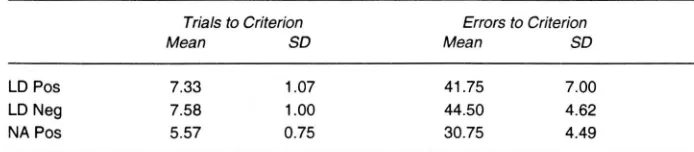
D u r i n g Phase 1 of the s t u d y , a l l three g r o u p s u n d e r w e n t an i m p l i c i t learn-i n g sesslearn-ion w h e r e they w e r e exposed to a n d learn-i m p l learn-i c learn-i t l y learned to crlearn-iterlearn-ion the correct p r o n u n c i a t i o n of p s e u d o w o r d s that f o l l o w e d one of the t w o possible p h o n i c s rules. A m e a s u r e m e n t of trials to criterion revealed a significant dif-ference b e t w e e n g r o u p s , F(2,33)=9.55, p<.05, MS=11.86. A T u k e y b Post H o c analysis s h o w e d that the difference occurred between the n o n - L D g r o u p a n d b o t h L D g r o u p s . Trials a n d errors to criterion for a l l g r o u p s are illustrated i n Table 2.
Perfor-J.K. McNamara and J. Wagner
Table 2
Trials and Errors to Criterion
Trials to Criterion Errors to Criterion
Mean SD Mean SD
LD Pos 7.33 1.07 41.75 7.00 LD Neg 7.58 1.00 44.50 4.62 NA Pos 5.57 0.75 30.75 4.49
m a n c e score of M=8.25 (1.22), L D N e g h a d a m e a n of M=8.33 (1.05), a n d N A Pos h a d a m e a n of M = 9 . 3 8 (1.13). A o n e - w a y analysis of variance i n d i c a t e d that there w a s a significant difference b e t w e e n g r o u p s i n their ability to transfer k n o w l e d g e to m e m o r y , F(2,33)=3.89, p<.05, MS=1.13. A T u k e y b Post H o c analysis r e v e a l e d that the difference occurred between the g r o u p of students w i t h o u t L D a n d b o t h g r o u p s of students w i t h L D .
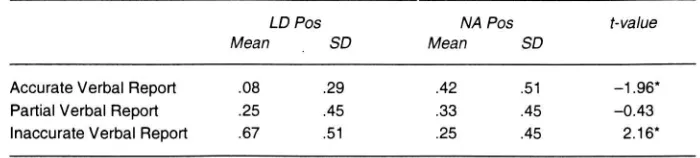
In Phase 3 o n l y students i n L D Pos a n d N A Pos used the role-reversed teaching technique i n o r d e r to v e r b a l i z e about the p h o n i c s rule. V e r b a l reports w e r e r e c o r d e d a n d c o d e d i n t o three o p e r a t i o n a l l y d e f i n e d variables. T h e first v e r b a l report v a r i a b l e w a s labeled A c c u r a t e V e r b a l R e p o r t ( A V R ) . In o r d e r for students to receive a score of 1 for this variable, they m u s t have f u l l y a n d accurately v e r b a l i z e d the mechanics of the p h o n i c s rule. Specifically, students n e e d e d to state f u l l y that the p s e u d o w o r d s d i f f e r e d i n p r o n u n c i a t i o n a c c o r d i n g to the suffix a n d m i d d l e consonant b l e n d of each w o r d . T h e second v e r b a l report v a r i a b l e w a s labeled P a r t i a l V e r b a l R e p o r t ( P V R ) . In o r d e r for students to receive a score of 1 for this variable, they m u s t p a r t l y complete a s o m e w h a t inaccurate v e r b a l report about the mechanics of the p h o n i c s rule. Specifically, students n e e d e d to state that the p s e u d o w o r d s w e r e p r o n o u n c e d differently a n d that the difference w a s dependent o n either the p s e u d o w o r d ' s m i d d l e consonant b l e n d or the p s e u d o w o r d ' s suffix c o m p o n e n t . The third v e r b a l report v a r i a b l e w a s labeled Inaccurate V e r b a l Report (IVR). In o r d e r for stu-dents to receive a score of 1 for this variable, they m u s t have h a d c o m p l e t e l y inaccurate v e r b a l reports about the p h o n i c s rule. G r o u p differences for a l l V e r b a l R e p o r t variables are illustrated i n Table 3.
Table 3
Univariate t-tests for Group Differences in Verbal Reports
LDPos NA Pos t-value Mean SD Mean SD
Accurate Verbal Report .08 .29 .42 .51 -1.96* Partial Verbal Report .25 .45 .33 .45 -0.43 Inaccurate Verbal Report .67 .51 .25 .45 2.16*
*p<.05.
Discussion
Little research has been d o n e o n the role of consciousness i n the a c q u i s i t i o n of p h o n i c s rules. In this s t u d y students b o t h w i t h a n d w i t h o u t L D were exposed to t w o types of p s e u d o w o r d s c o n f o r m i n g to one of t w o p h o n i c s rules.
O u r first h y p o t h e s i s e x a m i n e d the association b e t w e e n w h a t w a s i m p l i c i t l y learned a n d w h a t c o u l d be v e r b a l i z e d i n students b o t h w i t h a n d w i t h o u t L D . O n e element of this h y p o t h e s i s w a s students' i m p l i c i t l e a r n i n g a n d i m p l i c i t k n o w l e d g e . A s i n d i c a t e d i n Table 1, students w i t h L D took s i g n i f i c a n t l y longer to reach the p h o n i c s rule c r i t e r i o n a n d also m a d e significantly m o r e errors w h i l e r e a c h i n g this criterion. T h i s result is not s u r p r i s i n g g i v e n the c h r o n o l o g i -cal a g e - m a t c h d e s i g n of this s t u d y . Students w i t h L D w e r e m a t c h e d w i t h N A students for c h r o n o l o g i c a l age a n d , as m e a s u r e d b y the W o o d c o c k J o h n s o n Test Battery, w e r e r e a d i n g s i g n i f i c a n t l y b e l o w the N A g r o u p . These data c o m -b i n e d w i t h the i n f o r m a t i o n f r o m teachers a n d the data a c q u i r e d f r o m IEPs suggest that the students w i t h L D i n this s t u d y h a v e a significant p h o n o l o g i c a l p r o c e s s i n g p r o b l e m that affects their r e a d i n g ability. A s s u m i n g this, it w a s expected that students w i t h L D w o u l d appear to l a g i n their i m p l i c i t a c q u i s i -t i o n of -the p s e u d o w o r d p h o n i c s rule. The da-ta i n Table 1 indica-te -tha-t -this l a g exists. H o w e v e r , it is i m p o r t a n t to recognize that students w i t h L D e v e n t u a l l y d o acquire the p h o n i c s rule.
F o l l o w i n g the i m p l i c i t a c q u i s i t i o n phase, b o t h L D a n d N A g r o u p s w e r e a d m i n i s t e r e d a test of i m p l i c i t k n o w l e d g e . The N A g r o u p h a d an average i m p l i c i t k n o w l e d g e score of 78.17% a n d the L D g r o u p s h a d a n average i m p l i c i t k n o w l e d g e score of 69.42. These results indicate that b o t h g r o u p s a c q u i r e d the p h o n i c s r u l e i n s o m e i m p l i c i t sense. A l t h o u g h students w i t h o u t L D d i d s h o w a
Table 4
Pre- Posttest Scores of Knowledge of Phonics Rules
Pretest Posttest t-value Mean SD Mean SD
NA Pos 9.38 1.13 9.67 1.13 -2.00 LD Pos 8.25 1.22 8.79 1.30 -3.32* LD Neg 8.33 1.05 8.42 .90 - . 3 4
J.K. McNamara and J. Wagner
q u i c k e r rate of i m p l i c i t l e a r n i n g , these results d i d n o t indicate that students w i t h L D lack the capacity to learn the p h o n i c s rule i m p l i c i t l y . In fact, the g r o u p s of students w i t h L D d i d reach criterion s o o n after the g r o u p of students w i t h o u t L D . There w a s n o t one case i n w h i c h a L D student d i d n o t reach criterion. These results are i n accordance w i t h the f i n d i n g s of W i n t e r a n d Reber (1994) w h o m a k e three a s s u m p t i o n s about i m p l i c i t functions. First, i m p l i c i t systems s h o u l d be robust i n the face of disorders a n d d y s f u n c t i o n s that c o m -p r o m i s e ex-plicit c o g n i t i v e systems. Second, i m -p l i c i t cognitive functions s h o u l d s h o w f e w e r effects of age a n d d e v e l o p m e n t a l l e v e l than explicit cognitive functions. T h i r d , measures of i m p l i c i t functions s h o u l d s h o w less i n d i v i d u a l -t o - i n d i v i d u a l v a r i a b i l i -t y -than c o r r e s p o n d i n g measures of explici-t func-tions. Students w e r e able to learn to decode the p s e u d o w o r d s . M o s t students w e r e also able to pass the transfer test, w h i c h meant that they h a d some i m p l i c i t k n o w l e d g e of the u n d e r l y i n g rules g o v e r n i n g the p s e u d o w o r d s .
O u r first h y p o t h e s i s also i n c l u d e d the expectation that there w o u l d be some d i s s o c i a t i o n b e t w e e n w h a t w a s i m p l i c i t l y learned a n d w h a t c o u l d be v e r b a l -i z e d . T h -i s w a s p a r t l y s u p p o r t e d -i n that o n l y 8% of students w -i t h L D a n d o n l y 4 2 % of students w i t h o u t L D w e r e able to verbalize accurately about the p h o n i c s r u l e . I n i t i a l l y , this suggests that a dissociation exists between i m p l i c i t and e x p l i c i t k n o w l e d g e . I n other w o r d s , students b o t h w i t h a n d w i t h o u t L D d i d h a v e i m p l i c i t k n o w l e d g e of the p h o n i c s rule, b u t h a d significantly less explicit k n o w l e d g e of the rule. A great deal of p s y c h o l o g i c a l research recog-nizes a d i s s o c i a t i o n b e t w e e n conscious a n d u n c o n s c i o u s functions. H o w e v e r , r e a d i n g research has n o t v e n t u r e d into this area. Results of this s t u d y suggest that neither the students w i t h or w i t h o u t L D h a d a f u l l conscious awareness of the p h o n i c s rule. W e offer t w o possibilities to e x p l a i n this f i n d i n g . First, it is possible that the ability to verbalize about a learned p h e n o m e n o n develops h i e r a r c h i c a l l y . T h a t is, as students continue to progress i n their processing f l u e n c y a n d automaticity, they w i l l reach a stage w h e r e the u n d e r l y i n g rules g o v e r n i n g w o r d s w i l l b e c o m e f u l l y conscious. T h i s e x p l a n a t i o n m a y result i n the belief that conscious awareness of a learned p h e n o m e n o n is a k i n to the u n d e r l y i n g c o g n i t i v e processing. T h i s h o l d s an i m p o r t a n t educational i m p l i c a -tion. S t u d e n t s ' a b i l i t y to verbalize about a phonics rule, or a n y other learned p h e n o m e n o n , m a y be d e v e l o p m e n t a l i n that some students w i l l reach ver-b a l i z a t i o n p r o f i c i e n c y ver-before others. A s s u m i n g this, educators m u s t ver-be aware that a student's i n a b i l i t y to verbalize about a learned p h e n o m e n o n is n o t p e r e n n i a l . W i t h c o n t i n u e d s c a f f o l d i n g students w i l l p r o b a b l y d e v e l o p p r o f i -ciency i n v e r b a l i z i n g about the p h e n o m e n o n .
little c o g n i t i v e capacity w a s available for v e r b a l i z a t i o n . T h i s e x p l a n a t i o n m a y also be u s e f u l i n e x p l a i n i n g the difference i n v e r b a l i z a t i o n between students w i t h a n d w i t h o u t L D . Research has been successful i n s h o w i n g that m a n y students w i t h L D have d i f f i c u l t y w i t h processing a n d storage functions as-sociated w i t h W M (for a r e v i e w see S w a n s o n 1998).
A l t h o u g h some dissociation exists, the ability to report v e r b a l l y o n the m e c h a n i c s of the p h o n i c s rule w a s at least p a r t l y evident i n students both w i t h a n d w i t h o u t L D . T h i s is s o m e w h a t contradictory to the f i n d i n g s of other research (Berry & Broadbent, 1988; L e w i c k i et al., 1988; N i s b e t t & W i l s o n , 1977). H o w e v e r , one m i g h t expect the current results g i v e n this s t u d y ' s m e t h o d o l o g -ical a n d theoret-ical a s s u m p t i o n s . First, i n f o l l o w i n g the practice of m a n y class-r o o m s , the v e class-r b a l class-repoclass-rts i n the cuclass-rclass-rent s t u d y w e class-r e class-retclass-rospective i n natuclass-re. H o w e v e r , the reports w e r e obtained i m m e d i a t e l y f o l l o w i n g the p h o n i c s rule l e a r n i n g session. In accordance w i t h the i n f o r m a t i o n processing m o d e l p r o p o s e d b y E r i c s s o n a n d S i m o n (1993), w e p r e d i c t e d that retrospective verbal reports o b t a i n e d i m m e d i a t e l y after the a c q u i s i t i o n phase s h o u l d be relatively accurate a n d complete. T h e results of this s t u d y indicate that 4 2 % of the students w i t h o u t L D h a d f u l l y accurate v e r b a l reports a n d another 33% h a d p a r t l y accurate verbal reports of the p h o n i c s rule. T h i s m a y be u n d e r s t o o d i n terms of the i n f o r m a t i o n accessible i n S T M w h e n the v e r b a l reports were elicited. M u c h of the i n f o r m a t i o n that w a s called o n to be v e r b a l i z e d about m a y n o t yet h a v e transferred to L T M . Therefore, this i n f o r m a t i o n w o u l d still be i n S T M , accessible to consciousness a n d able to be v e r b a l i z e d .
J.K. McNamara and J. Wagner
A second e x p l a n a t i o n d r a w s f r o m the idea that students w i t h L D s h o w p o o r c o n t r o l processes i n their ability to rehearse a n d control i n f o r m a t i o n (Swanson, 1998; W o n g , 1982). These control processes are associated w i t h the executive c o m p o n e n t of W M a n d are c r u c i a l factors i n students' ability to encode i n f o r -m a t i o n so that it c a n be assi-milated a n d a c c o -m -m o d a t e d i n L T M . The executive p r o c e s s i n g difficulties experienced b y students w i t h L D m a y be manifest i n an i n a b i l i t y to m a i n t a i n i n f o r m a t i o n i n S T M . F o l l o w i n g the f r a m e w o r k of E r i c s s o n a n d S i m o n (1993), maintenance of i n f o r m a t i o n i n S T M is a prerequisite of v e r b a l i z a t i o n . C o n s e q u e n t l y , executive control difficulties experienced by s t u -dents w i t h L D m a y h a v e affected their ability to report v e r b a l l y about their a c q u i s i t i o n a n d the mechanics of the p h o n i c s rule.
T h e t h i r d h y p o t h e s i s of this s t u d y addressed the cognitive benefits of u s i n g a role-reversed teaching technique. T h i s technique w a s c o n s i d e r e d metacognitive i n that students h a d to m o n i t o r , question, a n d regulate their o w n u n d e r -s t a n d i n g of the p h o n i c -s rule -so that they c o u l d verbalize it to a n a i v e -subject. S u c h i n t e r n a l m e t a c o g n i t i v e m o n i t o r i n g increases d e p t h of cognitive process-i n g . T h e N A g r o u p a n d one L D g r o u p ( L D pos) w e r e g process-i v e n the o p p o r t u n process-i t y to use this technique, whereas the second L D g r o u p w a s not. A l l three g r o u p s w e r e then g i v e n a posttest of i m p l i c i t k n o w l e d g e . This test was a d m i n i s t e r e d i n o r d e r to measure the effect of the v e r b a l i z a t i o n technique. Results s h o w e d that the L D g r o u p e m p l o y i n g the technique significantly i m p r o v e d their posttest scores. T h e increase w a s large e n o u g h that there w a s n o longer a significant difference b e t w e e n students w i t h a n d w i t h o u t L D . T h i s suggests that the e m p l o y m e n t of this strategy w a s beneficial for students w i t h L D i n their k n o w l e d g e of the p h o n i c s rule. T h i s observation h o l d s some i m p o r t a n t e d u c a -tional i m p l i c a t i o n s . First, as stated above, this type of role reversal scaffolds students' m e t a c o g n i t i v e m o n i t o r i n g . S u c h m o n i t o r i n g is beneficial i n that it enables students to m o n i t o r the adequacy of the i n f o r m a t i o n o n w h i c h they w i l l base their teaching, a n d this i n t u r n increases students' d e p t h of cognitive p r o c e s s i n g . T h e second i m p l i c a t i o n is affective i n nature. W h e n e m p l o y i n g the role reversal technique, students take the p o s i t i o n of the teacher. T h i s itself can m a k e students feel that their i n p u t is i m p o r t a n t a n d also that they are r e s p o n -sible for the o u t c o m e of the task. Increased r e s p o n s i b i l i t y often leads to an internal locus of c o n t r o l . Students w h o have an internal locus of control tend to m a k e i n t e r n a l causal explanations for a task a n d hence have increased positive reactions a n d reasons to persist or w o r k h a r d at a task. T h i s is p a r t i c u l a r l y i m p o r t a n t for students w i t h L D w h o t y p i c a l l y experience a great deal of academic f r u s t r a t i o n a n d often have a l o w academic self-concept.
F i n a l l y , students b o t h w i t h a n d w i t h o u t L D w e r e successful i n the i m p l i c i t l e a r n i n g of a p h o n i c s rule. O n the other h a n d , w h e n e x a m i n i n g students' v e r b a l reports, a significant b e t w e e n - g r o u p difference was f o u n d . H e n c e there w a s evidence of s o m e d i s s o c i a t i o n between i m p l i c i t l e a r n i n g a n d explicit k n o w -ledge. H o w e v e r , this d i s s o c i a t i o n was not absolute. Students w i t h o u t L D were quite efficient a n d accurate i n their v e r b a l reports, whereas students w i t h L D w e r e m u c h less successful.
p o o r a b i l i t y to v e r b a l i z e a b o u t this r u l e . A l s o , m a n y students w i t h L D h a v e e x e c u t i v e p r o c e s s i n g p r o b l e m s that m a y affect their a b i l i t y to acquire a n d t h e n v e r b a l i z e a b o u t p h e n o m e n a b e i n g l e a r n e d . In this s t u d y these d i f f i c u l t i e s m a y h a v e b e e n m a n i f e s t e d i n a d e l a y i n L D s t u d e n t s ' a b i l i t y to acquire a p h o n i c s r u l e i m p l i c i t l y a n d to v e r b a l i z e a b o u t this r u l e .
T h e r e l a t i o n s h i p s b e t w e e n i m p l i c i t a n d e x p l i c i t functions are d e s e r v i n g of f u r t h e r research. E d u c a t o r s m u s t be a w a r e of the benefits of a l l o w i n g i m p l i c i t l e a r n i n g to take p l a c e i n the c l a s s r o o m . H o w e v e r , e d u c a t o r s m u s t also be a w a r e that v e r b a l a b i l i t y m a y n o t be a r e p r e s e n t a t i v e m e a s u r e of this l e a r n i n g . T h i s is e s p e c i a l l y true w i t h the l e a r n i n g - d i s a b l e d p o p u l a t i o n .
References
Atkinson, R.C., & Shiffrin, R. (1968). H u m a n memory: A proposed system and its control processes. In K. Spence & J. Spence (Eds.), The psychology of learning and motivation (vol. 2, pp. 85-195). N e w York: Academic Press.
Baddeley, A . D . (1986). Working memory. London: Oxford University Press.
Baddeley, A . D . , & Hitch, G . (1974). W o r k i n g memory. In G . H . Bower (Ed.), The psychology of learning and motivation (vol. 8, pp. 47-90). San Diego, C A : Academic Press.
Berry, D . C . (1994). Implicit learning: Twenty-five years on. A tutorial. In C. Umilta & M .
Moscovitch (Eds.), Attention and performance: Conscious and nonconscious information processing. Attention and performance series (pp. 755-782). Cambridge, M A : М П Press.
Berry, D . C , & Broadbent, D.E. (1988). Interactive tasks and the implicit-explicit distinction. British journal of Psychology, 36,209-231.
Berry, D . C , & Broadbent, D.E. (1987). The combination of explicit and implicit learning processes in task control. Psychological Research, 49, 7-15.
Broadbent, D.E., & Fitzgerald, M . H . (1986). Implicit and explicit knowledge i n the control of complex systems. British Journal of Psychology, 77,33-50.
Daneman, M . , & Carpenter, P. (1980). Individual differences in working memory and reading. Journal of Verbal Learning and Verbal Behavior, 19,450-466.
Dulany, D.E., Carlson, R . A . , & Dewey, G.I. (1984). A case of syntactical learning and judgment: H o w conscious and how abstract. Journal of Experimental Psychology: General, 113,541-555. Ericsson, K . A . , & Simon, H . A . (1993). Protocol analysis. Cambridge, M A : M I T Press.
Gleason, J.B. (1985). Studying language development. In J.B. Gleason (Ed.), The development of language (pp. 1-37). Columbus, O H : Merrill.
Karanth, P., & Suchitra, M . G . (1993). Literacy acquisition and grammaticality judgments in children. In R.J. Scholes (Ed.), Literacy and language analysis (pp. 143-157). Hillsdale, NJ: Erlbaum.
Lewicki, L., H i l l , T., & Bizot, E. (1988). Acquisition of procedural knowledge about a pattern of stimuli that cannot be articulated. Cognitive Psychology, 20, 24-37.
Mathews, R.C., Buss, R.R., Stanley, W.B., Blanchard-Fields, F., Cho, J.R., & Durham, B. (1989). Role of implicit and explicit processes in learning from examples: A synergistic effect. Journal of Experimental Psychology, 15,1083-1100.
Nagy, W . E., & Anderson, R.C. (1984). H o w many words are there in printed school English? Reading Research Quarterly, 19,357-366.
Nisbett R.E., & Wilson, T.D. (1977). Telling more than we can know: Verbal reports on mental processes. Psychological Review, 84,231-250.
Reber, A.S. (1993). Implicit learning and tacit knowledge: An essay on the cognitive unconscious. Oxford, U K : Oxford University Press.
Smith, E. (1994). Similarity versus rule-based categorization. Memory and Cognition, 22,377-386. Stanley, W.B., Mathews, R . C , Buss, R.R., & Kotler-Cope, S. (1989). Insight without awareness: O n
the interaction of verbalization, instruction and practice in a simulated process control task. Quarterly Journal of Experimental Psychology, 41A, 553-557.
Stanovich, K . E . (1986). Matthew effects in reading: Some consequences of individual differences in the acquisition of literacy. Reading Research Quarterly, 21,360-407.
J.K. McNamara and J. Wagner
Swanson, H . L . (1993). W o r k i n g memory in learning disability subgroups. Journal of Experimental Child Psychology, 56,87-114.
Swanson, H . L . (1998). Learning disabilities and memory. In B.Y.L. W o n g (Ed.), Learning about learning disabilities (pp. 107-154). San Diego, C A : Academic Press.
Swanson, H . L . , Ashbaker, M . , & Lee, C . (1996). The effects of processing demands on the working memory of learning disabled readers. Journal of Experimental Psychology, 59,213-247. Tarver, S.G., Hallahan, D.P., Kauffman, J.M., & Ball, D . W . (1976). Verbal rehearsal and selective
attention in children with learning disabilities: A developmental lag. Journal of Experimental Child Psychology, 22,375-385.
V a n Orden, G . C . , Pennington, B.F., & Stone, G . O . (1990). W o r d identification in reading and the promise of subsymbolic psycholinguistics. Psychological Review, 97,488-522
Wagner, R.K., & Torgesen, J.K. (1987). The nature of phonological processing and its role i n the acquisition of reading skills. Psychological Bulletin, 101,192-212.
Winter, B., & Reber, A.S. (1994). Implicit learning and the acquisition of natural languages. In N . C . Ellis (Ed.), Implicit and explicit learning of language (115-146). London: Academic Press. W o n g , B.Y.L. (1982). Strategic behaviors in selecting retrieval cues in gifted, normal achieving