Abstract—Incineration has been the only effective way of
reducing plastic waste after recycling in the modern societies, yet a better solution for processing waste plastics and simultaneously producing renewable energy is presented and demonstrated in this paper. R-ONETM, an optimized Pyrolysis technology converting varieties of plastic waste into clean and low sulfur content fuel which meets the most stringent international standard, emits no toxic gases such as Dioxins and other secondary pollution. R-ONETM recycles 100% of its own output of syngas (5-10%) as the major energy source while converting around 80% of the mixed plastic waste into high grade fuel; and the other 10-15% into carbon black. In comparison with incinerators, carbon dioxide production by R-ONETM is around 100X lower. Furthermore, its energy efficiency (from the energy balance calculation) is one of the highest in the world compared to any renewable energy technologies or any waste processing technologies. Both of these objectives are reached by R-ONETM.
Index Terms—Clean diesel, pyrolysis, renewable energy, R-ONE, waste processing.
I. INTRODUCTION
Due to many good characteristics, such as its relatively low cost, ease of manufacture, versatility, and imperviousness to water; plastics have been used in a massive and growing range of products and have already substituted many traditional materials in most of their former uses. However, with plastic production increasing, plastic waste generation is also on the rise which in turn is causing serious environmental problems.
Global plastics production is currently estimated to be 300 million metric tons each year and is growing at a rate of 4% annually [1]. The World Bank projects that 1.3 billion metric tons of municipal solid waste (MSW) is generated each year, a number that is expected to grow to 2.2 billion metric tons per year (MTPY) by 2025. Around 10% of the total MSW produced, or 130 Million MTPY, is plastic [2]. Since plastic waste virtually does not degrade, it persists for hundreds years after they are dumped in the dumpsites. Thus, this accumulation of plastic products is serious threat to the prospect of the ecosystem in general and to the health of human society in particular.
Manuscript received June 23, 2017; revised February 23, 2018. Gordon Yu is with Taiwan Hsinchu Green Industry Association, Taiwan (e-mail: [email protected]).
Chih-Young Hung is with the National Chiao Tung University, Taiwan. (e-mail: [email protected]).
Isaac Hung is with EVP R-ONE, Taiwan (e-mail:
As the calorific value of the plastics is comparable to that of hydrocarbon fuel, production of fuel from plastic waste could provide a good opportunity to utilize the waste as a better alternative to dumpsites. For example, the Ocean Recovery Alliance has identified the plastics-to-fuel (PTF) technologies as one potential solution to reducing plastic marine litter and the landfilling of end-of-life plastics [3]. Currently, there are three technologies used to convert plastic waste into energy, namely they are combustion, gasification and pyrolysis. Table I below shows various technologies and the types of materials they can convert.
The issue of using pyrolysis technology to achieve the goal of PTF, however, is not purely a technology matter [9], [10]. The efficiency, and thus the cost, of conducting a specific pyrolysis technology is another matter of concern. A recent study by Ye (2016) examined the developments of various pyrolysis companies and the challenges that they face [11]. Ye pointed out that while there have been many attempts to develop a successful pyrolysis technology for several decades in many countries; they were not able to find an operating industrial-scale plant that is converting non-recycled plastics (NRP) to synthetic oils. Existing companies are either still under development, have shut down due to low oil prices, or are using a more homogenous plastic feedstock from industrial wastes. Combined with the low cost of oil and technical and economic process challenges that companies are facing in this developing field, it is currently not feasible to use material recover facility (MRF) residues as pyrolysis feedstock. However, the residues can be mixed with other pyrolysis feedstock. Municipalities can make changes to their recycling systems so as to increase the amount of NRP directed to MRF and, therefore, the amount of feedstock suitable for pyrolysis plants. However, there is no point in increasing the NRP stream until there is an economically viable pyrolysis plant that will use this stream to produce synthetic oil.
In this paper, we present an optimized pyrolysis technology which converts varieties of plastic waste into clean and ultra-low sulfur content fuel that meets the most
An Optimized Pyrolysis Technology with Highly Energy
Efficient Conversion of Waste Plastics into Clean Fuel
While Substantially Reducing Carbon Emission
Gordon Yu, Chih-Young Hung, and Isaac Hung
stringent international standards while emitting no toxic gases such as dioxins and other secondary pollution. This
proprietary technology, R-ONETM of EVP, is currently being adopted in several new plants that are under construction.
TABLEI:TYPES OF MATERIALS AND REACTORS OFFERED IN THE LITERATURE
Fig. 1. Functional block diagram of R-ONE.
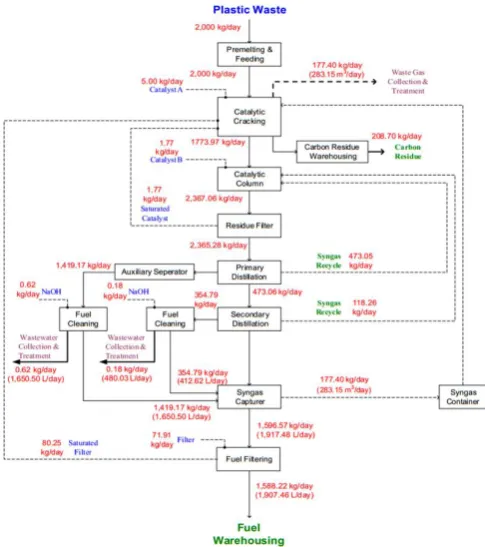
The functional diagram of R-ONETM (Regenerated Oil & New Energy), an optimized pyrolysis technology, is shown as Fig. 1, which is capable of processing 20 tons/day plastic waste. Below, the actual operational data from the demo plant using R-ONETM technology is provided for discussion purposes: As illustrated in the mass balance flow chart of Fig. 2, we use mixed plastic waste [85% (PP+PE+PS) and 10%-15% others (ABS+PET+PVC…)] to evaluate the mass balance relations in R-ONETM process currently at EVP’s demonstration facility in Hukou, the results show that the produced weights of fuel, syngas and carbon residue (carbon black) are 1,588.22 kg/day, 177.40 kg/day and 208.70 kg/day, giving the produced ratio of fuel, syngas and carbon residue at 79.41 %, 8.87% and 10.44 % by weight.
In addition to thermal energy (lower than 400°C) and proprietary-processing/molecular-recombination
technologies, R-ONETM also utilizes 3 types of heterogeneous catalyst at 3 stages of the production process: pre-melt feeding, cracking, and filtration respectively. Every 1,000 kg of plastic waste processed requires 39.35 kg of catalysts which end up as carbon residues when the R-ONETM process is completed.
The R-ONETM system uses three energy sources: electricity, optional diesel fuel, and syngas. Electricity is used only at the pre-melt feeding and stirring process, and requires 250 kW for 1 ton of plastic processed. R-ONTME diesel fuel (Calorific Value: 11,000 Kcal/Kg or 9,197 Kcal/L with
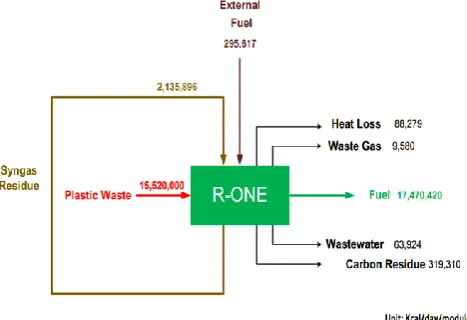
density of 0.836 Kg/L) is used only at the initial starting of the reactor, and requires 16.07 liters for 1 tons of plastic processed. The rest of the production process uses syngas generated by R-ONETM process, and it is entirely, internally sustained. Fig. 3 is the energy balance relation graph to illustrate.
Fig. 2. R-ONE mass balance flow chart.
If such waste plastic of 2 tons/day were processed by incineration (which is the majority of the cases in Taiwan) then the carbon dioxide emission (Plastic: 75.1 Kg CO2/GJ)
will be:
15,520,000 Kcal/day x 4.1848 J/cal x 75.1 Kg CO2/GJ =
4,880 Kg CO2/day
carbonaceous material such as plastics in an oxygen-starved atmosphere and the larger hydrocarbon chains break down into smaller molecules; there is almost no carbon dioxide emission in the main process. However small amounts of carbon dioxide are generated due to the sustained fuel of syngas generated by R-ONETM or initial use of optional diesel fuel. When burning the syngas, the carbon dioxide emission (Sysngas: 56,100 Kg CO2/TJ ) will be:
295,617 Kcal/day x 4.1848 J/cal x 56,100 Kg CO2/TJ = 69
Kg CO2/day
R-ONETM can reduce about ~70X CO2 emission for plastic
waste treatment compared to incineration or so-called Waste To Energy (WTE). The component analysis report of Table II (2014/07/21 tested by SGS) [12] shows that R-ONE carbon residue contains 54.34 wt% ash, 33.24 wt% volatile matter and 12.42 wt% fixed carbon. Calorific value of the carbon residue becomes relatively low with 1,583 Kcal/Kg due to high contents of ash. From the viewpoint of energy transfer rate, the gross calorific value of raw waste plastics is about 7,760 Kcal/kg. In other words, about 79.6% energy has been directly converted to R-ONETM fuel product. Compared with most incinerators (or WTEs) where energy conversion efficiency are in the low 20’s, typical pyrolysis is much better, while this test result confirms that R-ONETM is the most efficient waste plastic processing and refinery process of all other renewable energy technologies.
Fig. 3. Energy balance relation graph.
TABLE II:SGSCERTIFIED TEST REPORT OF R-ONE CARBON REDIDUE
TEST ITEM(S) UNIT METHOD RESULT
ASH wt% ASTM D3174-12 54.34
VOLATILE MATTER wt% ASTM D3175-11 33.24
FIXED CARBON wt% ASTM D3172-13 12.42
TOTAL SULFUR wt% ASTM D4239-13e1 <0.05
Heavy metals are found in R-ONETM carbon residue, such as Lead, Nickel, Zinc, Copper, Chromium, Antimony and Barium which are considered to have come from the feedstock of waste plastics. This is unavoidable as these heavy metals are the additives of plastic. Fortunately, they can be separated out during the purification process of carbon black. R-ONETM carbon residue, with determined mean size
of 20 μm, is easily filtered. Therefore, there will not be any air pollution problems during its collection, transportation, and treatment.
A. Treatment Advantages
R-ONETM Technology features several advantages; it can process varieties of mixed plastic waste, as demonstrated by the above data which is obtained by processing [85% (PP+PE+PS) and 10%-15% others (ABS+PET+PVC…)], in a manner of without cleaning and without sorting, so R-ONETM eventually can reach the goal of processing NRP, especially for MRF residues, making it the best companion for recycling facilities. Also, its “High Temperature Residue Removal Technique” enables the removal of residues while maintaining the reactor’s temperature at an ideal level. This technique not only keeps production running continuously, but also reduces energy consumption and ensures the safety of operators. In addition, R-ONETM production lines are assembled with a modular design concept, connecting ten individual reactors together. This allows maintenance to be done on each reactor individually without stopping production of the rest of the production line. Taking the scarcity of natural resources into consideration, R-ONETM Technology is self-sustained in that the syngas generated is fully recycled as the production’s heating source.
In contrast to conventional landfill and incineration, R-ONETM treatment is environmentally friendly while generating no pollutants to soil and underground water. Burning plastics typically will produce toxic material such as Dioxin, yet under the Oxygen-starvation condition and relative low temperature (<400 oC), R-ONETM does not generate Dioxin at all, SGS test report also confirms that. Also, R-ONETM production yields very low emissions, in several orders of magnitude smaller than the regulation standard for controlled pollutants such as PM2.5, SO2 & NOx
(Table III).
TABLEIII:SGSCERTIFIED EMISSION REPORT OF R-ONE PRODUCTION PLANT
CO2 O2 Actual Value Unit
Particulate matter (PM)
NIEA A101.74C 4.7 14.5 13.3 mg/Nm3 8.91E-04 500 (mg/Nm3)
Sulfur dioxide (SO2)
NIEA A413.74C 5.5 16.25 18.6 ppm 3.35E-03 650 (ppm)
Nitrogen oxides (NOx)
NIEA A411.74C 5.5 16.25 11.8 ppm 1.52E-03 250 (ppm)
Emission (kg/hr)Emission Standard
(Taiwan)
Air Pollutants and Test Methods
Composition (%) Emission Value
B. Production Outputs
In R-ONETM production (Fig. 3), the majority (80%-85%) of the plastic wastes are converted into light fuel oil. Compared to conventional fuel refinery methods, R-ONE follows a “Circular Economy” manner aiming to conserve natural resources. The World Economic Forum defines Circular Economy as following:
restorative or regenerative by intention and design. It replaces the end-of-life concept with restoration, shifts towards the use of renewable energy, eliminates the use of toxic chemicals, which impair reuse and return to the biosphere, and aims for the elimination of waste through the superior design of materials, products, systems and business models.” [13]
In this regard, R-ONETM Technology takes waste as a source for fuel generation, and produces light fuel oil with competitive specifications (Table IV). Better combustion efficiency with Cetane Index of 61.2, much better than typical petro-chemical diesel Cetane Index of 40+ (Table V), R-ONETM either provides 10~15% higher horsepower, or reduce oil consumption by 10~15% compared with fossil-fuel diesel, from the data of 11096 kcal/kg Heat of Combustion (Table VI). Diesel-engine vehicles or equipments using R-ONETM emit almost no black smoke at all due to high Cetane number (better combustion efficiency) and low Micro Carbon Residue which is around 1/4 of fossil-fuel counterpart.
Fig. 3. R-ONE factory in production.
TABLEIV:SGSCERTIFIED TEST REPORT OF R-ONELIGHT FUEL OIL
UNIT RESULT
℃ 56.5
kcal/kg 11096
--- 61.2
ppm 10.7
g/mL 0.8406
Density, 15℃ ASTM D4052
Heat of Combusiton ASTM D240
Cetane Index ASTM D4737
TEST ITEM(S) METHOD
Flash Point ASTM D93
Sulfur(S) ASTM D5453
While sulfur contributes heavily to acid rain formation [14] , R-ONETM takes special consideration and generates renewable oil with only 10 ppm of sulfur content, as a response to environmental awareness. MARPOL (The International Convention for the Prevention of Pollution from Ships) Annex VI entered into force for the Sulfur content no more than 35,000ppm for marine diesel started from 2012, which is also the current specification of CPC (China Petroleum Corp., the largest oil company in Taiwan) Fishing Boat Diesel Fuel B & Fuel C [15]; the Sulfur content specification of cleanest CPC Fuel A is 10,000ppm, 1000 times higher than R-ONE’s 10ppm. MARPOL’s roadmap is to mandate Sulfur content from current 35,000ppm to 5000ppm by 2020 (or 2025), the wide-spread of R-ONETM will likely to make it happen earlier, or even push further to
1000ppm, the same with current mandate since 2015 in IMO (International Maritime Organization) designated Emission Control Areas (ECAs) such as East/West coasts of North America, North Sea & Baltic Sea, etc. [16]
TABLEV:CHARACTERISTICS COMPARISON OF R-ONE
Unit R-ONE
Renewable Diesel
Automotive Diesel
U.S.A No.2
China
0# Taiwan
Cetane
Number ~60
Better
Combustion 40 49 48
Sulfur ppm 10 Clean 15 50 10
Oxidation
Stability g/m3 2.6 Stable - 25 25
Micro Carbon Residue
% 0.08
Lower Maintenance
Cost
0.35 0.3 0.3
TABLEVI:HEAT VALUE COMPARISON OF R-ONE Net Heat
Value
R-ONE (PTO A Fuel)
Automobile Diesel
U.S No.2 China #0 Taiwan
kcal / kg 11,096 10,125 9,181 9,600
R-ONETM Technology converts plastic waste into light fuel oil without generating toxic byproduct such as Dioxin, with little or no emissions, which can potentially reduce environmental burdens. The treatment follows a sustainable spirit in order to conserve natural resources and mitigate global warming; the carbon dioxide emission is reduced for almost 100X in compared with incinerator, and the energy conversion of close to 80% is among the highest in the world which makes R-ONETM potentially be the most efficient renewable energy apparatus. The output contains competitive specifications in terms of environmental protection such as 1,000X lower in Sulfur content, and economical optimization of 10~15% more horsepower or less oil consumption. In response to the currently overloading plastic wastes in Hong Kong resulting from China’s “Green Fence” policy, R-ONETM stands as a viable solution ought to be considered; R-ONETM will be needed whenever there are tons of plastic waste, which virtually are every nation and every city, whether it’s on the land, or by the sea and even under the sea.
ACKNOWLEDGEMENT
Special gratitude to EVP R-ONETM Market Development team, eTouch Innovation Co. Ltd. and National Chiao Tung University New Energy Research Lab.
REFERENCES
[1] Plastics Europe. Plastics – The facts 2013. [Online]. Available: http://www.plasticseurope.org/documents/document/2013101409582 4final_plastics_the_facts_2013_published_october2013.pdf [2] The World Bank, “What a waste: A global review of solid waste
management,” March 2012.
[3] 2015 Plastics-to-Fuel Project Developer’s Guide, Prepared By: Ocean
Recovery Alliance, June 2015.
[4] M. Thomas, “Novel and innovative pyrolysis and gasification technologies for energy efficient and environmentally sound MSW disposal,” Waste Management, vol. 24, 2004, pp. 53–79.
[5] L. Sørum et al., “Pyrolysis charactersitcics and kinetcics of municipal solid wastes,” Fuel, vol. 80, pp. 1217–1227, 2001.
[6] A. Smith et al., “Waste management options and climate change: Final report,” Rep. Prepared by AEA Technology for the European Commission, DG Environment; B4-3040/99/136556/MAR/E3, 2001.
[7] S. L. Wong et al., “Current state and future prospects of plastic waste as source of fuel: A review,” Renewable and Sustainable Energy Reviews, vol. 50, pp. 1167–1180, 2015.
[8] K. Bidhya et al., “Plastics to fuel: A review,” Renewable and Sustainable Energy Reviews, vol. 54, 2016, pp. 421–428.
[9] L. Y. Lin et al., “Preferential policies promote municipal solid waste (MSW) to energy in China: Current status and prospects,” Renewable and Sustainable Energy Reviews, vol. 36, 2014, pp. 135–148. [10] H. Zhou et al., “An overview of characteristics of municipal solid waste
fuel in China: Physical chemical composition and heating value, Renewable and Sustainable Energy Reviews, vol. 36, 2014, pp. 107–122.
[11] Y. Diane, “Developments in industrial scale pyrolysis of non-recycled plastics (NRP),” Columbia University, 201.
[12] SGS Taiwan Ltd. Test Report #KI/2014/70289, Product: “R-ONE Carbon Black”, July 28, 2014.
[13] World Economic Forum, “Towards the circular economy: Accelerating the scale-up across global supply chains,” Geneva, Switzerland, January 2014.
[14]United States Environmental Protection Agency. (2014). Causes of
acid rain. [Online]. Available:
http://www.epa.gov/region1/eco/acidrain/causes.html
[15] Specification of Petroleum, CPC Corp, Taiwan, Version 7.9, April 2012.
[16] Edmund Hughes, “MARPOL annex VI – An update of international regulatory developments for prevention of air pollution and the energy efficiency of ships,” July 2016 Global Shippers’ Forum AGM Colombo, Sri Lanka.
Gordon Yu got theMSEE 1987 University of Texas, Arlington, Texas USA, the BSEE 1979 National Chiao Tung University, Hsinchu, Taiwan.
He is currently the CEO of Etouch Innovation Co. Ltd., managing director & chief strategy officer of EVP, chief strategy officer of UWin Nanotech, and managing director of Taiwan Hsinchu Green Industry Association, all based in Taiwan. More than 150 patents holder in Taiwan, China, USA and EU, he has been awarded Taiwan 9th “Innovative research Award” by Minister of Economic Affairs, 5th
“Rising Star Award” by the Prime Minister, and 11th “National Award of
Outstanding SME” by the President of Taiwan.
Mr. Yu has been a frequent invited Speaker for Sustainability around the world such as “International Conference on Solid Waste, Hong Kong, May 2015, “ECO Technology Show” Brighton, UK, June 2015, “Global Bioeconomy Summit”, Berlin, Germany, Nov. 2015, “International Conference on Synergy between Science and Social Development in Solid Waste Management”, Hong Kong, Sept,. 2016, and “EU-Taiwan Green Summit: Moving towards a Circular Economy and Sustainable Trade”, Taipei, Nov. 2016, etc. Mr. Yu is a member of Taiwan Cradle-to-Cradle Alliance and a Board member of Taiwan Hsinchu Green Industry Association.
Chih-Young Hung earned his B.S in electrical engineering from National Chiao Tung University, Hsinchu, Taiwan in 1979, MA in management from Sonoma State University, Rohnert Park, CA, USA, in 1984, and Ph.D. in finance from Texas Tech University, Lubbock, Texas USA in 1990.
He worked for ERSO/ITRI as an assistant R&D engineer for two years. His main task involved the design and implementation of circuit board for an industrial robot’s controller. He joined and remains at his current job as a professor at the National Chiao Tung University since 1990. He has published several books and also papers in various academic journals. His main research interests are in the area of technology foresight, assessment and selection.
Professor Chih-Young Hung is the Honorary Chairman of the Chinese Valuation Association, Taiwan. He is a board member of the Chinese Society of the Management of Technology.
Isaac Hung got the MSBE 2016 in water resource engineering University of Arizona, Tucson, Arizona USA, the BSBE 2014 in controlled environment agriculture University of Arizona, Tucson, Arizona USA.
He is currently an assistant project manager at EVP R-ONE in Taipei City, Taiwan. Mr. Hung has worked with ultrafine bubbles at GAIA USA, Inc and engineering projects at Bosque Engineering, LLC.