52
Comparison Between the Effect of Polymers and
Surfactants on the Release of Drug from Controlled
Release Matrices
Hassan Ali Alhmoud
*Department of pharmaceutical sciences, College of pharmacy, Yarmouk University, Irbid, Jordan
ABSTRACT
The hydrophobic polymers Eudragit RL100 and Eudragit RS 100 with sorbitol were used for preparation of controlled release matrices of flurbiprofen. The effect of different surfactants was studied. The proposed mechanisms of drug release from the matrices were wetting, solubilization and dissolution of the soluble surfactant that disrupt the matrices.
The dissolution rate of drug was low when Eudragit RS 100 was used in the preparation of the matrices by the incorporation of 1% surfactants, while a significant increase of drug release produced by using Eudragit RL100. The charge, solubility, and the concentration of the surfactant have a significant role on the release rate of flurbiprofen. It was found that the cationic surfactants cetrimide and cetyl pyridinium chloride did not affect the contact angle and had no changes on the dissolution of drug. While the anionic surfactants produced wetting, solubilization and lowered the contact angle, the dissolution rate of drug was increased.
The use of hydrophilic polymer with an anionic charge sodium carboxymethyl cellulose (NaCMC) in the preparation of the matrices with propranolol hydrochloride as a model drug produced significant effect on the dissolution rate of drug.
The present study is aimed at exploring and comparing the effect of the hydrophilic and hydrophobic polymers with that of the surfactants on the release rate of drug and the mechanism by which they act.
Key Words:flurbiprofen, propranolol HCl, matrix, controlled release, hydrophobic polymers, Hydrophilic
polymers, Surfactants
eIJPPR 2017; 7(6):52-58 HOW TO CITE THIS ARTICLE: Hassan Ali Alhmoud. (2017). “Comparison Between The Effect of Polymers And Surfactants on The Release of Drug From Controlled Release Matrices” , International Journal of Pharmaceutical and Phytopharmacological Research, 7(6), pp.52-58
INTRODUCTION
The importance of controlled release dosage forms is advantageous over the conventional dosage forms (1 - 2). The controlled release matrix is one of the most attractive and interesti
ng one because of the economic and interesting view. The properties of the acrylic resins polymers have been studied, the Eudragit polymers are
biocompatible non-biodegradable acrylic resins consisting of copolymers acrylic and methacrylic resins. A number of publications reported the use of these polymers in the preparation of controlled release matrices [3-7].
The hydrophilic polymers and specially celluloses are extremely popular in the preparation of controlled release dosage forms. The ease of compression and
Corresponding author: Hassan Ali Alhmoud
Address: Department of pharmaceutical sciences, College of pharmacy, Yarmouk University, Irbid, Jordan e-mailhassan.alhmoud@ yu.edu.jo
Relevant conflicts of interest/financial disclosures: The authors declare that the research was conducted in the absence of any commercial or financial relationships that could be construed as a potential conflict of interest.
53 their ability to accommodate large amount of drug and
the minimum influence of the processing variables are the main reasons for their popularity [8 -9]. Sodium Carboxy Methyl Cellulose (NaCMC) is a widely used polymer due to its availability in a range of viscosity and good swelling and erosion characteristics which can be used to modulate the release of various drugs [10 -14]. Several studies have been made by combining the hydrophilic-hydrophobic polymers to produce controlled release tablets [15 - 19].
The influence of surfactants on drug release from acrylic resins was studied, four surfactants sodium lauryl sulphate (SLS), sodium taurcholate (ST), cetylpyredinium chloride (CPC), and cetrimide (Cet.) were used to study their effects when they were incorporated within the matrices on the release rate of drug. The Mechanism of drug release which follows the addition of the surfactant may improve the wettability of the tablets, solublization of the drug and the soluble surfactant which cause disruption of the matrix and increase the release of the drug.
In the matrices of propranolol HCl as a model drug, the results were different. The matrices with Eudragit RL100 and RS 100 were disrupted and the entire drug was released in less than four hours with both polymers [21]. The access of the dissolution medium to the matrices dissolves the soluble drug, [22] channels were formed within the tablets, which increased by time and weakened the adhesive forces between the components and caused disruption of the matrices. This was not observed in the matrices of the slightly soluble drug (flurbiprofen) [22] by which the drug was released in a very slow rate [3, 5].
The use of the anionic hydrophilic polymer NaCMC altered the results in the preparation of the matrices with the cationic propranolol HCl as a model drug. The incorporation of the surfactants within the hydrophilic matrices of propranolol showed an interesting effect. Adding anionic surfactants to the matrices decreased the release rate of drug due to the interaction between the cationic drug and the anionic additives, while the addition of the cationic surfactants showed an increase in the release rate of drug due to the wetting, solubilization and the repulsive effect of the charges, which weakened the interaction between
the drug and additives and increase of drug release [4, 7].
Another difference between the effect of anionic NaCMC and the surfactants is that high percent of polymer was decreased in the release rate. While by adding the surfactants, high release rate of the drug may occur until the CMC of the surfactant after that point the increase of drug release will be in a less amount [15]
EXPERIMENTAL MATERIALS
To prepare the matrices, the following materials were applied: flurbiprofen a gift from Boots Co. Ltd, Propranolol HCl, and sorbitol were sponsored by the Arab Pharmaceutical Manufacturing- Jordan (APM), sodium lauryl sulfate and magnesium stearate were purchased from BDH, cetrimide was purchased from Serva, sodium carboxymethyl cellulose was purchased from FMC, sodium taurocholate and cetylpyridinium chloride were purchased from Fluka. Eudragit RL100 and Eudragit RS 100 were sponsored by Evonik. All the chemicals were reagent grade.
METHODS
Preparation of tablets
The Eudragit RL100 and RS100 were powdered in a ball mill and sieved through a 300µm sieve. The drugs and the excipients were blended for five minutes in a blender. The powders were compressed to prepare a 500 mg tablets in a single tabletting machine (Korch- Erweka). The ratio between the diameter and the thickness of the cylindrical flat faced tablets was between 0. 7 and 0.9 cm. The hardness of the tablets was about 9 kg measured by Schleuniger-2 hardness tester.
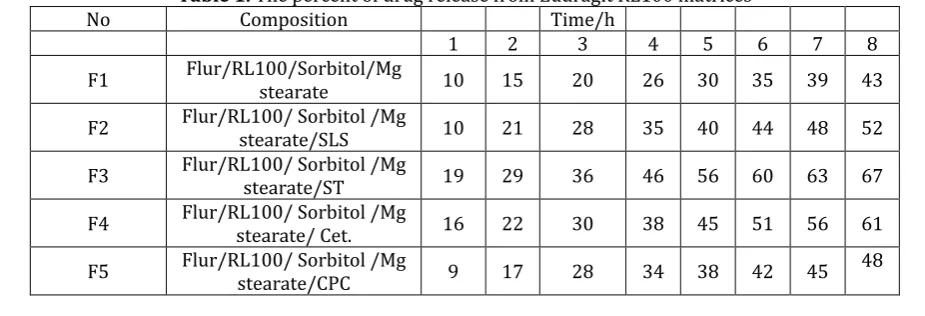
In the case of flurbiprofen with Eudragit RL100, formulations were prepared as listed in Table 1. In the case of flurbiprofen with Eudragit RS 100, formulations were prepared as listed in Table 2 to evaluate the release rate of drug.
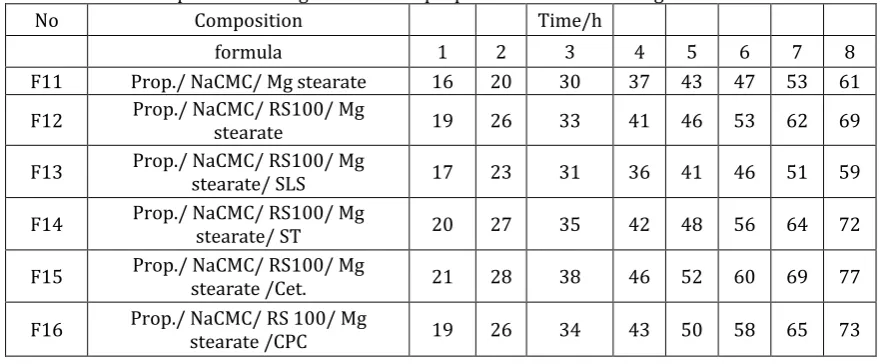
In the case of propranolol hydrochloride, formulations were prepared as listed in table 3 to evaluate the release rate of drug.
Table 1. The percent of drug release from Eudragit RL100 matrices Time/h
Composition No
8 7 6 5 4 3
2 1
43 39 35 30 26 20
15 10 Flur/RL100/Sorbitol/Mg
stearate F1
52 48 44 40 35 28 21
10 Flur/RL100/ Sorbitol /Mg
stearate/SLS F2
67 63 60 56 46 36
29 19 Flur/RL100/ Sorbitol /Mg
stearate/ST F3
61 56 51 45 38 30
54 1- Surfactants incorporated in each tablet individually
in all formulations from 2 to 5 is 1 % w/w. 2- All the above formulations have the following compositions (Flur. 49 %, RL100, 25 %, Sorbitol, 25 %, and Mg stearate, 1 %.
Table 2. Percent of drug release from Eudragit RS 100 matrices Time/h Composition No 8 7 6 5 4 3 2 1 30 27 25 23 20 16 12 10 Flur/RS100/Sorbitol/Mg stearate 6 44 39 35 31 26 220 16 12 Flur/RS100/ Sorbitol /Mg stearate/SLS 7 46 42 38 34 29 24 19 14 Flur/RS100/ Sorbitol /Mg stearate/ST 8 33 31 28 25 22 18 14 9 Flur/RS100/ Sorbitol
/Mg stearate/ Cet. 9 29 27 25 22 19 15 12 8 Flur/RS100/ Sorbitol /Mg stearate/CPC 10
1- Surfactants incorporated individually in each tablet
in all formulations from 7 to 10 is 1 % w/w. 2- All above formulations have the following compositions (Flur. 49 %, RS100, 25 %, Sorbitol, 25 %, and Mg stearate, 1%.
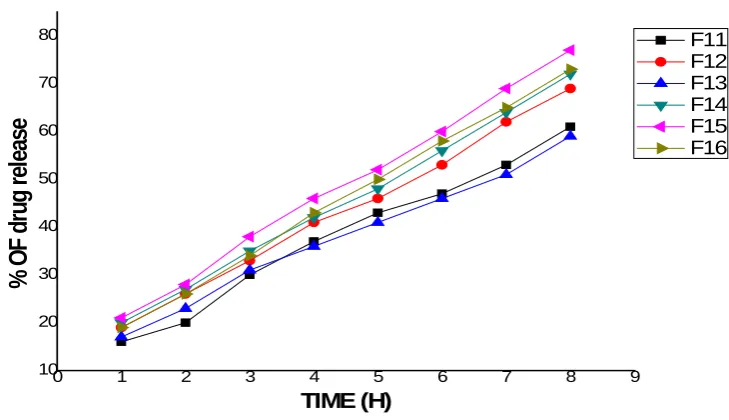
Table 3. The percent of drug release from propranolol HCl and Eudragit RS 100 matrices Time/h Composition No 8 7 6 5 4 3 2 1 formula 61 53 47 43 37 30 20 16 Prop./ NaCMC/ Mg stearate
F11 69 62 53 46 41 33 26 19 Prop./ NaCMC/ RS100/ Mg
stearate F12 59 51 46 41 36 31 23 17 Prop./ NaCMC/ RS100/ Mg
stearate/ SLS F13 72 64 56 48 42 35 27 20 Prop./ NaCMC/ RS100/ Mg
stearate/ ST F14 77 69 60 52 46 38 28 21 Prop./ NaCMC/ RS100/ Mg
stearate /Cet. F15 73 65 58 50 43 34 26 19 Prop./ NaCMC/ RS 100/ Mg
stearate /CPC F16
Incorporated Surfactants individually in each tablet in all formulations from 13 to 16 is 1 % w/w.
2 – Formula 11 composed of (Prop. 32% / NaCMC 67% / Mg stearate1 %).
3 - All the formulations from 12 to 16 have the following compositions (Prop. 32 %, RS100 17 % NaCMC 50 %, and Mg stearate, 1 %.
Dissolution testing
The in vitro drug release from the formulations was assessed, the USP paddle method (Erweka, DT 6R, Heusentamm, Germany) was used for all dissolution studies. The test was performed at 37°C with a rotation speed of 100 rpm using 900 ml phosphate buffers with 7.4 pH.
Assay
Samples of 5 ml were withdrawn each hour; from the dissolution medium and replaced immediately with an equal volume of the respective dissolution medium maintained at 37 ± 0.1°C. Test samples were filtered
through 0.45 μm filter, and assayed
spectrophotometrically at 289 nm for propranolol hydrochloride a d 248nm for flurbiprofen using a blank solution as a reference with a UV-Vis double-beam spectrophotometer (Systronic 2202). The mean of three determinations was used to calculate the drug release rate from each of the formulations.
Assessment of dissolution data
55
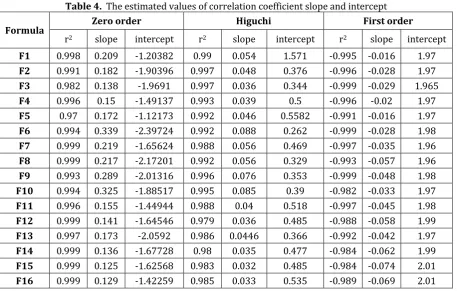
Table 4. The estimated values of correlation coefficient slope and intercept
Formula Zero order Higuchi First order
r2 slope intercept r2 slope intercept r2 slope intercept F1 0.998 0.209 -1.20382 0.99 0.054 1.571 -0.995 -0.016 1.97
F2 0.991 0.182 -1.90396 0.997 0.048 0.376 -0.996 -0.028 1.97
F3 0.982 0.138 -1.9691 0.997 0.036 0.344 -0.999 -0.029 1.965
F4 0.996 0.15 -1.49137 0.993 0.039 0.5 -0.996 -0.02 1.97
F5 0.97 0.172 -1.12173 0.992 0.046 0.5582 -0.991 -0.016 1.97
F6 0.994 0.339 -2.39724 0.992 0.088 0.262 -0.999 -0.028 1.98
F7 0.999 0.219 -1.65624 0.988 0.056 0.469 -0.997 -0.035 1.96
F8 0.999 0.217 -2.17201 0.992 0.056 0.329 -0.993 -0.057 1.96
F9 0.993 0.289 -2.01316 0.996 0.076 0.353 -0.999 -0.048 1.98
F10 0.994 0.325 -1.88517 0.995 0.085 0.39 -0.982 -0.033 1.97
F11 0.996 0.155 -1.44944 0.988 0.04 0.518 -0.997 -0.045 1.98
F12 0.999 0.141 -1.64546 0.979 0.036 0.485 -0.988 -0.058 1.99
F13 0.997 0.173 -2.0592 0.986 0.0446 0.366 -0.992 -0.042 1.97
F14 0.999 0.136 -1.67728 0.98 0.035 0.477 -0.984 -0.062 1.99
F15 0.999 0.125 -1.62568 0.983 0.032 0.485 -0.984 -0.074 2.01
F16 0.999 0.129 -1.42259 0.985 0.033 0.535 -0.989 -0.069 2.01
RESULTS
The results of dissolution experiments for the tablets of different formulations are presented in tables 1, 2 and 3. The results are expressed in % of drug release as a function of time, the results are the mean of three determinations, these determinations were around the mean value of ± 1 (i.e. when the mean percent of drug release is 46 % after a limited hour the other determination were of the values between 45 – 47 % release).
Discussion
The results in (table 1 & figure 1) illustrate that adding 1% surfactants to formulation 1 leads to the increase in the dissolution rate of the drug in different ratios. The % increase of drug release by the addition of SLS
was 9% after eight hours and 24% by the addition of ST. This increase may be due to one or all of the following: firstly, the high solubility of the surfactants (ST 2 in 1, SLS 1in 10) [22]; secondly, both drug and surfactant have the same negative charges, which increase drug release [3,5]; thirdly, to the wetting effect of the surfactant, where it was found in a previous study by measuring the contact angle of water on the tablets of the formulations, the value of the contact angle decreased from 61 with no surfactant to 51 with ST and 54 with SLS [4]; finally, it may be due to the excess amount of the soluble ammonium groups within the polymer Eudragit RL100, which potentiates the effect of the very soluble surfactant to produce the increase of drug release.
0 1 2 3 4 5 6 7 8 9
5 10 15 20 25 30 35 40 45 50 55 60 65 70
%
of
dr
ug
re
le
as
e
56 The % increase of drug release by adding surfactant
Cet. was 18% and 5 % with CPC. In the case of Cet., the high solubility of the surfactant (Cet. 1 in 2, and CPC 1 in20) [22] increased the % dissolution of the drug due to its wettability effect on the tablets because it was found by measuring the contact angle of water on the tablets of the formulations with Cet. the value of the contact angle decreased from 61 with no surfactant to 52 [4]. The increase which was produced by the use of CPC was in a less % due to the less solubility of CPC in comparison with Cet., and the value of the contact angle by the use of the surfactant CPC was decreased to 56 only [4].
Through the comparison of the % of drug release between formulation F1 in table 1 and F6 in table 2, it is observed that the release of drug from F1is more than that of F6 by 13 %. The only difference between the two formulations is that, F1 contains Eudragit RL100 And F6 contains Eudragit RS100 and all the other components are the same. This increase of drug release may be due to excess amount of the soluble
quaternary ammonium groups in Eudragit RL 100 which may facilitate the access of the dissolution medium to the tablets, potentiate the effect of the soluble sorbitol [3] and produce more dissolution of the drug.
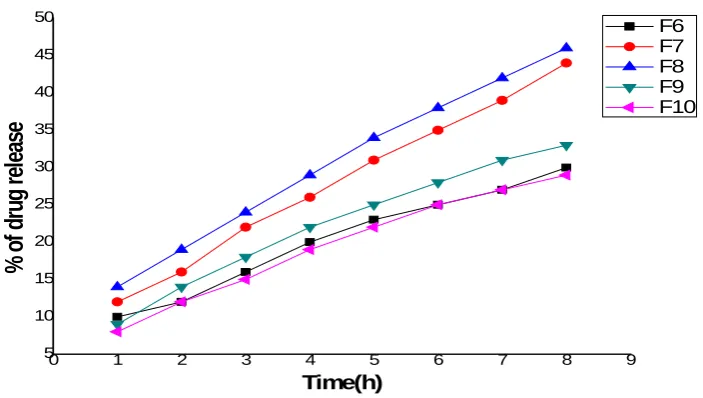
The results in table 2 and figure 2 illustrate the effect of addition 1% of surfactant to formulation 6 on the dissolution of drug from the tablets. The results showed that by the addition of SLS, the increase of drug release was 14 % after eight hours (F7) and 16 % in the case of ST after eight hours (F8). These increase may be due to one or all of the following. Firstly, the drug and surfactant have negative charges which produce an increase of drug release; [5] secondly, the high solubility of the surfactants; finally, to the wetting effect of the surfactant, where it was found in a previous study by measuring the contact angle of water on the tablets of the formulations, that the value of the contact angle decreased from 60 with no surfactant to 54 with ST and 53 with SLS [4].
0 1 2 3 4 5 6 7 8 9
5 10 15 20 25 30 35 40 45 50
%
of
dr
ug
re
le
as
e
Time(h)
F6 F7 F8 F9 F10
Figure 2: The effect of the addition of 1% of the four surfactants that added to formula 6 (Flur/ 49 % Eudragit
RS100 25%/sorbitol 25 % / Mg stearate 1%) in table 2. While the addition of 1% surfactant to formulation 6 showed that in the case of addition of Cet., the increase of drug release was 3% after eight hours (F9) and a decrease by 1 % in the case of CPC after eight hours (F10). These results may be due to firstly, the complex formation between the anionic drug and the cationic surfactants [7]; secondly, Eudragit RS100 is more hydrophobic in comparison with RL100 which
reduces the access of the dissolution medium to the tablets and decreases the release of the drug. Despite of the high solubility of Cet., a slight increase of the drug release was observed, while the less soluble CPC decreased or approximately had no effect on the drug release.
57
0 1 2 3 4 5 6 7 8 9
10 20 30 40 50 60 70 80
%
O
F
dr
ug
re
le
as
e
TIME (H)
F11 F12 F13 F14 F15 F16
Figure 3: The effect of the addition of 1% of the four surfactants that added to formula 12 (Prop. 32 % Eudragit Rs100 17%/NaCMC 50% / and Mg stearate 1%) in table 3.
Formulation F11 illustrated that the use of the hydrophilic polymer NaCMC increases or decreases the release of the obtained drug, where the % increase of NaCMC within the matrices decreased the drug release rate, while % decrease of NaCMC increased the release rate of drug [10, 21]. These results may be due to one or all of the following reasons: Firstly, the dissolution medium accessed the matrices, the matrices swelled and the drug diffused from it [7-9, 21]; secondly, NaCMC is an anionic polymer, while propranolol HCl is a cationic drug, so a complex was formed, which reduced the release rate of the drug [16 - 18]. In a previous study, it was found that the use of hydrophobic polymers dramatically increased the drug release just in the preparation of the propranolol matrices, where the entire drug released in less than three hours [21, 23].
In formulation F12, the addition of 16 % Eudragit RS100 and percent reduction of NaCMC from 67% to 50% within the matrices produced increase dissolution in the drug from 61% to 69%. Despite that Eudragit RS100 is a hydrophobic polymer, the solubility of propranolol HCl increased the access of the dissolution medium to the tablets, pores were formed within the matrices, which reduce the adhesive forces between the components of the tablets with time and increased the release rate of the drug [10, 12, 22]. In formulation F13, the addition of 1% of the anionic surfactant SLS led to a decrease of drug release from 69 % to 59%. This decrease may be due to the complex formation between the cationic propranolol HCl and the anionic surfactant SLS [7]. In
propranolol HCl and the anionic very soluble surfactant ST, this weak complex is not strong for preventing the very soluble ST (2in 1) to reduce the dissolution of the drug. Also the CMC of ST is 0.5%; so, the micelle formation after that concentration led to this slight increase [15] while the solubility of SLS is 1 in 10 and its CMC is 0.75% [6,15]. In the formulations F15 and F16, the addition of 1% of the cationic surfactant Cet. increased the release rate of the drug 8 % from 69 % to 77 % (F15) and 4 % from 69 % to 73% [10] by the addition of 1% CPC. This increase may be due to the same charges of the drug and the surfactant which facilitate the release of drug from the tablets, also the solubility of the surfactant plays a role in increasing the release of the drug from the tablets (Cet. 1 in 2 & CPC 1 in 20).
CONCLUSION
58 propranolol matrices due to the difference in
solubility of both of the drugs used in the study.
The use of the anionic hydrophilic polymer (NaCMC) in the preparation of the matrices had produced a controlled release propranolol HCl tablets with and without the hydrophobic polymers.
ACKNOWLEDGMENT
The author would like to acknowledge Yarmouk University for its support to the work, and also the APM of Jordan for their support of the materials used in the study.
REFERENCES
[1] Remington's pharmaceutical sciences 17th Edition,
Mack publishing company, Easton, Pennsylvania, USA 1985
[2] Efentakis M, Al-hmoud H, Choulis NH (1990). Effect of additives on Fluorbiprofen controlled release preparation. Acta Pharm. Technol. 36(4):237-239. [3] Efentakis M, Al-Hmoud H, Buckton G, Rajan Z (1991). The influence of surfactants on drug release from a hydrophobic matrix; Int. J. Pharm. 70(1):153-158.
[4] Efentakis M, Buckton G, Al-Hmoud H (1992). The effect of surfactant charge on drug release from acrylic matrices: STP Pharm. Sci. 2(4):332-336.
[5] Efentakis M, Al-Hmoud H, Buckton G, Rajan Z (1991). The influence of surfactants on drug release from acrylic matrices: Int. J. Pharm. 74(1991):169-174.
[6] Al-Hmoud H, Ibrahim M, El-Hallous E (2014a). Surfactant solubility, concentration and the other formulation effects on the drug release rate from a controlled- release matrix. Afr. J. Pharm. Pharmacol. 8(13):364-371.
[7] Al-Hmoud H, Ehab IE, Nasser EI Attia OA, Eldessoky SD (2014b). Formulation of propranolol HCl controlled release tablets: effect of surfactant charge and mechanism of drug release. Afr. J. Pharm. Pharmacol. 8(43):1110-1117.
[8] Alderman, D. A., A Review of Cellulose Ethers in Hydrophilic Matrices for Oral Controlled Release Dosage Forms. Int. J. pharm. Tech. Prod. MFg.5 (1984)1-9.
[9] Ranga, K, V., Padmalatha, D. K.and Buri, P. K. Cellulose matrices for Zero-order release of soluble drugs. Drug. Dev. Ind. Pharm., 14 (1988) 2299 – 2320. [10] H. alhmoud, M. Efentakis and N. H. Choulis. A controlled release matrix using a mixture of hydrophilic and hydrophobic polymers. Int. J. Pharm.68 (1991) R1 – R3
[11] Velasco MW, Ford JL, Rowe P and Rajabi-Siahboomi AR., “Influence of drug: hydroxypropylmethyl cellulose ratio, drug and polymer particle size and compression force on the release of diclofenac sodium from HPMC tablets”, J. Contr. Rel., 57:75–85, 1999.
[12] Levina M and Rajabi-Siahboomi AR., “The influence of excipients on drug release from
hydroxypropyl methylcellulose matrices”, J. Pharm. Sci., 93:2746–2754, 2004.
[13] Levina M, Gothoskar A, Rajabi-Siahboomi AR. Application of a modeling system in the formulation of extended release hydrophilic matrices. Pharm Tech Eur. 2006; 18:20–26.
[14] Al-Hmoud H, Ibrahim M and El-Hallous E., “Surfactant solubility, concentration and the other formulation effects on the drug release rate from a controlled- release matrix”, Afr. J. Pharm. Pharmacol., 8:364-371, 2014a.
[15] Alhmoud HA., “The effect of surfactant above and below the critical micelle concentration (CMC) and the mathematical models used to determine the kinetics of drug release from the matrix system”, Afr. J. Pharm. Pharmacol., 10: 88-94, 2016.
[16] Sankar R, Dastagiri Y, Rao AN, Dhachinamoorthy D and Sekhar KB., “Effect of Hydrophylic and Hydrophobic Polymers on Losartan Potassium matrix tablet”, J. Pharm. Res., 3:2195-2197, 2010.
[17] Sundaramurthi K, Kavimani S, Vetrichelvan T, Manna PK and Venkappayya D., “Formulation and evaluation of extended release dosage form of metformin hydrochloride using combined hydro-phobic and hydrophilic matrix”, Indian J. Pharm. Edu. Res., 42: 232-241, 2008.
[18] Tiwari SB., “Controlled Release Formulation of Tramadol Hydrochloride Using Hydro-philic and Hydrophobic Matrix System”, AAPS Pharm. Sci. Tech., 4:1-6, 2003.
[19] Kuksal A, Tiwary AK, Jain NK and Jain S., “Formulation and In Vitro, In Vivo Evaluation of Extended- release.
Matrix Tablet of Zidovudine: Influence of Combination of Hydrophilic and Hydrophobic Matrix Formers”, AAPS Pharm. Sci. Tech., 7: 1, 2006.
[20] Molla AK, Shaheen SM, Rashid M and Motahar Hossain AKM., “Rate Controlled Release of Naproxen from HPMC Based Sustained Release Dosage Form: I. Microcapsule Compressed Tablet and Matrices”, Dhaka University J.Pharm. Sci., 4, 2005.
[21] Hassan A. Alhmoud, The influence of the composition and charges of the acrylic resins, the hydrophilic polymer, and the other excipients on the release rate of drug from the matrices. Adv. Biomed. Pharma. 3:6 (2016) 373-379.
[22] Martindale. The Extra Pharmacopoeia, 31st edition. The Pharmaceutical Press, London, 936-937, 1996.