Strength and Stiffness Classes of Brazilian Timbers:
the New Brazilian Code for Design of Timber
Structures
Almir Sales, Francisco Antonio Rocco Lahr
1Almir Sales, 2Francisco Antonio Rocco Lahr
1Professor – Department of Civil Engineering, Federal University of São Carlos (UFSCar)
e-mail [email protected]
2
Professor – Department of Structural Engineering, São Carlos Engineering School, University of São Paulo (EESC-USP)
Abstract— The present study aimed to propose the strength and stiffness classes of Brazilian timbers in the new Brazilian Code for Design of Timbers Structures (draft code NBR 7190:2012). For this purpose the strength and stiffness properties of forty species of tropical and forestation Brazilian timbers were determined and a rigorous statistical analysis was made. In order to determine the strength and stiffness classes, approximately 9,000 individual tests were analyzed, at 12% moisture content. To analyze the data the multivariate analysis and cluster techniques were used. The statistical results defined two sets of classes: one of softwood species with three classes and the other hardwood species with five classes. The adoption of two sets is due to the significant difference in stiffness properties values between the softwood and hardwood species.
Index Term— stress classes systems, mechanical properties, timber structures, Brazilian timbers
I. INTRODUCTION
The specification of timber design in Brazil has been made through the choice of traditional species, where the mechanical properties of several species were determined by different Brazilian laboratories, and these values were adopted for our use.
Stress class systems are used to simplify the choice for structural design, reducing the need to check the botany species. These systems allow one to utilize the available timbers in its proper region. Another advantage of this system is the utilization of stress class in order to use the large variety of timber grown in Brazil.
This work aims to:
1. Propose a method to provide the establishment of strength and stiffness classes for timbers.
2. Develop a stress class system for timbers grown in Brazil.
3. Propose strength and stiffness class, in order to assist the NBR 7190 revision - Brazilian Standard to Design and Construction of Timbers Structures.
A. Stress Class Systems
Generally, the stress class systems are independent of the grading system used and offer an opportunity to simplify timber specification.
Green [1] and Larsen [2] related the main advantages of the stress class system:
1. For most properties, the system is species independent for hardwoods and softwoods. Thus, stress class systems focus attention on the use of the material, not on which species is being used;
2. The system greatly reduces the alternatives that an engineer must consider when designing with wood.
3. The system does not have to be changed every time. A change occurs in grading procedures, when new technical data become available [3], or when new species are added [4].
4. The stress class system is not dependent upon the method used to sort timber into the classes. It is only necessary that the timber have the specified properties.
B. Development of Stress Class Systems
To develop stress class systems, according to Green [1], usually one can use one of the following procedures:
1. Rank the strength values to grades of important species groups. Class boundaries are then established in order to make the most efficient use of natural breaks in the ranked properties.
or
Stress class systems take into account the characteristic values for strength properties and medium values for stiffness properties. The moisture content is usually about 12%.
In this study the stress class system is developed using the strength and stiffness values obtained with specimens according NBR 7190:1997 [6].
II. MATERIALS AND METHODS
In this study we considered forty tropical and forestation species, hardwood (34 species) and softwood (6 species), grown in Brazil. The properties of these samples were determined in the Laboratory of Wood and Timber Structures (LaMEM), of São Paulo University, Brazil.
In order to determine the strength and stiffness classes, approximately 9,000 individual tests were analyzed, at 12 % moisture content. These measurements were in accordance with the test method of the Brazilian Code NBR 7190:1997 [6].
A. Wood Species Used
Brazilian native hardwood has been one of the most adopted materials in civil construction, especially tropical timber. This has often caused the scarcity and near extinction of some species. Notwithstanding, on account of the great diversity of species and the still great level of natural resources, the hardwoods are responsible for 70% of the Brazilian timber production [7] and represent more than 80% of the exported amount of sawed wood [8].
The native hardwood species studied here were taken from the Amazon forest, the most important source of sawed wood in the Brazilian market.
The following wood species were used:
1. Angelim Araroba (Votaireopsis araroba) 2. Angelim Ferro (Hymenolobium sp) 3. Angelim Pedra (Hymenolobium petraeum) 4. Angelim Pedra Verdadeiro (Dinizia excels) 5. Branquilho (Terminalia sp)
6. Cafearana (Andira sp)
7. Canafístula (Cassia ferruginea) 8. Casca Grossa (Vochysia sp)
9. Castelo (Gossypiospermum praecox) 10. Cedro amargo (Cedrella odorata) 11. Cedro doce (Cedrella sp) 12. Champanhe (Dipterys odorata) 13. Cupiúba (Goupia glabra) 14. Cutiúba (Qualea paraenses)
15. Garapa Roraima (Apuleia leiocarpa) 16. Guaiçara (Luetzelburgia sp)
17. Guarucaia (Peltophorum vogelianum)
18. Ipê (Tabebuia serratifolia) 19. Jatobá (Himenaea sp) 20. Louro Preto (Ocotea sp) 21. Maçaranduba (Manilkara sp) 22. Mandioqueira (Qualea sp)
23. Oiticica Amarela (Clarisia racemosa) 24. Oiuchu (Inga sp)
25. Quarubarana (Erisma uncinatum) 26. Sucupira (Diplotropis sp) 27. Tatajuba (Vagassa guianensis)
28. Eucalipto Grandis (Eycalyptus grandis) 29. Eucalipto Maculata (Eucalyptus maculata) 30. Eucalipto Paniculata (Eucalyptus paniculata) 31. Eucalipto Propinqua (Eucalyptus propínqua) 32. Eucalipto Saligna (Eucalyptus saligna)
33. Eucalipto Tereticornis (Eucalyptus tereticornis) 34. Eucalipto Urophylla (Eucalyptus urophylla) 35. Pinus caribaea var.caribaea [softwood] 36. Pinus caribaea var.bahamensis [softwood] 37. Pinus caribaea var.hondurensis [softwood] 38. Pinus elliottii var. elliottii [softwood] 39. Pinus oocarpa shiede [softwood] 40. Pinus taeda [softwood]
B. Properties Considered to the Analysis
Compression parallel to grain values were determined for a moisture content of 12%, using testing units in small clear specimens with the following dimensions: 5cm x 5cm x 20cm.
The following properties were considered:
1. ρbas = specific gravity (Kg/m 3
) 2. ρap,12% = density (12%) (Kg/m3)
3. ρap,verde = density (green) (Kg/m3)
4. fc0 = compression parallel to grain (MPa)
5. fv0 = shear (MPa)
6. Ec0 = modulus of elasticity obtained in parallel
compression tests (MPa)
7. Et0 = modulus of elasticity obtained in parallel tension
tests (MPa)
8. EM = modulus of elasticity obtained in bending tests
(MPa)
C. Statistics Analysis
To analyze the data the multivariate analysis and cluster technique were used. These techniques allowed us to analyze a lot of data and variables numbers simultaneously [9].
distance 𝑥, 𝑦 = 𝑥
𝑖− 𝑦
𝑖𝑖
)
2
Since the critical experimental values of the data collected are inferior to the critical values in the panel, one should not reject the hypothesis of a null H0—that is, one can suppose the
normal frequency of distribution as satisfactory to represent the values of the properties obtained during tests with hardwood and softwood [10, 11].
The hierarchical centroid method was used to determine the strength and stiffness classes of timber. This method allowed us to pinpoint the homogeneous clusters [12].
In the centroid method the distance between two clusters is defined as the Euclidean distance between their centroids, or means. The Euclidean distance is probably the most common chosen type of distance, which corresponds to the geometric distance in the multidimensional space. It is computed as:
(1)
III. RESULTS AND DISCUSSION
A. Softwood
Using statistical analysis of the data of the specimens of softwood, the followings results were obtained:
1. Normal distribution probability of strength and stiffness properties was confirmed by softwood data analyzed.
2. The statistical equivalence was obtained between the medium values of Ec0 and Et0 of softwood.
3. The ratio between EM and Ec0 of softwood may be
used by:
EM = 0.826 Ec0 (2)
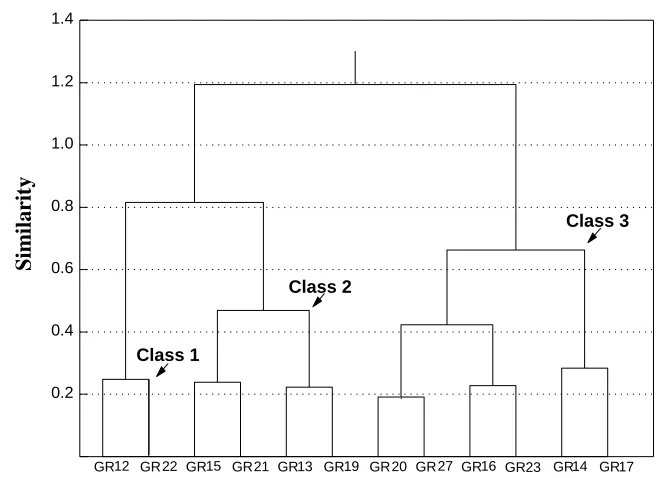
4. The hierarchical centroid method resulted in three clusters to represent the softwood strength classes, as we can observe in Figure 1.
Fig. 1. Centroid dendrogram for softwood
Based on the clusters obtained from softwood, it was possible to present the following Brazilian timbers strength classes (softwood) for the new Brazilian Code for Design of Timbers Structures (draft code NBR 7190:2012), Table I.
GR GR GR GR GR GR GR GR GR GR GR
0.2 0.4 0.6 0.8 1.0 1.2 1.4
Class 3
Class 2
Class 1
17 14 23 16 27 20 19 13 21 15 22 12
Sim
il
a
ri
ty
Groups
Table I
Strength classes and characteristics values of softwood (draft code NBR 7190:2012)
Softwood (values at standard condition of
moisture content of 12%)
Classes
fc0,k
(MPa)
fv0,k
(MPa)
Ec0,m
(MPa)
ρap,m
(Kg/m3)
C20 20 4 3,500 500
C25 25 5 8,500 550
C30 30 6 14,500 600
where:
fc0,k = Characteristic compression strength (MPa);
fv0,k = Characteristic shear strength (MPa);
Ec0,m = Medium modulus of elasticity (obtained in parallel
compression tests) (MPa);
ap, m = Medium density (moisture content of 12%) (kg/m 3
).
The characteristic values presented in Table I allow us to specify the strength classes to structural design. As an example, if one considers strength class ―C25‖ of softwood, it means that the characteristic strength in compression parallel to grain must have a value greater than 25 MPa (Table I).
B. Hardwood
Using statistical analysis of the data of the specimens of hardwood, the followings results were obtained:
1. Normal distribution probability of strength and stiffness properties was confirmed by hardwood data analyzed.
2. The statistical equivalence was obtained between the medium values of Ec0 and Et0 of hardwood.
3. The ratio between EM and Ec0 of hardwood may be
used by:
EM = 0.915 Ec0 (3)
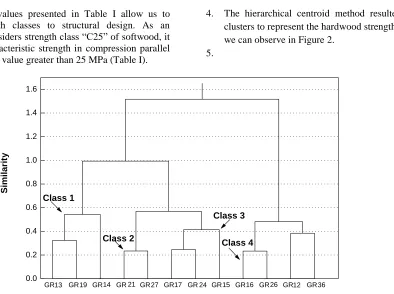
4. The hierarchical centroid method resulted in three clusters to represent the hardwood strength classes, as we can observe in Figure 2.
5.
Fig. 2. Centroid dendrogram for hardwood
Based on the clusters obtained from hardwood, it was possible to present the following Brazilian timbers strength classes (hardwood) for the new Brazilian Code for Design of Timbers Structures (draft code NBR 7190:2012), Table II.
Table II
Strength classes and characteristics values of hardwood (draft code NBR 7190:2012)
Hardwood (values at standard condition of moisture content of 12%)
Classes
fc0,k
(MPa)
fv0,k
(MPa)
Ec0,m
(MPa)
ρap,m
(Kg/m3)
D20 20 4 9,500 650
D30 30 5 14,500 800
D40 40 6 19,500 950
D50 50 7 22,000 970
D60 60 8 24,500 1,000
GR GR GR GR GR GR GR GR GR GR GR GR
0.0 0.2 0.4 0.6 0.8 1.0 1.2 1.4 1.6
36 12 26 16 15 24 17 27 21 14 19 13
Class 4 Class 3
Class 2 Class 1
Sim
il
a
rit
y
Groups
where:
fc0,k = Characteristic compression strength (MPa);
fv0,k = Characteristic shear strength (MPa);
Ec0,m = Medium modulus of elasticity (obtained in parallel
compression tests) (MPa);
ap, m = Medium density (moisture content of 12%) (kg/m3).
The characteristic values presented in Table II allow us to specify the strength classes to structural design. As an example, if one considers strength class ―D40‖ of hardwood, it means that the characteristic strength in compression parallel to grain must have a value greater than 40 MPa (Table II).
IV. CONCLUSIONS
The statistical results defined two sets of classes: one of softwood species with three classes and the other of hardwood species with five classes. The adoption of two sets is due to the significant difference in stiffness properties values between the softwood and hardwood species.
The hierarchical centroid method was appropriated to determine the strength and stiffness classes of timbers.
The characteristic values presented in Tables I and II allow us to specify the strength classes to structural design. As an example, if one considers strength class ―C30‖ of softwood, it means that the characteristic strength in compression parallel to grain must have a value greater than 30 MPa (Table I); if one considers strength class ―D50‖ of hardwood, it means that the characteristic strength in compression parallel to grain must have a value greater than 50 MPa (Table II).
The Brazilian timber supply chain will benefit with the new classification. The application of the new Brazilian Code for design of timber structures (draft code NBR 7190:2012) will increase the use of forestation wood (eucalyptus and pinus) instead of to utilize only the native rainforest tropical.
The improvement of the knowledge concerning the physical and mechanical properties of wood and their inter-relationships is an important contribution for the enhancing of wood as a structural material, making it more competitive in relation to other materials such as steel and concrete.
ACKNOWLEDGMENT
The authors acknowledge CAPES, FAPESP, and MCTI/CNPq and the Laboratory of Wood and Timber Structures (LaMEM) of the São Paulo University. My appreciation goes out to Professor Carlito Calil, Junior, and Professor Francisco Antonio Rocco Lahr, who have mentored me through this area of research.
REFERENCES
[1] GREEN, D.W.; KRETSCHMANN, D.E. (1990). Stress class systems: an idea whose time has come? US Department of Agriculture. Forest Service, Forest Products Laboratory. Research Paper, n. FPL-RP-500, p. 1-22.
[2] LARSEN, H.J. (1994). An introduction to EUROCODE 5. In: Pacific Timber Engineering Conference, Gol Coast Australia. v.1, p.41-57.
[3] SALES, A.; CANDIAN, M.; CARDIN, V.S. (2010). Nondestructive evaluation of timber: the new Brazilian code for the design of timber structures. Materials and Structures, v. 43, p. 213-221.
[4] SALES, A.; CANDIAN, M.; CARDIN, V.S. (2011). Evaluation of the mechanical properties of Brazilian lumber (Goupia glabra) by nondestructive techniques. Construction & Building Materials, v. 25, p. 1450-1454.
[5] STANDARDS ASSOCIATION OF AUSTRALIA. (1994). Timber structures code. Australia, SAA..
[6] Brazilian Association of Techinal Standards (1997) ABNT – NBR 7190:1997 – Projeto de Estruturas de Madeira (Design of Structural Timber). Rio de Janeiro (available only in Portuguese).
[7] SBS - Sociedade Brasileira de Silvicultura (1990). A sociedade brasileira e ser patrimônio florestal. São Paulo, 120p. (available only in Portuguese).
[8] ZENID, G.J. (1990). Noções de classificação de toras e de madeiras serradas. São Paulo, Instituto de Pesquisas Tecnológicas do Estado de São Paulo, 90p. (available only in Portuguese).
[9] JOHNSON, R.A.; WICHERN,D.W. (1988). Applied multivariate statistical analysis. 2. Ed. Englewood Cliffs, New Jersey, Prentice Hall, pp.341-79, 543-81.
[10] SALES, A.; CALIL, C.; LAHR, F.A.R. (1998). Strength and stiffness for Brazilian timbers: methodology proposed. In: 5th World Conference
on Timber Engineering. V.2, p.730-731.
[11] SALES, A.; CANDIAN, M.; de SALLES, C.V. (2011). Evaluation of the mechanical properties of Brazilian lumber (Goupia glabra) by nondestructive techniques. Construction & Building Materials, v. 25, p. 1450-1454.
[12] SALES, A. (1996). Proposition of strength classes to timbers. Ph.D. Thesis. University of São Paulo. São Paulo, Brazil. 223p. (available only in Portuguese).
BIOGRAPHICAL SKETCH OF AUTHORS
Almir Sales—Professor of Civil Construction–Department of Civil
Engineering, Federal University of São Carlos (UFSCar); Ph.D. in Construction Engineering by Escola Politecnica Construction Engineering, University of São Paulo (USP)–Brazil
Francisco Antonio Rocco Lahr—Professor of Timber Structures–