R E S E A R C H
Open Access
Elucidating the influence of supervisors
’
roles on implementation climate
Alicia C. Bunger
1*, Sarah A. Birken
2, Jill A. Hoffman
3, Hannah MacDowell
4, Mimi Choy-Brown
5and Erica Magier
1Abstract
Background:Supervisors play an essential role in implementation by diffusing and synthesizing information, selling implementation, and translating top management’s project plans to frontline workers. Theory and emerging evidence suggest that through these roles, supervisors shape implementation climate—i.e., the degree to which innovations are expected, supported, and rewarded. However, it is unclear exactly how supervisors carry out each of these roles in ways that contribute to implementation climate—this represents a gap in the understanding of the causal mechanisms that link supervisors’behavior with implementation climate. This study examined how supervisors’performance of each of these roles influences three core implementation climate domains (expectations, supports, and rewards).
Materials and methods:A sequenced behavioral health screening, assessment, and referral intervention was implemented within a county-based child welfare agency. We conducted 6 focus groups with supervisors and frontline workers from implementing work units 6 months post-implementation (n= 51) and 1 year later (n= 40) (12 groups total). Participants were asked about implementation determinants, including supervision and implementation context. We audio-recorded, transcribed, and analyzed focus groups using an open coding process during which the importance of the supervisors’roles emerged as a major theme. We further analyzed this code using concepts and definitions related to middle managers’roles and implementation climate.
Results:In this work setting, supervisors (1) diffused information about the intervention proactively, and in response to workers’questions, (2) synthesized information by tailoring it to workers’individual needs, (3) translated top managements’project plans into day-to-day tasks through close monitoring and reminders, and (4) justified implementation. All four of these roles appeared to shape the implementation climate by conveying strong expectations for implementation. Three roles (diffusing, synthesizing, and mediating) influenced climate by supporting workers during implementation. Only one role (diffusing) influenced climate by conveying rewards. Conclusions:Supervisors shaped implementation climate by carrying out four roles (diffusing, synthesizing, mediating, and selling). Findings suggest that the interaction of these roles convey expectations and support for implementation (two implementation climate domains). Our study advances the causal theory explaining how
supervisors’ behavior shapes the implementation climate, which can inform implementation practice.
Keywords:Supervisors, Implementation, Middle managers, Implementation climate
© The Author(s). 2019Open AccessThis article is distributed under the terms of the Creative Commons Attribution 4.0 International License (http://creativecommons.org/licenses/by/4.0/), which permits unrestricted use, distribution, and reproduction in any medium, provided you give appropriate credit to the original author(s) and the source, provide a link to the Creative Commons license, and indicate if changes were made. The Creative Commons Public Domain Dedication waiver (http://creativecommons.org/publicdomain/zero/1.0/) applies to the data made available in this article, unless otherwise stated. * Correspondence:[email protected]
1College of Social Work, The Ohio State University, 1947 College Road, Columbus, OH 43210, USA
Background
Successful implementation of new treatment interventions is dependent on a strong and supportive implementation climate within organizations or the shared perception that an intervention is expected, supported, and rewarded [1–4]. According to Klein, Conn, and Sorra’s Theory of Innovation Implementation, implementation climate is shaped by organizational resources and strategies which are often determined by top-level executive leaders. Supervisors, and other middle managers, bridge organizational hierarchies and are therefore essential for translating executive-level expectations, supports, and re-wards for implementation to the front lines. Indeed, empir-ical evidence suggests that supervisors may have a direct influence on their unit or team’s implementation climate (e.g., [5, 6]). However, the underlying causal mechanisms that link supervisors’ behavior to the implementation cli-mate are unclear.
Drawing from the Theory of Middle Managers’ Roles in Healthcare EBP Implementation, supervisors may influence the implementation climate at the front lines by fulfilling several middle management roles [7]. By sharing and helping their supervisees make sense of information, translating organizational strategies into day-to-day work tasks, and championing implementa-tion, supervisors influence the implementation climate [7–11]. Although recent evidence and theory suggest a link between supervisors and implementation climate, it is unclear how each of these roles conveys expectations, supports, and rewards for implementation (i.e., the causal mechanisms underlying the empirical link between super-visors’roles and implementation climate) [11]. As a result, there is a limited understanding of specific strategies supervisors might use to create a strong implementation climate, and in turn, implementation and client outcomes.
Set within the context of a large public child welfare agency, this study explored how supervisors’roles influ-ence implementation climate at the front lines of a high-stress and resource-constrained working environment, where implementation strategies must be feasible and ef-fective. Our study is intended to inform the refinement of causal theories (e.g., Theory of Middle Managers’ Roles in Healthcare EBP Implementation), by identifying practical strategies that supervisors use to promote im-plementation and exploring how these strategies influ-ence the degree to which the intervention is expected, supported, and rewarded at the front lines of their organization (the three domains of implementation cli-mate). First, we consider the evidence suggesting the importance of a strong implementation climate for sup-porting proficient use of new interventions and extant theory that explains how supervisors may shape the implementation climate.
Implementation climate
Implementation climate is an organizational or group-level construct that reflects three domains—the degree to which professionals share the belief that a specific innovation is (1) expected, (2) supported, and (3) rewarded [3]. Implementation climate is a strong predictor of an organization’s consistent and quality use of an innovation [1,2,12,13]. Unlike the organizational climate (which ref-erences general perceptions of the work environment), implementation climate strategically focuses on the context for a specific intervention. Staff in the same organization or team may perceive a positive climate for implementing one intervention and a negative climate for implementing another. A strong implementation climate is driven by implementation strategies and policies (set by top managers)—ideally, by providing resources, training, and incentives; helping to“fit”the intervention into exist-ing practice; and removexist-ing barriers, organizations theoret-ically set expectations, provide support, and reward staff for using the new intervention proficiently [2,3].
Although top-level managers set the implementation strategies and policies, emerging evidence highlights how the implementation climate can vary across teams or units in an organization, which may be attributed to the differences in supervisors’ behaviors and skills. In teams with a stronger implementation climate, supervisors tended to emphasize and spend more time covering evidence-based treatments [5,14]. Also, more competent, proactive, and transformational leadership approaches by supervisors within teams and units generated stronger and more supportive implementation climates [15–17]. These prior studies indicate that supervisors can positively or negatively influence the implementation climate (given the same organizational supports and policies). However, the specific ways in which supervisors convey that an Contributions to the literature
Research shows that supervisors and other middle managers play an important role in implementation by shaping the implementation climate (i.e., shared belief that
implementation is expected, supported, and rewarded). We found that supervisors fulfilled four roles during
implementation: they diffused and synthesized information, mediated between strategy and day-to-day tasks, and
justified implementation. Together, these roles interacted to convey expectations and support for implementation at the front lines.
We did not find a robust evidence of how supervisors convey rewards for implementation.
intervention is expected, supported, and rewarded (i.e., shape the implementation climate) are unclear.
Supervisors’roles in implementation
Frontline supervisors serve essential administrative, educational, and supportive functions within health and human service settings as they “direct, coordinate, en-hance, and evaluate”frontline professionals’performance (p. 11) [18]. Generally, high-quality and proactive super-vision builds workers’practice competency, mediates the stress of emotionally burdensome work, and has been linked to a variety of outcomes including satisfaction, re-tention, and overall performance [19–22]. Specifically, during implementation, supervisors are highly influential as they are one of the most common sources of advice about an intervention and its implementation [23]. When supervisors support and use interventions as intended, frontline professionals are more likely to adopt and adhere to intervention protocols as well [24, 25]. However, prior studies have demonstrated variation and gaps in supervisors’skills when helping frontline profes-sionals implement a new intervention across a variety of settings [5, 26–28], which may explain variations in im-plementation climate across teams.
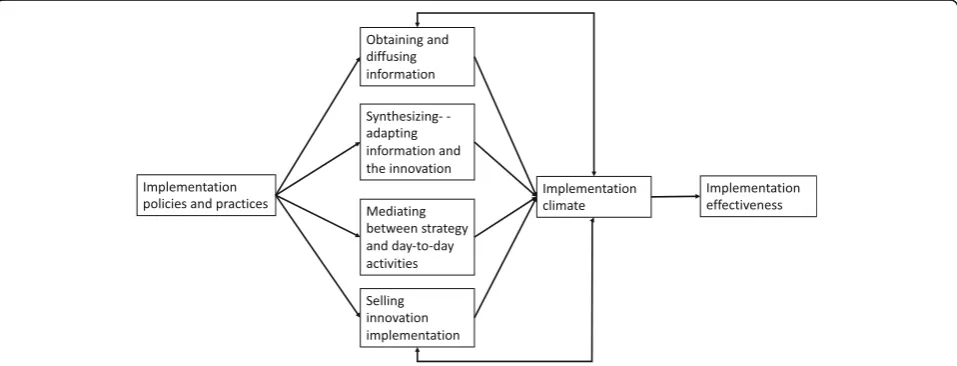
The Theory of Middle Managers’ Role in Healthcare EBP Implementation suggests that variations in the way supervisors (and other middle managers) carry out four critical roles directly shape implementation climate, which in turn influences the implementation success [7, 10]. First, supervisors obtain and diffuse informa-tion, facts, support, and praise. Second, supervisors
synthesize that information by interpreting, adapting,
and making it relevant to frontline professionals. Third, supervisorsmediatebetween top management’s strategy and day-to-day activities by identifying tasks and monitoring performance. Finally, supervisors sell
implementation by justifying implementation and
en-couraging intervention use.
Theoretically, by performing these four roles, supervi-sors can directly influence the implementation climate [11, 29] (Fig. 1). By diffusing and synthesizing informa-tion, mediating between top management strategies and everyday practice, and selling implementation, supervi-sors can directly shape how frontline professionals per-ceive that an intervention’s use is expected, supported, and rewarded. For instance, supervisors may convey ex-pectations and norms for implementation while diffusing and synthesizing information [30]; supervisors support and reward innovation use through ongoing coaching, feedback, encouragement, and breaking the work down into manageable tasks [31]. Prior research suggests that all four roles are considered important [10] and may build on and reinforce one another to promote implemen-tation success [9]. However, while theory and evidence sug-gest a link between these roles and implementation climate, we do not know how each role and the underlying mecha-nisms of action shape how innovation use is expected, supported, and rewarded (the three implementation climate domains). Therefore, this study is intended to address this gap and elucidate how supervisors shape the implementa-tion climate. Specifically, we examined how supervisors fulfill middle managers’roles (diffusing, synthesizing, medi-ating, and selling) during the implementation of a new behavioral health intervention and how these roles target the three implementation climate domains (expectations, supports, and rewards) at the front lines.
Methods
Study context
This qualitative study was conducted in the context of the Gateway CALL system demonstration project intended to improve access to mental health services for children
and youth who enter foster care. The research team was contractually partnered with a county-based public child welfare agency located within an urban midwestern state (USA) that employs about 700 staff and serves about 30,000 children and families with a $200 million (USD) oper-ating budget annually. At the time of the study, the agency was structured hierarchically, with up to 3 to 5 administra-tive levels separating frontline workers from the top clinical and executive directors. Communication about organizational changes typically flowed in a top-down fash-ion [32]. Similar to many other public child welfare agencies, this agency experienced substantial stress due to community demands, changing policies, and worker turnover. The inter-vention conceptualized frontline child welfare workers as
“gateways”to specialty mental health services [33,34] and in-volved the implementation of a phased service cascade inter-vention that included the introduction of four components. First, a new behavioral health screening process was imple-mented within child welfare intake units. Workers in these units investigated child maltreatment allegations and assessed whether family safety risks required intervention. A positive behavioral health screen at intake triggered a behav-ioral health assessment and referral to treatment by a co-located behavioral health team from a local non-profit organization (the second and third intervention compo-nents). The behavioral health assessment team members provided behavioral health consultation, assessment, and linkage support to child welfare agency workers. The fourth component involved case monitoring practices by ongoing child welfare workers to ensure that children received the services recommended by the assessment team. Ongoing workers link families with an array of services, work with caregivers, and assess their progress.
The intervention was rolled out in phases across intake units (and by extension, throughout the behavioral health team, and ongoing child welfare units); the first four intake units began implementing the new screening procedures in February 2015, and the second group of 4 intake units began implementing in October 2015. About 250 frontline staff and supervisors from the agency were involved. The intervention and its imple-mentation have been detailed elsewhere [35, 36]. This study drew from focus group discussions held throughout implementation designed to identify barriers and facilita-tors to using the intervention components as intended. All study procedures were reviewed and approved by the first author’s Institutional Review Board. For purposes of trans-parency, we described the methods, results, and interpre-tations consistent with the Consolidated Criteria for Reporting Qualitative Research [37] (Additional file1).
Participants
Study participants included 83 unique child welfare workers (from intake and ongoing units), behavioral
health clinicians, and their supervisors in intervention implementing units (about one third of all staff involved in implementation). Most were female (80%), and worked in their position for an average of 5 years (although this ranged from 9 months to 31 years). In terms of their high-est degree, half of the participants held bachelors’and half held master’s degrees. To recruit a criterion sample of par-ticipants representing all implementing units and roles [38], the research team collaborated with the agency. Spe-cifically, project leaders at the agency asked the supervi-sors of the implementing units to identify staff with experience implementing the intervention components and invite them to attend voluntary focus groups. While these methods precluded us from tracking all those re-cruited, these procedures yielded 51 participants in 2015 and 40 participants in 2016; only 8 individuals participated in both years. The composition of the groups shifted over time due to the expansion to new units (and expanding the number of individuals with exposure to the interven-tion) and high turnover in the agency (Table 1). Because of our recruitment methods, it is unclear how many indi-viduals were invited but did not participate.
Data collection procedures
Twelve focus groups were conducted with 4 to 12 par-ticipants in each group; 6 groups were conducted in July 2015 (6 months after the initial implementation;n= 51), and 6 were conducted in July 2016 (18 months after the initial implementation; n= 40). The groups were homogenous in terms of participants’ unit type (e.g., intake, behavioral health, ongoing) to explore differences and similarities in participants’perspectives depending on their unique role in the intervention. Also, to encourage participants to share their honest perceptions without fear of potential evaluation or retribution, separate groups were held for those in frontline positions and supervisors. To protect participants’privacy and keep their conversa-tions confidential, no other individuals besides the partici-pants and research team members were permitted to join the focus group. Lunch was provided as an incentive.
members due to prior meetings to discuss implementation and evaluation planning. To build rapport, each research team member introduced themselves briefly at the begin-ning of the discussion, explained their role on the team, and shared how the team will share general themes from the focus group to evaluate and refine the project’s imple-mentation plans.
To understand how workers’ implementation experi-ences evolved over time during implementation, both sets of focus groups (in 2015 and in 2016) followed the same semi-structured interview guide focused on implementa-tion (Addiimplementa-tional file2). The guide was developed in collab-oration with the agency partners to elicit participants’ views about the new screenings and assessments, changes to their practice, and how the tools were implemented and supported throughout the system. The guide was also pilot tested before the first focus groups with the research team. Discussions were audio-recorded and professionally transcribed. Each facilitator typed up any field notes and also wrote a summary of their impressions after each group.
Analysis
Transcripts were analyzed using a multi-step process and managed using Atlas.ti 6 and Dedoose. First, tran-scripts were analyzed using an inductive coding ap-proach consistent with a modified grounded theory approach [39]. An initial codebook was developed based on the interview guide and impressions from the first set of focus groups in 2015. The codebook was refined throughout three coding cycles where two coders inde-pendently applied the code book to one transcript, com-pared their results, resolved coding disagreements with the assistance of a third member of the research team, and adjusted the code book. This final codebook was applied to all other transcripts from 2015 and 2016 by two independent coders who met to discuss the discrepancies. Coders reached at least 80% agreement on all transcripts. At this stage of analysis, we shared a one-page brief with all participants summarizing general focus group themes and invited their feedback [40]. During this member-checking phase, feedback from participants suggested that they felt heard dur-ing the focus groups.
Next, one code “Supervision” (n= 87 excerpts; about 45 pages of single-spaced text) was further extracted for deductive coding. A second codebook was developed based on concepts, domains, and definitions found in seminal papers on middle managers’roles [7] and imple-mentation climate [3] (Additional file3). Finally, we con-structed a conceptual matrix to identify and examine excerpts about the relationship between the specific middle management roles (as enacted by supervisors, herein referred to as “roles”) and the conceptual do-mains of implementation climate [41]. Excerpts for each code were reviewed and discussed by the team for inter-pretation; quotes were selected to illustrate each major theme (minor edits were made for readability and brev-ity purposes).
Results
What do supervisors do during implementation?
Participants described examples of how supervisors filled all four middle management roles during implementation. Throughout the conversations about supervisors, and re-gardless of what type of role was described, participants emphasized the importance of daily in-person communi-cation during regular staff meetings, one-on-one supervi-sion, other formal or informal meetings, or via email and phone. Participants reported feeling as though they were
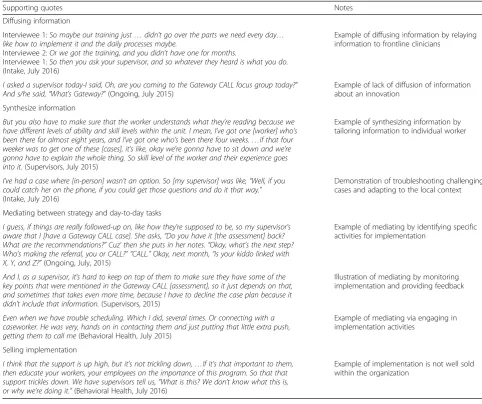
“constantly talking about” the intervention and its imple-mentation with their supervisors. Supervisors confirmed that regular discussion was intended to help workers learn how to use the new tools, make sense of new procedures, and monitor their workers’ implementation over time. Through these interpersonal interactions, supervisors dis-seminated and synthesized information, mediated between strategy and day-to-day tasks, and sold implementation. Illustrative quotes are presented in Table2.
Diffuse information
Throughout the focus groups, participants reported how their supervisors were the primary source of information during implementation. Supervisors actively communi-cated with their staff about available supports for imple-mentation (e.g., training opportunities, materials), their expectations for implementing the intervention compo-nents, and signaled praise and reinforcement when their Table 1Focus group participants by role in 2015 and 2016
July 2015 (6 groups), total July 2016 (6 groups), total Participated 2016 only, total
Participated both years, total
Unique participants, total
Behavioral health clinicians 7 4 4 0 11
Intake workers (2 groups) 14 15 11 4 25
Ongoing workers (2 groups) 18 13 11 2 29
Supervisors 12 8 6 2 18
staff used the intervention as intended. Supervisors also diffused information when responding to workers’ ques-tions. However, especially during the focus groups with ongoing workers, participants described inconsistent diffusion of information among the supervisors in their units, and some were not even familiar with the project. Poor diffusion generated confusion and frustration, which led frontline workers to seek information from other sources or not at all.
Synthesize information
Participants described how supervisors synthesized in-formation—helping their staff use general information that they learned in training about the intervention com-ponents and their implementation in routine practice. Frontline child welfare workers and behavioral health clinicians relied on their supervisor to make sense of new practice workflows, make decisions about when and how to implement, and integrate information learned
from the new tools into practice. Supervisors described synthesizing information by tailoring it based on workers’abilities, work style, commitment, and attitudes toward the intervention. Synthesis also occurred when supervisors helped workers adapt the intervention and troubleshoot challenging cases which emerged especially among child welfare workers in the intake units adminis-tering the behavioral health screens.
Mediating between strategy and day-to-day tasks
Participants described several examples of how supervi-sors facilitated implementation by mediating between agency strategy (implementing the Gateway CALL pro-ject) and day-to-day frontline tasks. Supervisors identi-fied and reminded staff of implementation activities (e.g., bringing the electronic tablet to the caregiver’s home to conduct the behavioral health screen, checking the elec-tronic file for completed screens, and filing the assessment results in the case file once completed). Sometimes, Table 2Quotes illustrating middle managers’roles during implementation
Supporting quotes Notes
Diffusing information
Interviewee 1:So maybe our training just…didn’t go over the parts we need every day… like how to implement it and the daily processes maybe.
Interviewee 2:Or we got the training, and you didn’t have one for months.
Interviewee 1:So then you ask your supervisor, and so whatever they heard is what you do.
(Intake, July 2016)
Example of diffusing information by relaying information to frontline clinicians
I asked a supervisor today-I said, Oh, are you coming to the Gateway CALL focus group today?” And s/he said,“What’s Gateway?”(Ongoing, July 2015)
Example of lack of diffusion of information about an innovation
Synthesize information
But you also have to make sure that the worker understands what they’re reading because we have different levels of ability and skill levels within the unit. I mean, I’ve got one [worker] who’s been there for almost eight years, and I’ve got one who’s been there four weeks.…if that four weeker was to get one of these [cases], it’s like, okay we’re gonna have to sit down and we’re gonna have to explain the whole thing. So skill level of the worker and their experience goes into it.(Supervisors, July 2015)
Example of synthesizing information by tailoring information to individual worker
I’ve had a case where [in-person] wasn’t an option. So [my supervisor] was like,“Well, if you could catch her on the phone, if you could get those questions and do it that way.”
(Intake, July 2016)
Demonstration of troubleshooting challenging cases and adapting to the local context
Mediating between strategy and day-to-day tasks
I guess, if things are really followed-up on, like how they’re supposed to be, so my supervisor’s aware that I [have a Gateway CALL case]. She asks,“Do you have it [the assessment] back? What are the recommendations?”Cuz’then she puts in her notes.“Okay, what’s the next step? Who’s making the referral, you or CALL?” “CALL.”Okay, next month,“Is your kiddo linked with X, Y, and Z?”(Ongoing, July, 2015)
Example of mediating by identifying specific activities for implementation
And I, as a supervisor, it’s hard to keep on top of them to make sure they have some of the key points that were mentioned in the Gateway CALL [assessment], so it just depends on that, and sometimes that takes even more time, because I have to decline the case plan because it didn’t include that information.(Supervisors, 2015)
Illustration of mediating by monitoring implementation and providing feedback
Even when we have trouble scheduling. Which I did, several times. Or connecting with a caseworker. He was very, hands on in contacting them and just putting that little extra push, getting them to call me(Behavioral Health, July 2015)
Example of mediating via engaging in implementation activities
Selling implementation
I think that the support is up high, but it’s not trickling down,…If it’s that important to them, then educate your workers, your employees on the importance of this program. So that that support trickles down. We have supervisors tell us,“What is this? We don’t know what this is, or why we’re doing it.”(Behavioral Health, July 2016)
workers noted how their supervisors followed up on their reminders during supervision or case reviews, which helped walk workers through the new workflows. Supervi-sors noted how these reminders and follow-up activities were linked to their efforts to monitor implementation among their staff. Some supervisors (in the intake units and the behavioral health assessment team) kept separate notes and tracking systems that monitored the progress of each case and those in the ongoing units used formal re-view/approval processes to provide feedback on perform-ance. Supervisors also actively assisted their staff to use the tools and procedures correctly and on time by en-gaging in implementation activities. These activities tended to involve assistance with connecting and commu-nicating with other staff and caregivers given the import-ance of regular coordination between work units and caregivers (who provided the responses to the screens and assessments). Notably, some participants mentioned how their supervisors did not remind them or follow up on project implementation, suggesting that mediating behav-iors varied by supervisor.
Selling implementation
Themes and examples of how supervisors “sold” (or did not sell) the importance of implementation were infquent. In only 1 of the 12 focus groups, participants re-ported that their direct supervisors were “fans” or
“advocates” of the project, which conveyed its import-ance. Rather, discussion suggested that especially within the child welfare agency, workers may not have been sold on the project’s rationale, were encouraged to im-plement to comply with the funders’ expectations (in-stead of another reason), and that workers may have implemented without understanding the core problems Gateway CALL was designed to address.
How do supervisors influence implementation climate?
The matrix analysis-identified excerpts where descrip-tions of supervisors’roles overlapped with the three con-ceptual domains of implementation climate (the shared belief that Gateway CALL was expected, supported, and rewarded). Of these excerpts, many highlighted how su-pervisors’ activities conveyed expectations or supported Gateway CALL implementation. Few excerpts described how supervisors conveyed rewards.
Convey expectations
Participants from all groups discussed how supervisors conveyed expectations, when they diffused and sized information, and mediated. By diffusing or synthe-sizing information about Gateway CALL, supervisors communicated expectations (requirements) for complet-ing the new tools and procedures. Especially in the child welfare units, frontline workers noted how their
supervisors told them that the new intervention proce-dures were mandatory when diffusing information, thus setting expectations for practice. Some supervisors also noted that they tailored information to the individual needs of their workers (synthesizing) and described the anticipated outcomes of the project (facilitating children’s access to care, a selling activity) to communicate the pro-ject’s priority and value within the agency. These commu-nicated expectations were further reinforced when supervisors mediated between agency strategy and day-to-day activities at the front lines (via identifying tasks, moni-toring implementation, and issuing reminders). In fact, many of the excerpts that described how workers per-ceived expectations also contained examples of how their supervisor engaged in mediation activities. As intake workers described, supervisors used a variety of mediating activities to reinforce expectations for implementing the screening tools such as monitoring their implementation, and issuing reminders:
Interviewee 1: I mean, my supervisor made it kind of mandatory, so it’s like,“You forgot it the one visit. Like, well, guess you got to go back out.”But that’s about it. Interviewee 2: Our supervisor wrote up on a white board in her office if we had a custody case, and she wrote,“Gave to CALL.”So, we’d kind of check on each other but also see for ourselves.
Interviewee 3: It’s on the face sheet too. They would write,“You need to complete Gateway CALL.” (Intake, July 2015)
While the child welfare intake workers discussed how their supervisors conveyed clear expectations about screening, ongoing workers (in the child welfare agency) described how unclear communication may have nega-tively impacted the degree to which workers perceived that the intervention was expected. For instance, workers in the ongoing units noted how some supervisors “do not tell us either way” and there was“little to no direct-ive” in their office about whether they were expected to ensure and monitor whether children received the ser-vices recommended by the assessment team (the fourth intervention component). In one of the ongoing groups (July 2015), workers described how the absence of clear communication and strong expectations led them to defer to an external behavioral health providers’ discre-tion rather than follow through on the assessment team’s recommendation.
Provide support
and were linked to descriptions of three role types, highlighting how a variety of supervisory activities helped workers and clinicians feel supported especially at the beginning of implementation. Within the child welfare ongoing units, workers noted how “constant conversa-tion” with their supervisors about the project generally (diffusing activities), reminders, and assistance with applying the new procedures with specific families (syn-thesizing activities) helped them to feel supported. Supervisors also supported their staff through their mediating activities. For instance, a behavioral health clinician described how her supervisor supported her implementation efforts by monitoring her use of the new assessment tools and assisting with score interpret-ation (mediating activities).
So [my supervisor], was really involved in that one, really helped with the interpretation and we had a meeting after that and another call when it come through just to kind of review where we were at. And, so there was a lot of support in that first part.
(Behavioral Health, July 2015)
There were also instances where workers’ described how even with clear directions from their supervisor, they still felt unsupported because of limited communi-cation with and help from their supervisors. For ex-ample, one intake worker (July 2015) shared how they received directions from their supervisor“to show up to this [training] and I had no idea what was going on… and that [the screens] had to be on time. S/he told me to do these custody cases.” In these situations, workers turned to co-workers for the explanation of the interven-tion’s purpose and support.
Reward implementation
Discussion of rewards for implementation was rare, and workers often felt as though supervisors conveyed expec-tations for task completion without any positive feedback which may have led to confusion about how the interven-tion should be implemented. As one CALL clinician sum-marized,“we still don’t know what we can do because the feedback we get is.“We need the data. We have to do it. You have to do it.” Themes about the role of supervisors for rewarding implementation only emerged during focus group discussions with frontline intake workers in 2015. In both focus groups with intake workers, some workers noted that their supervisors diffused verbal praise (e.g.,
“good job”) when they successfully used the new screening tools and occasionally bought lunch for workers in the unit to reward implementation (diffusing information and rewards). However, intake workers from other units ex-plained that diffusion of rewards and praise for implemen-tation and other work efforts are rare but incredibly
powerful for emotionally bolstering those on the front lines during implementation, and in general:
There is not a lot of thanks in our job. People don’t want to see us. People do not like us. You know?… So, when your supervisor does say, like, good job, it’s just like…I did do something right today even though I have 35 voicemails from people screaming at me. You know?…Just having that sometimes is enough to be like, oh, okay. Well, all hope isn’t lost… (Intake, July 2015)
Discussion
Supervisors can directly influence the implementation climate or the shared sense that an intervention is ex-pected, supported, and rewarded. Yet, we have limited understanding of exactly how supervisors shape the implementation climate. This study drew on the theory of middle managers’roles in healthcare EBP implementa-tion to examine the relaimplementa-tionship between four supervisory roles (diffusing and synthesizing information, mediating, and selling implementation) and implementation climate. Although these roles have been highlighted in other stud-ies, this is the first to examine how they influence the three implementation climate domains (expectations, sup-port, and rewards). Moreover, we observed how supervi-sors shape the implementation climate in a high-stress and resource-constrained work environment, which illus-trates the feasibility and acceptability of carrying out these roles. Thus, our results advance causal theory about how supervisors (and other middle managers) shape imple-mentation climate and impleimple-mentation practice. Our findings suggest that these roles interact and may espe-cially reinforce expectations and support for implemen-tation. We discuss these findings and their implications for advancing theory, and development of implementa-tion strategies that target or engage individuals in these key roles.
Supervisors shape the climate during implementation
theory and the application of this theory to supervi-sors’ behaviors within child welfare contexts. Our re-sults also confirm that frontline supervisors are appropriate and indeed significant targets for imple-mentation strategies.
Importantly, this study offers preliminary evidence of how supervisors directly influence the implementation climate, as posited by theory. All four of these roles ap-peared to convey expectations for implementation in this organization, which is one of the implementation climate domains. Carrying out diffusing, synthesizing, and medi-ating roles also seemed to convey support, particularly during the early stages of implementation. However, there was only limited evidence of how these roles con-vey rewards for implementation. These findings lead us to several insights that have implications for implemen-tation research and practice.
First, the data suggest that these roles may interact with one another in potentially powerful ways to shape the implementation climate. In fact, these roles seemed to reinforce one another, whereby synthesizing infor-mation, mediating (e.g., reminding a worker to conduct the new screening), and selling the importance of the intervention for improving children’s outcomes empha-sized basic expectations and information about new mandates that supervisors diffused to their staff. In a similar fashion, during early implementation phases, diffusing information, synthesizing efforts to help workers understand and apply the new intervention procedures, and mediating activities that held workers accountable also helped frontline professionals feel sup-ported, a second implementation climate domain. The in-teractions among these roles (and how supervisors in this study often carried out more than one role in a given ex-ample) highlight the potentially reinforcing effects and raise conceptual questions about whether these four roles are operationally distinct. However, they also warn of the potential for “mixed messaging” if supervisors’ roles are not carried out consistently. For instance, supervisors might diffuse information about an intervention and im-plementation expectations. Yet, without efforts to monitor how well workers are implementing the intervention (me-diating), or help working through difficult cases (synthe-sizing), workers could feel unsure about what is expected of them or whether there is sufficient support or justifica-tion for making these changes to their practice. Consistent execution (across roles and over time) might be especially important in settings with high staff turnover, and thus in-tensive staff training and support needs. For instance, the median length of employment for a frontline intake worker at this organization during the study period was only 8 months, and supervisors were constantly support-ing newly hired frontline staff. Diffussupport-ing, synthesizsupport-ing, me-diating, and “selling” efforts that converge around the
same message may provide clear and constant support that help newer workers learn their jobs and implement interventions.
Second, our findings may also reflect complex interac-tions among supervisors’roles, implementation climate, and general organizational climate, consistent with the evidence from other studies on middle managers [11]. For example, participants from both the child welfare agency and behavioral health team were very attuned to how supervisors conveyed organizational expectations of them (half of the coded climate excerpts referenced ex-pectations), while discussions about how supervisors provided support or rewards were very limited. In fact, supervisors in this study may have carried out their roles with an emphasis on expectations because of the general organizational and child welfare system culture and cli-mate. Child welfare settings are driven by federally man-dated benchmarks and time frames for practice [44], which often lead to supervision characterized as “ de-tached and empty” [27] and emphasizing administrative oversight and compliance over education and support [45,46]. This may explain why there were few examples of how supervisors justified the rationale for the inter-vention or rewarded a job well done, although future studies examining the nuanced relationship between organizational context, roles, and implementation cli-mate are needed.
Limitations
Our findings should be interpreted in light of a few limi-tations. First, this study relies on self-report, and we did not confirm how supervisors performed each role, their proficiency, or the influence on the implementation cli-mate. Second, while our focus group guide asked about supervision and the general organizational context, we did not specifically ask how supervisors carried out these four roles, or about the implementation climate, so we may not have captured all of the information partici-pants could have offered. Third, our findings about specific implementation roles and activities may have limited generalizability to other health and human ser-vice organizations. However, we drew our in-depth data from multiple work units, functions, and points in time and interpreted our results in light of rich contextual in-formation. Our qualitative results provide examples of supervisors’behaviors in a single context. In the future, these reported behaviors could be triangulated with ex-ternal observations to test the interrelationships between roles and climate. Ideally, we would examine the causal effects of these different roles on implementation climate by conducting a randomized controlled trial where workers’ exposure to each role was manipulated. How-ever, this type of design and deliberately withholding po-tentially necessary supervisory roles within a real-world service delivery organization is not feasible. Therefore, other non-experimental approaches are likely to be ne-cessary. This trajectory of research could specify the causal mechanisms that explain how supervisors and other middle managers create a strong and positive im-plementation climate and directly inform how supervi-sors support implementation within their teams.
Conclusion
Supervisors have direct influence over the implementation climate at the front lines and by extension implementation and client outcomes. This study provided preliminary evi-dence to elucidate how supervisors shape the degree to which an intervention was expected, supported, and rewarded (i.e., the implementation climate). Specifically, we show how supervisors fill four important roles during implementation: they diffuse and synthesize information, sell implementation, and mediate between organizational strategy and day-to-day tasks. Our findings suggest that these roles may interact with one another in potentially powerful ways to shape the implementation climate. They may also reflect complex interactions among supervisors’ roles, implementation climate, and general organizational climate, consistent with the evidence from other studies on middle managers [11]. These results advance the The-ory of Middle Managers in Healthcare EBP Implementa-tion and inform how supervisors might facilitate strong conditions for implementation within their teams.
Supplementary information
Supplementary informationaccompanies this paper athttps://doi.org/10. 1186/s13012-019-0939-6.
Additional file 1.Consolidated Criteria for Reporting Qualitative Research (COREQ) Checklist.
Additional file 2.Focus group guide.
Additional file 3.Codebook
Abbreviations
EBP:Evidence-based practice; CALL: Consultation, Assessment, Liaison, and Linkage
Acknowledgements
The authors wish to thank their project partners, the staff who participated in this project, and the evaluation team members who helped coordinate data collection.
Authors’contributions
ACB and SB conceptualized the research question. AB designed the implementation and outcome evaluation of the larger project and led this substudy and manuscript preparation. AB, JH, and HM gathered and coded the data and contributed to the interpretation. MCB directed the analysis and assisted with the result interpretation. EM assisted with the analysis and result interpretation. All authors contributed to the manuscript preparation and have read and approved the final manuscript.
Funding
This work was funded by the US Department of Health and Human Services, Administration for Children, Youth, and Families; Children’s Bureau (Grant #90CO1104).
Availability of data and materials
The data gathered and used for this analysis is not publically available because of the inclusion of identifying information of the participants and potentially sensitive case information.
Ethics approval and consent to participate
This research study was reviewed and approved by the Institutional Review Board at The Ohio State University. Informed consent was obtained from all participants.
Consent for publication
Not applicable
Competing interests
The authors declare that they have no competing interests.
Author details
1College of Social Work, The Ohio State University, 1947 College Road, Columbus, OH 43210, USA.2Department of Health Policy and Management, Gillings School of Global Public Health, University of North Carolina at Chapel Hill, 1105C McGavran-Greenberg Hall, Campus Box 7411, Chapel Hill, NC 27599, USA.3School of Social Work, Portland State University, 1800 SW 6th Avenue, Suite 600, Portland, OR 97201, USA.4Bureau of Maternal, Child and Family Health, Ohio Department of Health, 246 North High Street, Columbus, OH 43215, USA.5School of Social Work, University of Minnesota, Peters Hall, 1404 Gortner Ave, Saint Paul, MN 55108, USA.
Received: 13 May 2019 Accepted: 11 September 2019
References
1. Klein KJ, Conn AB, Sorra JS. Implementing computerized technology: an organizational analysis. J Appl Psychol [Internet]. 2001 [cited 2012 Jul 25];86: 811–824. Available from:http://www.ncbi.nlm.nih.gov/pubmed/11596799 2. Klein KJ, Sorra JS. The challenge of innovation implementation. Acad Manag
3. Weiner BJ, Belden CM, Bergmire DM, Johnston M. The meaning and measurement of implementation climate. Implement Sci [Internet]. 2011 [cited 2011 Nov 17];6:78. Available from:http://www.implementationscience. com/content/6/1/78
4. Helfrich CD, Weiner BJ, McKinney MM, Minasian L. Determinants of implementation effectiveness. Med Care Res Rev. 2007;64:279–303. 5. Dorsey S, Kerns SEU, Lucid L, Pullmann MD, Harrison JP, Berliner L, et al.
Objective coding of content and techniques in workplace-based supervision of an EBT in public mental health. Implement Sci. 2018;13:1–12. 6. Aarons GA, Glisson C, Green PD, Hoagwood K, Kelleher KJ, Landsverk JA,
et al. The organizational social context of mental health services and clinician attitudes toward evidence-based practice: a United States national study. Implement Sci. 2012;7:56.
7. Birken SA, Lee SYD, Weiner BJ. Uncovering middle managers’role in healthcare innovation implementation. Implement Sci [Internet]. BioMed Central; 2012 [cited 2017 Mar 12];7:28. Available from:http://www.ncbi.nlm. nih.gov/pubmed/22472001
8. Birken SA, Lee S-YD, Weiner BJ, Chin MH, Schaefer CT. Improving the effectiveness of health care innovation implementation: middle managers as change agents. Med Care Res Rev [Internet]. 2013 [cited 2014 Dec 22];70: 29–45. Available from:http://mcr.sagepub.com/content/70/1/29.short 9. Engle RL, Lopez ER, Gormley KE, Chan JA, Charns MP, Van Deusen Lukas C.
What roles do middle managers play in implementation of innovative practices? Health Care Manage Rev. 2017;42:14–27.
10. Birken SA, DiMartino LD, Kirk MA, Lee SYD, McClelland M, Albert NM. Elaborating on theory with middle managers’experience implementing healthcare innovations in practice. Implement Sci [Internet]. 2016;11:1–5 Available from:https://doi.org/10.1186/s13012-015-0362-6.
11. Birken S, Clary A, Tabriz AA, Turner K, Meza R, Zizzi A, et al. Middle managers’role in implementing evidence-based practices in healthcare: a systematic review. Implement Sci. Implementation Science. 2018;13:1–14. 12. Jacobs SR, Weiner BJ, Reeve BB, Hofmann DA, Christian M, Weinberger M.
Determining the predictors of innovation implementation in healthcare: a quantitative analysis of implementation effectiveness. Implement Sci [Internet]. 2015 [cited 2017 May 3];15. Available from:https://
bmchealthservres.biomedcentral.com/articles/10.1186/s12913-014-0657-3 13. Turner K, Trogdon JG, Weinberger M, Stover AM, Ferreri S, Farley JF, et al.
Testing the organizational theory of innovation implementation
effectiveness in a community pharmacy medication management program: a hurdle regression analysis. Implement Sci. 2018;13:1–13.
14. Dorsey S, Pullmann MD, Kerns SEU, Jungbluth N, Meza R, Thompson K, et al. The Juggling Act of Supervision in Community Mental Health: implications for supporting evidence-based treatment. Adm Policy Ment Heal Ment Heal Serv Res. 2017;44:838–52.
15. Aarons GA, Sommerfeld DH. Leadership, innovation climate, and attitudes toward evidence-based practice during a statewide implementation. J Am Acad Child Adolesc Psychiatry. Elsevier. 2012;51:423–31.
16. Aarons GA, Ehrhart MG, Farahnak LR, Sklar M, Horowitz J. Discrepancies in leader and follower ratings of transformational leadership: relationship with organizational culture in mental health. Adm Policy Ment Heal Ment Heal Serv Res. 2017;44:480–91.
17. Shuman CJ, Liu X, Aebersold ML, Tschannen D, Banaszak-Holl J, Titler MG. Associations among unit leadership and unit climates for implementation in acute care: a cross-sectional study. Implement Sci [Internet]. Implementation Science. 2018;13:62 Available from:https://implementationscience. biomedcentral.com/articles/10.1186/s13012-018-0753-6%0Ahttp://www.ncbi. nlm.nih.gov/pubmed/29695302%0Ahttp://www.pubmedcentral.nih.gov/ articlerender.fcgi?artid = PMC5918552.
18. Kadushin A, Harkness D. Supervision in social work. 5th ed. New York, NY: Columbia University Press; 2014.
19. Carpenter J, Webb CM, Bostock L. The surprisingly weak evidence base for supervision: findings from a systematic review of research in child welfare practice (2000-2012). Child Youth Serv Rev. 2013;35:1843–53.
20. Ludwick T, Turyakira E, Kyomuhangi T, Manalili K, Robinson S, Brenner JL. Supportive supervision and constructive relationships with healthcare workers support CHW performance: use of a qualitative framework to evaluate CHW programming in Uganda. Hum Resour Health. 2018;16:1–8.
21. Mor Barak ME, Travis DJ, Pyun H, Xie B. The impact of supervision on worker outcomes: a meta-analysis. Soc Serv Rev [Internet]. 2009;83:3–32 Available from:https://www.journals.uchicago.edu/doi/10.1086/599028.
22. Birken SA, Lee SYD, Weiner BJ, Chin MH, Schaefer CT. Improving the effectiveness of health care innovation implementation: middle managers as change agents. Med Care Res Rev [Internet]. SAGE PublicationsSage CA: Los Angeles, CA; 2013 [cited 2017 Mar 12];70:29–45. Available from: http://mcr.sagepub.com/cgi/doi/10.1177/1077558712457427 23. Bunger AC, Doogan N, Hanson RF, Birken SA. Advice-seeking during
implementation: a network study of clinicians participating in a learning collaborative. Implement Sci [Internet]. BioMed Central; 2018 [cited 2018 Jul 30];13:101. Available from:https://implementationscience.biomedcentral. com/articles/10.1186/s13012-018-0797-7
24. Cunningham CE, Barwick M, Rimas H, Mielko S, Barac R. Modeling the decision of mental health providers to implement evidence-based children’s mental health services: a discrete choice conjoint experiment. Adm Policy Ment Heal Ment Heal Serv Res [Internet]. 2018;45:302–317. Available from: https://doi.org/10.1007/s10488-017-0824-z
25. Schoenwald SK, Sheidow AJ, Chapman JE. Clinical supervision in treatment transport: effects on adherence and outcomes. J Consult Clin Psychol. 2009; 77:410–21.
26. Bailin A, Bearman SK, Sale R. Clinical supervision of mental health professionals serving youth: format and microskills. Adm Policy Ment Heal Ment Heal Serv Res [Internet]. 2018;45:800–812. Available from:http://link. springer.com/10.1007/s10488-018-0865-y
27. Radey M, Stanley L.“Hands on”versus“empty”: supervision experiences of frontline child welfare workers. Child Youth Serv Rev. 2018;91:128–36. 28. Choy-Brown M, Stanhope V. The availability of supervision in routine mental
health care. In: Clin Soc Work J [Internet], vol. 46: Springer US; 2018. p. 271– 80. Available from:https://doi.org/10.1007/s10615-018-0687-0.
29. Birken SA, Lee S-YD, Weiner BJ. Uncovering middle managers’role in healthcare innovation implementation. Implement Sci [Internet]. 2012;7:28. Available from:http://www.pubmedcentral.nih.gov/articlerender.fcgi?artid= 3372435&tool = pmcentrez&rendertype = abstract
30. Choy-Brown M, Stanhope V, Tiderington E, Padgett DK. Unpacking clinical supervision in transitional and permanent supportive housing: scrutiny or support? Adm Policy Ment Heal Ment Heal Serv Res [Internet]. Springer US; 2016 [cited 2018 Nov 8];43:546–54. Available from:http://link.springer.com/1 0.1007/s10488-015-0665-6
31. Saldana L, Chamberlain P, Chapman J. A supervisor-targeted
implementation approach to promote system change: the R3model. Adm Policy Ment Heal Ment Heal Serv Res. 2016;43:879–92.
32. Cao Y, Bunger AC, Hoffman J, Robertson HA. Change communication strategies in public child welfare organizations: engaging the front line. Hum Serv Organ Manag Leadersh Gov. 2016;40:37–50.
33. Stiffman AR, Pescosolido B, Cabassa LJ. Building a model to understand youth service access: the gateway provider model. Ment Health Serv Res [Internet]. 2004;6:189–198. Available from:https://doi.org/10.1023/B:MHSR. 0000044745.09952.33
34. Bunger AC, Stiffman AR, Foster KA, Shi P. Child welfare workers’connectivity to resources and youth’s receipt of services. Adv Soc Work. 2009;10:1–21. 35. Bunger AC, Powell BJ, Robertson HA, MacDowell H, Birken SA, Shea C.
Tracking implementation strategies: a description of a practical approach and early findings. Heal Res Policy Syst. 2017;15.
36. Gopalan G, Bunger A, Powell BJ. Skills for developing and maintaining community-partnerships for dissemination and implementation research in children’s behavioral health: implications for research infrastructure and training of early career investigators. Adm Policy Ment Heal Ment Heal Serv Res [Internet]. Springer US; 2019 [cited 2019 Mar 27];1–17. Available from: http://link.springer.com/10.1007/s10488-019-00930-5
37. Tong A, Sainsbury P, Craig J. Consolidated Criteria for Reporting Qualitative Research (COREQ): a 32-item checklist for interviews and focus groups. Int J Qual Heal Care [Internet]. Narnia; 2007 [cited 2019 Apr 30];19:349–57. Available from: https://academic.oup.com/intqhc/article-lookup/doi/10.1093/intqhc/mzm042 38. Palinkas LA, Horwitz SM, Green CA, Wisdom JP, Duan N, Hoagwood K.
Purposeful sampling for qualitative data collection and analysis in mixed method implementation research. Adm Policy Ment Heal Ment Heal Serv Res [Internet]. Springer US; 2015 [cited 2017 Sep 12];42:533–44. Available from:http://link.springer.com/10.1007/s10488-013-0528-y
39. Stern PN, Porr CJ. Essentials of Accessible Grounded Theory. Walnut Creek, CA: Left Coast Press; 2011.
41. Miles MB, Huberman AM, Saldana J. Qualitative data analysis: a methods sourcebook. 3rd ed. Thousand Oaks, CA: SAGE Publications; 2014. 42. Lang JM, Campbell K, Shanley P, Crusto CA, Connell CM. Building capacity for
trauma-informed care in the child welfare system. Child Maltreat [Internet]. SAGE PublicationsSage CA: Los Angeles, CA; 2016 [cited 2019 Apr 24];21:113–24. Available from:http://journals.sagepub.com/doi/10.1177/1077559516635273 43. Hoffman JA, Bunger AC, Robertson HA, Cao Y, West KY. Child welfare
caseworkers’perspectives on the challenges of addressing mental health problems in early childhood. Child Youth Serv Rev [Internet]. 2016 [cited 2016 Apr 18];65:148–155. Available from:http://www.sciencedirect.com/ science/article/pii/S0190740916301153
44. Smith BD, Donovan SE. Child welfare practice in organizational and institutional context. Soc Serv Rev. 2003;77:541–63.
45. Strand VC, Badger L. Professionalizing child welfare: an evaluation of a clinical consultation model for supervisors. Child Youth Serv Rev [Internet]. Pergamon; 2005 [cited 2019 Mar 8];27:865–80. Available from:https://www. sciencedirect.com/science/article/pii/S019074090400252X
46. Westbrook TM, Ellis J, Ellett AJ. Improving retention among public child welfare workers. Adm Soc Work [Internet]. Taylor & Francis Group ; 2006 [cited 2019 Mar 8];30:37–62. Available from:http://www.tandfonline.com/ doi/abs/10.1300/J147v30n04_04
47. Aarons GA, Ehrhart MG, Farahnak LR, Sklar M. Aligning leadership across systems and organizations to develop a strategic climate for evidence-based practice implementation. Annu Rev Public Health [Internet]. Annual Reviews; 2014 [cited 2014 Nov 6];35:255–274. Available from:http://www. annualreviews.org/eprint/WwymdvbJuxk8u9rzGrxF/full/10.1146/annurev-publhealth-032013-182447
48. Williams NJ, Glisson C, Hemmelgarn A, Green P. Mechanisms of change in the ARC organizational strategy: increasing mental health clinicians’EBP adoption through improved organizational culture and capacity. Adm Policy Ment Heal Ment Heal Serv Res [Internet]. Springer US; 2016 [cited 2016 Jul 29];1–15. Available from: http://link.springer.com/10.1007/s10488-016-0742-5
49. Glisson C, Schoenwald SK, Hemmelgarn A, Green P, Dukes D, Armstrong KS, et al. Randomized trial of MST and ARC in a two-level evidence-based treatment implementation strategy. J Consult Clin Psychol. 2010;78:537–50.
Publisher’s Note