Open Access
Research article
Signal encoding in magnetic particle imaging: properties of the
system function
Jürgen Rahmer*, Jürgen Weizenecker, Bernhard Gleich and Jörn Borgert
Address: Philips Research Europe – Hamburg, Röntgenstraße 24-26, 22335 Hamburg, Germany
Email: Jürgen Rahmer* - [email protected]; Jürgen Weizenecker - [email protected]; Bernhard Gleich - [email protected]; Jörn Borgert - [email protected]
* Corresponding author
Abstract
Background: Magnetic particle imaging (MPI) is a new tomographic imaging technique capable of imaging magnetic tracer material at high temporal and spatial resolution. Image reconstruction requires solving a system of linear equations, which is characterized by a "system function" that establishes the relation between spatial tracer position and frequency response. This paper for the first time reports on the structure and properties of the MPI system function.
Methods: An analytical derivation of the 1D MPI system function exhibits its explicit dependence on encoding field parameters and tracer properties. Simulations are used to derive properties of the 2D and 3D system function.
Results: It is found that for ideal tracer particles in a harmonic excitation field and constant selection field gradient, the 1D system function can be represented by Chebyshev polynomials of the second kind. Exact 1D image reconstruction can thus be performed using the Chebyshev transform. More realistic particle magnetization curves can be treated as a convolution of the derivative of the magnetization curve with the Chebyshev functions. For 2D and 3D imaging, it is found that Lissajous excitation trajectories lead to system functions that are closely related to tensor products of Chebyshev functions.
Conclusion: Since to date, the MPI system function has to be measured in time-consuming calibration scans, the additional information derived here can be used to reduce the amount of information to be acquired experimentally and can hence speed up system function acquisition. Furthermore, redundancies found in the system function can be removed to arrive at sparser representations that reduce memory load and allow faster image reconstruction.
Background
"Magnetic Particle Imaging" (MPI) is a method for imag-ing distributions of magnetic nano-particles which has been introduced recently [1]. For generating a detectable particle signal, the method exploits the non-linear mag-netization response of ferromagnetic particles to an
exter-nally applied oscillating magnetic drive field. The magnetization response induces a voltage in receive coils, which constitutes the MPI signal.
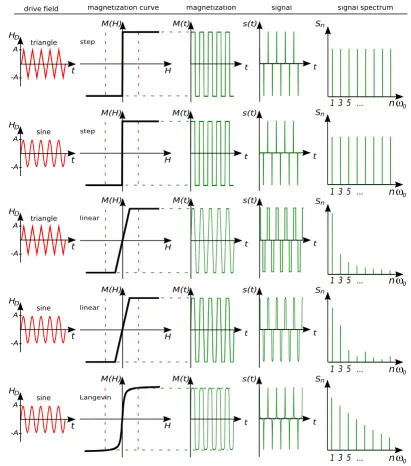
As shown in figure 1, its spectrum contains higher har-monics of the drive frequency, which represent the
finger-Published: 1 April 2009
BMC Medical Imaging 2009, 9:4 doi:10.1186/1471-2342-9-4
Received: 9 December 2008 Accepted: 1 April 2009
This article is available from: http://www.biomedcentral.com/1471-2342/9/4
© 2009 Rahmer et al; licensee BioMed Central Ltd.
BMC Medical Imaging 2009, 9:4 http://www.biomedcentral.com/1471-2342/9/4
print of the particles. Spatial localization is achieved by superimposing an inhomogeneous, static magnetic selec-tion field, that limits the particle response to a small region, also called field free point (FFP). The effect of the drive field is to move the FFP in space. Using orthogonal sets of drive field coils, fast spatial coverage with a 2D or 3D trajectory of the FFP can be achieved, allowing real-time tomographic imaging of particle distributions [2].
Since the particles' magnetic moment is about eight orders of magnitude larger than the proton magnetic moment used in MRI, MPI achieves high sensitivity [3]. This makes it a promising candidate for dynamic medical imaging applications, e.g., blood flow imaging in coronary arter-ies. Feasibility of 3D real-time visualization of blood flow through the vascular system of a living mouse has been demonstrated recently [4].
For MPI, in contrast to established imaging modalities like MRI and CT [5], no simple mathematical transform has yet been identified to reconstruct images from the acquired data. Therefore, MPI image reconstruction requires knowledge of a "system function" describing the system response to a given spatial distribution of particles,
i.e., mapping particle position to frequency response. To solve the reconstruction problem, the system function has to be inverted, usually requiring some regularization scheme [3]. To date, the system function is determined experimentally by measuring the magnetization response of a point-like sample at a large number of spatial posi-tions corresponding to the number of image pixels or vox-els [1]. This calibration procedure requires very long acquisition times and furthermore provides a system func-tion that is contaminated with noise. Due to the large size of the system function matrix, solving the inverse recon-struction problem is also quite time-consuming and claims large amounts of computer memory.
From a theoretical understanding of the signal encoding process one expects to gain insight into the structure of the system function. This knowledge can be used to speed up the system function acquisition or to even simulate parts or all of the system function. Information about the matrix structure can furthermore help to find more com-pact system function representations, helping to reduce memory requirements and speed up reconstruction. Finally, identification of a mathematical transform
lead-Basic MPI Principle Figure 1
ing from the data to the image would greatly simply the reconstruction process.
Methods
Signal GenerationThe basic principle of signal generation in MPI relies on the non-linear magnetization response M(H) of ferromag-netic particles to an applied magferromag-netic field H, cf. figure 1. An oscillating drive field HD(t) of sufficient amplitude leads to a magnetization response M(t) of the particles, which has a different spectrum of higher harmonics than the drive field. If, for instance, a harmonic drive field is used, the drive field spectrum only contains the base fre-quency, whereas the particle response also contains mul-tiples thereof. The information contained in these higher harmonics is used for MPI. Experimentally, the time-dependent change in particle magnetization is measured via the induced voltage in receive coils. Assuming a single receive coil with sensitivity r(r) at spatial position r, the changing magnetization induces a voltage
according to Faraday's law. 0 is the magnetic permeabil-ity of vacuum. The receive coil sensitivpermeabil-ity r(r) = Hr(r)/I0
derives from the field Hr(r) the coil would produce if driven with a unit current I0 [5].
In the following, the sensitivity of the receive coil is approximated to be homogeneous over the region of interest, i.e., r(r) is constant. If Mx(r, t) is the magnetiza-tion component picked up by a receive coil in x direction, i.e., having the sensitivity r = (x, 0, 0)T, the detected
sig-nal can be written as
Neglecting constant factors, we introduce the notation s(r,
t) for signal generated by a point-like distribution of par-ticles at position r. If the particle distribution is approxi-mated by a distribution, the volume integral vanishes and the particle magnetization Mx(r, t) is determined by
the local field H(r, t). For the moment, the field is assumed to have only one spatial component Hx(r, t), which is pointing in receive-coil direction x. The signal can then be written as
Since this equation holds for a general 1D setup where the field is aligned with the direction of the acquired magnet-ization component, the subscript x has been omitted. Equation 3 shows that high signal results from the combi-nation of a steep magnetization curve with rapid field var-iations. Fourier expansion of the periodic signal s(t) generated by applying a homogeneous drive field H(r, t) = HD(t) yields the signal spectrum Sn, as shown in figure 1. Intensity and weight of higher harmonics in the spec-trum are related to the shape of the magnetization curve
M(H), and to the waveform and amplitude of the drive field HD(t). To illustrate their influence on the spectrum,
a number of representative cases are shown in figure 2.
The step function relates to an immediate particle response and creates a spectrum that is rich in high har-monics. The spectral components have constant magni-tude at odd multiples of the drive frequency. The even harmonics are missing due to the sine-type pattern of the time signal s(t). The step function corresponds to an ideal par-ticle response and represents the limiting case for the achievable weight of higher harmonics. For this magneti-zation curve, triangle and sine drive fields yield the same result.
If the particle response to the drive field is slowed down by introducing a linear range in the magnetization curve, the relative weight of higher harmonics is reduced. Thereby, the harmonic drive field performs better than the triangular excitation, since it sweeps faster over the linear range.
The last row in figure 2 shows a more realistic particle magnetization as given by the Langevin function [6]
M() = M0 (coth - 1/), (4)
where M0 is the saturation magnetization and is the ratio between magnetic energy of a particle with magnetic moment m in an external field H, and thermal energy given by the Boltzmann constant kB and temperature T:
A higher magnetic moment results in a steeper magnetiza-tion curve and creates more higher harmonics for a given drive field amplitude. Alternatively, high harmonics can be generated from a shallow curve using faster field varia-tions, e.g., induced by a higher drive field amplitude. It should be noted that MPI uses ferromagnetic particles to obtain a sufficiently steep magnetization curve [1]. For low concentrations, however, their mutual interactions can be neglected and they can be treated like a gas of par-amagnetic particles with extremely large magnetic
V t
t r t r
( )
= −0 d∫
( )
⋅( )
3d d
object
r M r, (1)
V t
t M t r
x x
( )
= −μ σ0∫
( )
3d
d d
object
r, . (2)
s t
t M t t M H t
M H
H t
t M H
H t
r r r
r r
, , ,
, ,
( )
= −( )
= −(
( )
)
= − ∂
∂
( )
= − ′( )
d d
d d d
d
d
(( )
dt .(3)
= 0mH
BMC Medical Imaging 2009, 9:4 http://www.biomedcentral.com/1471-2342/9/4
moment, a phenomenon also known as "super-paramag-netism" [7].
1D Spatial Encoding
To encode spatial information in the signal, a static mag-netic gradient field HS(r), also called selection field, is intro-duced. For 1D encoding, the selection field has a non-zero gradient only in x direction, Gx = dHS/dx. If the gradient is non-zero over the complete field of view (FOV), the selec-tion field is monotonically rising or falling, thus it can cross zero only in a single point, the above-mentioned
FFP. In regions far away from the FFP, the particle magnet-ization is driven into saturation by the selection field.
Application of a spatially homogeneous and temporally periodic drive field HD(t) in addition to the selection field
HS(r) corresponds to a periodic displacement of the FFP along the gradient direction. The particles experience a local field
H(x, t) = HS(x) - HD(t). (6)
Particle Magnetization Response Figure 2
The minus sign has been chosen to make later calculations more convenient. Since the FFP sweeps over each spatial position x at a different point in time, each position can be identified by its characteristic spectral response.
Harmonic Drive Field – Ideal Particles
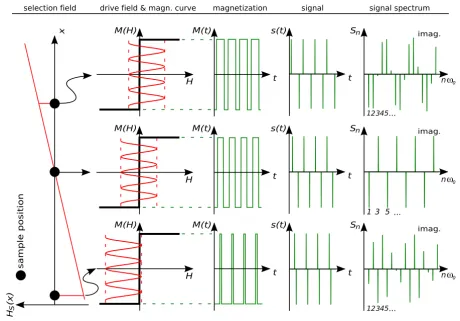
Figure 3 shows spectra at three different spatial positions generated by ideal particles exposed to a selection field HS
of constant gradient strength G and a harmonic drive field
HD of frequency 0 = 2/T and amplitude A. A derivation of their functional form is given in appendix A.1 and A.2. For the nth harmonic, corresponding to the nth compo-nent of a Fourier series expansion, one finds the following dependence on particle position x:
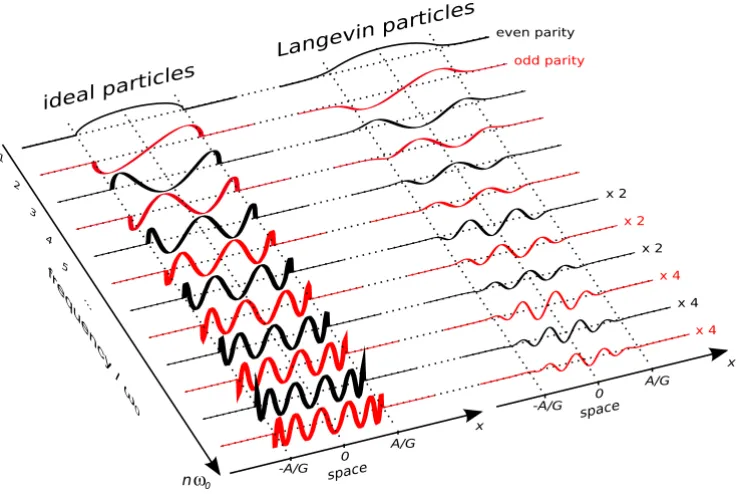
where the Un(x) represent Chebyshev polynomials of the second kind (42). The functions are defined in the range -1 < Gx/A < 1. A cosine drive field has been used instead of the sine drive field to arrive at a simpler expression. The spatial dependence for the first harmonics is plotted in the left part of figure 4. One finds an increasing number of oscillations with increasing frequency components n. This relates to the fact that Chebyshev polynomials form a complete orthogonal basis set (cf. appendix A.2), so that any particle distribution C(x) can be expanded into these functions. Successive frequency components have alter-nating spatial parity with respect to the center of the FOV (even/odd).
The Sn(x) can be seen as a sensitivity map, describing the spatial sensitivity profile of each frequency component n. In an MPI experiment, a 1D particle distribution C(x) would generate spectral signal components
Thus, the Sn(x) represent the system function introduced by [3]. The system function not only describes the spatial sig-nal dependence, but also contains information about the particles' magnetization curve and system parameters (e.g. drive field amplitude A and frequency 0 = 2/T, selection
field gradient G).
Using (7), the spectral signal components (8) for ideal particles can be written as
In this notation, the Vn correspond to coefficients of a
Chebyshev series, cf. equation (58). It follows that the particle concentration can be reconstructed by doing a Chebyshev transform of the measured Vn, i.e., by evaluat-ing the Chebyshev series
Hence, for ideal particles under the influence of a har-monic drive field and a constant selection field gradient, reconstruction of the spatial particle distribution simply corresponds to calculating the sum over the measured harmonics Vn weighted with Chebyshev polynomials of the second kind. In terms of the system function
, the particle concentration can be written as
Harmonic Drive Field – Langevin Particles
For more realistic particles as described by (4), the system function Sn(x) is given by a spatial convolution between the derivative of the magnetization curve, M'(HS), and the Chebyshev components, as derived in A.2. Using equa-tion (7) one can write:
Depending on the steepness of M(H), the Sn(x) will be a
blurred version of the , extending slightly beyond the interval which is covered by the FFP motion
and to which the are confined. Thus, particles that are located slightly outside the range accessed by the FFP also generate signal. The right part of figure 4 displays components of the system function for particles following the Langevin magnetization curve in a constant selection field gradient.
S x M
T n
Gx A M
T U Gx A Gx
n
n
ideal
i
i
( )
= − ⎛⎝⎜
⎞ ⎠⎟
= − −
(
)
−4 0
4 0 1
1
sin arccos
/
(
/AA)
2, n=1 2 3, , ,,(7)
Vn=
∫
Sn( ) ( )
x C x d x n=FOV
, 1 2 3, , ,. (8)
V M
T C x U Gx A Gx A x
n n
A G A G
= −
( )
−(
)
−(
)
−
∫
4 0 1
1
2
i / / d .
/ /
(9)
C x G
A T
M Un Gx A Vn
n
( )
= −(
)
= ∞
∑
24 0 1 1
i
/ . (10)
Snideal
( )
xC x G
A T
M Gx A Sn x Vn
n
( )
= − ⎛⎝
⎜ ⎞
⎠ ⎟
−
(
)
=( )
∞
∑
24 0
1
1 2
2
1
/ ideal .
(11)
S x
M M Gx S x
n
( )
= ′( )
∗ n( )
1 2 0
ideal
. (12)
Snideal
( )
xBMC Medical Imaging 2009, 9:4 http://www.biomedcentral.com/1471-2342/9/4
In the measurement process according to (8), the FOV now refers to the range where the Sn(x) are non-zero. A sufficiently steep magnetization curve can provide con-finement to a region not much larger than the range cov-ered by the FFP, i.e., -A/G <x <A/G.
Since the system function components cannot be sharper than the convolution kernel, an MPI experiment with Lan-gevin particles will run into a resolution limit correlating with the width of M'(x). Since the derivative of the mag-netization curve is a symmetric function M'(x) = M'(-x), one can use (12) to show that
Dependence of Magnetization Response on Selection Field Offset Figure 3
Dependence of Magnetization Response on Selection Field Offset. Relation between ideal particle response and selection field offset. A constant gradient G is assumed leading to a selection field HS(x) = Gx. The superposition of selection field HS(x) and harmonic drive field HD(t) = A cos 0t generates a magnetization response M(x, t) which induces a voltage pro-portional to s(x, t) in the receive coil. Depending on position x, the signal spectrum has a characteristic pattern Sn(x). Since the signal s(t) is real and odd, its Fourier components are purely imaginary.
V S x C x x
M M Gx S x C x x
M
n n
n
=
( ) ( )
= ⎡⎣ ′
( )
∗( )
⎤⎦( )
=
∫
∫
FOV
ideal
FOV
d
d 1
2 0
1 2 00
1 2
′
(
(
−)
)
( )
⎡⎣ ⎢ ⎢ ⎢
⎤
⎦ ⎥ ⎥ ⎥
( )
=
−
∫
∫
M G x x Sn x x C x xA G A G
ideal
FOV
d d
/ /
M
M Sn x M G x x C x x x
A G A G
0
ideal
FOV
d d
( )
⎡ ′(
(
−)
)
( )
⎣ ⎢ ⎢
⎤
⎦ ⎥ ⎥
∫
∫
− / /
(13)
=
( ) ( )
−
∫
Sn x C x x
A G A G
ideal d ,
/ /
where corresponds to the expression in square brackets in (13). Since (14) corresponds to (9), recon-struction for the harmonic drive field is given by (11), i.e.,
This means, that in the interval where the ideal particle
system function is defined, i.e., -A/G <x <A/G,
can be directly reconstructed. If the particle
con-centration C(x) is confined to the FOV, is just the convolution of C(x) with M'(x):
From this equation, one can infer that the resolution of the reconstructed image is limited by the width of M'(x). If the particle magnetization curve is known and the measurement provides sufficient SNR, deconvolution can be used to overcome this limitation. However, in practical
applications with distributions of different particles sizes and magnetization curves, deconvolution may be diffi-cult. Therefore, the following paragraph gives an estima-tion of the achievable spatial resoluestima-tion without deconvolution. The derivative of the Langevin curve in equation (4) is
which corresponds to the blue curve plotted in figure 1. The full width at half maximum (FWHM) of this curve can be determined numerically as FWHM 4.16. If the parti-cle magnetization m and the selection field gradient strength G are known, this can be translated to a spatial resolution using equation (5):
The particle magnetization depends on particle diameter d according to the following relation [8]:
Spatial Dependence of Spectral Signal Components Figure 4
Spatial Dependence of Spectral Signal Components. Spatial dependence of spectral signal components for a harmonic drive field in combination with a constant gradient selection field. Left: ideal particles. Right: Langevin particles. For these more realistic particles, the spatial response functions extend beyond the range [-A/G; A/G] covered by the FFP motion.
C x
( )
C x G
A T
M Gx A Sn x Vn
n
( )
= − ⎛⎝
⎜ ⎞
⎠ ⎟
−
(
)
=( )
∞
∑
24 0
1
1 2
2
1
/ .
ideal
(15)
Snideal
( )
x
C x
( )
C x
( )
C x
M M x C x
( )
= 1 ⎡⎣ ′( )
∗( )
⎤⎦2 0 . (16)
d
d M
( )
=M 1 − ⎛
⎝ ⎜ ⎜
⎞
⎠ ⎟ ⎟
0 2
1 2 sinh
, (17)
Δ =x k T Δ
mG
B
FWHM
0 . (18)
m= M ds
6
BMC Medical Imaging 2009, 9:4 http://www.biomedcentral.com/1471-2342/9/4
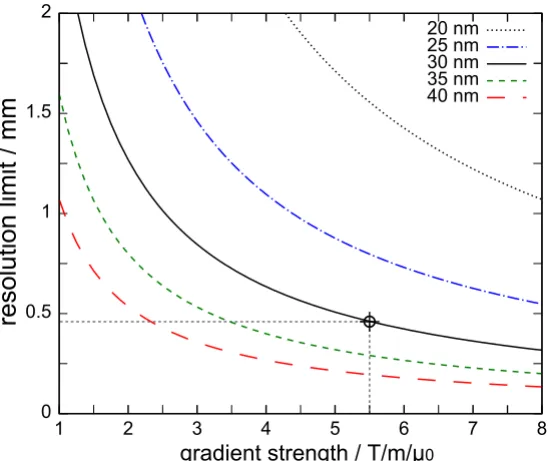
Assuming magnetite particles (Fe3O4) with a saturation magnetization of MS = 0.6 T/0, the resolution limit x
imposed by the magnetization curve can be calculated. Figure 5 shows x as a function of gradient strength for different particle diameters. The cross-hairs indicate the gradient strength of 5.5 T/m/0 and the dominating parti-cle diameter of 30 nm used in real-time in vivo MPI [4]. This gradient/particle combination theoretically allows a resolution better than 0.5 mm. However, due to the wide distribution of particle sizes and the regularization applied in reconstruction [3] to mitigate limited SNR, the observed resolution was not better than x 1.5 mm.
Triangular Drive Field
An illustrative case is to use a triangular drive field instead of the harmonic field, cf. appendix A.3. The system func-tion for ideal particles then has the form
for an FFP motion covering the range 0 <x < 2A/G. Now, instead of the Chebyshev series, a Fourier series can be used to reconstruct a particle concentration
The measured frequency components Vn are proportional
to components in k space, which are related to the spatial distribution C(x) by Fourier transformation. In terms of the system function, (21) becomes
For realistic particles, the system function has to be con-volved with M'(HS). Since equations (12–14) derived for harmonic drive field excitation hold for the triangular sys-tem function as well, a modified/convolved concentration
can be reconstructed in the range 0 < x < 2A/G.
Matrix Formulation
For MPI image reconstruction, the continuous spatial dis-tribution of particles will be mapped to a grid, where each grid location represents a small spatial region. Further-more, only a limited number n of frequency components is recorded. If the spatial positions are indexed with m, (8) becomes
Resolution Limit (without Deconvolution) for Different Particle Sizes as a Function of Gradient Strength Figure 5
Resolution Limit (without Deconvolution) for Different Particle Sizes as a Function of Gradient Strength. Res-olution x achievable without deconvolution for different diameters d of magnetite particles (Fe3O4) as a function of gradient strength G. According to equations (18) and (19), the limit is proportional to d-3 and G-1. The cross-hairs indicate a gradient/ particle combination used in recent in vivo experiments [4].
S x M
T n
G Ax
n ideal
i
( )
= − ⎛⎝⎜
⎞ ⎠⎟
4 0
2
sin , (20)
C x G
A T
M n
G Ax Vn
n
( )
= ⎛⎝⎜
⎞ ⎠⎟
= ∞
∑
i4 0 2
1
sin . (21)
C k
( )
C x G
A T
M Sn x Vn
n
( )
= − ⎛⎝
⎜ ⎞
⎠
⎟
( )
= ∞
∑
4 02
1 ideal
. (22)
C x
( )
Vn SnmCm m
or, in vector/matrix formulation,
v = Sc. (24)
Calculation of the concentration vector then basically cor-responds to an inversion of matrix S:
c = S-1v. (25)
This notation will be used for 2D or 3D imaging as well, which requires collapsing spatial indices into the single index m. Thus, concentration is always a vector, independ-ent of spatial dimension.
Going back to the 1D case for a harmonic drive field, introduction of a scalar
and a diagonal matrix
allows derivation of the following identity by comparing (25) with (11):
S-1 = ST. (28)
Thus, in the case of 1D imaging of ideal particles, the inverse matrix can simply be obtained by multiplication of the transpose with a scalar and a diagonal matrix.
Using only a limited number of frequency components corresponds to working with a truncated Chebyshev series. The Chebyshev truncation theorem then states that the error in approximating the real concentration distribu-tion is bounded by the sum of the absolute values of the neglected coefficients. More importantly, for reasonably smooth distributions, the error is on the order of the last retained Chebyshev coefficient [9].
2D and 3D Spatial Encoding 1D Drive Field
A first step towards describing 2D and 3D imaging is to look at the 3D system function of particles in a 3D selec-tion field HS(r) combined with a 1D drive field HD(t). Using a harmonic drive field and choosing a Maxwell coil setup to create a selection field as described in equation (68), the total field can be approximated by
The system function can be written as a convolution over the z component of the selection field (cf. (65))
In this vector, each component refers to the signal induced by the respective x/y/z magnetization component. Detec-tion of these components requires three orthogonal (sets of) receive coils. For ideal particles (cf. (66)), the explicit spatial dependence becomes (cf. (70))
where the asterisk denotes convolution over the z compo-nent, i.e., the direction of the FFP motion resulting from the drive field. Thus, an expression describing the 3D spa-tial dependence of the respective magnetization compo-nent is convolved in drive field direction with the set of 1D Chebyshev functions.
The shape of the convolution kernel is determined by M/
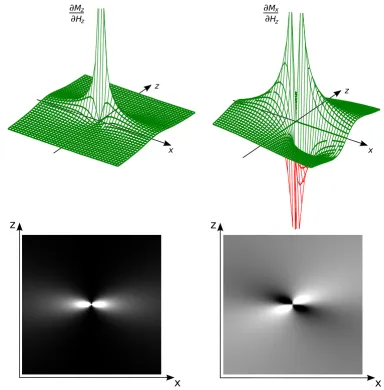
Hz, which describes how the magnetization responds to the drive field change. For ideal particles, it is singular at the origin. Figure 6 shows the xz plane of the 3D kernel for the signal components detected in z and x direction,
Sn,z(r) and Sn,x(r), respectively. Along the center line in drive field direction, the kernel for the Mz magnetization corresponds to the delta distribution, just as in the 1D sit-uation (48). With increasing distance from the center line, the kernel broadens and its amplitude decreases rapidly. For Mx, and for symmetry reasons also for My, the kernel is zero on the symmetry axes. It has high amplitude close to the singularity at the origin.
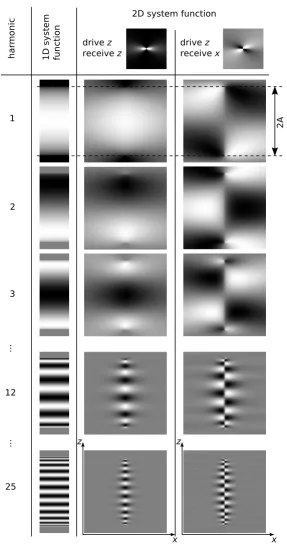
To form the 3D ideal particle system function, the 3D ker-nel is convolved along the drive field direction with the 1D Chebyshev polynomials (31). Figure 7 shows central 2D slices extracted from selected harmonics for the above case of 1D drive field motion in z direction. Directly on the line covered by the FFP trajectory, the system function is given by Chebyshev polynomials and therefore can encode an arbitrary particle distribution, as discussed for the 1D situation. With increasing distance to the center line, the convolution kernel has an increasing blurring
= − ⎛ ⎝ ⎜ ⎞ ⎠ ⎟ 2 4 0 2 G A T M (26)
mm nm
Gxm A n m = −
(
)
= ≠ 1 1 2 0 /, for ,
(27)
H r, H H
cos .
t r t
Gx Gy
Gz A t
( )
=( )
−( )
= ⎛ ⎝ ⎜ ⎜ ⎜ ⎞ ⎠ ⎟ ⎟ ⎟− ⎛ ⎝ ⎜ ⎜ ⎜ ⎞ ⎠ ⎟ ⎟ ⎟ S D 2 0 0 ω (29)Sn M H n Sz Sz
T
s
H z U H A H A
= − ∂
( )
∂ ∗⎡⎣⎢ −(
)
−(
)
⎤⎦⎥ 2 1 1 2 i / / . (30)Sn r
T M
G
x y z
xz yz x y ( )= − + +
(
)
− − + ⎛ ⎝ ⎜ ⎜ ⎜ ⎞ ⎠ ⎟ ⎟ ⎟ ⎡ ⎣ ⎢ ⎢ ⎢ ⎢ ⎤2 0 1
2 2 4 2 3 2 2 2 2 2 i / ⎦⎦ ⎥ ⎥ ⎥ ⎥ ∗⎡ ( ) −( )
⎣⎢Un−1 Gz A Gz A ⎤⎦⎥
2
2 / 1 2 / ,
BMC Medical Imaging 2009, 9:4 http://www.biomedcentral.com/1471-2342/9/4
effect, so that finer structures of the higher Chebyshev pol-ynomials are averaged to zero. Therefore, the signal in higher system function components condenses to the line of the FFP trajectory (cf. figure 7, harmonic 12 and 25), where the blurring effect is low. This can be explained by the fact that only in the close vicinity of the FFP, the field change is rapid enough to stimulate a particle response that generates high frequency components.
In an MPI experiment, it can be useful to exploit sym-metries in the system function to partially synthesize the system function and thus speed up its acquisition and reduce memory requirements. From the 3D response to the 1D FFP motion, two basic rules can be derived for the parity of the system function in the spatial direction indexed with i {x, y, z}.
1. The "base" parity is given by the parity of the convolu-tion kernel shown in figure 6. It is even, if the receive direction j {x, y, z} is aligned with the drive direction k {x, y, z}. This corresponds to the magnetization deriva-tive component MjHk for j = k. Otherwise kernel parity is odd:
2. If the spatial direction of interest is a drive field direc-tion, i.e., i = k, then parity alternates between successive harmonics h of that drive field component:
Convolution Kernel Resulting from Magnetization Derivative Figure 6
Convolution Kernel Resulting from Magnetization Derivative. Derivative of ideal particle magnetization with respect to the Hz field component. The derivatives of the Mz (left) and Mx component (right) are shown. Top and bottom row show a 3D view and gray-scale plot of the xz plane, respectively. The displayed functions represent the convolution kernel applied to the basis set in drive field direction, cf. equation (31).
p j k
j k
kernel =
=
− ≠
⎧ ⎨ ⎩
1 1 ,
2D Ideal Particle System Function for 1D FFP Motion Figure 7
BMC Medical Imaging 2009, 9:4 http://www.biomedcentral.com/1471-2342/9/4
The reason is the alternating parity of the Chebyshev pol-ynomials in the 1D system function.
Parity observed for harmonic h in a spatial direction i then is pi,j,k,h = pCheb·pkernel.
2D and 3D Drive Field
As displayed in figure 7, the spatial pattern of the particle response for higher harmonics is confined to a narrow region close to the line of the FFP motion. Therefore, to induce a particle response with high harmonics extending over the whole 2D plane, a lateral displacement of the FFP is necessary. This is achieved by adding a second drive field which displaces the FFP in x direction. For 3D encod-ing, a third drive field for FFP displacement in y direction is necessary. Figure 7 furthermore shows that high resolu-tion is obtained only in the close vicinity of the FFP trajec-tory line. Thus, the 2D or 3D trajectrajec-tory should be sufficiently dense to achieve homogeneous resolution over the imaging plane or volume. For a simple imple-mentation, one can choose harmonic drive fields with slight frequency differences in the orthogonal spatial directions, causing the FFP motion to follow a 2D or 3D Lissajous pattern. In the following, a 2D system function requiring two drive frequencies is investigated. The treat-ment of a 3D system function using three drive frequen-cies would be analogous. Figure 8 displays a 2D Lissajous pattern generated by the superposition of two orthogonal harmonic drive fields with frequency ratio x/z = 24/25:
Using a 3D selection field according to (29), the doubled selection field gradient in z direction requires Az = 2Ax to cover a quadratic FOV with the FFP motion. Figure 8 dis-plays the first components of a simulated 2D system func-tion for ideal particles exposed to the superposifunc-tion of the 2D Lissajous drive field and the 3D selection field. Each receive direction has its own set of system functions, denoted by 'receive x' and 'receive z'. Components corre-sponding to higher harmonics of the respective drive fre-quency are indicated by red frames. On the x channel, they have a spacing of 24 components. In the spatial x
direction, they closely resemble the 1D Chebyshev series, while in z direction, they show no spatial variation. On the z channel, harmonics of the drive frequency exhibit a spacing of 25 components with a spatial pattern that is
basically rotated by 90 degrees with the respect to the x
components.
While components corresponding to harmonics of the drive field frequencies only allow 1D encoding in the respective drive field direction, components arising from a mixture of both drive frequencies provide spatial varia-tion in both direcvaria-tions at the same time. For instance, moving to the left from the first x drive-field harmonic on the x channel (component 24) corresponds to mix fre-quencies mx + n(x - z) with increasing integer n and m
= 1. For larger m, one starts at a higher harmonic m. Mov-ing to the right corresponds to negative n. Thus, pure drive field harmonics and their vicinity relate to low mixing orders, while increasing distance goes along with larger n
and higher mixing orders.
It should be noted that the system function component observed for mx + n(x - z) appears a second time at fre-quency mx + n(x + z). Thus every component
corre-sponding to frequency mixes appears twice. Examples are components 23 and 73 (m = 1, n = 1, green frames) or 47 and 97 (m = 2, n = 1, blue frames), but also 26 and 74 (m
= 1, n = -2, orange frames) on the x channel.
Figure 8 also plots the maximum intensities (weights) of the generated system function components. Highest intensities are found in pure multiples of the drive quencies, however with a decrease towards higher fre-quencies. Components corresponding to mix frequencies have much lower intensity than pure harmonics. If the system function is acquired experimentally, these compo-nents will be the first to fall below the noise level. Thus, low SNR in the system function acquisition will reduce the achievable resolution.
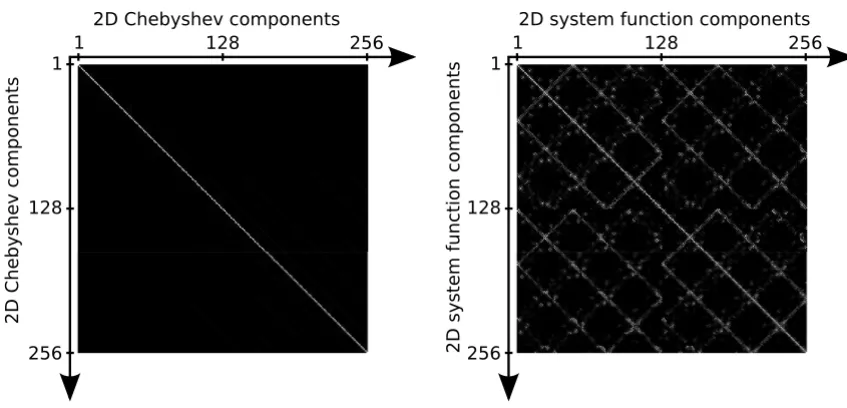
The higher the order of a system function component, the finer its spatial structure. This behavior and the general spatial patterns closely resemble 2D Chebyshev polyno-mials, which can be written as a tensor product of the 1D polynomials for each direction: Un(x) 丢Um(z). Figure 9 plots the first components of these functions. The 2D Chebyshev functions satisfy an orthogonality relation similar to (50). A graphical representation of this relation for the first 256 components is shown in the left part of figure 10. The inner product between orthogonal func-tions vanishes, so that only the product of a function with itself is non-zero, leading to the diagonal line in figure 10. In the right part, the corresponding plot is shown for the normalized rows of an ideal particle 2D Lissajous system function. Bright spots and lines off the diagonal indicate that some system function components are not orthogo-nal with respect to each other. However, black regions pre-vail and one can infer that most components are
p j k
j k
h
Cheb =
( )
− =≠ ⎧
⎨ ⎪ ⎩⎪
+
( )
1 1
1
,
, .
(33)
HD t
A t
A t
x x
z z
( )
= ⎛⎝ ⎜ ⎜ ⎜
⎞
⎠ ⎟ ⎟ ⎟
cos
cos .
ω
ω
2D Ideal Particle System Function for 2D Lissajous FFP Motion Figure 8
BMC Medical Imaging 2009, 9:4 http://www.biomedcentral.com/1471-2342/9/4
orthogonal. Therefore, there is only little redundancy in the system function.
To demonstrate this, a phantom image (figure 11, left) is expanded into an equal number of 2D Chebyshev and Lis-sajous system function components, respectively. The number of components has been chosen to equal the the number of pixels in the image (64 × 64). The image obtained from the Chebyshev transformation exhibits reduced resolution compared to the original image. The reason is that the Chebyshev functions provide higher res-olution at the edges of the FOV but reduced resres-olution at the center. To keep the high resolution at the image center, higher Chebyshev components would have to be included in the expansion. The image obtained from the system function components has been reconstructed by inverting the system function matrix using minimal regularization to suppress noise [10]. Half the system function
compo-nents were taken from the receive x system function, the other half from the z function (as displayed in figure 8). Resolution of the image is better than observed for the Chebyshev expansion, but the image has small artifacts that make it appear less homogeneous. Considering the fact that some system function components are not orthogonal and therefore redundant, the image quality is quite good. The reconstructions from only the x or z com-ponents show significantly worse image quality, indicat-ing that these subsets are not sufficient to homogeneously represent the image information.
Results and discussion
MPI signal encoding can provide a system function that forms a well-behaved basis set capable of representing highly resolved image information.
Pictorial Table of 2D Chebyshev Functions Figure 9
For 1D harmonic excitation of ideal particles, the system function corresponds to a series of Chebyshev polynomi-als of the second kind. Therefore, a fast and exact recon-struction is provided by the Chebyshev transform.
The properties of realistic particles are introduced into the system function by a convolution-type operation leading to a blurring of the high-resolution components. This introduces a resolution limit which is determined by the steepness of the particle magnetization curve. While in principle, a higher resolution image can be regained by deconvolution, resolution provided by realistic particles without deconvolution is already in the sub-millimeter range [3].
The system function for 2D imaging is determined by the trajectory taken by the FFP and a kernel representing the region around the FFP which contributes to the signal. The shape of this FFP kernel is determined by the topology of the selection field. The simple case of constant selection field gradients in all spatial directions has been demon-strated. For ideal particles, the kernel has sharp singulari-ties which provide high spatial resolution. However, regions around these sharp peaks also contribute to the signal. This is probably the reason for the observation that in 2D encoding using a 2D Lissajous pattern, the system function is not exactly represented by 2D Chebyshev func-tions. Therefore, reconstruction cannot be done by using the Chebyshev transform as in 1D, but requires the inver-sion of the system function matrix. However, a close
rela-Orthogonality Plots Figure 10
Orthogonality Plots. Orthogonality plot for the first 256 basis set components. Left: 2D Chebyshev basis set. Right: 2D MPI ideal particle system function for Lissajous FFP motion with frequency ratio 24/25. System function matrix rows were normal-ized.
Test Images Figure 11
BMC Medical Imaging 2009, 9:4 http://www.biomedcentral.com/1471-2342/9/4
tionship between the 2D Lissajous system function and the 2D Chebyshev polynomials is obvious. This may be used to transform the system function into a sparser rep-resentation using a Chebyshev or cosine-type transforma-tion, resulting in lower memory requirements and faster reconstruction.
The 2D Lissajous system function does not form a fully orthogonal set, since it contains redundant components. Nonetheless, it is capable of encoding highly resolved image information as shown in figure 11. Possible mis-matches between the information content of the acquired data and the desired pixel resolution can be mediated by using regularization schemes in the reconstruction [10]. In experimentally acquired data, the necessary degree of regularization will also depend on the SNR. Optimally, to take into account noise in the system function as well as in the measured object data, image reconstruction should be based on the total least squares approach [11].
To speed up the tedious experimental acquisition of the system function, one can use the parity rules derived for the 2D system function. In theory, these allow to con-struct the complete system function from measuring only one quadrant of the rectangle of the Lissajous figure. For a 3D Lissajous figure, one octant would suffice, accelerating the system function acquisition by a factor of eight. Exper-imentally, the symmetry can be disturbed by non-perfect alignment of coils. Nonetheless, knowledge of the under-lying theoretical functions and their parity can help to model the system function from only a few measured samples.
In a real MPI experiment, one usually acquires many more frequency components than the desired number of image pixels. Therefore, one has the freedom to make a selection of system function components to constitute a more com-pact basis set providing better orthogonality. For instance, duplicate system function components can be removed after acquisition to arrive at a smaller system function matrix to speed up image reconstruction. Furthermore, a selection of harmonics according to their weight can help to reduce matrix size. It is also conceivable to modify the weight of certain components to influence image resolu-tion and SNR.
2D imaging of realistic particles has not been simulated in this work, but from the 1D derivations, one can infer that a blurring of the FFP kernel depending on the steepness of the particle magnetization curve will occur. This would remove the kernel singularities, but would also result in a slight loss of resolution, as discussed for the 1D case.
3D imaging has not been shown, but 2D results can be directly extrapolated to 3D by introducing an additional
orthogonal drive field enabling 3D FFP trajectories. For a 3D Lissajous trajectory, close resemblance of the system function to third order tensor products of Chebyshev pol-ynomials can be expected.
The selection field topology and the FFP trajectories used in this work have been chosen for their simple experimen-tal feasibility. However, many alternative field configura-tions are conceivable. For the FFP trajectory, one can as well use radial or spiral patterns [12], or even patterns that are tailored to the anatomy to be imaged. Trajectories can be adapted to deliver varying resolution over the image. For the selection field, a topology creating a field-free line instead of the FFP promises more efficient scanning [8]. More research is required to identify field configurations optimal for specific applications.
Conclusion
This work for the first time reports on the properties of the MPI system function. It shows that MPI signal encoding using harmonic drive fields in combination with constant selection field gradients provides a system function capa-ble of representing highly resolved image information in rather compact form. The close relation to Chebyshev pol-ynomials of the second kind can be used to speed up sys-tem function acquisition by partially modeling it, or to reduce memory requirements by applying tailored spar-sity transforms resulting in faster reconstruction times.
The system functions explored here are tied to specific field configurations and scanning trajectories. Many other configurations are feasible, providing the flexibility to tai-lor system functions to satisfy certain experimental needs regarding speed, resolution, and sensitivity.
Competing interests
All authors are employees of the Philips Technologie GmbH Forschungslaboratorien, Hamburg, Germany.
Authors' contributions
JR and JW derived the mathematical treatment. JR further-more wrote the manuscript, made the simulations and fig-ures. BG and JB contributed ideas central to spatial encoding and image reconstruction in MPI and supported the development of the manuscript in helpful discussions. All authors read and approved the final version of the manuscript.
Appendix
A Mathematical Derivations for 1D Encoding
A.1 Signal Fourier Components Generated by a Periodic Drive Field
As shown in equation (3), the MPI signal is generated by the magnetization of particles following an externally applied (1D) field H. For spatial encoding, the field is split
and a homogeneous drive field HD(t) with a temporal
var-iation, as shown in equation (6). The drive field is assumed to be periodic with frequency 0 = 2/T. Since the drive field causes a periodic change in magnetization, the acquired signal can be represented by a Fourier series
Using 0 = 2/T, the coefficients are defined as
To get rid of the time variable, parametrization is changed to the drive field by taking the inverse function of HD(t),
t = t(HD), (37)
which may require piecewise definition if the inversion is ambiguous. Ignoring this for the moment, equation (36) formally becomes
where dH/dt = dHD/dt has been used.
In the following, (38) is evaluated making different assumptions on the type of drive field, selection field, and magnetization curve.
A.2 Fourier Components Generated by a Harmonic Drive Field
A harmonic drive field is easy to implement experimen-tally. With amplitude A and frequency 0, one can write:
H(x, t) = HS(x) - HD(t) = HS(x) - A cos 0t. (39)
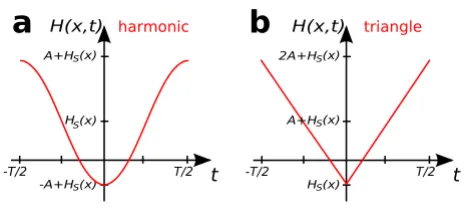
The cosine function has been chosen to arrive at a sine function after taking the derivative. The superposition of the two field components is shown in figure 12a. Time can be expressed as
The two solutions have to be taken into account, and the integral (38) has to be split accordingly:
Functions of the type sin(n arccos x) bear a close similarity to Chebyshev polynomials of the second kind [9]:
Thus, (41) can be written as
where has been used. If we
define
Superposition of Drive and Selection Fields Figure 12
Superposition of Drive and Selection Fields. Superposi-tion of selecSuperposi-tion and drive field at a spatial posiSuperposi-tion x. The magnetization flips when the field H(x, t) = HS(x) - HD(t) crosses zero. The selection field offset HS(x) causes a time shift of the magnetization flip. Harmonic (a) and triangular (b) drive fields with amplitude A are displayed. Note that for mathematical convenience, the harmonic drive field ranges from -A to A, whereas the triangular field varies between 0 and 2A.
s t Sn n t
n
( )
==−∞ ∞
∑
ei0. (35)S
T s t t T M H
H
t t
n n t n t
T T T T =
( )
− = − ′( )
− − −∫
∫
1 0 1 0
2 2
2 2
e d d
d e d
i i .
/ / / / (36) S
T M H H H
n
n t H
H T H T = − ′
(
−)
− ( ) − ( ) ( )∫
1 0 2 2 s D i De D d
D D , / / (38)
t H H
A
D D
(
)
= 10
arccos . (40)
S
T M H H H
M H H
n n H A
A A n = − ⎧⎨⎪ ′
(
−)
⎩⎪ + ′(
−)
( ) − −∫
1S D i arccos D
S D i e d e D/ arrccos /
arccos / a
H A
A A
n H A n
H
T M H H
D D d e e D S D i i ( ) − ( ) −
∫
⎫⎬⎪ ⎭⎪= −1 ′
(
−)
− rrccos /sin arccos / .
H A
A A
H
T M H H n H A H
D d
i
d
D
S D D D
( ) − −
(
)
= − ′(
−)
(
(
)
)
∫
2 A A A∫
(41)U x n x
x
n
( )
=+
(
)
(
)
(
)
sin arccos sin arccos .
1
(42)
S
T M H H U H A H A H
n n A A = − ′
(
−)
−(
)
−(
)
−∫
2 1 1 2 i dS D D/ D/ D,
(43)
BMC Medical Imaging 2009, 9:4 http://www.biomedcentral.com/1471-2342/9/4
the integration limits can be set to infinity. This is an arti-ficial construction, since the drive field HD cannot reach infinite values, but it shows that (43) is a convolution:
Thus, for a harmonic drive field, the frequency compo-nents form a set of Chebyshev polynomials, convolved with the derivative of the magnetization curve. Assuming a homogeneous drive field amplitude A, the spatial varia-tion of the frequency components depends on the spatial variation of the selection field HS(x).
Addition of a Constant Field Gradient for 1D Spatial Encoding
To make an explicit choice for the selection field, a con-stant 1D field gradient G generating a field HS(x) = Gx is introduced. Then the frequency components have the fol-lowing spatial dependence:
Ideal Particles
For ideal particles, the magnetization curve corresponds to the sign function, so that, introducing the saturation magnetization M0, the magnetization becomes
The derivative is the delta distribution
M'(H) = M0 2 (H). (48)
The convolution integral (43) then reduces to
when a constant selection field gradient G has been assumed. The Chebyshev polynomials form a complete basis set and satisfy the orthogonality relation [9]
Therefore, the frequency components meas-ured by MPI can be used to represent any spatial particle distribution in the range -A/G <x <A/G accessed by the drive field.
A.3 Fourier Components Generated by a Triangular Drive Field
If a triangular drive field is used instead of the cosine field, the superposition of selection and drive field becomes
H(x, t) = HS(x) - HD(t) = HS(x) - A tri 0t (51)
as shown in figure 12b. Note that in order to keep the functional form simple in later calculations, tri 0t varies between 0 and 2, i.e., the imaging range has been shifted to 0 < x < 2A/G. Time can then be expressed as
and the resulting signal components are
Addition of a Constant Field Gradient for 1D Spatial Encoding
For a selection field HS(x) = Gx, the spatial dependence becomes
Ideal Particles
For ideal particles, the integral (53) reduces to
when a constant selection field gradient is assumed.
A.4 Derivation of the Chebyshev Transform from the Sine Transform
A function f(x) that is defined on the interval [0, ] and is zero at the edges of the interval, i.e., f(0) = f() = 0, can be mirrored to form an odd function over [-, ] and thus can be expanded into a sine series. The following relations hold for the coefficients bk [13]:
Un−1
( )
x 1−x2 =sin(
narccos( )
x)
=0 for x >1,(44)
S
T M H U H A H A
n= − ′
( )
S ∗⎛⎝⎜ n−(
)
−(
)
⎞⎠⎟2
1
1
2
i
S/ S / .
(45)
S S x
T M Gx U Gx A Gx A
n= n
( )
= − ′( )
∗⎛ n(
)
−(
)
⎝⎜ − ⎞⎠⎟ 2 1 1 2 i / / . (46)
M H M H H
H H H
( )
= = > = − < ⎧ ⎨ ⎪ ⎩ ⎪ 0 1 0 0 0 1 0sgn , sgn
, ,
, .
with
(47)
S x M
T U Gx A Gx A
n n
ideal
( )
= − i(
)
−(
)
−
4 0 1
1
2
/ / ,
(49)
Un
( ) ( )
x Um x −x x= nm−
∫
1 2 2 1 1d π δ . (50)
Snideal
( )
xt H H D
A
D
(
)
= 10 2
ω π
(52)
S H
T M H H n
H
A H
n
A
S S D D
i D d
( )
= − ′(
−)
⎛ ⎝⎜ ⎞ ⎠⎟∫
2 2 0 2sin π .
(53)
S x
T M Gx H n
H A H n A
( )
= − ′(
−)
⎛ ⎝⎜ ⎞ ⎠⎟∫
2 2 0 2i D d
D sin π D.
(54)
S x M
T n Gx A n ideal i
( )
= − ⎛ ⎝⎜ ⎞ ⎠⎟ 4 0 2Using the substitution x arccos(x), one can easily show that the expansion changes to
or,
Since the range [0, ] is mapped to [-1, 1] by the coordi-nate transform, there is no symmetry requirement for f(x).
B Mathematical Derivations for 2D/3D Encoding
Using a pair of detection coils in z direction, the acquired signal is proportional to the time-variation of the z com-ponent of the magnetization. According to (3),
i.e., the total differential has to be taken. The same holds for receive coil pairs in x and y direction, so that (59) can be written in vector form:
It should be noted that M/Hk generally is a function of
H(r, t), which can be chosen as the sum of a static selec-tion field HS(r) and a homogeneous drive field HD(t). Assuming a 3D drive field that has an overall periodicity with cycle duration T = 2/0, all three spatial compo-nents can be expanded into Fourier series, so that simi-larly to (36)
The sum has been pulled out of the integral under the assumption that all individual integrals exist.
B.1 1D Harmonic Drive Field in z Direction
If a periodic 1D drive field is chosen in z direction,
then only the time derivative of the Hz component is dif-ferent from zero
The derivations for 1D encoding still hold for this situa-tion. According to (38), the frequency components gener-ated by a periodic drive field can be formally written as
If a harmonic drive field HD(t) = A cos 0t is used, the fre-quency components are based on Chebyshev polynomi-als, as derived in (45),
The convolution operation only involves the z compo-nent of the field, which is why HSz appears in the
argu-ment of the Chebyshev function.
B.1.1 Ideal Particles
Assuming ideal particles, the magnetization follows the external field as described by
The differentials for the three spatial components are:
f x bk kx b f x kx x
k
k
( )
= ⇔ =( )
= ∞
∑
sin∫
sin1 0 2 π π d (56)
f x x b Uk x b f x U x x
k
k k k
( )
= −( )
⇔ =( )
( )
= ∞ − − −∑
∫
1 2 2
1 1
1 1
1
π d .
(57)
f x b Uk x b f x U x x x
k
k k k
( )
=( )
⇔ =( )
( )
− = ∞ − − −∑
1 1∫
1 1
1 2
2
1
π d .
(58)
S t
tM t
M z H k H k t M z z k H z
( )
= −(
( )
)
= − ∂ ∂ = −(
)
⋅ =∑
d d d d H H 1 3 ∇∇ , (59)S t M H M M H
t t H k
H k t k H
( )
= −(
( )
)
= − ∂ ∂ = −(
⊗)
⋅ =∑
d d d d 1 3 . (60)Sn S n t M
T T
T T
k
T t t T H k
H k t
n t t
=
( )
= − ∂∂ −
−
−
∫
−∫
1 0 1 0
2 2
2 2
e d d
d e i d
iω ω
/ /
/ /
==
∑
31 .(61) HD D t H t
( )
=( )
⎛ ⎝ ⎜ ⎜ ⎜ ⎞ ⎠ ⎟ ⎟ ⎟ 00 , (62)
S t M
H z H z t
( )
= − ∂ ∂ dd . (63)
Sn M H H n t H
H T H T
T H z H
= − ∂
(
−)
∂ − ( ) − ( ) ( )∫
1 0 2 2s D e i d
D D D D ω / / . (64)
S M H H
M H
n
A A
n
T H z U H A H A H
T H z
= − ∂
(
−)
∂(
)
−(
)
= − ∂(
)
∂ − −∫
2 1 2 1 2i S D d
i S
D D D
∗∗⎛ −
(
)
−(
)
⎝⎜
⎞ ⎠⎟
U n 1 H z AS 1 H z AS 2 .
(65) M H H H H H
( )
= ≠ = ⎧ ⎨ ⎪ ⎩ ⎪M0 0
0 0
,
, .
BMC Medical Imaging 2009, 9:4 http://www.biomedcentral.com/1471-2342/9/4
3D spatial encoding requires a 3D selection gradient. An easy way to set up a 3D gradient is to use a Helmholtz pair of coils supplied with opposite currents in the two coils, also called the Maxwell coil [14]. Near the symmetry center, the generated gradient field can be approximated linearly:
Including the above homogeneous drive field along the z
direction, the total field becomes
The spatial dependence of the signal picked up in three spatial directions (65) then becomes
where the convolution involves the z variable only.
C List of Symbols A drive field amplitude
C(r) (true) particle concentration at position r
particle concentration convolved with M'(r), reconstructed concentration
Fourier transform of particle concentration C(x)
c concentration vector
G magnetic field gradient
H magnetic field
HD(t) drive field (spatially homogeneous)
Hr(r) field produced by a receive coil
HS(r) selection field (static)
I0 unit current
kB Boltzmann constant
0 magnetic permeability of vacuum
m single particle magnetic moment
M0 saturation magnetization
M' derivative of the particle magnetization curve with
respect to the magnetic field:
M(r, t) magnetization (depending on space and time)
Mx(r, t) magnetization component detected by x receive coil
0 drive field frequency 0 = 2/T
r spatial coordinate vector
s(t) signal detected from a point-like sample
Sn signal spectrum derived from s(t) by discrete Fourier transformation
r(r) receive coil sensitivity
S system function matrix
t time
T cycle duration of periodic drive field excitation
T temperature
Un(x) nth Chebyshev polynomial of the second kind
∂ ∂ = − ∂ ∂ = − ∂ ∂ = − = + M x
H z M
H xH z
M y
H z M
H yH z
M z
H z M
H z M H x H y 0 3 3 2 2 3 2 0 0 0 H H H H 2 2 3 H . (67)
HS
( )
r = ⋅ =G r r r⎛ ⎝ ⎜ ⎜ ⎜ ⎞ ⎠ ⎟ ⎟ ⎟ = ⎛ ⎝ ⎜ ⎜ ⎜ ⎞ ⎠ ⎟ ⎟ ⎟ G G G G G G x y z 0 0 0 0 0 0 0 0 0 0
0 0 2 .
(68)
H r, H r H r
cos
t t
G G
G A t
( )
=( )
−( )
= ⎛ ⎝ ⎜ ⎜ ⎜ ⎞ ⎠ ⎟ ⎟ ⎟ − ⎛ ⎝ ⎜ ⎜ ⎜ ⎞ ⎠ ⎟ ⎟ S D 0 0 0 00 0 2
0 0 ⎟⎟ . (69) S M T xz
G x y z
U Gz A Gz A
S
n x n
n
, ( )r =
+ +
(
)
∗⎛⎝⎜ − ( ) −( ) ⎞⎠⎟2 0 2
2 2 4 2 3 2
2 1 2
1 2 i ,, , y n n M T yz
G x y z
U Gz A Gz A
S r ( ) =
+ +
(
)
∗⎛⎝⎜ − ( ) −( ) ⎞⎠⎟2 0 2
2 2 4 2 3 2
2 1 2
1 2 i zz n M T x y
G x y z
U Gz A Gz A r
( ) = − +
+ +
(
)
∗⎛⎝⎜ − ( ) −( ) ⎞⎠⎟2 0 2 2
2 2 4 2 3 2
2 1 2
1
2
i ,
(70)
C
( )
rˆ
C k
( )
M M
H
Publish with BioMed Central and every scientist can read your work free of charge
"BioMed Central will be the most significant development for disseminating the results of biomedical researc h in our lifetime."
Sir Paul Nurse, Cancer Research UK
Your research papers will be:
available free of charge to the entire biomedical community
peer reviewed and published immediately upon acceptance
cited in PubMed and archived on PubMed Central
yours — you keep the copyright
Submit your manuscript here:
http://www.biomedcentral.com/info/publishing_adv.asp
BioMedcentral
V(t) induced voltage
V signal induced by particle distribution C(r)
v signal vector
x achievable spatial resolution without deconvolution
Langevin function argument = 0mH/kBT
Acknowledgements
This work was supported by the German Federal Ministry of Education and Research (BMBF) under the grant number FKZ 13N9079. The authors thank T. Knopp for helpful suggestions for improving the manuscript.
References
1. Gleich B, Weizenecker J: Tomographic imaging using the non-linear response of magnetic particles. Nature 2005,
435:1214-1217.
2. Gleich B, Weizenecker J, Borgert J: Experimental results on fast 2D-encoded magnetic particle imaging. Phys Med Biol 2008,
53:N81-N84.
3. Weizenecker J, Borgert J, Gleich B: A simulation study on the res-olution and sensitivity of magnetic particle imaging. Phys Med Biol 2007, 52:6363-6374.
4. Weizenecker J, Gleich B, Rahmer J, Dahnke H, Borgert J: Three-dimensional real-time in vivo magnetic particle imaging. Phys Med Biol 2009, 54:L1-L10.
5. Liang ZP, Lauterbur PC: Principles of Magnetic Resonance Imaging New York: IEEE, Inc.; 2000.
6. Chikazumi S, Charap SH: Physics of Magnetism New York: Wiley; 1964.
7. Bean CP, Livingston JD: Superparamagnetism. J Appl Phys 1959,
30:120S-129S.
8. Weizenecker J, Gleich B, Borgert J: Magnetic particle imaging using a field free line. J Phys D: Appl Phys 2008, 41:105009. 9. Boyd JP: Chebyshev and Fourier Spectral Methods New York: Dover
Publications, Inc.; 2001.
10. Press WH, Teukolsky SA, Vetterling WT, Flannery BP: Numerical Rec-ipes in C Cambridge: Cambridge University Press; 1992.
11. Golub GH, van Loan CF: Matrix Computations third edition. Baltimore: The Johns Hopkins University Press; 1996.
12. Knopp T, Biederer S, Sattel T, Weizenecker J, Gleich B, Borgert J, Buzug TM: Trajectory Analysis for Magnetic Particle Imaging. Phys Med Biol 2009, 54:385-397.
13. Bronstein IN, Semendjajew KA: Taschenbuch der Mathematik Stutt-gart: Teubner; 1991.
14. Jin JM: Electrom
![Figure 1Basic MPI PrincipleBasic MPI Principle. Basic MPI principle [1]. The drive field HD(t) generates a particle response M(t) that induces a voltage in the receive coils](https://thumb-us.123doks.com/thumbv2/123dok_us/507179.1545232/2.612.109.499.89.367/figure-principlebasic-principle-principle-generates-particle-response-receive.webp)