R E S E A R C H A R T I C L E
Open Access
A 12-month, moderate-intensity exercise training
program improves fitness and quality of life in
adults with asthma: a controlled trial
Andreas Meyer
1*, Sabine Günther
2, Timm Volmer
3, Karin Taube
4and Hans J Baumann
2Abstract
Background:Physical training has been shown to improve exercise capabilities in patients with asthma. Most studies focused on children and younger adults. Previously, the maximum program duration was six months. It is not known whether the same results may be obtained with lower intensity programs and sustained for time periods longer than 6 months. This controlled study was undertaken to investigate the effects of a moderate intensity outpatient training program of one year duration on physical fitness and quality of life in adults with asthma.
Methods:21 adult asthmatics (mean age 56 ± 10 years) were allocated to outpatient training (n = 13) or standard care (n = 8). Exercise consisted of once weekly, 60-minute sessions of moderate intensity. Assessments at baseline and after one year included cardiopulmonary exercise testing and Short Form-36 and Asthma Quality of Life Questionnaires.
Results:Following one year of exercise, relevant improvements were observed in the training group for maximum work capacity (p = 0.005), peak oxygen uptake (p < 0.005), O2pulse (p < 0.05), maximum ventilation (p < 0.005), and
most of the quality of life domains. No changes were observed in the control group.
Conclusions:A physiotherapist-led, long-term, moderate-intensity exercise program of one year duration can induce clinically relevant improvements in exercise capabilities and health-related quality of life in well-motivated adults with asthma.
Trial registration:clinicaltrials.gov NCT01097473. Date trial registered: 31.03.2010.
Keywords:Asthma, Adult, Exercise, Physical fitness, Quality of life
Background
Asthma is a chronic disease that is characterized by re-versible bronchial obstruction leading to dyspnea and limited exercise capabilities [1]. Asthmatics often strug-gle to distinguish breathlessness associated with bronch-oconstriction from breathlessness caused by exercise-induced hyperventilation. Patients may develop anxiety about both experiences leading to a sedentary lifestyle and subsequently lack of fitness. This mechanism is il-lustrated by the observation that exercise capabilities in asthmatics are related to habitual activity rather than
airflow obstruction or bronchial hyperreactivity [2]. Adult patients with asthma are less fit than their peers [3].
Physical training in general is well known to support a healthy lifestyle. Regular aerobic exercise improves car-diovascular function, reduces mortality, and leads to a variety of psychological and sociological benefits [4]. As in healthy individuals, regular physical training improves health in people with asthma: Therefore, current guide-lines incorporate the recommendation for all patients with asthma to engage in regular physical activity [1,5].
A recent Cochrane analysis showed positive effects of physical training on physical fitness in asthma whereas only limited data regarding health-related quality of life was found [6]. Only studies with at least twice weekly sessions were included. In most studies on exercise * Correspondence:[email protected]
1
Department of Pneumology, Kliniken Mariahilf GmbH, Mönchengladbach, Germany
Full list of author information is available at the end of the article
training in asthma the interventions took place in spe-cialized rehabilitation clinics and lasted from 3 weeks up to no more than 6 months. The intensive use of resources involved may impede the transfer of the published results into real life in the light of limited economical resources.
While a significant proportion of the adult population suffers from asthma, the published studies included pre-dominantly children or young adults [7,8]. A consensus report emphasized the need for research on the effects of pulmonary rehabilitation especially in elderly asth-matics [9]. As yet, no program has been evaluated which offers regular physical training for one year or more to adult asthmatics in an outpatient setting.
For this reason an inexpensive outpatient training pro-gram for adult patients with asthma was developed. Its goal was to encourage inactive individuals to start and continue physical training. The hypothesis was that this long-term training program of once-weekly sessions would improve cardiorespiratory fitness and quality of life in adults with asthma.
Methods
Participants
A prospective pseudo-randomized controlled study of adults with asthma was carried out. Patients were in-cluded if they had not participated in a pulmonary re-habilitation program in the past 12 months. Inclusion and exclusion criteria were adopted from the German Airway League recommendations [10]: Patients with postbronchodilator FEV1< 60% predicted, history of
re-current exacerbations, hypoxemia (PaO2< 50 mm Hg),
hypercapnia (PaCO2> 45 mm Hg), history of
decompen-sated cor pulmonale, uncontrolled coronary heart dis-ease, uncontrolled arterial hypertension, no history of hemodynamically relevant cardiac rhythm disorders, se-vere osteoporosis or other comorbities limiting exercise capabilities, severe overweight (body mass index > 35 kg/ m2), were excluded. Patients unable or unwilling to attend training sessions regularly were also excluded. Patients were excluded, if they were unable tolerate a minimum work with the equivalent of 50 Watt on a cycle ergometer. This test was performed as needed by the referring pulmonary specialist prior to referral. There was no upper limit of exercise capabilities as an exclusion criterion.
A newspaper article was used to recruit subjects in the Hamburg metropolitan area (a city of 1.7 million inhabi-tants). Patients were allocated to the intervention or control group depending on where the patients lived: pa-tients living within 7 km of the training locations formed the intervention group while those living further away served as controls.
All participants had a diagnosis of asthma according to standard criteria [11]. The patients’ pulmonary specialists
confirmed the diagnosis and were responsible for their medical treatment, which had to be consistent with stand-ard recommendations. The determination whether allergic asthma was present was made by the referring pulmonary specialists which included assessment of the medical his-tory, serological and skin prick testing.
The local ethics committee of the Chamber of Physicians of Hamburg approved the study protocol. All patients agreed to participate in the study and gave their written in-formed consent.
Training program
Study participants were allocated to three previously established outpatient pulmonary training groups run in cooperation with local sports clubs. Training was carried out in groups of 8–12. Weekly sessions ran for 60 mi-nutes in the late afternoon. Sessions were held in an in-door gym equipped with simple training devices such as gymnastic balls, elastic bands and benches. All trainers were educated in exercise therapy and respiratory physiotherapy. One of two physicians (A.M., K.T.) was present during training sessions. Peak flow was mea-sured before and after each session. Participants were asked to use their inhaled bronchodilators before each session prior to peak flow measurements. Each partici-pant kept a training log to record attendance rates and peak flow measurements.
The training program was standardized across all groups. A 15-min. warm-up period of walking at differ-ent speeds accompanied by light exercises of differdiffer-ent muscle groups was followed by endurance and circuit training including upper and lower extremities for 30 -minutes. Participants were encouraged to exercise at a cardiac frequency > 60% of the maximum heart rate reached during the initial cardiopulmonary exercise test. Such training intensity is generally rated as moderate [12]. Patients monitored their own heart rate. Partici-pants were advised to use diaphragmatic breathing and pursed lip breathing to improve ventilation. The last 15 minutes included a cool down phase with progressive stretching and muscle relaxation. No rhythm or music was used during the sessions to allow participants to ex-ercise at their own pace. Subjects were encouraged to in-crease physical activity at home, i.e. to walk instead of drive, climb the stairs instead of using the elevator etc. Apart from the training sessions no other interventions such as education or counselling were included in the study program. The control group did not receive any intervention.
Assessments
cardiopulmonary exercise testing was performed in one pulmonary specialist practice. The investigator (S.G.) was blinded to group status. An unsteady state cycle ergometer test (Oxycon alpha, Viasys, Würzburg, Germany) was per-formed with work increments of 10 watts each minute until exhaustion.
At the same time points, all participants were asked to complete two self-administered quality of life question-naires. We used a German validated version of the short form 36 (SF-36), a questionnaire covering general as-pects of health-related quality of life [13]. Scores range from 0 (worst possible health) to 100 (best possible health status). Clinically important differences were de-termined from published recommendations [14].
The second instrument was the validated German ver-sion of the disease specific Asthma Quality of Life Ques-tionnaire (AQLQ) [15]. The response options for each of the 32 items in four domains are on a 7-point scale where 1 indicates maximal impairment and 7 indicates
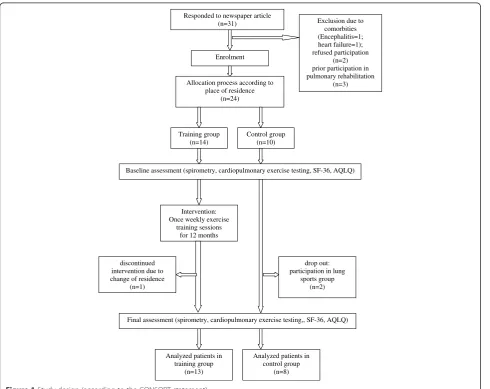
no impairment. A change > 0.5 points was rated as clin-ically significant as recommended [16]. See Figure 1 for patient flow.
Sample size
The sample size was based on a power calculation using maximum oxygen uptake (VO2max) as the primary
out-come measure (effect size, 1.16; standard deviation [SD], 4.0 L/min). VO2maxwas chosen as the primary outcome
measure because it is a valid and reliable measure of exer-cise capabilities. The estimate of the effect size was based on previous studies on exercise training in pulmonary habilitation [17]. The estimated number of patients re-quired in each group to detect a difference in VO2maxwith
80% power, a 2-tailed test, anαlevel ofPless than .05 and an allocation ratio of 0.8 was 10 patients in the intervention group and 8 patients in the control group. To allow for a 10% dropout rate, additional patients were recruited.
Responded to newspaper article (n=31)
Enrolment
Exclusion due to comorbities (Encephalitis=1; heart failure=1); refused participation
(n=2) prior participation in pulmonary rehabilitation
(n=3) Allocation process according to
place of residence (n=24)
Training group (n=14)
Control group (n=10)
Baseline assessment (spirometry, cardiopulmonary exercise testing, SF-36, AQLQ)
Intervention: Once weekly exercise
training sessions for 12 months
Final assessment (spirometry, cardiopulmonary exercise testing,, SF-36, AQLQ)
Analyzed patients in training group
(n=13)
Analyzed patients in control group
(n=8) discontinued
intervention due to change of residence
(n=1)
drop out: participation in lung
sports group (n=2)
Statistical analysis
Data were analysed for statistical significance using SPSS 7.5. Results were reported as means with stand-ard deviation (SD). Normality was tested using the Kolmogorov-Smirnov-test. A pairedt-test was used to compare measurements made at the start (t1) and fol-lowing one year of physical training (t2) in each group and a two-sample t-test for unequal variances. Effects were considered significant at p < 0.05.
Results
Patient population
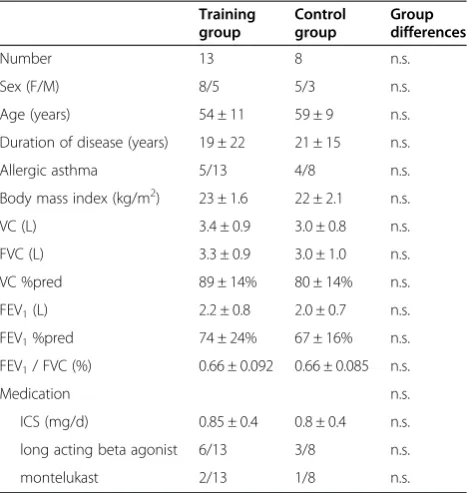
Thirty-one patients responded to the newspaper article. Six subjects had to be excluded. Of the remaining 24 pa-tients, 14 were assigned to the training program and 10 served as controls. One patient in the active group moved away and did not complete the study. Two pa-tients in the control group wanted to participate in the active lung sports group and were consequently ex-cluded from the study. Characteristics of the 21 partici-pants (13 women, 8 men, mean age 57 ± 10 years) completing the study are shown in Table 1. All results refer to this population. There were no differences be-tween the groups in age, duration of disease, lung func-tion or medicafunc-tion. In the exercise group, 6 subjects had mild, 4 moderate, and 3 severe asthma. The control group included 2 subjects with mild, 3 with moderate, and 3 with severe asthma.
The follow-up assessment regarding lung function and testing and body mass index showed no statistically differences compared to baseline assessments in both groups.
Exercise tolerance
Cardiorespiratory performance at peak exercise for pa-tients undergoing training and controls is shown in Table 2. All 21 participants had two cardiopulmonary exercise tests over a period of 12 month. At baseline (t1), reduced maximum work rates (WRmax) and
max-imum oxygen uptake (VO2max) demonstrated the
partici-pants’ low level of fitness. WRmax was only 68% of
predicted. Those assigned to the exercise group im-proved their mean WRmax by 18 ± 18 watts (p = 0.005),
their mean VO2max by 4.6 ± 4.36 ml/min/kg (p < 0.005),
their oxygen pulse by 1.6 ± 1.98 ml (p < 0.05), and their minute ventilation (VE) by 13.2 ± 18.72 l/min (p < 0.005)
after one year (t2). WRmax was different after one year
between the two groups (p < 0.05). In the control group, no changes of VO2max, maximal VE, or oxygen pulse
were observed after 12 months.
Health-related quality of life
Results of health status assessments are shown in Table 3. At baseline (t1) patients in both groups showed
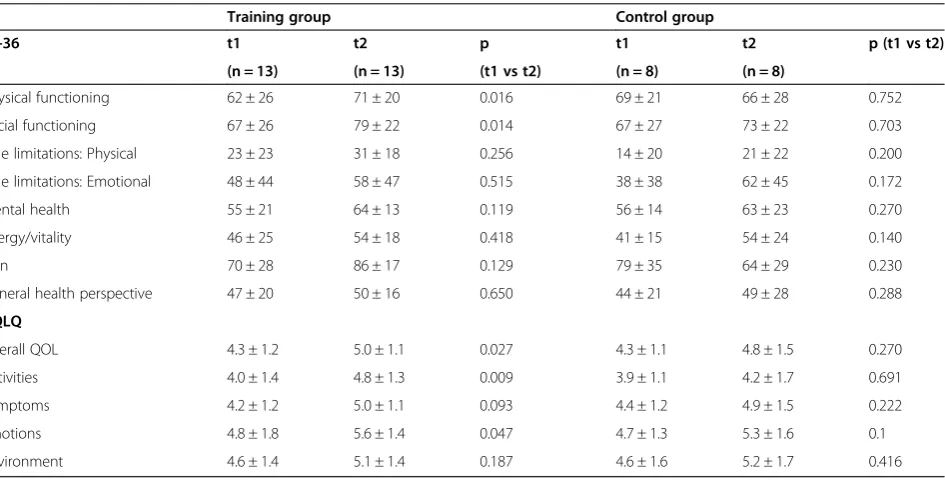
reduced quality of life according to their SF-36 and AQLQ scores. Complete quality of life data were ob-tained from all study participants at the final assess-ments (t2). Following the training program there were improvements in the SF-36 variables physical (+8.8 ± 10.7; p < 0.05) and social functioning (+11.5 ± 13.5; p < 0.05) for the training group (Table 3). Both changes were close to the published threshold for a clinically import-ant difference. Regarding AQLQ, we found statistically and clinically significant improvements in the domains: activities (+0.8 ± 0.8; p < 0.05), emotions (+0.8 ± 1.2; p < 0.05) and overall quality of life (+0.6 ± 0.9; p < 0.05). The symptoms domain did not reach the level of statistical sig-nificance (+0.6 + 1.2; p = 0.093). All parameters remained unchanged in the control group after one year.
There was no relationship between improvements in exercise capabilities and the improvements in SF-36 or AQLQ scores at the end of the study.
Peak flow measurements and adverse events
Patients used their medication regularly and peak flow measurements were constant over one year. A slight in-crease in peak flow rates was observed after each training session. No adverse events were noted during training ses-sions. Inhaled corticosteroid dose and bronchodilator use
Table 1 Baseline characteristics of the study population (n = 21)
Training group
Control group
Group differences
Number 13 8 n.s.
Sex (F/M) 8/5 5/3 n.s.
Age (years) 54 ± 11 59 ± 9 n.s.
Duration of disease (years) 19 ± 22 21 ± 15 n.s.
Allergic asthma 5/13 4/8 n.s.
Body mass index (kg/m2) 23 ± 1.6 22 ± 2.1 n.s.
VC (L) 3.4 ± 0.9 3.0 ± 0.8 n.s.
FVC (L) 3.3 ± 0.9 3.0 ± 1.0 n.s.
VC %pred 89 ± 14% 80 ± 14% n.s.
FEV1(L) 2.2 ± 0.8 2.0 ± 0.7 n.s.
FEV1%pred 74 ± 24% 67 ± 16% n.s.
FEV1/ FVC (%) 0.66 ± 0.092 0.66 ± 0.085 n.s.
Medication n.s.
ICS (mg/d) 0.85 ± 0.4 0.8 ± 0.4 n.s.
long acting beta agonist 6/13 3/8 n.s.
montelukast 2/13 1/8 n.s.
Values are mean ± standard deviation. F: female.
FEV1: forced expiratory volume in one second in litre/% of predicted. ICS: inhaled corticosteroids (relative to beclomethasone).
M: male. n.s.: not significant.
was unchanged to the baseline status in both groups. Dur-ing the study period 2 patients in the trainDur-ing group and 4 patients in the control group needed the transient adminis-tration of oral corticosteroids.
Adherence to training sessions
Adherence was 75 ± 15% during the study period. Most common reasons were personal (other engagement, holiday, social events) and to a much lesser degree exerbations. The only patient who dropped out of the ac-tive group moved away.
Discussion
The present study showed that adults with asthma partici-pating in a long-term, outpatient training program experi-enced improved cardiorespiratory fitness and health-related quality of life. These results were achieved by a program of comparatively low intensity. A unique feature of the study in comparison to previous studies of physical training in asthma is its duration of one year.
Optimal asthma care should lead to a normal life with-out restrictions [18]. This includes adequate medication, patient education on disease self-management, and psy-chological support. In addition, regular physical activity
Table 2 Peak exercise tolerance of training and control group before (t1) and after (t2) one year
Training group Control group
t1 t2 p t1 t2 p
(n = 13) (n = 13) t1 vs. t2 (n = 8) (n = 8) t1 vs. t2
WR (Watt)∑ 97 ± 32 116 ± 31 0.005 107 ± 22 100 ± 28 0.480
VO2(ml/kg/min) + 15.7 ± 5.0 20.4 ± 4.0 0.004 15.8 ± 4.0 16.8 ± 6.2 0.452
VO2/HR (ml) 8.7 ± 3.6 12.2 ± 3.9 0.032 9.4 ± 2.7 11.0 ± 2.5 0.108
VE(l/min) + 38.2 ± 17.3 51.5 ± 20.3 0.002 42.1 ± 10.0 42.1 ± 10.3 0.993
Values are mean ± standard deviation.
No statistically significant differences between both groups at t1.
∑p < 0.05 between both groups at t2. n.s.: not significant.
VO2/HR: O2pulse. VE: minute ventilation.
VO2: oxygen uptake per kg body weight. WR: work rate.
+ p < 0.1 between both groups at t2.
Table 3 Health-related quality of life of training and control group before (t1) and after (t2) one year
Training group Control group
SF-36 t1 t2 p t1 t2 p (t1 vs t2)
(n = 13) (n = 13) (t1 vs t2) (n = 8) (n = 8)
Physical functioning 62 ± 26 71 ± 20 0.016 69 ± 21 66 ± 28 0.752
Social functioning 67 ± 26 79 ± 22 0.014 67 ± 27 73 ± 22 0.703
Role limitations: Physical 23 ± 23 31 ± 18 0.256 14 ± 20 21 ± 22 0.200
Role limitations: Emotional 48 ± 44 58 ± 47 0.515 38 ± 38 62 ± 45 0.172
Mental health 55 ± 21 64 ± 13 0.119 56 ± 14 63 ± 23 0.270
Energy/vitality 46 ± 25 54 ± 18 0.418 41 ± 15 54 ± 24 0.140
Pain 70 ± 28 86 ± 17 0.129 79 ± 35 64 ± 29 0.230
General health perspective 47 ± 20 50 ± 16 0.650 44 ± 21 49 ± 28 0.288
AQLQ
Overall QOL 4.3 ± 1.2 5.0 ± 1.1 0.027 4.3 ± 1.1 4.8 ± 1.5 0.270
Activities 4.0 ± 1.4 4.8 ± 1.3 0.009 3.9 ± 1.1 4.2 ± 1.7 0.691
Symptoms 4.2 ± 1.2 5.0 ± 1.1 0.093 4.4 ± 1.2 4.9 ± 1.5 0.222
Emotions 4.8 ± 1.8 5.6 ± 1.4 0.047 4.7 ± 1.3 5.3 ± 1.6 0.1
Environment 4.6 ± 1.4 5.1 ± 1.4 0.187 4.6 ± 1.6 5.2 ± 1.7 0.416
Values are mean ± standard deviation.
provides benefits in asthmatic patients: Beneficial effects have been reported in a number of studies on children and young adults using in- and outpatient training programs.
The present study differs from those previously pub-lished in three important aspects. First, the training pro-gram duration was the longest ever reported for a controlled trial of exercise training in patients with asthma. Previous reports used programs of 6 to 16 weeks duration [7,19,20]. It is well known that effects gained by pulmonary rehabilitation programs wane subsequently [21]. Rather than achieving greater improvements of limited duration, training programs in chronic diseases should aim for lasting effects. The optimal duration of exercise programs is currently unknown. However, current guidelines recommend the longest duration pos-sible and practical [21]. Whether it is pospos-sible in training programs using three sessions per week to keep adher-ence of patients with asthma above the suggested level of 75% for more than 16 weeks has not been shown before. Hence, extrapolation of the results found in previous, shorter trials might be problematic. The latest Cochrane re-view on physical training in asthma addresses this aspect and explicitly stresses the specific need for studies of longer duration, i.e. one year or more [6].
However, mechanisms explaining improvements of short to medium-term programs (i.e. up to 16 weeks) may not be the same as those responsible for the changes reported in the present study: In the long-term setting adherence and psychological effects may become more important than training intensity or frequency. In this respect, a study that followed young asthmatics after attending a 10-week re-habilitation program is noteworthy [22]. Patients were en-couraged to undertake physical training at home but training intensity was left up to them. Interestingly, half of the patients decided to exercise 1–2 times per week but this was sufficient to maintain the initially achieved improve-ments over three years. This result highlights the assump-tion that over a longer period of time training once a week appears appropriate and feasible for most patients.
Second, the present study investigated effects of phys-ical training in adults with asthma with a mean age of 56 ± 10 years. Apart from very few previous reports [19,20,23] only children or young adults have been in-vestigated so far [7,8]. As asthma is a common diagnosis in adults this lack of data is surprising but may be due to underdiagnosis of adult asthma [9]. The only reports that studied older asthma patients differed from the present study as they either used breathing exercises as only training element [23], used a design of considerably higher intensity than in the present study [20] or failed to induce improvements in exercise capabilities [19]. Ex-clusion criteria especially regarding certain comorbidities may represent a possible reason for the paucity of data
on exercise training in elderly asthma patients. The present study confirms that exercise training is feasible and effective not only in young but also in older patients in asthma.
Together with the studies from Turner et al. [19] and Boyd et al. [20] the present report is the first controlled trial that measured quality of life in a group of adult asthmatics participating in physical training. All study participants had a reduced quality of life according to SF-36 and AQLQ at baseline comparable to reported re-sults for adults with asthma [24]. After one year of exer-cise training, components of SF-36 and AQLQ increased to a clinically meaningful extent [16,25]. In contrast to this study, Turner et al. only found improvements in quality of life while exercise capacity remained un-changed [19]. Boyd et al. demonstrated increments both in quality of life and fitness levels, however their study used a higher training intensity and covered a shorter time period [20].
Previous controlled studies reporting quality of life data only studied children [26,27], young adults [7,8] or mixed groups of patients with asthma and COPD [28]. All reported improvements in some of the measured components. As in the present study, changes in exer-cise performance were not correlated with the corre-sponding changes in quality of life in all but one report [7]. This observation indicates that factors other than physical capabilities influence quality of life. Further-more, physical training can also improve emotional scores. This fact underlines the important link between physical and emotional handicap in chronic diseases such as asthma and the psychological barriers against physical activity [2].
Third, in the present study a training program of lower intensity than usually recommended achieved the improve-ments. It is generally assumed that aerobic endurance train-ing on fewer than 2 days per week, at less than 40-50% of VO2max, and for less than 10 min is not a sufficient stimulus
for developing and maintaining fitness [29]. In contrast, the presented training group only had once weekly supervised sessions. Several circumstances may explain why this pro-gram still demonstrated increases in exercise capabilities similar to reported results [7,19,20].
The subjects started the program with a markedly re-duced fitness reflected in a WRmax of 68% of predicted
recommends a lower intensity and frequency of exer-cise [31]. Disabled subjects with chronic diseases and reduced physical fitness might not wish to achieve the highest levels of fitness. For these patients it appears to be sufficient to get fit enough to permit daily living.
Exercise limitation in asthmatics is not correlated to disease severity but is largely due to psychological ftors [2,32]. Patients may reduce their daily physical ac-tivity due to perceived dyspnea leading to a lower level of fitness. Once patients are used to certain levels of dys-pnea, they may tolerate higher exercise levels independ-ent of underlying lung function. It is well documindepend-ented that physical training does not induce improvements in lung function [6]. In line with this observation an in-crease in maximum VEwithout changes in lung function
was found. In this study, patients trained under perman-ent supervision of a physician. Hence, patiperman-ents felt more confident and exercised near their physical limits. Once they experience benefits from physical training, this may translate into a higher degree of activity in daily life.
Experiments in healthy twins have shown that intense training with several sessions per week can increase fit-ness rapidly with the disadvantage that this fitfit-ness is lost in the same time period [33]. Low intensity training once a week is a sufficient training stimulus and results in a relevant but much slower increase in maximal workload. “Athletic performance” which describes stability of fitness over time in this mode of training appears to be higher. This aspect is important for patients with chronic diseases who cannot attend training sessions regularly. In this study, training attendance was 75 ± 15% over one year.
Compared to published studies, the cost of establish-ing our trainestablish-ing program was low. Usestablish-ing facilities at local sports clubs, it was possible to run our program at a cost of €10 per training session per participant. This low cost design improves the practicability of the pre-sented program in the current health care environment with its financial restrictions. The ratio of 8–12 partici-pants per single trainer was higher than usual. While it was impossible to offer each subject individualised train-ing, this was balanced by higher motivation in a group of patients with common interests. Furthermore, every unit of the program allowed training on an individual level.
Study limitations
This study has some limitations including the non-randomized allocation process. Intervention allocation was based on the patient’s place of residence for prac-tical reasons. As there were only two training sites avail-able only patients living nearby were included in the training group. It was felt that travelling long distances would have impeded long-term adherence since travel time is a well-known factor of non-adherence. However,
the conclusions drawn are unlikely to be limited to a great extent by this methodological aspect. The alloca-tion process resulted in equally distributed baseline characteristics in both groups. As all participants lived in the same urban area the social environment was com-parable for all participants.
The high motivation in the training group was demon-strated by a high attendance rate and the fact that the only patient who dropped out had moved away. As motivation represents an important factor, one has to be careful when generalizing the results from a single group.
As the use of oral corticosteroids during the study period was higher in the control group than in the train-ing group, the intergroup difference in exercise capabil-ities may be explained by a difference in exacerbation rates. Although it cannot be ruled out that this differ-ence was purely by chance, we hypothesize that the lower exacerbation rate in the intervention group may reflect antiinflammatory effects of aerobic training. This hypothesis is supported by consistent reports of reduced airway inflammation following exercise training [34]. Furthermore, a prospective study found that in older women regular physical activity was associated with a re-duced risk of asthma exacerbations [35].
We did not measure physical activity outside training sessions; total exercise time per week is unknown. As a consequence, we cannot determine whether the once weekly training sessions or general lifestyle changes led to the observed improvements. Future studies should therefore measure physical activity levels, both pre- and post-intervention.
It is important to notify that the positive effects on physical fitness achieved in our comparably small sample may not be generalized to the broader asthmatic popula-tion as it is well known that training effects are greater in less fit individuals. This correlation has been shown in the work of Mendes et al. who found an inverse correl-ation between baseline VO2max and the training-related
improvements in VO2max[7].
Conclusions
This study demonstrates that a long-term, moderate-intensity physical training program was associated with relevant improvements of fitness and health-related quality of life in well-motivated older adults with asthma. These ef-fects were achieved in outpatient sport groups using limited resources. The duration of the program, one year, is the longest published so far.
Abbreviations
Competing interests
Dr. Volmer was a full-time employee of GlaxoSmithKline at the time of the study initiation. The remaining authors declare that they have no competing interests.
Authors’contributions
AM and KT participated in developing the study design, SG collected the data, HJB and AM drafted the manuscript. TM performed the statistical analysis. All authors revised the manuscript critically for important intellectual content. All authors read and approved the final manuscript.
Acknowledgements
The authors thank Dr. Liz wager for her editorial assistance. The authors paid Dr. Wager for her writing assistance.
This research received no specific grant from any funding agency in the public, commercial, or not-for-profit sectors.
Author details
1Department of Pneumology, Kliniken Mariahilf GmbH, Mönchengladbach, Germany.2Department of Pneumology, University Medical Centre
Hamburg-Eppendorf, Hamburg, Germany.3SMARTSTEP Consulting, Hamburg, Germany.4Atem-Reha, Hamburg, Germany.
Received: 7 November 2014 Accepted: 22 April 2015
References
1. Global strategy for asthma management and prevention Revised 2014 -online appendix. http://www.ginasthma.org/local/uploads/content/files/ GINA_Appendix_2014_Jun11.pdf. Accessed 20 Jan 2015.
2. Garfinkel SK, Kesten S, Chapman KR, Rebuck AS. Physiologic and
nonphysiologic determinants of aerobic fitness in mild to moderate asthma. Am Rev Respir Dis. 1992;145:741–5.
3. Westermann H, Choi TN, Briggs WM, Charlson ME, Mancuso CA. Obesity and exercise habits of asthmatic patients. Ann Allergy Asthma Immunol. 2008;101:488–94.
4. Erikssen G, Liestol K, Bjornholt J, Thaulow E, Sandvik L, Erikssen J. Changes in physical fitness and changes in mortality. Lancet. 1998;352:759–62. 5. Buhl R, Berdel D, Criée C-P, Gillissen A, Kardos P, Kroegel C, et al.
Guidelines for diagnosis and treatment of asthma patients. Pneumologie. 2006;60:139–77.
6. Carson KV, Chandratilleke MG, Picot J, Brinn MP, Esterman AJ, Smith BJ. Physical training for asthma. Cochrane Database Syst Rev. 2013;9:CD001116. 7. Mendes FA, Goncalves RC, Nunes MP, Saraiva-Romanholo BM, Cukier A,
Stelmach R, et al. Effects of aerobic training on psychosocial morbidity and symptoms in patients with asthma: a randomized clinical trial. Chest. 2010;138:331–7.
8. Dogra S, Kuk JL, Baker J, Jamnik V. Exercise is associated with improved asthma control in adults. Eur Respir J. 2011;37:318–23.
9. Hanania NA, King MJ, Braman SS, Saltoun C, Wise RA, Enright P, et al. Asthma in the elderly: current understanding and future research needs–a report of a National Institute on Aging (NIA) workshop. J Allergy Clin Immunol. 2011;128:S4–24.
10. Worth H, Meyer A, Folgering H, Kirsten D, Lecheler J, Magnussen H, et al. Recommendations of the German Respiratory League on sports and physical training for patients with obstructive respiratory tract diseases. Pneumologie. 2000;54:61–7.
11. American Thoracic Society Committee on Diagnostic Standards. Definitions and classification of chronic bronchits, asthma and pulmonary emphysema. Am Rev Respir Dis. 1962;85:762–8.
12. Garber CE, Blissmer B, Deschenes MR, Franklin BA, Lamonte MJ, Lee I-M, et al. American College of Sports Medicine position stand. Quantity and quality of exercise for developing and maintaining cardiorespiratory, musculoskeletal, and neuromotor fitness in apparently healthy adults: guidance for prescribing exercise. Med Science Sports Exerc. 2011;43:1334–59.
13. Bullinger M. German translation and psychometric testing of the SF-36 health survey: preliminary results from the IQOLA project. International Quality of Life Assessment. Soc Sci Med. 1995;41:1359–66.
14. Wyrwich KW, Tierney WM, Babu AN, Kroenke K, Wolinsky FD. A comparison of clinically important differences in health-related quality of life for patients
with chronic lung disease, asthma, or heart disease. Health Serv Res. 2005;40:577–91.
15. Juniper EF, Buist AS, Cox FM, Ferrie PJ, King DR. Validation of a standardized version of the asthma quality of life questionnaire. Chest. 1999;115:1265–70. 16. Juniper EF, Guyatt GH, Willan A, Griffith LE. Determining a minimal
important change in a disease-specific quality of life questionnaire. J Clin Epidemiol. 1994;47:81–7.
17. Strijbos JH, Postma DS, van Altena R, Gimeno F, Koeter GH. A comparison between an outpatient hospital-based pulmonary rehabilitation program and a home-care pulmonary rehabilitation program in patients with COPD. A follow-up of 18 months. Chest. 1996;109:366–72.
18. Global Initiative for Asthma: Global Strategy for Asthma Management and Prevention. WHO; 2012.
19. Turner S, Eastwood P, Cook A, Jenkins S. Improvements in symptoms and quality of life following exercise training in older adults with moderate/ severe persistent asthma. Respiration. 2011;81:302–10.
20. Boyd A, Yang CT, Estell K, Ms CT, Gerald LB, Dransfield M, et al. Feasibility of exercising adults with asthma: a randomized pilot study. Allergy Asthma Clin Immunol. 2012;8:13.
21. Spruit MA, Singh SJ, Garvey C, ZuWallack R, Nici L, Rochester C, et al. An official American thoracic society/European respiratory society statement: key concepts and advances in pulmonary rehabilitation. Am J Respir Crit Care Med. 2013;188:e13–64.
22. Emtner M, Finne M, Stalenheim G. A 3-year follow-up of asthmatic patients participating in a 10-week rehabilitation program with emphasis on physical training. Arch Phys Med Rehabil. 1998;79:539–44.
23. Gomieiro LT, Nascimento A, Tanno LK, Agondi R, Kalil J, Giavina-Bianchi P. Respiratory exercise program for elderly individuals with asthma. Clinics (Sao Paulo). 2011;66:1163–9.
24. Siroux V, Boudier A, Anto JM, Cazzoletti L, Accordini S, Alonso J, et al. Quality-of-life and asthma-severity in general population asthmatics: results of the ECRHS II study. Allergy. 2008;63:547–54.
25. Wyrwich KW, Nelson HS, Tierney WM, Babu AN, Kroenke K, Wolinsky FD. Clinically important differences in health-related quality of life for patients with asthma: an expert consensus panel report. Ann Allergy Asthma Immunol. 2003;91:148–53.
26. Fanelli A, Cabral ALB, Neder JA, Martins MA, Carvalho CRF. Exercise training on disease control and quality of life in asthmatic children. Med Sci Sports Exerc. 2007;39:1474–80.
27. Basaran S, Guler-Uysal F, Ergen N, Seydaoglu G, Bingol-Karakoc G, Ufuk Altintas D. Effects of physical exercise on quality of life, exercise capacity and pulmonary function in children with asthma. J Rehabil Med. 2006;38:130–5.
28. Cambach W, Chadwick-Straver RV, Wagenaar RC, van Keimpema AR, Kemper HC. The effects of a community-based pulmonary rehabilitation programme on exercise tolerance and quality of life: a randomized controlled trial. Eur Respir J. 1997;10:104–13.
29. ACSM. American college of sports medicine position stand. The recommended quantity and quality of exercise for developing and maintaining cardiorespiratory and muscular fitness, and flexibility in healthy adults. Med Sci Sports Exerc. 1998;30:975–91.
30. Baumann HJ, Kluge S, Rummel K, Klose HF, Hennigs JK, Schmoller T, et al. Low intensity, long-term outpatient rehabilitation in COPD: a randomised controlled trial. Respir Res. 2012;13:86.
31. Chodzko-Zajko WJ, Proctor DN, Fiatarone Singh MA, Minson CT, Nigg CR, Salem GJ, et al. American college of sports medicine position stand. Exercise and physical activity for older adults. Med Sci Sports Exerc. 2009;41:1510–30. 32. Clark CJ, Cochrane LM. Assessment of work performance in asthma for
determination of cardiorespiratory fitness and training capacity. Thorax. 1988;43:745–9.
33. Meller W, Mellerowicz H. Vergleichende untersuchungen über dauertraining mit verschiedener häufigkeit, aber gleicher arbeit und leistung an eineiigen zwillingen. Sportarzt und Sportmedizin. 1968;12:520–3.
34. Pakhale S, Luks V, Burkett A, Turner L. Effect of physical training on airway inflammation in bronchial asthma: a systematic review. BMC Pulm Med. 2013;13:38.