Student Perceptions of the Professional Behavior of Faculty Physicians
Karen Szauter MD, Betty Williams PhD, Michael A. Ainsworth MD, Michael Callaway MS, Robert Bulik PhD, Martha G.Camp PhD
Department of Internal Medicine and Office of Educational Development The University of Texas Medical Branch,
Galveston Texas
Abstract: This study was conducted to obtain a baseline understanding of the professional behav-ior of clinical faculty physicians from the medical students’ perspective. Students completed a professionalism evaluation of supervising faculty at the end of each required third-year clerkship over a one year period. Results were analyzed by specific behaviors and across clerkships. Dif-ferences were noted in the frequency of the types of problems seen, and varied by clerkship disci-pline. The most common transgressions of professional behavior reported were the use of deroga-tory language towards other services or patients and the disrespectful treatment of others. Our study served to provide objective feedback to the faculty about student perceptions of faculty as role models for professionalism while on clinical rotations.
Key Words: Professionalism, undergraduate medical education, role models
Professional behavior is fundamental to the prac-tice of medicine. To provide medical students expo-sure to the theories of professional behavior and clear practice guidelines, many institutions have intro-duced formal instruction and evaluation systems to track students’ professional development.1,2,3 In addi-tion to formalized professionalism educaaddi-tion, a learn-ing environment that reinforces optimal professional behavior is key to the internalization of these impor-tant concepts. Ideally, the theoretical concepts of pro-fessionalism are reinforced to students through the consistent observation of professional behavior among their teachers.
As teachers, medical school faculty and volun-teer physician preceptors accept the important re-sponsibility of serving as role models to medical stu-dents.4 Prior studies have examined the characteris-tics that students and residents value in their teachers. Although a high standard of knowledge is vital, hu-manistic and professional characteristics are reported by trainees as important in role models.5,6,7 We per-formed this study to better understand student percep-tions of the professional behavior of the supervising faculty physicians at our institution. We hoped to gain insight into the culture our educational program, and to identify professionalism issues that might benefit from focused faculty development.
Methods
A seven-statement “Evaluation of Professional-ism” form was developed. Each statement began with “I observed my faculty…” and addressed issues
that could be objectively assessed during standard student-faculty interactions (Table 1). Students re-sponded to each statement on a four-point scale an-chored by “consistently”, “frequently”, “occasion-ally”, and “never”.
The form was shared with the seven third-year clerkship directors and agreement for clerkship par-ticipation was obtained. The Institutional Review Board reviewed the protocol and permission was granted to conduct the study. During the 1999-2000 academic year, the Evaluation of Professionalism forms were distributed at the end of each of the seven third-year clinical clerkships: Pediatrics (4 weeks), Internal Medicine (8 weeks), Psychiatry (6 weeks), Obstetrics and Gynecology (6 weeks), Family Medi-cine (4 weeks), Surgery (8 weeks), and the Multidis-ciplinary Ambulatory Clerkship (a combined Pediat-rics, Internal Medicine and Family Medicine ambula-tory rotation, 12 weeks). Students were asked to complete an evaluation form for each faculty with whom they had meaningful contact during the clerk-ship. Students completed the forms anonymously and were asked not to identity the faculty being evaluated. Students did identify the clerkship disci-pline, type of rotation (general vs. subspecialty) and location of the experience (on campus vs. off cam-pus). A section for comments was provided.
allowed a comparison of responses to each statement by clerkship. The data from each clerkship were fur-ther analyzed by rotation type and location. All comments were content analyzed for major themes and grouped for review.
An additional analysis was performed by scoring each evaluation form using a simple rubric to obtain a binomial score. Specifically, if the student’s re-sponse to any of the statements was “consistently”, “frequently” or “occasionally”, the form was desig-nated as “issues identified”. If the response to each of the seven statements was “never”, the evaluation form was designated as “no issues identified”. The percent of forms with “issues identified”(suggesting that the student observed some type of unprofessional behavior in the supervising faculty member), was compared to the percent of forms with “no issues identified” for each clerkship.
Results
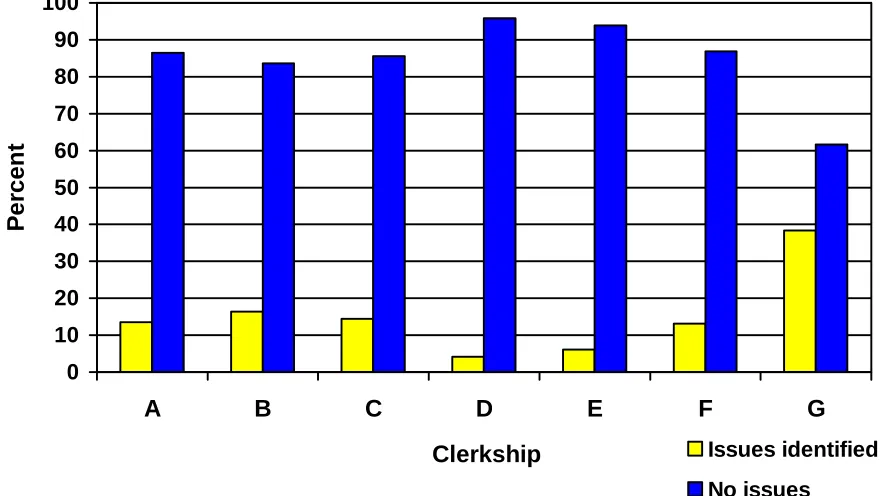
During the study period, 2,685 evaluation forms were collected from the class of 200 students. The percent of “never” responses are shown by statement and by clerkship (Table 2). There were notable dif-ferences in the reporting of problems of professional behavior by clerkship discipline, ranging from almost no problems reported (Clerkship D and E) to many problems noted (Clerkship G). [Note: Specific clerk-ship identities are deliberately not linked to the re-sults of this report to avoid fueling speculation about disciplines or educational settings based on data from a single institution.] When the data were broken down further and analyzed by clerkship rotation and
location, the frequency of re-ported problems was somewhat higher for general vs. subspe-cialty rotations and for on campus vs. off campus rotations. Our findings showed that the most common transgressions of faculty professional behavior reported by students were the use of deroga-tory commentary directed at other services, at patients, or toward a patient’s family.
When viewing each evalua-tion form (e.g.: one student – faculty interaction) as a unit of measure, the frequency with which issues were noted varied by clerkship. Figure 1 shows the percent of evaluation forms, compared across clerkships, with “issues identified” vs. those with “no issues identified”.
TABLE 1: Evaluation of Professionalism
Students were asked to react to following seven statements:
• I observed my faculty making derogatory comments about other ser-vices
• I observed my faculty making derogatory comments about a patient or the patient’s family
• I observed my faculty inappropriately withholding information or inten-tionally giving incorrect information to a patient
• I observed my faculty using disrespectful terminology in the description of patients (e.g.: gomer, hit, frequent flyer, dirtball)
• I observed my faculty discussing confidential information in an inap-propriate setting (e.g.: cafeteria, elevator)
• I observed my faculty treating non-physician healthcare workers in a disrespectful or inappropriate manner
•
I observed my faculty treating patients differently because of the pa-tient’s financial status, ethnic background, sexual or religious prefer-encesStudents provided many comments about their supervising faculty. Many of the comments praised the faculty for providing excellent teaching and role modeling for the students. The majority of the nega-tive comments dealt with issues of language use, in-appropriate use of humor, disrespectful treatment of patients or colleagues, and apparent disinterest in teaching. Students also provided commentary re-garding the professional behavior of other team members including residents and the nursing staff. These comments also tended to be at the extremes: either examples of exceptional behavior or comments revealing behaviors that had a negative impact on the learning environment.
Discussion
Table 2: Percent of “never” responses to each statement
CLERKSHIP
(n= number of evaluations collected) Statement on Evaluation
Form
A n=275
B n=391
C n=660
D n=191
E n=668
F n=237
G n=263 derogatory comments
about other services
94.9 90.0 92.7 98.9 97.9 96.2 73.0
derogatory comments about a patient /patient’s family
92.0 92.6 92.7 98.4 97.0 92.8 82.1
inappropriately withhold-ing /intentionally givwithhold-ing incorrect information to a patient
99.6 97.8 97.7 99.5 99.6 97 96.6
disrespectful terminology in the description of pa-tients
95.6 91.0 94.8 97.9 99.3 94.1 82.1
confidential information in an inappropriate setting
97.5 96.2 96.5 99.5 98.5 95.4 94.3
treating non-physician healthcare workers in a disrespectful or inappropri-ate manner
98.9 97.2 97.4 99.5 99.3 98.7 87.1
treating patients differently because of patient’s back-ground/beliefs
98.9 97.7 97.4 97.9 99.4 98.7 94.7
* Percent responses <95 are shown in bold
for this study also have a potential to be modified with feedback, and therefore are valuable to recog-nize since change is possible.
Because the data were collected throughout an academic year, students had an opportunity to com-plete the same evaluation form during each clinical clerkship. Differences seen in the responses to spe-cific statements, and the overall differences in the evaluations between clerkships, suggest that the stu-dents did discriminate in their responses to each statement (see Table 2). Issues often discussed dur-ing the teachdur-ing of medical professionalism, such as breach of confidentiality and the inadequate disclo-sure of information to patients were faculty behaviors observed infrequently by students. However, unpro-fessional use of language and disrespectful behavior towards others were behaviors more commonly iden-tified by students in faculty. Differences noted
be-tween clerkships are difficult to interpret. Potential explanations for these differences are many: a few unprofessional individuals in a department, a depart-mental attitude or belief unique to this institution, or even an attitude consistent across institutions in a specific discipline. Given that the primary focus of this study was to better understand student percep-tions of the professional behavior and culture of our own institution, we are reluctant to over interpret or speculate more broadly on these finding.
0 10 20 30 40 50 60 70 80 90 100
A
B
C
D
E
F
G
Clerkship
P
e
rcen
t
Issues identified
No issues
Figure 1
that students have their first prolonged exposure to clinical faculty in both a patient care and teaching role. Impressions of clinical faculty, and of specific specialties in medicine, are formed during this critical year of education. Role modeling experiences influ-ence career selection at both the student and housestaff level.9,10 Physician-teachers have an im-portant responsibility to optimize the learning envi-ronment and to promote the professional develop-ment of the medical students through consistent, pro-fessional behavior. An environment with conflicting guidelines and practices can result in student behav-iors that are contrary to professional expectations.11, 12
Certain limitations of the study must be noted. The evaluation form was distributed at the end of each rotation along with other evaluation tools. Ad-ditional time for reflection, or focus group discus-sions of the clerkship experience, may have resulted in different frequencies of reported behaviors or more descriptive qualitative data, respectively Understand-ing a student’s reaction to a specific situation can also not be assessed by the methodology used. For exam-ple, a comment made by a faculty member about a patient may be considered derogatory by one student but not by another.
While raising awareness of behaviors can be aided by studies such as this, changing the behavior
of clinical faculty is much more challenging. Our findings have been shared with the Deans, Depart-ment Chairs and Clerkship Directors through a num-ber of venues, and hard copies of the data were pro-vided to these administrators with their own depart-ment’s data identified. The study results have been mentioned in presentations on professionalism in-cluding grand rounds and community-based faculty development workshops. It is hoped that understand-ing where change needs to occur will encourage some of the faculty members to recognize and mod-ify their own behavior, and encourage others to work towards a culture where these behaviors are no longer tolerated among their colleagues.
A follow up study on student perceptions of the residents is being completed. Additional plans are underway to study faculty of all four of the health care schools at our university
Acknowledgements
References 8. ABIM Foundation. American Board of Inter-nal Medicine. ACP-ASIM Foundation. Ameri-can College of Physicians-AmeriAmeri-can Society of Internal Medicine. European Federation of Internal Medicine. Medical professionalism in the new millennium: a physician charter. An-nals of Internal Medicine. 136(3):243-6, 2002. 1. Fehser J. Teaching professionalism: a student's
perspective. Mount Sinai Journal of Medicine. 69(6):412-4, 2002.
2. Papadakis MA, Osborn EHS, Cooke M, Healy K. A Strategy for the Detection and Evalua-tion of Unprofessional Behavior in Medical Students. Academic Medicine 1999;74(9) 980-990.
9. Erzurum VZ, Obermeyer RJ, Fecher A, Thya-garajan P, Tan P Koler AK et al. What influ-ence medical students’ choice of surgical ca-reers. Surgery. 2000;128:258-256.
3. Hemmer PA. Hawkins R. Jackson JL. Pangaro LN. Assessing how well three evaluation methods detect deficiencies in medical stu-dents' professionalism in two settings of an in-ternal medicine clerkship. Academic Medicine. 2000;75(2):167-73, 2000.
10. Connelly MT, Sullivan AM, Peters AS, Clark-Chiarelli N, Zotov N, Martin N, Simon SR, Singer JD, Block SD. Variation in Predictors of Primary Care Career Choice by Year and Stage of Training: A National Survey. Journal of General Internal Medicine. 2003;18(3):159-169.
4. Ficklin FL, Browne VL, Powell RC, Carter JE. Faculty and House Staff Members as Role Models. Journal of Medical Education
1988;63: 392-396.
11. Feudtner C, Christakis DA, Christakis NA. Do Clinical Clerks Suffer Ethical Erosion? Students’ Perceptions of Their Ethical Envi-ronment and Personal Development. Aca-demic Medicine. 1994; 69(8) 670-679. 5. Maheux B, Beaudoin C, Berkson L, Cote L ,
Des MJ, Jean P. Medical faculty as humanistic physicians and teachers: the perceptions of students at innovative and traditional medical schools. Medical Education. 2000;34-630-634
12. Maudsley RF. Role models and the learning environment: essential elements in effective medical education. Academic Medicine. 2001; 76:432-434.
6. Wright S. Examining what residents look for in their role models. Academic Medicine. 1996;71:290-292.
Correspondence
7. Wright SM, Kern DE, Kolodner K, Howard DM, Brancati FL. Attributes of excellent at-tending-physician role models. New England Journal of Medicine. 1998;339:1986-1993.
Karen Szauter, MD
The University of Texas Medical Branch Route 0420