O R I G I N A L R E S E A R C H
Developing and Validating an Adjustment Scale:
The Adaptation Status Assessment of
Drug-Resistant Tuberculosis Patients
This article was published in the following Dove Press journal: Psychology Research and Behavior Management
Haini Liu1 Jingjie Zhao2 Yi Cao1 Hualin Jiang3 Shaoru Zhang1 Zhongqiu Hua1 Jing Ren1 Dan Ren1
1Department of Nursing, Health Science
Center, Xi’an Jiaotong University, Xi’an, People’s Republic of China;2College of Media, Xijing University, Xian, People’s Republic of China;3Department of Epidemiology and Health Statistics, Health Science Center, Xi’an Jiaotong University, Xi’an City, People’s Republic of China
Purpose: Drug-resistant tuberculosis (DR-TB) remains a major global public health issue.
For DR-TB patients, effective adaptation is crucial to prevent disease progression, improve health outcomes and decrease mortality. To date, there is no appropriate tool for evaluating the adaptation status of DR-TB patients. In this work, we aim to develop an adjustment scale for DR-TB patients (AS-DRTBP) and to evaluate its psychometric properties.
Patients and Methods:The development of the AS-DRTBP was based on the theory of
the Roy adaptation model (RAM). The scale was designed through a literature review, in-depth individual interviews, a Delphi survey, and pilot testing. In total, 433 patients with DR-TB were recruited to validate the instrument. The split-half reliability coefficient, Cronbach’s alpha coefficient, and test-retest reliability coefficient were calculated to assess the reliability of the instrument. Content validity, construct validity and concurrent validity tests were applied to calculate the validity of the instrument.
Results:Thefinal AS-DRTBP consisted of four dimensions and 26 items. The Cronbach’s
alpha coefficient, split-half reliability coefficient and test-retest reliability coefficient were 0.893, 0.954, and 0.853, respectively. The content validity index was 0.92. Four factors that explained 64.605% of the total variance were also further determined by confirmatory factor analysis (CFA). The CFA results showed that thefitting effect of the model was appropriate (CMIN/DF = 1.681, GFI = 0.832, AGFI = 0.799, RMSEA = 0.055, SRMR = 0.0684). The AS-DRTBP and adjustment scale had correlation in the total score, and the correlation coefficient was 0.355 (p<0.05).
Conclusion: Thefindings of this study demonstrate that the AS-DRTBP is a reliable and valid
instrument for measuring the adaptation status of patients with DR-TB, allowing health providers to comprehend the adaptive level of DR-TB patients and thus laying the foundation for interventions to help these patients achieve a physiologically, psychologically and socially optimal outcome.
Keywords:adaptation, drug-resistant tuberculosis, validation, reliability, adjustment
Introduction
Drug-resistant tuberculosis (DR-TB) is a major global public health challenge.1
China has the second highest DR-TB burden worldwide, with 73,000 reported cases
in 2017.1DR-TB patients experience a long treatment duration, severe adverse drug
reactions, and a heavy economic burden.2For DR-TB patients, effective adaptation
is crucial to prevent disease progression.3
The Roy adaptation model (RAM) was proposed by Callista Roy. According to
this model, adaptation is defined as the ability of an individual to adjust to the
Correspondence: Hualin Jiang; Shaoru Zhang
Health Science Center, Xi’an Jiaotong University, No. 76 Yanta West Road, Yanta, Xi’an, Shanxi 710061, People’s Republic of China
Tel +86 029 8265 7015 Fax +86 029 8265 7017 Email [email protected]; [email protected]
Psychology Research and Behavior Management
Dove
press
open access to scientific and medical research
Open Access Full Text Article
Psychology Research and Behavior Management downloaded from https://www.dovepress.com/ by 118.70.13.36 on 26-Aug-2020
environment and to maintain the optimal state of the
individual’s body and mind. The RAM suggests that all
humans have certain needs that they need to meet to maintain integrity. These needs are met through the four modes of adaptation, namely, the physiologic,
self-concept, role function, and interdependence modes.4,5
Maladaptation presents in several ways, including physi-cal discomfort, psychologiphysi-cal distress, individual role
reversal and interpersonal breakdown.6 Maladaptation
increases disease recurrence and mortality; conversely,
successful adjustment accelerates recovery.7 Being
diag-nosed with DR-TB is a strong emergent stimulus and an
extremely stressful experience for patients.8 DR-TB
patients suffer from fear, stigma, interpersonal breakdown, severe adverse drug reactions and, consequently,
maladap-tation (e.g., a serious decline in treatment confidence, poor
drug compliance and a heavy psychological burden),2,3,9
thus leading to worse treatment outcomes and a lower
quality of life.10 Providing biopsychosocial care for
DR-TB patients in hospitals and communities is a crucial
issue.11 It is vital for health service providers to assess
the performance of patients’adaptation status and to
eval-uate the adjustment level, thus managing maladaptation
and promoting patients’well condition during their
treat-ment journey.
Examining patients’ adaptation status is premised on
effective and reasonable assessment instruments. Several adjustment assessment tools are available for adaptation status assessment, such as the scales for patients with
stoma,11patients with chronic obstructive pulmonary
dis-ease (COPD),12 antenatal patients13 and patients with
cancer.14 However, these scales are related to specific
disease categories, and to date, relevant research focused on a TB patient adjustment scale has not been conducted. It is necessary to develop an adaptation status scale for the DR-TB population.
The RAM concepts of stimuli, coping mechanisms, and modes of adaptation have been translated into several middle-range concepts and measured using new and
exist-ing instruments.15 Based on the RAM, we developed an
adjustment scale for DR-TB patients (AS-DRTBP) based on the following steps: a literature review, expert consulta-tion, and pretesting. The reliability and validity of the scale were evaluated by calculating the internal
consis-tency and reliability coefficients and by conducting
exploratory factor analysis (EFA) and confirmatory factor
analysis (CFA).
Materials and Methods
Participants
A convenience sampling strategy was used to recruit par-ticipants with DR-TB from six institutions in Shaanxi
Province (Shaanxi Province Tuberculosis Hospital, Xi’an
Chest Hospital, Huashan Hospital, and the designated TB hospitals of the Baqiao District, Weiyang District and Lianhu District) between January 2018 and May 2019.
The inclusion criteria were (a) having a confirmed
diagnosis of TB infection with DR-TB, including rifampi-cin-resistant TB (RR-TR) or multidrug-resistant TB (MDR-TB), (b) being 18 years of age or older, (c) being conscious and able to answer questions (with the research-ers reading the scale to elderly or illiterate participants), and (d) being willing to participate in the study and sign-ing the written informed consent form. Considersign-ing that patients diagnosed with extensively drug-resistant TB (XDR-TB) often suffer from more serious conditions and complications, this study excluded patients with XDR-TB and other patients designated for intensive care.
In factor analysis,five participants per item is the
mini-mum recommended sample size. Since the expected number of items was 33, a minimum of 165 participants were
required.16 It has been widely acknowledged that the EFA
and CFA samples should be two independent samples, with
sizes of at least 100 participants17 and 200 participants,18
respectively. Taken together, assuming a 20% non-response rate, a minimum sample size of 360 was required.
Scale Development
Theoretical FrameworkThe AS-DRTBP was developed based on the theory of the
RAM. Roy first published the RAM in 1970 and since
then has continuously updated it.19The RAM strengthens
the adaptive level and process of people as an adaptive system facing various stimuli in the environment from
a holistic perspective.5 According to the RAM, humans
are considered an adaptive system. After stimulation by external and internal environments, the human body responds through a physiological regulation system and a cognitive regulation system that can generate changes in physiological function, self-concept, role function and interdependence. Finally, the body generates an adaptive
response or an ineffective response.6 In recent years, the
RAM has been used to guide the development of prenatal assessment tools for pregnant women and the
develop-ment of tools for studying stoma patients20 and cancer
Psychology Research and Behavior Management downloaded from https://www.dovepress.com/ by 118.70.13.36 on 26-Aug-2020
patients,14among others. Patients living with DR-TB suf-fer from changes related to physiology, psychology, role and society, and they need to adjust and adapt to these changes, which are consistent with the four adaptation
modes of Roy’s adaptation theory. Therefore, this study
used Roy’s adaptation theory to guide the development of
the AS-DRTBP. Based on the four adaptation modes, the framework of the AS-DRTBP is divided into four sec-tions: physiological function, self-concept, role function, and interdependence.
Development of the Item Pool
A literature review and individual in-depth interviews were conducted to generate the initial item pool of the AS-DRTBP. The literature review included studies on the adjustment of patients, changes in the physiology, psychology, role and inter-personal relationships of DR-TB patients and the development
of specific scales, identifyingfields involving DR-TB patient
adjustment. For the interviews, we recruited a convenience sample of 23 DR-TB patients to explore the changes and coping methods they experienced during their disease journey. At the end of this step, a draft of the AS-DRTBP, consisting of 32 candidate items, was formed.
Delphi Method
The Delphi method was used to select the items of the AS-DRTBP. Twelve experts with expertise in TB control and care in China (four TB prevention and control researchers, four clinical diagnosis and treatment physicians, two TB educators, and two nurse consultants in TB) evaluated the item pool of the scale. Two rounds of Delphi method expert letter consultation by email were used to screen the items in the AS-DRTBP. In each round, the experts were required to
rate the importance of each item on afive-point Likert scale
ranging from 1=least relevant to 5=most relevant. Items with an assigned average item score > 3.50, a coefficient of varia-tion (CV) < 0.25 and an item-level content validity index
(I-CVI, defined as the proportion of experts who rated the
item as 4 or 5) > 0.78 were retained. The accuracy and clarity
of the items were also evaluated by the experts.21After the
two-round Delphi consultation, there were a total of 33 items, and these items formed the initial AS-DRTBP: 2 items for physiological function, 8 items for self-concept, 15 items for role function and 8 items for interdependence.
Pilot Study
A pilot study of the AS-DRTBP was conducted at Xi’an
Chest Hospital, Shaanxi Province, China, in June 2018. A convenience sampling method was used to survey 59
DR-TB patients to complete the prefinal version of the
AS-DRTBP for testing the clarity and intelligibility of the items, the layout of the scale and the time needed to complete
the test. The respondents were 18–67 years of age, and the
mean age was 35.95 years (SD = 12.45). All of the patients who participated in the pilot study provided general demo-graphic data and completed the initial draft of the
AS-DRTBP in 15–18 min. The respondents showed few
pro-blems with the intelligibility and clarity of the items, and they presented a good acceptance of the scale. After revising the expression of some items based on feedback, the test version of the AS-DRTBP, consisting of 33 items, was established.
Data Collection
The research team that administered the questionnaire was composed of three trained researchers. We distributed the questionnaires to the patients in a face-to-face manner and acquired written informed consent prior to the survey. The questionnaire was composed of three parts: demographic data, the DRTBP and the adjustment scale. The AS-DRTBP consisted of four sections: physiological function, self-concept, role function and interdependence. The physio-logical function section included multiple choice questions
whose scores were summed. In contrast, afive-point Likert
scale ranging from 1 (strongly disagree) to 5 (strongly agree) was used to quantify the results of the other three parts. The
adjustment scale was a general scale measuring the patient’s
adaptive level.15It consisted of a single item and a ten-point
rating scale ranging from 1 (not well) to 10 (very well), with a lower number indicating more compromised life processes and a higher number indicating the opposite. The adjustment scale has been used to measure adjustment to living with spinal cord injury among spinal cord-injured individuals.22,23
Data Analysis
Data analyses were performed using IBM SPSS (version 22.0) and AMOS (version 20.0). Descriptive statistics were used to describe the demographic variables.
Item Analysis
A quantitative method was used to verify thefitness of the
items, thus examining whether an item should be removed or retained in this study. An item was removed if it met one or more of the following criteria: (1) the mean of the item was extreme, or its variance was zero; (2) the critical
ratio (CI) value of an item was found to be nonsignificant;
or (3) the correlation coefficient between the item and the
total score was not significant.24
Psychology Research and Behavior Management downloaded from https://www.dovepress.com/ by 118.70.13.36 on 26-Aug-2020
Validity Analysis Content Validity
Content validity was assessed in thefinal round of the Delphi
survey. The experts were required to verify the relevance and
importance of each item using afive-point Likert scale. The
proportions of items given a rating of 4 or 5 by all experts were computed to determine the I-CVI. The average content validity index of each item represented the content validity index at the scale level (S-CVI). A statistically acceptable I-CVI should be > 0.78, and a statistically acceptable S-CVI should be > 0.90.21
Construct Validity
The construct validity of the scale was tested by the total samples, which were randomly divided into two parts (N1 = 206, N2 = 227). One group of patients (N1 = 206) was used to perform the EFA, while the other group (N2 = 227) was used to perform the CFA. The number and nature of the potential factors in the scale were determined by the EFA. The factors of the scale were extracted by principal component factor analysis with the varimax orthogonal rotation method. Prior to performing EFA, the Kaiser-Meyer-Olkin (KMO) test
for sampling adequacy and Bartlett’s test of sphericity were
conducted. If Bartlett’s test of sphericity obtained a result of
p<0.05 and the KMO value was > 0.6, then the data were
suitable for EFA.25The number of potential factors was
deter-mined according to the following criteria: (a) an eigenvalue > 1.0 and (b) a scree plot representing all factors above the elbow
or a break in the plot.26Items were retained if they met the
following two criteria: (a) a factor loading > 0.4 without a crossing factor and (b) a conceptual coherence of the items with their corresponding factors.27,28The factor structure of
the scale identified in the EFA was verified by a CFA. As the
sample data (N2 = 227) did not have a normal distribution, the parameters of this model were estimated by the generalized
least squares (GLS) method.27Modelfitness was evaluated by
the minimum discrepancy divided by its degrees of freedom
(CMIN/DF), the goodness of fit index (GFI), the adjusted
goodness offit index (AGFI), and the root mean square error
of approximation (RMSEA). If the CMIN/DF < 2 (p>0.05),
the GFI and AGFI > 0.90, and the RMSEA < 0.08, then the data indicate a good modelfit.29
Concurrent Validity
Concurrent validity was assessed by the Spearman
correla-tion coefficient between the AS-DRTBP scores and the
adjustment scale scores as well as the factor scores.
Reliability Analysis
The Cronbach’s alpha coefficient, split-half reliability coeffi -cient and test-retest reliability coefficient were calculated to evaluate the reliability of the AS-DRTBP. The split-half reliability method was used to divide the scale items of the AS-DRTBP into odd-even parts according to the number, and then, the correlation of the score between the two parts was computed. Test-retest reliability was assessed by ran-domly selecting 51 DR-TB patients from the total number of participants. These patients were assessed again two weeks
later. The interclass correlation coefficient (ICC) of the
scores was calculated to determine the test-retest reliability of the scale. A statistically acceptable reliability coefficient of the total scale should be > 0.70, and a statistically accep-table reliability coefficient of a subscale should be > 0.6.30
Results
Participants
’
Demographic
Characteristics
A total of 456 participants were recruited for thefield test.
A total of 442 participants completed the AS-DRTBP; thus, the response rate was 96.93%. The researchers checked the questionnaires before entering the data. Nine invalid ques-tionnaires with obvious response rules were excluded. The valid AS-DRTBP sample size was 433, which was more than the minimum required number of participants. Overall, the
respondents were 18–78 years of age, and the mean age was
34.92 years (SD = 14.35). The mean age of the DR-TB patients was basically similar to that of patients in other
provinces in China.31,32 The mean ages of the respondents
in the EFA and CFA groups were 35.56 years (SD = 15.22) and 34.34 years (SD = 13.52), respectively. The demographic characteristics of the EFA, CFA and total samples are shown
inTable 1. In the EFA (N1 = 206) and CFA samples (N2 =
227), the differences in demographic characteristics such as gender, age, educational level, nationality, marriage, resi-dence, patient type, economic income, and insurance type were not statistically significant.
Item Analysis
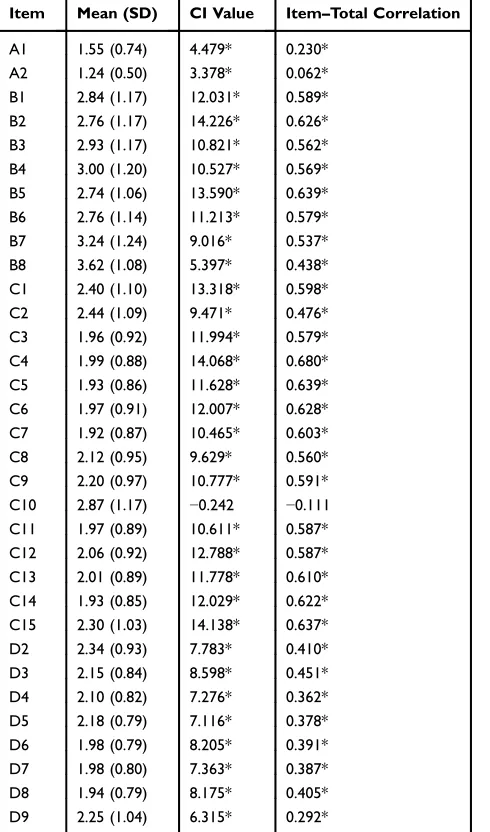
The means of all items ranged from 1.24 to 3.62. There were no items with a variance of 0. The CI values of all items
except for item C10 were significant; the item-total
correla-tions of all items except for item C10 were significant.
According to the criteria mentioned above, item C10 (After I recovered from my illness, I can continue to take on my original job and family responsibilities) was removed.
Psychology Research and Behavior Management downloaded from https://www.dovepress.com/ by 118.70.13.36 on 26-Aug-2020
Finally, 32 items were retained.Table 2shows the results of the item analysis.
Assessing the Psychometric Properties of
the Scale
Content Validity
In the final round of Delphi consultation, the CVI ranged
from 0.80 to 1.00 for each item, and the average CVI for all items of the scale was 0.92. The results showed that the
majority of experts assessed the items on the scale with
a rating of“quite important”or“most important”,
indicat-ing strong agreement among the specialists and, therefore, high content validity.
Construct Validity by EFA
The KMO result was 0.85, and the result of Bartlett’s test of
sphericity was significant (χ2= 4341.006,p<0.001), demon-strating that the sample data were suitable for factor analysis. To obtain the best factor structure, the stepwise deletion
Table 1Demographic Characteristics of Participants
Total (N=433) EFA (N1=206) CFA (N2=227) χ2/z p
Gender 0.481 0.488
Male 268 131 137
Female 165 75 90
Age(Mean ± SD) 34.92±14.35 35.56±15.22 34.34±13.52 −0.460 0.645
Education background 1.089 0.896
Primary School or below 33 17 16
Junior High School 98 48 50
Senior High School 115 53 62
Junior college 96 48 48
Bachelor’s Degree or above 91 40 51
Nationality 0.029 0.865
Han 421 200 221
Minority 12 6 6
Marriage 0.961 0.811
Unmarried 184 83 101
Married 238 118 120
Divorced 5 2 3
Spouses loss 6 3 3
Residence 0.180 0.671
Urban 208 92 106
Rural 225 114 121
Patient type 0.033 0.856
Outpatient 92 43 49
Inpatient 341 163 178
Economic income 1.062 0.900
≤1999 yuan 133 62 71
2000–4999 yuan 208 103 105
5000–9999 yuan 75 34 41
≥10,000 yuan 17 7 10
Insurance type 3.254 0.776
Public pay 8 4 4
Rural cooperative medical care 241 116 125
Urban residents medical insurance 130 61 69
Commercial insurance 9 5 4
Self-pay 33 13 20
Psychology Research and Behavior Management downloaded from https://www.dovepress.com/ by 118.70.13.36 on 26-Aug-2020
method in the EFA program was used for the 32 items of the
scale. Prior to the final factor analysis, six items were
removed because they had cross-loadings or did not
concep-tuallyfit with the other items pertaining to the same factor.
Ultimately, four factors with eigenvalues > 1 were generated, and 26 items accounting for 64.605% of the variance were retained. The results showed that the factor loading of each
item was above 0.4 and without cross-loadings. Cattell’s
scree plot (Figure 1) presented a clear break after the fourth
component. As shown inTable 3, based on the factor loading
results and the item contents, factor 1 (10 items) was named “role function”, factor 2 (7 items) was named“self-concept”,
factor 3 (7 items) was named“interdependence”, and factor 4
(2 items) was named“physiological function”.
Construct Validity by CFA
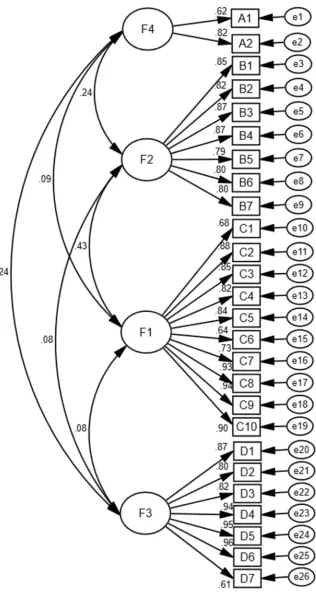
The CFA model of the AS-DRTBP consisted of four
factors and 26 items. An acceptable model fit was
indi-cated by CMIN/DF = 1.681, GFI = 0.832, AGFI = 0.799,
and RMSEA = 0.055. Figure 2 shows the standardized
path diagram of the CFA model.
Concurrent Validity
Concurrent validity was assessed by Spearman’s rank
cor-relation analysis due to the non-normally distributed scores of the AS-DRTBP and the adjustment scale (p<0.10). As shown inTable 4, the correlation coefficient between the total scores of the AS-DRTBP and the
adjust-ment scale was 0.355, and the correlation coefficient
between the scores of each subscale of the AS-DRTBP and the adjustment scale ranged from 0.165 to 0.292.
Reliability Analysis
As shown inTable 5, the Cronbach’s alpha coefficient was
0.893 for the total scale and ranged between 0.606 and 0.940 for each of the dimensions. The split-half reliability
coefficient of the AS-DRTBP was 0.954 and ranged
between 0.610 and 0.953 for each of the dimensions. The
test-retest reliability coefficient of the total scale over
a two-week interval for the 51-patient subsample was 0.853 and ranged between 0.716 and 0.820 for each of the dimensions.
Discussion
To the best of our knowledge, little research has focused on the development of a questionnaire for the adaptation status with respect to DR-TB. In this study, we developed
Table 2Results of Item Analysis
Item Mean (SD) CI Value Item–Total Correlation
A1 1.55 (0.74) 4.479* 0.230*
A2 1.24 (0.50) 3.378* 0.062*
B1 2.84 (1.17) 12.031* 0.589* B2 2.76 (1.17) 14.226* 0.626* B3 2.93 (1.17) 10.821* 0.562* B4 3.00 (1.20) 10.527* 0.569* B5 2.74 (1.06) 13.590* 0.639* B6 2.76 (1.14) 11.213* 0.579*
B7 3.24 (1.24) 9.016* 0.537*
B8 3.62 (1.08) 5.397* 0.438*
C1 2.40 (1.10) 13.318* 0.598*
C2 2.44 (1.09) 9.471* 0.476*
C3 1.96 (0.92) 11.994* 0.579* C4 1.99 (0.88) 14.068* 0.680* C5 1.93 (0.86) 11.628* 0.639* C6 1.97 (0.91) 12.007* 0.628* C7 1.92 (0.87) 10.465* 0.603*
C8 2.12 (0.95) 9.629* 0.560*
C9 2.20 (0.97) 10.777* 0.591* C10 2.87 (1.17) −0.242 −0.111 C11 1.97 (0.89) 10.611* 0.587* C12 2.06 (0.92) 12.788* 0.587* C13 2.01 (0.89) 11.778* 0.610* C14 1.93 (0.85) 12.029* 0.622* C15 2.30 (1.03) 14.138* 0.637*
D2 2.34 (0.93) 7.783* 0.410*
D3 2.15 (0.84) 8.598* 0.451*
D4 2.10 (0.82) 7.276* 0.362*
D5 2.18 (0.79) 7.116* 0.378*
D6 1.98 (0.79) 8.205* 0.391*
D7 1.98 (0.80) 7.363* 0.387*
D8 1.94 (0.79) 8.175* 0.405*
D9 2.25 (1.04) 6.315* 0.292*
Note:*P<0.001.
Abbreviation:SD, standard deviation.
Figure 1Cattell’s scree plot.
Psychology Research and Behavior Management downloaded from https://www.dovepress.com/ by 118.70.13.36 on 26-Aug-2020
T able 3 Results of Explorator y Factor Analysis Item F1 F2 F3 F4 C5 I am unwilling to continue taking medicine by the pr escribed dosage (such as reducing or stopping medicine) when I get better . 0.860 0.112 − 0.017 0.042 C11 I am unwilling to continue with regular re vie ws. 0.851 0.043 0.078 0.024 C14 I am unwilling to cooperate with the examination and tr eatment. 0.832 − 0.041 0.063 − 0.090 C12 I am unwilling to receiv e diagnosis and tr eatment in the designated tuber culosis hospital. 0.825 0.059 0.128 − 0.130 C13 I am unwilling to accept the management and guidance of TB contr ol personnel. 0.804 0.014 0.152 − 0.073 C 4 I am u n w illing to se e k m e d ical tr e at me n t in time w h e n I ge t w o rs e o r w h e n adv e rs e re ac tion s o ccur . 0.802 0.132 0.085 0.098 C6 I am unwilling to tak e actions to pr e vent transmission, such as w earing a mask in public places and spitting ev er ywher e. 0.792 0.181 0.014 − 0.029 C7 I am unwilling to maintain good living habits, such as opening windows freq uently and quitting smoking and drinking. 0.790 0.118 − 0.073 0.080 C3 I am unwilling to tak e medicine regularly (ref ers to not using medication intermittently at will or stopping medicine without re ason). 0.705 0.177 − 0.053 0.058 C8 Visits and tr eatment w er e affected because of w ork and study . 0.647 0.068 0.007 0.010 B1 I am feeling afraid, depr essed and melancholy . 0.072 0.824 0.078 0.110 B4 I feel lik e I am a bur den to m y family or those who ar e close to me. 0.050 0.819 0.037 0.026 B2 The isolation (such as living in differ ent rooms and ha ving separate eating utensils) mak es me feel lonely and inferior . 0.163 0.816 0.023 0.074 B5 It feels lik e people ar ound me (friends, colleagues, neighbours) ar e tr ying to av oid me . 0.190 0.791 − 0.006 − 0.047 B3 I fear that m y illness will not be cur ed or will re lapse. 0.040 0.779 0.051 0.131 B6 My spirits ar e fl agging. 0.141 0.745 0.085 − 0.003 B7 I w orr y that the disease will affect m y futur e w ork, study , mate selection and fertility . 0.034 0.706 0.069 − 0.012 D 6 The m edical st af f can understand m y feeling o f illnes s, an d the y offer w ords of com fo rt and encouragement. − 0.015 0.061 0.862 0.129 D5 The medical staff can pr ovide information support, such as tr eatment and health knowledge. 0.069 0.085 0.840 0.068 D7 The medical staff can standar dize the management, super vision and assistance of m y tr eatment. 0.103 0.041 0.824 0.024 D3 Family members can shar e house w ork and super vise me in taking medicine. 0.049 − 0.020 0.815 − 0.061 D4 My war d mate can share the tr eatment experience with me and talk with me about the tr oubles and w orries associated with the disease. 0.076 0.032 0.775 0.168 D2 Relativ es and friends can giv e me emotional car e . 0.048 0.134 0.695 − 0.174 ( Continued )
Psychology Research and Behavior Management downloaded from https://www.dovepress.com/ by 118.70.13.36 on 26-Aug-2020
T able 3 (Continued). Item F1 F2 F3 F4 D8 Social medical insurance (ne w rural cooperative medical insurance , medical insurance for urban residents, etc.) and commer cial insurance can so lv e the cost pr oblem of tr eatment. − 0.037 0.020 0.671 − 0.009 A1 The following questions relate to common symptoms of TB. Please select your curr ent symptoms (multiple choices) (1) Cough (2) Expectoration (3) F e ver (4) Chest pain (5) W eakness (6) Asthma (7) Diarrhoea (8) Dyspnea (9) Night swea ts (10) Appetite decr eases (11) W eight Loss (12) Haemoptysis or Haemosputum (13) Abnormal menstruation (female) (14) Others 0.055 0.073 − 0.033 0.825 A2 The following questions relate to common adv erse reactions to drug therap y. Please select your curr ent adv erse re actions (multiple choices). (1) Dizziness (2) Abnormal re nal function (3) Abnormal liv er function (4) Gastr ointestinal reaction (5) Arthralgia (6) Dark yellow skin (7) F ev er (8) Drug allergy (9) Abnormal blood routine (10) Hypokalemia (11) Impair ed vision, blurring of vision (12) Dysaudia (13) P eripheral polyneuritis (14) Others − 0.060 0.110 0.129 0.787 Eig en value 7.228 4.376 3.783 1.410 Contribution rate (%) 27.800 16.831 14.550 5.424 Cumulativ e contribution rate (%) 27.800 44.631 59.181 64.605 Note: The bolded number re pr esents the maximum factor loading of an item, which corr esponds to the factor in the re lated column.
Psychology Research and Behavior Management downloaded from https://www.dovepress.com/ by 118.70.13.36 on 26-Aug-2020
Figure 2The standardized path diagram of the confirmatory factor analysis.
Note:A1 to D7 represents the items of AS-DRTBP, F1 to F4 represents the four factors of AS-DRTBP.
Psychology Research and Behavior Management downloaded from https://www.dovepress.com/ by 118.70.13.36 on 26-Aug-2020
a novel instrument consisting of 26 items and evaluated its reliability and validity. The AS-DRTBP was proven to be both reliable and valid for measuring the performance of adaptation status in patients living with DR-TB.
The split-half reliability coefficient and Cronbach’s
alpha coefficient for the total scale were 0.954 and 0.893,
respectively, and for each dimension, these values ranged from 0.610 to 0.954 and from 0.606 to 0.940, respectively.
The reliability validation results fulfilled the requirement
of a reliability coefficient > 0.7 for the total scale and
a reliability coefficient > 0.6 for each dimension of the
scale,33 indicating satisfactory internal consistency. The
overall test-retest reliability coefficient was 0.853, and
the correlation coefficient of each dimension was between
0.716 and 0.820, indicating that the scale had acceptable stability over time.
Content validity refers to the degree to which a tool has an appropriate sample of items for the construct being
measured.21 In this study, the most commonly used and
convincing approach, the Delphi method, was applied to
assess the content validity of the AS-DRTBP.34 For the
conventional Delphi method, a sufficient number of
experts and a heterogeneous sample were used to ensure
that the entire spectrum of opinions was effective.35
Previous research has shown that the Delphi panel size requirements are modest and that a group size of 10 to 18 members is a fairly safe choice. In our study, the number
of experts, 12, was within the recommended range.36,37
Moreover, the experts in this study included TB preventive and control experts, clinicians, educators and nurses, cov-ering a wide range of occupations and ensuring sample heterogeneity. In this study, the S-CVI was 0.9, and the I-CVI ranged from 0.80 to 1.00. The results met the criteria of acceptability (S-CVI > 0.90, I-CVI >0.78), indicating that the AS-DRTBP can accurately measure the true content of the adaptation level of TB patients.
Construct validity was evaluated by EFA and CFA. The EFA generated a clear four-factor solution consistent with
theoretical concepts; the factors were named “role
func-tion”,“self-concept”, “interdependence” and“
physiologi-cal function”.26The four factors accounted for 64.61% of
the total variance, which was higher than the criterion of
60%,27indicating that the common factors extracted were
reliable. The factor loading for each item was greater than 0.4 and without cross-loadings, suggesting tight relation-ships between the items and the factors. In general, these four factors represent the overall structure of the scale.
A CFA was performed to confirm the structure of the scale
for the other sample. The CFA results revealed that CMIN/DF
was 1.681, which met the criterion of less than 2.38 The
RMSEA was 0.055, which met the criterion of less than
0.08, indicating a reasonable modelfit. The GFI was 0.832,
and the AGFI was 0.799; these results deviated from the ideal standard of 0.90 but fell within the acceptable range.33Overall,
the CFA showed that the fitting effect of the model was
acceptable and that the structure of the scale was consistent with the theoretical concept.
The concurrent validity results demonstrated moderate correlations between the total scores of the AS-DRTBP and the adjustment scale and low correlations between the AS-DRTBP subscales and the adjustment scale. The adjustment scale was a general scale and measured the overall adaptation level, while the AS-DRTBP showed the adaptation issues that DR-TB patients suffered and
measured patients’ TB-specific adjustment condition. The
Table 4 Concurrent Validity (the Correlation Between the
Scores of as-DRTBP and the Adjustment Scale)
Dimension Spearman’s Rho Correlation
Coefficients
Physiological function 0.165*
Self-concept 0.279*
Role function 0.292*
Interdependence 0.279**
Total 0.355*
Note:*P<0.001.
Table 5Reliability of the AS-DRTBP
Dimension Number of Items Cronbach’sα Split-Half Reliability Test-Retest Reliability
Physiological function 2 0.606 0.610 0.820*
Self-concept 7 0.914 0.927 0.802*
Role function 10 0.940 0.953 0.716*
Interdependence 7 0.916 0.937 0.820*
Total 26 0.893 0.954 0.853*
Note:*Correlation is significant at the 0.01 level (2-tailed).
Psychology Research and Behavior Management downloaded from https://www.dovepress.com/ by 118.70.13.36 on 26-Aug-2020
result of moderate correlations may partly reflect the
spe-cificity of the AS-DRTBP.
Implications for Clinical Practice
Successful adaptation to a disease is helpful for maintaining physical and mental health, thus accelerating disease reha-bilitation. Early detection of the maladaptation of DR-TB
patients and timely intervention are beneficial for
maintain-ing the balanced life of patients. This study provides a simple, practical tool, the AS-DRTBP, for evaluating the adaptation status in patients with DR-TB. For clinical appli-cation, health care providers can use it to assess baseline data and the intervention effect on the adaptation status. For
scientific research, the AS-DRTBP enriches the application
scope of the RAM and provides a reference for the
devel-opment of adaptation scales for other specific diseases. We
excluded XDR-TB patients from participation in this study. Most of these patients were recurrent patients or MDR-TB patients who experienced treatment failure or relapse. Additionally, some XDR-TB patients often suffer from more serious conditions and live with complications, and
some of them may be unable to complete investigations.39,40
Thus, the accuracy of the AS-DRTBP may be affected. The applicability of the AS-DRTBP in XDR-TB patients could be validated in further research to determine whether it is necessary to develop a special scale for XDR-TB patients.
Several limitations of this study must be noted. First,
we carried outfield testing only at tuberculosis hospitals in
Shaanxi Province; thus, in further studies, researchers can expand the samples to other regions of China. Second, the
correlation coefficient between the items of the
physiolo-gical function dimension and the total score of the adjust-ment scale was 0.165, which may be because the physiological function dimension contains only objective indicators while the other dimensions contain subjective factors. A moderate correlation between the total scores of the AS-DRTBP and the adjustment scale showed that the concurrent validity was acceptable.
Conclusion
The AS-DRTBP was developed following scale develop-ment steps based on the theory of the RAM. The scale includes 26 items divided into 4 dimensions, including role function, self-concept, interdependence and physiological function. The present study showed that the AS-DRTBP has good validity and reliability. The AS-DRTBP can be used by researchers, educators and clinicians as a tool for baseline data collection and intervention evaluations. The
AS-DRTBP can be applied to investigate the adaptation status of DR-TB patients but not XDR-TB patients. The applicability of the AS-DRTBP in XDR-TB patients could be validated in further research.
Ethics Statement
The Ethics Committee of Xi’an Jiaotong University
approved this study. The participants were given written informed consent. The investigation process adhered to the
principle of confidentiality, with the questionnaires
com-pleted anonymously, and the research data were used only in this research.
Acknowledgments
We would like to thank the participants in this study for their invaluable contribution. We would especially like to thank the Shaanxi Provincial Institute for Tuberculosis Control and Prevention for their kind support, assistance and guidance.
We would also like to thank the Xi’an Chest Hospital and
Shaanxi Province Tuberculosis Hospital for their kind sup-port in data collection. In addition, we are grateful for the
financial support provided by the National Natural Science
Foundation of China (Award number: 71774131)
Funding
This work was supported by the National Natural Science Foundation of China (Award number: 71774131).
Disclosure
Haini Liu and Jingjie Zhao are co first authors. The
authors report no conflicts of interest in this work.
References
1. Global tuberculosis report 2018. Licence: CC BY-NC-SA 3.0 IGO. Geneva: World Health Organization,2018.
2. Shringarpure KS, Isaakidis P, Sagili KD, Baxi RK, Das M, Daftary A.
“When treatment is more challenging than the disease”: a qualitative study of mdr-tb patient retention. PLoS One. 2016;11(3):e0150849. doi:10.1371/journal.pone.0150849
3. Kumar BA. Rehabilitation of treated TB patients: social, psychological and economic aspects.Int J Mycobacteriol. 2016;5(Suppl 1):S129– S130. doi:10.1016/j.ijmyco.2016.11.021
4. Roy C. The roy adaptation model. Comment.Nurs Outlook.1976;24 (11):690–691.
5. Aggleton P, Chalmers H. Models and theories. Two. The Roy adapta-tion model.Nurs Times.1984;80(40):45–48.
6. Roy SC, Corliss CP. The roy adaptation model: theoretical update and knowledge for practice.NLN Publ.1993;(15–2548):215–229. 7. Alimohammadi N, Maleki B, Abbasi S, Shakerian B, Hemati Z. The
effect of adaptation training on controlling maladaptation behaviors in adolescents with asthma based on roy adaptation model. Tanaffos.
2018;17(2):103–109.
Psychology Research and Behavior Management downloaded from https://www.dovepress.com/ by 118.70.13.36 on 26-Aug-2020
8. Sawyer JM, Asgr R, Todd Fordham FN, Porter JDH. A public health approach to palliative care in the response to drug resistant TB: an ethnographic study in Bengaluru, India.BMC Palliat Care.2018;17 (1):120. doi:10.1186/s12904-018-0374-5
9. Schnippel K, Firnhaber C, Berhanu R, Page-Shipp L, Sinanovic E. Adverse drug reactions during drug-resistant TB treatment in high HIV prevalence settings: a systematic review and meta-analysis.J Antimicrob Chemother.2017;72(7):1871–1879. doi:10.1093/jac/dkx107
10. Ahmad N, Javaid A, Syed Sulaiman SA, et al. Effects of multidrug resistant tuberculosis treatment on patients’health related quality of life: results from a follow up study.PLoS One.2016;11(7):e0159560. doi:10.1371/journal.pone.0159560
11. De Schacht C, Mutaquiha C, Faria F, et al. Barriers to access and adherence to tuberculosis services, as perceived by patients: a qualitative study in Mozambique. PLoS One. 2019;14(7): e0219470. doi:10.1371/journal.pone.0219470
12. Akyil RC, Erguney S. Roy’s adaptation model-guided education for adaptation to chronic obstructive pulmonary disease. J Adv Nurs.
2013;69(5):1063–1075. doi:10.1111/j.1365-2648.2012.06093.x 13. Lee LY, Tsang AY, Wong KF, Lee JK. Using the Roy adaptation
model to develop an antenatal assessment instrument.Nurs Sci Q.
2011;24(4):363–369. doi:10.1177/0894318411419209
14. Hirokawa K, Suzuki S. Development of an adjustment ability scale for outpatients with cancer: verification of its reliability and validity.
Nurs Open.2018;5(3):351–361. doi:10.1002/nop2.145
15. Desanto-Madeya S, Fawcett J. Toward understanding and measuring adaptation level in the context of the roy adaptation model.Nurs Sci Q.2009;22(4):355–359. doi:10.1177/0894318409344753
16. Rattray J, Jones MC. Essential elements of questionnaire design and development.J Clin Nurs.2007;16(2):234–243. doi:10.1111/j.1365-2702.2006.01573.x
17. Gaskin CJ, Happell B. On exploratory factor analysis: a review of recent evidence, an assessment of current practice, and recommenda-tions for future use. Int J Nurs Stud. 2014;51(3):511–521. doi:10.1016/j.ijnurstu.2013.10.005
18. Meng L, Jin Y. A confirmatory factor analysis of the utrecht work engagement scale for students in a Chinese sample. Nurse Educ Today.2017;49:129–134. doi:10.1016/j.nedt.2016.11.017
19. Barone SH, Roy CL, Frederickson KC. Instruments used in Roy adapta-tion model-based research: review, critique, and future direcadapta-tions.Nurs Sci Q.2008;21(4):353–362. doi:10.1177/0894318408323491
20. Dellafiore F, Conte G, Baroni I, et al. Ostomy adjustment inventory-23 (OAI-23): development and testing of the Italian version.J Wound Ostomy Cont Nurs.2019;46(1):38–43. doi:10.1097/won.0000000000000493 21. Wang H-C, Chao Y-FC, Tsai J-C, et al. Development and preliminary
validation of a questionnaire on regular exercise beliefs among patients with chronic obstructive pulmonary disease. J Clin Nurs.
2014;23(7–8):1133–1143. doi:10.1111/jocn.12300
22. DeSanto-Madeya S. Adaptation to spinal cord injury for families post-injury. Nurs Sci Q. 2009;22(1):57–66. doi:10.1177/0894318 408327295
23. DeSanto-Madeya SA. A secondary analysis of the meaning of living with spinal cord injury using roy’s adaptation model. Nurs Sci Q.
2006;19(3):240–246. doi:10.1177/0894318406289493
24. Xie Y, DeVellis RF. Scale development: theory and applications.
Contemp Sociol.1992;21:876. doi:10.2307/2075704
25. Oroviogoicoechea C, Watson R, Beortegui E, Remirez S. Nurses’ perception of the use of computerised information systems in prac-tice: questionnaire development. J Clin Nurs. 2010;19:240–248. doi:10.1111/j.1365-2702.2009.03003.x
26. Fabrigar LR, Wegener DT, MacCallum RC, Strahan EJ.Evaluating the use of exploratory factor analysis in psychological research.Psychol Methods,1999;4(3), 272–299. doi:10.1037/1082-989X.4.3.272 27. Li WH, Chung JO, Chui MM, Chan PS. Factorial structure of the
Chinese version of the 12-item general health questionnaire in adolescents. J Clin Nurs. 2009;18(23):3253–3261. doi:10.1111/ j.1365-2702.2009.02905.x
28. Lin CC, Wu CC, Anderson RM, et al. The chronic kidney disease self-efficacy (CKD-SE) instrument: development and psychometric evaluation.Nephrol Dial Transpl.2012;27(10):3828–3834. doi:10.1093/ ndt/gfr788
29. Kline RB.Principles and Practice of Structural Equation Modeling. 4th ed. Boca Raton: The Guilford Press;2015.
30. Indrayan AKM.Medical Biostatistics. 4th ed. New York: CRC Press;
2018.
31. Li XF, Wang L, Tan Y, Hou J, Ma J. Distinct prevalence of drug-resistant tuberculosis in gansu, china: a retrospective study on drug susceptibility profiles between 2010 and 2014. Microb Drug Resist.2017:23(8):1025–1031. mdr.2016.0208.
32. Luo D, Chen Q, Xiong G, et al. Prevalence and molecular character-ization of multidrug-resistant M. tuberculosis in Jiangxi province, China.Sci Rep.2019;9(1):7315. doi:10.1038/s41598-019-43547-2 33. Chen X, Hu Y, Zhu D, Li J, Zhou L. Chinese version of the aging
perceptions questionnaire (C-APQ): assessment of reliability and validity. Aging Ment Heal. 2016;20:567–574. doi:10.1080/13607863. 2015.1028332
34. Fernandez-Dominguez JC, Sese-Abad A, Morales-Asencio JM, Sastre-Fullana P, Pol-Castaneda S, de Pedro-gomez JE. Content validity of a health science evidence-based practice questionnaire (HS-EBP) with a web-based modified Delphi approach.Int J Qual Heal Care.2016;28(6):764–773. doi:10.1093/intqhc/mzw106 35. Keeney S, Al E. A critical review of the Delphi technique as a research
methodology for nursing.Int J Nurs Stud.2001;38(2):195–200. 36. Okoli C, Pawlowski SD. The Delphi method as a research tool: an
example, design considerations and applications.Inf Manag.2004;42 (1):15–29.
37. Paliwoda SJ. Predicting the future using Delphi.Manag Decis.1983. doi:10.1108/eb001309
38. Gotay CC, Blaine D, Haynes SN, Holup J, Pagano IS. Assessment of quality of life in a multicultural cancer patient population.Psychol Assess.2002;14(4):439–450.
39. Tiberi S, Zumla A, Migliori GB. Multidrug and extensively drug-resistant tuberculosis: epidemiology, clinical features, manage-ment and treatment. Infect Dis Clin North Am. 2019;33 (4):1063–1085. doi:10.1016/j.idc.2019.09.002
40. Ennassiri W, Jaouhari S, Cherki W, Charof R, Filali-Maltouf A, Lahlou O. Extensively drug-resistant tuberculosis (XDR-TB) in Morocco.J Glob Antimicrob Resist.2017. doi:10.1016/j.jgar.2017.07.002
Psychology Research and Behavior Management
Dove
press
Publish your work in this journal
Psychology Research and Behavior Management is an international, peer-reviewed, open access journal focusing on the science of psychol-ogy and its application in behavior management to develop improved outcomes in the clinical, educational, sports and business arenas. Specific topics covered in the journal include: Neuroscience, memory and decision making; Behavior modification and management; Clinical
applications; Business and sports performance management; Social and developmental studies; Animal studies. The manuscript manage-ment system is completely online and includes a very quick and fair peer-review system, which is all easy to use. Visit http://www. dovepress.com/testimonials.php to read real quotes from published authors.
Submit your manuscript here:https://www.dovepress.com/psychology-research-and-behavior-management-journal
Psychology Research and Behavior Management downloaded from https://www.dovepress.com/ by 118.70.13.36 on 26-Aug-2020