Catalytic And Selective Transition
Metal Mediated Isomérisations Of
Aiiylic Alkoxides To Enolates
A Thesis Presented By
Simon Jonathan Robinson
In Partial Fulfilment of The Requirements For The Award of The Degree of
Doctor of Philosophy
of the
University of London
Christopher Ingold Laboratories Departm ent Of Chem istry University College London 20 Gordon Street
ProQuest Number: U644314
All rights reserved
INFO RM A TIO N TO ALL U SER S
The quality of this reproduction is dependent upon the quality of the copy submitted.
In the unlikely event that the author did not send a complete manuscript
and there are missing pages, these will be noted. Also, if material had to be removed, a note will indicate the deletion.
uest.
ProQuest U644314
Published by ProQuest LLC(2016). Copyright of the Dissertation is held by the Author.
All rights reserved.
This work is protected against unauthorized copying under Title 17, United States Code. Microform Edition © ProQuest LLC.
ProQuest LLC
789 East Eisenhower Parkway P.O. Box 1346
Abstract
The thesis is split into three chapters. The first chapter, the introduction, presents a broad review on enantioselective transfer hydrogenation reactions of organic compounds catalysed by transition metals,, and their application in the asym m etric reduction of ketones, im ines and activated carbon-carbon double bonds. Emphasis will be placed on m echanistic aspects, in addition to the effect of substrate and ligand architecture on the stereochem ical outcom e of the reaction. The second chapter will discuss a series of investigations into the application of transition m etals in the catalysis of allylic alkoxides to metal enolates in a stereo, regio and enantioselective manner. This catalytic process represents a novel preparation of m etal enolates which differs from the traditional approach utilising carbonyl compounds. The third and final chapter will involve a form al description of the experimental procedures that make up the results presented in chapter two.
Several nickel based catalyst systems were investigated which had the potential fo r use as asym m etric catalysts, by simple replacement of the pre-existing ligands with chiral ligands. The Ni(COD)2/Ligand catalyst system demonstrated a greater activity than the NiCl2(Ligand) based catalyst system, and was therefore studied in greater depth. Excellent stereocontrolled enolate form ation was demonstrated when using either benzene as solvent, or using pyridine as ligand, particularly when using a primary allylic alkoxide as substrate. These conditions, however, did not lead to significant improvements in stereoselectivity in tetrasubstituted enolate form ation, although there was an exception with the alkoxide of (E)-2-methyl-1 -phenyl-2-buten-1 -ol, in which an (Z) : (E) enolate ratio of 5 : 1 was obtained. It was also found that both the Ni(CO D)2/Ligand and NiCl2(Ligand) catalyst systems demonstrated poor regiocontrol, where enolate regioisom ers were possible.
A r a n g e o f p r o c h i r a l a l l y l i c a l k o x i d e s u b s t r a t e s w a s t e s t e d u s i n g N i ( C O D) 2 i n c o m b i n a t i o n w i t h a
c h i r a l l i g a n d , b u t e n a n t i o m e r i c e x c e s s e s i n t h e i s o m e r i s e d p r o d u c t s w e r e n o t d e t e c t e d b y c h i r a l
s h i f t ^ H - N M R , o r b y c h i r a l G C . T h i s l a c k o f a s y m m e t r i c i n d u c t i o n i s a t t r i b u t e d t o a n u m b e r o f
p o s s i b l e f a c t o r s , d i s c u s s e d h e r e i n d e t a i l . A n i n v e s t i g a t i o n u s i n g d e u t e r i u m i s o t o p i c l a b e l l i n g w a s
a l s o c o n d u c t e d i n o r d e r t o e l u c i d a t e t h e p o s s i b l e m e c h a n i s t i c p a t h w a y s i n o p e r a t i o n w i t h t h e
n i c k e l c a t a l y s t .
Contents
Page
Abstract i
Contents ii
Abbreviations iv
Stereochemical Notation vi
Acknowiedgements vii
Chapter One:
Asymmetric Transfer Hydrogenation Reactions
Promoted by Chiral Homogeneous Ruthenium,
Iridium and Rhodium Complexes
Introduction 2
Transfer hydrogenation 2
Chiral ruthenium cataiysis 7
Chiral iridium cataiysis 19
Chiral rhodium cataiysis 25
Mechanistic studies 32
Conclusions 42
Chapter Two:
Results and Discussion
Enoiate form ation 45
Isomérisation of aiiylic aicohois 46
New approach to enoiate chem istry 52
Mechanistic overview 53
Aims of the project 59
Isom érisations with non-chiral Ni(li) com piexes
introduction 61
Initial studies 68
Studies on regiocontrol 71
Attem pted isomérisations of prochiral allylic alkoxides 75
Isom érisations with chiral Ni(0) complexes
Introduction 81
Use of chiral phosphine ligands 84
Chiral nitrogen ligands 85
Enantioselective isom érisations of other allylic alkoxides 100
M odifications of the isom érisation reaction
Introduction 111
Soivent effects 111
C ountercations 114
Isom érisations with non-chiral Ni(0) com plexes
Introduction 123
isom érisation of primary aiiylic alkoxides 123
Isomérisation of secondary allylic alkoxides 127
Potential synthetic applications 135
Isom érisation of allylic am ines 137
Studies on regiocontrol 138
M echanistic studies
Introduction 141
Isomérisation of simple deuterated substrates 142
Isomérisation of deuterated prochiral substrates 144
isom érisations with chirai Ni(il) com piexes
Introduction 153
Use of pyridine as ligand 153
Use of b/'s(oxazoline) as ligand 154
Isom érisations with Rh(l) com plexes
Introduction 157
Isomérisations with chiral BINAP ligands 157
Isomérisations with b/s(oxazoline) as ligand 168
C onclusions and Perspectives
Conclusions and perspectives 173
Chapter Three: Experimental Section
General procedures 177
Standard procedure for degassing 179
Standard procedures for quench and work-up 179
Preparation of the catalyst solutions 180
Standard procedure for the isomérisation reaction 180
Substrate preparation 181
Ligand preparation 205
Isomérisations using NiCl2(DIPHO S)/PrM gCI 219
Isomérisations using NiClglDIPHOSyLiBEtaH or NiCl2(DIPHOS)/KBEt3H 220
Isomérisations using Ni{C0 D)2 227
Isomérisations using NiCl2(Ligands) 258
Isomérisations using [Rh(C0D )B IN A P rC i0 4’ 262
Isomérisations using [Rh(Ligands)]^ 265
Abbreviations
A Ac acac AHg AIBN Ar BBN BDPOP BHT BINAP S/s(oxazoline) BMPP Bn BPDODP BPPFA BPPM br BuCH IR APH O S COD COE Cy D d D □CM DHz DIBAL DIOP DIPHOS DME DMF
DMPP ,
DMSO ee equiv Et FOD GC GCMS h
Hydrogen acceptor molecule; e.g. acetophenone Acetyl
Acetylacetonate (2,4-Pentane dione anion)
Reduced hydrogen acceptor molecule; e.g. using acetophenone as A, then AH2 is 1-phenylethanol
Azaisobutyronitrile Undefined aromatic group 9-Borabicyclo[3.3.1]non-9-yl
2,4-S/s[(diphenylphosphino)oxy]pentane 2,6-Di(f-butyl)-4-methylphenyl
{R o r S)-2,2’-S/s(diphenylphosphino)-1,1’-binapthyl
2.2-Bis-[(4S)'A'{a\ky\ or aryl)-1,3-oxazolin-2-yl]-propane or 4,4’-di(alkyl or aryl)-2,2’-b/s(oxazoline)
Benzylmethylphenylphosphine Benzyl [(Diphenylphosphino)oxy]-1,3-diphenylpropane A/,A/-Dimethyl[1-(2-(diphenylphosphino)ferrocenyl)ethyl]amine A/-(Butoxycatbonyl)-4-[(diphenylphosphino)methyl]pyrrolidine Broad Butyl
(R or S)-2,3-B/s(diphenylphosphino)butane Cyclooctadiene
Cyclooctene Cyclohexyl Deuterium Doublet
Oxidised donor molecule; using propan-2-ol as DH2, then D is acetone Dichloromethane
Hydrogen donor molecule; e.g. propan-2-ol Diisobutylaluminlum hydride
(R o r S) 1,2-0-lsopropylidene-2,3-dihydroxy-1,4-b/s(diphenyl- phosphino)butane
1.2-S/s(diphenylphosphino)ethane 1.2-Dimethoxyethane A/,A/-Dimethylformamide Dimenthylphenylphosphine Dim ethylsulfoxide Redox potential Enantiomeric excess Molar equivalents Ethyl
6,6,7,7,8,8,8-Heptafluoro-2,2-dimethyloctane-3,5-dione anion Gas Chromatography
Gas Chromatography Mass spectroscopy Hour(s)
H HD HMPA HPLC HRMS / IR k L LDA lit. LRMS m M m.p. MDPP Me mesityl n n NAD NADH NBD NMDPP NMR NORPHOS P PCC Ph Pr PROPHOS pTSA py r R s t t t* TBDMS TDA TEAF Tf Tfc THF TLC IM S Hydrogen 1,5-Hexadiene Hexamethyiphosphoramide
High Performance Liquid Chromatography High Resolution Mass Spectroscopy Iso
Infra-red Spectroscopy Rate constant
Any ligand; (L-L is specifically a bidentate ligand) Lithium Diisopropylamine
Literature value
Low Resolution Mass Spectroscopy Multiplet
Undefined metallic element Melting point
Menthyldiphenylphosphine Methyl
2,4,6-trimethylphenyl Neo
Number of ligands
Nicotinamide adenine dinucleotide
Reduced form of nicotinamide adenine dinucleotide Norbornadiene
Neomenthyldiphenylphosphine
Nuclear Magnetic Resonance Spectroscopy
2('Exoj,3('endo>b/s(diphenylphosphino)-bicyclo[2.2.1]heptene Prochiral
Pyridinium chlorochromate Phenyl
Propyl
{R or S)1,2-B/s(diphenylphosphino)propane
para-Toluenesulfonyl chloride (4-m ethylbenzenesulfonyl chloride) Pyridine
Racemic
Undefined alkyl group Singlet
Tert Triplet
Triplet of peaks in the ratio 1:1:1 f-Butyldimethylsilyl
Tr/s[2-(2-methoxyethoxy)ethyl]aniline Triethylam m onium formate
T rif luoromethanesulfonyl (+)-T rifluoroacetylcamphorate Tetrahydrofuran
stereochemical Notation
The stereochem istry of compounds is illustrated graphically following the conventions of IVIaehr/ Thus bold type is used to represent bonds towards the observer relative to the page, and dashed bonds to represent bonds away from the observer. Diastereomeric com pounds are represented using bold and dashed lines when racemic, and bold and dashed wedges when homochiral.
c c
a
Racemic homochiral
Acknowledgements
I would like to especially thank: my supervisor, Professor W illie M otherwell for his continued support, encouragem ent and friendship over the last three years; Cathy, Diyan, Kamal, Kit, Matt, Mike and T illy for their tim e to proof read this thesis; and to the technical staff at the Christopher Ingold Laboratories for their services, especially Gill Maxwell (NMR), Mike Cocksedge (Mass Spec, at the School of Pharmacy) and John Hill (GCMS).
Special thanks also to all the people, past and present, who have m ade working on the 4rth floor a sheer delight, especially Adrian, Alvin, Ashley, Caroline, Cathy, Diyan, Donogh, Ellen, Eric B., Eric P., Jean-M arc, Kamal, Kit, Letitia, Lewis, Man-Tat, Maria, Marta, Martin, Matt, Mike, Mila, Najeeb, Nicola, Pete, Phill, Pierre, Richard, Rima, Robyn, Rodney, Sheena, Sylvan, Tilly, Tim, Yui-Fai and Zena, to name but a few ...
A big hearty thanks also goes to the members of Side-Show-Bob, fo r introducing me to the delights of numerous pubs in the London area, especially around Camden. And the GC, what can I say? I hope that my successor will be able to continue to manage this very lively operation in the same way that I was able to.
And finally. I’d like to offer my sincerest thanks to my fam ily and close friends who have always been there when I have needed them.
Chapter 1
Asymmetric Transfer Hydrogenation
Reactions Promoted by Chiral
introduction
Introduction
The work described in this thesis involves the development of a novel approach to the preparation of enolate anions in a regio-, stereo- and enantio-controlled fashion, brought about by the transition m etal-m ediated isomérisation of allylic alkoxide substrates. The mechanism through which this transform ation is believed to proceed bears a close resemblance to an area of chem istry referred to as transfer hydrogenation, whereby an organic substrate is oxidised in order to reduce a different organic compound. Thus, the isomérisation of an allylic alcohol can be form ally viewed as an intram olecular transfer hydrogenation process.
There have been many reports in recent years in which high levels of asym m etric induction have been achieved fo r the transfer hydrogenation reaction of activated double bonds, such as carbonyls, a,p-unsaturated carbonyls and acids. The following survey provides a review of the most significant results obtained so far in this field of study.
Transfer hydrogenation
A technique which has received increasing attention in recent years is the use of transition metals to catalyse the reduction of organic compounds via transfer hydrogenation.^’^ Transfer hydrogenation differs from conventional hydrogenation techniques in that the source of the hydrogen is from another organic molecule, rather than m olecular hydrogen. The hydrogen source, or H-donor (DH2), is oxidised as the hydrogen is delivered to reduce the substrate molecule, or H -acceptor (Figure 1).
X ..H
r A r 2 + DH,DHg ^ I + D (1)
R1 Hydrogen R 2 Acceptor Hydrogen
Donor
X = C R j , O, NR,
Figure 1
Introduction
2H
H
M e ,^ O H
M e
2H
O
X
M e M e
2H
O H
- 2 H
' t '
- 2 H N — N --- ;
/ \
H H
- 2 H
- 2 H
An
c o .
- 2 H HN = NH ---^ N ,
Figure 2
The M eerw ein-Ponndorf-Verley réduction of carbonyl compounds by means of A I(O P r)3 and propan-2-ol as a hydrogen source is a classic example of transfer hydrogenation in operation
(Figure 3).
AI(OPr)3/iPrOH
7 6 %
AI(OPr)3/iprOH
9 0% O H
Figure 3
Introduction
obviates these difficulties in that gas containm ent is not necessary and sim ple m echanical stirring of solutions is usually all that is required. W ith a catalyst and m olecular hydrogen, changes in catalyst, solvent, pressure and tem perature are variables in the reaction, but with H-donors, an additional variable is introduced in the choice of H-donor which can affect the rate and specificity of the reduction.
The most popular H-donors are alcohols. According to their relative oxidation potentials, secondary alcohols are better H-donors than prim ary ones, however both have been successfully em ployed in the reduction of ketones.^ Am ong the secondary alcohols, propan-2-ol is the reagent of choice because it has an appropriate boiling point and solubility properties, and upon dehydrogenation affords acetone, a low boiling liquid which can be easily removed from the reaction mixture. The use of propan-2-ol, however, does have some inherent chem ical problems.
Formic acid and its salts, such as triethylam m onium form ate (TEAF), have proved to be useful sources of hydrogen as dehydrogenation is an irreversible and exotherm ic process, which usually overwhelm s the energetic requirements of the reduction process."*
There are several ways to effect an enantioselective hydrogen transfer and, according to a classification scheme introduced several years ago, the following basic types can be distinguished (Figure 4a an d b).
Chiral
D H g + A ( p ) --- ► D
+
AHg-
(2)
D H / + A ( p ) --- ► D ( p ) + A H / ( 3 )
Chiral
D H / + A ( p ) --- — --- 1 ^ D ( p )
+
ah/
(4)
D H2* Chiral H-Donor. A H2* Chiral hydrogenated H-Acceptor D H2(r) Racemic H-Donor A (r) R acem ic H-Acceptor
D (p ) Dehydrogenated H-Donor with A (p ) H-Acceptor with a prochiral centre a prochiral centre
Figure 4a
Introduction
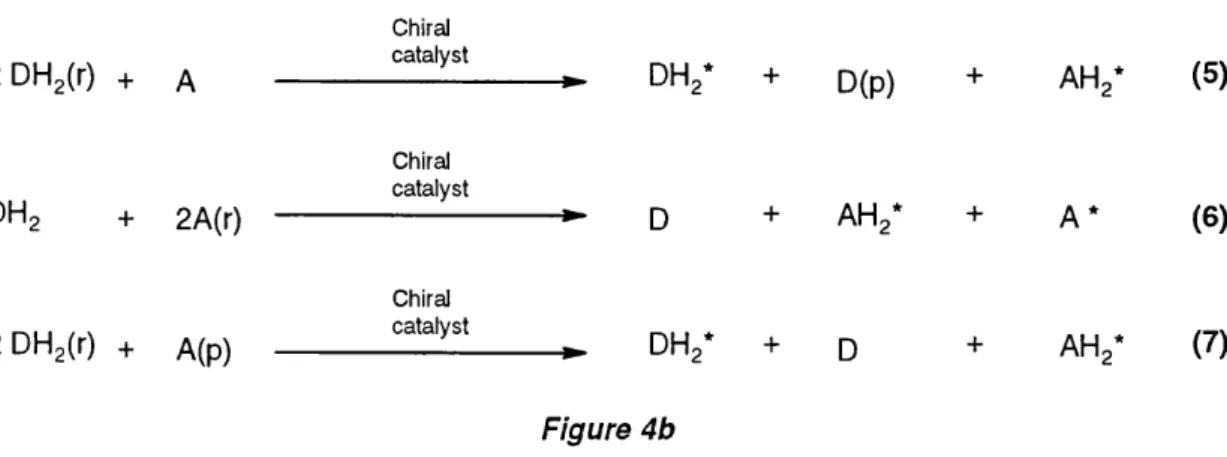
Enantiom eric enrichment of racemic H-donors, i.e. kinetic resolution, can take place in the presence of chiral catalysts (Figure 4b, Equation 5) and this has been observed in several instances.®
Chiral
2 DHg(r) + A ► DH2* + D(p) + AHg* (5)
Chiral catalyst
DHg + 2A(r) ► D + AHg* + A * (6)
Chiral
2 DH2(r) + A(p) ---D H / + D + A H j* (7)
Figure 4b
These reactions are particularly interesting since, when the appropriate experim ental conditions are met, kinetic resolution and enantioselective reduction may occur sim ultaneously, producing two different optically active compounds in a single reaction, i.e. chiral H-donor and the chirally reduced alcohol product. There are two ways to achieve this goal in the presence of a chiral catalyst: either by reducing racemic H-acceptor, A(r), with a deficit of H-donor (Equation 6), or by reacting an excess of racemic H-donor, D(r), with a prochiral H -acceptor (Equation 7).
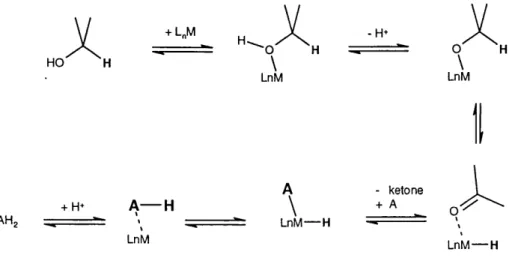
From a m echanistic point of view, two general reaction paths can be envisaged fo r hydrogen transfer to occur: either via a concerted process referred to as Direct hydrogen transfer (Figure 5a), or via a stepwise process, referred to as the Hydridic route (Figure 5a).
H O H \ \ LnM LnM
u
A
-LnM+ H+ I I
X.
H --- O H
AHg \ I , \
L n M - - - A L n M ---A
Introduction
+ LnM _ X - H+
- , O H O H \ \ LnM LnM
A - ketone
+ H+ A H \ + A
AHg ^ — L n M — H \ LnM
L n M — H
Figure 5b : Hydridic Route. A = hydride acceptor, e.g. ketone, etc.
The Direct Hydride Transfer route im plies that hydrogen is transferred from the H-donor to the H- acceptor, A, in a concerted process where both the H-donor and H-acceptor are heid in close p roxim ity to each other, involving a cyclic transition state sim ilar to that proposed during the M eerw ein-P onndorf-V erley reduction. The Hydridic Route involves the interm ediate form ation of a m etal hydride d erivative by interaction of the cataiyst with the H-donor, foiiowed by hydride delivery from the m etal to substrate A.
If a Hydridic Route is in operation, then enantiofacial discrim inating reactions of the type in
E quation 4 should be only m arginally affected by chiral H-donors. Reactions of the type shown in E quation 3 should in principie yield chiral products. In contrast, enantiom er discrim inating reactions of the type shown in Equation 5-7 should always lead to optically active products, irrespective of the reaction mechanism.
introduction
Chiral Ruthenium Cataiysis
Reduction of Prochiral Ketones
The potential fo r the asym m etric reduction of prochiral ketones via transfer hydrogenation has been of great interest since this process was first reported in 1980/^ Very low optical yields were obtained using [H4Ru4(CO)8((-)-DIOP)2] as a preformed catalyst with propan-2-ol or benzyl alcohol as the source of hydrogen. Aryl-alkyl ketones gave consistently better enantiom eric excesses than diaikyl ketones, with the best result obtained using PhCO(/-Pr) (10% ee)
(Figure 6).
H
(-)-DIOP
Figure 6
Entry Substrate Tim e (hours) Yield ee
1 PhCOMe 111 35% 4% (S)
2 PhCOEt 139 44% 5% (S)
3 PhCO(pPr) 86 37% 10% (S)
4 PhCO(f-Bu) 283 36% 7% (S)
5 MeCOPr 408 27% <1% (R)
6 MeCO(f-Bu) 476 2 2% 2% (S)
In 1991 B ackvall and Chowdhury showed that 0.1 mol% of the com plex (PhaP^aRuCla was an effective cataiyst fo r the hydrogen transfer reduction of k e t o n e s . T h i s discovery has led to the developm ent of several asymmetric processes which use this ruthenium catalyst m odified with chiral ligands, a variety of which wiil be discussed.^
Introduction
transfer hydrogenation reduction of acetophenone, affording ('fîj-1-phenylethanol in up to 60% ee. Com plex (2) offered at most only 12% ee.
PPh, N//;
P P h ,
Figure 7
The use of the C2-sym m etric tridentate ligand, (1R
,1’R)-2,6-bis[^-{6\pheny\-phosphino)ethyl]pyridine (3) was found to be effective in the asym m etric reduction of a variety of ketones in the presence of the catalyst, [RuCl2(C6H6)]2, with 74% as the highest enantiom eric excess obtained (Figure 8).^^
R1
O O H
' ^ R 2 +
[RuCyCeH,)],/
Ligand, Base
O O H
A . + R1' ^ R 2
Ligand :
% / ^ N PPhg
(3)
PPh.,
Figure 8
Entry Substrate Base Tim e Yieid ee
1 PhCOMe NaOMe
NaH
24 hours 24 hours
67% 93% ■
48% (R)
40% (R)
2
o 5
NaOMe 24 hours 33% 74% (R)3
o
NaOMe 24 hours 92% 42% (R)
Introduction
Reports by Noyori and co-workers (see later) postulated that the NH m oiety in some ligands, e.g.
ligand (4) (Figure 9) played a pivotal role in controlling the reaction selectivity and activity,^® by hydrogen bonding with the oxygen atom in ketone substrates. The NH functionality was considered to help stabilise the cyclic transition state during the step where the stereochem istry was established.
P h ., ^ N H T s P h ^ NH
(5)
I : '
V .
Ph
Ph
(4) (5) (6) (7).
Figure 9
Promoted by these reports, Zhang and co-workers designed ligands (5), (6) and (7)^^ fo r use in the transfer hydrogenation on a variety of aryl alkyl and dialkyl ketones. A m axim um of 80% ee was achieved fo r the quantitative reduction of PhCO(f-Bu) in propan-2-ol catalysed by [RuCl2(C6H6)]2 in the presence of the ligand (7) (n=2). Interestingly, the reduction of pinacolone, MeCO(f-Bu), was achieved in 92% yield and in 49% ee using the ligand (5). The optical yield was found to increase by 12% by repeating the reaction in the presence of 0.1M PhCH(OH)CH3 with 12% ee (R). The increase was speculated to be attributed to the lower redox potential of acetophenone compared to pinacolone, hence the com plex was catalysing the dehydrogenation of 1-phenylethanol more efficiently than that of the chiral MeCH(OH)(f-Bu) product. As a result, erosion of the enantiomeric excess due to the reverse process of hydrogen transfer from the product was reduced, thus affording the transfer hydrogenated product with a higher optical yield.
Knochel recently reported the use of new C2-sym m etrical diam inoferrocenyl derivatives (8) and 2-am ino(sulfonam ido)cyclohexanes (9) as highly active ligands fo r the ruthenium catalysed asymmetric transfer hydrogenation of ketones (Figure 10).^°
N H R 2
^ R 1
N H R 2
(8) (9)
Figure 10
10 Introduction
Contrary to m any existing catalyst systems, the ligands (8) were found to exhibit high activity at
25°C and operate even at -30°C, with up to 90% ee. Ligands (9) were found to offer quantitative
conversions and up to 96% ee using triethylam m onium form ate at 30°C.
Ligand (10) (Figure 11), developed by Sammakia and Stangeland, was also found to be an e ffective catalyst and was able to reduce a variety of ketones with optical yields generally over 90% ee.'21
(Ph^Pj^RuCy (0.2 mol%: /-PrOH, fP r O K (2 .5 % )
(1 0) (R = Ph)
O H A r'
Fe PPh
(10)
Figure 11
Substrate Temp Reaction tim e Yieid ee
PhCOMe 28°C 7 hours 80% 94% (R)
PhCOEt 50°C 1 hours 85% 96% (R)
PhCO(/-Pr) 80°C 1 hours 87% 8 8% (R)
(2-N p)C 0M e 28°C 7 hours 82% 95% (R)
(mesityl)COMe 80°C 1 hours 81% 95% (R)
Several experim ents were conducted that were designed to elucidate the structure of the active catalytic species in the reaction. A phosphine free catalyst was prepared by the addition of the ferrocenyl ligand to RUCI3.3H2O, the precursor in the literature preparation of (Ph3P)3RuCl2. This catalyst was found to be much less active than the (Ph3P)3RuCl2/(1 0) catalyst, affording
1-phenylethanol in only 9% ee. Interestingly, the selectivity could be largely restored by the addition of Ph3P, as illustrated below (Figure 12).
F p h a P -fre e ” ! I catalyst | (0.4% )
APrOK (2.5% ), /■PrOH, 5 0 “C
9% ee
Figure 12
then, add Ph^P (0.6m ol% ) and p-M eCgH^CO M e
O H 80 % ee
11 Introduction
adding PhaP and p-m ethylacetophenone, the p-methylacetophenone was reduced to the (R)
enantiom er of the carbinol in 80% ee, indicating that the PhaP is bound to the m etal in the stereochem istry determ ining step.
S im ilar levels of asym m etric induction were achieved using chiral thiourea ligands, developed by Lemaire and co-workers.^ Using two equivalents of ligand (11) in the presence of [RuCl2(C6H6)]2, up to 94% ee was achieved in the asym m etric reduction of 2-methyl-1 -phenyl-propan-1 -one
(Figure 13).
[R u C l2(C6H6)]2/ 2 Ligand 5 mol%, 8 2 “C
Ligand :
94 % ee Ph
Ph Ph - N ' ' H N
-H
(11)
Ph
Figure 13
The excellent catalytic perform ances of amine-based transition metal com plexes as well as the effectiveness of certain C2-sym m etrical ligands prompted Noyori and co-workers to develop new chiral Ru(ll) com plexes with well shaped C2-chiral ligands, in addition to developing non- phophine -based chiral ruthenium catalysts due to the greater number of structural perm utations
(Figure 14).'^
(12)
Rn Ru,
OgSAr
(13)
Ru Ru
' C l ' ^ Y ^ s
( X ”
(14) (15)
12 Introduction
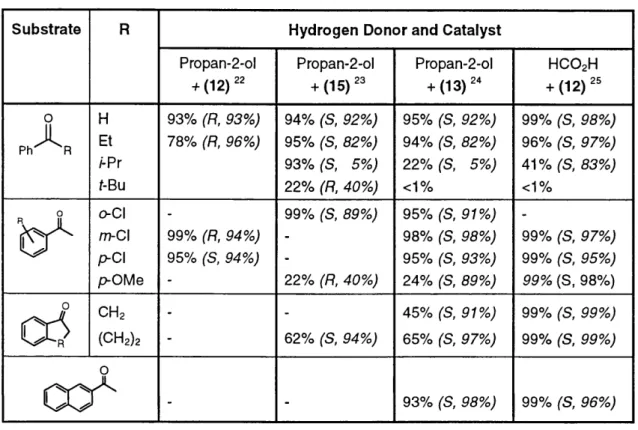
These new catalyst systems were found to be very effective in the reduction of a variety of aryl- substituted acetophenones, some of which are listed below (Figure 15).
Substrate R Hydrogen Donor and Catalyst
Propan-2-ol
+ (12)
Propan-2-ol
+ (15)
Propan-2-ol
+ (13)
HCO2H
+ (12)
H Et /-Pr f-Bu
93% (R, 93%)
78% (R, 96%)
94% (S, 92%)
95% (S, 82%>) 93% (S, 5%>)
22% (R, 40%)
95% (S, 92%)
94% (S, 82%) 22% (S, 5%)
<1%
99% (S, 98%,)
96% (S, 97%,)
41% (S, 83%o)
<1% o-CI
m-CI p-CI p-OMe
99% (R, 94%)
95% (S. 94%)
99% (S, 89%>)
22% (R. 40%)
95% (S, 91%)
98% (S, 98%)
95% (S, 93%)
24% (S, 89%)
99% (S, 97%o) 99% (S, 95%,) 99%, (8, 98%)
c d
CHs(CH2)2
-62% (S, 94%)
45% (S, 91%)
65% (S, 97%)
99% (S, 99%,) 99% (S. 99%,)
c a ^
- - 93% (S, 98%,) 99% (S, 96%,)Figure 15 : Product yield (configuration, ee)
The catalytic reduction of acetophenone derivatives proceeds at room tem perature using 0.5 mol% of catalyst and 0.5 mol% of Me2CH0K as co-catalyst. The rate and enantioselectivities were found to be sensitive to steric crowding of the substrates as well as the electronic properties of the ring substituents. The use of ethanolamine as a ligand led to a marked increase in the reaction rate. Chiral ligands based on this structure were therefore developed and catalyst systems such as (13) and (15) were found to offer consistently higher enantiomeric excesses.
13 introduction
could be shifted by the continuous removal of acetone, however this was found to be technically difficult.
Despite the reaction reversibility being the greatest flaw in the reduction using propan-2-ol as the H-donor, this tendency has however been utilised for the kinetic resolution of secondary alcohols by dehydrogenative oxidation. Thus racemic 1-phenylethanol was found to be enriched by up to
1 1% enantiomeric excess when heated at 165°C with 1,3-diphenyl-2-propen-1-one as the H- acceptor, in the presence of chiral Ru(ll)/chiral phosphine com plexes (Figure 16).^'^^
O H
+
Ph
Ru(ll) catalyst
chiral phosphine A 4. A . Ph Ph
Up to 11%ee
Ph
P h .
Ph
BMPP
Figure 16
Chiral Catalyst Reaction tim e Yield ee
[RuCl2((+)-BMPP)3] 70 hours 26% 1% (S)
[RuCl2((-)-BMPP)3] 3 hours 41% <1% (S)
[RuCl2((-)-DIOP)3] 24 hours 57% 11% (S)
Far superior enantiomeric excesses of 1-phenylethanol were obtained with the chiral Ru(ll)-diam ine com plexes by Noyori and co-workers. Thus, when a 2.0M solution of a racemic alcohol in acetone containing 0.2 mol% of the com plex (16) was allowed to stand at 28®C fo r 36 hours, the (S) enantiomer was consumed preferentially to recover the (R) enriched enantiom er (17) in approxim ately 50% yield and up to 99% enantiomeric excess (Figure 17)^^
O H
A ,
+
A r " R
u
A
O H O
J i
4-A r" '^ R Catalyst
O O H O H
A r R A r ^ R
(17)
Catalyst :
T s
Ov. .i
t
R"
N Cl
14 Introduction
Figure 17
Substrate R Reaction tim e Recovered (17)
OH H 36 hours 50% (R, 92%)
iK N ^
p-OMe 2 2 hours 47% (R .9 2 % )
V
p-NM e2 30 hours 44% (R .9 8 % )OH
CH2 6 hours 47% (R. 97%)
CO
(CH2)2 6 hours 49% (R ,9 9 % )Figure 17
This ruthenium catalysed asym m etric reaction using acetone as the hydrogen acceptor provides a chem ical analogue to the biological oxidation of alcohols using the enzyme alcohol dehydrogenase and NAD®°
The use of form ic acid, which can be viewed as an adduct of H2 and CO2, involves an irreversible decom position which would effect the transfer hydrogenation reaction with complete enantioselectivity and, in principle, 1 0 0% conversion, overcom ing som e of the reversibility problem s encountered with propan-2-ol. Its use in asym m etric ketone reduction however has remained elusive due to the lack of suitable transition metal catalysts,^^'^^'^^ however Noyori and co-workers screened several catalysts and ligands and revealed that the chiral ruthenium com plex (12) (Figure 15, colum n 6) offered very high chem ical and optical yields.
W hen com pared with alcohols, form ic acid is favoured as sterically congested ketones were readily reduced in greater yield and enantiomeric excess. Even low oxidation potential compounds, such as p-m ethoxyacetophenone, were reduced to chiral alcohols in 97-99% ee. The sulfur containing ketones (18) (Figure 18) were reduced in 98-99% ee to the corresponding chiral alcohols, alcohols which serve as key intermediates fo r the synthesis o f inhibitors fo r the enzyme carbonic anhydrase. Reduction of ketone (19) afforded the alcohol (2 0) in 92% ee.
O H X = 8 9 5% , 9 9% ee
X = S 0 2 95 % , 98 % ee
0 Û
O H
68%
9 2 % ee
COjMe (20)
Figure 18
15 Introduction
O ther examples also demonstrate the chem oselectivity of the reaction, which was found to proceed without affecting an olefinic linkage, ester, sulfide, sulfone, a nitro group, aryl chloride and cyanide, and furan, thiophene, and quinoline rings. It was also noted that the enantiom eric integrity of the product alcohol remained intact under the conditions of the reaction, hence confirm ing the irreversibility of the process.
Reduction of Imines
The asym m etric transfer hydrogenation of imines has remained largely undeveloped,^"* however Noyori and co-workers found that their chiral Ru(ll) catalysts of the type (13) (Figure 14) could achieve the chiral reduction to amines efficiently using TEAF as the hydrogen source (Figure 19, Equation 7/*®
HN HN HN
X = S 82% , 83% ee.
X = S O ; 84% , 88% ee. 90% , 89% ee. 7 2 % , 7 7 % ee.
(1)
Chiral Ru catalyst
HCO;H / EtjH
R = M e 86% , 97% ee R = Ph 83% , 96 % ee
(2)
C H ,0 C H ,0
(21)
CH3O
(
22)
(23)(3)
Figure 19
This method was also applicable to the synthesis of optically active indoles. Chiral am ines were accessible from imines, as illustrated (Figure 19, Equation 2). The functional group selectivity of the catalyst system is noteworthy. A com petitive experim ent using a m ixture of the im ine (21)
(Equation 3) and the structurally sim ilar ketone (22) revealed that the im ine (21) is >1000 tim es
16 Introduction
Reduction of Activated olefins
The asym m etric transfer hydrogenation of a,p-unsaturated acids was accomplished fo r the first tim e using benzyl alcohol as the H-donor and chiral Ru(I)/phosphine catalysts.^^ The most significant results are summarised, with 16% as the highest optical yield obtained using the catalyst, [R u2Cl4((-)-DIOP)3] at 180°C (Figure 20).
Substrate Reaction tim e Yield ee
Tiglic acid 6 hours 1 0% 16% (R)
Ph
a-M ethylcinnam m ic acid 6 hours 36% 16% (R)
C O ,H
Itaconic acid 6 hours 31% 5% (S)
Mesaconic acid 9 hours 9% 3% (S)
Figure 20
Much better results were obtained later by Brunner and co-workers in the same process using TEAF as the hydrogen source.^® Preformed catalysts of the general form ula [Ru(acac-F6)(Ti^- C3Hs)(P-P)], where P-P are chiral bidentate phophine ligands, namely (-)-DIOP, (-)-BPPM, (-)- BINAP and BPPFA (Figure 21), were employed, with the best results obtained with the BINAP containing complex, in which itaconic acid was reduced in 94% ee.
PH^P
(R )-B IN A P
PPhg PPhj
17 Introduction
Substitution of the BINAP with other phosphine ligands resulted in a decrease of both the yield and the enantioselectivity of the reaction.
Higher selectivities were reported by Ogasawara and co-workers.^® Itaconic acid was converted into ('fîj-m ethylsuccinic acid in 92-97% ee by transfer hydrogenation from propan-2-ol in the presence of [RuH((-)-BINAP)2]PFg or [RuH2((-)-BINAP)2] as preformed catalysts. These optical yields are certainly higher than the value recorded using m olecular hydrogen with related Ru/BINAP catalysts.®^ Ethanol as well as benzyl alcohol could be used instead of propan-2-ol with no detrim ental effect, while with methanol both the rate and enantioselectivity were significantly lower.
The enantiofacial discrim inating hydrogen transfer reduction of conjugated carbon-carbon double bonds has been accomplished by means of optically active H-donors and in the presence of both achiral o r chiral ruthenium catalysts. Optically active glucides were employed with fair success in
the reduction of a,p-unsaturated ketones to saturated ketones in the presence of either (Ph3P)3RuCl2 or (Ph3P)4RuH2. Good product yields were obtained using non-prochiral substrates using the sugar as a source of hydrogen (Figure 22).^^
Ph
Ph
2 m ol% of
C a ta ly s t A : (P h3P )3RuC l2 in PhgO a t 180°C
C a ta ly s t B : (P h3P X R u H2 in toluene at 100°C
2 equivalents of sugar derivative
_______ I
PhFigure 22
Sugar derivative Catalyst Duration Yield
HO^
OMe
A B
2 0 hours
20 hours
87%
6%
A 4 hours 1 0 0%
(24)
B 2 0 hours 26%
'- ■
V
A 4 hours 1 0 0%
18 Introduction
(Ph3P )3R uC l2 (2 mol%)
in P h ,0 at 16 0“C
1 0 0%
Ph 5% ee (Ph3P)3R uC l2 (2 mo!%)
in P h ,0 at 16 0“C
4 0 % 34% ee (Ph3P )3R uC l2 (2 moi%)
in P h ,O a t 16 0“C
1 0 % 29% ee
Figure 23
E n a n t i o s e l e c t i v i t i e s u p t o 9 % e e w e r e r e p o r t e d b y O h k u b o a n d c o - w o r k e r s a f e w y e a r s l a t e r i n t h e
r e d u c t i o n o f t i g l i c a c i d w i t h t h e ( P h3P )3R u C l2 c a t a l y s t a n d s i m i l a r o p t i c a l l y a c t i v e H - d o n o r s . ^ ® ' ' * ®
H i g h e r o p t i c a l y i e l d s ( u p t o 2 3 % e e ) w e r e o b t a i n e d b y t h e s a m e a u t h o r w h e n t h e r e a c t i o n w a s
c a r r i e d o u t i n t h e p r e s e n c e o f t h e c h i r a l R u2C l4( ( - ) - D I O P) 3 c o m p l e x (Figure 24).
o u y ^ p p h2
H
( - ) - D I O P
Figure 24
Sugar derivative Cataiyst ee
(24)
( P h 3 P ) 3 R u C l 2
Ru2 C U ( ( - ) - D I O P ) 3
Ru2 C U ( ( + ) - D I O P ) 3
9% (R)
23% (R)
4% (R)
( P h 3 P ) 3 R u C l 2
R U 2 C l 4 ( ( - ) - D I O P ) 3
Ru2 C U ( ( + ) - D I O P ) 3
7% (R)
13% (R)
6% (R)
0 ^ ^ O H ( P h 3 P ) 3 R u C l 2 Ru2 C U ( ( - ) - D I O P ) 3
R U 2 C l 4 ( ( + ) - D I O P ) 3
3% (R)
7% (R)
1% (R)
( P h 3 P ) 3 R u C l 2
R U 2 C l 4 ( ( - ) - D I O P ) 3
< ^% (R )
2% (R)
I n s u m m a r y , t h e d i s c o v e r y o f t h e s e r e a c t i v e c h i r a l r u t h e n i u m c o m p l e x c a t a l y s t s h a s r e s u l t e d i n
h i g h l y e f f i c i e n t a s y m m e t r i c t r a n s f e r h y d r o g e n a t i o n s o f a v a r i e t y o f p r o c h i r a l s u b s t r a t e s .
E n a n t i o s e l e c t i v e c a t a l y s i s i n t h i s w a y p r o v i d e s a v i a b l e t o o l i n a s y m m e t r i c o r g a n i c s y n t h e s i s
c o m p e t i n g w e l l w i t h o t h e r p r o c e s s e s s u c h a s h y d r o g e n a t i o n ' * ^ a n d s t o i c h i o m e t r i c a n d c a t a l y t i c
19 Introduction
Chiral Iridium Catalysis
Chiral Iridium phosphine catalysts have been successfully used only in the transfer hydrogenation reduction of ketones with propan-2-ol as the hydrogen d o n o r/^ '^'*''^^
Selected results obtained in the reduction of acetophenone in boiling propan-2-ol with chiral lr(l) catalysts, prepared in situ from [Ir(C0D)CI]2'‘^’'^'* or [lr(acac)CI]2'‘^ with the chiral monodentate phosphines NMDPP, MDPP and DMPP, are given below (Figure 25). Using acetophenone, the optical yield increased from 18% ee'^'* to 48% ee'^^ upon changing ligands, from NMDPP to MDPP and lowering the reaction tem perature from 82°C to 25°C. DMPP affords com parable stereoselectivity, but with opposite enantioselectivity.
P P h ,
N M D P P M D P P D M P P
U
P h ,P P Ph ; C H IR A P H O S
P h,P P P h ,
/O o .
P h .P P P h ,
.O O, PPh.
P R O P H O S B D PO P B P D O D P
Figure 2 5
Substrate Ligand Tim e Yield ee
NMDPP 6 hours 9 6 % 18% (R)
0 MDPP 8 hours 8 8% 42% (R)
^ X
MDPP (25°C) 188 hours 3 0 % 48% (R)DMPP 16 hours 8 2 % 40% (S)
k
J
(+)-DIOP(-)-CHIRAPHOS -- -- 24% 14% (S)(S)(+)-PROPHOS - - 58% (S)
PhCOEt (+)-PROPHOS - - 66% (S)
PhCO(n-Pr) (+)-PROPHOS - - 56% (S)
PhCO(/-Pr) (+)-PROPHOS - - 51% (S)
20 Introduction
C om plexes of iridium containing chiral bidentate phophine ligands such as DIOP, etc. displayed good activity in the hydrogen transfer reaction of ketones. The enantioselectivity was strongly dependant on the phosphine ligand employed, with the highest value of 6 6% ee achieved using PRO PHO S. Lower values were obtained using CHIRAPHOS. The bidentate phosphorated ligands such a BDPOP and BPDODP offered poorer enantioselectivities.
Chiral nitrogen ligands have been used in asym m etric transfer hydrogenation m ore frequently and with greater success than in hydrogenation reactions,^’'*® reflecting the com patibility of nitrogen donor atom s with the mechanistic peculiarities of the reaction. The active catalyst prepared by the addition of chiral ('SJ-s-butylphenanthroline (25) to [lr(C O E )2CI]2 achieved excellent reaction rates and conversions fo r the reduction of acetophenone, however only 9% enantiom eric excess was obtained (Figure 26)^^ Pfaltz and co-workers, using a series of b/s(oxazoline) ligands (26) in combination with the [lr(C0D)CI]2 precursor, noted good a ctivity in the hydrogen transfer reduction in propan-2-ol heated to reflux in the presence of KOH.'^® Alkyl aryl ketones were readily reduced, yielding the corresponding carbinol in 47-91% ee, whereas dialkyl ketones were less reactive and gave low yields and racemic products (Figure 26).
Ligand R Substrate Catalyst Yield ee
\
PhCOMe 0.05 mol% 91% 8%0.025 mol% 0.013 mol%
90% 87%
9% 7%
(25) 0.008 mol% 87% 5%
Bn PhCOMe 1 mol% 89% 47%
/-Pr PhCOMe 1 mol% 89% 58%
f-Bu PhCOMe 1 mol% <5%
-R
/-Pr PhCO(APr) 1 mol% 70% 91%
(26) /-Pr p-MeOC6H4COMe 1 mol% 71% 57%
/-Pr 2-naphthylCOMe 1 mol% 94% 64%
Figure 26
2 1 Introduction
(27)
Figure 2 7
Base (B;)
(28)
A set of preform ed tetra- and penta-coordinated lr(l) complexes with pyridine based chirai ligands were prepared and tested for the reduction of a variety of ketones, using propan-2-oi as the H- donor (Figure 28)^
Figure 28
C om plexes such as (29) offered conversions greater than 90% within a few hours using only 0.1 m oi% of cataiyst. The activity and enantioselectivity were found to be strongly dependant on the structure of the ligand. Using the ligand (Ri=Bn, R2=Ph), then the reduction of acetophenone was achieved with 41 % ee.
The ir(i) com plexes containing chirai bidentate 2-pyridinyim ethyiam ine ligands (31) were tested with butyrophenone, PhCO(/-Pr), in propan-2-oi using 0.1 moi% cataiyst at 60°G, to afford the carbinol with optical yields ranging from 13% to 65% ee (Figure 29).^ A significant im provem ent .of the optical yield, from 19% to 54% and a 10-fold increase of the reaction rate was obtained when a m ethyl group was introduced onto the 6-position on the pyridine ring. A further increase, up to 65%, is observed upon changing the substituents at the stereogenic carbon, e.g. a methyl by a benzyl, or a phenyl by an ortho-naphthyl group.
Figure 2 9
Ri R2 Rs R Reaction tim e Yield ee
H Me Et H 17 hours 32% 13% (R)
H Ph Me H 20 hours 72% 19% (R)
Ph H Me Me 3 hours 92% 54% (S)
H Ph Bn Me 12 hours 91% 60% (R)
2 2 Introduction
It was noted that introduction of a phenyl group at the end of the alkyl chain, i.e. PhCOCH2CH2CH2Ph increased the enantioselectivity to greater than 90% ee, although a much longer reaction tim e was required. It was therefore apparent that a slower reaction rate allowed for greater enantioselectivity in this system.
A significant im provem ent in the stereoselectivity of the hydrogen transfer reduction was obtained using pentacoordinated neutral complexes, such as com plex (30) (Figure 28). X-ray crystallography has shown the structure to have a distorted square pyram idal geom etry, with the iodine atom in the apical position and with absolute (S) configuration about the iridium centre.'^® This com plex could reduce f-butyl phenyl ketone to the carbinol in 80% ee. This was im proved to 84% ee when the reduction was carried out in the presence of Nal.
Complexes (32) and (33) achieved moderate levels of product yield and enantioselectivity in the transfer hydrogenation of butyrophenone (Figure 30). Unlike the previous case, introduction of a methyl group to the 6-position on the pyridine ring in com plex (33) led to a reduction in the enantioselectivity (66% to 24% ee), which was more pronounced fo r com plex (32), with R = Me on the imino carbon (64% to 3% ee).^
Iridium complex /■PrOH, 60 °C
O O
R1
(33)
b f;
Complex R Ri Reaction time Yield ee
(32) H Ph 25 hours 68% 64% (S)
(32) Me Ph 25 hours 26% 3% (S)
(33) H Ph 24 hours 33% 66% (S)
(33) Me Ph 24 hours 13% 24% (S)
(33) H 4-styryl 20 hours 19% 68% (S)
23 Introduction
The behaviour of these catalysts results from a com prom ise of two contrasting param eters that determ ine the basic reactivity of the substrates, namely the steric hindrance and the electrophilicity of the carbonyl group. The latter is related to the redox potential {E°) of the
ketone / alcohol couple and increases with increasing P.® As a general trend, an increase in the bulkiness of the alkyl group on the aryl alkyl ketone substrate is associated with an increase in
the P of the carbonyl group. The reactivity of the carbonyl group in hydrogen transfer reductions is thus dictated by the steric hindrance of the alkyl group when sterically demanding catalysts are used. For less hindered catalysts, this effect is not as prominent, hence the reactivity is mainly dependant on the electrophilicity of the ketone.
Two styryl com plexes were synthesised for use either as homogeneous catalysis (34) and (35) or, after im m obilisation, as heterogeneous catalysts (36) and (37) (Figure 31).^°
(34)
bf;
(35)
bf;
2 2 % incorporaton of the iridium monomer in the polymer
Figure 31
I r t
R = Me (36) R = Bn (37)
24 Introduction
F ig u re 32
Substrate Catalyst Reaction tim e Yield ee
(34) 15 hours 97% 47% (R)
0
(35) 6 hours 93% 84% (R)
(36) 10 hours 98% 52% (S)
(37) 5 hours 92% 84% (S)
Polym er param eters are also important and definite im provem ents in enantioselectivity were achieved by changing the ester moiety of the methacrylate monom er. The heterogeneous catalyst derived from f-butyl methacrylate promotes the hydrogen transfer reduction of butyrophenone in up to 95% ee at 20% conversion. Unlike previous cases, the optical purity of the product is affected by the reaction tim e and decreases with increasing conversions (90% ee at 65% conversion).
The catalyst generated in situ from [lr(CO E)2CI]2 and the potentially tetradentate ligand PDPBI (38) frequently displayed high activity, but poor enantioselectivity in the hydrogen transfer reduction of acetophenone in propan-2-ol. However optical yields of up to 67% were achieved in the chem oselective reduction of 4-phenyl-3-buten-2-one (39) to the allylic alcohol using the same catalyst system (Figure 33). Higher optical yields (82%) could be obtained if the reaction was stopped at lower conversions.^^
Ligand :
Ph
[lr(C0E)2Ciy
ligand, propan-2-ol 67-82% e e
(39)
P h ^ N N ^ B n
Bn Ph
(38)
Figure 33
25 Introduction
Ph Ph
Ph H H
(40)
Ph
(41)
P h . Ph HgN N H T s
(4)
F ig u re 34
Substrate Catalyst Yield ee
o
II [lr(C0D)CI]2 / (40) 73% (6 days) <5%
[lr(C O D )C I]2/(41) 97% (6 days) <5%
U
[lr(C0D)CI]2 / (4) 87% (1 day) 92% (S)[lr(C0D)CI]2 / (4) 72% (1 day) 80% (S)
The results reported above indicate that, although lr(l) catalysts with chiral nitrogen ligands cannot com pete with the most efficient reagents that have been developed fo r the enantioselective reduction of ketones, the rather high enantioselectivities induced by some of these ligands look very promising for further advances in the future.
Chiral Rhodium Catalysis
The basic processes that have been investigated, using rhodium to m ediate the transfer hydrogenation reactions, are the reduction of ketones with alcohols,'^^ and of a,p-unsaturated acids, esters, ketones, and olefins with form ic acid or triethylam m onium form ate (TEAF).^^’^^
Chiral Phosphine Ligands
26 Introduction
F igure 35
Substrate (P-P) Reaction tim e Yield ee
PhCOMe (-)-CHIRAPHOS 4 hours 46% 7% (R)
(+)-PROPHOS 3 hours 60% 9% (R)
(+)-DIOP 5 hours 61% 2% (S)
PhCOEt (-)-CHIRAPHOS 4 hours 59% 34% (R)
(+)-PROPHOS 4 hours 54% 12% (R)
PhCOPr (-)-CHIRAPHOS 5.5 hours 53% 7% (R)
MeCOEt (-)-CHIRAPHOS 4 hours 70% 3% (S)
(+)-PROPHOS 1 hours 80% 1% (R)
MeCO(n-hex) (-)-CHIRAPHOS 3 hours 41% 9% (R)
(+)-PROPHOS 3 hours 87% 5% (R)
MeCO(/-Pr) (-)-CHIRAPHOS 3 hours 60% 5% (S)
MeCO(f-Bu) (-)-CHIRAPHOS 8 hours 41% 9% (R)
The presence of a strong base and an appropriate activation procedure are required to achieve a high catalytic activity and allowing a substrate to metal ratio as high as 1000 [i.e. 0.1 mol% catalyst). The enantioselectivity generally increases from DIOP to PROPHOS to CHIRAPHOS, but remains low, with the best ee not exceeding 34%. Interestingly, dialkyl ketones are sm oothly reduced, affording chem ical and optical yields com parable to the aryl alkyl derivatives.
Aqueous form ic acid (80% solution) was used as a H-donor achieving up to 19% ee in the hydrogen transfer reduction of (Zj-acetam idocinnnam ic acid (42) to A/-acetylphenylalanine using the preform ed catalyst [R h(C 0D )(+ )-N 0R P H 0S ]B F 4 (Figure 36)^^ The optical yield increased to 30% ee upon addition of sodium form ate, however 67% ee was obtained using the in situ
catalyst [Rh(C0D)CI]2 / NORPHOS. The enantioselectivity was strongly dependant on the structure of the phosphine ligand and decreased in the order NORPHOS > PROPHOS > BPPFA > DIOP.
COgH
NHAc
(42)
Catalyst, 1.1 -6.3 m o !%
HCOjH, 120°C CO^H NHAc
P P h . P P h ,
27 Introduction
Figure 36
Catalyst Reaction tim e ee
[ R h ( C 0 D ) ( + ) - N 0 R P H 0 S ] B F 4 16 hours 19% (R)
[ R h ( C 0 D ) ( + ) - N 0 R P H 0 S ] B F 4 16-24 hours 30% (R) [ R h ( C 0 D ) C I ] 2 / ( - ) - N O R P H O S 6-16 hours 67% (S)
[ R h ( C O D ) C I ] 2 / ( + ) - P R O P H O S 16-21 hours 52% (S)
[ R h ( C 0 D ) C I ] 2 / ( - ) - B P P F A 6-24 hours 30% (R)
[ R h ( C 0 D ) C I ] 2 / ( - ) - D I O P 17 hours 3% (S)
The use of TE A F instead of aqueous form ic acid resulted in a substantial increase in the reaction rate, thereby allowing the reactions to be conducted at temperatures as low as 25°C to 40°C.^'^ Increased enantioselectivities were observed, presumably due to the m ilder conditions of the reaction. (Zj-acetam idocinnnam ic acid (42) was reduced in 72% ee, while itaconic acid (See Figure 2 0 ) was reduced in 84% ee using BPPM as the chiral ligand and DMSO as solvent.
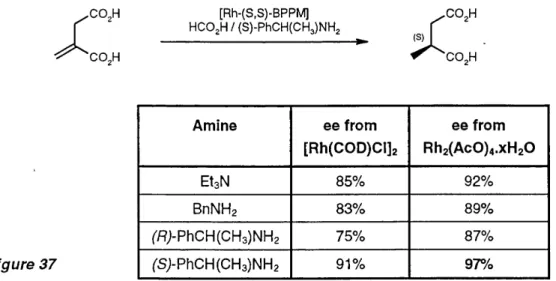
The rate and enantioselectivity of the hydrogen transfer reduction of itaconic acid was found to be dependant on the structure of both the am ine and of the rhodium catalyst precursor (Figure 37).^^ A im provem ent was noticed using [Rh2(ac)4].xH2 0 instead of [RH(C0D)CI]2. A double enantioselective hydrogen transfer was accomplished by substituting triethylam ine with (R) or
(S)-^ -phenylethylam ine. (SJ-methylsuccinic acid was thus prepared in 97% ee, which exceeded the best optical yield obtained in the asymmetric hydrogenation of itaconic acid with the related
R h(l)/(S ,S ; BPPM catalyst.^®
,C O ,H
‘co^H
[R h -(S ,S )-B P P M ] HCO^H / (S )-P h C H (C H J N H 2
C O ,H
(sJ
Figure 3 7
Amine ee from
[R h(C 0D )C I]2
ee from
Rh2(Ac0)4.xH20
EtsN 85% 92%
BnNH2 83% 89%
('R;-PhCH(CH3)NH2 75% 87%
('S;-PhCH(CH3)NH2 91% 97%
2 8 Introduction
Chiral Nitrogen Ligands
W ork in this field has mainly been concerned with optically active ligands containing pyridine derived ring systems. Optically active alkyl-2,2’-bipyridines and alkyl-1,10-phenanthrolines
(Figure 38) have been shown to be efficient chiral auxiliaries in Rh(l) catalysed enantioselective transfer hydrogenations, with the first set of results indicating the reduction of acetophenone to
("Sj-1-phenylethanol in up to 26% ee.^
R* = R* =
Figure 38
The active catalysts were generated in situ by the addition of excess ligand to Rh(COD)CI]2 in propan-2-ol, after which KOH was then added. In the absence of ligands the rhodium precatalyst was devoid of any catalytic activity since, upon heating in alkaline propan-2-ol, they were readily and quantitatively reduced to metallic rhodium.
The results obtained with ligand (44) (R = (S^-3-s-Bu) are of particular interest fo r three reasons. Firstly, the s-Bu substituent is usually poorly efficient in chiral transfer p r e c e s s e s 'a n d secondly, because the stereogenic centre of the alkyl group is four bonds away from the reactive site. Finally in the phenanthroline series the proxim ity effect does not seem to hold, since 3- substituted derivatives are more efficient than the corresponding 2-substituted.
The enantioselectivity is significantly increased to 63% ee without any detrim ental effect on the reaction rate when the (S)-3-s-Bu is substituted with the bulkier (S j-(ii2 ,2 -trim e th ylp ro p yl group). This is in contrast to the Ca-symmetric 3,8-di-(Sj-s-Bu-phenanthroline which generated a catalytic system of poor activity and devoid of enantiodifferentiating ability.^^
Lemaire and co-workers demonstrated the use of their chiral 1,2-b/s-amine (See Figure 34)^
29 Introduction
H
Ph_N
^ M e M e ^ H N — Ph
(45)
P h - N
2 M e M e ^ H N — Ph
(11)
Figure 39
Substrate Catalyst Yield (days) ee
t T Y * '
1,2-b/s-amine
[Rh(C0D)CI]2 / (40) 5% (6) 22% (R)
u
[R h(C O D )C I]2/(41) 29% (6) <5%[Rh(C0D)CI]2 / (4) 4% (1) 60% (S)
thiourea
[R h(C 0D )C I]2/1 x (1 1 ) 98% (1) 15% (S)
O [R h (C O D )C I]2 /2 x (1 1 ) 90% (1) 44% (S)
[R h (C O D )C i]2 /3 x (1 1 ) 97% (2) 63% (S)
U
[Rh(HD)CI]2/1 x (1 1 ) 94% (6) 17% (S)[R h (H D )C I]2 /2 x (1 1 ) 96% (6) 64% (S)
[R h (H D )C I]2 /3 x (1 1 ) 98% (1) 66% (S)
PhCOMe
diurea
[Rh(C0D)Cl]2 / (45) 97% (7) 43% (R)
PhCOEt [Rh(C0D)CI]2 / (45) 87% (7) 80% (R)
PhCO(/-Pr) [Rh(C0D)CI]2 / (45) 93% (11) 74% (R)
PhCO(f-Bu) [Rh(C0D)CI]2 / (45) 100% (4) 28% (S)
A recent report by Uemura and co-workers found that the Rh(l) catalysed hydrosilylation of -unfunctionaiised alkyl aryl ketones in methanol proceeded to give a chiral alcohol directly, rather than the hydrosilylated alcohol product as was observed when TH F was em ployed as the solvent.^® Closer examination of the system revealed that the reaction proceeded via a transfer hydrogenation pathway under very mild and neutral conditions, and not via hydrogenation by evolved hydrogen or hydrosilylation by the silane species. A variety of ketones were reduced with enantiorrieric excesses ranging from 22% to 95% ee, in the presence of Rh(l) and chiral substituted dichalcogenides (Figure 40).
o
. A ,
[R h (C 0 D )C I]2 . 2.5 mol% Ligand, 5 m ol% Ketone, 1 .0 mmol and Ph^SiHg
1.5 mmol in M eO H (2ml) O H A r '
Ligand :
NMBj Me^N
E —E -Fe Fe
30 Introduction
Figure 40
Substrate Ligand Yield ee
PhCOMe (47) 46% 48% (R)
PhCOMe (47) 50% 32% (R)
PhCOMe (46) 56% 10% (R)
PhCOMe (48) 72% 27% (R)
PhCOMe (47) 46% 48% (R)
PhCOEt (47) 28% 31% (R)
PhCOCOgMe (47) 95% 41% (R)
PhCO(f-Bu) (47) 11% 95% (R)
p-Me-CgH^COMe (47) 0%
-(2-thienyl)C 0M e (47) 100% 43% (R)
From the above table it was apparent that increasing the steric bulk around the ketone moiety resulted in lower conversions: Me (46%) to t-Bu (11%). It was also observed that when the chalcogenide was substituted with a diphenylphosphine group, transfer hydrogenation did not occur; further, the use of [lr(CO D)CI]2 or [Ru(C0D)Cl2]n as precatalysts failed to generate an active catalyst.
A new catalytic asym m etric transfer hydrogenation system was thus proposed. Ph2SiH2 and m ethanol was previously known only to give hydrogen under the conditions employed,^® as indicated by the evolution of hydrogen in the reduction of alkenes and alkynes using Ph2SiH2 and m ethanol in the presence of a Pd catalyst.®^
-A m echanism was postulated, which was believed to proceed by an initial ligand exchange of the COD with the dichalcogenide ligand. The resulting com plex catalysed the reaction of Ph2SiH2
with m ethanol to generate hydrogen and Ph2SiH(0Me). It is known that Rh(l) com plexes can catalyse such reactions:®®
c a t Rh
P h ,S iH , M e O H P h ,S iH (O M e )
The Rh(l) com plex then transfers hydrogen from the Ph2SiH(0Me) and/or m ethanol to the carbonyl enantioselectively:
A rC O R
+
P h ,S iH (O M e )cat. Rh
A rC H (O H )R
+
Ph,Si(0Me)231 Introduction
m ethanol (MeOD), alm ost equal amounts of deuterated and non-deuterated 1-phenylethanols were obtained, Indicating that the hydrogen introduced in this reduction cam e from both methanol and the Ph2S iH2. Further, it was found that Ph2SiD(OMe) was not form ed. It was evident that these observations excluded the intervention of a hydrosilylation pathway. The following m echanism was proposed, however there is no direct evidence to support the presence of the interm ediary species involved (Figure 41).
[R h (C O D )C I]
(Fc*Se)2 Ar
P h ,S iH ,
Rh(l) M e O H
or M e O D
or HD
R h C I(S e F c*)
PhgSiHpMe)
Ar^ ^R
H R h(S eF o* , 2
(D )
A
P h ,S iC I(O M e)
P h ,S iH (O M e M e O H P h,Si O M e )
' ^ " ' H ( D )
O R h (S e F c *),
Ar
^ ^ H ( D ) O^
'Rh(SeFc*)2
B
Figure 41
The m echanism illustrated above accounts fo r the form ation of the deuterated products when perform ing the reaction in MeOD. A detailed mechanism fo r the form ation of A fro m the species having an Rh-O bond B, Ph2SiH(OMe) and methanol is not yet known.