132
The Effect Competence And Motivation To
Satisfaction And Performance
Fikri Adam, Jeny Kamase
Abstract: This research aims to find out and analyze the influence of the competence, motivation towards job satisfaction.To know and analyze the competence and motivation towards the performance of employees.To know and analyze to find out and analyze the influence of the competence and motivation on performance through job satisfaction. The method of this research is quantitative descriptive using observation, interview and kuasioner in analyzing data to explain the phenomenon.Analysis tools used are SEM to explain all the hypotheses put forward in this study through the application of AMOS.The population in this study as many as 150 employees and a sample of this research using a multistage sampling, where the method is done by stages as follows using the sampling or judgement based on criteria and both use proportional stratified random sampling. The results of this research are positive effect not significant competencies against job satisfaction, motivation and positive effect significantly to job satisfaction, the positive effect of competence and not significantly to the performance of the employees.A positive and significant effect of motivation against the performance of employees. Job satisfaction the positive and significant effect against the performance of employees.Competence of influential positive and insignificant against the performance of employees through job satisfaction.significant motivation and a positive influence on performance that is mediated by job satisfaction.
Index Terms: Competence, Motivation, Satisfaction dan Performance.
————————————————————
1
I
NTRODUCTIONNational evelopment plans of both long-term or medium-term actualized through the work programme on each Ministry on the level of the Central Government and agencies under the auspices of the local governance including on public works The Province Of Gorontalo. Office of public works of the province of Gorontalo in performing basic tasks and functions based on one translation of vision, mission and programs as well as the activities of the regional Government of the province for development in the region of Gorontalo Province.The performance in General can be understood as a process as well as the results of the work.The performance is a process about how the work underway to achieve the results of the work, the results of the work itself also shows performance.Business and Blanchard (1993), Rivai (2005) in Sadariah (2012); Performance is a function of motivation and ability.Conditions that occur on the public works of the province of Gorontalo is a shortage of work volume (quantity), the delay in the work (not timely and not achieve target), the work does not match the technical specifications/contracts (quality), payment does not fit between the data report with the realization, service provision and infrastructure to the community particularly the community service providers less.The resulting performance means that employees have a relationship with discipline, knowledge, skills, leadership, integrity, responsibility, motivation, rewards and sanctions, supervision, satisfaction and dissatisfaction and have an impact on the work of work or achievements.Competence is the ability to execute or do a job or task that is based upon skills and knowledge.Mitrani et al, 1992; Spencer and Spencer, 1993 Competency is defined as "the underlying characteristics of the person and with regard to the effectiveness of individual performance in his work. In addition to competence, other things that need to be examined in an effort to increase employee performance is the motivation of working various instruments and policies.The Government of the province of Gorontalo provide motivation through some Performance Benefits, i.e. the policy area (TKD) to all civil servants every month with the value of allowances each is different every person in accordance with the position and standards evaluation/assessment i.e., responsibility, work achievement, discipline (presence), innovative.Giving
sanctions (punishment) for those who violate the provisions and regulations.In the context of employment, motivation is one of the important factors in encouraging an employee to work.Robbins, (2001) in Joseph (2008), mengdefinisikan motivation is the individual's willingness to issue a high effort to achieve the objectives of the organization.Gibson et. Al. (1998), and Porter & Lawler says that motivation effect significantly to job satisfaction.The statement Igalens & Roussel (1999) that the granting of salary is not certain or uncertain (flexible pay) to not give the workers motivation and job satisfaction and menghasiikan not useful if it provides permanently or remain and if not fixed give workers not motivated and don't produce job satisfaction.With regard to the phenomenon of previous research and theory, then the research will foster in the title influence of Competence and motivation towards job satisfaction and Employee Performance SEGWAY public works of the province of Gorontalo..
2
L
IETARURER
EVIEW2.1 Performance
an employee (individual), team or organization assigned with responsibility based on goals, objectives, vision, mission, and standards. and the time set by moral and ethics.
2.2 Competence
Competence is expected to improve performance and results of work, while competencies are needed in order to have capabilities that are in accordance with the needs of the organization so as to provide the best performance. Competence allows one to realize tasks related to the work needed to achieve goals According to Alexandeni, (2011) in Zahra (2011), Requirements are important for the effectiveness or success of leaders (leadership) and managers (management) in carrying out their respective roles, duties, functions, responsibilities and responsibilities are competencies. Based on the definition, the definition above, competencies can be interpreted as characteristics of the knowledge, skills, and behavioral abilities that a person needs to carry out tasks or activities more optimally.
2.3 Leadership
Leadership is the process by which an individual influences a group of individuals to achieve goals. Ali (2012), leadership is the ability of individuals to influence, motivate, and enable others to contribute to the effectiveness and success of the organizations they are members of. Ali (2012), leadership is the ability of individuals to influence, motivate, and enable others to contribute to the effectiveness and success of the organizations they are members of. Leaders who have high integrity usually have an honest attitude to maintain commitment and behave consistently. Integrity is absolutely necessary in leadership. Williams (2001) in Silalahi, et al. (2014), states that supervision is a general process of standard standards to achieve organizational goals, comparing actual implementation with specified standards, procedures, guidelines and taking corrective actions if necessary.
2.4 Dicipline
Good employee discipline will accelerate the achievement of organizational goals, high discipline results in achievement, while low discipline will become a barrier and slow the achievement of organizational goals. Arsyenda and Lating, (2013) discipline is a person's awareness and willingness to obey all applicable rules and social norms. dissipation of work is an orderly state in which a person or group incorporated in the organization wishes to comply with and carry out existing regulations, both written and unwritten. Work discipline is needed to keep the work performance of employees increasing. The definition and understanding above can be interpreted that discipline is a behavior or attitude that can refer to or show a person's personal character.
2.5 Motivation
Luthans (2006: 270) states that motivation is a psychological process directing behavior or a driver to achieve goals. Motivation influences performance, as shown by the relationship model of motivation with performance (Kreitner, Kinicki, 2001). Workers have the ability, work knowledge, disposition and nature, emotions, moods, beliefs and values at work. Workers will be more motivated if they believe that their performance will be known and valued. Mc. Clelland (1953) states that, humans in essence have the ability to excel above other people's abilities. Someone is
considered to have the motivation to excel if he has the desire to do a work of achievement better than the achievements of other people.
2.6 Job Satisfaction
Davis and Newstrom (1998; 105) describe job satisfaction as a set of employee feelings about whether or not their work is pleasing. According to Robbins (2003; 78) job satisfaction is a general attitude towards someone's work that shows the difference between the number of awards received by workers and the amount they believe they should receive. The key to satisfaction in this theory is the difference between aspects of work that are owned by what someone wants. Because of the large differences, the lower people's satisfaction. Sadariah (2012), states that there is a reciprocal relationship between performance and satisfaction. Job satisfaction causes an increase in performance so that satisfied workers will be more productive, job satisfaction occurs due to the existence of performance so that workers who have good performance will get satisfaction. Satisfied employees both internally and externally will play an active role in the tasks and responsibilities they carry out. Therefore, the level of employee job satisfaction is usually indicated by the attitude of the employees.
3
E
QUATIONSIn accordance with the objectives of the study to be achieved, this study explains the relationship and influence of competencies (X1), Motivation (X2), Job Satisfaction (Y) and Performance (Z). Data obtained through observation, interviews, questionnaires in data analysis to explain existing phenomena. The sample uses descriptive analysis and quantitative analysis to explain all hypotheses with the AMOS SEM (Structure Equation Modeling) Model. According to Singarimbun and Effendi (1995) in Sadariah (2012), populations are defined as generalizations consisting of objects or subjects that have certain characteristics and have equal opportunities to be selected as members of the sample. The sampling method used in this study is multistage sampling, which is a gradual sampling method, Sugiarto et al., 2003 in Arifin (2009). Based on this method, there are two stages of taking 150 samples. Based on these criteria, a sample of seven selected fields is determined. Furthermore, in the second stage, determining the official / employee sample in each field is done by Stratified proportional random sampling.
4
H
ELPFUL HINTS4.1 Figures and Tables
134 following picture:
Seen in the following picture:
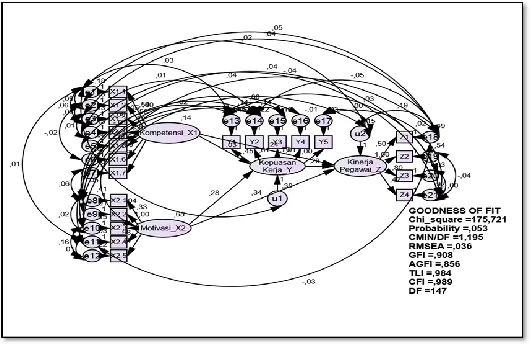
From the evaluation model shows that from eight criteria of goodness of fit indices, it can be seen from the eight criteria proposed, it seems that only two meet the criteria, but seeing the number of samples and indicators in this study is small. of fit indices so that the modification of the model is carried out by correlating the indicator error according to the instructions of the modification indices provided that the modification is done without changing the meaning of the relationship between the variables. The results of the analysis after the final model obtained are as follows.
Figure 2. Measurement of the final model variable relationship model
Based on the table above shows that of the eight criteria of Goodness Of Fit Indices proposed, it appears that one does not meet the criteria. So it can be concluded that the overall model can be said to be in accordance with the data and can be analyzed further. Based on the empirical model proposed in this study, testing of the hypothesis proposed through testing path coefficients in structural equation models can be tested. Table 5.29 is a hypothesis testing by From From the total of the nine direct pathways hypothesized, there are eight significant pathways and one path is not significant and among the four indirect pathways there is one that is not significant. The interpretation of Table 5.29 can be explained as follows:
Competence has a positive and not significant effect on job satisfaction with a coefficient value of 0.019. Positive
path coefficient values indicate that the latent variable Competence has a positive effect on job satisfaction with a value, so it is concluded that the effect that occurs between the latent variables of Competence and latent variables of job satisfaction is not significant. Thus the hypothesis is rejected. The results of this test show that the better the competencies that employees have, the more job satisfaction that is felt but not significantly increases.
Motivation has a positive and significant effect on job satisfaction with a coefficient of 0.342. Positive path coefficient values indicate that the latent variables of motivation have a positive effect on job satisfaction with values, so it is concluded that the effect that occurs between the latent variables of motivation and latent variables of job satisfaction is significant. Thus the hypothesis is accepted. The results of this test show that the better the motivation of employees, the job satisfaction increases significantly.
Competence has a positive and not significant effect on performance with a coefficient of 0.164. Positive path coefficient values indicate that the Competent latent variables have a positive effect on performance with values, so it is concluded that the effect that occurs between the Competent latent variables and the latent performance variables is not significant. Thus the hypothesis is rejected. The results of this test show that the better the competencies possessed by employees, their performance will increase but not significantly. Motivation has a positive and significant effect on
performance with a coefficient of 0.504. Positive path coefficient values indicate that the latent motivation variable has a positive effect on performance with values, so it is concluded that the effect that occurs between the latent motivational variables and significant performance latent variables. Thus the hypothesis is accepted. The results of this test show that the better the motivation possessed by employees, the more performance increases.
Job satisfaction has a positive and significant effect on performance with a coefficient of 0.356. Positive path coefficient values indicate that the latent variable job satisfaction has a positive effect on performance with values, so it is concluded that the effect that occurs between the latent variables of job satisfaction and significant performance latent variables. Thus the hypothesis is accepted. The results of this test show that the better employee job satisfaction, the performance will increase significantly.
Competence has a positive and not significant effect on performance through job satisfaction with a coefficient value of 0.007. Positive path coefficient values indicate that the latent variables of Competence have a positive effect on performance through job satisfaction and value, so it is concluded that the effect that occurs between the latent variables of Competence and latent performance variables through job satisfaction is not significant. Thus the hypothesis is rejected. The results of this test show that the better the competencies possessed by employees, the performance will increase positively but not significantly through job satisfaction. Motivation has a positive and significant effect on
0.179. Positive path coefficient values indicate that the latent motivation variable has a positive effect on performance through job satisfaction and value. through significant job satisfaction. Thus the hypothesis is accepted. The results of this test show that the better the motivation that employees have, the performance will increase positively through job satisfaction.
5
E
NDS
ECTIONS5.1 Effect of Competence on job satisfaction
The results of the research and hypothesis testing state that competency has a positive and not significant effect on job satisfaction. The results of this study prove that the competencies possessed by employees have not significantly increased job satisfaction in terms of Education / Knowledge provided to employees is not optimal both in terms of material aspects and processes and mechanisms that are implemented. Position or main tasks and functions are not in accordance with the level of education and knowledge possessed by employees, among others, Skills, where employees have a burden, duties and responsibilities that are not in accordance with the skills possessed, Leadership related to leadership ability in directing subordinates. In this case the leadership has not been able to direct subordinates in carrying out their duties and responsibilities. Low employee discipline becomes a barrier and impedes the achievement of organizational goals. Integrity that involves personal character that shows morals, noble character, trustworthiness, honesty, trustworthiness, consistency and commitment to the rules of the organization where things are not fully owned by the employee. The results of this study are different from the research carried out by Dhermawan, Sudibya and Utama (Udayana University 2012) entitled The Effect of Motivation, Work Environment, Competence and Compensation on Job Satisfaction and Employee Performance in the Bali Provincial Public Works Office Office which found that competence had a significant job satisfaction.
The preferred spelling of the word
“acknowledgment” in Effect of Motivation on job satisfaction The results of the study found that motivation had a positive and significant effect on employee job satisfaction. This means that if the motivation given to employees is good, it will increase job satisfaction. Good work motivation is the fulfillment of employee needs provided by the SKPD of the Gorontalo Provincial Public Works Office covering physiological needs, security, sense of belonging (social), self-esteem, and self-actualization. In addition, the Gorontalo Provincial Public Works Agency can provide performance allowances, working conditions, and teamwork, opportunities to develop, awards, sanctions, and dispositions fairly and transparently so employees will be motivated and this will result in fulfilling job satisfaction. The results of this study are in accordance with the previous research of Robbins (2003), Gibson et. Al. (1998), and Porter & Lawler say that motivation has a significant effect on job satisfaction. Effect of Competence on performance. The results of the study found that competence had a positive but not significant effect on performance. Application of competencies in the Public Works Agency such as the implementation of education and teaching that has not been optimal, skills that are still lacking, leadership patterns that are not in accordance with the work
requirements of employees in this agency, awareness of employees who are lacking in discipline and integrity and innovation and work experience still lacking so that this has an impact on not optimal employees in producing performance. This study supports Anila, Marnis and Ningsih (2012) and Rofiatun and Masluri (2011) found that Competence has a significant effect on employee performance.
5.2 Effect of Motivation on performance
The results of the study found that motivation had a significant effect on employee performance. Application of increased employee motivation such as physiological needs, security, sense of belonging (social), self-esteem, and self-actualization. In addition, the Gorontalo Provincial Public Works Agency can provide performance allowances, working conditions, and teamwork, opportunities to develop, awards, sanctions, and fair and transparent dispositions so that employees will be motivated and this will have an impact on improving employee performance. The results of this study support Musriha (2011), who found that work motivation had a significant impact on performance.
5.3 Effect of job satisfaction on performmance
The results show that job satisfaction has an effect on the performance of SKPD employees of the Gorontalo Provincial Public Works Office. To pay attention to aspects that can improve employee job satisfaction in terms of the Gorontalo Provincial Public Works Service is able to meet employee expectations in terms of satisfaction with productivity, satisfaction with absenteeism, satisfaction with salary, job satisfaction (Job), and satisfaction with promotion. The results of this study are in line with the research of Risambessy, A. Swasto, B. Thoyib, A. Astuti, S. Endang ,; 2012. Entitled "The Influence of Transformational leadership style, Motivation, Burnout towards Job Satisfaction and Employee Performance at a hospital in Malang Raya, East Java Province.
5.4 Effect of Competence on performance through job satisfaction
The results showed that competence had a positive and not significant effect on performance through job satisfaction. \ This is when it is associated with the direct influence of competence on satisfaction and performance, this indicates that the Gorontalo Provincial Public Works Office has chosen problems in terms of policies, programs and mechanisms related to competency. The Gorontalo Provincial Public Works Agency needs to review various matters such as patterns, media and educational materials, training and providing skills for employees. In addition, there needs to be a change in leadership patterns and styles and formulating appropriate actions and evaluations in disciplinary action, integrity and innovation for employees and always striving to improve work experience through employee work development patterns so that this has a good impact on job satisfaction and performance produced by employees.
5.5 Effect of Motivation on performance through job satisfaction
136 of belonging (social), self-esteem, and self-actualization. In
addition, the Gorontalo Provincial Public Works Agency can provide performance allowances, working conditions, and teamwork, opportunities to develop, appreciation, sanctions, and fair and transparent dispositions so that employees will be motivated and this will have an impact on increasing job satisfaction which ultimately leads to high performance achievement.
6.
A
CKNOWLEDGEMENTSBased on the results of the research and discussion stated earlier, then concluded several things as follows: Competence has a positive and insignificant effect on job satisfaction of the staff of the Gorontalo Provincial Public Works Department. These results indicate that the better the competencies possessed by employees, the greater the perceived job satisfaction that is not significant. Motivation has a positive and significant effect on job satisfaction of the staff of the Gorontalo Provincial Public Works Department. These results indicate that the better the motivation of employees, the job satisfaction increases significantly. Competence has a positive and not significant effect on the performance of employees of the Gorontalo Provincial Public Works Agency. These results indicate that the better the competencies possessed by employees, their performance will increase but not significantly. Motivation has a positive and significant effect on the performance of employees of the Gorontalo Provincial Public Works Agency. These results indicate that the better the motivation possessed by employees, the more performance increases. Job satisfaction has a positive and significant effect on the performance of employees of the Gorontalo Province Public Works Agency. These results indicate that the better employee job satisfaction, the performance will increase significantly. Competence has a positive and not significant effect on the performance of employees of the Gorontalo Provincial Public Works Department through job satisfaction. These results indicate that the better the competencies possessed by employees, the performance will increase positively but not significantly through job satisfaction. Motivation has a positive and significant effect on the performance of employees of the Gorontalo Provincial Public Works Department through job satisfaction. These results indicate that the better the motivation possessed by employees, the performance will increase positively through job satisfaction.
Suggestion
Based on conclusions, the authors provide several suggestions relating to the results of the research, namely: Competencies need to be studied and analyzed by the Public Works Department of Gorontalo Province because it does not have a significant effect on job satisfaction and employee performance. It is better for this agency to change and improve programs, policies, rules and mechanisms in a number of ways, namely: Employee education and training, Improving employee skills, Employee discipline, Pattern and style of leadership, Innovation and employee integrity and Improving work experience Gorontalo Provincial Public Works Agency needs to improve work motivation factors such as physiological needs, security, ownership (social), self-esteem, and self-actualization. The Gorontalo Provincial Public Works Agency can provide performance allowances, working conditions, and teamwork, opportunities to develop, award,
sanction, and disposition fairly and transparently so employees will be motivated and this will result in fulfilling job satisfaction and performance. This research only focuses on the object of research in the form of government organizations that are not profit-oriented so that it will be very different from profit-oriented organizations or companies so that for future researchers to research in profit-oriented organizations / companies. For further research to use other variables that affect job satisfaction and employee performance such as compensation, work environment, leadership and organizational culture For future researchers to use qualitative methods to obtain new information related to patterns in increasing job satisfaction and performance of employees in government agencies .
R
EFERENCES[1]. Abrecht, L, Simon. 2012. "Perceptions of integrity, competence, and trust in senior management as determinants of cynicism toward change". Public Administration & Management an Interactive Journal, 7.4.2002, pp. 320-343.
[2]. Abbas, Qaisar. Yacoob, Sara. 2009. "Effect of Leadership Development on Employee Performance in Pakistan". Pakistan Economic and Social Review, Vol. 47, No. 2, pp. 269-292.
[3]. Ahmad, S., & Shahzad, K. 2011. "Human Resource Management and employee performance: A case of University teachers of the Jammu and Kashmir (AJK) in Pakistan". African Journal of Business Management. Vol 5. No. 13, pg 22-25
[4]. Alf Crossman, Abou-Zaki Bassem. 2003. "Job Satisfaction and employee performance off Lebanese Banking staff." Journal of Management Psychology. Volume 18. No. 4. PP.368-376
[5]. Ali, A. 2012. Leadership and Influence in Organizations - A Review of Intellections. Faculty of Management Information Systems National University of Sciences & Technology, Pakistan. International Journal of Learning & Development. ISSN 2164-4063. 2012, Volume 2, Number 6
[6]. Ali, Asghar., & Akram., N. Muhammad ,. 2012. "Impact of financial rewards on employee's motivation and satisfaction in Pharmaceutical Industry, Pakistan". Global Journal of Management and Business Research. Vol 12. ISSN: 2249-4588
[7]. Alviah, R. (2012) Effect of Motivation and Supervision on Teacher Performance of Dharma Wanita Karangwaru Kindergarten Tulungagung. Journal of "AUTONOMY" Vol. 12 No.2. April 2012
[8]. Armstrong, Michael, 1998. A Handbook of Human Resource Management, Translation, Elex Media Kamputindo. Jakarta
[10]. Armstrong, Michael, 2006. A Handbook of 10th edition of Human Resource Management, Kogan Page, London and Philadelphia
[11]. Banamax, Aenkly. 2011. "Affect of competence, corporate culture and satisfaction toward performance". The International Journal of Human Resource Management, vol. 19, No. 7, July 2011, 127871297.
[12]. Bartol. Kathryn M. and David C. Martin. 1991. Management. New York: McGraw-Hill Companies, Inc.
[13]. Belcher, John G., Jr. 1987. Productivity Plus. Texas: Gulf Publishing Company
[14]. Bell, Julie.2009. Performance intelligence at work. New York: McGraw-Hill.
[15]. Becker, B.E ... & Gerhart, B. 1996. "The impact of human resource management on organizational performance: progress and prospects". Academy of Management Journal, 45, 587-597.
[16]. Boselie, P., Paauwe, J., & Jansen, P. 2001. "Human
Resouces Management,
and Performance: lessons from the Nethehand. "International Journal of Human Resources Management 12, pg 1107-1125.
[17]. Boselie, P., 2002. "Human Resouces Management, Work Systems and Performance". International Journal of Human Resources Management 12 (7) pp.243-245
[18]. Budhwar, P., & Sparrow, P.R., 1997. "Evaluating levels of integration strategies and development of Human Management Management in India". International Journal of Human Resources Management, 8pg476-494
[19]. Boyatzis, R.E., 2009. "Competencies as a behavioral approach to emotional intelligence". Journal of Management and development, 28 (9) pp.749-770
[20]. Cascio, W.F, 1989. Managing Human Resources: Productivity, Quality of Work Life, Profits. Second Edition, Me Graw-HHI, Inc. New York
[21]. Cascio, W.F, 1995. Managing Human Resources: Productivity, Quality of Life, Profits, Third Edition, Me Graw-HHI, Inc. New York
[22]. Chainiral. 2005. Competency Relations with the Performance of Immigration Officials Journal of FISIP Ul Dep. Administrative Science, Depok.
[23]. Chatman, Jennifer and Bersade. 1997. Employee satisfaction, factor Associted with company performance. Journal of applied psychology. February 29, 1997.
[24]. Chen, J.C., Silverthorne.C. 2008. "The impact of locus of control on job stress, job performance and job satisfaction in Taiwan". Leadership and organization development journal. 29 (7): 572-582.
[25]. Christopher Orpen, 1997. "The effect of formal mentoring on employee work motivation, organizational commitment and job performance". Journal of personal selling & sales management. Vol. j.pg 16-29
[26]. Cook, Sarah, and Steve Macaulay, 1997. Perfect Empowerment (transfer of language: Paloepi Tyas R). Jakarta: PT Elex Media Komputindo.
[27]. Costello, Sheila J. 1994. Effective Performance Management. New York. Me Graw-Hill, Companies, Inc.
[28]. Cushway, B., 1992. Human Resources Management, The Association for Management Education and Development, London.
[29]. Davis, K. & Werther, 1996. Human Resources and Personnel Management, Mc Graw Hill, USA.
[30]. Davis, Keith, and Newstrom, 1998. Behavior in Organizations. Agus Dharma Translation. Erlangga Publisher. Jakarta.
[31]. Dessler, Gary. (1993), Human Resources: Potential and Quality. Salemba Empat Publisher, Jakarta.
[32]. Dessler, Gary. (2007), Organization theory: Intergrating Structure and Behavior. Prentice Hall International Eds., New York
[33]. Dessler, Gary. (2011). Human Resource Management. Issue 10, Volume 1 and 2, (translation). Jakarta Index Publishers.
[34]. Devadass, Rajeswari. 2011." Employees motivation in organizations: an integrative literature review". International Conference on sociality and economics development. Vol. 10.
[35]. Elencov. S. Detelin, 2002. "Influences of leadership on Organizational performance in Russian Companies". Journal of Business Research, 467-480
[36]. Erari, Anita. Salim. U. Idrus, S, M. & Djumahir. 2013. "Financial Performance Analysis of PT Bank Papua: Application of Cael, Z-Score and Bankometer". Journal of Business and Management IOSR (IOSR-JBM), e-ISSN: 2278_487X. Volume 7, Issue 5, PP 08-16
[37]. Fahmi, Irham, 2011. Performance, Theory and Application Management, Alfabeta, Bandung
138 [39]. Goswami, B. Sharma, M. & Sujata. 2013.
"Performance Appraisal-Managemenet by, Objective and Assessment Center-Modem Approaches to Performance Appraisal". Journal of Business and Management IOSR (IOSR-JBM), e-ISSN: 2278_487X. Volume 7, Issue 5, PP 24-28
[40]. Greenberg, Jerald and Robert A.Baron.2003. Behavior in Organizations. New Yersey: Prentice Hal
[41]. Greenberg, E, Beth. Me Knight, John.F, Jf & Riddick, C, F. 2004. "Student Athlete Satisfaction at Big Ten University". Journal of the Indiana University Student Personnel Association, 2004 edition.
[42]. Gomes, 1995. Human Resource Management, ANDI Offset, Yogyakarta.
[43]. Guest, D.E., 1997. "Human Resources Management, and Performance; review and research agenda". International Journal of Human Resources Management, vol. 39, No. 4, pp. 969-970
[44]. Hairuddin, Arminas, Mursalim Umar Gani, Bahar Sinring, Zaenal Arifin (2017) Motivation, Competence and Organizational Commitment's Effect on Lecturers' Job Satisfaction and Lecturers Performance. IRA-International Journal of Management & Social Sciences
[45]. Hochwarter, Wayne A .; Perrewe, Pamela L; Ferris, Gerald R .; Brymer, Robert A. 1999. "Job Satisfaction and Performance: The moderating effects of Value attainment and affective disposition". Journal of vocational behavior 54, pp. 296-314-
[46]. Handoko, T, Hani. 1989. Management. Second Edition, BPFE. Yogyakart
[47]. Handoko, T.Hani. 1993. Personnel and Human Resource Management, BPFE Yogyakarta, Yogyakarta.
[48]. Handoko, T, Hani. 2006. Basics of Motivation. Liberty Publisher, Yogyakarta
[49]. Hasibuan, M, 1990. Human Resource Management, Haji Masagung, Jakarta.
[50]. Hasibuan, Melayu, SP, 2001. Human Resource Management, Revised Edition of Bumi Aksara, Jakarta.
[51]. Heller, Robert, Motivating People. 1998. London: Dorling Kindersley
[52]. Hersey, Paul, Kenneth H. Blanchatd and Dewey E. Johnson. 1996. Management of Organizational Behavior. New Yersey: Prentice Hall
[53]. Hestianto, Bayu. 2010. "Competence and motivation for work that is coloring Job Satisfaction with Increased Employment "Journal of Management &
HR Vol. 4. No. 2, Sept. 2010: 108-122, University of Hasanuddin Makassar.
[54]. Hong, Ng Chese, Eric. Hao, Z, L Kumar, Ramesh. Ramendran, Charles &Kadiresan, Vimala. 2012. "An Effectiveness of Human Resource Management Practices on Employee Retention in Institute of Higher Learning: - A Regression Analysis". International Journal of Business Research and Management (IJBRM), vol. 3: issue (2), 2012.
[55]. Igalens J, and Patricks Roussel, 1999, "Study of relationships between compensation packages, work motivation, and job satisfaction". Journal of Organizational behavior. Vol. 20, (is 7; pg.1003
[56]. Ivancevich, John M. 2001. Human Resource Management (8th). Richard D. Irwin, Inc., USA.
[57]. Katou, A. Anastasia. 2008. "Measuring the impact of HRM on organizational performance". Journal of Industrial Engineering and management. / SSA /: 2013-0953
[58]. Khan H. Alamdar, Nawaz M. Musarrat, Aleem M., Hamed W.; 2612. "Impact of job satisfaction on employee performance: An empirical study of autonomous Medical Institutions of Pakistan." African Journal of Business Management. Vol.6 (7), pp. 2697-2705,
[59]. Kopelman Richard E, and Thompson, Paul H. 1986. "Boundary conditions for expectancy theory of predictions of work motivation and job performance". Academic of Mangement Journal. Vol. 19.No. 2.pp 237-256.
[60]. Kreitner, Robert, and Angelo Kinicki. 2001. Organizational Behavior. New York: Me Graw-Hill, Companies, Inc.
[61]. Langdon, Ken, and Christina Osborn. 2001. Performance Reviews. New York: DK Publishing, Inc.
[62]. Lawson, Ken.2005. Performance Reviews. London: Axis Publishing Limited
[63]. Linawati., And Suhaji .; 2012, Effect of Motivation, Competence,
[64]. Leadership, and Work Environment on Employee Performance (Study at PT. Herculon Carpet Semarang). Journal. Lopez, Elsa .; 1982. "A test of the consistency of the job performance-job satisfaction relationship,". Academic of Mangement Journal. Vol. 25.No. 2.pp 335-348.
[66]. Mangkunegara, A, Anwar Prabu. (2000). Corporate Human Resource Management, Bandung: Rosda Karya.
[67]. Mangkunegara, Anwar Prabu. (2005). Organizational Behavior and Culture,First printing, PT Refika Aditama, Bandung
[68]. Mangkunegara, Anwar Prabu (2005), HR Performance Evaluation, PT Refika Aditama, Bandung.
[69]. Mason Michelle. 2012. Motivation, satisfaction, and innate psychologicalneeds. International Journal of Doctoral Studies. Volume 7, 2012Mathis, Robert L, and Jackson, John, H. 2
[70]. Risambessy, A. Swasto, B. Thoyib, A. Astuti, S. Endang ,; 2012. "The Influence of Transformational style leadership, Motivation, Burnout towards Job Satisfaction and Employee Performance". Journal of Basic and Applied Scientific Research. ISSN 2090-4304
Robbins, Stephen P. and Mary Coultar. 1996. Management. New Yersey.Prentice Hall
[71]. Robbins, Stephen P. 1996. Organizational Behavior. Seventh Edition, ASimon & Schusfer Company, Englewood Cliffs, New Jersey: 07632 Robbins, Stephen P. 2001. Organizational Behavior, upper Saddle River,New Jersey, Prentice Hall Inc.
[72]. Robbins, Stephen P. 2002. Essensials of Organizational Behavior (translation), Fifth edition, Erlangga Publisher, Jakarta
[73]. Robbins, Stephen P. 2003. Organizational Behavior. Companies, Inc.Management New Yersey: Prentice Hall
[74]. Rofiatun and Masluri. 2011. Effect of Organizational Climate and Employee Competence on employee performance with motivational mediation in Dinas Dinas in Kudus Regency.
[75]. Rowold, J.S., 2008, "Multiple effect of Human Resource Development interventions". Journal of European Industrial Training (Emerald Publishing group). Vol 32, No. 1, pp. 32-44
[76]. Sadariah, 2012, Effect of Leadership Style, Commitment, and Motivation on Job Satisfaction and Employee Performance at Makassar International Hasanuddin Cargo Business, Dissertation, Management Science Doctoral Program Postgraduate University of Indonesian Muslim Makassar, Makassar.
[77]. Schwartz, Andrew E. 1999. Performance Management. New York: Barrons Education series, Inc.
[78]. Setyaningdyah E, Kertahadi N. Umar, Thoyib A .; 2013 "The effects of human resource competence, organizational commitment and transactional leadership on work discipline, job satisfaction and employee's performance". Interdisciplinary of contemporary research journals in business. Vol. 5, No. 4.
[79]. Shahab, A, M. Nisa, I (2014). The Influence of Leadership and Work Attitudes toward Job Satisfaction and Performance of Employees. International Journal of Managerial Studies and Research (IJMSR) Volume 2, Issue 5, June 2014, PP 69-77 ISSN 2349-0330 (Print) & ISSN 2349-0349
[80]. Simanjuntak, Payaman. 2005. Performance Management. Economic Journal of the University of
Indonesia, Jakarta
Silalahi, Bonar, P., Lufti, Muslich., Khairah, Amaliah, F. (2014). Influence Motivation, Supervision and Work Discipline towards the Work Achievement of Revenue Service Officers, Regional Financial and Wealth Managers of Central Tapanuli Regency. PS Open University.
[81]. Sinha, Smrita. Singh, Ajay, Kr. Gupta, Nisha 7 Dutt, Rajul. 2010. "Impact of Work Culture on Motivation and Performance level of Employees in Private Sector Companies". ACTA OECONOMIA PRAGENSIA 6/2010, ISSN 0572-3043.
[82]. Soedjono. 2005. Effect of Organizational Culture on Organizational Performance and Employee Satisfaction at General Passenger Terminals in Surabaya.
[83]. Spencer, Lyle, M.Jr. and Signe M. Spencer. 1993. Competence at Work. New York .: John Wiley &
Sons, Inc.
Simamora, Henry. (1999). Human Resource
Management. Edition
First. Yogyakarta: STIE YKPN.
[84]. Srimulyani. A. Veronika. 2012. Effect of Motivation, on employee performance with mediating variables Job satisfaction in PDAM Kota Madiun.
[85]. Stuart-Kottze, Robin. 2006. Performance. London: Prentice Hall.
[86]. Sulaiman, W, S, W. Almsafir, M, K. Ahmad Z, A- 2013. "Job Performance:Relationship between Competency and Attitude towards Achieving National Vision "Journal of Advanced Social Research Vol. 3, 1-11
140 [88]. Sudin, Suhaimi. 2011. "Fairness of and Satisfaction
with Periomance Appraisal Process". Journal of Global Management, July 2011, Vol. 2. Number 1.
[89]. Sunya, Jusuf, Salim Basalamah, Ahmad Gani, Junaidin Zakaria (2017) The Influence Of Leadership, Competency, Motivation And Organizational Culture On Employees' Job Satifisfaction And Performance In Ternate City Government. Science Arena Publications International journal of Business Management
[90]. Suryana, Nana. Siti Haerani and Muh Idrus Taba, 2010. Effects of Leadership and work motivation on employee job satisfaction and company performance (Case study in PT INCO Surowako's Mining Division).
[91]. Tabroni, 2010, The Spiritual Leadership, second edition, UMM press, Malang
[92]. Friend, Koesmono. 2005. Effect of Organizational Culture on Motivation and Job Satisfaction and Employee Performance in the Medium-Scale Industrial Sub-Sector in East Java.
[93]. Vecchio, Robert P. 1995. Organizational Behavior. Florida: The Dryden Press
[94]. Wajdi & Narmodo, 2008, Effects of Motivation and Discipline on Employee Performance of the Regional Personnel Agency in Wonogiri Regency, Research Journal of the Department of Management
[95]. Werther, William, B. Jr. and Keith Davis. 1996. Human Resources and Personnel Management. New York: Me Graw-Hill
[96]. Wibowo, 2012. Performance Management, Third Edition, Jakarta. Rajawali Press,