ISSN 2307-4523 (Print & Online)
© Global Society of Scientific Research and Researchers http://ijcjournal.org/
An Analysis of the Business Accelerator Programs in
Turkey
Ceren Cubukcu
a*, Sevinc Gulsecen
ba,bInformatics Department, Istanbul University, Istanbul, Turkey aEmail: [email protected]
bEmail: [email protected]
Abstract
This paper analyses the business accelerator programs in Turkey. Business accelerators are new generations of incubation programs born especially to support technology entrepreneurs and help them reach to the next level. There are six startup accelerators in Turkey out of eighteen which fit into the criteria of accelerator programs. These are Kworks, ITU Seed, SuCool, IOT Telco Labs, Pilot and Starter’s Hub programs. All of these programs only accept technology entrepreneurs and help them grow their businesses. Using the interview method, this study provides an inside look into the models of these six programs. It provides detailed analysis about the general structure of the programs, the characteristics of the entrepreneurs in the programs, how the programs operate, information about the graduates of the programs, the mentor networks, the investment possibilities and the performance criteria of the programs. There are studies about accelerators in highly developed countries but the literature lacks information about accelerators in developing countries. Therefore, this study contributes to the literature by filling this gap.
Keywords: accelerators; incubators; startups; digital entrepreneurship.
1. Introduction
There has never been a better time to establish a technology or internet company due to the rapid development and advancement of technology and the Internet [1]. Nowadays anyone who wants to implement an internet or mobile technology project can carry out their projects with the tools they use for free or for a small fee. These projects are far different from the technology and internet companies that have been established in the Nineties. Having an internet company in the Nineties had a higher cost and, therefore more risk [2].
---
In the meantime, the costs have dropped considerably and knowledge has gained importance [3]. The ones who are able to turn their knowledge into a software program immediately begin to set up their companies with the minimum capital required. During the initial development of the internet, costs such as receiving servers, using licensed software, and working with appropriate software developers were high. Therefore, establishing a new internet company required a serious investment [4]. Now, thanks to the cloud technology and open source software, these costs are significantly reduced. In addition, developing internet and mobile projects has become much easier with the help of new software languages and platforms. The risk of establishing a new technology company also reduced due to decreased costs and ease of developing new software. This has led to an increase in the number of people seeking to establish a new technology venture in the recent years. In order to support these people, incubation centers started to be established by government, private sector, universities or investors [5].
Incubators became widespread in the early Nineties [6] but it has problems in its model such as a lack of exit policy [7]. Therefore, in addition to incubation centers, new generations of programs, which have grown rapidly in recent years to support entrepreneurs, have begun to open [8]. These new programs, born in the US especially to support technology entrepreneurs, are called accelerators. Accelerators, as the name suggests, are programs that provide entrepreneurs with the driving force they need in the initial stages of their ventures to accelerate their growth [9]. Accelerators generally provide support to entrepreneurs such as mentoring, training, seed financing, networking or office use in a short period of time such as three to six months [10,11,12]. Accelerator programs include startups to their programs according to the criteria they specify and accelerate their growth significantly. The first accelerator is considered to be the “Y Combinator” program, which was established in 2005 [13, 14]. This program operates with a more innovative and different business model compared to incubation centers [15].
Over 213 accelerators are present worldwide according to Seed-DB, a platform that analyses accelerators [14]. In Turkey, there are 18 programs that call themselves an accelerator. However, there is not any study in the literature that analyses accelerators in Turkey. Generally, there is information about accelerators in highly developed countries. For example; Lehmann [16] has a study about corporate accelerators in Germany, Isabelle [17] made a study with accelerators in Canada and Salido [18] performed a study on accelerators and incubators located at Germany, France, Italy, Spain, Netherlands, Sweden and the UK. However, the literature lacks information about accelerators in developing countries. Therefore, this study aims to fill this gap by providing an overview of accelerators in Turkey.
In the following sections accelerator programs in Turkey will be explained, which accelerator programs are chosen for this study and its reasons will be clarified, the data collection process will be mentioned and the findings will be explained. Finally, the limitations of this study and future research possibilities will be addressed.
2. Accelerator Programs in Turkey
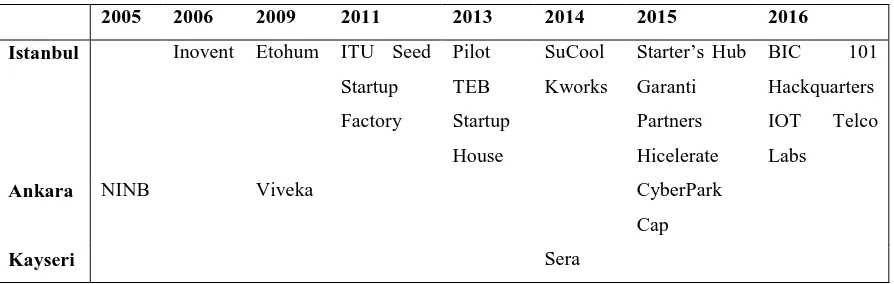
The first program that calls itself an accelerator in Turkey is “Inovent” founded by Sabanci University. Inovent is founded with the aim of commercializing the projects and researches of university faculty. Although “New Ideas New Businesses (NINB)” is established in 2005, it started as an entrepreneurship competition and transformed into an accelerator program in the following years. Therefore, Inovent is accepted as the first accelerator program in Turkey. After Inovent, the “Viveka” and “Etohum” programs were founded by investors in 2009. After 2011, due to the growing interest in digital entrepreneurship, accelerator programs were founded one after another and their numbers grew rapidly [19]. Accelerators are generally founded in Istanbul since Istanbul is the financial center of Turkey. However, there are accelerators in other cities of Turkey as well such as Ankara, the capital of Turkey, and Kayseri. In the table below, you can see when accelerator programs of Turkey are founded and in which city they are located at. Incubator programs of Turkey do not exist in the table below. Only the programs which identify themselves as accelerators are classified.
Table 1: Accelerator Programs in Turkey
2005 2006 2009 2011 2013 2014 2015 2016
Istanbul Inovent Etohum ITU Seed
Startup Factory
Pilot TEB Startup House
SuCool Kworks
Starter’s Hub Garanti Partners Hicelerate
BIC 101 Hackquarters IOT Telco Labs
Ankara NINB Viveka CyberPark
Cap
Kayseri Sera
As it can be seen from Table 1, there are 18 accelerator programs in Turkey. These are; NINB, Inovent, Etohum, Viveka, ITU Seed, Startup Factory, Pilot, TEB Startup House, SuCool, Kworks, Sera, Starter’s Hub, Garanti Partners, Hicelerate, CyberPark Cap, BIC 101, Hackquarters, and IOT Telco Labs. It can be noticed that after 2013, the number of these programs increased. However, Turkey has a population of 75 million and 18 programs is still a very low number compared to this population. Moreover, there are only three cities that have accelerator programs. Especially the fact that the headquarters of corporations and investors are located in Istanbul better explain why these programs are founded in here.
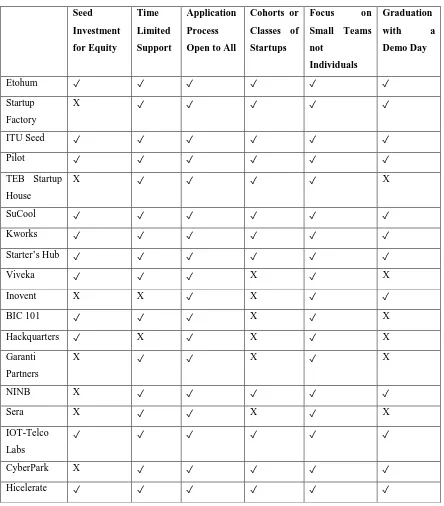
In order to create Table 2, first of all the web sites of accelerator programs are analyzed. General information about the programs is identified and whether there is an application link open to everyone has been checked. Then, using the contact information at each website, an email is sent to the program coordinators asking whether their programs have invested seed funds in startups, how long their program is, how they include entrepreneurs to their programs, and whether there is a graduation day. According to the information received from coordinators, below Table 2 is created.
Table 2: The characteristics of accelerator programs in Turkey
Seed
Investment
for Equity
Time
Limited
Support
Application
Process
Open to All
Cohorts or
Classes of
Startups
Focus on
Small Teams
not
Individuals
Graduation
with a
Demo Day
Etohum ✓ ✓ ✓ ✓ ✓ ✓
Startup Factory
X ✓ ✓ ✓ ✓ ✓
ITU Seed ✓ ✓ ✓ ✓ ✓ ✓
Pilot ✓ ✓ ✓ ✓ ✓ ✓
TEB Startup House
X ✓ ✓ ✓ ✓ X
SuCool ✓ ✓ ✓ ✓ ✓ ✓
Kworks ✓ ✓ ✓ ✓ ✓ ✓
Starter’s Hub ✓ ✓ ✓ ✓ ✓ ✓
Viveka ✓ ✓ ✓ X ✓ X
Inovent X X ✓ X ✓ ✓
BIC 101 ✓ ✓ ✓ X ✓ X
Hackquarters ✓ X ✓ X ✓ X
Garanti Partners
X ✓ ✓ X ✓ X
NINB X ✓ ✓ ✓ ✓ ✓
Sera X ✓ ✓ X ✓ X
IOT-Telco Labs
✓ ✓ ✓ ✓ ✓ ✓
CyberPark X ✓ ✓ ✓ ✓ ✓
Hicelerate ✓ ✓ ✓ ✓ ✓ ✓
have not invested in all of the startups they accepted into their programs, still there are some startups they have invested in. Therefore, they were also included among the accelerator programs that fit into the criteria. Moreover, ITU Seed has a research and development fund called “Seed Wallet” for certain entrepreneurs to develop their prototypes and move forward smoothly in the business development process. In the case of SuCool, it pays capital to entrepreneurs for the shares it receives during company establishment. For instance; if the company is going to be established with a capital of $50.000 and SuCool wants to own 3% shares, it will pay the share price of $1,500 in the establishment stage. Since this is also considered as an investment, SuCool is also included among the accelerator programs that fit into the criteria. Although Hicelerate program provided these criteria, it was removed from this study because the entrepreneurs who graduated from this program were taken to New York to establish their companies and grow up in the US market. However, this study is interested in accelerators which are located in Turkey as well as help startups grow in Turkish market. Hicelerate targets startups that want to exist entirely in the American market. For this reason, this program will not be covered by this study. On the other hand, Etohum did want to participate in this study. As a result, the programs which will be covered in this study are ITU Seed, Pilot, SuCool, Kworks, Starter’s Hub and IOT Telco Labs.
When these six accelerator programs are further examined, it can be found out that the ITU Seed program is established by Istanbul Technical University (ITU), SuCool is established by Sabanci University, Kworks is established by Koc University, Pilot is established by Turk Telekom International company, IOT Telco Labs is established by Nexus Ventures and Istanbul Startup Angels and finally, Starter’s Hub is established by Gedik Investment, Murat Vargi Holding Corporation, Bahcesehir University and NetMarble Turkey. These programs can be classified according to the accelerator types mentioned by Pauwels [14];
• Deal-flow Maker Programs: -
• Welfare Stimulator Programs: ITU Seed, Kworks, SuCool • Ecosystem Builder Programs: Pilot
• Hybrid Programs: IOT Telco Labs, Starter’s Hub
These four types of accelerator programs also have their own advantages and disadvantages. Hence, it is not right to say that one is superior to the other. Entrepreneurs should choose the most appropriate program according to their needs [17].
In the next section, the data collection process with the programs that meet the criteria will be mentioned and the results of this data will be explained.
3. Data Collection
measures the economic impact of incubator centers and accelerator programs in the US. In addition to Impact Index survey, Aspen Institute’s “Bridging the Pioneer Gap” [21] article is also used as a supplement for preparing the interview questions.
The questions asked in the interview can be gathered under the following titles; the general structure of the accelerator programs, the acceptance rates and the characteristics of the accepted entrepreneurs, the mentorship networks of the programs, how the program operates, the collaborations and partnerships made with other institutions and stakeholders, graduation requirements of the programs, the amount of investment that has been done so far and the entrepreneurship events that has been organized.
4. Findings
The following sections present the results of the analyses of six business accelerator programs.
4.1 General structure of the programs
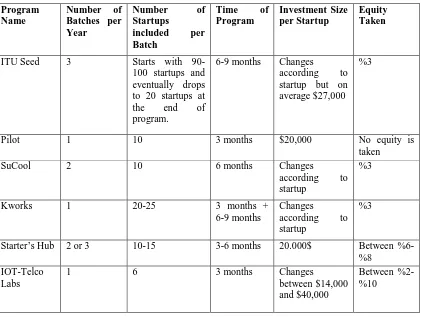
According to the answers given by the program coordinators as a result of the interviews, the below table which shows the general structure of the programs was created.
Table 3: General structure of the programs (1 USD= 3.65 TRY as of 14.04.2017)
Program Name
Number of Batches per Year
Number of Startups
included per Batch
Time of Program
Investment Size per Startup
Equity Taken
ITU Seed 3 Starts with
90-100 startups and eventually drops to 20 startups at the end of program.
6-9 months Changes
according to startup but on average $27,000
%3
Pilot 1 10 3 months $20,000 No equity is
taken
SuCool 2 10 6 months Changes
according to startup
%3
Kworks 1 20-25 3 months +
6-9 months
Changes
according to startup
%3
Starter’s Hub 2 or 3 10-15 3-6 months 20.000$ Between
%6-%8 IOT-Telco
Labs
1 6 3 months Changes
between $14,000 and $40,000
As it can be seen from Table 3, accelerator programs tend to accept 10 to 20 startups at a time. Coordinators do not want to go beyond a certain number of startups in order to be able to deal specifically with the needs of each one. The only exception to this is the ITU Seed program. ITU seed delivers an eight-week training program to every startup it accepts. After this training, it requires every startup to reach certain key performance indicators in order to graduate and make a presentation at the demo day. 20 startups selected among the ones that reach the key performance indicators defined by the program can present their startups to investors at the demo day called “Big Bang”.
Kworks, IOT Telco Labs and Pilot programs accept one batch of startups per year. On the other hand, Starter's Hub, ITU Seed and SuCool programs are able to accept several batches per year. Even though the ITU Seed program accepts startups three times a year, it makes only one graduation day at the end of the year. On this graduation and demo day called "Big Bang", the ones selected from the startups in these three batches present to investors on the stage.
The duration of the programs varies from three to nine months. Even though the durations shown on Table 3 are the formal ones, coordinators indicate that startups generally tend to stay on the program for about six or seven months. The amount invested in startups also differs in each program. For example; the Pilot program invests in $20,000 to all startups that they accept into the program. However, the IOT Telco Labs program invests amounts ranging from $14,000 to $40,000 in each startup. Also, the amount of shares received from entrepreneurs in IOT Telco Labs program varies according to the investment made. Unlike other accelerators in the table, the Pilot program does not demand any equity from entrepreneurs because it is supported by Turk Telekom International Company and doesn’t have a purpose of making profits. In addition to their investments in startups, programs also provide them with support such as training, mentoring, workshop facilities, arranging investor meetings, and the opportunity to meet potential customers.
The number of applications to programs also varies. Per year; ITU Seed receives 5,500 applications, Kworks receives 1000 applications, Pilot receives 500 applications, Starter's Hub receives 834 applications, SuCool receives 200 applications and IOT Telco Labs receives 100 applications. ITU Seed doesn’t only have an accelerator program, but also has pre-incubation and incubation programs. For this reason, ITU Seed generally has a higher number of applications compared to other programs because it has different programs for entrepreneurs at different stages.
In the interviews with the coordinators, they were asked why they chose to position their programs as an accelerator, not as an incubator, and to tell whether they knew the differences between the two programs. It has been determined that all of the coordinators are generally informed of the differences between these two types of programs and indicate that they prefer to be positioned as an accelerator program because they want the startups to progress more with an intensive consulting process in a shorter time frame.
When the coordinators were asked about the purpose of these programs, almost all of them replied as "contributing to the entrepreneurship ecosystem". This response was followed by support for innovation, contributing to the economy, spreading the entrepreneurial culture and having a worldwide startup from Turkey.
4.2 The characteristics of the entrepreneurs chosen to programs
The program coordinators state that they are open to accepting entrepreneurs from all over the world. Kworks and Starter's Hub programs have startups from Europe and Asia, but these entrepreneurs are required to stay in Istanbul during the program. Only in this way they are able to make use of the most of the support offered by the program. While all of the programs accept entrepreneurs from the technology sector similar to the ones around the world, the areas they focus in technology vary [22].
For instance; IOT Telco Labs, as its name implies, focuses on entrepreneurs operating in the fields of internet of things, telecom and software. ITU Seed prefers entrepreneurs that work in the field of big data and machine learning. Kworks stated that it generally includes financial technologies, software as a service, mobile and marketplace startups in its program, while Pilot stated that it prefers startups operating in the areas of artificial intelligence, intelligent houses / cities, and education technology. Starter's Hub and SuCool did not specify any area but stated that they give priority to startups with low operating costs and high profit opportunity.
According to the coordinators, the most important aspects when including startups in their programs are; team, innovation, product, growth potential, business model, market size, globalization potential, exit strategy, technology startups use and business plan. The demographic characteristics of entrepreneurs in the programs are very diverse. There are university students, new graduates and people with many years of business experience. The age usually ranges from 18 to 40 years old. Unfortunately, the percentage of women entrepreneurs in these programs is not over 30%.
It is noted that most of the startups involved in the programs are in the prototype phase or are ready to launch their products; some of them also have already made sales. Startups at the idea stage are few. The reason for this is that accelerator programs are short in duration so they prefer startups which have already made some progress because they can more easily support these kinds of startups. Incubation centers are more suitable for startups at the idea stage because they will require more time to start selling products or services.
Another point that attracts attention in the programs is the number of patents or patent applications. Unfortunately, while the number of patent applications in all accelerator programs, except ITU Seed, do not exceed 5 applications per program, it is around 100 applications in the ITU Seed program.
We can link this number to the strong ties between ITU Seed, ITU and ITU Technopark. We should also not ignore the fact that the ITU Seed program accepts much more startups to its organization compared to other accelerator programs. Therefore, they have made more patent applications than any other program.
For example, while Pilot thinks that the most important support for entrepreneurs is its investment support, it noticed after receiving feedback from entrepreneurs that the most important support for entrepreneurs is actually the opportunity to cooperate with Turk Telekom. Similarly, while other programs also pointed out that the mentorship network and cooperative opportunities are the most valuable supports for entrepreneurs, SuCool program stated that entrepreneurship camps in other countries are very important because they are a starting point for entrepreneurs who want to go global.
4.3 Mentorship networks of the programs
All of the mentors in accelerator programs work on voluntary basis. In some programs various incentives are offered to these mentors for their services. For instance; free use of the Kworks office and Kworks software programs as well as free access to the products of startups within Kworks program. In other programs, mentors support entrepreneurs in order to contribute to the entrepreneurial ecosystem or for personal satisfaction.
The programs identify mentors in several different ways. Starter's Hub, Kworks, and SuCool programs use both a formal application process to identify mentors and make offers to some individuals to be mentors. In addition, the SuCool program trained its own mentors with the "Tubitak Mentor Sea" program in 2016.
On the other hand, ITU Seed chooses to determine its mentors by reference. The Pilot program states that there is not a formal application process to be a mentor but still they evaluate the requests. IOT Telco Labs makes their own offers to the mentors.
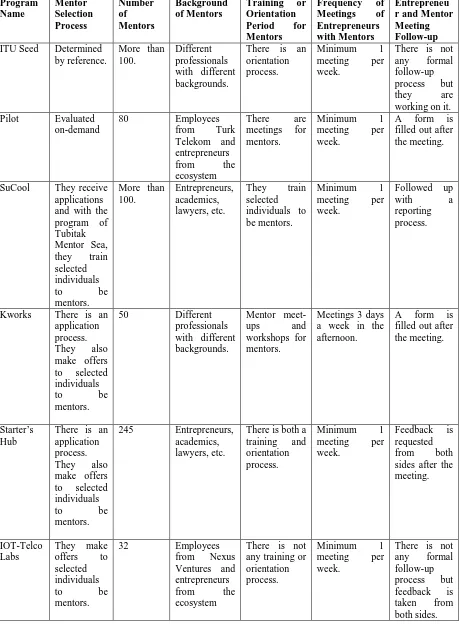
The number of mentors in the programs varies according to the program. For example; IOT Telco Labs has 32 active mentors, while Starter's Hub has 245. The number of mentors in other programs ranges from 50 to 100. Mentors' professional backgrounds are very diverse. In all programs, entrepreneurs, lawyers, finance professionals, academics, computer scientists and other people from various professional groups are mentoring. More detailed information about the mentors in accelerator programs can be found on Table 4.
As shown on Table 4, on almost all programs there is a training or orientation process for mentors. Although the names of these processes change in programs and sometimes they are called as a training program, sometimes as a meeting, the overall main goal is to explain how mentors can guide entrepreneurs.
According to interviews made with program coordinators, entrepreneurs need to meet with mentors at least once a week. However, entrepreneurs can benefit more from the program, if they meet with mentors more than once a week. Also, the more different mentors they meet, the more benefit they can get from the program.
Table 4: Information about mentors in programs Program Name Mentor Selection Process Number of Mentors Background of Mentors Training or Orientation Period for Mentors Frequency of Meetings of Entrepreneurs with Mentors Entrepreneu r and Mentor Meeting Follow-up ITU Seed Determined
by reference. More than 100. Different professionals with different backgrounds.
There is an orientation process.
Minimum 1 meeting per week.
There is not any formal follow-up
process but they are working on it. Pilot Evaluated
on-demand
80 Employees
from Turk Telekom and entrepreneurs from the ecosystem There are meetings for mentors. Minimum 1 meeting per week.
A form is filled out after the meeting.
SuCool They receive applications and with the program of Tubitak Mentor Sea, they train selected individuals to be mentors. More than 100. Entrepreneurs, academics, lawyers, etc. They train selected individuals to be mentors. Minimum 1 meeting per week. Followed up with a reporting process.
Kworks There is an application process. They also make offers to selected individuals to be mentors.
50 Different
professionals with different backgrounds. Mentor meet-ups and workshops for mentors.
Meetings 3 days a week in the afternoon.
A form is filled out after the meeting.
Starter’s Hub
There is an application process. They also make offers to selected individuals to be mentors.
245 Entrepreneurs, academics, lawyers, etc.
There is both a training and orientation process. Minimum 1 meeting per week. Feedback is requested from both sides after the meeting. IOT-Telco Labs They make offers to selected individuals to be mentors.
32 Employees
from Nexus Ventures and entrepreneurs from the ecosystem
There is not any training or orientation process.
Minimum 1 meeting per week.
4.4 Stakeholders and how the program operates
All of the accelerator programs have relations with different stakeholders, and these organizations provide them different supports. For instance; the stakeholders of ITU Seed include ITU, Tubitak, Automotive Industry Exporters Association and various corporations. Some of these institutions have provided funding for operational expenses, some have supported the installation of the research and innovation lab which is part of the accelerator program, some have supported and are still supporting for legal processes. The stakeholders of Kworks include Koc University and the Vehbi Koc Foundation. Operational expenses of Kworks are covered by the operation fund of the university. In addition, the building Kworks is in belongs to the foundation. Starter's Hub was established with the common funds of Gedik Investment, Net Marble Turkey, Murat Vargi Holding Corporation, Bahcesehir University and several individual investors. Operational expenses are also covered by this fund. Starter's Hub also works with major local and international corporations such as Turkcell, Intel, Arcelik, Is Bank and Amazon to provide services and tools for entrepreneurs to help grow their businesses. Operational expenses of the Pilot program are covered by Turk Telekom. There is no funding from any other institution to operate the program. Similarly, the operating costs of the IOT Telco Labs program are provided by Nexus Ventures. They also have a sponsor for the venue. Their most recent program took place in Uskudar Idea and Art Center. Alternatively, their more crowded events took place at another location called Collective House.
Government supports are also very important for accelerator programs. For example, although the SuCool program has been a stakeholder with Sabanci University and Sabanci Holding Corporation, it has benefited from the support of Istanbul Development Agency, Tubitak funds and EU funds. Similarly Kworks and ITU Seed programs were funded by Istanbul Development Agency and other national government funds. Moreover, SuCool, Kworks, and Starter's Hub programs also organize corporate trainings and paid events to generate revenue. In addition to this, Starter's Hub program rents out the event area in their office for the use of corporate companies. Although most of the accelerator programs in Turkey do not aim to make profits compared to their counterparts abroad, IOT Telco Labs and Starter's Hub programs that are founded for profit purposes also have reported that they have not yet made any profits.
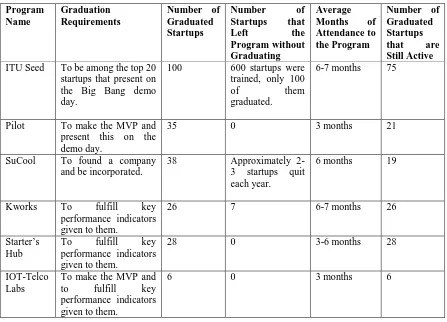
4.5 Graduation from the programs
table below to get more detailed information about the graduates who graduated from the programs.
Table 5: Graduation information of accelerator programs
Program Name Graduation Requirements Number of Graduated Startups Number of Startups that Left the Program without Graduating Average Months of Attendance to the Program Number of Graduated Startups that are Still Active ITU Seed To be among the top 20
startups that present on the Big Bang demo day.
100 600 startups were trained, only 100
of them graduated.
6-7 months 75
Pilot To make the MVP and present this on the demo day.
35 0 3 months 21
SuCool To found a company and be incorporated.
38 Approximately
2-3 startups quit each year.
6 months 19
Kworks To fulfill key performance indicators given to them.
26 7 6-7 months 26
Starter’s Hub
To fulfill key performance indicators given to them.
28 0 3-6 months 28
IOT-Telco Labs
To make the MVP and to fulfill key performance indicators given to them.
6 0 3 months 6
As can be seen in Table 5, not all startups chosen to accelerator programs can graduate. For example, ITU Seed starts its program with 100 startups each year, and only 20 of them qualify for graduation. Moreover, in Kworks and SuCool programs, every semester there are entrepreneurs who cannot graduate and leave the program. There are several reasons for this but the most common ones are; the entrepreneurs cannot reach the desired performance indicators, they fail in the validation phase, and they cannot make progress due to the disagreements between the startup team. In addition, there is no guarantee that a startup which successfully completes the accelerator program will survive. Although attending an accelerator program helps the survival of a startup, there are also startups that cannot adapt to the market conditions after they have left the protected environment of an accelerator. As can be seen from the table above, there are startups that have graduated from ITU Seed, Pilot and SuCool programs but still fail and shut down. In addition, the duration which startups stay on the program may be different from the official completion period of the program. For example; as shown in Table 3, while the duration of ITU Seed program lasts between six to nine months, it was stated that startups generally continued to program for about six or seven months.
Demo days are generally open to all, but there are also invite only ones. For example, the demo day of the Pilot program is not open to everyone. Despite this, on average 250 people attend the demo day each year. Participation to the demo days of Kworks vary between 200 and 250 people. Participation in demo days of IOT Telco Labs, SuCool and Starter's Hub programs vary between 100 and 200 people. 3,000 people participated to the last demo day of the ITU Seed program called "Big Bang", and 40,000 people followed this event live.
The reason why participation in the Big Bang event is so high actually stems from the fact that ITU Seed has made the promotion of this activity very well and attracted participation by including famous names in the event. E.g.; Mustafa Sandal, a famous Turkish singer, participated in the Big Bang event in 2016 and made an investment jointly with ITU Ari Technopark to eight of the ITU Seed entrepreneurs.
All programs have obligatory attendance policies. Entrepreneurs need to participate in the training and mentoring sessions offered by the program so that they can get the most out of it. Entrepreneurs do not have to come to the office of the program every day, but they should show up at least two times a week, or even three times a week in some programs in order to attend the training sessions or meet with the mentors.
Program coordinators are already advising entrepreneurs to go out and interview potential customers rather than stay in the office. In this way, they can verify or revise their products according to the expectations of potential customers. When coordinators are asked whether they have a virtual accelerator program, they state that they do not have such programs and they do not even consider starting it.
Only Starter's Hub has tried to run a virtual acceleration program for two months, but they did not continue it because they believed it was not as efficient as the face to face program. Other coordinators do not believe that entrepreneurs can get enough efficiency from the virtual programs as they get from the regular face to face programs. Therefore, they do not have plans to launch a virtual accelerator program.
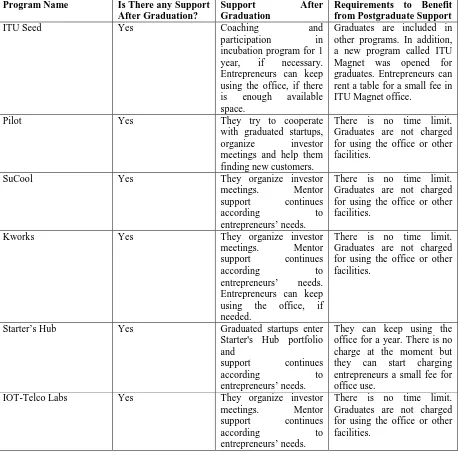
Support continues to the graduates of the programs. As indicated in Table 6 below, all accelerator programs continue to support startups that have been graduated and separated from their organizations. The support provided differs such as organizing investor meetings, bringing in new clients, mentoring, and allowing to keep using the office. Currently, there are no demands from the programs for the support provided. However, as the number of graduates increases, and the programs become unable to meet the demands, they can start charging the graduates for certain services.
For example; Starter's Hub said it could start charging fees from its graduates for the office use. ITU Seed announced that they will transfer the graduates who graduated from the accelerator program to the newly opened ITU Magnet program and in this new program; they will charge dues for the office use.
Table 6: Information on support after graduation
Program Name Is There any Support
After Graduation?
Support After Graduation
Requirements to Benefit from Postgraduate Support
ITU Seed Yes Coaching and
participation in incubation program for 1
year, if necessary. Entrepreneurs can keep using the office, if there is enough available space.
Graduates are included in other programs. In addition, a new program called ITU Magnet was opened for graduates. Entrepreneurs can rent a table for a small fee in ITU Magnet office.
Pilot Yes They try to cooperate
with graduated startups, organize investor meetings and help them finding new customers.
There is no time limit. Graduates are not charged for using the office or other facilities.
SuCool Yes They organize investor
meetings. Mentor support continues according to entrepreneurs’ needs.
There is no time limit. Graduates are not charged for using the office or other facilities.
Kworks Yes They organize investor
meetings. Mentor support continues according to entrepreneurs’ needs.
Entrepreneurs can keep using the office, if needed.
There is no time limit. Graduates are not charged for using the office or other facilities.
Starter’s Hub Yes Graduated startups enter
Starter's Hub portfolio and
support continues
according to entrepreneurs’ needs.
They can keep using the office for a year. There is no charge at the moment but they can start charging entrepreneurs a small fee for office use.
IOT-Telco Labs Yes They organize investor
meetings. Mentor support continues according to entrepreneurs’ needs.
There is no time limit. Graduates are not charged for using the office or other facilities.
4.6 Investment in startups
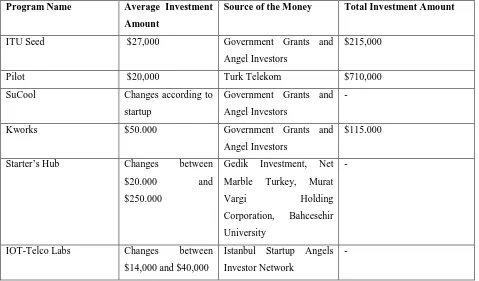
When the program coordinators were asked how much they invested in startups in their organizations, very different answers were received. In Table 7, you can see the average investment amount of the programs, the source of the investment fund and the total investment made so far.
million and also, added that this is a five-year fund. When asked if they have invested in a startup for the second round, they all mention that they have not yet made such an investment, but are open to such possibility. ITU Seed and IOT Telco Labs also pointed out how much investment their startups received from other sources or from angel investors in total. Accordingly, the startups of IOT Telco Labs received a total investment of $300,000 and the startups of ITU Seed received a total investment of $10,000,000.
Table 7: Information about investments
Program Name Average Investment
Amount
Source of the Money Total Investment Amount
ITU Seed $27,000 Government Grants and
Angel Investors
$215,000
Pilot $20,000 Turk Telekom $710,000
SuCool Changes according to
startup
Government Grants and Angel Investors
-
Kworks $50.000 Government Grants and
Angel Investors
$115.000
Starter’s Hub Changes between
$20.000 and $250.000
Gedik Investment, Net Marble Turkey, Murat
Vargi Holding Corporation, Bahcesehir
University
-
IOT-Telco Labs Changes between
$14,000 and $40,000
Istanbul Startup Angels Investor Network
-
4.7 Performance criteria
Unfortunately, none of the accelerator programs have the complete details of the graduated startups. For example; when asked about the total valuation of all startups who graduated from the program, only IOT Telco Labs could give a figure saying it is $10 million. Coordinators of the rest of the programs state that they do not want to give a number because they have not done this calculation before. Again, no clear information was obtained when asked how much profit graduated startups make and how many people they employ. Coordinators mention that they know which startups are profitable, but they do not know how much profit they make. In addition, employment numbers of the startups have not been followed up. Only the ITU Seed program says that all of their graduated startups employ around 1,000 employees in total. Other coordinators mention that there are startups that employ 2-3 individuals but there also others that employ 30-40 individuals, but they do not know how many employees they have in total. The lack of information about the graduates and the performance of programs is actually a global problem. Reference [26] stated the same issue for accelerators in Canada in their research.
4.8 Events, publicity and other details about the programs
All accelerator programs organize entrepreneurial events. Some of these programs organize open events for everyone, while others organize events only for entrepreneurs they include in their programs. For instance; while IOT Telco Labs and Pilot programs only organize events for entrepreneurs who are accepted into the program, Kworks is a very active hub for entrepreneurial events. Kworks organizes an average of 20-25 events per month and they are also quite varied. Some of these such as trainings, seminars, entrepreneurship meetings, workshops, etc. are open to everyone but some are specific to entrepreneurs participating in the program only. In addition, some of the events that are open to the public are also paid. Kworks sends a weekly e-mail newsletter to anyone who is a member of their email list to announce the activities it organizes. Starter's Hub focuses on investor-oriented events. The program, which organizes investor trainings every few months, also organizes paid events for corporations. The program generates income with these activities. Similarly, SuCool organizes paid events for corporate companies to generate income. In addition, the program organizes events for entrepreneurs such as trainings, seminars, entrepreneurship meetings, workshops and so on. ITU Seed organizes a wide range of events for entrepreneurs similar to Kworks and SuCool programs. ITU Seed, which organizes six or seven events on average per month, does not charge any fees for these events.
All of the employees of accelerator programs are working full-time. The ITU Seed team is the most crowded team with 14 full-time employees. When the number of startups included in the programs is compared with the number of employees, it is expected that the number of employees is higher in ITU Seed than in any other program because ITU Seed accepts more startups compared to other accelerator programs. ITU Seed is followed by Starter's Hub program with seven full-time employees. Unfortunately, all of the employees at ITU Seed and Starter's Hub do not have past entrepreneurship or investment experiences. Only some have experience with the subject. There are six full-time employees in Kworks, five in IOT Telco Labs, and three in SuCool and Pilot programs. Similarly, not all employees of these programs have previous entrepreneurship or investment experiences.
entrepreneurship blogs are also highly preferred tools for publicity. Other than social media and blogs, accelerator programs also benefit from different channels for promoting their programs. For example, the Kworks program is actively using Youtube and is making a new video every semester for promotion. The Pilot program uses digital media as well as print media and gives advertisements to newspapers and magazines. Interviews of entrepreneurs are also being broadcast on TV channels. The Pilot program believes that this is a good way of publicity for both themselves and their entrepreneurs. The Starter's Hub program not only makes promotions but also invites some entrepreneurs to apply to their programs.
The most challenging issue of all programs is to reach quality entrepreneurs and include them in their programs. This issue is followed by others such as entrepreneurs being inexperienced, being unable to explain their startup ideas fully, finding financing for entrepreneurs, making a contract with entrepreneurs, and coordinating graduates of the program. Some of these are actually global problems. The lack of financial resources [27] and a lack of startup experience in the team [28] are the biggest challenges that entrepreneurs often face with. In addition to these, unable to attract quality employees [29] or a lack of knowledge of how to grasp certain opportunities [30] are among the common problems entrepreneurs generally come up against.
It is also asked to program coordinators whether they see themselves competing with other accelerator programs. All of the program coordinators mentioned that they do not see other programs as competitors, but rather they complete each other. The main reason for this is that the ecosystem is not large enough for such a competition yet. The Starter's Hub coordinator said both competition and solidarity were important to them. Almost all of the coordinators state that they are aware of the international accelerator networks but they do not choose to be a member of them because they do not believe that these networks will add value to their programs. Only ITU Seed is included in the "UBI Global Network" program. Kworks applied to be a member of European Business Innovation Network and the SuCool program is also in the process of membership with an accelerator network. Other programs do not yet have such an initiative.
5. Conclusion
Accelerators are a new generation of programs born from incubators. Thus, the literature still lacks detailed information about these programs. Especially, there aren’t many studies about accelerators in developing countries. Therefore, this research provides detailed analysis about the general structure of the programs, the characteristics of the entrepreneurs in the programs, the mentor networks of the programs, how the programs operate, information about the graduates, the investment possibilities and the performance criteria of the programs. It also produced important results which will be beneficial for accelerator programs themselves, government agencies, universities, investors and scholars studying the subject. Despite the ambiguity of the success of these programs on entrepreneurs, hopefully, this study will encourage others to perform a similar study with accelerators in other countries.
6. Limitations and Recommendations
It doesn’t include accelerators in other developing countries such as China, South Africa or Brazil. Therefore, it may not represent accelerators in other regions. There may be cultural differences and culture effect is not part of this study. Another limitation is that new accelerator programs may open in Turkey after this study has been completed and therefore, some accelerator programs may be missing from this study.
Future research should study the accelerator programs located in different regions of the world especially in developing countries. There are cultural differences between Turkey and other countries. Thus, these differences may affect accelerator programs. Another research can study the success of entrepreneurs graduated from accelerator programs. Research is very limited on this area and there is still ambiguity about the success of accelerators on entrepreneurs [4]. Also, examining how entrepreneurs’ demographics such as age, gender education, work experience and family affect the support they receive from the accelerators and as a result, the success of their startups can be another topic worth exploring.
References
[1] B. Clarysse, M. Wright, and J. Van Hove. “A look inside accelerators.” London, UK.: Nesta, 2015.
[2] N.J. Dee, F. Livesey, D. Gill, and T. Minshall. “Incubation for Growth: A review of the impact of business incubation on new ventures with high growth potential,” Nesta, 2011.
[3] K. Walters, J. Stacey, C. Haley, and I. Roberts. “Startup Accelerator Programmes: A practice guide,” Nesta, 2014.
[4] Y. Hochberg. “Accelerating Entrepreneurs and Ecosystems: The Seed Accelerator Model,” in Proc. National Bureau of Economic Research–16th Innovation Policy and the Economy Conference, April 14, 2015.
[5] P. Miller, and K. Bound. “The startup factories: The rise of accelerator programmes to support new ventures.” Nesta, 2011.
[6] S. Hackett and D. Dilts. “A Systematic Review of Business Incubation Research,” The Journal of Technology Transfer, vol. 29, no. 1, pp. 55-82, 2004.
[7] J. Bruneel, T. Ratinho, B. Clarysse and A. Groen. “The Evolution of Business Incubators: Comparing demand and supply of business incubation services across different incubator generations,” Technovation, vol. 32, no. 2, pp. 110-121, 2012.
[8] S. Wise and D. Valliere. “The Impact on Management Experience on the Performance of Start-Ups within Accelerators,” The Journal of Private Equity, vol. 18, no. 1, pp. 9-19, 2014.
[10] S. Cohen. “What Do Accelerators Do? Insights from Incubators and Angels,” Innovations: Technology, Governance, Globalization, vol. 8, no. 3-4, pp. 19-25, 2013.
[11] M. Marangoz. Girisimcilikte guncel konular ve uygulamalar [Current topics and applications in entrepreneurship]. 1st edition, Inkilap Kitabevi Yayincilik, Istanbul, 2016.
[12] S. Mian, W. Lamine and A. Fayolle. “Technology Business Incubation: An overview of the state of knowledge,” Technovation, vol. 50-51, pp. 1-12, 2016.
[13] T. van Huijgevoort. “The ‘Business Accelerator’: Just a Different Name for a Business Incubator,” Thesis (Bachelor), Utrecht School of Economics, Utrecht, The Netherlands, 2012.
[14] C. Pauwels, B. Clarysse, M. Wright and J. Van Hove. “Understanding a new generation incubation model: The accelerator,” Technovation, vol. 50-51, pp. 13-24, 2016.
[15] J. Christiansen. “Copying Y Combinator: A framework for developing seed accelerator programmes,” Thesis(MBA), University of Cambridge, 2009.
[16] P. Lehmann. “Corporate Accelerators: Characteristics and Motives,” Thesis (Masters), Copenhagen Business School, 2013.
[17] D. Isabelle. “Key factors affecting a technology entrepreneur's choice of incubator or accelerator,” Technology innovation management review, 2013(February),16-22, 2013.
[18] E. Salido, M. Sabás, and P. Freixas. “The accelerator and incubator ecosystem in Europe,” Telefónica Europe, 2013.
[19] S. Cohen, and Y.V. Hochberg. “Accelerating Startups: The Seed Accelerator Phenomenon,” SSRN Electronic Journal, 2014.
[20] “Impact Index Survey Guide,” InBia, 2016.
[21] R. Baird, L. Bowles, and S. Lall. “Bridging the ‘Pioneer Gap’: The Role of Accelerators in Launching High-Impact Enterprises,” The Aspen Institute, 2013.
[22] N. Dee, D. Gill, C. Weinberg and S. McTavish. “Startup support programmes: What’s the difference?,” Nesta, 2015.
[23] E. Ries. The lean startup: How today's entrepreneurs use continuous innovation to create radically successful businesses. 1st edition, Crown Business, 2011.
[25] J. Vanderstraeten, and P. Matthyssens. “Measuring the performance of business incubators: A critical analysis of effectiveness approaches and performance measurement systems,” in Proc. ICSB conference, Cincinnati, US, 24-27 June, 2010
[26] E. Caley, and H. Kula. “Seeding success: Canada’s startup accelerators,” MaRS, Toronto, Canada, 2013.
[27] R. Smilor. “Entrepreneurship: Reflections on a subversive activity”, Journal of Business Venturing, vol. 12, no. 5, pp. 341-346, 1997.
[28] M. Gruber, I. MacMillan and J. Thompson. “Look Before You Leap: Market Opportunity Identification in Emerging Technology Firms,” Management Science, vol. 54, no. 9, pp. 1652-1665, 2008.
[29] C. Zott and Q. Huy. “How Entrepreneurs Use Symbolic Management to Acquire Resources,” Administrative Science Quarterly, vol. 52, no. 1, pp. 70-105, 2007.