Rinkal M. Patel, et al. J Sci Res Pharm, 2019;8(4):42-47 World Inventia Publishers
J
ournal of
S
cientific
R
esearch in
P
harmacy
http://www.jsrponline.com/
Vol. 8, Issue 4, 2019 ISSN: 2277-9469 USA CODEN: JSRPCJ
Research Article
STABILITY INDICATING RP-HPLC METHOD DEVELOPMENT AND VALIDATION FOR SIMULTANEOUS ESTIMATION OF OXYCODONE HCL AND NALTREXONE HCL IN CAPSULE
Rinkal M. Patel *, Jaymin Ghanshyambhai Patel, Bhumi Rajdevbhai Patel
Sharda School of Pharmacy, Pethapur, Gandhinagar, Gujarat, A-33, Krishna Bunglows, Nr. Prerna Park, Maninagar, Ahmedabad, INDIA.
Received on: 04-03-2019; Revised and Accepted on: 25-04-2019
ABSTRACT
A
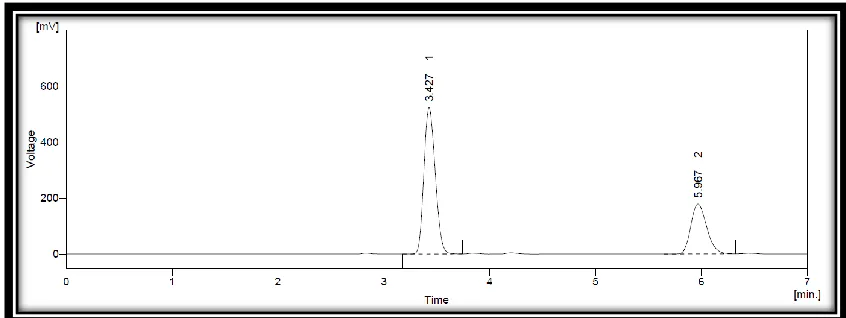
reverse phase high performance liquid chromatographic method was developed for the simultaneous estimation of Oxycodone HCl and Naltrexone HCl in Their Combined Dosage Form. The separation was achieved by LC- 20 AT C18 (250mm x 4.6 mm x2.6 µm) column and Buffer (Potassium Phosphate, pH 4.0): Methanol (75:25) as mobile phase, at a flow rate of 1 ml/min. Detection was carried out at 248 nm. Retention time of Oxycodone HCl and Naltrexone HCl were found to be 3.427 min and 5.967 min respectively. The method has been validated for linearity, accuracy and precision. Linearity observed for Oxycodone HCl 20-60 μg/ml and for Naltrexone HCl 2.4-7.2 μg/ml. Developed method was found to be accurate, precise and rapid for simultaneous estimation of Oxycodone HCl and Naltrexone HCl in their combine dosage form.
KEYWORDS: Oxycodone HCl, Naltrexone HCl, Stability indicating RP-HPLC Method, Validation Method.
INTRODUCTION
Oxycodone HCl is
(5R,9R,13S,14S)-4,5α-epoxy-14-hydroxy-3-methoxy-17-methylmorphinan-6-one hydrochloride. It comes under semisynthetic derivative of codeine. It is used in Chronic Pain. It acts by a weak agonist at mu, kappa, and delta opioid receptors within the central nervous system (CNS). Oxycodone primarily affects mu-type opioid receptors, which are coupled with G-protein receptors and function as modulators, both positive and negative, of synaptic transmission via G-proteins that activate effector proteins. Soluble water, sparingly soluble in anhydrous ethanol but practically insoluble in toluene [1, 2]. It is official in BP-2015, USP30-NF25.Fig. 1: Structure of Oxycodone HCl
*Corresponding author:
Rinkal M. Patel
Sharda School of Pharmacy,
Pethapur, Gandhinagar, Gujarat, A-33,
Krishna Bunglows, Nr. Prerna Park, Maninagar, Ahmedabad, INDIA.
* E-Mail:[email protected]
DOI: https://doi.org/10.5281/zenodo.2652396
Naltrexone HCl is a (1S,5R,13R,17S)-4-(cyclopropyl methyl)-10,17-dihydroxy-12-oxa-4-azapentacyclooctadeca-7(18),8,10-trien-14-one hydrochloride.
It comes a derivative of noroxymorphone. Naltrexone is a pure opiate antagonist and has little or no agonist activity. The mechanism of action of naltrexone in alcoholism is not understood; however, involvement of the endogenous opioid system is suggested by preclinical data. Naltrexone is thought to act as a competitive antagonist at mc, κ, and δ receptors in the CNS, with the highest affinity for the μ receptor. Naltrexone competitively binds to such receptors and may block the effects of endogenous opioids. This leads to the antagonization of most of the subjective and objective effects of opiates, including respiratory depression, miosis, euphoria, and drug craving. The major metabolite of naltrexone, 6-β-naltrexol, is also an opiate antagonist and may contribute to the antagonistic activity of the drug. Freely soluble in water, slightly soluble in ethanol (96 per cent), practically insoluble in methylene chloride [3, 4]. It is official in IP- BP-2015, USP30-NF25, IP-2018.
MATERIALS AND METHODS
Instrumentation:
HPLC Model - LC-20AT equipped with SPD-20 A Detector was employed in this method. Spinchrom software was used for peak integration along with data processing. The column used for separation of analytes is Hypersil BDS Column C18 (25 cm × 0.46 cm). Isocratic mode of elution was employed. Ultrasonic Water Bath, pH meter, Analytical Balance- AUX-200 are other equipments utilized.
Chemicals and Solvents:
Oxycodone HCl and Naltrexone HCl Drug was obtained from Remus Remedies. Marketed formulation was obtained from Pfizer. Other reagents used are Methanol (HPLC Grade), Potassium Dihydrogen (AR grade), Water (HPLC Grade) and Ammonium Acetate (AR Grade).
Preparation of standard solutions:
Oxycodone HCl standard stock solution: (400μg/mL): 40 mg of Oxycodone HCl was weighed and transferred to a 100 mL volumetric flask. Volume was made up to the mark with mobile phase.
Naltrexone HCl standard stock solution: (48 μg/mL): A 48 mg of Naltrexone HCl was weighed and transferred to a 100 mL volumetric flask. volume was made up to the mark with Methanol, take 10ml from this solution and Transfer to 100ml volumetric flask and volume was made up with the Mobile phase
Preparation of standard solution of binary mixtures of Oxycodone HCl (40 μg/mL) and Naltrexone HCl (4.8 μg/mL):
Take 1 mL from the Oxycodone HCl stock solution and 1mL from Naltrexone HCl stock solution and transferred to 10 mL volumetric flask and volume made up to the mark by mobile phase which was used in particular trials.
Analytical Method Development:
To optimize the HPLC parameters, several mobile phase compositions were tried. Satisfactory results were obtained from given chromatographic condition for Oxycodone HCl and Naltrexone HCl mentioned in Table no: 1.
Fig. 3: HPLC Chromatogram of Oxycodone HCl 40 ppm and Naltrexone HCl 4.8 ppm in Buffer (pH 4.0): Methanol (65:35)
Table No. 1: Method Development Parameters
Parameters Chromatographic Condition Mode of elution Isocratic
Mobile Phase Buffer (pH 4.0): Methanol (65:35) Column C18 (25cm x 0.46 cm) Hypersil BDS
Flow rate 1ml/min
Runtime 7 min
Injection volume 20 µL
Detection wavelength 248 nm
Analytical Method Validation:
The developed chromatographic method was validated as per ICH guideline for following parameters.
System Suitability:
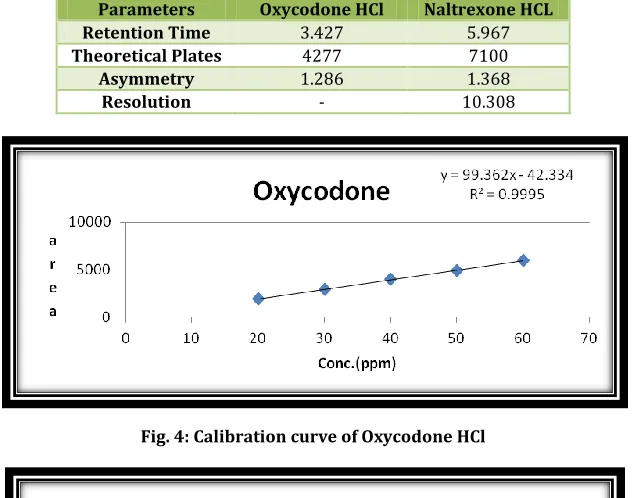
As per USP-24, system suitability tests were carried out on freshly prepared standard stock solution of Oxycodone HCl and Naltrexone HCl of both drugs under optimized
chromatographic condition and parameters were studied to evaluate the suitability of the system. Results are shown in Table:2
Linearity and Range:
Table No. 2: System Suitability Studies
Parameters Oxycodone HCl Naltrexone HCL Retention Time 3.427 5.967 Theoretical Plates 4277 7100
Asymmetry 1.286 1.368
Resolution - 10.308
Fig. 4: Calibration curve of Oxycodone HCl
Fig. 5: Calibration curve of Naltrexone HCl
Fig. 6: Overlay chromatogram of different concentrations of mixtures of Oxycodone HCl and Naltrexone HCl
Accuracy:
Good recoveries of Oxycodone HCl and Naltrexone HCl were obtained at various added concentrations. By spiking standards like 80%, 100% and 120%. Results are shown in Table 3.
Precision:
The results of the repeatability, intra-day and inter-day precision experiments are shown respectively as given in
Table 3. The developed method was found to be precise as the %RSD were< 2%.
Robustness:
parameter and the %RSD were found to be less than 2%. Results are shown in Table 3.
Degradation Study:
The drug content was employed for acidic, alkaline and oxidant media and for thermal and photolytic stress conditions. After the degradation treatments were completed, the stress content solutions could equilibrate to room temperature, 20µl were injected into the system and the chromatograms were recorded to assess the stability of sample. Specific degradation conditions described as following.
Acidic Degradation Condition:
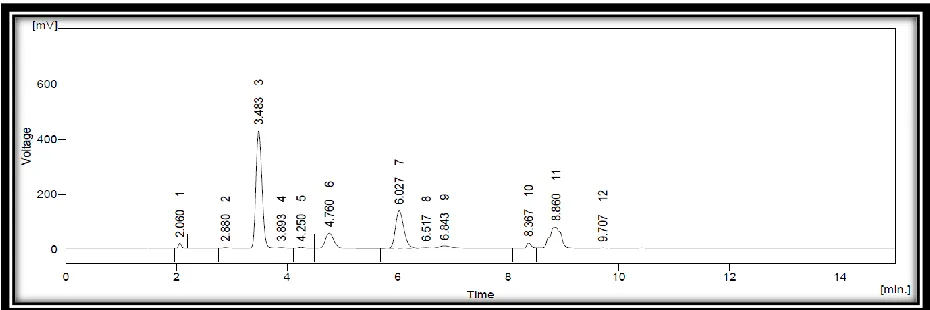
Accurately measured 1 ml of sample stock solution was transferred into 10 ml volumetric flask and 3ml 1N HCl was added and kept for 4hr at 60oC for acid hydrolysis. Then the solution was neutralized with 3ml 1N NaOH and then volume was made up to mark with diluent to get 40 µg/ml of Oxycodone HCl and 4.8 µg/ml of Naltrexone HCl and filtered through 0.45 μm membrane filter paper and injected in to HPLC system (Fig. 7).
Basic Degradation Condition:
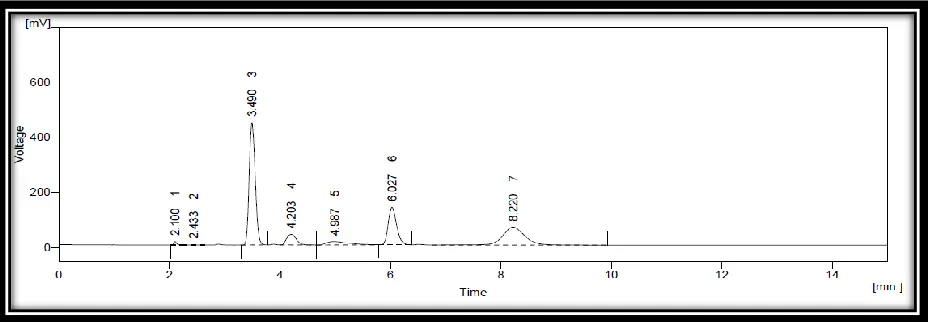
Accurately measured 1 ml of sample stock solution was transferred into 10 ml volumetric flask and 3 ml 1N NaOH was added and solution was kept for 4hr at 60oC for base hydrolysis. Then the solution was neutralized with 1N HCl and then volume was made up to mark with diluent to get 40 µg/ml of Oxycodone HCl and 4.8 µg/ml of Naltrexone
HCl and filtered through 0.45 μm membrane filter paper and injected in to HPLC system (Fig. 8).
Oxidative Degradation Condition:
Accurately measured 1 ml of sample stock solution was transferred into 10 ml volumetric flask and 3 ml 30%v/v H2O2 was added and solution was heated at room temperature for 4hr for oxidative hydrolysis. Then the volume was made up to mark with diluent to get 40 µg/ml of Oxycodone HCl and 4.8 µg/ml of Naltrexone HCl and filtered through 0.45 μm membrane filter paper and injected in to HPLC system (Fig. 9).
Thermal Degradation Condition:
A 40 mg of Oxycodone HCl and 4.8mg of Naltrexone HCl were taken in same petridish, petridish was put in oven for 4hrs at 1100C temperature, than after petridish was removed and cool at room temperature, than this combined powder was transferred to 100ml volumetric flask and volume was made up with mobile phase, 1ml of this solution was transferred in 10ml volumetric and volume was made up with mobile phase to make 40μg/ml for Oxycodone HCl and 4.8μg/ml for Naltrexone HCl (Fig. 10).
Photolytic Degradation Condition:
Photo Degradation studies were performed by Transferring one ml of stock solution in to 10 ml of volumetric flask. The volumetric flask was kept in UV Chamber for 10 hrs. Then the volume was adjusted with diluent to get 4.8μg/ml for Naltrexone HCl and 40μg/ml for Oxycodone HCl (Fig. 11).
Fig. 7: Chromatogram of Oxycodone HCl and Naltrexone HCl sample in 1N HCl (60 °C for 4 hrs.)
Fig. 9: Chromatogram of Oxycodone HCl and Naltrexone HCl sample in 30% H2O2 (RT for 4hr.)
Fig. 10: Chromatogram of Oxycodone HCl and Naltrexone HCl sample at 110 °C for 4hr.
Fig. 11: Chromatogram of Oxycodone HCl and Naltrexone HCl sample at 248nm UV light (10hr)
RESULTS AND DISCUSSION
Validation Parameters: The method was validated in compliance with ICH guidelines [5].
Force Degradation Studies: In the present investigation of the
Oxycodone HCl and Naltrexone HCl were subjected to its stability studies as per ICH guideline5. The results of the forced degradation study of Oxycodone HCl and Naltrexone HCl are summarized in Table 4 & 5.
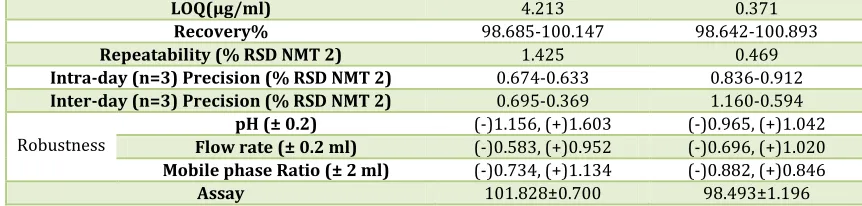
Table No. 3: Regression analysis data and summary of validation parameter
PARAMETERS OXYCODONE HCl NALTREXONE HCl Linearity Range(n=3) (μg/ml) 20-60 2.4-7.2
Regression Equation(R2) y= 99.362x– 42.334 y=389.32x –24.449
Co-relation Coefficient 0.9995 0.9997
LOQ(μg/ml) 4.213 0.371 Recovery% 98.685-100.147 98.642-100.893 Repeatability (% RSD NMT 2) 1.425 0.469 Intra-day (n=3) Precision (% RSD NMT 2) 0.674-0.633 0.836-0.912 Inter-day (n=3) Precision (% RSD NMT 2) 0.695-0.369 1.160-0.594
Robustness Flow rate (± 0.2 ml) pH (± 0.2) (-)1.156, (+)1.603 (-)0.583, (+)0.952 (-)0.965, (+)1.042 (-)0.696, (+)1.020 Mobile phase Ratio (± 2 ml) (-)0.734, (+)1.134 (-)0.882, (+)0.846
Assay 101.828±0.700 98.493±1.196
Table No. 4: Results of forced degradation study of Oxycodone HCl
Oxycodone HCl
Parameter Standard Sample
Area %Degradation Area %Degradation
Acid 3197.231 19.318 3234.747 18.372
Base 2928.167 26.108 2969.977 25.053
Thermal 2608.297 34.180 2566.366 35.238 Oxidation 3324.446 16.108 3353.274 15.381
Photo 3462.319 12.629 3501.526 11.640
Table No. 5: Results of forced degradation study of Naltrexone HCl
Naltrexone HCl
Parameter Standard Sample
Area %Degradation Area %Degradation
Acid 1462.652 22.430 1443.098 23.467
Base 1350.251 28.391 1382.892 26.660
Thermal 1382.780 26.666 1345.094 28.665 Oxidation 1507.698 20.041 1431.564 24.079
Photo 1615.632 14.317 1595.254 15.398
CONCLUSION
The HPLC method developed for the analysis of
Oxycodone HCl and Naltrexone HCl. Their pharmaceutical preparations are simple, rapid and economic with less run time. The method has been validated and it has been shown that it is reliable, linear, accurate and precise as well as robust with minor variations in chromatographic parameters. Therefore, it can be applied for both routine analytical and quality control assay and it could be a very powerful tool to investigate stability of Oxycodone HCl and Naltrexone HCl.ACKNOWLEGEMENT
Authors are grateful to Zydus Pharmaceuticals Pvt.
Ltd., Gujarat, India for providing gift sample.REFERENCES:
1. “Drug profile for Oxycodone HCl”, October-2018,
https://www.drugbank.ca/salts/DBSALT000277
2. “Drug profile for Oxycodone”, October-2018,
https://www.drugbank.ca/drugs/DB00497
3. “Drug profile for Naltrexone HCl”, October-2018,
https://www.drugbank.ca/salts/DBSALT000670
4. “Drug profile for Naltrexone”, October-2018,
https://www.drugbank.ca/drugs/DB00704
5. ICH, Validation of Analytical Procedures; Methodology, Q2 (R1), International Conference on Harmonization, IFPMA, Geneva 1996.
How to cite this article:
Rinkal M. Patel, et al. STABILITY INDICATING RP-HPLC METHOD DEVELOPMENT AND VALIDATION FOR SIMULTANEOUS ESTIMATION OF OXYCODONE HCL AND NALTREXONE HCL IN CAPSULE. J Sci Res Pharm 2019;8(1):42-47.
DOI: https://doi.org/10.5281/zenodo.2652396
Conflict of interest: The authors have declared that no conflict of interest exists.