Abstract
--Innovations are necessary to ride the inevitable tide of change. Most of enterprises are striving to reduce their computing cost through the means of virtualization. This demand of reducing the computing cost has led to the innovation of Cloud Computing. Cloud Computing offers better computing through improved utilization and reduced administration and infrastructure costs. Cloud Computing is the sum of Software as a Service (SaaS) and Utility Computing. Cloud Computing is still at its infant stage and a very new technology for the enterprises. Therefore, most of the enterprises are not very confident to adopt it. This research paper tackles this issue for enterprises in terms of cost and security. In this paper we discuss the benefits and drawbacks an enterprise can have while they adopt Cloud Computing in terms of Cost and Security.
In the end, concluding that Cloud Computing is better for medium and small sized enterprises as compared to large enterprises in terms of both cost and data security.
Index Terms: SaaS (Software as a Service), IaaS (Infrastructure as a Service), PaaS (Platform as a Service)
Manuscript received June, 2017. (Please Fill Below Details)
Syed Jamaluddin Ahmad1, Assistant Professor, Department of Computer Science & Engineering, Shanto-Mariam University of Creative Technology, City:
Dhaka, Country: Bangladesh, Mobile No.: +8801633628612 (Email: [email protected])
Roksana Khandoker Jolly2, Senior Lecturer, Department of Computer Science & Engineering, University of South Asia, City: Dhaka, Country: Bangladesh,
Mobile No.: +8801737157856 (Email: [email protected])
GSJ: Volume 6, Issue 1, January 2018, Online: ISSN 2320-9186
www.globalscientificjournal.com
Immense implementation of Cloud Computing on
distinct pilot projects as a specimen of the
delineation of cost effectiveness to manifest as
Cloud Computing democracy to be or not to be
I. INTRODUCTION AND BACKGROUND
Cloud Computing has become one of the most talked about technologies in recent times and has got lots of attention from media as well as analysts because of the opportunities it is offering. The market research and analysis firm IDC suggests that the market for Cloud Computing services was $16billion in 2008 and will rise to $42billion/year by 2012 (Gleeson, 2009). It has been estimated that the cost advantages of Cloud Computing to be three to five times for business applications and more than five times for consumer applications (Lynch, 2008). According to a Gartner press release from June 2008, Cloud Computing will be “no less influential than e-business” (Gartner, 2008).
Enterprises have been striving to reduce computing costs and
for that reason most of them start consolidating their IT operations and later using virtualization technologies. For the good of the enterprises there is a new technology to help them in this i.e. Cloud Computing. Cloud Computing claims to take enterprises search to a new level and allows them to further
reduce costs through improved utilization, reduced
administration and infrastructure cost and faster deployment cycles (Boss et al., 2007, p2). Cloud Computing is a term used to describe both a platform and type of application. As a platform it supplies, configures and reconfigures servers, while the servers can be physical machines or virtual machines. On the other hand, Cloud Computing describes applications that are extended to be accessible through the internet and for this purpose large data centers and powerful servers are used to host the web applications and web services (Boss et al., 2007, p2).
The cloud is a metaphor for the Internet and is an abstraction for the complex infrastructure it conceals. There are some important points in the definition to be discussed regarding Cloud Computing. Cloud Computing differs from traditional computing paradigms as it is scalable, can be encapsulated as an abstract entity which provides different level of services to the clients, driven by economies of scale and the services are dynamically configurable (Foster et al., 2008, p1).
Cloud Computing can also be described as ultimately virtualized system and a natural evolution for data centers which offer automated systems management (Boss et al.,2007, p4).
Enterprises need to consider the benefits, drawbacks and the effects of Cloud Computing on their organizations and usage practices, to make decision about the adoption and use. In the enterprise, the “adoption of Cloud Computing is as much dependent on the maturity of organizational and cultural (including legislative) processes as the technology, per se” (Fellowes, 2008).
Many companies have invested in Cloud Computing technology by building their public clouds, which include Amazon, Google and Microsoft. These companies are often releasing new features and updates of their services.
Economics3 center on their website to have academic and community advice regarding these issues (Khajeh-Hosseinwe
et al., 2010b, p2). This shows that there are still lots of doubts about the costs and security for enterprises to adopt Cloud Computing. Hence, the issues of economics and security in Cloud Computing for enterprises must be further researched. For this reason, issues around migrating application systems to the cloud and stakeholders include technical, project, operations and financial managers as well as the engineers who are going to be developing and supporting the individual systems. For enterprises economics or cost factor is important but at the same time customer relationships, public image, flexibility, business continuity and compliance are of same importance (Khajeh-Hosseinwe et al., 2010b, p2). Hence, enterprises need to understand how Cloud Computing affects all these however; we shall discuss the following specific issues in this paper.
The economic and organizational implications of the
cost model in Cloud Computing.
The data security, availability and privacy issues that Cloud Computing raises.
It affects in the deployment of Digital Bangladesh.
IV. RESEARCH QUESTION
As Cloud Computing is one of the most talked about technologies now days and it has great importance in enterprises because of the cost and computational promises it offers. We will conduct the research on the issue of Cloud Computing and Enterprises. Fox Mobile Group is an enterprise which is using Cloud Computing and we will study them to answer our research question which is:
and data security for Enterprises to adopt Cloud Computing?
II. PURPOSE OF RESEARCH
The purpose of the thesis is to find out the benefits and drawbacks in regards with cost, data security and data availability an in the context of Digital Bangladesh; enterprise can have by the use of Cloud Computing for the implementation and management of their information system. Finally concluding the factors in terms of cost and data security, enterprises should keep in mind while adopting Cloud Computing for the effective and efficient use of their information system.
III. RESEARCH DELIMITATION
During our research we will not consider the SaaS (Software as a Service) and PaaS (Platform as a Service) of Cloud Computing as the enterprise which we are focusing i.e. Fox Mobile Group is not using it. We will not study the whole information system of the enterprises but will focus on few divisions or parts of the information system (the divisions will be chosen after first interview with the company) in which enterprises are using Cloud Computing technology. We will also not discuss the Legal issues in the security of Cloud Computing.
V.
VI. DEFINITION
There have been many definitions of Cloud Computing by different researchers. Barkley RAD defines Cloud Computing as:
“Cloud Computing refers to both the applications delivered as services over the Internet and the hardware and systems software in the datacenter that provide those services. The services themselves have long been referred to as Software as a Service (SaaS). The datacenter hardware and software is what we will call a Cloud. When a Cloud is made available in
a pay-as-you-go manner to the general public, we call it a Public Cloud; the service being sold is Utility Computing. We use the term Private Cloud to refer to internal datacenters of a business or other organization, not made available to the General Public. Thus, Cloud Computing is the sum of SaaS and Utility Computing, but does not include Private Clouds. People can be users or providers of SaaS, or users or providers of Utility Computing.” (Armbrust et al., 2009, p6) The summary of the features of Cloud Computing described by Stanoevska-Slabeva and Wozniak is (Stanoevska-Slabeva and Wozniak, 2009, p50):
Cloud Computing is a new computing paradigm.
Infrastructure resources (hardware, storage and
system software) and applications are provided in X-as-a-Service manner. When these services are offered by an independent provider or to external customers, Cloud Computing is based on pay- per-use business models.
Main features of Clouds are virtualization and
dynamic scalability on demand.
Utility computing and SaaS are provided in an
integrated manner, even though utility computing might be consumed separately.
Cloud services are consumed either via Web browser
or via a defined API.
VII. CLOUD COMPUTING ARCHITECTURE
Figure 1 - Visual model of NIST Working Definition of Cloud Computing (Cloud Security Alliance, 2009, p14) definition provided by NIST of Computing. NIST defines the
Cloud Computing architecture by describing five essential characteristics, three cloud services models and four cloud deployment models (Cloud Security Alliance, 2009, p14).
Essential Characteristics of Cloud Computing
As described above, there are 5 essential characteristics of Cloud Computing which explains there relation and difference from the traditional computing.
On-demand-self-service
Consumer can provision or un-provision the services when needed, without the human interaction with the service provider.
Broad Network Access
It has capabilities over the network and accessed through standard mechanism.
Resource Pooling
The computing resources of the provider are pooled to serve multiple consumers which are using a multi-tenant model, with various physical and virtual resources dynamically assigned, depending on consumer demand.
Rapid Elasticity
Services can be rapidly and elastically provisioned. Measured Service
Cloud Computing systems automatically control and optimize resource usage by providing a metering capability to the type of services (e.g. storage, processing, bandwidth, or active user accounts) (Cloud Security Alliance, 2009, p15).
Cloud Service Models
There are 3 Cloud Services Models and these 3 fundamental classifications are often referred to as “SPWE model” i.e. software, platform or infrastructure as a service.
Cloud Software as Service
This is a capability in which the consumer can use the provider‟s applications running on the cloud.
Cloud Platform as Service
In this type of service, the consumer can deploy, the consumer created or acquired applications created by using programming languages or tools provided by provider, on the cloud infrastructure.
Cloud Infrastructure as Service
Cloud Deployment Models
Public Cloud: The cloud infrastructure is available to the General Public.
Private Cloud: The type of the cloud, that is available solely for a single organization.
Community Cloud:In this type of cloud deployment model, the infrastructure of the cloudis shared by several organizations and supports a specific community with
shared concerns.
Hybrid Cloud: This is a cloud infrastructure that is a composition of two or more
clouds i.e. private, community or public (Cloud Security Alliance, 2009, p17).
VIII. CLOUD COMPUTING EVOLUTION
There has always been a debate about the evolution of Cloud Computing and the most important point in that is Grid Computing. Some people call Cloud Computing and Grid Computing the same phenomena while others call Cloud Computing an extension of Grid computing. To find the truth we need to know about the Grid computing (Stanoevska- Slabeva, Wozniak, 2009, p59).
“A computational grid is a hardware and software infrastructure that provides dependable, consistent, pervasive, and inexpensive access to high-end computational capabilities.” (Stanoevska-Slabeva and Wozniak, 2009, p23) Some of the Organizations have also defined the Grid computing with respect to the features. According to IBM “Grid computing allows you to unite pools of servers, storage systems, and networks into a single large system so you can deliver the power of multiple-systems resources to a single user point for a specific purpose. To a user, data file, or an application, the system appears to be a single enormous virtual computing system.” (Kourpas, 2006, p13).
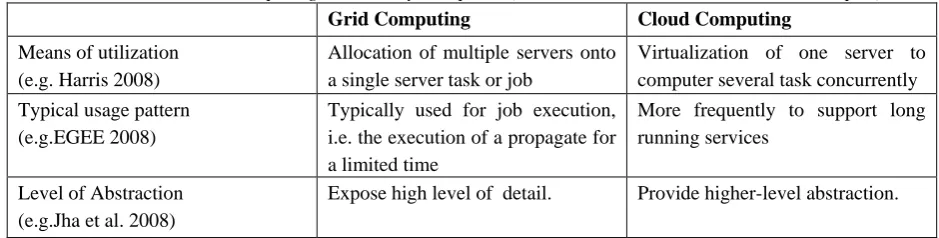
The description of Cloud Computing earlier and of Grid computing here shows that Cloud Computing and grid computing have many similarities. This leads to discussion about the differences in these two technologies. The table below shows the technical differences among Cloud Computing and grid computing presented by Katarina Stanoevska-Slabeva and Thomas Wozniak
Table 1 – Grid and Cloud Computing Technically Compared (Stanoevska-Slabeva and Wozniak, 2009, p59)
Grid Computing Cloud Computing
Means of utilization (e.g. Harris 2008)
Allocation of multiple servers onto a single server task or job
Virtualization of one server to computer several task concurrently Typical usage pattern
(e.g.EGEE 2008)
Typically used for job execution, i.e. the execution of a propagate for a limited time
More frequently to support long running services
Level of Abstraction (e.g.Jha et al. 2008)
Expose high level of detail. Provide higher-level abstraction.
Along with the differences in technology among Grid Computing and Cloud Computing, usage patterns are also different between them. Grid is usually used for job execution while clouds are more frequently used to support long-running services (EGEE, 2008, p4).
As mentioned above, there is a debate in the technology world that Cloud Computing has evolved from Grid Computing and that Grid Computing is the foundation for Cloud Computing. Foster et al. (2008) for example describe the relationship between Grid and Cloud Computing as follows:
“We argue that Cloud Computing not only overlaps with Grid Computing, it is indeed evolved out of Grid Computing and relies on Grid Computing as its backbone and infrastructure support. The evolution has been a result of a shift in focus from an infrastructure that delivers storage and compute resources (such is the case in Grids) to one that is econoour based aiming to deliver more abstract resources and services (such is the case in Clouds).”(Foster et al., 2008, p2).
IX. CLOUD COMPUTING ADOPTION
Cloud Computing is also about how IT is provisioned and used and not only about technological improvements of data centers (Creeger, 2009, p50). Enterprises must consider the benefits, drawbacks and other effects of Cloud Computing on their enterprises and usage practices before adopting and using Cloud Computing (Khajeh- Hosseinee et al., 2010b, p2). In enterprises, the adoption of Cloud Computing is much dependent on the maturity of organizational and cultural processes as the technology per se (Fellowes, 2008). Some predict that adoption of Cloud Computing is not going to happen overnight, rather it could take 10 to 15 years before typical enterprise make this shift (Sullivan, 2009, p1). Hence, we are currently at the start of a transition period during which many decisions need to be made with respect to adoption of Cloud Computing in the enterprise.
Hence, the challenges that enterprises must address before Cloud Computing adoption are : i) to provide accurate information on costs of cloud adoption;
ii) to support risk management; and iii) to ensure that decision makers can make informed trade-offs between the benefits and risks (Khajeh-Hosseinweet al., 2010c, p4).
X. CLOUD COMPUTING AND COST
The economic appeal of Cloud Computing is often mentioned as “converting capital expenses to operating expenses” (Armbrust et al., 2009, p12). Enterprises using Cloud Computing pay differently depending on the agreement between them and the Cloud Computing providers. Usually Cloud Computing providers have detailed costing models which are used to bill users on pay per use basis (Khajeh-Hosseinwe et al., 2010b, p4). There are different cost models available in the market for Cloud Computing. However, the most used model is discussed by Armbrust, which is a short term billing model. Armbrust describes the short term billing model as one of the most interesting and novel feature of Cloud Computing. Researchers have discussed the economics of Cloud Computing in two respects i.e. Consumer Perspective and Provider Perspective. Both the perspectives have different cost/price models.
XI. COST IN CONSUMER PERSPECTIVE
Hence, Amazon states that by statistically multiplexing multiple instances on a single physical box, that box can be rented to many customers who will not interfere with each other (Armbrust et al., 2009, p5). Armbrust (2009) calls this method of costing as “pay as you go”. For instance, if one purchase hours from Cloud Computing, they can be distributed non-uniformly in time in the networking community i.e. uses 200 server-hours today and no server-hours tomorrow and pay for only what you use. Though this pay-as-you-go can be more expensive than buying a comparable server over the same period, but Armbrust argue that the cost is overweighed by the Cloud Computing benefits of elasticity and transference of risk. Regarding elasticity in Cloud Computing, the ability to add or remove resources at a fine grain (one server at a time) and along with used time of minutes rather than hours or weeks allows matching resources to workload more closely (Armbrust et al., 2009, p10). The server utilization of the real world estimates from 5% to 20% (Rangan and Siegel, 2008). This seems quite low, but it is an observation that the average workload for many services exceeds by the factors 2 to 10. Some users deliberately specify for less than expected peak as they must specify the peak but in return they allow resources to be idle in the non-peak times. This results in the waste of resources (Armbrust et al., 2009, p10).
There are other models also available in the market in consumer perspective. They have taken one of three forms i.e. tiered pricing, per-unitpricing and subscription-based pricing (Youseff et al., 2008, p7). Amazon cloud has adopted the tiered pricing model in which the cloud services are offered in several tiers and every tier provides fixed computing specifications (i.e. memory allocation, CPU type and speed etc.) and SLA (Service Level
Agreement) at a certain price per unit time (Youseff et al., 2008, p7). Perunit pricing is mostly used with data transfer and memory usage (Youseff et al., 2008, p7). GoGrid Cloud offering uses the main-memory allocation,where they denote “RAM/hour” as usage unit for their system (GoGrid, 2010). This method is more flexible than tiered pricing as it allows users to reallocate the memory location based on their needs. Finally the subscription-based model is mostly used for SaaS. This model lets the users topredict their periodic expenses of using Cloud Computing (Youseff, et al.,2008, p7).
XII. COST IN PROVIDER’S PERSPECTIVE
For enterprises, in addition to investing the Cloud Computing cost, it is important to know the cost of providing Cloud Computing services because of couple of reasons. Firstly, there is a possibility that enterprises can‟t legally migrate to public clouds, hence the use of private clouds become more important. Secondly, if enterprises once start private cloud, they can always rent out its spare IT space. Therefore, because of these reason it is good for enterprises to know the cost of
having private cloud. Some researchers have worked with the cost of cloud data centers. Greenberg et al. described how the cloud data center costs can be reduced by keeping in mind the cost of servers, infrastructure, power, and networking. According to them the costs can be reduced by running data centers at cooler temperatures to reduce cooling costs and building micro data centers to reduce bandwidth cost (Greenberg et al., 2009, p3).
XIII. CLOUD COMPUTING’S COST EFFECT
As we have already mentioned that Cloud Computing is an evolution from the Grid Computing, therefore we can say that most of the enterprises moved from Grid to Cloud. Hence, now we will study as how the enterprises are affected after moving from Grid to Cloud. In other words, we will see what Grid Computing had and what Cloud Computing possesses now to help the economics of enterprise.
XIV. BENEFITS
total cost for the cloud service (Rosenthal et al., 2009, p346). In conventional systems, system resource utilization is low, estimated at 15–20 % for data centers; other estimates are lower (Evdemon and Liptaak, 2007). There are many reasons for low utilization as managers usually tend to buy for near peak and future loads and thus do not use the whole capacity all the time. While to help in this matter Cloud Computing smoothes these effects across many customers and today may attain 40 % (Vogels, 2008) utilization (Rosenthal et al., 2009, p346).
Server power is expensive because of processes like cooling and other overhead power consumptions. If combined together, they can be equal to the cost of one typical server used today. Cloud providers can do a lot better than typical server centers due to the better management of voltage conversions, cooler climates and better cooling, and lower electricity rates (cloud vendors tend to cluster near hydropower). Cloud providers are also usually located where real estate is cheap (Rosenthal et al., 2009, p346).
Rosenthol et al. (2009) in their article “Cloud Computing: A new business paradigm for biomedical information sharing”, discussed about the three major cost drivers of biomedical enterprises and how these are effected by the Cloud Computing technology. They include system administration, idle capacity, and power usage and facilities (Rosenthal et al., 2009, p346).
XV. DRAWBACKS
Mayur et al. (2008) investigates the Amazon data storage service S3 for scientific data- intensive applications. According to them as S3 bundles at a single pricing method for all three data characteristics i.e. high durability, high availability and fast access but most of applications do not need all bundled together. For example, archival storage; which needs durability but can survive with lower availability and access performance. Hence, it is suggested that S3 should provide services through a number of limited classes of service so that users can choose their desired durability/availability/access performance mix to better costs (Mayur et al., 2008, p8). Hence, the cost is higher with storage service group durability/availability/access performance together. In the report “Clearing the Air on Cloud Computing” by McKinsey & Co, they state that Cloud Computing can cost twice as much as in-house data centers. However, this is the issue only for large enterprises but small and medium sized enterprises are not affected by it and they get cost benefits. According to them” Cloud offerings currently
are most attractive for small and medium-sized
enterprises…and most customers of clouds are small businesses” (Lublinsky and Boris, 2009). The reason for this is that the smaller companies don‟t have the option of developing themselves into giant data centers. Cost variability is a key aspect of Cloud Computing and when enterprises opt for cost transparency, scalability and cost variability, a new challenge
and opportunity arises (Qamar et al., 2010, p2).
XVI. CLOUD COMPUTING VERSUS DESKTOP
GRID
Cloud Computing has taken the commercial computing by storm. According to Kondo et al. (2009), the adoption of Cloud Computing by enterprises is in its infancy as performance and cost benefits are not clear, especially for desktop grids (volunteer computing). He compares the cost benefits of Cloud Computing for desktop grid applications. Cloud Computing provides easy access to company‟s high performance computing and storage infrastructure through the web services (Kondo, et al., 2009, p1). Cloud Computing also hides the complexity of IT infrastructure management from its users and provide massive scalability, reliability, high performance and specifiable configurability. All these capabilities are provided at a low cost comparing with dedicated infrastructure (Kondo et al., 2009, p1). Both Cloud Computing and desktop grids have similar properties i.e. transparency. On both platforms, the users don‟t know where there tasks are executed. However, Cloud Computing infrastructure is different from desktop grids in both hardware and software but two main differences are configurability and quality of service. Cloud provides the configurable environment in terms of OS and software stack with Xen virtual machine forming the basis of EC2, while in desktop Grids, virtual machines are still in research (Kondo et al., 2009, p2). Kondo et al. (2009) compared the cost benefits between these two platforms from the perspective of a parallel and compute intensive application. They calculated the desktop grid (volunteer computing) overhead for platform construction, application deployment, computer rates and completion times.
XVII. DATA SECURITY IN CLOUD
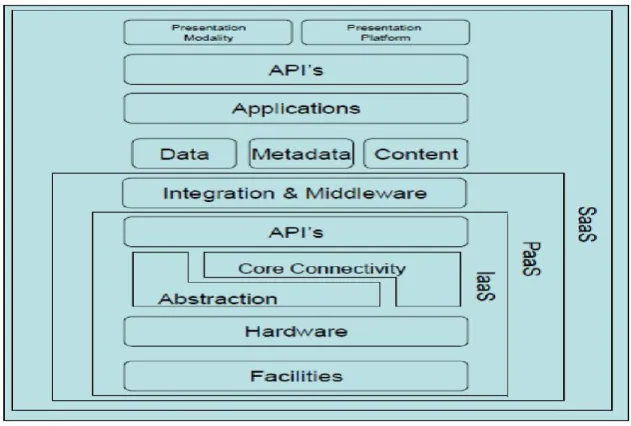
Figure 2 - Cloud Reference Model (Cloud Security Alliance, 2009, p18)
(Gens, 2008). To understand the security issue in Cloud Computing, it is important to know the architecture of Cloud Computing. Once known the architecture of Cloud Computing then it becomes easier to understand the data security and privacy issues and also to figure them out. We have presented the architecture of cloud above in section 2.1. Mostly the security issues which arise in Cloud Computing are the result of users/enterprises lack of control on the physical infrastructure. Enterprises mostly don‟t know where their data is physically stored and which security mechanisms are in place to protect data i.e. whether the data is encrypted or not and if yes, which encryption method is applied also if the connection used for data to travel in the cloud is encrypted and how the encryption keys are managed (Window Security, 2010). Jensen et al. (2009) presented the technical security
issues in Cloud Computing, however, these issues are more related with the problems of web services and web browser and not of Cloud Computing. These issues are still very important to Cloud Computing as Cloud Computing makes a lot of use of web services and users rely on web browsers to access the services offered by the cloud. The common attacks on web services include the XML Signature Element Wrapping, where XML signature is used for authentication (Jensen et al., 2009, p3). Browser Security is also an important issue in Cloud Computing as in a cloud most of the computation is done on remote servers and the client PC is only used for I/O, and authorization of commands to cloud. Hence, standard web browser was a need of situation to send I/O and this was utilized
by different names: web applications, web 2.0 or Software as Services (SaaS). However, the use of web browser raised the question of security. TLS (Transport Layer Security) is important in this matter as it is used for host authentication and data encryption. XML signature or XML encryption cannot be used by browser directly as data can be only encrypted through TLS and signatures are only used with the TLS handshake. Hence, browser only serves as a passive data store (Jensen et al., 2009, p4). As stated above, understanding the relationships and dependencies among Cloud Computing models is critical for understanding the security risks of it. For all the cloud services IaaS is the foundation and PaaS is build on it, while SaaS is build on PaaS and IaaS as described in the cloud
virtualization security. On the other hand consumer is responsible for security at IT system level i.e. operating system, applications and data (Cloud Security Alliance, 2009, p25). We can illustrate this issue by the help of a diagram, which shows how security structure responsibilities for different models vary (Cloud Security Alliance, 2009, p26).
Governance and Enterprise Risk Management
It deals with the ability of organization to governing and measuring enterprise risk caused by Cloud Computing. It tackles with the issues like legal precedence for agreement breaches, ability of user organizations to adequately assess risk of a cloud provider, responsibility to protect sensitive data and how international boundaries can affect these issues.
Legal and Electronic Discovery
It addresses the legal issues when enterprises adopt Cloud Computing i.e. protection requirements for information and computer systems, security breach disclosure laws, regulatory requirements, privacy requirements, international laws etc.
Compliance and Audit
It is about maintaining and proving compliance when enterprises move to Cloud Computing.
Information Lifecycle Management
It deals with the management of data which resides in the cloud i.e. items surrounding the identification and control of data in the cloud, compensations controls which can be used to deal with the loss of physical control, and who is responsible for data confidentiality, integrity and availability.
Portability and Interoperability
It discusses the movement of data from one provider to another or bringing it back to the enterprise.
And the Operational Domains consist of:
Traditional Security, Business Continuity and Disaster
Recovery
This takes into account as how the operational processes and procedures used to implement security are affected by Cloud Computing. This section also focuses on the risks of adopting Cloud Computing, in hopes for better enterprise risk management model.
Data Center Operations
It discusses the evaluation of provider‟s data center and architecture as what are the common data center characteristics for long term stability.
Incident Response, Notification and remediation
It addresses the items that should be in place at both provider and user levels to ensure proper incident handling and forensics.
Application Security
It talks as how to secure the application software which is running in the cloud or being developed in cloud. This includes the choice if to move to cloud and if yes then which cloud
platform should be adopted i.e. IaaS, SaaS, or PaaS.
Encryption and Key Management
It identifies the proper encryption usage and scalable key management. It more talks about as why the encryption and key management should be used,
bothfor protecting access to resources as well as for protecting data.
Identity and Access Management
It discusses the management of identities and leveraging directory services to provide access control. It also takes into account the assessment of an enterprise‟s readiness to conduct cloud based Identity and Access Management (IAM).
Virtualization
It discusses the use of virtualization in Cloud Computing. It discusses the risks associated with multi-tenancy, VM isolation, VM coresidence, hypervisor vulnerabilities etc. It also discusses the security issues related to only system/hardware virtualization (Cloud Security Alliance, 2009, p26-28).
The European Network and Information Security Agency (ENISA) also worked with the security issues in Cloud Computing and provided the most critical security risks while adopting Cloud Computing and which should be kept in mind before switching to Cloud Computing. They presented 35 risks which are involved with the security while adopting Cloud Computing (Catteddu and Hogben, 2009, p23). These 35 risks can be divided into the following categories:
Policy and organizational risks such as vendor lock-in, loss of governance, compliance challenges, and cloud provider acquisition.
Technical risks such as data leakage, distributed denial of service attacks, loss of encryption keys, and conflicts between customer hardening procedures and cloud platforms.
Legal risks such as data protection and software licensing risks.
Risks not specific to the cloud such as network problems, unauthorized access to data centers, and natural disasters (Catteddu, and Hogben, 2009, p24).
Benefits of Scale
It is a fact that all types of security measures which are implemented on a larger scale are cheaper. Hence by adopting Cloud Computing enterprises gets better protection with same amount of money. The security includes all kinds of defensive measures such as filtering, patch management, hardening of virtual machine instances, human resources and their management and vetting, hardware and software redundancy, strong authentication, efficient role-based access control and federated identity management solutions by default, which also improves the network effects of collaboration among various partners involved in defense (Catteddu, and Hogben, 2009, p17). Along with these benefits, other benefits include:
Multiple Locations:
independence from failure. Hence, it provides the disaster recovery.
Edge Networks:
Cloud Computing provides reliability, quality increase and less local network problems for enterprises by having storage, processing and delivery closer to the network edge.
Improved Timelines of Response (incidents):
Cloud providers have larger to incidents or well-run-larger-scale systems. These systems help in improved timelines of response e.g. because of the early detection of new malware deployments, it can develop more effective and efficient incident response.
Threat Management:
The small enterprises don‟t have resources to hire specialists for dealing with specific security issues but cloud providers can do that and provide better threat management (Catteddu, and Hogben, 2009, p17).
Security as Market Differentiator
For most of the enterprises security is the most important issue while moving to Cloud Computing. They make choices on the basis of reputation of confidentiality, Cloud Computing benefits, risks and recommendations for information security integrity and resilience and security services offered by provider. This drives Cloud Computing providers to improve the security to compete in the market (Catteddu, and Hogben, 2009, p17).
Standard Interfaces for Managed Security Services
Standardized open interfaces to managed security services (MSS) providers are often provided by the large cloud providers. This offers more open market for security services where customers can choose or switch providers more easily with lower setup costs. Hence, the more resources can be scaled in a granular way without taking care of the system resources, the cheaper it gets to respond to sudden peaks in demand (Catteddu, and Hogben, 2009, p18).
Rapid, Smart Scaling of Resources
There are already many cloud resources including storage, CPU time, memory, web service requests and virtual machine instances which can be rapidly scaled on demand and as the technology is improving granular control over resource consumption is increasing. The cloud provider also have the resources and the rights to dynamically reallocate resources for filtering, traffic shaping, encryption etc, when an attack (e.g. DDoS) is likely or is taking place, to increase support for defensive measures. Hence, the cloud providers can limit the effect that some attacks have on the availability of resources
that legitimately hosted services use by the combined use of dynamic resource allocation and appropriate resource optimization methods. Therefore the ability to dynamically scale the defensive resources on demand has resilience benefits for enterprises. Furthermore, the more the scaling of resources in a granular way, the cheaper it is to respond to sudden peaks in demand (Catteddu, and Hogben, 2009, p18). Craig Balding is a system/database administrator after graduating from university with a Systems Analysis degree in 1994. He has ISC (Information Systems Security) certification. He is also ISACA i.e. Certified Information Security Auditor and Chartered IT Professional. Balding (2008) presents seven technical security benefits for enterprises. Some of them are immediate benefits while others may arrive with time and have some conditions attached. Cloud offers major security benefits to small and medium enterprises as most of them suffer with limited or non-existence in-house resources and budgets (Balding, 2008). The seven technical security benefits presented by Balding (2008) basically strengthen the above talked benefits and they include:
i. Centralized Data
One of the main security benefit provided by Cloud Computing is the centralized data. The benefits of centralized data are reduced data leakage and better monitoring. Reduced data leakage is the most talked and popular benefit from the Cloud providers for enterprises. Most of the enterprises save their data on tapes and laptops but they are never secured. It is more secured to transfer data in the form of temporary caches or handled devices than transferring through laptops. Also not all small enterprises are using encryption techniques. Hence, the data can be made more secured with the use of Cloud Computing technology. It is also easier to control and monitor data through central storage. However, on the other side it is also risky to have all data at one place as if theft happens, all data is lost but Balding prefers the centralized data. It is better to spend time on designing the security for one centralized place rather than figuring out the way to secure all the places where companiesreside their data (Balding, 2008).
By the use of Infrastructure as a Service (IaaS), it is possible to build a dedicated forensic server in the cloud as of in the enterprise and place it offline, ready for use anytime. One only needs to pay for storage and if an incident happens, enterprise just brings it online from the Cloud provider‟s web interface rather than calling someone to bring it online or install some boot server. Evidence acquisition time is also decreased if enterprises decide to adopt Cloud Computing. For instance, if a server in the Cloud gets compromised, one can clone the server and make it available instantly to Cloud Forensics server. Cloud Computing is beneficial in eliminating or reducing service downtime. As mentioned above one don‟t need to go to someone to tell them that system should be taken offline because of the abstraction of hardware by Cloud Computing providers. Hence, abstracting the hardware removes a barrier to even doing forensics in some situations. The evidence transfer time is also decreased in Cloud Computing for enterprises. In the cloud bits to bits copies are super-fast because of the replicated, distributed file system. It is also free to make copies in the cloud because of the network perspective. Without the cloud one must invest lot of time and expensive provisioning of physical devices. Cloud Computing eliminates the forensic image verification time by implementation of cryptographic checksum or hash. For instance, Amazon S3 generates MD5 hash automatically when one stores an object hence; there is no need to generate time consuming MD5 checksums using external tools. Immense CPU power through Cloud Computing decreases time to access protected documents. One can test a wider range of different passwords in less time to speed investigation (Balding, 2008).
iii. Password Assurance Testing (Cracking)
The enterprises usually test password strengths regularly by running password crackers which is a time consuming process. However, this password cracking time is decreased by the use of Cloud Computing as Cloud providers do it by themselves. Another benefit of using cloud is keeping cracking activities to dedicated machines. Usually enterprises use distributed password cracker to spread the load across non-production machines but with cloud you place them on dedicated Compute instances (Balding, 2008).
iv. Logging
Cloud Computing provides another benefit for enterprises in the form of unlimited storage for logs. By the help of these logs in the cloud, enterprises can leverage cloud compute to index these logs in real time and get better and fast search results. Enhanced logging is another beneficial aspect of Cloud Computing. Most of the modern operating systems offer extended logging system in the form of C2 audit trial but this is usually not used by enterprises because of performance degradation and log size issues. However, with Cloud Computing you can „opt-in‟ easily if you are willing to pay for extended logging (Balding, 2008).
v. Improved State of Security Software (Performance)
Cloud Computing drives vendors to create more efficient security software. In cloud all billable CPU cycles get noticed hence, more attention will be paid by enterprises to inefficient processes e.g. poorly turned security agents. Therefore process accounting will make a comeback and vendors will go for improved security software (Balding, 2008).
vi. Security Builds
Pre-hardened, change control builds are another benefit of Cloud Computing. This is primarily a benefit of virtualization based Cloud Computing. Now one can start secure by creating the Gold Image VM and clone away. It will also reduce exposure through patching offline as Gold images can be kept securely up to date. While offline VM can be easily patched „off‟ the network. It is also very easy to test impact of security changes on cloud. Enterprises just need to make a copy of their production environment, implement a security change and then just test the impact at low cost with minimal startup time. This removes a major barrier of doing security in production environments (Balding, 2008).
vii. Security Testing
Cloud Computing provides reduced cost of testing security. With SaaS, the providers only ask for a portion of security testing costs to enterprises as they are sharing the same application as a service. Hence, you don‟t pay much and save cost (Balding, 2008).
XVIII. DATA ANALYSIS
Once the data collection process was achieved, next step was data analysis. There were many methods which make the data analysis more meaningful. These techniques could be used to manage the interview text, to compress the interview in the form of some short sentences in order to get the important points said in the interview. Depending on the data collection methods and tools that we used, we chose to select the case study analysis to analyze our data. It was very important during analysis to understand the textual data. One should highlight and understand the important part of a text to be able to comprehend the general meaning and then interpret it to bring coherence and sense. Hence, to achieve that we have pursued a circular process, We understood the text as a whole, and then interpreted parts of the text so We can have a better understanding of the whole, and back to the parts, and so on. In our study since we conducted multiple case studies, we were confronted to different people involved with Cloud
Computing. Therefore, we encountered contradictory,
differences, we were able to determine a link between our cases and interpret them as a whole to create a general
knowledge about the issue. The interpretation of different cases can take many meanings; it can be different persons that we interviewed and different study of information systems on the same issue. Hence, by this we decided what the cases were, and with the help of this method we found links among them. Furthermore, we developed naturalistic generalizations from the data we analyzed. This was a generalization that the cases show to the people so they could learn it, and apply to another set of population (Creswell, 2007, p163). It was clear that our form of writing the report for the study should be in relation with the strategy, the data collection and the data analysis. But first there were a few points that need to be discussed in order to deliver a suitable, credible and reliable report. First, we did the reflexivity and representation in writing the report. The researchers cannot be distanced from the report, since we have a deep involvement in it; we have to assume the consequences (Creswell, 2007, p179). Hence, we as a researcher explained our situation and the context in which we were writing the report. Since everything that happened around me affected me and it affected our interpretation. Therefore, the report that we have produced is a representation of what we experienced during a precise laps of time, and thus it cannot be acknowledged as a universal reference defying the law of space and time. We had the duty to inform the readers so they can have a better understanding of the overall study and interpretations we made. We also had to be aware of the participants feeling about the report, to see how they react to it, it is important be able to hear all the voices of a qualitative study. Second, we had to be aware of the audience we were writing the report for (Creswell, 2007,
p180). Our primary audiences were teachers and researchers in the Information Systems field, and also students who were consulting our work for further studies. Hence, the report was shaped in a suitable form that let the audience have an easy understanding and critical judgment on our report. Third, we had identified our audience, so we focused on encoding our writings. This meant that we had to choose our words carefully and in respect to the audience. Since our audience was mainly in the educational field, we used academic writing for our report (Creswell, 2007, p181). Now that we decided different tools and tips for our report, we concentrated on the overall structure of the case study report. The structure was a case study structure report. This approach was suggested by Stake (1995) in Creswell book, (Creswell, 2007, p183-184) and from our point of view fits perfectly with our type of study. We began our report by identifying the issue, Cloud Computing and the information systems in enterprises, and the purpose of the study. After that we concentrated on to find out if it was beneficial for enterprises to use Cloud Computing to have an efficient and effective information system in terms of cost and security, and finally the method of the study. Next, we presented a full description of the case and its context. Then we presented the issues that were being studied in the precise context, this was from our understanding or from different literature that we came across and from which we made references. Then we investigated some of the issues, at this point we began to confirm or discredit the evidence we gathered, so that we could begin to interpret it. Next, we presented statements, and a summary of what we understood about the case, our interpretation, and we discuss the conclusion being naturalistic generalization, so the reader can-judge-for-himsel
XIX. INTERVIEWS
We found Fox Mobile Group in Berlin, an enterprise which is using Cloud Computing and can give answers of what benefits and drawbacks they are obtaining by adopting Cloud Computing. We conducted couple of interviews there with an employee responsible for Cloud Computing. As we mentioned before the reason to choose Fox Mobile Group was easy and difficult at the same time because we did internship there which resulted in easier access to the contact person and information but also getting biased and over through some critical information. However, we tried to maintain the balance as we know how important it is for research. On the other hand, we were also successful in finding a Cloud Computing provider named DNS Europe. We conducted the interview with them about the benefits and drawbacks they think enterprises can achieve with their adoption of Cloud Computing.
XX. CLOUD COMPUTING AND COST
The first interview was conducted with an employee of Fox Mobile Group named X. The purpose for this first interview was to get to know about the company and its work. This interview was targeted to the cost effect (benefits and drawbacks) of Cloud Computing in enterprise. Mr. X is an IT teare leader and responsible for the developer team. In his developer teare they are responsible for developing music services on one side and on the other side so called acquisition engine, which is a server that hosted landing pages and record statistics. He described Fox Mobile Group as a global leader in mobile content distribution, production and services, offering more of the benefits of mobile entertainment to consumers and business partners than anyone else. A division of News Corporation's Digital Media Group, FMG distributes and produces more mobile entertainment to more people and business partners in more ways and in more places than anyone else in the world. Its headquarter is in Berlin, Germany and Beverly Hills, Calif., Fox Mobile Group is wholly-owned by News Corporation (NASDAQ: NWS, NWSA; ASX: NWS, NWSLV). The main area where fox mobile is working is
mobile entertainment products including ring tones,
to the interviewee, FMG started using Cloud Computing with acquisition engine project. It was developed by an external software company and the company chose to deploy it in the Amazon cloud and it was the requirement from their strategy. However, the decision to put the application in cloud was of Fox Mobile Group. It was from the beginning of the project deployed in the cloud. The interviewee defined the Cloud Computing as “Cloud computing is a flexible way to allocate resources out of a pool, enabling to consume processing power according to your needs. It makes easy to set up and decommission server instances, allowing the size of your infrastructure to grow when you need to address peaks while saving costs when you do not need the extra power anymore. The global usage of a cloud leads to the optimization of resources so that in the end it makes them cheaper for everybody involved”. For this project the FMG is using IaaS (Infrastructure as a Service) because this is the model that fits best to their needs. They use the cloud as an infrastructure where they deploy their own application. They are using IaaS from Amazon which is being managed by a third party company named Right Scale. When asked about the reason to choose the specific cloud provider the interview replied that Amazon is a major player on this market, so it makes it obviously a candidate. It has benefited from its own internal needs for scalability and infrastructure flexibility and they continually extend their offer. In regards with the procedure to start working with Cloud Computing and the contract and legal issues, the interviewee was of the view that it is fairly straightforward to create an account and set up a server. There is plenty of ready to use server images that covers the need for different setups like Web, Application or databases Server. That said, the teare that created the infrastructure had to write a fairly amount of scripts to tailor the
environment. Before the adoption of Cloud Computing the FMG had exclusively been using the services of a classical datacenter. Mr. X was of the view that the location of data and the security requirements around them are obviously important issues and datacenter standard compliances and SLAs address them. Of course, deploying in the cloud kind of emphasizes the question about data security. But cloud does not mean automatically security problems. We are in the first place responsible for making our application secure. That said, we need sometimes some standardized compliances at enterprise level. Because we plan to deploy more in the cloud in the future, we are discussing an enterprise agreement with Amazon. When asked about how they were catering the daily demand before moving to cloud, the response was quite straight forward as it is a new application and its their first experience. Along with testing, cost was one of the main factors for FMG to move to cloud. However, at the same time the interviewee told that cost was not the first factor to adopt Cloud Computing. The first reason was to give the teare a complete autonoour on their deployment needs, allowing controlling the whole lifecycle of their activities. Cloud Computing is definitely more cost effective but costs were not the biggest reason in this case. The motivation in the first place was a new way to work for the team, a process to make them independent especially regarding their deployment and scalability needs. FMG had no particular problem related to being in cloud so far hence, they said they are satisfied. However, they need to automate their deployment process just like the way they have done it in their process so far. Also they have to work a bit on their own on the monitoring of their
application, what otherwise has been part of their standard processes in their classical datacenter infrastructure. In the cloud their teare is responsible for itself.
FMG did not opt for Grid computing before Cloud Computing as it is a new application which is developed in recent past however; they have used virtualized resources in their data center so Cloud Computing is a next step. When the interviewee was asked that durability, high availability and fast access are provided in a bundle from many cloud providers but some applications do not need them all and did your application need those all and If not then how is Cloud Computing cost effective? According to him considering their application they need high availability and performance but he could imagine for other profiles of application that you might want to choose the quality of services you need. He thinks it is very specific for application and they are happy for all these as they need all in their own specific application. Another benefit which the interviewee stated was that the system administration is lessened through the ability of loading a server image with the operating system and the software we need is just a mouse click away. And every developer in the teare is able to do it. Sure it goes along with a couple of things developers have to take care of. All in all, it is cost effective.
Appendix A: Interview 1 Purpose of the Interview
The purpose for this first interview is to get to know about the company and its work. This interview will be targeted to the cost effect of cloud computing in enterprise.
Questionnaire for the Interview General Enterprise
What is your position and responsibilities in the company? We are responsible for developer team. We are responsible for developing music services on one side and on the other side so called acquisition engine, which is a server that hosted landing pages and record statistics.
What are the main areas of work of Fox Mobile Group? How big is the enterprise? You consider it to be large, medium or small?
The main area where fox mobile is working is mobile entertainment products including ring tones, wallpapers, music, games range covering new smart phones and older devices. It‟s a medium sized enterprise.
We presume you are using could computing, When did the Fox Mobile adopt cloud computing?
Fox started using cloud computing with acquisition engine project. It was developed by an external software company and they choose to deploy it in the Amazon cloud and it was the requirement from their strategy.
Whose decision was to move to cloud?
It was decision of Fox Mobile Group. It was from the beginning of the project deployed in the cloud.
Can you please define cloud computing as what it is to you? Cloud computing is a flexible way to allocate resources out of a pool, enabling to consume processing power according to your needs. It makes easy to set up and decommission server instances, allowing the size of your infrastructure to grow when you need to address peaks while saving costs when you do not need the extra power anymore. The global usage of a cloud leads to the optimization of resources so that in the end it makes them cheaper for everybody involved.
We are using IaaS (Infrastructure as a Service) because this is the model that fits our needs. We use the cloud as an infrastructure where we deploy our own applications.
Which Cloud provider are you using?
We are using Amazon and we manage our cloud infrastructure through third party Company named Right Scale.
Any specific reason to choose that provider?
Amazon is a major player on this market, so it makes it obviously a candidate. It has benefited from its own internal needs for scalability and infrastructure flexibility and they continually extend their offer.
How did you get started with the cloud? Easy process? Legal procedures? Number of days to start working? Contract
to be signed?
It is fairly straightforward to create an account and set up a server. There is plenty of ready to use server images that covers the need for different setups like Web, Application or databases Server. That said, the teare that created the infrastructure had to write a fairly amount of scripts to tailor the environment.
How was Fox dealing with its data, before cloud computing? If In house data center
� What were the issues in it?
We had exclusively been using the services of a classical datacenter so far. The location of data and the security requirements around them are obviously important issues and datacenter standard compliances and SLAs address them. Of course, deploying in the cloud kind of emphasizes the question about data security. But cloud does not mean automatically security problems. You are in the first place responsible for making your application secure. That said, you need sometimes some standardized compliances at enterprise level. Because we plan to deploy more in the cloud in the future, we are discussing an enterprise agreement with Amazon.
According to you what were general/main factors to move to Cloud?
We think the first reason was to give the teare a complete auto hour on their deployment needs, allowing to control the whole lifecycle of their activities. Costs are another reason.
How were you catering before the daily demand of the application moved on cloud? Did you guess the peak hours?As we mentioned, it is a new application and also our first experience in Cloud.
XXI. Cost Effect
Is cloud computing more cost effective and is the cost biggest reason to move to cloud?
It is more cost effective but costs were not the biggest reason in this case. The motivation in the first place was a new way to work for the team, a process to make them independent especially regarding their deployment and scalability needs.
Do you think “the cost model” is beneficial for enterprise and you are happy with it?
Which costing model are you using with cloud providers? Pay as you go, tiered, per unit pricing, subscription based?
We pay for every hour per machine hence, it is pay as u go. As you are big company, why didn’t you go for having private cloud and saving cost in longer term?
No we do not think we will go for a private cloud, in the sense of setting up a cloud infrastructure on our own. We don't expect saving costs that way. What we might use is something like a virtual private cloud to connect our cloud setup to our classical infrastructure via a virtual private network.
Do you see any issues in Cloud computing so far? We had no particular problem related to being in the cloud so far. Hence, we can say we are satisfied. We need to auto matize our deployment process just like the way we have done it in our process so far. Also we have to work a bit on our own on the monitoring of our application, what otherwise has been part of our standard processes in our classical datacenter infrastructure. In the cloud our teare is responsible for itself.
Are you aware with the elasticity factor of cloud? What do you think about it?
Elasticity is scaling capacity up and down. The obvious advantage of this is on the cost side; when you need more resources for a limited period of time, you only have to pay for the extra power in this limited period of time.
Before cloud Grid was in the market, why didn’t you opt for going for it?
We have used virtualized resources in our datacenter. Cloud computing is kind of a next step.
High durability, high availability and fast access are provided in a bundle from many cloud providers but some applications don’t them all. Did your application need them all? If not then how is cloud cost effective?
Considering our application we need high availability and performance but We can imagine for other profiles of application you might want to choose the quality of services u need. We think its very specific for application. We are happy for all these as we need all in these applications.
System administration is lessened through the ability of loading a server image with the operating system and the software you need just by the mean of a mouse clicks. And
every developer in the teare is enable to do it. Sure it goes along with a couple of things developers have to take care
of. All in all, it is cost effective.
Appendix B: Interview 2 Purpose of the Interview
The purpose for the second interview is to get to know about the security of enterprise and security effect of cloud computing in enterprise.
XXII. Questionnaire for the Interview Security Effect
Did you think of security issue while moving to cloud computing?
For your enterprise cloud computing is secured or not?
Security is probably one of the questions that kind of worry people who are new to cloud. As we told you in the previous interview, our teare took over an application that was already deployed in the cloud. Nevertheless, as it was new to us, one of our infrastructure engineers did a small survey about that topic. We also look at the documentation provided by Amazon about their security standards. We concluded that the security in the cloud primary depends on the way you tackle security issues at the level of your server. The cloud is not a bigger threat as such when it matters to deal with the security at your application level (i.e.
authenticating and authorizing access) or
configuring which ports should be opened. At infrastructure level, we rely on Amazon and we feel they have tremendous experience here.
Have you implemented the security by yourself in the enterprise?
Apart from security at application level, our developer teams rely on our infrastructure teare for security questions regarding networks, firewall, protocols allowed to access servers or data in our standard datacenter.
Do you know where your data is stored and does it make you worried?
Do you know if your data is encrypted? If yes, which encryption method is applied?
Our data are not encrypted.
Is the connection used for data to travel is encrypted?
We used HTTPS for the communication between our frontend application deployed in the cloud and our APWE applications which are deployed in our standard datacenter. Also, the access to our APIs implies that the client uses a SSL client certificate we issued.
The https is done by you or cloud did it?
We do not have any instruction or constraints imposed by cloud or their team. It is an application choice to communicate through https.
Do you implement TLS (Transport Layer Security)?
We rely on the protocols supported by the application server or the underlying operating system.
In IaaS of Amazon EC2 security is the responsibility of both the sides i.e. enterprise and cloud provider in the form of Physical security, Network Infrastructure, IT systems and application Security. How do you manage it?
Physical security is something we take as part of the service so we assume that nobody can connect from the cloud to our server from a private address because it should be something restricted only for Amazon technical staff. We haven‟t done anything on our own regarding that.
Did you think of Governance Issues while adopting cloud computing including
o Governance and Enterprise Risk Management o Legal and Electronic Discovery
o Compliance and Audit
o Information Lifecycle Management o Portability and Interoperability
We think very basically the decision was taken to deploy only application which has no sensitive data so may be if you could access our database you will see some product numbers but you wouldn‟t see the price paid for the thing. Hence, it is more of a testing phase.
What do you think are the security benefits of cloud computing?
We don‟t think benefit is the added value of cloud computing and it is not one of the promises of the concept cloud. Hence, We don‟t think anyone would say that We are going to cloud because we are more secured instead they will say We are going to cloud because it is scalable. But that said, you benefit of large scale experience regarding security in data center and virtualized systems.
Do you think security of cloud becomes better because of market differentiator?
Of course, it helps in a certain way.