ISOLATION AND CHARACTERIZATION OF PSEUDOMONAS PUTIDA PRODUCING BIOPLASTIC (POLYHYDROXY ALKANOATE) FROM VEGETABLE OIL WASTES
Iman H Gatea, Alaa S Abbas, Ameena G Abid, Amal A Halob, Sana K Maied and Azhar S Abidali
Environment and Water Directorate, Iraq/Ministry of Science and Technology, Iraq. Email: [email protected]
Article received 5.5.2018, Revised 3.6.2018, Accepted 11.6.2018
ABSTRACT
The current study aimed isolation and characterization of local bacterial isolates capable of production Poly hydroxy alkanoate (PHA) using oil residues as a single carbon source. Many polluted environmental sites were used as sources of isolation of bacterial isolates.
The collected samples were processed by serial dilution followed by spread plating in nutrient agar plates to get isolated colonies. Bacterial isolates were tested for (PHA) granules production using Sudan blank and Nile blue stains, nine of fifty isolates could produce PHA. Production of the polymer of bacterial isolates was found to be ranging from 21% - 57 % (w/w) of the biomass. The highest PHA yield was observed in Pseudomonas putida SD12, which was diagnosed according to diagnostic methods, i.e., colony morphology, gram staining, and then was confirmed by new gram-negative identification card (Vitek 2 NGNC). PHA accumulating was 2.80g/L, amounting to 57.20% (w/w) of cell dry weight. Waste frying oil was the best source of carbon which gave better results for PHA production than pure oil. PHA production was 2715 ppm with comparison of 1223 mg /3mlwhen used pure oil as a carbon source when incubated at 30°C after 48 hours.
Key words: Pseudomonas putida, poly hydroxy alkanoate, bioplastic, waste oil
INTRODUCTION
Synthetic plastic is one of the human inventions developed into many different industries and commodities in human’s life [Sudesh and Iwata 2008]. They are designed to be of high perform- ance and stability to make it resistant to chemical and natural conditions.
it has been a form of large plastics as industrial polymers since 1940, as it has been used as an alt-ernative to glass, wood, other structural materials and even metals in many industrial, [Poirier et al, 1995, Lee, 1996). Bio-based materials such as polynucleotides, polyoxoesters, polyamides, poly-saccharides, polythioesters, polyanhydrides and polyisoprenoids potential candidates for substi-tution of synthetic [Steinbuchel, 2001]. An impor-tant family of biomaterials is which are usually built from hydroxy-acyl–CoA derivatives through different metabolic pathways.
The term polymers represent compounds produced by microorganisms under different environmental conditions and are chemically non-related [Poirier et al,1995, Degeest et al,2001; Sudesh and Iwata 2008]. Bio-plastics vary in their basic structure, structure of molecules and physical properties depending on their microbial origin, and most of them are characterized as biodegradable and bio-compatible, making it extremely important in terms of biotechnology.
Bio plastic is a special type of biomaterial. They are polystyres, produced by a number of
The number and size of the granule, the comp-osition of the monomer, the molecular structure, and the physical and chemical properties vary according to the producer organism [Murray et
al., 1994; Ha. and Cho, 2002]. Focusing on the
importance of supporting research in the pro-duction of biological products will enrich the wealth of all mankind. This study examined the production of polyhydroxy alkanoate by local bacterial isolate isolated from soil samples; their diversity in soil makes them a suitable area for exploit as potential producers of PHA. In this work we studied PHA recovery from Pseudomo-nas putida Sd12 which possesses tendency to utilize corn oil and it has been reported pre-viously. That waste frying oil are desired feed sto-cks for PHA production because they are also inexpensive in comparison with pure oil and other carbon sources, such as sugar. In this paper we also detected PHA production using private stains.
MATERIALS AND METHODS
Samples collection: Soil sample, sewage sludge and detergent waste were collected from differ-ent sites in Baghdad Isolation and purification of bacteria. Sequence of series of selected environ-ental models was carried out and plated on nut-rient agar medium plates. Plates are incubated at 30° C for 48 hours. Isolated colonies were puri-fied to obtain a single colony and maintained a slant droplet at 4 ° C.
PHA producers screening: Sudan Black B dye was used for qualitatively test for PHA production as rapid screening of PHA producers. Nutrient agar medium supplemented with 1% glucose was autoclaved and poured into petri plates. After solidification, plates were inoculated with the bacterial isolates. The plates were incubated at 30°C for 24-48 hrs. To remove the excess stain from the colonies they were washed with 98% ethanol. The dark blue colored colonies represen-ted positive for PHA production.
Detection of PHB with Nile blue: Positive isolates for Sudan black B were further screened by Nile blue A, a more specific stain, which is considered a more rapid and sensitive, Carbon-rich nutrient agar medium supplemen-ted with 0.5 μg/mL Nile blue A and inoculated with bacterial isolates and growth of the cells occurred in the presence of the dye. After Nile blue a staining, bright orange fluorescence on irradiation with UV light was shown from PHA accumulating colonies, and their
fluorescence intensity increased with the incre-ase in PHA content of the bacterial cells. The isol-ates which showed bright orange fluorescence were selected as PHA accumulators.
Production media: For PHB production, the bact-erium was grown in basal medium modified by Gamal et al., (2012) called productive medium containing (g/L): (NH4)2SO4 1.0, KH2PO4 1.5, Na2HPO4.12H2O 9.0, MgSO4.7H2O 0.2, 1 mL of trace elements solution (FeSO4.7H2O 10, ZnSO4. 7H2O 2.25, CuSO4.5H2O 1.0, MnSO4.4H2O 0.5, CaCl2.2H2O 2.0, Na2B4O7.10H2O 0.23, 1.0 ml of waste frying oil as the sole carbon source. 100 ml media was prepared, autoclaved and used for PHB production by the organisms. The pH was adjusted to 7.0 before sterilization. Experimental conditions: Batch experiments were performed in shake flasks for production of the biopolymer was quantified in shake flasks as batch experi-ments. Flasks were inoculated with the bacterial isolates and incubated for 48 h at 30°C, 120 rpm. Then the PHB produced was extracted using chloroform method and quantified using crotonic acid standard graph. Extraction and quantitative analysis of PHA: Sample was taken from the pro-duction media. Centrifuged at 10,000 rpm at 4˚C for 20min. The supernatant was discarded and 0.1ml of acetone was added to the pellet and keep till it dries. After the acetone is dried 1:1 of 500μl of NaClO and chloroform was added (NaClO cleaves the cell wall and chloroform disso- lves PHA). Mixture was mixed thoroughly and kept for about 30min. Then centrifuged at 10,000 rpm for 30min at 4˚C for 20min. Three layers were formed: top NaClO, middle cell debris and bottom chloroform with PHA. The chloroform layer was pipetted into glass bottles. Kept out till the chloroform dries. Then 5ml of sulfuric acid was added into the bottles and kept in hot air oven at 100˚C for 1hr which converts it to Crotonic acid. The absorbance was taken at 235 nm using sulfuric acid as blank in UV Spectro-photometer [John and Ralph, 2001].
RESULTS AND DISCUSSION
A wide variety of bacteria are known as PHA granules accumulators intracellular as an energy reserve material. Over 90 genera of microorga-nisms have been recorded to accumulate about 150 polyhydroxy alkanoate polyesters granules [Du, 2001; Steinbüchel, 2001]. In the present study, we isolated 50 bacteria from soil, sewage sludge and oil waste. Nine of these isolates were positive for PHA production using Sudan black and Nile blue staining in the plate). After cell staining using Sudan black and safranin, PHA granules were detected inside the cells as black color against red back ground (Figure 1). The isolates which are stained dark, those microbes were selected and screened for producing PHA; they were cultivated in the media containing WFO as standard carbon source. We have noticed that nine bacterial isolates were able to produce major amounts of PHA during growth using the production media mentioned above containing a single carbon source which was corn oil.
Figure 1: Sudan black B stain of PHA granules (black section) of. Bacterial isolates observed under contrast phase
PHA granules exhibited a strong orange fluorescence when stained with Nile blue A. When it is combined with extraction proce- dures, staining with Nile blue A is a satisfactory test for the presumptive identification of PHA granules in bacterial cells.
Figure 2: Positive PHA producer bacterial isolates showing fluorescence orange Nile blue on agar plate under UV light
Of all environmental sources, 9 isolates were found to be the most efficient in producing the material after staining it with specialized dyes; it is as follows (Sd4, Sd9, Sd12, Em3, Em6, Em9, Bb2, Bb4 and Bb7). Compared with other isolates, Sd12 was superior, dry cell weight was 4.9g\l whereas PHA reached 2.80g\l yielding 57% of PHA, as shown in Table 1.
Table 1: production of PHA by selected bacterial isolate
PHA content % PHA g/l
Biomass g/l Parameter
Isolates
35 0.90
2.62 Em3
35 0.83
2.33 Em6
36 0.82
2.24 Em9
27 0.51
2.65 Sd4
20 0.42
2.05
Sd9
57 2.80
4.90 Sd12
21 0.32
2.52 Bb7
39 0.90
2.34 Bb2
30 1.00
3.32 Bb4
Chemical analysis should still be performed to confirm the presence of PHA. The ability of bact-erial isolates to produce the matbact-erial is determined
by polymer extraction, degradation to crotonic
acid, and Check for decomposition products by UV spectra. The results showed that isolation 12
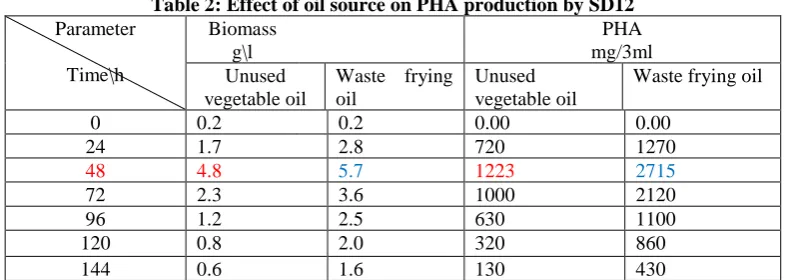
(Sd-12) and after 48 hours of growth at 30 ° C was 5.7 g/l using oily residues and the value of the product
was 2715 mg/3 ml While the biomass of isolation
after 48 and under the same conditions was 4.8 g /l using unused oil while the value of the product was 1223 mg/3.
Table 2: Effect of oil source on PHA production by SD12
Parameter
Time\h
Biomass g\l
PHA mg/3ml Unused
vegetable oil
Waste frying oil
Unused vegetable oil
Waste frying oil
0 0.2 0.2 0.00 0.00
24 1.7 2.8 720 1270
48 4.8 5.7 1223 2715
72 2.3 3.6 1000 2120
96 1.2 2.5 630 1100
120 0.8 2.0 320 860
144 0.6 1.6 130 430
Accordingly, PHA accumulation after 48 hours of
incubation in bacterial cells was the best Table 2.
The synthesis of PHA was observed from the log phase of growth and it keep up late exponential stage where the source of carbon was consumed
both for growth and for production of PHA.
Depending on morphological, biochemical tests and Vitek 2 NGNC the highest production isolate SD12 was characterized as Pseudomonas putida. Maximum PHA production was determined using 1% of WFO after 48 hours of growth at 30°C
comparison with pure oil as carbon source. Conclusion
Theaim of this study was to screen and select sui- tablebacterialisolatesfor PHA production. Among the 9 isolated bacteria, isolate SD12 was found to be more efficient for PHA production in the media containing waste frying corn oil as the carbon source with PHA content of 57%.
Although pure corn oil proved to be good carbon source for the growth of the bacteria, but this sou-rce of carbon was less efficient in making use of it for PHA production.
Non-solvent-based extraction techniques for ext-raction of PHA needs to be developed, as it will help to significantly reduce PHA production cost. Also the cultural parameters have to be optimized with other stress conditions so that the biomass and in turn PHA yield can be increased.
The focus of future research would be to reduce the cost of production as well as improve the qua-lity of the polymers to make it suitable for high cost products.
REFERENCES
Albuquerque, M., M. Eiroa, C. Torres, B.R. Nunes and M.A.M. Reis, Strategies for the development of a side stream process for
polyhydroxyalkanoate (PHA) production from sugar cane molasses. Journal of Biotechno- logy 130: 411-421 (2007).
Baumann, P., L. Baumann, M. Mandel, and R. Allen. Taxonomy of aerobic marine eubac-teria. J. Bacteriol. 110: 402–429 (1972). Collee, J.G., Duguid, J.P., Fraser, A.G. and P.
Marmion, Mackie & McCartney practical medical microbiology. English: 14th ed !996). Degeest, B., F. Vaningelgem and L. Vuyst, Micr-obial physiology, fermentation kinetics proc-ess engineering of heteropolysaccharide pro-duction by lactic acid bacteria. International Dairy Journal 11: 747-757 (2001).
Du G., Yu J., Chen J. and S. Lun, Continuous production of poly-3-hydroxybutyrate by Ralstonia eutropha in a two-stage culture system. J Biotechnol. 88: 59–65 (2001). Dunlop, W. F., and A. W. Robards,
Ultrastruc-tural study of poly-fI-hydroxybutyrate granu-les from Bacillus cereus. J. Bacteriol. 114: 1271-1280 (1973).
Gamal R.F., Abdelhady H.M., Hassan E.A., El-Tayeb T.S. and K.A. Aboutaleb, Production of PHAs from waste frying oil by Pseudo-monas fluorescens S48 using different bio-reactor feeding strategies. Egypt J. Microbiol. 47: 130-136 (2012).
Ha, C.S. and W.J. Cho, Miscibility, properties and biodegradability of microbial polyester conta-ining blends. Programe Polymer Science 27: 759-809 (2002).
473 Jeffrey G. Banks and Ron G. Board, The
classi-fication of pseudomonads and other oblige-tory aerobic Gram-negative bacteria from British pork sausage and ingredients. Syst. Appl. Microbiol. 4: 424–438 (1983)
Kalaivani, R. and V. Sukumaran, Isolation and identification of new strains to enhance the production of biopolymers from marine sam-ple in Karankura, Tamil Nadu. Eur. J. Exp. Biol. 3(3): 56-64 (2013).
Kuniko, M., Y. Nakamura and Y. Doi, New bacte-rial coployestras produced in Alcaligenes eutrophus from organic acids. Polymer Commun. 29: 174-176 (1998).
Law J. and R.A. Slepecky, Assay of poly-hydroxy butyric acid. J. Bacteriol. 82:52–55 (1961). Lee, S.Y., Bacterial polyhdroxyalkanoates.
Biote-chnology and Bioengineering 49: 1-14 (1996). Mackie and McCartney, Screening and Isolation of PHB-Producing Bacteria in a Polluted Marine. Microbiology, 3th edn; Pp. 54-55 (1989).
Madison, L.L. and G.W. Huisman, Metabolic Engineering of Poly (3-Hydroxyalkanoates): From DNA to Plastic. Microbiology Molecu-lar Biology Review, 63: 21-53 (1999).
Madison, L.L. and G.W. Huisman, Metabolic engineering of Poly (3-Hydroxyalkanoates): From DNA to Plastic. Microbiol. Mol. Biol. Rev. 63(1):21-53 (19999).
Murray, R.G.E., R.D. Doetsch and C.F. Robinow, Determinative and cytological Light
micro-scopy In Manual of Methods for Genera Bact- eriology. American Society of Microbiology
10: 21-41 (1994).
Ostle A G and J.G. Holt, Nile blue A as a fluore- scent stain for polyhydroxybutyric acid. Appl. Environ Microbiol. 44: pp 23841 (1982). Palleroni, Norberto, Human-and Animal
Pathoge-nic Pseudomonads. The Prokaryotes Volume III, New York: Springer-Verlag (1992). Poirier, Y., C. Nawrath and C. Somerville,
Prod-uction of polyhydroxyalkanoates, a family of biodegradable plastics and elastomers, in bacteria and plants. Biotechnology, 6: 552-560 (1995).
Steinbüchel A., Perspectives for biotechnological production and utilization of biopolymers: metabolic engineering of polyhydroxy alka-noats biosynthesis pathways as a successful example. Macromol. Bioscien. 1:1–24 (2001). Steinbuchel, A., Perspectives for biotechnological production and utilization of biopolymers: Metabolic engineering of polyhydroxy alka-noate biosynthesis pathways as a successful example. Macromolecular Bioscience 1: 1-24 (2001).
Sudesh, K. and T. Iwata, Sustainability of bioba-sed and biodegradable plastics. Clean Soil, Air, Water 36: 433-442 (2008).
Zinn, M., B. Witholt and T. Egli, Occurrence, synthesis and medical application of bacterial polyhydroxy alkanoate. Advanced Drug Review (2001).