Pak. J. Anal. Environ. Chem. Vol. 11, No. 2 (2010) 23 – 29
A Green Analytical Procedure for Sensitive and Selective
Determination of Arsenic in Scalp Hair Samples of
Arsenic Exposed Adults of Both Genders
Jameel A. Baig
1,2, Tasneem G. Kazi
1, Abdul Q. Shah
1, Hassan I. Afridi
1,
Ghulam A. Kandhro
1and Sumaira Khan
11National Center of Excellence in Analytical Chemistry, University of Sindh, Jamshoro, Pakistan 2Young Welfare Society Mughalabad, Near Akri, Taluka Faiz Ganj, District Khairpur,Pakistan
--- ---
Abstract
A green analytical procedure based on cloud point extraction (CPE) is proposed for arsenic determination in biological samples (scalp hair). The scalp hair samples were subjected to microwave assisted digestison in a mixture of nitric acid and hydrogen peroxide (2:1 ratio), prior to preconcentration by CPE. Arsenic in digested samples of scalp hair was formed complex with ammonium pyrrolidine dithiocarbamate (APDC), and resulted As-PDC complex was extracted by a non-ionic surfactant octylphenoxypolyethoxyethanol (Triton X-114), after centrifugation the surfactant-rich phase was diluted with 0.1 mol L−1 HNO3 in methanol. For optimum recovery of
analyte, the influence of the analytical parameters including pH, amounts of complexing and surfactant reagents were investigated. An enrichment factor of 50 was obtained for the preconcentration of As. Limit of detection and quantitation obtained under the optimal conditions were 0.03 and 0.11 µg kg-1, respectively. The obtained result showed sufficient recovery (> 98%)
for As in certified reference material of human hair (BCR 397). The developed method was applied to the determination of As in scalp hair samples of male and female subjects of two villages of Hyderabad, Pakistan.
Keywords:Arsenic, Cloud point extraction, Scalp hair samples, Electrothermal atomic absorption spectrometry.
--- ---
Introduction
In recent years, toxicity of arsenic (As) compounds has raised concern about their environmental, occupational and nutritional safety because many As compounds are toxic and potentially carcinogenic [1-3]. Humans are exposed to As via air, water, and food. The contamination of natural water by As might be caused by geological and industrial manufacturing processes [4]. Accumulation of environmental pollutants/ contaminants affecting human health can be determined through the bio-monitoring of various biological specimens (blood, urine, hair and nail). But As in hair samples has been widely used as a biomarker for human exposures to arsenic
environment [5, 6]. In view of the above facts, fast, sensitive, accurate and simple analytical methods for the As in environmental and biological samples are required for obtaining helpful information on toxicity and its biotransformation in fauna and flora.
Recently, various types of analytical techniques, such as electrothermal atomic absorption spectroscopy, (ETAAS) electrothermal vaporization inductively coupled plasma mass spectrometry, hydride generation–atomic absorption spectroscopy and hydride generation– atomic fluorescence spectrometry have been used
for the determination of the low concentration levels of As [4].
However, direct determination of trace amounts of metals in human biological sample is difficult due to various factors, particularly low concentrations of trace amounts of metals and interference from the sample matrix [4]. Pre-concentration addresses both of these problems. There are a lot of methods for preconcentration and separation, such as liquid–liquid extraction and solid phase extraction [4, 7]. The traditional extraction and other conventional separation methods are time-consuming and labor-intensive approaches, besides requiring relatively large amounts of high-purity and frequently toxic solvents, which have to be disposed off properly [4]. Therefore, pre-concentration and separation methods based on cloud point extraction (CPE) can solve these problems and practical application of surfactants in analytical chemistry [10]. CPE exhibits much more environmental friendly nature. It is safer because small volumes of noxious surfactants are used instead of toxic organic solvents. The analytical potential of the CPE has been discussed by several authors and included this technique in green chemistry [11-13].
In Pakistan limited data on the determination of As in human hair based on conventional acid digestion procedures is available [11]. Therefore, in the present work, we have proposed a CPE method for the determination of total arsenic in scalp hair samples of skin disorder patients and healthy referent subjects by ETAAS. Several experimental variables, complexing reagent (APDC), non ionic surfactant (Triton X-114) and pH were investigated in detail. The accuracy of proposed CPE method was checked by simultaneously analyzing the human hair certified reference material ‘CRM’ (BCR 397). The proposed method was applied on scalp hair samples of residents (male and females) of two villages of Hyderabad, Pakistan.
Experimental
Sampling
Scalp hair (n = 260) samples were collected in April 2009 from individuals living in villages of Hyderabad district (25º22′N:68º22′E),
Sindh, a region of Pakistan having arsenic contaminated groundwater. The age range of the participants spanned 25–75 years (140 women, 120 men). Hair samples were collected from nape of the head using stainless steel scissors. The hair samples were sealed separately in labeled polyethylene zip lock bags and were not opened until returned to laboratory for cleaning. Prior to analysis, all hair samples were cut into 2 cm with a stainless steel scissors. The washing procedure carried out, was that proposed by International Atomic Energy Agency (IAEA), and thus, hair samples were first washed with ultrapure water and then three times with acetone and finally, they were again washed with ultrapure distilled water (three times). The samples were then oven-dried at 80 ○C.
The persons who gave their consent were recruited for biological samples collection. Before start of this study, each participant was informed about the aim of study in local language (Sindhi) through a consent form about the aim of the study using a formatted questionnaire to obtain verbal information (most of the resident were illiterate), including demographic and lifestyle characteristics such as smoking, tea consumption, duration of living in understudy areas, sources of drinking water and have or have not skin problem.
Reagents
(Merck, Germany), and Pd stock standard solution, 3000 mgL−1, was prepared from Pd 99.999% (Aldrich, USA). The working solution of modifiers was prepared by diluting 10 mL of each stock solution in 100 mL. The standard reference material of human hair BCR 397 (Brussels, Belgium) was used. The pH of the sample solution was adjusted with 0.1M HCl (Merck, Germany). Ultrapure water obtained form ELGA labwater system (Bucks, UK), was used throughout the study. Nitric acid (HNO3) ≈16 M and 30% hydrogen peroxide (H2O2) were obtained from (Merck, Germany).
Equipment
A thermostatic water bath maintained at the desired temperatures (Gallankamp, Germany) was used to study temperature effects on cloud point extraction. The phase separation was assisted with a centrifuge ROWKA Laboratoryjna type WE-1, nr-6933 (Mechanika Phecyzyjna, Poland). A PEL domestic microwave oven (Osaka, Japan), programmable for time and microwave power from 100 to 900 W, was used for total digestion of samples.
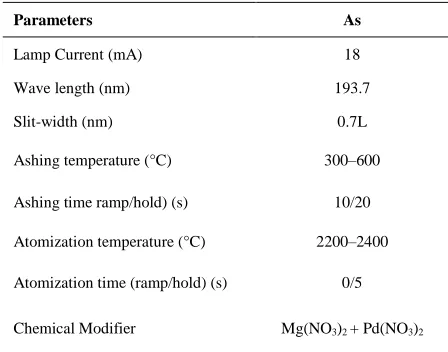
Table 1. Graphite furnace heating program.
Parameters As
Lamp Current (mA) 18
Wave length (nm) 193.7
Slit-width (nm) 0.7L
Ashing temperature (°C) 300–600
Ashing time ramp/hold) (s) 10/20
Atomization temperature (°C) 2200–2400
Atomization time (ramp/hold) (s) 0/5
Chemical Modifier Mg(NO3)2 + Pd(NO3)2
Dry temperature (°C)/ Dry time (ramp/hold) (s)= 80–120/(1/30) Cleaning temperature (°C)/ Cleaning (ramp/hold) (s) = 2400– 2800/(0/2)
Atomiation site = L'vov platform of a graphite tube. Carrier gas 200mL/min and Sample volume 10L + 10L modifier in each case.
A pH meter (Ecoscan Ion 6, Kuala Lumpur, Malaysia) was employed for pH
adjustments. A programmable ultrasonic water bath, model No. SC-121TH (Sonicor, Deep Park, NY, USA) was used for incubation with temperature ranging from 0 to 80 ○C at intensification frequency 35 kHz. The As in micelle mediated phase was determined by a double beam Perkin Elmer model A Analyst 700 (Norwalk, CT, USA) atomic absorption spectrophotometer, equipped with a graphite furnace HGA-400, auto sampler AS-800 and deuterium lamp for background correction. Single element hollow cathode lamp of As operated at 7.5mA was used as radiation source. The As signal was isolated at 193.7nm with a spectral bandwidth of 0.7nm and atomization was achieved in a pyrocoated graphite tube with integrated platform. The WinLab 32 software was used to acquire and process analytical data. The graphite furnace heating program, flow of gases and details of modifier is given in Table 1.
Cloud point extraction procedure
A microwave assisted acid digestion procedure was carried out to obtain total As in scalp hair samples. The six replicates samples of CRM (0.2 g) and triplicate of scalp hair samples (0.2 g) were directly weighed into Teflon PTFE flasks. Two ml of a freshly prepared mixture of concentrated HNO3 and H2O2 (2:1, v/v) was added to each flask and was kept for 10 min at room temperature. The flasks were sealed and the mixture submitted to the microwave heating program.25 Following digestion, samples were transferred to 20 ml volumetric flask and the volume was made-up with de-ionized water. The digested samples were further divided into two set , one set of digested solution was subjected to ETAAS for total As determination, while other set was subjected to cloud point extraction of As ,prior to subjecting ETAAS.
ultrasonic bath at 20-60°C for 5-20 min. After different time intervals, separation of the two phases was achieved by centrifuging for 5 min at 3500 rpm. After cooling in ice-bath, the surfactant-rich phase became viscous and the upper aqueous phase decanted. To decrease the viscosity of extracts added acidic ethyl alcohol (0.1M HNO3) and introduced into ETAAS with modifier. A blank submitted to the same procedure was measured parallel to the calibration solutions of standards, human hair CRM (BCR 397) and real samples.
Statistical analysis
Data processing and statistical analysis were conducted by using computer program EXCEL (XP 2002; Microsoft Corp., Redmond, WA) and Minitab 13.2 Minitab Inc., State (College, PA) software packages. Normally distributed data were expressed as means ± std, Student's t-test and Mann-Whitney test were used to assess the significance of the differences between the variables investigated in proposed method.
Results and Discussion
The proposed preconcentration methodology (CPE) was easy, rapid and interference free and did not require any particular technical skill apart from conventional extraction methods. We used these methods to evaluate the contamination of As in biological samples at trace levels. The complexing reagent APDC reacts quickly with As in aqueous solution to form a brown complex [3, 4, 7]. The influence of different analytical parameters (pH, amounts of reagents, concentration of non-ionic surfactant, time and temperature) were studied for the optimum recovery of both elements in different matrices.
Effect of pH
The pH of sample solution is one of the most important factors affecting the formation of complexes and their subsequent extraction [14]. Therefore, pH of the sample solution was a critical factor. In order to evaluate the effect of pH on complex formation of As with APDC, the experiments were carried out over the pH range of
1-10 (Fig. 1), using 0.1 mol L-1 HCl/ NaOH. As shown in Fig. 1, the maximum signal for As was achieved in the range of 3.5–5.5. In subsequent experiments a pH of 4.0 was chosen.
Figure 1. Effect of pH on the CPE of 10µg L−1 As (APDC = 0.008% (w/v), concentration of Triton X-114 = 0.12%, equilibration temperature = 40 ○C, equilibration time =10 min).
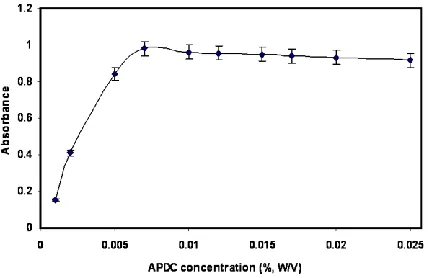
Figure 2. Effect of concentration of APDC on the CPE of 10µg L−1 As (concentration of Triton X-114 = 0.12% (v/v), pH = 4.0, equilibration temperature = 40 ○C, equilibration time = 10 min).
Effect of APDC concentration
Effect of triton X-114
The non-ionic surfactant Triton X-114 was chosen because of its easy availability in a high purified homogeneous form, less toxicity, low cost and its high density to facilitate phase separation by centrifugation. Additionally, the cloud point temperature of Triton X- 114 is about 40 °C [12]. A successful CPE should be able to maximize the extraction efficiency through minimizing the phase volume ratio (Vorg/Vaqueous), so as to improve the preconcentration factor. The (Fig. 3) shows the variation in extraction efficiency of As with APDC complex range of 0.01 - 0.25% was observed. The 60-70 % recovery was observed at 0.05% of Triton X-114, while the extraction efficiency reaches a maximum in the concentration of 0.12%. So, a concentration of 0.12% was chosen as the optimum surfactant concentration in order to achieve the highest possible extraction recovery of As from standards, CRM and scalp hair samples, while less than 0.12% the extraction efficiency of complexes is low probably because of the inadequacy of the assemblies to entrap the hydrophobic complex quantitatively. At volume higher than 0.12% (v/v), the signals decrease because of the increment in the volumes and the viscosity of the surfactant phase. To decrease the viscosity of extracts acidic ethyl alcohol 0.1 mol L-1 was added.
Figure 3. Effect of concentration of Triton X-114 on the CPE of 10µg L−1 As (APDC = 0.008% (w/v), pH = 4.0, equilibration temperature = 40 ○C, equilibration time =10 min).
Effects of equilibration temperature and time
To achieve an easy and efficient phase separation and preconcentration, the optimum incubation time and equilibration temperature are necessary. Considering that the formation and precipitation of surfactant-rich phase is mainly
depends on the behavior (for instance the cloud point temperature) of the employed non-ionic surfactant. It was found that 40 ○C is adequate for these analyses. The dependence of extraction efficiency upon equilibration time was studied for a time span of 5–20 min. An equilibration time of 10 min was chosen for the maximum quantitative extraction.
Interferences
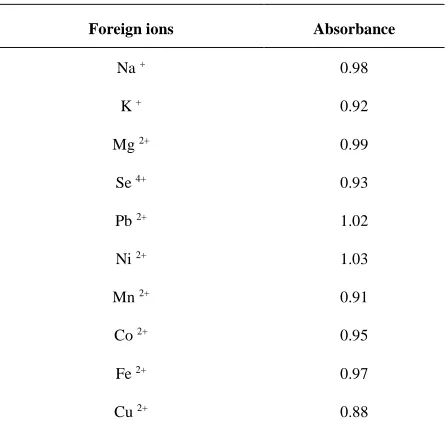
To evaluate the selectivity of the proposed method for determination of trace levels of As, the effect of typical potential interfering ions (10 µg L-1) was investigated (Table 2). The results showed that Se4+, Pb2+, Ni2+, Co2+, Mn2+ and Fe2+ (up to the concentration level of 100 mg/L), Na+ (up to 1000 mg L-1), Mg2+ and K+ (up to 500 mg L-1) did not cause any significant interference on the CPE of As. Therefore, the proposed method had good selectivity.
Table 2. Effect of foreign ions on the pre-concentration and determination of As (10µg L−1).
Foreign ions Absorbance
Na + 0.98
K + 0.92
Mg 2+ 0.99
Se 4+ 0.93
Pb 2+ 1.02
Ni 2+ 1.03
Mn 2+ 0.91
Co 2+ 0.95
Fe 2+ 0.97
Cu 2+ 0.88
Analytical performance
absorbance and the concentration of As in SH samples is expressed as µg g-1. The limits of detection (LOD) and limits of quantification (LOQ) for As were calculated as under,
m s 10 LOQ and m 2 3
LOD d respectively,
where s is the standard deviation of ten measurements of the blank and m is the slope of the calibration graph. The LOD and LOQ of As were 0.03 and 0.11 ηg g-1, respectively. The enhancement factor of about 50 was obtained by preconcentration a 10ml of sample. The results indicated that the method has good precision.
The method was assured by the analysis of triplicate samples, reagent blank, procedural blanks and standard reference material. In order to validate the method for accuracy and precision, a certified reference material BCR 397 (human hair) was analyzed with As content of 0.32 ± 0.02 µg g−1. The %recovery of As with CPE was higher than those obtained without CPE (Table 3). The precision of the methods, expressed as the relative standard deviation (RSD) of 6 independent analyses of the same sample with and without CPE were 4.6 and 8.36%, respectively.
Table 3. Determination of As in certified human hair samples by conventional acid digestion method (CDM) and cloud point extraction (CPE) (n = 6).
Certified sample of human hair (BCR 397) (µg g-1)
Certified
values CPE
% recovery (RSD)
CDM
0.31±0.02
0.298±0.012 96.1 (4.02)
With CPE 0.306±0.004 98.7 (1.30)
Application
This study has documented the As concentration in scalp hair samples of both adult genders were used as biomarkers for monitoring of As exposure and applied to estimate individual exposure of subjects through As contaminated drinking water. The developed cloud point extraction method was successfully applied for the analysis of scalp hair samples for As contents. Determination of As in hair samples is useful as a confirmatory feature in As poisoning provided
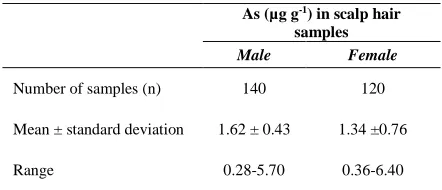
external contamination by arsenic can be excluded [15, 16]. This study has documented the As concentration in scalp hair sample of male and female subjects of two villages of district Hyderabad using optimized CPE method. Experimental results are listed in (Table 4). Analysis of the scalp hair samples showed that the As content in male and female ranging from 0.28 to 5.70 μg g−1 (n=140, mean 1.62 μg g−1) and 0.36 to 6.40 μg g−1 (n = 120, mean 1.34 μg g−1), respectively. The subjects under investigation are residents of two villages situated in Hyderabad, where the underground water contains As > 50 µg L-1. The concentration of As in scalp hair sample of male and females was significantly higher than permissible levels of As in human hair (0.08– 0.25µg g−1) [17]. It has been reported that high accumulation of As in hair samples in the concentration ranges of 0.70–16.2 [18] and 0.17– 14.4 μg g−1 [19], respectively in individuals consuming As contaminated groundwaters in West Bengal., which are higher than our study.
Table 4. Concentrations of As in Scalp hair Samples of (µg g-1) of
local pollution of district Hyderabad.
As (µg g-1) in scalp hair
samples Male Female
Number of samples (n) 140 120
Mean ± standard deviation 1.62 ± 0.43 1.34 ±0.76
Range 0.28-5.70 0.36-6.40
Conclusions
biological samples. In the essay, the experimental results showed that the CPE was a successful method for determination of As in hair samples with satisfactory recoveries. The concentration of As in scalp hair (males and females) among rural poor residents of two villages of Hyderabad district was higher than permissible levels of As for human hair, clearly revealed that the potential risk of arsenicosis.
Acknowledgements
This work was supported by Higher Education Commission (HEC), Islamabad (Grant No. 20-1246/R&D/9). T.G. Kazi would like to acknowledge the National Center of Excellence in Analytical Chemistry University of Sindh, Jamshoro for providing facility to carry out this work.
Prof. Dr. Tasneem G. Kazi and Dr. Hassan I. Afridi conceived of the study, participated in its design and coordination. Mr. Abdul Q. Shah and Mr. Ghulam A. Kandhro performed the data analyses and Sumaira Khan performed part of collection of data. Mr. Jameel A. Baig participated in the design of the study, performed the statistical data analyses and drafted the manuscript. All authors read and approved the final manuscript.
Reference
1. J. A. Baig, T. G. Kazi, M. B. Arain, A. Q. Shah, H. I. Afridi, G. A. Kandhro, R. A. Sarfraz, M. K. Jamali and S. Khan, J. Hazard. Mater., 167 (2009) 745.
2. J. A. Baig, T. G. Kazi, M. B. Arain, H. I. Afridi, G. A. Kandhro, R. A. Sarfraz, M. K. Jamali and A. Q. Shah, J. Hazard. Mater.,
166 (2009) 662.
3. J. A. Baig, T. G. Kazi, A. Q. Shah, M. B. Arain, H. I. Afridi, G. A. Kandhro and S. Khan, Anal. Chim. Acta., 651 (2009c) 57.
4. F. Shemirani, M. Baghdadi and M. Ramezani, Talanta, 65 (2005) 882.
5. D. Nandi, R. C. Patra and D. Swarup, Bull. Environ. Contam. Toxicol., 75 (2005) 251. 6. K. Sera, S. Futatsugawa and S. Murao, Nucl.
Instrum. Methods Phys. Res. Sect. B., 189 (2002) 174.
7. F. Shemirani, M. Baghdadi, M. Ramezani and M. Reza Jamali, Anal. Chim. Acta., 534 (2005) 163.
8. M. J. Slotnick and J. O. Nriagu, Environ. Res., 102 (2006) 125.
9. J. L. Manzoori and A. Bavili-Tabrizi, J. Microchem., 72 (2002)1.
10. M. A. M. S. Daveiga, V. L. A. Frescura, B. A. Welz and J. Curtius, J. Anal. Atom. Spectrom., 18 (2003) 501.
11. A.Q. Shah, T. G. Kazi, J. A. Baig, H. I. Afridi, G. A. Kandhro, M. B. Arain, N. F. Kolachi and S. K. Wadhwa, Food Chem. Toxicol., 48 (2010) 65.
12. M. F. Silva, E. S. Cerutti and L. D. Martinez,
Microchim. Acta., 155 (2006) 349.
13. C. D. Stalikas, Trends Anal. Chem., 21 (2002) 343.
14. J. T. Hindmarsh, Clin. Biochem., 35(2002) 1. 15. J. A. Baig, T. G. Kazi, A. Q. Shah, G. A.
Kandhro, H. I. Afridi, M. B. Arain, M. K. Jamali and N. Jalbani, J. Ecotoxicol. Environ. Safety., 73 (2010a) 914.
16. J. A. Baig, T. G. Kazi, A. Q. Shah, H. I. Afridi, G. A. Kandhro, S. Khan, J. Hazard. Mater., 178 (2010b) 941.
17. T. G. Kazi, M. B. Arain, J. A. Baig, M. K. Jamali, H. I. Afridi, N. Jalbani, R. A. Sarfraz, A. Q. Shah and A. Niaz, J. Sci. Total Environ., 407 (2009) 1019.
18. B. K. Mandal, Y. Ogra and K. T. Suzuki,
Toxicol. Appl. Pharmacol., 189 (2003) 73. 19. G. Samanta, R. Sharma, T. Roychowdhury