Sustainable Commuting @Work
S. Castellani
1,*, A. Grasso
1, J. Willamowski
1and D. Martin
11 Xerox Research Centre Europe, 6, chemin de Maupertuis, F-38240, Meylan, France
Abstract
Local governments are seeking effective ways to promote sustainable commuting for reducing energy consumption and improving commuters’ experience. They often use so-called “Workplace Travel Plans” as policy interventions to engage work organizations as active players, promoting sustainable commuting amongst their employees. However, it remains difficult to systematically engage work organizations and commuters in such efforts for a number of reasons, ranging from preferences to constraints that they have to deal with. We aim at providing commuters, work organizations, and public administrators with tools that facilitate this engagement. In this paper, we discuss the requirements for the design of technology supporting corresponding services for commuters and work organizations and we shortly illustrate the infrastructure that we are developing to provide such services.
Keywords: Sustainable commuting, behaviour change support, motivational levers, incentive mechanisms.
Received on 13 June 2014, accepted on 19 August 2014, published on 31 October 2014
Copyright © 2014 S. Castellaniet al., licensed to ICST. This is an open access article distributed under the terms of the Creative Commons Attribution licence (http://creativecommons.org/licenses/by/3.0/), which permits unlimited use, distribution and reproduction in any medium so long as the original work is properly cited.
doi: 10.4108/amsys.1.4.e6
*Corresponding author. [email protected]
1. Introduction
Transportation is a key domain for promoting sustainability in the EU and in the US as it accounts for about one third of their energy consumption, but changing the transportation habits of large populations of citizens is a hard challenge. Local governments and companies have developed various interventions to support sustainable mobility, but the results are sparse, and the majority of them do not reach the critical mass necessary to have sufficient impact as described in [15].
One typical, and promising, intervention is the deployment of so-called “Workplace Travel Plans” (WTP). A WTP typically consists of a set of policies and incentives to reduce Single Occupancy Vehicle (SOV) usage and promote greener commuting choices instead. A WTP may, for instance, include targeted subsidies for busses, trains, or car sharing. WTPs are used by local governments to engage work organizations as active players promoting sustainable commuting amongst their employees. While WTPs have been successfully used to an extent in some countries, it still remains difficult for local governments to systematically and actively engage work organizations and commuters in such efforts. This aspect is particularly important as it has been seen that WTPs tend to work best in organizations that are
kept engaged until they progress from a reactive to a proactive role, i.e. organizations that can map the benefits of WTPs to their own objectives [15]. These objectives include showing corporate social responsibility, becoming an “employer of choice” and reducing real estate costs. To achieve this long term engagement, singular or sporadic interventions are not enough, as these organizational benefits are of a special kind and they can be appreciated only in the long term by the organization and/or at specific moments in the life of a company.
Our approach is therefore to work on the foundational requirement to support commuting stakeholders, that is, commuters, work organizations, and public administrators, in an on-going program of measures towards sustainable commuting. These measures should have low adoption costs and increasingly intercept with the company business goals and appropriation of the tools. More specifically, we are working on the design of technology interventions (tools and services) to promote sustainable commuting habits among commuters and within their work organizations to help commuters change current transportation habits reducing SOV usage.
EAI Endorsed Transactions on Ambient Systems 03 - 10 2014 | Volume 1 | Issue 4 | e6 S. Castellani et al.
2 interventions, and propose a novel architecture to expand on those in line with our user observations.
2. Understanding commuting to support
change
2.1 Commuter attitudes toward mobility
Behaviour change models ([4], [10], [13]) recognize that behaviour is dependent on a combination of capability, opportunity and motivation, and also that an individual’s behaviour is not only dependent on the individual itself but also on the context, and in particular the existing infrastructure and the social environment. To change behaviour requires first to understand the behaviour and its determinants, and then to design an appropriate intervention addressing the key sources of the behaviour, considering the intervention’s practicability, acceptability, and affordability.
Technology designers should be fully aware of what existing studies about transportation and especially car transportation and commuting (the largest portion of car traffic) have observed, namely the advantages, costs and benefits of SOV usage compared to other transportation means, and how these figure or not when making mobility choices ([6], [7], [8], [9], [12]).
In the following we present a summary of our understanding of the domain that we are addressing.
Benefits and costs of SOV in comparison to other means
In general there is an overwhelming preference for my car. Indeed it offers great flexibility – adaptable to changes in
time schedule (a sudden late meeting), route (need to pick up something/one unexpectedly), and carrying capacity
(extra load or passengers). If the routes are relatively clear, delays are rare, parking is available and cheap (or free at home and work), the commute is relatively short, costs are negligible, then benefits (convenience, privacy, comfort, pleasure, status, and flexibility) or perceived benefits (ideas of freedom and the possibility) massively favour driving.
Costs and benefits often figure in the choices of people to use other means of transport instead of the car and they are
comparative, i.e. the cost-benefits of one form of transport can be off-set against another option. People will have ways of prioritizing certain costs and benefits over others, but this prioritization may change according to the particulars of
unfolding circumstances, i.e. I may take my bike to work
today even though I have a lot to carry (and would normally take the car) just because it is really important to me to get the fresh air and exercise from cycling.
Obvious costs/benefit dimensions are: (1) Financial –
buying a car, maintaining it, paying the insurance, and price of fuel. Tolls and parking can also be added. (2) Time – if the car does not offer a time saving compared to other forms of transport it loses its appeal, particularly if the time costs come in sitting in traffic, looking for parking (and walking from parking to destination). Financial and time are the
obvious dimensions, but other dimensions exist too, e.g. fitness, travel enjoyment, independence, flexibility, environmental impact, etc. [3].
Informal Calculus
Despite the many dimensions that affect and characterize trips, people essentially move around by habit. People have routines based on their needs, preferences and constraints. For many, the decision on which mode of transport they will adopt for their commuting is not necessarily made on a daily basis. For example if they are quite restricted in transport options (no public transport available or conversely not owning a car), they work out their favorite commuting option once in the beginning. Then, many of these commuters will by habit, always take a certain bus, walk or drive a certain route. For others, there might be the need and/or the wish to re-organize their transport more frequently, e.g. if their routine is often disrupted and they have to frequently figure out alternative solutions or because they want to improve particular aspects such as increasing physical activity in certain periods of their life.
In any case, as a general rule people seek economy of
effort in their decision making, choosing the most
obvious, simplest ‘solution’. People will engage in planning, communicating and monitoring to the extent that they have to. As already stated, the car offers flexibility to deal with changing and unfolding constraints. The interesting cases are those who have and take different transport options, and how their decisions are made in relation to constraints and an unfolding situation. It is likely that these people need to organize their transport choice around life requirements and constraints more, i.e. they are not so immediately flexible, they may well have back up plans and they may well defer certain things until a triggering life event happens [3]. In summary, the interesting thing about those who take different modes of transport is that their decisions must
turn on something (even if it is just an ‘I felt like that
today’).
Probing the thinking (or lack of thinking) behind transport choices is useful and our research is planning to unveil more details beyond those already published in [16]. However, we would like to close this section with the observation that this emphasis on the cost/benefit dimensions has to be handled with care by designers. As computer scientists there is a tendency towards us seeing this as a resource allocation and scheduling, and information provision problem, particularly as this seems to apply well to the person who would really like to take the sustainable choice, but has a complicated life (and therefore complicated commuting requirements).
2.2 Adding local administration and the work
organizations attitudes
success. On the base of what we described in the previous section, we believe that they can be more successful if they intercept the favorable moments where mobility changes can happen while intersecting also with the business needs of the work organizations [15]. Little literature is available on the topic and we have complemented it with our own still under way. A first step has been a small study [16] where we interviewed 11 people from the three stakeholders for sustainable commuting (public administrators, organizational personnel, and commuters) about their motivations and behaviours with respect to commuting and WTPs. In particular we have been interested in understanding what makes them more or less successful. The analysis of our interviews pointed to four problems that undercut the potential of WTPs in promoting sustainable commuting and complement the observations already presented about the mobility “informal calculus”.
The first problem pertains to the poor synergy amongst the three stakeholders who formulate, put in place, and follow their own “siloed” initiatives thus reducing their global impact. There is a need to support better communication and coordination between the stakeholders and their initiatives by supporting tailored, traceable, and continuous interactions among them.
A second problem is that WTPs’ benefits, costs, and
impact are difficult to estimate in advance for the three
stakeholders, and this can prevent particular work organizations’ engagement since it can be hard for them to understand the benefits before allocating resources. Technology has then to support the systematic tracking of WTPs benefits, costs, and impact.
The third problem is that each work organization and commuter has a unique profile and current WTPs are not easily adaptable to these profiles. A corresponding requirement is to support multi-level profiling (of work organizations and commuters) and low-cost tailoring of WTPs to fit the individual actor’s resources, needs, and motivational factors.
Last but not least, WTPs are often perceived as a short term effort and punctual intervention, while organizations and individuals are not always equally open for change - and behaviour change is inherently rather a long term process.In response, technology should support travel planning as a program of continuous behaviour-change interventions with a long-term perspective. Technology support should help to intercept favorable moments when individual organizations or commuters are more receptive. Also, since a WTP takes years to run, the interventions should be scheduled and monitored to capture their long-term impact.
We found these four barriers also resonating with the complexity of supporting change that we have learnt from literature ([10], [13]). On this basis, we are designing technology addressing these problems by providing services to promote new sustainable commuting practices.
3. Requirements for technology
3.1 Existing systems
The topic of facilitating the move to more sustainable mobility habits has started to be addressed by a variety of technology enabled projects. Some projects, like the IRMA
system [11], do not explicitly aim to motivate more sustainable mobility, but indirectly do so by providing a rich integration of dynamic mobility data to support multimodal trip planning “balancing efficiency of time, energy/pollution and cost”. They incorporate other dimensions than time like the comparative cost of walking or biking.
Other efforts have focused on providing explicit individualized feedback to support change, e.g. MatkaHupi
“targets behavior change through personalized challenges that are tailored according to individual behavior and constructed through automated sensing of user behavior” [5]. TripZoom has further extended this notion by introducing a social dimension: “Tripzoom is integrated with social networks like Facebook and Twitter to make traveling a social experience and to let your family, friends, colleagues or buddies help or challenge you in making the smart choice” [2]. This social support is provided by 1) comparing your personal mobility profile with that of your friends and 2) allowing sharing of best practices and “challenging” friends to do the same.
Finally, Trip Advisor for Reducing CO2-consumption in the Peacox project [14] also aims at providing efficient, environmentally friendly, and multi-modal route planning through personalized feedback and social motivation, as it provides: “personal recommendations based on […] travel patterns; precise feedback about […] ecological travel impact; […]; challenges and rewards to share […] green achievements with others”.
We believe that these projects provide essential and enabling layers of functionality to address the requirements described earlier:
integrate a large set of data and services to adapt the mobility support and advice to fine-grained personal mobility needs along a variety of dimensions beyond just time: multimodality, cost, real-time information, amount of physical effort;
track individual behaviours to learn about user habits;
introduce personal and dynamic feedback about mobility impact;
introduce a social dimension to motivate change by comparison, competition and by achievement of goals.
3.2 Sustainable commuting infrastructure
EAI Endorsed Transactions on Ambient Systems 03 - 10 2014 | Volume 1 | Issue 4 | e6 S. Castellani et al.
4 previous section, commuters may change needs, constraints, and preferences in the organization of their commuting journeys when they become parents or when they relocate to a new address. More precisely, the support to move towards more sustainable commuting has to be adaptive to their constraints and motivational levers. To support the
interception of these moments is particularly important as
the process of transportation choice, as mentioned, often happens by habit and comfort, and those moments provide a unique opportunity space for change, as reported also in [3]: the family situation, health, and wealth, if the employee has children or not, if they have moved recently, etc. Related to this latter, various levers can individually play a
motivational role: direct sensitivity to environmental
issues, but also indirect ones like costs and degree of physical activity.
In other words, it should be considered that employees’ commuting behaviour is impacted by private and work factors and constraints and it is not only a question of motivation. On the other side, the work organization and the social work context, if effectively supported, can provide enablers and additional motivation to put in place changes that would be more difficult if not supported, both practically and culturally.
More specifically, what we mean with assistance to commuters is the provision of support for them to make informed decisions (in the best case upon detection of
favourable moments through HR information), on their choices by providing them with:
an explicit accounting of the various “costs” of their mobility habits;
an explicit simulation of what the “benefits” of alternative means could be, taking into account the specific personal, social and organizational context;
a set of services to organize their mobility differently, enacting the alternatives provided by the simulation, e.g. car sharing with colleagues, fitness monitoring and mentoring;
a set of incentive mechanisms provided through and by the work organization in a contextualized and personalized way.
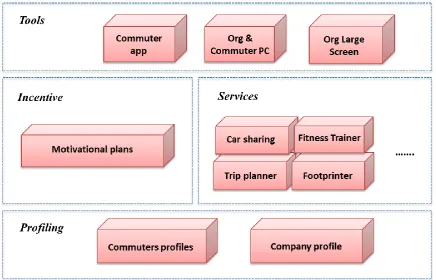
Figure 1 shows a high level functional architecture of the infrastructure that we are developing for the provision of sustainable commuting oriented services considering these features, also in order to make experiments and learn in real settings.
The first capability of the infrastructure is the capture of the profiles, the commuting history and the current situation, preferences and constraints of the commuters and the work organisation. This will allow the system to analyse mobility patterns and styles correlating them with the company profile based on the analysis of geography, available transportation infrastructure, and work context.
The system will, in turn, provide support to commuters and work organisations to analyse their mobility patterns and styles, organise their journeys when needed (short, mid or long term), and identify opportunities for change by providing incentives mechanisms (motivational plan)
and work organisation based services. In other words
the system captures past and present in terms of mobility patterns and conditions for commuters and work organisations, and help figure out what the future could be for them and how to support change.
We have already identified some of the possible services to be provided: car sharing among users belonging to the work community, to help reducing SOV; trip planning, to provide commuters with the right piece of information at the right moment concerning their mobility options; personal training, to improve wellness and increase physical activity as appropriate; and environment footprint awareness, to provide commuters with information on the impact of their mobility behaviour.
Two additional very important dimensions that we are also considering in the design of the infrastructure, and its services and tools, are ease of use and privacy, which, as we have learned also from previous experience in designing systems in support of behaviour change [17], are even more important in this context than what they usually are. Ease of use is central because change has to break existing habits while very pragmatic priorities exist (getting to work on time and dealing with private life contingencies in our case), i.e. the use of the system to promote change must not constitute an additional “cost”. Privacy is also central, as the system needs to collect rich behaviour data about personal movements, and sometimes has to make them visible to exploit them socially (e.g. to support car-sharing functionality to and from work). The infrastructure, tools and services that we are building will integrate these two dimensions by design.
Conclusions
We are working on the design and construction of an infrastructure providing services for supporting more sustainable commuting based on a set of requirements that we have identified and collected through an analysis of existing related work in the domains of work journey planning, motivational mechanisms and tools, complemented by a preliminary field study. In particular, we are building a commuting assistant for commuters and work organisations. In this paper we have illustrated our analysis in order to understand commuting for supporting change and the technology requirements that we have
collected thus far for the system. Moreover we have shortly introduced the high level functional architecture of the infrastructure for the commuting assistant to facilitate sustainable workplace travelling.
References
[1] Ai He, H., Greenberg, S., and Huang, E. M. (2010). “OneSize Does Not Fit All: Applying the Transtheoretical Model to Energy Feedback Technology Design”. In Proc. of CHI’12 Conference. ACM, pp. 927-936.
[2] Broll, G., Cao, H., Ebben, P., Holleis, P., Jacobs, K., Koolwaaij, J., Luther, M., and Souville, B. (2012). “tripzoom: An App to improve your Mobility Behavior”. In Proc. of MUM’12 Conference, ACM.
[3] Dalla Rosa J. (2007). A step towards sustainable transportation behaviour, MS Thesis, Univ. of Waterloo. [4] Hekler, E.B., Klasnja P., Froehlich, J. E., and Buman, M.P.
(2013). “Mind the theoretical gap”. In Proc. of CHI '13 Conference, ACM, pp. 3307-3316.
[5] Jylha, A., Nurmi, P., Siren, M., Hemminki, S., and Jacucci, G. (2013). “MatkaHupi: a Persuasive Mobile Application for Sustainable Mobility”. In Proc. of Ubicomp’13
Conference, ACM, pp. 227-230.
[6] Laurier, E, & Lorimer, H, (2012). “Other ways: Landscapes of commuting”, Landscape Research, 37, 2, pp. 207-224.
[7] Laurier, E., Lorimer, H, Brown, B., Jones, O., Juhlin, O., Noble, A., Perry, M., Pica, D., Sormani, P., Strebel, I., Swan, L., Taylor, A. S., Watts L., and Weilenmann A. (2008). “Driving and passengering: notes on the ordinary organisation of car travel”, Mobilities, 3, 1, pp. 1-23. [8] Laurier, E. (2005) “Searching for a parking space”,
Intellectica, 2-3, 41-42, pp. 101-116.
[9] Laurier, E. (2004). “Doing Office Work on the Motorway”, Theory, Culture & Society, 21, 4/5, pp. 261-277.
[10] Michie, S., van Stralen, M. M., and West, R. (2011). “The behaviour change wheel: A new method for characterising
and designing behaviour change
interventions”. Implementation Science Journal, 6:42. [11] Motta, G., Sacco, D., Beloni, A., and You, L. (2013). “A
system for Green Personal Integrated Mobility”. In Proc. of Int. Conference on Service Operations and Logistics, Informatics (SOLI), 2013, IEEE, pp. 1-6.
[12] Ozenc F.K., Cranor L.F., and Morris J.H. (2011). “Adapt-a-ride”. In Proc. of DPPI'11 Conference. ACM, NY, USA. [13] Patterson, K. and Grenny, J. (2007). “Influencer: The power to change anything”. Tata McGraw-Hill Education. [14] Peacox 2014, Peacox EU project,
http://www.project-peacox.eu/.
[15] Roby H. (2010). “Workplace travel plans: past, present and future”, Journal of Transport Geography 18, pp. 23-30. [16] Willamowski, J., Convertino, G., and Grasso, A. (2014).
“Leveraging Organizations for Sustainable Commuting: A Field Study”. In CHI'14 Workshop on "What have we learned? A SIGCHI HCI & Sustainability".