(PLATES
36-53)
1N
April, 1936, the accidental discovery of antiquities in the building lot of A. G.
Jl Christodoulos, at 28 Lenormant Street, Athens, led to the clearing of a number
of ancient graves. By permnission
of the Greek Archaeological Service the operation
was carried out by workmen from the Agora Excavations, under the supervision of
Miss Virginia Grace.1 The area in which the graves were found lies some distance
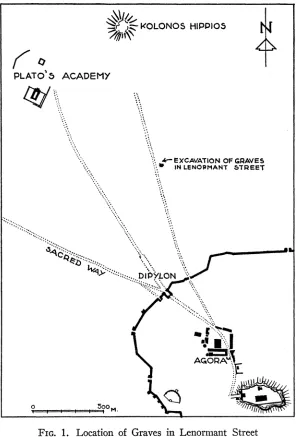
to the northwest of the Agora, outside the circuit of the ancient walls (Fig.
1).2Although few objects of outstanding interest came from this exploration, whether
from undisturbed burials or among the chance finds alongside, the material has
appeared worth presenting in full in that the small area provides a convenient cross
section of one of the ancient cemeteries of Athens and serves to illustrate both ordinary
grave furnishings and also various types of burial over a period ranging in date
from the Persian Wars to the first century after Christ.3
Nineteen burials are recorded here, most of them inhumations.4 In addition, a
'Cf. Hesperia, VI, 1937, pp. 360-363.
2 The finds from Lenormant Street, now housed in the Stoa of Attalos, were examined by the
writer in the winter of 1959 in the course of a visit to Athens made possible by generous grants from the Charles Phelps Taft Memorial Fund of the University of Cincinnati and the American Philo- sophical Society. Miss Grace had made careful and perceptive notes on all the objects at the time of their excavation, and these she very generously placed at my disposal. I have profited also from frequent discussions with her during the preparation of the article itself. I am much indebted also to Miss Lucy Talcott and to Professor Homer A. Thompson. In 1936 Miss Emilie Haspels was good enough to examine photographs of the black-figured lekythoi; since that time some of her attributions have been included in Sir John Beazley's Attic Black-figure Vase-painters (Oxford,
1956; referred to hereafter by the abbreviation ABV). Her further suggestions are also included in this article. At various places in the text acknowledgment is made of assistance freely given by colleagues. Others, not named, have also helped, and I am grateful to them as well.
The water colors and the drawings of the burials are by Piet de Jong.
3 The present article includes a catalogue of the finds and descriptions of the graves. Some
topographical notes by Miss Grace will appear later. Since the text of my article was completed a study of another somewhat similar cross section of an Athenian cemetery has appeared: S. I. Charitonides, " Excavation of Classical Burials near Syntagma Square," 'Apx. 'E+., 1958 (1961), pp. 1-152, pls. 1-26. See, e.g., on cremation pits, pp. 131-132; for black-glazed feeders, p. 61, fig. 104; p. 80, fig. 137.
4 The burials are here arranged in chronological order, and are lettered in a continuous sequence.
The individual grave-offerings are designated on the plates and elsewhere in the article by a com- bination of the grave letter and the object number. Numbers without a preceding letter designate miscellaneous finds. The concordance between the excavator's grave numbers and the new series is as follows: A = 8, B 7, C= 10, D= 1, E Burned Pit 1, F = Burned Pit 2, G=Fifth c.
B.C. urn burial, H 12, I 5, J 4, K 14, L Roman urn burial, M 2, N 3, 0 6,
P = 11, R = 13, S 9, T = Disturbed Roman burial.
Hesperia, XXXII, 2
American School of Classical Studies at Athens is collaborating with JSTOR to digitize, preserve, and extend access to
Hesperia
114 CEDRIC G. BOULTER
considerable number of miscellaneous finds are catalogued. Some of these will have
been originally contained in graves, but many others will be objects discarded in
antiquity. The earliest burial (Grave A) may be as early as the decade 480-470
B.C.From the fifth century there are four inhumations, two cremation pits, and a plain
KOLONOS HIPPIO$ %
PLATOX5 ACADEMY
.*-EXCAVATION OF GRAVES IN LENOPMANT STREET
lv-q D1155LON
0 ., 00,,
FIG. 1. Location of Graves in Lenormant Street
marble sarcophagus. The next group of graves (five inhumations and one urn burial)
ranges from the end of the fourth century into the second century
B.C.Finally there
The graves are undistinguished structurally, and, except for those of the fifth
century, the contents are also modest. Even the fifth century graves could not be
described as rich, but they do reflect the character of an age when the simplest furnish-
ings possess interest and taste. It is true that the decoration of the black-figured
lekythoi is frequently wretched, but the potter's work retains its integrity, and does
not share the decline exhibited by the drawing.
From the earliest burial to the latest, the commonest object found is the vessel for
perfumed oil or unguents. The total (in clay, glass, and alabaster) far outnumbers
that of all the other objects. Familiar as this circumstance is, it may be worth calling
attention to two interesting phenomena. In a fifth century grave (Grave D) there are
three white ground lekythoi by the Bird Painter. Each of the three represents a
woman bringing offerings to a tomb. The offerings do not duplicate each other. There
is suggested a deliberate choice by the purchaser or purchasers to suit the occasion.5
Among the Hellenistic graves, where the place of the lekythos' is taken by the fusi-
form unguentarium, one (Grave K) contained the astonishing total of 31, as though
the mourners had sought to make up by numbers for the insignificance and dullness
of the vessel itself.
In the fifth century graves, besides the lekythoi, there were usually a few toilet
articles, such as mirrors or powder boxes. In the grave with the lekythoi by the Bird
Painter was a pair of feeding bottles, the spout of one marked as from ancient use.
The contents of the later graves are conventional, and perhaps the only object of
special note is the Charon's piece in gold foil from Grave L.
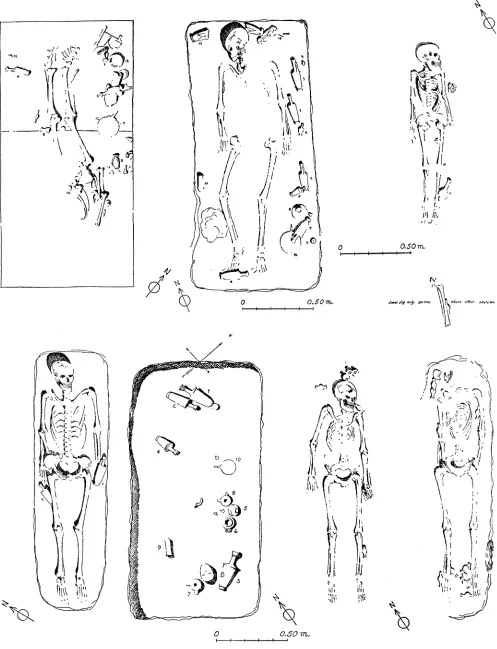
GRAVE A (Fig. 2)
The grave was built of roughly finished slabs of stone. The four sides were each made of a single slab, the long slabs recessed to take the short ones. The floor and cover of the grave were each of three slabs. The depth of the vault thus constructed was 1.04 m. The skeleton, which was imperfectly preserved, lay on its back, the arms extended along the sides. The date suggested by Miss Haspels for the lekythoi from Grave A is the decade 480-470 B.C.
A 1. White ground lekythos. Pls. 36, 38.
P 10328. H. 0.21 m. In the center, a quadriga, with an armed warrior on its far side. To the right a warrior aims his spear (across the vacant space at the back) at another warrior, who crouches behind his shield in front of the
rearing horses. Meaningless inscriptions. Ap- plied red and white. Triple row of dots above. Lotus buds and tongues on shoulder.
The Diosphos Painter, ABV, p. 509, 1.
A 2. Black-figured lekythos. P1. 36.
P 10335. H. 0.17m. Three women dancing; branches in background. Above, rightward key pattern. On shoulder, rays and tongues. Ap- plied red for folds and fillets, white for flesh.
The Haaimon Group, ABV, p. 553, 397.
A 3. Black-figured lekythos. P1. 36.
P 10331. H. 0.175m. Surface worn and chipped. Dionysos, moving to right, between two maenads on donkeys. Applied red and white for details. Above the picture, a crude crenelle pattern. Rays and tongues on shoulder.
5 For more conclusive evidence of such a practice cf. P. E. Corbett, " The Burgon and Blacas
116 CEDRIC G. BOULTER
The Haimon Group, ABV, p. 549, 301. Cf. No. 4 (P1. 47), ABRV, p. 549, 302.
A 4. Black-figured lekythos. P1. 36.
P 10327. H. 0.164 m. Surface badly worn. Woman seated with lyre between two seated women. A branch in the background. Right- ward key pattern above. Rays and tongues on
shoulder.
The Haimon Group. ABV, p. 554, 408.
A 5. Black-figured lekythos. P1. 36.
P 10329. H. 0.17 m. Handle nmissing; surface chipped. Sides concave at center. Three pairs of men and women embracing. Applied red and white. Double row of dots above. Rays and tongues on shoulder.
The Haimon Group, ARBV, p. 554, 420.
A 6. Black-figured lekythos. P1. 36.
P 10332. H. 0.175 m. Parts of body and neck missing. Mounted Amazon to right, between two bearded warriors with swords girt on and himatia over out-stretched arms. All three carry spears. Applied red for folds, fillets, mane. Above, rightward key pattern. Rays and tongues on shoulder.
The Haimon Group, ARBV, p. 549, 295.
A 7. Black-figured lekythos. P1. 36.
P 10334. H. 0.203 m. Bits missing. Quadriga with charioteer to right. In the center, on the farther side of the horses, an armed warrior. In background, branch with white fruit. Above, double dotted line. On shoulder, rays and tongues. Applied red for horses' manes, tails, and one collar, also border of shield. White for fruit, chiton of charioteer, crest of helmet, de- vice on shield, trimmings of harness.
Miss Haspels sees in this lekythos and 1n A 9 the style of the Diosphos and Haimon Painters.
A 8. White ground lekythos. P1. 36.
P 10326. H. 0.26 m. Parts missing; the vase has been strengthened with plaster. A draped female, holding out a flower, stands between
two youths leaning on staves. " Branches with big black apples " (Haspels, Attic BRack-figured Lekythoi, p. 166; hereafter ABL). Applied red on the clothing and in bands below the picture. Double dotted line above. On the shoulder palmettes and tongues.
Manner of the Emporion Painter, ABV, p. 586, 4.
A 9. White ground lekythos. P1. 36.
P 10333. H. to top of handle 0.221 m. Parts missing. Hermes, Herakles, and two other draped figures; branches. Above, double dotted line. On shoulder, palmettes and tongues. The surface is light buff; so also A % above. Red stripes below picture, and around upper step of foot.
On the style, see A 7.
A 10. Black-figured lekythos. P1. 36.
P 10330. H. to top of handle 0.20 m. Mouth and parts of body missing; surface badly worn. Three women dancing. Flesh white, mostly without black ground. Branches. Double dotted line above. Palmettes on shoulder.
The Haimon Group, ABV, p. 553, 398 cf. A 2.
A 11. Corinthian pyxis. P1. 36.
P 10336. H. of bowl 0.052 m.; d. 0.072 in.; h. of lid 0.06 m.; d. 0.076 m. Fraginentary and worn. Brownish red clay; pale buff surface; black and red pailnt. The lid, at the top, has a rilled rim. On its sides there is a simple meander of interlocking hooks, the upper ones black, the lower red, bordered above and below by bands in the same colors. The upper sur- face of the lid is decorated with red and black bands, Z pattem, and leaves (?).
For the shape, cf. Payne, Necrocoriia, p. 333, fig. 177.
A 12. Bronze mirror. P1. 38.
/ I |il..
FIG. 2. Graves A, B, O and H, C, D, I J~~~~0. 5
U 5 0 0.507Th.
4-
10~~~~~~~~~~~~~,*~
YN>
iz~
~
~
~
'i
~
~
$
~~~~~~~~~~~~~~~~~~3
118 CEDRIC G. BOULTER
pair of volutes with a palmette between, and on either side a pair of tendrils uncurling hori- zontally. The surface is lumpy, and part has scaled off.
Cf. Studies presented to David M. Robinson, I, p. 569; the date there suggested for the ac- companying lekythoi (" the years of the battle of Marathon ") seems too early; as a group they probably belong to the decade 480-470 B.C., and may possibly be later.
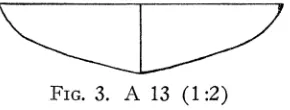
A 13. Bronze phiale. Fig. 3.
B 474. H. 0.021 m.; d. 0.102 m. Much en- crusted. Plain shallow bowl, the rim slightly thickened. A second similar, but slightly larger, phiale (B 473) is not illustrated.
FIG. 3. A 13 (1:2)
A 14. Bronze boss. P1. 53.
B 476. H. 0.008 in.; d. 0.024 mn. A round cap, with no apparent means of attachment. A sec- ond similar example (B 477) is not illustrated.
A 15. Bronze tack. P1. 53.
B 472. H. including point, 0.011 m. ; d. 0.013 m. A round cap, in this respect like the preceding.
GRAVE B (Fig. 2)
The skeleton lay with its head to the north, with the arms extended at the sides and the knees slightly bent to the left. The head also was turned to the left. Bronze bosses found near the corners of the grave would indicate that burial was made in a wooden coffin.
Miss Haspels has attributed the lekythoi from this grave to the Beldam Painter and to work- shops in his sphere of influence, and dates them in the decade 470-460 B.C., allowing a lower limit of 450. The grave itself mnust be at least as late as 450, possibly even the third quarter of the century; see below on B 8.
B 1. White ground lekythos. P1. 37.
P 10319. H. 0.222 m. Draped figure playing the double flute between armed warriors (pyr- rhichists) moving right, looking left. Branches in the background. Rightward key pattern above. On the shoulder rays and tongues.
The Beldam Painter (Miss Haspels, by letter).
B 2. White ground lekythos. P1. 37.
P 10321. H. 0.227 m. Surface flaked and worn. Herakles and Amazons. Herakles, advancing from right, is in silhouette with details partly in incision, partly in white paint. The faces of the two Amazons are drawn in outline. The central, smaller one has white on her right arm
(the only one visible) and on her feet and legs. In both, parts of the clothing are in thin glaze, with details in white. Above, rightward key pattern. On the shoulder, rays and tongues.
The Beldam Painter, ABV, p. 709, 586.
B 3. White ground lekythos. P1. 37.
P 10318. H. 0.228 mn. Surface badly flaked, and much of picture missing. From left, a horse prances right carrying rider in cloak and peta- sos. From right, a helmeted warrior advances, holding out shield and casting javelin. Remains of third figure in center; branch in background. Rightward key pattern above. On the shoulder, rays and tongues.
The Beldam Painter (Miss Haspels, by letter).
B 4. White ground pattern lekythos. P1. 37. P 10325. H. 0.208 m. Surface worn and dam- aged. Three horizontal palmettes midway on the body; above and below are bands of checker pattern, the upper one bounded by rightward key pattern. On the shoulder, rays and tongues.
From a workshop imitating the Beldam workshop (Miss Haspels, by letter).
B 5. Lekythos with palmettes. P1. 37.
an arc in white above each one. On the shoul- der, rays and tongues.
The Beldam workshop (Miss Haspels, by letter; cf. ABL, p. 185).
B 6. Small black-glazed lekythos. P1. 37.
P 10320. H. 0.102 m. Intact; the lip is set askew. On the shoulder rays and tongues, on a reserved surface reddened with miltos.
The Beldam workshop, or a workshop imi- tating it (Miss Haspels, by letter).
B 7. Red-figured lekythos. P1. 37.
P 10324. H. 0.211 m. The surface is chipped and flaked, and much of the glaze is gone, including almost all the details of the figure. A woman dressed in chiton and himation runs right and looks back left. She holds a sprig of ivy in her left hand. Rightward key pattern above. The shoulder, the neck, and the inside of the handle are reddened with miltos. Palm- ettes alnd tongues on shoulder.
Aischines Painter, ARV, p. 496, 75. Miss Haspels remarks (ABL, p. 178) that the Ais- chines Painter "seems to have been, through- out his career, under the influence of the Bel- dam workshop." This example is an exception to her statement (ibid.) that "all his lekythoi have the sharp shoulder-edge and straight body peculiar to the Beldam workshop," as will be
seen by contrast with B 1, 2, and 3.
B 8. Black-glazed bowl with lid. P1. 37.
P 10323. H. including lid 0.105 n.; max. d. 0.109 m. The rim of the bowl is flalnged to receive the lid. The resting surface of the ring foot is flat and narrow; its inner face is slightly concave, and offset from the central part of the base; at the center of the latter is a slight conical bump. This treatment of the underside is ex- actly paralleled in D 5 (P1. 39), a black-glazed lidded bowl from the second half of the century. The same profiling is attested in other bowls of the later fifth century; cf. Hesperia, XVIII, 1949, p. 329, no. 67; also fig. 5, no. 63.
The bowl is glazed all over, except for the resting surface of the foot and the center of the
underside. The lid has a finely profiled knob; its top is reserved, and on a surface reddened with miltos bears two circles and a dot. The inside of the lid is also reserved and reddened with the stain especially dark in a large area extending across the center.
Sparkes and Talcott, Pots and Pans of Classi- cal Athens, Princeton, 1958 (hereafter Pots and Pans), fig. 53, right.
B 9. Terracotta spindle whorl. P1. 37.
MC 373. H. 0.043 m.; d. 0.039 m. Concave conical top; rounded bottom. Plain bands of black glaze, and rows of short vertical strokes. Pots and Pans, fig. 57.
B 10. Alabastron of alabaster. P1. 37.
ST 201. H. 0.12m.; d. rim 0.045m.; d. neck 0.023 m. Intact, but slightly weathered. Vein- ing prominent around lower half. Lugs on either side.
Cf. Hesperia, XXVII, 1958, p. 217, pl. 49, a; Pots and Pans, fig. 48, left.
B 11. Alabastron of alabaster. P1. 37.
ST 198. H. pres. 0.125 m. Broken and re- paired. Surface much weathered. Small lugs on either side. Remains of two more alabastra were found in the grave, in fragmentary con- dition.
B 12. Bronze mirror. P1. 37.
B 471. D. 0.17 m. A plain disk, the edge pro- jecting slightly on the reverse. The start of the handle is preserved. With the mirror was a small heart-shaped piece of bronze with a loop rolled at the broad end. The mirror was placed in the grave face up.
B 13. Bronze boss. P1. 53.
B 470. D. 0.037 m. Round cap-like head, with iron nail (L. 0.04 m.; square in section, taper- ing) possibly belonging.
B 14. Bronze boss. P1. 53.
CEDRIC G. BOULTER
For similar bosses, cf. Richter, Greek, Etrus- can and Roman Bronzes, New York, 1915, p. 354.
B 15. Iron nail. P1. 53.
IL 594. L. 0.034 m.; max. th. 0.011 m. Square in section. Traces of wood adhering. Prob- ably from a bronze boss like those above. Frag- ments of other nails and bosses were found in the grave.
GRAVE C (Fig. 2)
The skeleton lay on its back with its head to the northeast and its arms extended by its sides. The left hand, palm up, held a lekythos ('C 1), and near the right hand, partly under the right femur, was another smaller lekythos (C 2). These were the only offerings in the grave. Its date will lie somewhere in the middle part of the fifth century; see below under C 1.
C 1. White ground pattern lekythos. P1. 38.
P 10339. H. 0.227 m. Across the front, hori- zontal bands of ornament: in the center, ivy, between bands of lattice work; rightward key pattern above. On the shoulder, rays and tongues on a reserved ground. These have mostly faded, and so too almost all the black glaze on mouth and handle.
The Beldam Painter (Miss Haspels, by let- ter). Pattern lekythoi like this begin about 470, and go on into the third quarter of the century; cf. Hesperia, XXII, 1953, p. 71, no. 21.
C 2. White ground pattern lekythos. P1. 38.
P 10340. H. 0.189 m. From the top down, the pattern consists of stripes, rightward key pat- tern, stripes, a deep band of crosshatching, a double row of dots, a band of lattice work. The white slip is applied also to the neck and shoul- der; here the usual rays and tongues.
The Beldam Painter (Miss Haspels, by let- ter; cf. the preceding).
GRAVE D (Fig. 2)
The cutting for the grave was rectangular in shape, with rounded corners, about 1.90 x
1.00 m. It was oriented from southeast to northwest. All that remained of the skeleton was a small and much damaged skull that lay at the southeast end. The presence among the offerings of lekythoi by the Bird Painter would suggest a date around 430-420 B.C. A photo- graph of the vases from Grave D was earlier published in A.J.A., XL, 1936, p. 202, fig. 23, and Hesperia, VI, 1937, p. 363, fig. 24.
D 1. White ground lekythos. Pls. 39-41.
P 10277. H. 0.263 m. In the center, a grave monument. On a plinth with four steps rests a small stele with a plain top. Behind it (and appearing to rest on the second stage of the plinth) is a large egg-shaped mound that rises above, and dwarfs, the stele. Both are adorned with fillets.
From the left, a woman brings an alabastron. On the right, a youth with long curling hair, wrapped in a himation. Above the picture, meander. On the shoulder, palmettes and egg pattern.
The lines of the drawing are thin and fine, and pinkish gray in color. The same color is used for the hair. The youth's cloak is bright red, and so too are the fillets. The woman's garment is dark red. Black is used for one of the fillets, for the strings that hang from them, and for the folds around the youth's shoulders. All these colors are matt. Above and below the meander, and below the picture, are pairs of stripes in yellow-brown glaze.
In the two figures a distinction in style is to be observed in the rendering of the hair and of the garments; the woman is in the earlier, classical manner; the youth suggests rather the style of the lekythoi of the late fifth century.
well known, however, that the subjects of white ground lekythoi frequently possess meaning on more than one level, and that we should not always insist on extracting from them a single, matter-of-fact explanation (cf. Beazley, Attic White Lekythoi, London, 1938, p. 11). For the vase-painter the conversion of the burial mound to a shape with an important symbolic meaning was a step both obvious and easy, and the monument on our lekythos may well embody a dual significance.
D 2. White ground lekythos. Pls. 38, 39, 44.
P 10278. H. 0.228 m. A woman approaches a tomb, bearing a basket with fillets and a wreath. The stele rests on a two-stepped plinth, and is bound about with fillets. Above the picture, meander. Shoulder ornament as in the preceding. Here the woman's hair is reddish; the colors of her garment have faded away. It seems unlikely that there was ever more than one figure on this vase.
The Bird Painter, ARV, p. 811, 11.
D 3. White ground lekythos. Pls. 39, 41.
P 10280. H. 0.265 m. In the center, a stele (plinth in two stages) surmounted by a palm- ette. From the left a woman brings a ple- mochoe; on the right there are faint traces of a figure who seems to have had the hair and dress of the youth on D 1. Shoulder ornament as in the two preceding.
The Bird Painter, ARV, p. 811, 12.
D 4. White ground lekythos. P1. 39.
P 10279. H. 0.214 m. Surface much damaged. Remains of seated woman facing right. Above the picture, rightward key pattern. Yellow and brown glaze line for the drawing. The shoulder, the neck, and the inside of the handle are re- served; on the shoulder, rays and tongues.
D 5. Black-glazed bowl with lid. P1. 39.
P 10283. H. with lid 0.068 m.; max. d. 0.085 m. The rim of the bowl is flanged to receive the lid. For the treatment of the foot and floor cf. B 8. The inside of the lid is reserved and rubbed
with miltos. There is a knob handle with flat top.
D 6. Black-glazed skyphos of Corinthian type. P1. 39.
P 10284. H. 0.077 m.; d. of rim 0.088 m.; d. of foot 0.046 m. Most of one handle missing. Underside of foot reserved only in center, with two circles and a dot. All the rest is glazed. Traces of bands of applied red at the level of the handles. Thin fabric and delicate handles. On the shape in the mid-fifth century cf. Hesperia, XXII, 1953, pp. 72, 74, under no. 26, and also p. 73, fig. 2, no. 25, where the foot is a good deal like that of D 6.
D 7. Black-glazed feeder. P1. 39.
P 10281. H. 0.055 m.; d. 0.066 m. End of spout broken away. On the top, surrounding the central opening, a stamped pattern of seven linked palmettes. The sides of the foot are pro- filed; its plain undersurface is slightly concave, reserved, and reddened with miltos.
Pots and Pans, fig. 52. On the shape in general, see Snijder, Mnentosyne, Ser. 3, I, 1934, pp. 34ff.
D 8. Black-glazed feeder. P1. 39.
P 10282. H. 0.053m.; d. 0.067m. Glaze on spout and handle much worn as from use. Like the preceding, except that the palmettes are nine in number and the central opening is bor- dered by impressed tongues.
Pots and Pans, fig. 52.
D 9. Alabastron of alabaster. P1. 39.
ST 196. H. 0.133 m. Broken and repaired; about a third is missing. The surface is weath- ered, and the rim is chipped along the edge. Lugs on either side.
D 10. Bronze mirror. Not illustrated. B 458. D. 0.098 m. Bent and broken. At al- most opposite points on the rim a suspension ring and the tang of the handle.
122 CEDRIC G. BOULTER
B 482. D. ca. 0.027 m. About half preserved, including the hub, two spokes, and part of the rim. Cut from a thin sheet of metal.
For an extensive bibliography on bronze wheels of this sort cf. Robinson, Excavations at Olynthus, X, pp. 512 f.
D 12. Small bronze ring handle. P1. 53.
B 456. D. ring 0.018 m.; d. disk 0.017 mn. Perhaps for the lid of a wooden pyxis. A nar- row strip of bronze was doubled over the ring, and its ends passed through a hole in the center of a slightly domed disk. The ends of the strip were turned back against the inside of the lid. For the use of such handles on pyxides of clay cf. CVA, Copenhagen, fasc. 4, III I, pl. 163, nos. 1 and 2. Two other handles like D 12 were found in the grave (B 457 and B 459), but no remains of vessels to which they might have been attached. Cf. also the stray find, No. 44.
Also in Grave D there were found a lump of white lead (face powder?) and a knucklebone.
GRAVE E (pyre)
The pit was unusually deep, ca. 2.00 m. Its sides were blackened from the fire, and beneath the surface of black the clay had burned red. At the bottom of the pit were charred remains of wood, burned fragments of pottery, and a quantity of pure ash. There was no trace of bones in this pyre, but some fragments were observed in Grave F. On such cremation pits see Hesperia, XX, 1951, pp. 81 ff. The vases from Grave E date within the second quarter of the fifth century B.C.
E 1. White ground lekythos. P1. 42.
P 10342. H. pres. 0.19 m. Mouth, handle, and bits of side missing. Two quadrigas race to- ward right. Dotted bands above and below. On shoulder, rays and tongues.
The Haimon Group, ABV, p. 545, 210.
E 2. Black-figured lekythos. P1. 42.
P 10345. H. pres. 0.215 m. The neck, part of
the handle, and bits of the wall are missing. Herakles and three Amazons. Herakles aims a blow at an Amazon, who has sunk to one knee. A second Amazon rushes up from the right to help her, and a third, behind Herakles, runs off left. A double dotted line above, the dots alternately black and white. On the shoul- der, rays and tongues. Applied white for female flesh and variously elsewhere.
The Haimon Group, ABV, p. 549, 286.
E 3. Black-figured lekythos. P1. 42.
P 10343. H. 0.266 m. Half the foot missing and fragments from the sides. Subject as in the preceding. Here the knee of the Amazon at- tacked by Herakles has not yet touched the ground. In E 2 the fleeing Amazon carried a bow in her lowered right hand; here this hand and arm were raised, but are lost in a break. Three dotted lines above. On the shoulder, rays and tongues. Applied white as in E 2; in some places where white might be expected the stir- face has burned red.
The Haimon Group, ABV, p. 549, 287.
E 4. Black-figured lekythos. P1. 42.
P 10344. H. 0.205 n. Parts missing from wall and mouth. In the center, a reclining sympo- siast, bearded. At the foot of his couch stands a woman, playing the lyre. The group is flanked by maenads on donkeys. Branches in back- ground. On shoulder, rays and tongues. White for lyre, flesh of player, and various ornaments.
The Haimon Group, ABV, p. 551, 339.
E 5. White ground lekythos. P1. 42.
P 10346. H. pres. 0.23 m. The neck and parts of the foot and walls are missing. Surface much damaged. Quadriga before a draped seated person. One or more other draped figures on the far side of the horses. Double row of dots above; rightward key pattern below. On the shoulder, rays and tongues.
The Haimnon Group, ABV, p. 542, 102.
E 6. White ground lekythos. P1. 42.
of sides missing; surface badly worn. Quadriga right. Above, rightward key pattern; below, a double row of dots. Rays and tongues on shoulder.
The workshop of the Haimon Painter (Miss Haspels, by letter, comparing A 4).
E 7. White ground lekythos. P1. 42.
P 10348. H. 0.174 m. Three upright palmettes, an arc in black above each one, and half another beyond, on each side. On the shoulder, rays and tongues.
From a workshop imitating the Beldam workshop, conceivably the same as B 4 (Miss Haspels, by letter).
E 8. Small lekythos. P1. 42.
P 10350. H. 0.085 m. Part of foot and sides missing; surface badly burned. No ornament discernible except glaze on lip, rays and tongues on shoulder, stripe just below shoulder.
Probably from the workshop of the Diosphos Painter (Miss Haspels, by letter).
E 9. Black-glazed lidded bowl with stem and foot. P1. 42.
P 10347. H. including lid 0.094m. Max. d. 0.105 m. The bowl is flanged to receive the lid, which has a flat-topped knob, its sides doubly convex. Glazed all over except for the sides of the knob, the underside of the lid and the flange of the bowl, the outer edge and the resting surface of the foot.
GRAVE F (pyre)
The pit measured 2.00 m. in an approximate east-west direction, and 1.20 m. north-south. The walls of the pit were fired black on the surface and red underneath, as in Grave E. The hardness of the burned earth attests a strong fire. At the bottom the layer of black was in places as much as 0.18 m. thick. There were large charred pieces of wood, but almost no ash. A few fragments of bone were found, and four vases. They date the pyre to the third quarter of the fifth century B.C.
F 1. White ground lekythos. Fig. 4; Pls. 40, 43, 44.
P 10369. H. 0.304m.; d. 0.10m. Fragments of shoulder, handle, walls, and foot missing. There is a false interior, cylindrical in shape, 0.057 m. in height, with a diameter of 0.031 m.
l
. ~~~~~~~~~~~ws
F
I
~
~~~~~~~~~
c S124 CEDRIC G. BOULTER
(Fig. 4; P1. 43, lower right; note, from the latter, the slight taper at the base, which is not squared off as in Fig. 4). A vent-hole (smaller than the head of a pin) is pierced at the base of the handle, almost at the center of its inner side.
A youth and a woman face each other at a stele; the youth, standing at the left, is nude, and holds a strigil in his left hand. On the wall behind him hangs an aryballos. The woman wears a purple chiton; in her left hand she holds an alabastron; with her right she clasps the top of her head. Behind her hangs a sakkos. The plain stele rests on three steps, and is topped by a simple moulding, just below which are tied fillets, one red, one brown. At base of neck, egg pattern. On the shoulder, three palmettes with tendrils: the central one hangs vertically, the other two are placed obliquely. Above the scene, stopped meander interrupted by dotted saltire squares. Thin glaze drawing, no relief lines.
Thanatos Painter, ARV, p. 808, 2. Hesperia, VI, 1937, pp. 361-362, figs. 22-23. On the false interior cf. ABL, pp. 176 ff.; Hampe and Simon, Griechisches Leben im Spiegel der Kunst, Mainz, 1959, no. 36; Dietrich von Both- mer, Ancient Art from New York Private Col- lections, New York, 1961, pp. 60-61, nos. 237, 239, 240, see especially the X-ray photo of no. 239, pl. 88.
F 2. White ground squat lekythos. P1. 43. P 10372. H. 0.147 n.; d. 0.08 m. Some small chips missing. Maenad with thyrsos and phiale. Folds of chiton in thin glaze; rest of drawing in a firm glaze line. Neck set in a little from shoulder. Shallow groove at start of white near outside of shoulder. Reserved stripe below pic- ture. Underside and all but top of outside of ring foot reserved.
Hesperia, VI, 1937, p. 361, fig. 22.
F 3. Black-glazed squat lekythos. P1. 43.
P 10371. H. 0.119m.; d. 0.08m. Small pieces missing. Grooves around neck at top and mid-
dle. Neck and shoulder both slightly offset. Glazed all over save for upper surface of mouth and underside of base.
Hesperia, VI, 1937, p. 361, fig. 22. Pots and Pans, fig. 52.
F 4. Black-glazed lekanis. P1. 43.
P 10370. H. with lid 0.13 m.; d. 0.188 m. Parts of lid, bowl, and one handle missing. The rim below the inset flange has a concave profile. Broad ring foot; the undersurface of the floor is reserved and bears two glazed circles. Other- wise the bowl and lid are glazed all over. The top of the handle knob has a raised rim; there is a small depression at its center.
Hesperia, VI, 1937, p. 361, fig. 22; XXVII, 1958, p. 205, pl. 48, d.
GRAVE G (urn burial)
G 1. Marble urn and lid. P1. 45.
ST 202. H. 0.38 m.; 1. 0.625 m.; w. 0.85 m. A block of Pentelic mnarble, rough hewn on the sides, and smoothed with a claw(?) on top. The interior has been hollowed in a rectangle, rounded at the corners, 0.23 m. deep, deepening further toward the center. The inner surface was finished with a sharp point. The lid is a disk 0.81 m. in diameter and 0.18 m. thick. It is rough hewn around the edge, and on top, and smoothed underneath, with the same tool used on the top of the urn. The incompatibility of shape as between lower and upper part is per- suasively explained by Professor Homer A. Thompson, who suggests that the disk had been intended (but not used) for some other pur- pose, e. g. as a simple colunmn base like those in the peristyle of the Pompeion. The urn was opened by the owner of the property on Lenor- mant Street before the actual excavation began. He states that in addition to a few fragments of burned bones it contained only the three alabastra described below.
G 2. Alabastron of alabaster. P1. 45.
Where it is well preserved the veining of the stone is displayed in fine horizontal wavy lines. Lugs on either side; beneath each lug there is a low pendant relief, trapezoidal in plan; this feature occurs regularly in the alabastra from Lenormant Street.
Pots and Pans, fig. 48, second from left.
G 3. Alabastron of alabaster. P1. 45.
ST 194. H. 0.135 m.; d. rim 0.051 m.; d. neck 0.016 m. Weathered on one side. The top is removable. Lugs as before.
G 4. Alabastron of alabaster. P1. 45.
ST 195. H. 0.128 m.; d. rim 0.045 m.; d. neck 0.019 m. Holes worn through on weathered side, and one lug missing.
GRAVE H
Grave H was a disturbed burial, apparently cut through in the digging of the later Grave 0
(Fig. 2). The finds consisted of two leg bones and two fusiform unguentaria (P 10315- 10316), one of which is described below. The grave is perhaps the earliest of the Hellenistic group (see below).
H 1. Fusiform unguentarium. P1. 46.
P 10316. H. 0.094m.; d. 0.047m. The clay is gray on the surface, and red along the breaks. Stripes (red-white-red) around neck, shoulder, and body.
On the type, cf. Homer A. Thompson, Hes- peria, III, 1934, pp. 472-474. The plumpness of H 1 places it early in the development, pre- sumably in the late fourth century B.c.
GRAVE I (Fig. 2)
Tiles formed a cover above the skeleton, which lay on its back with the head to the northeast and the arms extended at the sides. With it were found six fusiform unguentaria (P 10309- 10314), three of which are described below to illustrate the range of size and shape. Their proportions are similar to those of H 1 above, but they are slightly less plump, and probably a bit later.
I 1. Fusiform unguentarium. P1. 46.
P 10312. H. 0.098m.; d. 0.041 m. Gray, mot- tled with reddish brown; red in the breaks. Stripes (red-white-red) carelessly applied on neck, shoulder, and body.
I 2. Fusiform unguentarium. P1. 46.
P 10311. H. 0.08 m.; d. 0.036 m. Red clay mottled with dark. Two white stripes, much faded, around the body.
I 3. Fusiform unguentarium. P1. 46.
P 10313. H. 0.079 m.; d. 0.035 m. Dark gray clay on the surface, and in the break on one side; in the breaks on the other side, red. Faint traces of white stripes around shoulder.
GRAVE J (Fig. 2)
The skeleton, which was poorly preserved, lay on its back with the head to the northeast and the arms extended at the sides. With it were found 11 fusiform unguentaria (P 10298- 10308). They range in height from 0.07 m. to 0.115 m., but exhibit little difference in shape, either among themselves, or with the unguen- taria in Grave I. The decorative stripes, how- ever, with one exception are here limited to neck and shoulder. Both graves are probably to be dated in the late fourth century or the third.
J 1. Fusiform unguentarium. P1. 46.
P 10299. H. 0.108m.; d. 0.042m. Stripes (red-white-red) on neck and shoulder.
J 2. Fusiform unguentarium. P1. 46.
P 10303. H. 0.077 m.; d. 0.03 m. Stripes as in the preceding.
GRAVE K
126 CEDRIC G. BOULTER
or body is often askew, the surface dented, the foot rough and lumpy. The proportion of height to diameter of body is often as great as 5 to 1. The necks are chimney-like, the legs concave and thin. White stripes usually occur on neck, shoulder, and body. The grave is probably to be dated in the second century B.C.; cf. the examples published by Thompson, Op. cit., p. 392j, D 77, 78, p. 473.
K 1. Fusiform unguentarium. P1. 46.
P 10404. H. 0.103 m.; d. 0.021 m. Light gray clay. Somewhat misshapen before firing. Kiln smudges on body. White stripes on neck, shoulder, and body.
K 2. Fusiform unguentarium. P1. 46.
P 10381. H. 0.153 m.; d. 0.034 m. Gray clay. Stripes as in the preceding.
GRAVE L (urn burial)
A marble coffer lined with lead contained charred fragments of bone, leaves from a gold wreath, and a bit of gold foil that had served as a " Charon's piece " dating perhaps from the mid-second century B.C. (see below). Cf. A.J.A., XL, 1936, p. 201, figs. 24-25; Hesperica, VI, 1937, p. 363, figs. 26, 27.
L 1. Marble urn. P1. 45.
ST 197. H. with lid ca. 0.40 m.; d. ca. 0.36 m. A hollowed cylinder of bluish marble. The underside is rough, the upper edge worked to receive a lid, and the outside smooth. The lid, of Pentelic (?) marble, is well finished only around the edges. Inside the urn is a dose- fitting but separate lead box, 0.19 m. deep and 0.23 m. in diameter.
L 2. Gold leaves. Not illustrated.
J 25. The leaves vary in length from 0.03 m. to 0.066 m. They are made of thin foil, cut and creased to produce a fan-shaped leaf, each with three lobes ending in points. There are 85 more or less complete leaves and about 50 fragments. About a dozen have a distinct red- dish discoloration.
Hesperia, VI, 1937, p. 363, fig. 27.
L 3. " Charon's piece." P1. 45.
J 26. D. 0.01 m. A piece of gold foil pressed over the figure of an owl. The modelling is sharp.
Numerous parallels are known from the Kerameikos, e. g. Arch. Anz., LI, 1936, col. 214; LIII, 1938, col. 607f.; LVII, 1942, cols. 236, 238, 243-244, figs. 15, 17, 18, 21.
Miss Margaret Thompson, curator of Greek coins for the American Numismatic Society, has kindly provided the following note:
" The technique of producing such foil pieces seems to have varied. At times they were made from coins. A bracteate in the Copenhagen Collection (SNG 151) was fashioned from the reverse of an Athenian New Style drachma, and pieces in the American Numismatic So- ciety's trays with heads of emperors surrounded by clear traces of inscriptions were undoubtedly pressed over the obverses of Roman coins. In the Medieval period foils derive from coin types but cannot be associated with actual coins. This, I think, is also the case with the little Athenian piece from Lenormant Street. Its size is not exactly right for a coin prototype and furthermore it shows none of the subsidiary details, such as ethnic, laurel spray or wreath, that one would expect to find if the foil had been made from an Athenian coin. It seems to me that an abbreviated copy of the basic coin type of Athens rather than a coin itself was used.
" The owl of the bracteate is very similar in style to owls found on Athenian coins of about 160-140 B.C. Shape, stance, and details of tech- nique, such as the rendering of the plumage and the size of head and eyes, all point to this general period. If a contemporary coin was copied, the foil is probably to be dated mid- second century B.C."
A. Thompson, who cites a seal stone with owl on amphora, Furtwangler, Antike Gemmen, pl. XXVIII, 71) or over a punch die, perhaps made specifically for the production of such pieces.
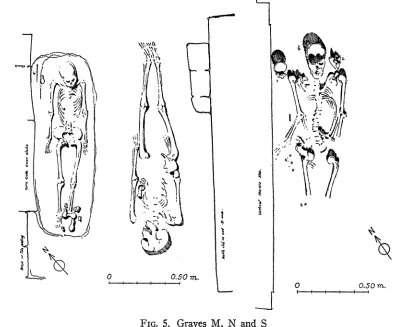
GRAVE M (Fig. 5)
With this grave we begin the group of burials from the Roman era, though Grave M is not
necessarily the earliest of the group. It had a covering of tiles. The skeleton lay on its back, the arms extended at the sides, the head to the northeast. Besides the bronze needle and the unguentaria listed below the grave contained also five knucklebones (P1. 46, center, right). With regard to its date Professor Henry S. Robinson has kindly informed me that the bulbous unguentarium in clay occurs from the
late first century B.C. through the first century
after Christ. Within this period no chrono- logical development is apparent. Cf. Agora, V, p. 15, under no. 50.
M 1. Unguentarium. P1. 46.
P 10292. H. 0.06 m.; d. 0.04 m. Pale brown clay; no glaze.
M 2. Unguentarium. P1. 46.
P 10293. H. 0.074 m.; d. 0.042 m. Brownish clay. Thin metallic glaze on neck and lip. Dented before baking.
M 3. Unguentarium. P1. 46.
P 10294. H. 0.092 m.; d. 0.036 m. Clay brown to buff.
0.50 7n,.
0 0.50.
128 CEDRIC G. BOULTER
M 4. Unguentarium. P1. 46.
P 10295. H. 0.074 m. ; d. 0.034 m. Pale brown clay. Neck and shoulder dented spirally.
M 5. Unguentarium. P1. 46.
P 10351. H. 0.07 m.; d. 0.042 m. Light brown clay.
M 6. Bronze needle. P1. 46.
B 463. L. 0.067 m.; max. th. 0.004m. Square in section, thickening toward the middle.
GRAVE N (:Fig. 5)
This grave lay beside Grave M, but with the body placed in the opposite direction, the feet to the northeast. With the skeleton was found a single unguentarium and nothing else.
N 1. Unguentarium. P1. 46.
P 10296. H. 0.13 m. d. 0.055 m. Broken and repaired. Dull brown clay; thin metallic glaze on neck and lip.
GRAVE 0 (Fig. 2)
Tiles covered the skeleton, apparently that of a girl, not fully grown. Her head, which lay to the northeast, was turned to her left; her arms were at her sides. In addition to the unguen-; tarium and the glass bead listed below the grave contained six knucklebones (P1. 46, bot- tom left) bunched together beside the left elbow.
O
1. Unguentarium. P1. 46.P 10317. H. 0.145 mi.; d. 0.064 m. Pale brown to buff clay.
O 2. Blue glass pendant. P1. 46.
G 129. H. 0.017m.; w. 0.008m. Pyramidal, and pierced at the top, like a miniature loom- weight.
O 3. Earrings (fragmentary; not illustrated).
B 467. Thin bronze wire, with bits of glass bead attached. One fragment was found by the right ear, the rest just below the left.
GRAVE P
The sides of the grave were built of small stones and covered with -stucco. Tiles were used as a cover. The skeleton lay with its head to the east. Perhaps to be associated with this grave is the columnar grave monument published in Hesperia, XXVI, 1957, p. 220, no. 79, pl. 57.
P 1. Unguentarium. P1. 46.
P 10341. H. 0.108 m.; d. 0.044 m. Reddish buff clay.
P 2. Iron ring. Pls. 46, 53.
IL 600. D. ca. 0.043 m. Much encrusted. Among the stray finds are five similar rings; see on No. 49 (P1. 53). Two of them have protuberances that may be the remains of some attachment, perhaps a key. Cf. Davidson, Corinth, XII, p. 138, no. 975, pl. 70.
P 3. Iron clamp. P1. 53.
IL 601. L. 0.037 m. Like a modern clasp used for holding together perforated papers; the two legs are bent wide apart; the head is missing. The grave also contained remains of iron nails.
GRAVE R
This was a disturbed burial. Besides some fragments of bone, lying in disorder, it yielded only a bulbous unguentarium (P 10373, not illustrated).
GRAvE S (FFig. 5)
The skeleton lay on its back, its head to the northeast, the arms bent at the elbows. Beside the right shoulder was a jug in plain ware, and beside the left were the fragments of another. Otherwise there was nothing but some iron nails.
S 1. Jug. P1. 45.
Professor Robinson compares the jug figured in his volume on Roman pottery, Agora, V, pl. 8, H 17, and suggests as a likely date the second half of the first century after Christ.
S 2. Fragmentary jug. P1. 45.
P 10338. H. pres. 0.104 m.; d. rim 0.089 m. A number of joining fragments from the upper part, but none of the handle nor foot. Red clay, outer surface dark gray; thin fabric. The body narrows to an offset, slightly concave, rim.
Cf. Robinson, op. cit., pl. 7, G 103; date as for the preceding.
S 3. Iron nails. P1. 53.
IL 599. Eight heads, and four pieces of shaft, square in section. Only a selection is illustrated.
GRAVE T
With some fragments of bone were found two glass bottles and a bronze mirror.
T 1. Glass bottle. P1. 45.
G 128. H. 0.085 m.; d. 0.062 m. Originally decorated with marvered threads, now missing. Cf. C. Isings, Romam Glass from Dated Finds, Groningen/Djakarta, 1957, pp. 41-43, Form 28; datable specimens are mostly from second half of first century after Christ.
T 2. Glass bottle. P1. 45.
G 127. H. pres. 0.052 m. The upper part is missing.
On the date cf. the preceding.
T 3. Bronze mirror. P1. 53.
B 462. D. O).112m.; th. 0.002m. The edge is broken on one side. A plain disk; no remains of a handle.
MISCELLANEOUS FINDS
POTS
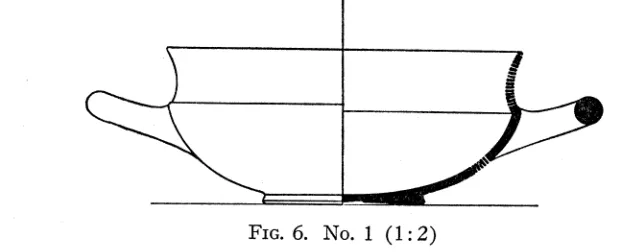
1. Fragments of stemless cup with intentional red. Fig. 6 (profile drawing only; for illustra- tions of the fragments see the references cited below).
P 10359. (a) D. foot 0.058 m.; max. dim. 0.088m. (b) W. handle frag. 0.057m. (a) Eight joining fragments preserve the foot and part of the interior. (b) Two joining frag- ments preserve the handle and part of the offset rim.
Low flat foot, reserved beneath, with two black circles at the center. Inside, on a ground line, stands a dog in black silhouette; a bushy tail curls over to touch his back. Along the edges of tail and belly the details of his shaggy coat are rendered in relief line, elsewhere by light incision. The eye is deeply incised. Firm black for the dog, the ground line, and the in- terior of the rim. Reserved: in addition to the underside of the foot, the inside of the handle and the wall between the handle roots. The rest of the preserved surface (save for the han- dle: ordinary glaze, mottled red and black) is in intentional red, somewhat peeled.
The cup has figured prominently in discussions of the technique of intentional red: cf. Hes-
130 CEDRIC G. BOULTER
peria, XV, 1946, p. 286, under no. 52, pp. 318- 319, under 239, pl. 36; B.S.A., XLVI, 1951, pp. 143 if., pl. 15, d; Het Nederlands Kunst- historisch Jaarboek, 1954, p. 130, note 7, p. 133, fig. 8. It has been demonstrated that the color can be produced by the addition of red ocher to the glaze; cf. A.J.A., LXII, 1958, pp. 165 ff. On the date see Hesperia, XV, 1946, pp. 318-319, under no. 239: possibly the 480's, or perhaps even earlier.
2. Black-figured lekythos. P1. 47.
P 10367. H. pres. 0.173 m. The foot and parts of the body and lip are missing. Two chariots racing. White for robes of charioteers, and for some of the horses. Red for some manes and tails. Above, a double row of dots. Rays and tongues on the shoulder.
The Haimnon Group, ABV, p. 545, 209.
3. White ground lekythos. P1. 47.
P 10364. H. pres. 0.14 m. Eight joining frag- ments from the lower part of the body. A draped figure mounts a chariot; another stands on the far side of the horses. A red stripe below the picture, and another at the lower edge of each of two reserved bands below.
The Haimon Group, ABV, p. 542, 103.
4. Black-figured lekythos. P1. 47.
P 10286. H. pres. 0.155 m. Neck, handle, and part of shoulder missing. Dionysos, moving to right, between two maenads on donkeys. Above, a double row of dots. Applied red. Rays and tongues on shoulder.
The Haimon Group, ABV, p. 549, 302. Cf. A 3, ABV, 549, 301. There both riders move right, here they approach each other. No. 4 is larger. The hoofs of the donkey on the left do not touch the baseline; cf. ABL, p. 131.
5. Black-figured lekythos. P1. 47.
P 10365. H. pres. 0.145 m. The neck, most of the shoulder, and part of the body are missing. Peleus and Thetis. Above, a double row of dots; rays on shoulder. Added red and white.
The Haimnon Group, ABV, p. 550, 323.
6. White ground lekythos. P1. 47.
P 10368. H. pres. 0.127 m. The neck, the base, and parts of the body are missing. Four stand- ing draped figures; branches in the background. Added red for folds and fillets. Above, a double row of dots. Rays and tongues on shoulder on a reserved ground.
The Haimon Group, ABV, p. 554, 413.
7. White ground lekythos. P1. 47.
P 10272. H. 0.203 m. Pieces missing from the body. A quadriga being harnessed: the pole horses are in place and the trace horses are being led up, one from the left, and the other from the right, the latter by a nude boy. A draped, bearded figure (the charioteer?) stands on the far side of the pole horses, looking left. Branches in the background. Above the picture, a triple row of dots, checker board style. On the shoulder (reserved), rays and tongues. Ap- plied red, including a narrow red band around the upper edge of the foot. The sides of the foot are reserved, except for the projecting torus at the bottom.
The Haimon Painter, ABV, p. 539, 12.
8. Fragment of white ground lekythos. P1. 47. P 10273. D. 0.071 m. Two joining fragments preserve part of the shoulder and the figured scene. Two draped bearded figures face each other; between them, a sphinx left. Branches in background. Above, rightward key pattern between pairs of parallel lines. Applied red. Rays and tongues on the reserved shoulder.
The Haimon Painter, ABV, p. 539, 11.
9. Fragment of white ground lekythos. P1. 47.
P 10363. H. pres. 0.057 m. Two joining frag- ments preserve part of the wall and shoulder. Of the figured scene there remains the upper part of a mourning figure, the hand clutching the hair. Above, meander, between double lines; on the shoulder, palmettes. The hair and the bounding lines are in brownish yellow glaze.
10. Fragment of white ground cup. P1. 47.
P 10357. Max. dim. 0.04 m.; th. 0.004 m. Head of youth left. The upper part of the head is preserved, with a forearm across it. The sur- face in front of the head has chipped away. Hair and outline of arm in brownish yellow glaze. Eye and ear in relief line; a fillet in added clay. Black glaze on back of fragment. One thinks of a Death of Orpheus, and his effort to ward off a blow with his lyre.
Our head is not too far from the head of Orpheus on the cup by the Pistoxenos Painter, ARV, p. 575, 2; Pfuhl, Malerei und Zeichnung der Griechen, fig. 416. If No. 10 is from a similar scene, the forearm, which is left, not right, may possibly belong to a Thracian woman. On the other hand, the rendering could be an oversight on the part of the artist; cf. the Death of Orpheus by the Niobid Painter, ARV, p. 422, 52; Caskey and Beazley, Attic Vase Paint- ings in the Museum of Fine Arts, Boston, II, p. 73, pl. LVII, where one Thracian woman has been given two left hands, and another two left feet.
11. Fragment of white ground cup. P1. 47. P 10411. Max. dim. 0.036 m. A single sherd preserves on the interior the end of a drapery fold hanging beside a chest or basket, which is hatched diagonally with relief lines. The dra- pery is matt black with borders in thick white, dotted. The ground is a firm white. The out- side appears to have been banded with glaze, a good deal peeled.
Nos. 10 and 11 (not from the same cup) add two scraps to the series of splendid white ground pieces well known from the second quarter of the fifth century.
12. Red-figured kylix. P1. 48.
P 10271. H. 0.15 m.; d. 0.325 m. Large frag- ments of the walls and parts of the foot are missing; restored in plaster. I: Komos. Re- mains of two draped figures: a woman playing the flute and a man with head thrown back singing; behind the woman hangs a flute case.
The man holds a stick in his right hand. The figures stand on a reserved exergue. The space outside the tondo is reserved, save for a glazed band at the rim. The exterior is also reserved save for the outside of the handles, and three narrow glazed bands: around the rim, the stem, and the edge of the foot. The underside of the foot is reserved with a glazed band near its edge. The reserved areas have a polished buff surface unusual in red-figure.
Manner of Douris, early, ARV, p. 294, I, 2. Bloesch, Formen Attischer Schalen, p. 83, pl. 24, 1, where it is assigned to the potter Brygos.
13. Red-figured oinochoe. P1. 49.
P 10408. H. pres. 0.127 m. ; d. 0.15 m.; d. foot 0.106 m. Numerous joining fragments preserve most of the foot and the lower part of the body. A man, holding a jug in his left hand, bends toward an amphora that rests in a stand. His head, shoulders, and right arm are missing; his himation is knotted around his waist, and falls to his knees. To the right of the amphora, the feet and legs of another figure, probably a youth (no garment visible), facing left; a bit of his hand remains, holding something that looks like a stick. To the left of the scene, be- hind the first figure, are four amphoras, one pair behind the other; the pair in front rest in stands. On these four jars there are horizontal stripes in dilute glaze. A dotted band below the scene; a reserved band at the sides. Thin glaze on the interior. On the exterior the glaze is occasionally mottled or worn. The underside of the base is reserved, and except for the rest- ing surface is deeply reddened with miltos. The scene may be interpreted as the interior of a wineshop. The figure to the left will be that of the shopkeeper, an identification suggested by the knotted himation. He has probably bent over to draw a sample of wine from the am- phora, and passes it now to the buyer, whose empty jug he holds in his left hand.
132 CEDRIC G. BOULTER
LXXIX, 1948, pp. 189-190. Our vase appears in van Hoorn, Choes and Anthesteria, no. 196, fig. 82, and is there dated 430 B.C. I should
be inclined to place it in the second quarter of the fifth century rather than the third. For a similarly casual treatment of himation folds that appear, like ours, as if only recently re- leased from archaic strictness, cf. a cup by the Penthesilea Painter, ARV, p. 587, no. 94; Caskey and Beazley, Attic Vase Paintings in the Museum of Fine Arts, Boston, II, pl. LIV. Miss Grace notes that the extant examples of striped amphoras are from the Perserschutt or earlier; see also Miss Grace's Amphoras and the Ancient Wine Trade, figs. 5, 6. On the dotted border cf. Hesperia, XXVII, 1958, p. 158.
14. Fragment of red-figured bell-krater. P1. 49.
P 10355. Max. dim. 0.165 m. Five joining fragments preserve part of rim and figure scene. One youth looking left, his left hand raised, another facing right. Thinned glaze for side- burns.
" Manner of Polygnotos; add as no. 2 bis" (ms. Paralipomena to ARV, p. 1929).
15. Red-figured hydria. P1. 50.
P 10360. H. restored 0.325 m.; d. restored 0.255 m. Large portions of the wall, and frag- ments of foot, rim, and handles are missing; restored in plaster. There is no direct join be- tween the neck and shoulder fragments, and the restored height is thus conjectural. The horizontal handles, as restored, are equidistant from the vertical handle; and for the left hand fragment the position seems fixed. This ar- rangement, however, brings them considerably nearer the back than the front, and it may not be correct. If it is correct, there were four figures in the scene. From left to right: woman seated right, holding box; youth (wearing boots) standing beside another chair, holding spears (?), butt down; standing figure (foot only) ; woman standing. No relief contours.
Egg pattern on rim. Meander interrupted by saltire squares below picture.
Ca. 420 B.C. (?)
16. Fragments of red-figured bell-krater. P1. 50.
P 10358. (a) Max. dim. 0.145m.; (b) max. dim. 0.105 m. Nike crowning victorious figure.
(a) Part of a pedestal, with lower part of a draped figure standing thereon. Nike ap- proaches from the right: (a) preserves most of her body; she wears a peplos. Part of a wing appears on a joining fragment not illus- trated. (b) Head and arms of Nike, holding fillet; part of hair and drapery of figure being crowned. Contour stripes mostly in dilute glaze. Overfold of peplos ornamented at bottom with zigzags; above these, a row of small circles.
The fragments show a general resemblance to the work of the Group of Polygnotos.
17. Fragmentary red-figured cup. P1. 50.
P 10410. Max. dim. 0.084 m. Eight joining fragments preserve a small portion of the wall and the start of the foot. Outside, some of the floral ornament belonging to the handle zone. Inside, on black glaze, part of an incised rosette. Manner of the Sotades Painter, ARV, p. 455, IV, 1.
18. Fragment of red-figured cup. P1. 50.
P 25395. Max. dim. 0.048m. One fragment preserves part of the tondo and of the scene on the outside. Inside: part of face of figure right, wearing a fillet with upright leaves in front; around tondo, meander. Outside: lower half of a woman to right, wearing chiton.
Manner of the Jena Painter, Paralipomena, p. 2557: " what remains of the interior is like him, of the exterior not."
19. Fragment of red-figured stemless cup. Pl. 51.