ClassiC artiCle
T
HEC
HARACTERIZATION OFF
IRES INR
ELATION TOE
COLOGICALS
TUDIESA.G. McArthur and N.P. Cheney
Forest Research Institute, Canberra, Australia
INTRODUCTION
Literature dealing with the effects of fire on vegetation and soil has been adequately summarized by Hare (1961). In some two hundred references there is almost a complete absence of a precise description of the type of fire causing the various effects described.
The pioneer Australian study of the effect of fire on soil temperature by Beadle (1940), although not describing the type of fire ade -quately, at least described the type of fuel in which the fires burnt and gave some dimen -sions whereby a reasonable estimate of the fire energy could be determined.
Even in very recent studies of fire effects, little attention has been given to a description of the fire which produced the published re -sults. Uggla (1960) talks in general terms of “feeble forest fires” and describes soil heating effects from a number of undefined test fires. Yet the paper states that “the severity of the fire is dependent on several factors such as for -est type, the quantity and composition of com -bustion material and the strength of the wind.” Byram (1959) was the first to recognise the need for a precise definition of fire behaviour. He introduced terms such as available fuel en -ergy, total fuel en-ergy, fire intensity, total fire intensity, and combustion rate. All these can be used “to define specific combustion and fire behaviour terms and establish units of mea -surements which thus far have been used in a general sense only.”
The fire behaviour terms defined by Byram were used by McArthur (1962) to describe prescribed burning conditions in eucalypt for-ests and by Van Wagner (1964) to characterize
a fire in red pine stands in Ontario. The fire energy concept has been enlarged on by Van Wagner (1965).
It is now generally accepted that four pri -mary factors must be specified before possible effects of fire on vegetation or soil can be con -sidered. These are:
(1) Fire frequency.
(2) Heat intensity and duration. (3) Fuel bed characteristics.
(4) Soil and vegetation characteristics.
The purpose of this paper is to outline quantitative methods of describing fires which are meaningful for the purpose of considering fire effects on vegetation, soil or microfaunal activity.
THE FIRE ENERGY CRITERIA
Fire behaviour can be described in such terms as rate of forward spread, flame height, scorch height, ground fire, crown fire, and so on. A fire may be described as “cool” or “hot” or of “low intensity” or “high intensity.” These are purely qualitative expressions and in no way indicate the damage potential of a fire. If a measure of fuel quantity was introduced, rate of spread would be the most adequate of the above descriptions.
fire front. Fire intensity can be expressed by a simple equation.
I = Hwr (1)
where I = fireline intensity in kW m-1 of fire
front, H = heat yield in kJ kg-1of fuel, w =
weight of available fuel in kg m-2, and r = rate of forward spread in m sec-1.
Fire intensity can vary from 17 kW m-1 to
around 103000 kW m-1 in forest and
grass-fires. However, the more normal intensity range for a grassfire would be 17 kW m-1 to 24
000 kW m-1.
In the intensity range of 17 kW m-1 to 350
kW m-1 little damage is done to forest trees
al-though some significant ecological changes can occur in this range. Many Australian spe -cies, particularly members of the Proteaceae, Myrtaceae and Casuarinaceae can be killed by these low intensity fires but little seedling re -generation will result as the fire is not hot enough to induce germination. Dogwood (Cassinia aculeate [Labill.] R.Br.) is another fire weed species which can be killed by a re -markably low intensity fire. Many of these species are highly inflammable and are unde -sirable fire fuel components.
In the intensity range 350 kW m-1 to 1700
kW m-1 some slight physical damage to euca
-lypt and coniferous species occurs. Some ulti-mate branchlets on more fire sensitive euca -lypts may be killed and occasional log degrade in the form of gum veins may occur.
Fires in the intensity range of 1700 kW m-1
to 3500 kW m-1 generally cause physical dam
-age to the bole and crown of eucalypts and some timber degrade is likely. Loss of incre-ment due to crown scorch will occur in the more fire sensitive species. Young regenera -tion up to 4.5 m in height may be killed. A fire intensity of 3500 kW m-1 is about the maxi
-mum that a Pinus radiata D.Don plantation can stand without causing some tree deaths. However, Pinus elliottii Engelm. can with -stand a fire intensity of 3500 kW m-1 to 7000
kW m-1, without causing death of mature trees.
A 2 yr to 3 yr loss of increment will result from a fire of this intensity.
The expression of fire intensity gives the rate of energy output of each meter of the fire front, and may at first appear a little compli -cated. However, the three variables in the equation are easily measured and provide a precise means of estimating the damage poten -tial of a fire.
Heat yield or heat of combustion is fairly constant over a wide range of natural fuels and can generally be taken as 14000 kJ kg-1 to
15000 kJ kg-1of fuel. It varies slightly with
fuel moisture content and may be reduced due to incomplete combustion in a fast spreading, high intensity fire.
The second term, weight of fuel consumed, is difficult to estimate, and generally requires measurement. However, reasonably precise ocular estimates can be made with some prac -tice. The range of fuel quantity is not great in natural fuels and may range from 4.5 Mg ha-1
to around 45 Mg ha-1 in exceptionally heavy,
long unburnt fuels. In the absence of fuel quantity measurements, yardsticks such as time since last burn, fuel depth and fuel conti -nuity may be used to estimate roughly fuel quantity.
Fuel availability is complicated by rain ef-fects and the relationship between total fuel and available fuel will be discussed later.
Rate of forward spread of a fire varies con -siderably and may range from <1 m sec-1 to 1
m sec-1 in the case of a fire burning in eucalypt
forest or from <1 m sec-1 to 6.1 m sec-1 in the
case of a grassfire. However, it is the easiest of the three variables determining fire intensity to measure providing some time record of the fire is available.
Fire intensity, expressed in kW m-1 of fire
front should be associated with specific fire behaviour characteristics such as flame height, scorch height, rate of spread and damage.
Beyond intensities of 3500 kW m-1, physi
by the fire but most will coppice or regenerate heavily from seed.
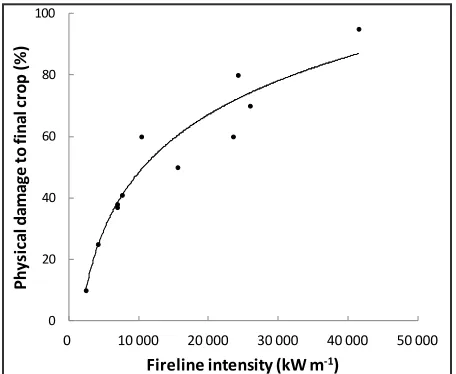
The relationship between fire intensity and damage to a 40 year-old pole stand of jarrah (E. marginata Donn. Ex. Sm.) is shown in Fig -ure 1. Jarrah is one of the most fire resistant eucalyptus species and the data is derived from damage incurred in the Dwellingup Fire of January, 1961. The estimate of physical dam -age is expressed in terms of final crop poten -tial. A damage assessment of 100 % means that no trees in the stand will make final crop trees due either to death or severe log degrade. It seldom means that all trees are killed. A 50% assessment of physical damage indicates that sufficient trees remain for afinal crop, but most will carry severe fire scars and there will be at least 20 % loss of timber due to degrade, and an absolute loss of 5 years increment.
The same study related monetary loss per acre to fire intensity and these values are shown in Figure 2. This loss is in terms of commercial timber and does not include other values such as watershed or recreation.
The fire intensity is generally calculated for the headfire region and intensity on the sides and rear of a fire will be much lower due to
slower rates of spread. The headfire zone gen -erally embraces no more than one third to one half of the total area burnt by an individual fire and the fire damage assessed for the headfire region should not apply to the whole fire area.
The fire intensity concept has an important advantage in that it can be readily calculated without having seen the fire, provided the rate of spread and fuel consumption per unit area is known.
Fire danger rating systems for Forest Fuel Types developed by McArthur (1963) are based on rate of spread derived from meteoro-logical and fuel factors and can be related di-rectly to fire intensity. This system is in the form of a simple slide rule and could be readi-ly applied to ecological fire studies. Cheney (1965) has further enlarged on the fuel energy concept involved in this system of fire danger rating.
FUEL AVAILABILITY
Fuel quantity is one of the major variables affecting fire behaviour. For a given set of meteorological conditions rate of forward progress of a fire is directly related to the quantity of fuel available for combustion. As
0 20 40 60 80 100
0 10 000 20 000 30 000 40 000 50 000
Ph
ys
ic
al
d
am
ag
e t
o f
in
al
cr
op
(%
)
Fireline intensity (kW m-1)
Figure 1. Relationship between fire intensity and physical damage to final crop potential in a pole-sized 40 year-old stand of jarrah (E. marginata).
0 20 40 60 80 100 120 140
0 5 000 10 000 15 000 20 000 25 000 30 000 35 000 40 000 45 000
M
on
et
ar
y d
am
ag
e (
do
llar
s h
a-1)
Fireline intensity (kW m-1)
fuel quantity doubles, rate of spread will dou -ble and fire intensity will increase fourfold.
Fuel quantity affects all aspects of fire be -haviour such as rate of spread, fire intensity, flame height, scorch height, crownfire forma -tion, the spotting process and through all these, the damage resulting from the fire.
Two concepts of fuel availability are re-quired before specific damage effects of a fire can be considered.
“Available fuel” is the quantity of fuel which is consumed in a fire. It is subject to wide variation and even in a relatively uniform fuel type the available fuel will depend on the moisture content of the individual fuel compo -nents. If the fuel complex has a moisture gra -dient due to the influence of recent rain, then only a proportion of the total fuel will burn. This is the whole basis of prescribed burning where the technique is to burn when the lower fuel bed and the large fuel components are moist. Thus only a proportion of the total fuel is consumed and fire intensity is kept to pre -scribed limits. Even under mild meteorologi -cal conditions, if all the fuel is dry enough to burn, it is frequently impossible to carry out prescribed burning in heavy fuel accumulation without doing damage.
The quantity of fuel consumed in a fire also varies with the intensity of the fire and more fuel is usually consumed in a fast run-ning headfire than in a slow moving headfire, or in a fire spreading against the wind.
“Total fuel” is the quantity of fuel which would burn under the driest conditions with a high intensity fire. This sets a worst-possible or maximum value for available fuel.
The quantity of fuel consumed in a fire also depends on fuel arrangement and a dura-tion effect. It is possible to pile large logs in a slash heap mixed with finer and drier fuel components and have most of the fuel compo -nents completely consumed. Under natural conditions of a moving flame front, these larg -er components are seldom consumed. The longer duration of the fire and the arrangement of the fuel components gives more effective heat transfer and the rate of drying of the larg -er components is sufficiently rapid for com -bustion to take place.
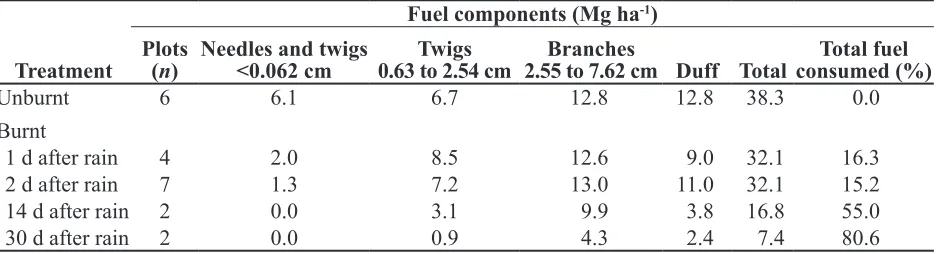
The change in fuel availability is illustrat -ed by recent figures from fire behaviour stud -ies in P. radiata fuel types (Table 1).
In this study experimental fires were burnt on successive days after heavy rain in a fuel complex which is in a drying cycle. Changes in fire intensity and damage effects associated with increasing fuel availability can be readily studied under these conditions.
The P. radiata stand has been thinned and the fuel complex is extremely heterogeneous due to uneven logging slash accumulation. However, the figures do indicate the dramatic changes which took place in fuel availability.
Logs greater than 7.6 cm diameter are ex -cluded from the analysis because they are sel
-Fuel components (Mg ha-1)
Treatment Plots (n) Needles and twigs <0.062 cm 0.63 to 2.54 cmTwigs 2.55 to 7.62 cm Duff TotalBranches consumed (%)Total fuel
Unburnt 6 6.1 6.7 12.8 12.8 38.3 0.0
Burnt
1 d after rain 4 2.0 8.5 12.6 9.0 32.1 16.3
2 d after rain 7 1.3 7.2 13.0 11.0 32.1 15.2
14 d after rain 2 0.0 3.1 9.9 3.8 16.8 55.0
30 d after rain 2 0.0 0.9 4.3 2.4 7.4 80.6
Table 1. Fuel components in a 23 year-old stand of P. radiata pruned and thinned and subjected to fires of
dom consumed in a fire. In this stand the large log component averages around 9 Mg ha-1.
The only fuel components consumed in a very moist fuel complex are needles and small twigs. As the fuel mass dries, the larger com -ponents become available for combustion and add to the available fuel. After 14 days larger twigs and branches burn and the duff layer has dried out sufficiently to burn. Under very dry conditions only the larger branches and the bottommost layer of duff are not consumed. The fire has virtually burnt down to mineral soil and under these conditions fire damage would be accelerated.
The change in fire behavior characteristics and fire intensity resulting from this increased fuel availability is shown in Table 2.
If fire intensity rose to above 7000 kW m-1
in this particular fuel type, a crown fire would develop and the green crowns would be con -sumed. This fuel component would add around 6.7 Mg ha-1 to available fuel and a wall
of flames 18 m to 24 m high would develop. The maximum rate of forward progress in this fuel type would be around 0.6 m sec-1 and
the fire intensity around 110 000 kW m-1a
tremendous rate of energy release. This gives some indication of the range of fire intensity possible in these coniferous forests.
FIRE DURATION
The duration of flaming combustion over a unit area has a very significant effect on dam -age to living vegetation and heat penetration into the soil.
The burnout time or residence time of a fire depends on the rate of spread of the fire, the quantity of fuel available for combustion, and the combustion rate of the fuel. Thus for a specific fuel, it is directly related to fire inten -sity.
Combustion rate varies to some extent ac -cording to the moisture content of the fuel but is mainly a function of fuel particle size. Combustion rates for some typical fuels are given in Table 3.
Knowing the quantity of fuel available for combustion, it is a simple calculation to deter-mine the period over which flaming combus -tion will take place.
Burnout time (s) =
Heat yield (kJ kg-1) × Fuel quantity (kg m-2) (2) Combustion rate (kW m-2)
Thus for a fuelbed of eucalyptus litter car -rying 22.4 Mg ha-1 of available fuel, the burn
-out time would be
Treatment Total fuel(Mg ha-1) Fuel consumed(Mg ha-1) Rate of forward progress (m s-1) Flame height(m) Flame depth(m) Fire intensity(kW m-2)
1 d after rain 38.3 6.3 0.025 0.3 0.6 232
2 d after rain 38.3 5.8 0.025 0.6 0.8 291
14 d after rain 38.3 21.1 0.048 1.2 1.8 1868
30 d after rain 38.3 30.9 0.066 2.7 4.6 3874
Table 2. Changes in fire behaviour resulting from increased fuel availability in P. radiata stands.
Fuel type Combustion rate (kW m-2)
Eucalypt leaves and twigs 249.7
P. radiata needles and twigs 397.3
Wheat stubble 919.3
Improved pasture (rye grass and clover) 1702.5
Table 3. Combustion rates for typical Australian fuel types determined from experimental fire behaviour
15106 × 2.24
249.7 = 136 s.
In comparison the burnout time for a grass -fire in an average fuel quantity of 4.5 Mg ha-1
would only be about 4 s.
As heat penetration into the soil and through the bark of living vegetation is closely related to burnout time or flame persistence, the damage potential of the eucalypt fire is much greater than the grassfire.
The use of the fire intensity concept to characterize fire in terms of potential damage can only be applied to a moving flame front.
As many studies of fire effects have been confined to stationary fires such as burning slash piles, the damage potential of these fires can be determined from the burnout time which incorporates both fire intensity and du -ration effect.
A pile of eucalypt logs would be expected to have a combustion rate of around 11 kW m-2 to 23 kW m-2. If the fuel loading is 112 Mg ha-1 or 11.2 g m-2, the burnout time would be
15 106 × 11.21
11.35 = 14 920 s (or 248 min or 4.15 h).
This is a reasonably modest pile of logs and fuel quantities in the order of 672 Mg ha-1
are quite common in heavy slash fires. Such a quantity of fuel would have a burnout time of 27 h, producing a tremendous heat flux to con -siderable depth in the soil.
CONCLUSION
The most meaningful expression of a fire in terms of potential damage to vegetation and soil is given by the fire energy concept. This is related to rate of spread, heat yield of the fuel and the quantity of fuel available for combustion.
Burnout time or flame persistence is an im -portant fuel characteristic related largely to fuel particle size. Heavier fuels such as euca -lypt litter have burnout times ranging up to several minutes, whereas the so-called “flash fuels” such as grass, burnout in a few seconds. Heat penetration into the soil and damage to vegetation is directly related to this duration effect.
In any specific fuel type physical damage to the vegetation and monetary damage to a commercial forest crop is directly related to the fire intensity.
The characterization of a stationary fire, typified by a burning slash pile is best ex -pressed by burnout time calculated from heat yield, fuel quantity and combustion rate. Long duration effects are typical of these fires and soil heating can reach high values at depths exceeding 30 cm to 43 cm.
Little attention has been given in this paper to the effect of fire frequency on vegetation or soil changes or to the effect of the physical properties of soils or to the heat tolerance of different species. All these are important vari -ables and must be considered together with the fire energy before possible effects of fire on vegetation or soil can be determined.
LITERATURE CITED
Beadle, N.C.W. 1940. Soil temperatures during forest fires and their effect on the survival of vegetation. Journal of Ecology 28: 180-192. doi: 10.2307/2256168
Byram, G.M. 1959. Combustion of forest fuels. Pages 61-89 in: K.P. Davis, editor. Forest fire: control and use. McGraw Hill, New York, New York, USA.
Cheney, N.P. 1965. Problems in the application of McArthur’s Fire Danger Index. Department of National Development, Forestry and Timber Bureau, Canberra, Australia.
Hare, R.C. 1961. Heat effects on living plants. USDA Forest Service Occasional Paper 183, Southern Forest Experiment Station, New Orleans, Louisiana, USA.
McArthur, A.G. 1962. Control burning of eucalypt forests. Department of National Develop -ment, Forestry and Timber Bureau Leaflet 80, Canberra, Australia.
McArthur, A.G. 1963. Forest fire danger meter. Department of National Development, Forestry and Timber Bureau, Canberra, Australia.
Uggla, E. 1960. Ecological effects of fire on north Swedish forests. Pages 994-997 in: Proceed -ings of the fifth world forestry congress, volume II. Food and Agriculture Organization of the United Nations, 29 Aug-10 Sep 1960, Seattle, Washington, USA.
Van Wagner, C.E. 1964. History of a small crown fire. Forestry Chronicle 40: 202-209. doi: 10.5558/tfc40202-2
Van Wagner, C.E. 1965. Describing forest fires—old way and new. Forestry Chronicle 41: 301