https://doi.org/10.5194/ms-9-123-2018
© Author(s) 2018. This work is distributed under the Creative Commons Attribution 4.0 License.
Tool selection method based on transfer
learning for CNC machines
Jingtao Zhou1, Han Zhao2, Mingwei Wang1, and Bingbo Shi1
1The Key Laboratory of Contemporary Design and Integrated Manufacturing Technology Ministry of Education, Northwestern Polytechnical University, Xi’an, 710072, China
2China Academy of Space Technology, Beijing, 100081, China
Correspondence:Jingtao Zhou ([email protected])
Received: 26 August 2017 – Revised: 23 December 2017 – Accepted: 7 February 2018 – Published: 27 February 2018
Abstract. Owing to the changes in product requirements and development of new tool technology, traditional tool selection approach based on the human experience is leading to time-consuming and low efficiency. Un-der the cooperation of historical data resource accumulated by manufacturing enterprises, with human expert resource, a new tool selection mechanism can be established. In this paper, we apply transfer learning to tool selection issue. Starting from the foundation of migration, we showed a unified expression of expert experience and process case in a multi-source heterogeneous environment. Then, we propose a transfer learning algorithm (TLrAdaBoost) based on AdaBoost, which uses a small amount of target domain data (expert experience sample) and a large number of source domain low-quality data (process case sample), to build a high-quality classification model. Experimental results show the effectiveness of the proposed algorithm.
1 Introduction
Tool is the executive part of CNC machine, which directly affects the machined surface. It needs to realize the func-tion of CNC machine tool on the upper layer, and deter-mines the processing quality of products on the lower layer. Tool selection is reasonable or not, not only related to the machine tool processing efficiency, workpiece size accuracy and surface roughness or other related indicators, but also plays an important role in production costs and enterprise efficiency. In the traditional tool selection process, due to the level of experience and knowledge of the process sonnel uneven, there is a great difference in the cutting per-formance of tools selected by different process personnel. In other words, there is uncertainty in the selection results, re-sulting in time-consuming and low efficiency. In recent years, traditional tool selection based on the human experience is increasingly unable to adapt to the development needs of manufacturing enterprises, mainly for the following reasons: (1) The growing demand for personalized products, which leads to an increasingly diversified product type and product structure of manufacturing enterprises, and the product cy-cle changes rapidly (Car et al., 2009); (2) New tool materials
and structures continue to emerge, the general process per-sonnel lack experience of tool selection, and need more help from human experts. Therefore, for the celerity and accuracy of tool selection, it is desirable to have a new tool selection mechanism to make up for deficiencies above.
identifying and extracting features from tool selection data and information to learn a more intelligent selection method. In order to identify and extract features, firstly, we need to understand what kind of composition the data and informa-tion has. They mainly come from the following two types of resources: (1) Expert experience resources: the domain pro-fessional knowledge and technical level is high, but domain experts have the characteristics of scarcity, so the quality of resources is high, but the number is less. (2) Process cases resources: manufacturing enterprises have a large quantity of process cases, so these resources are numerous but with lower quality. It can be seen that these two types of resources and the sample sets extracted from them will be unbalanced in quantity and quality. Besides, within the same type of re-sources, there is almost no guarantee that the number of sam-ples collected for each tool is equivalent. Therefore, due to the imbalance in the data source, our method for tool se-lection is to solve an unbalanced problem. If we only use a small number of high-quality expert experience resources as training samples, it is not enough to learn a reliable clas-sifier. Meanwhile, only using lots of low-quality process re-sources as training samples can’t guarantee that the learned classifier has a low error rate. Owing to the unbalanced na-ture of the data sources, we try to apply transfer learning to the knowledge balance and integration of expert experience and process cases in tool selection.
The remaining sections are organized as follows: In the next section, we present the literature review on tool selection and transfer learning. After that, in Sect. 3, we generalize our approach, explain its principles, and decompose it into two main parts. In Sect. 4, we give a unified expression of multi-source heterogeneous knowledge, establishing the basis of transfer learning. In Sect. 5, we define some notations we will use later and give our algorithm. Section 6 briefly introduces the scene vector similarity calculation method. In Sect. 7, we give examples to verify the validity of the method. Finally, concluding remarks are given in Sect. 8.
2 Related work
Over the years, there has been some reported work on trans-fer learning. At first, it is a key point to establish the basis of transfer learning, which means we must get the unified repre-sentation of the knowledge. It is difficult and laborious to ex-tract empirical knowledge from human experts and formalize the knowledge into decision rules that can characterize the expert performance (Leake et al., 1996). But under certain circumstances, it works well. According to the characteris-tics that human experts diagnose the fault of transformer, Shi et al. (2009) analyze and discuss the system structure, knowl-edge representation and reasoning mechanism to build fault diagnosis expert system of transformer. Besides, the struc-tured characteristics of the case-based process system and the large amount of process cases can help us to model well.
Therefore, we extract features from multi-source heteroge-neous knowledge resource of tools, which contains expert experience and process cases, and unify them to establish the basis of transfer learning.
Secondly, transfer learning theory resolves the problem of unbalanced learning and sample migration between differ-ent domains, which is mainly used for internet applications, like, text classification, clustering problem, collaborative fil-tering, image recognition, emotion classification, etc. Cur-rently, transfer learning has well resolved unbalanced prob-lem (Pan and Yang, 2009). Transfer learning first appeared in the field of human learning, mankind is able to quickly learn new knowledge largely due to the ability of knowledge trans-fer. For example, the knowledge transfer will occur between cycling and riding motorcycles. It focuses on the knowledge transfer between different but similar areas, tasks and distri-butions. When the task from one new domain comes, new domain samples are relabeled costly, and it would be a waste to discard all the old domain data (Li et al., 2015). Wang et al. (2014) propose a transfer learning method for col-laborative filtering, called Feature Subspace Transfer (FST) to overcome the sparsity problem in collaborative filtering. Kuhlmann and Stone (2007) proposed a graph-based method for identifying previously encountered games, and applied this technique to automate domain mapping for value func-tion transfer and speed up reinforcement learning on variants of previously played games. Wu and Dietterich (2004) inte-grated the source domain data in Support Vector Machine (SVM) framework for improving the classification perfor-mance. Argyriou et al. (2008) proposed a transfer learning al-gorithm in heterogeneous environment, and presented meth-ods for learning and expressing the heterogeneous environ-ment structure. In this paper, the data source characteristics of transfer learning are similar to those of the AdaBoost algo-rithm, then we ameliorate the AdaBoost algorithm with con-tinuous confidence output to make it have the ability of sam-ple migration, and improve the classification performance, so that it is successfully applied to the tool selection in the field of industrial manufacturing.
3 Principle explanation
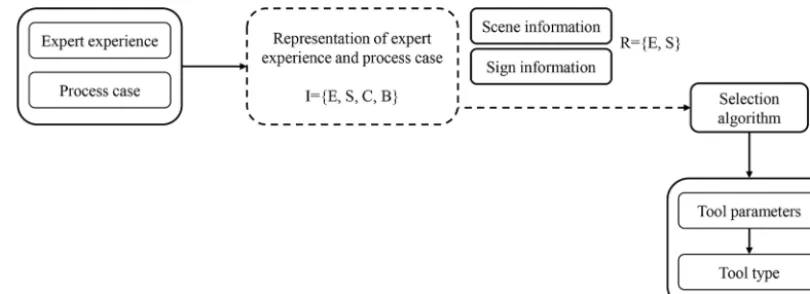
Figure 1.The selection principle of tools.
There are two key points in our approach: we establish the unified expression of expert experience and process case. Nevertheless, these two parts are multi-source heterogeneous and require a uniform representation of knowledge from different resources. By doing so, a large number of high-quality training samples can be provided for selected algo-rithm model. Secondly, TLrAdaBoost algoalgo-rithm, using the ideology of transfer learning, is proposed to deal with the problem of unbalanced learning and sample migration be-tween different domains. For learning an effective classifier for tool selection problem, a sufficient number of high qual-ity training samples are required. AdaBoost algorithm has a solid theoretical basis and efficient computing performance, its advantage is that after several iterations, it can easily pro-vide such high-quality training samples, and thus improve the classification performance of weak classifier, which has made a great success in face recognition, such as Freund and Schapire (1995), Schapire et al. (1998) and Schapire and Singer (1999). However, it has two shortcomings when deal-ing with the problem of tool selection: (1) AdaBoost is based on the assumption that the distribution of the class within the domain is roughly balanced, but the tool selection problem is an unbalanced classification problem in one field. It will lead to a decline in classifier performance. (2) AdaBoost re-quires samples of training classifiers and test classifiers from the same domain, which does not have the ability to migrate samples from other areas and can’t solve the problem of im-balance between domains. To resolve the existing problems of AdaBoost algorithm, our TLrAdaBoost algorithm makes a use of transfer learning theory, so that it has the ability to deal with unbalanced classification learning and data migra-tion. At the same time, we introduce the similarity matching of scene vectors, and finally realize the selection of tools.
To sum up, we will introduce the core content of our algo-rithm.
4 The unified representation of expert experience and process case
Based on the above analysis, we firstly extract empirical knowledge from human experts and formalize the knowl-edge into clear representation. Empirical knowlknowl-edge in broad sense refers to people with the ability to identify and handle problems, which contains cognitive elements and skill ele-ments (Von Krogh and Roos, 1996). Cognitive eleele-ments of problem identification are referred to as the “mental model” by Johnson Laird (Polanyi, 1966), who believes that it is a reflection of reasoning capability achieved in the practice of dealing with the similar problems in brain. Skill elements of solving problems mainly include specific knack, craft and skill in a certain context. Empirical knowledge exists in the various forms of “cases” in everyday life, which is generally more obscure. The knowledge embedded in these “cases” has three characteristics: operational, contextual, specific (Zhou et al., 2010). We use these characteristics to describe “cases”, which means that we use a scenario – “scene information” to define general feature knowledge, and define specific knowl-edge in the “cases” with the “sign information”. Then, we further establish the knowledge expression model, so as to solve the problem.
Tool selection expert experience refers to knowledge and skills about tool selection of the experts from tool manufac-turer and manufacturing enterprises, which exists in the brain of these experts or their related discourses. According to the method above, a tool selection expert experience can be rep-resented as a “case” using the logical process of “scene infor-mation+sign information→tool parameters→tool type”. The specific representation, which contains four elements, is as follows.
I= {E, S, C, B}
Figure 2.Data structure of expert experience and process cases.
information of tool parameters; B – is a nonempty set that represents the name or type of the cutting tool.
Scene information: it refers to the information about ma-chine tool, workpiece, process, etc, related to a specific pro-cessing work step.
Sign information: it refers to a detailed description of the main signs of different processing problem under a certain scene information. The basic form of processing will be the sign information here.
Cutting tool parameter information: it refers to the at-tribute features of the selected tool under requirements of actual processing work step, including toolbar information, the clamping way of blade, blade information.
Name or type of cutting tool: it refers to the experts se-lect the cutting tool parameter information according to the specific scene and sign information, and then determines the tool type for the actual machining. Such as cylindrical turn-ing tool (CTGNR2020K12).
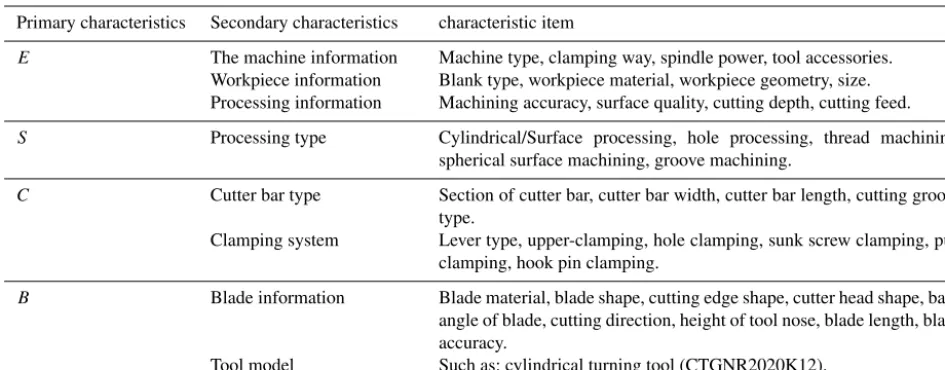
For example, in the selection of CNC turning tool, the in-stances of expert experience can be expressed in four mem-ber groups which mainly include the characteristic items in Table 1.
Process case is referred to the results of cutting tool selec-tion by the technicians according to the specific producselec-tion requirements. It exists in a large number of CNC machin-ing process cards and cutter specification cards. It is not hard to find those two parts including all the information of the above four-member group. Therefore, the representation of a process case can be referred to the representation of ex-pert experience. Tool selection of exex-pert experience and pro-cess cases can be expressed by a data structure as shown in Fig. 2. The arrow reflects the internal logical relationship of the structure.
Through the above data structure, the sample set of expert experience and process cases can be expressed by vectorI= {E, S, C, B}. In the two groups of samples, sign information S only has one characteristic attribute. Taking the selection of CNC lathe tool as an example, characteristic attribute S refers to the basic processing form that has 5 attribute values. Most of the models of the CNC lathe tool can be divided into these 5 categories based on the basic processing form, so the sign informationS can be used as the label information of samples.
5 TLrAdaBoost algorithm
5.1 Relevant definition
In order to make the algorithm more clearly, we give the def-initions related to the problem. This algorithm is concerned with the migration of instances between the similar domains, sharing the same classification objectives between domains.
5.1.1 Basic symbols
– Xais Target Sample Space,Xbis Source Sample Space. – Y= {1,2, . . ., C}is Class Space.
– Functionc:X→Y, Samplesx∈Xare mapped to real class labelsc(x)∈Y.
5.1.2 Test data set
– S= {x1, . . ., xm},S∈Xa,mis the number of elements in the collection.
5.1.3 Training data set
– TT= {xiac(xia)},xia∈Xa,i=1, 2,. . .,d – TS= {xjbc(xjb)},xjb∈Xb,j=1, 2,. . .,q
c(x) is true label ofx,TTis target training data set,TSis source training data set and includingTS1TS2, . . ., TSK.
5.2 Description
The description of the TLrAdaBoost algorithm is as follows: Input: Tagged data set:TT,TS1TS2, . . ., TSK; Test data set S; Basic classification algorithm “Learner”; Iteration number N.
– Step 1. Merge all source domain training set and target domain training set.
T =TS1∪TS2∪. . .∪TSK∪TT
– Step 2. Initialization:
w1i(xi)=1/|T|, (xi, yi)∈T
– Step 3. Do Fort=1, 2,. . .,N
Table 1.The characteristic items contained in expert experience (CNC turning tool).
Primary characteristics Secondary characteristics characteristic item
E The machine information Machine type, clamping way, spindle power, tool accessories. Workpiece information Blank type, workpiece material, workpiece geometry, size. Processing information Machining accuracy, surface quality, cutting depth, cutting feed.
S Processing type Cylindrical/Surface processing, hole processing, thread machining, spherical surface machining, groove machining.
C Cutter bar type Section of cutter bar, cutter bar width, cutter bar length, cutting groove type.
Clamping system Lever type, upper-clamping, hole clamping, sunk screw clamping, pull clamping, hook pin clamping.
B Blade information Blade material, blade shape, cutting edge shape, cutter head shape, back angle of blade, cutting direction, height of tool nose, blade length, blade accuracy.
Tool model Such as: cylindrical turning tool (CTGNR2020K12).
a. Class distribution: pl= P i:yi=l
wit, l=1, 2, . . .,
C;
b. To redivide T: T =T1t∪T2t∪. . .∪Tnt t, and compute the sum ptj,l= P
i:(xi∈Tjt,yi=l)
wit of the
weights ofl∈ {1, . . ., C}class samples inTjt; c. ht(x): x∈Tjt, ht(x, l)=ln(ptj,l/pl),
j=1, . . ., nt;
d. To select ht(x) and make Zt=
nt P
j=1 C Q
l=1
(pjt·l/pl)pl the minimum;
e. To computer the Transfer Efficiency of each source training data set and the target training data set:akt,k=1,. . .,K.
2. To adjust sample weight:
wti+1=
wtiexp(−ht(xi, yi)+ C P
l=1
plht(xi, l)
+αkt)/Zt,(xi, yi)∈Si wtiexp(−ht(xi, yi)
+
C P
l=1
plht(xi, l))/Zt,(xi, yi)∈TT
– Output: Strong Classifier:H(x)=argmaxl{f(x, l)}
In the formula,f(x, l)=
T P
t=1 ht(x, l).
5.3 Analysis
TLrAdaBoost, based on real-AdaBoost that has continu-ous confidence output, is proposed, which is able to deal
with data migration and sample imbalance among different classes.
The training sample set collected from the whole sample space isS= {(x1, y1), . . .,(xm, ym)}, for multi-classification problemyi∈ {1,2, . . ., C}, the confidence level of labell is ht(x, l) that is the output of weak classifierht(x). The strong classifier that has better classification performance consists ofT(t=1, . . ., T) weak classifiersht(x) in some way. Lin-ear combination is the most commonly used combination so
we use combination functionf(x, l)=
T P
t=1
ht(x, l) and the
strong classifierH(x)=argmaxl{f(x, l)}. The strong clas-sification algorithm always hopes that the training error rate Eq. (1) is the least:
ε=
m X
i=1
w1iH(xi)6=yi
(1)
In the formula,w1i =1/m, the value of
H(xi)6=yiis 1 if the conditions meet, otherwise is 0.
When the class distribution is unbalanced, assuming that the prior probability of different labels ispl=Prx∈Sy=l, a reasonable approach is to change the average confidence
value to f(x)=
C P
l=1
plf(x, l). It is proved that when T is
very large, ht(x) is independent of each other and ht(x, l) is uniformly bounded, so the error rate of the training error rate expressed by the symbolic function can be transformed into the extreme value problem of the exponential function. In other word, Eq. (1) can be approximated as Eq. (2).
ε=
m X
i=1
w1iH(xi)6=yi
≤
m X
i=1 wi1
T Y
t=1
exp (−ht(x, yi))
+
C X
l=1
By traininght(x) to make Eq. (1) minimum is transformed into making Eq. (2) minimum. The extremum of Eq. (2) can be done by training ht(x) one by one in a recur-sive way, specifically by selecting ht(x) such that Zt=
nt P
j=1 L Q
l=1
(ptj,l/pl)pl is minimized. Zt is called as the
normal-ization factor. Therefore, the training error rate can be esti-mated as Eq. (3).
ε≤
T Y
t=1 Xnt
j=1 L Y
l=1
(ptj,l/pl)pl !!
(3)
Transfer Efficiencyis a measure of the performance of the target task before and after the migration. In the T itera-tion process, the algorithm first will be trained on the tar-get field training set for weak classifier ht(x) that obeys the distribution of w(TT)/kw(TT)k, while kvk is the L1 norm of feature vector. Then, each source training set is combined with the target training set in turn to generate a new training set TSI i∪TT that obeys the distribution of w(TSi∪TT)/
w(TSi∪TT)
. On the basis of this, the new classifierh∗t(x) is trained. Weight error of the training set can be calculated by Eq. (4).
ε= X
(xi,yi)∈TT
wt(xi)|h(xi)−yi|/kwT(TT)k (4)
Calculated by the formula,εtis the weight error ofht(x), and εt∗iis the weight error ofh∗t(x). The transfer efficiency is de-fined as the difference of the weight error that isαti=εt−ε∗ti. IfTSI i is the positive migration, there is exp(α
i
t)(1, e], or exp(αti)(1/e, 1] when it is the negative migration, other-wise exp(αti)=1.
6 Scene information vector similarity calculation
The ultimate goal of tool selection is to select a tool that can meet the requirements of machining according to the scene information of a practical application of the CNC cutter. TL-rAdaBoost algorithm only achieves the preliminary classifi-cation of tools, it is necessary to select a specific tool name or model by measuring the similarity between the scene information vector of all the sample samples in the class space and the actual application scene vector. Vector simi-larity refers to the degree of simisimi-larity between two equal di-mension vector objects. There are two kinds of measurement methods: distance measure method and similarity function method (Zhang et al., 2009). In this paper, the angle cosine method (Eq. 5) is used to measure the degree of similarity between two vectors.
sim (x, y)=cos(x, y)=(x, y)/(kxk · kyk)
=
n X
i=1 xi·yi/(
n X
i=1 xi2·
n X
i=1
yi2)1/2 (5)
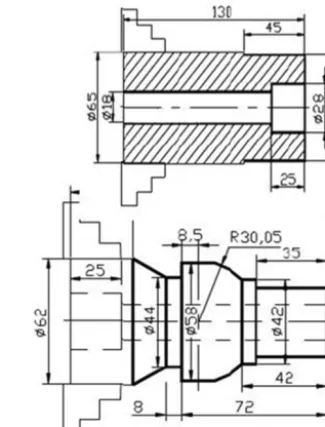
Figure 3.Shaft parts process diagram.
The geometric significance of the cosine angle is the cosine value of two vectors inN-dimensional space consisting ofN elements. Each element in a vector needs to be dimensionless before using it, so that the elements are positive and the range of cosine value is [0,1]. The larger the value is, the smaller the angle between two vectors is and the more similar the two vectors are. When two vectors are exactly the same, the value is 1 (Tian and Xie, 2006).
7 Instance verification
Our method based on transfer learning, which is different from the traditional one, automatically selects tools through the computer, ensuring the rapid and accurate selection of tools. The method is verified by an example as follows.
A process diagram of shaft parts is shown in Fig. 3. Ma-chining inner holes of∅28×25 is a step in the processes.
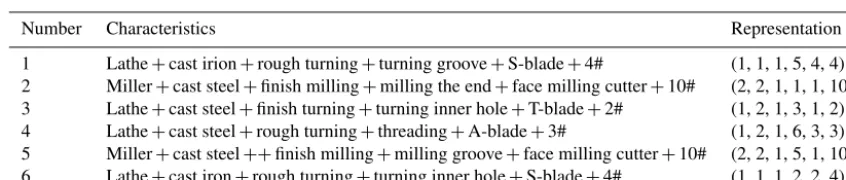
Requirements: turning, rough machining, the workpiece ma-terial is cast steel. For the sake of convenient calculation, we give parametric representation and construct the train-ing sample set only for machine type, workpiece material, machining accuracy, basic processing form, blade shape and tool number. The results are shown in Tables 2, 3.
We use the sample set of target domain and the sample set of source domain as the input data, and the basic process-ing form as the class label. Meanwhile, the TLrAdaBoost algorithm is used to study the training samples, the train-ing results are 6 kinds of samples: inner hole turntrain-ing, end surface turning, spherical turning, threading, groove turning, end milling, groove milling. And inner hole turning is in line with the requirements of instances. Its parametric matrix is
Table 2.Target domain sample set (Expert experience sample set).
Number Characteristics Representation
1 Lathe+cast steel+rough turning+turning inner hole+T-blade+2# (1, 2, 1, 2, 1, 2) 2 Lathe+cast steel+rough turning+turning the end+S-blade+4# (1, 2, 1, 1, 2, 4) 3 Lathe+cast steel+rough turning+turning spherical+T-blade+5# (1, 2, 1, 5, 1, 5) 4 Lathe+cast iron+finish turning+threading+A-blade+3# (1, 1, 2, 6, 3, 3)
Table 3.Source domain sample set (Process case sample set).
Number Characteristics Representation
1 Lathe+cast irion+rough turning+turning groove+S-blade+4# (1, 1, 1, 5, 4, 4) 2 Miller+cast steel+finish milling+milling the end+face milling cutter+10# (2, 2, 1, 1, 1, 10) 3 Lathe+cast steel+finish turning+turning inner hole+T-blade+2# (1, 2, 1, 3, 1, 2) 4 Lathe+cast steel+rough turning+threading+A-blade+3# (1, 2, 1, 6, 3, 3) 5 Miller+cast steel++finish milling+milling groove+face milling cutter+10# (2, 2, 1, 5, 1, 10) 6 Lathe+cast iron+rough turning+turning inner hole+S-blade+4# (1, 1, 1, 2, 2, 4)
A=
1 2 1
1 2 1
1 1 1
2 1 2
3 1 2
2 2 4
The first 4 columns of the matrix are the scene information matrix
B=
1 2 1
1 2 1
1 1 1
2 3 2
.
The parameterized representation of the scene information vector isC=[1 2 1 2]. According to Eq. (5), the angle co-sine of each row vector in matrixBand vectorCis calculated separately. And the final result shows that the scene “num-ber 1” in the target domain sample set is exactly the same as instance scene. Therefore, the “T-blade+2#” is the final selection of CNC tool. The results proved to be correct.
We also choose groove processing tool selection as an ex-perimental validation. The dataset comes from Xi’an Win-way Tools Co. Ltd., including tool design drawings, process files, and expert experience data. For the sake of data repre-sentation and experiment convenience, 12 properties of tool selection knowledge representation were selected as the sam-ple shared attribute space, covering the machine tool factors, process factors and workpiece factors, as shown in Table 4.
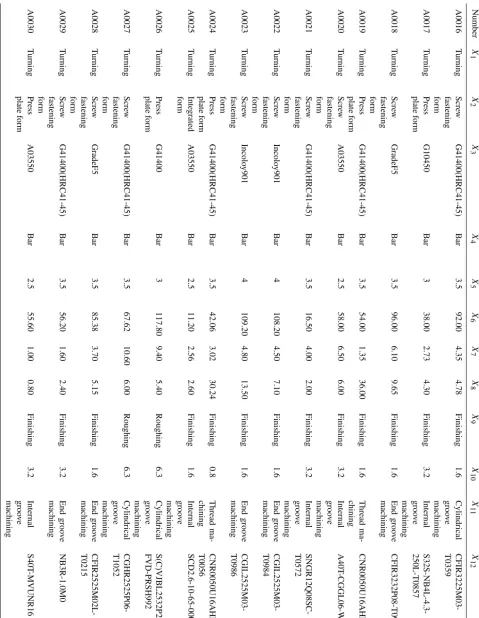
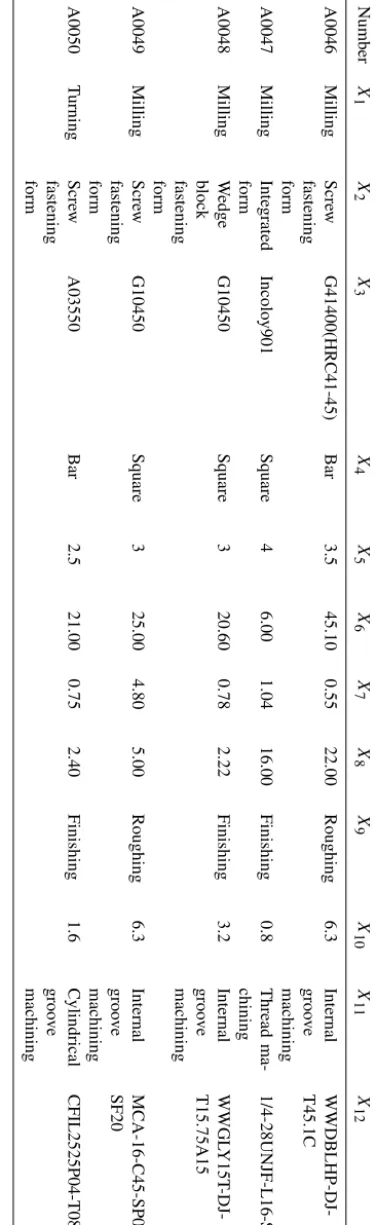
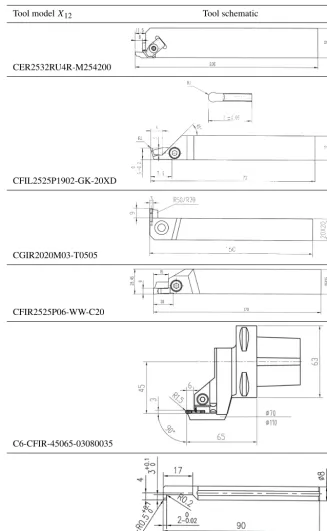
A total of 50 sets of samples are used in the experiment, of which 35 groups are in the form of turning and the rest are in the form of milling. During training, samples A0001–A0049 are randomly input to the classifier and the number A0050 is used as a test sample to verify the feasibility of the algorithm. Sample data set as shown in Appendix A. Table A1 shows tool selection scene information and tool model of the sample dataset, Table A2 shows tool design drawings corresponding to the tool model.
In order to ensure the unity of presentation of tool selec-tion scene informaselec-tion, data pre-processing is required before tool selection. Discrete attributesX1–X5,X9–X11need to be binarized. Table 5 uses the clamping methodX2 as an ex-ample. Other discrete attributes are handled in the same way. Continuous attributesX6–X8usesK-means clustering to di-vide continuous attribute space into six intervals, and then uses different integer values to represent the data falling in each sub-interval. The representation of scene information is shown in Appendix B. In Table B1, the clustering center val-ues represents the continuous attributesX6–X8.
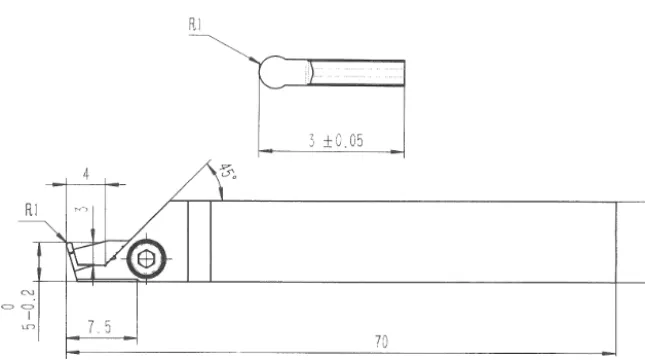
The scene information selected for test sample A0050 is: turning, screw fastening form, A03550, bar, cutting per-formance 2.5, diameter 21.00 mm, groove deep 0.75 mm, groove width 2.40 mm, finishing, Ra1.6. The size of the part slot is shown in Fig. 4. Continuous attributes diame-ter, groove depth and groove width are divided into appropri-ate clustering intervals according to the value of the distance from the clustering center. Therefore, the scene information of No. A0050 can be expressed as a vector:
P V = [0 0 0 0 0 1 0 1 1]
Table 4.Dataset properties.
Machine Tool clamping Workpiece Blank Cutting Diameter typeX1 methodX2 materialX3 shapeX4 performanceX5 X6/mm Groove deep
X7/mm
Groove width
X8/mm
Processing accuracyX9
Surface rough-nessX10/µm
Basic processing formX11
Tool modelX12
Table 5.Discrete attribute clamping methodX2.
Screw fastening Press plate Lever fastening Integrated Wedge block Compound form form form form fastening form fastening form
Integer value 0 1 2 3 4 5
Binary value 000 001 010 011 100 101
Figure 4.Test sample A0050 part slot size.
KV=
0 0 0 0 0 1 2 0 1 1
0 0 4 0 2 5 4 2 1 1
0 1 3 0 2 5 4 1 0 3
0 1 4 0 2 5 3 0 1 0
0 0 4 0 2 4 3 1 1 1
0 1 2 0 1 5 5 1 0 3
0 0 4 0 2 3 5 1 0 3
0 0 5 0 3 4 2 2 1 1
1 0 4 0 2 3 1 0 0 3
According to Eq. (5), the angle cosine valueMibetween each row vector in the matrixKVand vectorP V, whereKVand
Figure 5.Sample A0002 part slot size.
P V are converted to binary, is calculated respectively, and the result is shown in Table 6.
Table 6.Similarity calculation results.
M1=0.8660 M2=0.6124 M3=0.3651 M4=0.4082 M5=0.4082
M6=0.3651 M7=0.3849 M8=0.3849 M9=0.4082
due to the similar processing factors and the non-conflicting spatial position constraints.
8 Conclusion
We apply transfer learning to tool selection issue in the field of industrial manufacturing in this paper. Starting from the foundation of migration, we showed a unified expression of expert experience and process case in a multi-source het-erogeneous environment. In addition, we proposed a trans-fer learning algorithm (TLrAdaBoost) based on AdaBoost, which uses a small amount of target domain data (expert ex-perience sample) and a large number of source domain low-quality data (process case sample), to build a high-low-quality classification model. In this process, the imbalance data prob-lem that AdaBoost can’t solve is resolved. Finally, we use the scene similarity matching method to select the tool model or name. The results show that the proposed method using TLrAdaBoost can effectively classify samples by learning cross-domain knowledge.
Appendix A
Figure A1.Sample No. A0002 cutting tool scheme.
T ab le A1. Continued. Number X1 X2 X3 X4 X5 X6 X7 X8 X9 X10 X11 X12 A0031 T urning Scre w fastening form Incolo y901 Bar 4 86.60 2.65 8.50 Finishing 1.6 Cylindrical groo v e machining CFIR3225P08-T0994 A0032 T urning Scre w fastening form A03550 Bar 2.5 95.48 2.85 4.95 Finishing 0.8 End groo v e machining CFIR2525M04- T0911 A0033 T urning Scre w fastening form A03550 Bar 2.5 17.00 1.75 17.70 Finishing 0.8 Internal groo v e machining S12U-SDRCP07-D A0034 T urning Scre w fastening form G41400 Bar 3 77.00 7.00 3.50 Roughing 25 End groo v e machining CGIL3225P02R650700- QW A0035 Milling Scre w fastening form G41400(HRC41-45) Square 3.5 42.93 2.11 0.90 Finishing 1.6 Internal groo v e machining WWM254150-DJ- X32R.4 A0036 Milling
Compound fastening form
G41400(HRC41-45) Square 3.5 34.10 0.50 4.22 Finishing 0.8 Internal groo v e machining BF-D34D34.1-CC06- CF50 A0037 Milling Inte grated form Incolo y901 Square 4 11.00 1.08 18.00 Finishing 0.8 Thread ma-chining TM-MJ11X1.25- 10R1-SP-E0560 A0038 Milling Inte grated form G41400(HRC41-45) Square 3.5 6.00 0.79 14.00 Finishing 0.8 Thread ma-chining 1/4-28UNJF-3B-8876 A0039 Milling
Compound fastening form
G41400 Square 3 50.10 1.00 3.00 Roughing 12.5 Internal groo v e machining BR-D44.6D45.1- CC09-B50 A0040 Milling Scre w fastening form G41400(HRC41-45) Bar 3.5 60.00 1.40 3.20 Roughing 6.3 Cylindrical groo v e machining SMT -40-125-25SF A0041 Milling Scre w fastening form A03550 Bar 2.5 66.60 3.09 26.00 Finishing 0.8 Thread ma-chining CNL0040H22Q-12- 20SF A0042 Milling W edge
block fastening form
Table A2.Sample tool data set.
Tool modelX12 Tool schematic
CER2532RU4R-M254200
CFIL2525P1902-GK-20XD
CGIR2020M03-T0505
CFIR2525P06-WW-C20
C6-CFIR-45065-03080035
HW-2D162-615
Table A2.Continued.
Tool modelX12 Tool schematic
MR6-ISO1.0-048-6R1
A32R-CGIR4004-T0920
CFIR1212H03-T0870
E05E-1.25ISO-10-NR-S9354
E05E-1.0ISO-15-NR-S9354
CGIR2525P1604-WWWYL
Table A2.Continued.
Tool modelX12 Tool schematic
ZY15R04-62758
CFIL2525KNB3-T0904
NB3R-2.5-T0449
CFIR3225M03-T0359
S32S-NB4L-4.3-250L-T0857
CFIR3232P08-T0910
CNR0050U16AHD
Table A2.Continued.
Tool modelX12 Tool schematic
A40T-CGGL06-WW
SNGR12Q08SC-T0572
CGIL2525M03-T0984
CGIL2525M03-T0986
32 CNR0050U16AHD-T0056
SCD2.6-10-65-0002
Table A2.Continued.
Tool modelX12 Tool schematic
S(C)VJBL2532P22-FVD-PRSH992
CGHR2525P06-T1052
CFIR2525M02L-T0215
NB3R-1.0M0
S40T-MVUNR16
CFIR3225P08-T0994
CFIR2525M04-T0911
Table A2.Continued.
Tool modelX12 Tool schematic
S12U-SDRCP07-D
CGIL3225P02R650700-QW
WWM254150-DJ-X32R.4
BF-D34D34.1-CC06-CF50
TM-MJ11X1.25-10R1-SP-E0560
1/4-28UNJF-3B-8876
Table A2.Continued.
Tool modelX12 Tool schematic
BR-D44.6D45.1-CC09-B50
SMT-40-125-25SF
CNL0040H22Q-12-20SF
WWGMC3597-DJ-X28R40D
MST-D18.5-4.2-90-SF20-E0392
SM20.2-15-80-SF20
Table A2.Continued.
Tool modelX12 Tool schematic
M5-10-3F-60-D6
WWDBLHP-DJ-T45.1C
1/4-28UNJF-L16-SP
WWGLY15T-DJ-T15.75A15
MCA-16-C45-SP05-SF20
CFIL2525P04-T0881
Appendix B
Table B1.Representation of scene information.
Attributes: Integer value
Machine typeX1 Turning: 0 Milling: 1 Tool clamping
methodX2
Screw fastening form: 0
Press plate form: 1
Lever fastening form: 2
Integrated form: 3
Wedge block fastening form: 4
Compound fas-tening form: 5
Workpiece mate-rialX3
Aluminum alloy: 0
Medium carbon steel: 1
Alloy steel: 2
Titanium alloy: 3
Heat treated al-loy steel: 4
High-temperature alloy: 5 Blank shape X4 Bar: 0 Square: 1
Cutting perfor-manceX5
2.5: 0 3: 1 3.5: 2 4: 3
DiameterX6/mm 8.70: 0 21.10: 1 42.33: 2 59.72: 3 86.93: 4 109.54: 5 Groove deep
X7/mm
0.86: 0 1.69: 1 2.74: 2 4.25: 3 6.40: 4 10.00: 5
Groove width
X8/mm
2.39: 0 4.92: 1 8.38: 2 14.65: 3 26.71: 4 36.00: 5
Processing accu-racyX9
Roughing: 0 Finishing: 1
Surface rough-nessX10/µm
0.8: 0 1.6: 1 3.2: 2 6.3: 3 12.5: 4 25: 5
Basic processing formX11
Cylindrical groove machin-ing: 0
End groove ma-chining: 1
Internal groove machining: 2
Competing interests. The authors declare that they have no con-flict of interest.
Acknowledgements. The work is supported by the National Key Technology R&D Program of China (Grant No. 2015BAF17B01).
Edited by: Xichun Luo
Reviewed by: two anonymous referees
References
Ahmad, Z., Rahmani, K., and D’Souza, R. M.: Applications of ge-netic algorithms in process planning: tool sequence selection for 2.5-axis pocket machining, J. Intell. Manuf., 21, 461–470, 2010. Argyriou, A., Maurer, A., and Pontil, M.: An Algorithm for Transfer Learning in a Heterogeneous Environment. Machine Learning and Knowledge Discovery in Databases, European Conference, Ecml/pkdd 2008, Antwerp, Belgium, 15–19 September 2008, Proceedings DBLP, 71–85, 2008.
Car, Z., Barisic, B., and Ikonic, M.: GA based CNC turning center exploitation process parameters optimization, Metalurgija, 48, 47–50, 2009.
Freund, Y. and Schapire, R. E.: A desicion-theoretic generaliza-tion of on-line learning and an applicageneraliza-tion to boosting, European Conference on Computational Learning Theory Springer, Berlin, Heidelberg, 23–37, 1995.
Geng, L., Zhang, Y. F., and Li, H. Y.: Multi-cutter selection and cut-ter location (CL) path generation for five-axis end-milling (fin-ish cut) of sculptured surfaces. The International Journal of Ad-vanced Manufacturing Technology, 69, 2481–2492, 2013. Kuhlmann, G. and Stone, P.: Graph-Based Domain Mapping for
Transfer Learning in General Games. Machine Learning: Ecml 2007, European Conference on Machine Learning, Warsaw, Poland, 17–21 September 2007, Proceedings DBLP, 188–200, 2007.
Leake, D. B.: Case-Based Reasoning: Experiences Lessons and Fu-ture Directions, International Information Science Foundation (IISF) in Japan, 1996.
Li, X., Mao, W., and Jiang, W.: Extreme learning machine based transfer learning for data classification, Neurocomputing, 174, 203–210, 2015.
Meng, F. J., Chen, Z. T., Xu, R. F., and Li, X.: Optimal barrel cutter selection for the CNC machining of blisk, Comput. Aided De-sign, 53, 36–45, 2014.
Oral, A. and Cakir, M. C.: Automated cutting tool selection and cut-ting tool sequence optimisation for rotational parts, Robot. Cim.-Int. Manuf., 20, 127–141, 2004.
Pan, S. J. and Yang, Q.: A Survey on Transfer Learning, IEEE T. Knowl. Data En., 22, 1345–1359, 2009.
Polanyi, M.: The Tacit Dimension, London, Routledge & Kegan Paul, 1966.
Schapire, R. E. and Singer, Y.: Improved Boosting Algorithms Us-ing Confidence-rated Predictions, Mach. Learn., 37, 297–336, 1999.
Schapire, R. E., Freund, Y., Bartlett, P., and Lee, W. S.: Boosting the margin: a new explanation for the effectiveness of voting meth-ods, Ann. Stat., 26, 1651–1686, 1998.
Shi, J., Weiguang, T., and Daling, W.: Design of the Transformer Fault Diagnosis Expert System Based on Fuzzy Reasoning, Computer Science-Technology and Applications, 2009, IFC-STA’09, International Forum on IEEE, 110–114, 2009.
Tian, R. and Xie, P.: Study on the Standardization of Similarity Evaluation Method of Chromatographic Fingerprints (Part I), Traditional Chinese Drug Research & Clinical Pharmacology, 2006.
Von Krogh, G. and Roos, J.: Five claims on knowing, European Management Journal, 14, 423–426, 1996.
Wang, J. and Ke, L.: Feature subspace transfer for collaborative fil-tering, Neurocomputing, 136, 1–6, 2014.
Wu, P. and Dietterich, T. G.: Improving SVM accuracy by training on auxiliary data sources, Icml, 8 pp., 2004.
Zhang, Y., Liu, Y., and Ji, Z.: Vector similarity measurement method, Technical Acoustics, 28, 532–536, 2009.