R E S E A R C H
Open Access
The eight essential elements of inclusive
STEM high schools
Melanie LaForce
1*, Elizabeth Noble
1, Heather King
1, Jeanne Century
1, Courtney Blackwell
1, Sandra Holt
2,
Ahmed Ibrahim
1and Stephanie Loo
1Abstract
Background:Inclusive STEM (traditionally known to stand for“Science, Technology, Engineering, and Math”) high schools are emerging across the country as a mechanism for improving STEM education and getting more and diverse students into STEM majors and careers. However, there is no consensus on what these schools are or should be, making it difficult to both evaluate their effectiveness and scale successful models. We addressed this problem by working with inclusive STEM high school leaders and stakeholders to articulate and understand their intended school models. This“bottom-up”approach is in contrast with other studies that have taken a“top-down,” literature-based approach to defining STEM schools.
Results:Through this process, we identified 76 critical components of STEM schools and derived a theoretical framework of eight elements that represent the common goals and strategies employed by inclusive STEM high schools across the country: Personalization of Learning; Problem-Based Learning; Rigorous Learning; Career, Technology, and Life Skills; School Community and Belonging; External Community; Staff Foundations; and External Factors. This framework offers a clear picture of what exactly inclusive STEM schools are and common language for both researchers and practitioners. Interestingly, STEM disciplinary content did not emerge as a defining
component across school models.
Conclusions:Findings suggest that STEM school leaders and stakeholders view their STEM school identity as rooted in pedagogy, transferrable skills, school culture, and rigorous instruction across all subjects, including, but not restricted to, STEM. This raises questions about the goals of inclusive STEM high schools and the STEM discipline outcomes that we should reasonably expect to see from STEM schools.
Keywords:STEM education, STEM schools, Conceptual framework
Background
The STEM education movement has gained dramatic momentum over the past decade. This is reflected not only in the proliferation of local and state STEM pro-grams that now exist across the country, both in schools and out, but also in the numerous federal reports and policies, the federal budget, and initiatives like the White House’s Educate to Innovate (National Research Council (NRC) 2011, 2013; National Academies 2005; President’s Council of Advisors in Science and Technology (PCAST) 2010). During his administration, President Obama has made improving STEM education a priority, backed by a
5-year strategic plan to support STEM education, released in 2013. This attention to STEM education is due in large part to the need to bolster the US STEM workforce to compete in a global economy (United States Department of Labor, 2007). According to predictions, the number of jobs in the STEM sector will increase more rapidly over the next decade than jobs in any other sector (Committee on STEM Education National Science and Technology Council 2013; Klobuchar, 2014): analysts estimate that by 2018, non-STEM jobs will increase by 9.8%, while STEM jobs will increase by 17% (Langdon et al. 2011). Coming on top of an already-existing shortage of qualified STEM workers, these projections seem cause for serious concern. Some have characterized this shortage as the result of a“leaky pipeline” (Alper 1993; Leboy 2008; Valla & Ceci 2014) through which students, especially women and
* Correspondence:[email protected]
1Outlier Research & Evaluation, UChicago STEM Education, University of
Chicago, 1427 E. 60th Street, Chicago, IL 60637, USA
Full list of author information is available at the end of the article
other underrepresented groups, leave STEM fields. The metaphor suggests that somewhere in the course of their preK–16 education, these groups either lose interest in STEM-related learning, lose confidence in their abilities to perform in these fields (Wells, Sanchez, & Attridge 2007; Unfried, Faber, & Wiebe 2014), or feel that the“STEM cul-ture” is not welcoming to them (Good, Rattan, & Dweck 2012; Smith, Lewis, Hawthorne, & Hodges 2013), resulting in large numbers of students opting out of (or not opting into) STEM majors and careers (e.g., Blickenstaff 2006; Wickware 1997). Thus, many efforts to improve STEM education seek to grow student interest and achievement through increased time and emphasis on STEM subjects, different approaches to the content, and the use of a variety of instructional strategies. One such strategy is the creation of inclusive STEM high schools, which aim to provide rigorous STEM learning (Riley et al. 2013) to students of all socio-economic, demographic, and achievement back-grounds (Peters-Burton et al. 2014).
Despite the attention and resources being given to STEM and STEM schools, there remains little consensus about what STEM schools should look like in practice and even about what “STEM” actually is in the oper-ational context of K12 education. Some definitions of STEM focus on disciplinary integration. For example, Merrill (2009) defines STEM as
a standards-based, meta-discipline residing at the school level where all teachers, especially science, technology, engineering, and mathematics (STEM) teachers, teach an integrated approach to teaching and learning, where discipline-specific content is not divided, but addressed and treated as one dynamic, fluid study (pg. 1).
Others take the interdisciplinary nature one step further by proposing that efforts to integrate STEM subjects should expand to encompass the arts, thus shifting the “STEM” initiative to the “STEAM” initiative (Science, Technology, Engineering, Arts, and Mathematics; Platz 2007).
In contrast, still others see the STEM movement as an opportunity to highlight subject-specific content that had previously been overlooked. More specifically, they high-light the“T”or the“E”in STEM (e.g.,“Staking the Claim for the‘T’in STEM”[Kelley, 2010],“Supporting the T and the E in STEM” [Harrison, 2011],“Advancing the “E” in K-12 STEM Education”(Rockland et al. 2010)).
Despite this lack of shared definition, there are nu-merous schools around the country that identify themselves—in name, mission, or otherwise—as STEM schools. Selective enrollment math- and science-focused high schools, which admit based on achievement, have existed for several decades (e.g., Subotnik, Tai, & Almarode 2011). These often highly competitive schools, however, serve only a small portion of the student population, and
enrollment of minority students has typically been low (Means, Confrey, House, & Bhanot 2008). Inclusive STEM high schools, which are the focus of the current study, have no admissions criteria for students and as such serve a broader and often more diverse population of students (Means et al. 2008; NRC 2011). These schools have more recently emerged as a trend and are now found around the country. Beyond the surface-level characteristic of their enrollment structure, however, the ways and extent to which inclusive STEM high schools are similar or different in their intended models and practice has been to largely unknown—which poses a problem for research on STEM schools as a singular innovation.
Researchers are already beginning to engage in compara-tive studies of inclusive STEM schools and their surround-ing non-STEM counterparts (e.g. Young et al. 2011); however, what is lacking from the current body of litera-ture on STEM schools is an examination of what STEM schoolsarein actuality—what they do, how they interpret the term “STEM,” what their goals are—and thus what outcomes we can and should expect from them. Without shared language to describe STEM schools, findings about impact will not contribute to a developing knowledge base that can inform continued growth and improvement.
In this study, we address the questions: What is an inclu-sive STEM high school? What specific components are present in these schools? Why are components present, meaning, what specific outcomes are intended for students, staff, and the community at large? We examine how inclu-sive STEM high schools themselves articulate what they are; how this may (or may not) align with the national push for improved science, technology, engineering, and math education; and the outcomes they intend for their students. Understanding the intended models and specific model components of functioning inclusive STEM schools allows us to examine the implementation of strategies and how that implementation relates to outcomes, as well as to de-velop a comprehensive theoretical framework of common STEM school practices, which we present here. This framework can inform future research and suggest a widely applicable model that will provide policy-makers and prac-titioners with common ground for discussion and collabor-ation. It can also help interested practitioners understand, implement, and improve the practices these STEM schools use. The insight gained from this study about what STEM school leaders believe makes their schools“STEM schools” also illuminates the definition of STEM that these leaders are employing, which has important implications for un-derstanding student STEM outcomes.
Methods
Theoretical approach
STEM high schools across the USA. We sought to de-rive a theoretical model for inclusive STEM high schools by employing a “component approach,” (Century et al. 2010; Hall & Hord 1987) working to identify and clearly describe the critical components of each of the 20 inclu-sive STEM high school models, identify commonalities, and synthesize them into key conceptual elements. The component approach has roots in educational change lit-erature where Hall and Hord (1987) suggested that to analyze different instantiations of an innovation (in this case, the inclusive STEM high school),“the components or building blocks of the innovation must be defined” (p. 117). This approach has become increasingly visible in educational implementation studies as an essential step toward understanding the parts of educational interven-tions that are most closely associated with desired student outcomes (Damschroder et al. 2009). Some refer to these critical components as “critical program dimensions,” “model dimensions,” “fidelity criteria,” “essential charac-teristics,” and “critical parts” (Bond et al. 2000; Huntley: Operationalizing the concept of “fidelity of implementa-tion”for NSF-funded mathematics curricula, unpublished 2005; Mowbray et al. 2003; Sabelli & Dede 2001; Wang et al. 1984). In S3, we identified what we refer to as “crit-ical components”that in turn comprise larger conceptual “elements.”
Our specific component framework is based in our previous work on measuring the fidelity of implementa-tions (Century & Cassata 2014), which was then adapted for specific study of STEM schools in a precursor study to S3 (the Ohio STEM Learning Network Study (OSLN; NSF #1008569), which examined five inclusive STEM high schools in Ohio). The framework organizes innovation components into two broad categories: struc-tural components and interactional components. Struc-tural components“include the organizational, design, and support elements that are the building blocks of the innovation”(Century & Cassata 2014, p. 88); interactional components are the expected or intended behaviors of the innovation’s users—in this case, the participants in the school community.
It is important to stress that the strategy employed in this study (S3), as well as the previous OSLN study, used a qualitative, ground-up approach, in that it relied on the schools’creators, leaders, and key teachers to articu-late their STEM school models. The eight element model that was ultimately derived is rooted inthe school leaders’ own descriptions. This approach stands in con-trast to Peters-Burton et al. (2014), for example, who uti-lized a literature-driven approach wherein they identified 10 “critical components” of STEM schools in existing literature, and then conducted in-depth case studies of inclusive STEM schools to examine the extent to which these components were present. Our approach was
driven by a commitment to ascertaining what STEM schools actually are, on the ground, as defined by their creators and leaders. Then, we sought to synthesize their descriptions into a general model of inclusive STEM high schools that would benefit the field as a whole.
Sample
Sample schools reside in seven states. This includes four schools each in Ohio, Texas, and Washington State; three in California; two each in North Carolina and Tennessee; and one in New York, for a total of 20. The research team worked closely with state-level STEM policy leaders to se-lect and recruit participant schools that (1) were inclusive, in that they had no achievement-based admissions criteria; (2) were representative of the range of inclusive STEM schools across each state; and (3) had the capacity (staff, time, and administrator support) to participate in a large research study. The final criterion was necessary in order to (a) complete the research study and (b) not overburden school personnel or detract from their duties at their re-spective schools. We sought schools that were in at least their second year of implementation with two exceptions (new STEM schools in Ohio and Tennessee were in-cluded, as network leaders felt confident in their abilities to participate). We also required that schools self-identified (as per the administration) as “STEM” schools (with “STEM” left open to their interpretation). All schools were affiliated with centralized state STEM net-works, though their level of involvement varied. Of the 20 schools, seven were suburban, nine were urban, and four were rural. School sample size ranged from 44 to 619 stu-dents. Ethnic distribution of students varied: one school was majority African American/Black, seven were major-ity Hispanic/Latino, and 12 were majormajor-ity white. The total student sample (as reported on questionnaires during the second year of the study) was 11.6% African American/ Black; 0.6% American Indian or Alaska Native; 9.0% Asian; 28.6% Hispanic/Latino; 1.3% Hawaiian or Pacific Islander; 1.5% Middle Eastern; 33.7% White/Caucasian; 7.2% Mixed race; 1.9% other; and 4.6% preferred not to answer. As the final sample included a range of schools with varying demographics and from a large diversity of contexts (e.g., geographic, socio-economic, political), we are confident that findings from this study are generalizable to a broad range of STEM schools across the nation.
Data collection strategy and sources
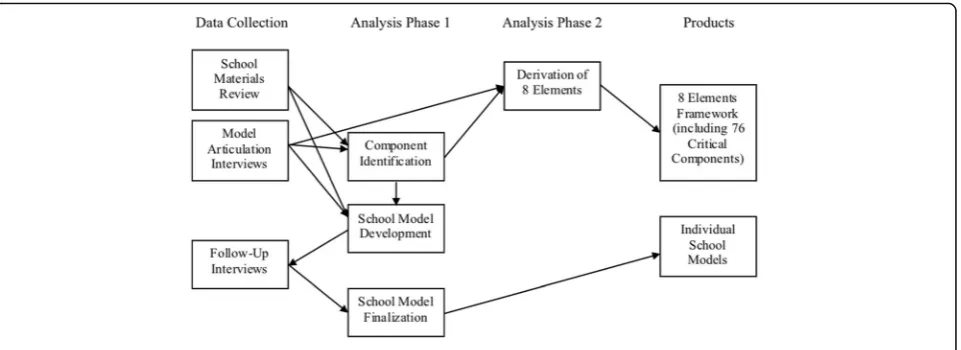
those developers, and (c) individuals involved in pro-gram implementation. Thus, we began the process of ar-ticulating each school’s critical components by reviewing schools’ written materials and conducting “model articulation” interviews with the school stake-holders who were most knowledgeable about each re-spective STEM school model (e.g., school founders, principals, and lead teachers).
We obtained written materials about each school from school leaders and school websites, including mission statements, student and parent handbooks, policy docu-ments, presentation materials, links to news stories, school videos, and other descriptive documents. We reviewed these documents prior to the model articula-tion interviews in order to gain a basic understanding of each of the schools and provide context for the inter-views themselves.
We conducted one model articulation interview with each school (N= 20); interviews included one to six leaders at each school (most interviews were conducted with two to three leaders). Participants included school founders, school leaders, key external partners (e.g., community advisors), and lead teachers. Eighteen took place during the spring of 2013, while the remaining two were conducted the following school year due to compli-cations in scheduling. The model articulation interviews used a semi-structured interview process, with an inter-view protocol adapted from Gugiu and Rodriguez-Campos (2007) that focused on precisely delineating and identifying each school model’s critical components. Each interview began with the question,“What are the most important el-ements or components of your school?”The protocol then directed interviewers to probe for more detail on the com-ponents so that each could be fully described and provided a number of sample questions and prompts for use as ap-propriate. In addition to asking the stakeholders to identify and describe the critical components of their school’s
model, these prompts were also used to elicitwhythe com-ponents were critical (i.e., the outcomes they were intended to produce), how they would describe the component to a new student or teacher, what they look like in practice, and which structures or supports may be present to ensure that the component is enacted as intended. For example, if ad-visory was mentioned as a core component of a school, in-terviewers followed up by asking questions such as,“Can you define what you mean by advisory? What are you try-ing to accomplish for students or for the school by havtry-ing an advisory class? If I were a new student, how would you describe advisory to me? What do you want teachers to know about advisory and why it is an important part of the school?” These probing questions were asked for each component mentioned by participants. We reiterated dur-ing these conversations that our focus was on the school’s intentional model or what the school was trying to do or accomplish, rather than what might just be happening there. Each interview lasted up to 2 h.
Follow-up interviews were conducted with 16 of the 20 schools during the 2013–2014 school year. (Two schools were no longer participants in the study at that point. At the other two schools, we were unable to ar-range a time for these interviews with school leaders due to time constraints and scheduling issues despite mul-tiple attempts; however, these schools continued partici-pation in all other aspects of the study including teacher, student, and school leader questionnaires, and in one case, an on-site visit for qualitative data collection). In each follow-up interview, the school leader was present; at some, other stakeholders present during the initial model articulation interviews were present as well. These interviews lasted for approximately 1 h each; the first half of the interview centered on the drafted indi-vidual school model, while the second half focused on gaining deeper understanding of two particular critical components (problem-solving projects and
supported instruction) in each school that identified these as important pieces of their models.
Data analysis phase 1—identifying the critical components of inclusive STEM high schools
A second (non-speaking) researcher took detailed notes during each model articulation interview, and each inter-view was subsequently transcribed verbatim using HyperTranscribe software. Researchers reviewed critical components identified from the five Ohio inclusive STEM high schools in the previously mentioned OSLN study. Then, one researcher conducted a comprehensive coding of each interview with a focus on identifying crit-ical components. Researchers conducted the coding by annotating the interview transcripts in Microsoft Word using the comment function and then organized the coded critical components using Excel spreadsheets. After the first researcher completed coding, a second re-searcher, typically one who was present during the articu-lation interview, reviewed the codes. Both researchers then met to reconcile any differences.
Verifying the components in each STEM school model
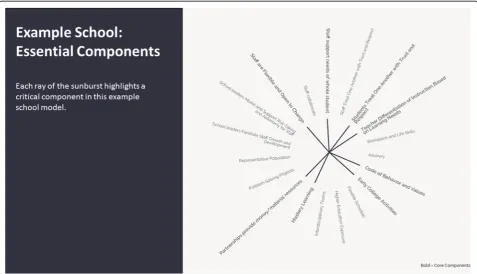
In the next stage of the model articulation process, re-searchers organized the components into a graphic sum-mary model for each school (see Fig. 2 for an example). We shared each STEM school’s model with that school’s stakeholders to gauge face validity, asking school staff
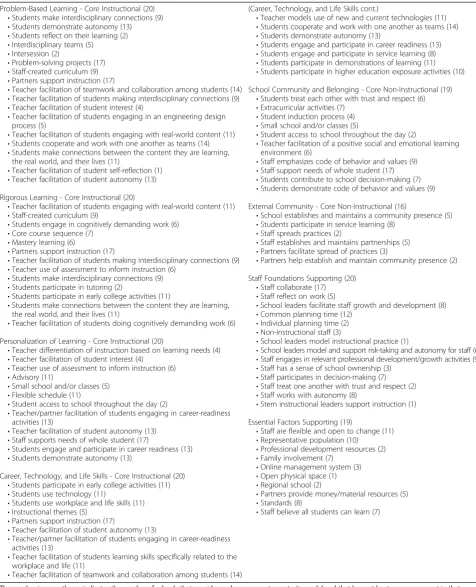
about the accuracy and importance of the components identified in the model, and whether they felt any import-ant part of their school was not represented. In general, school stakeholders felt that models were accurate repre-sentations of their school. Only a few suggested slight lan-guage changes or inclusion of another critical component. Researchers discussed any issues or concerns raised by school leaders or other participants and made agreed-upon changes to the draft models. Each school’s final model included 11–31 critical components agreed upon by two researchers and school interviewees. In total, we identified 76 distinct critical components across all of the schools (see Table 1 for a list of the components and the number of schools that consider each component core to its model).
Data analysis phase 2—deriving the essential elements from identified critical components
After identifying the 76 critical components present across all of the S3 schools, we used a grounded-theory approach (Strauss & Corbin 1994) to explore whether we could de-rive an overarching theoretical framework for inclusive STEM schools in general, as we recognized that a compre-hensive list of 76 different critical components was too de-tailed to provide a clear understanding of just what inclusive STEM high schools are. To derive this frame-work, we used a three-step process of (a) model articula-tion interview transcript review; (b) thematic coding of
Table 1The 8 Elements and components
Problem-Based Learning - Core Instructional (20)
•Students make interdisciplinary connections (9)
•Students demonstrate autonomy (13)
•Students reflect on their learning (2)
•Interdisciplinary teams (5)
•Intersession (2)
•Problem-solving projects (17)
•Staff-created curriculum (9)
•Partners support instruction (17)
•Teacher facilitation of teamwork and collaboration among students (14)
•Teacher facilitation of students making interdisciplinary connections (9)
•Teacher facilitation of student interest (4)
•Teacher facilitation of students engaging in an engineering design process (5)
•Teacher facilitation of students engaging with real-world content (11)
•Students cooperate and work with one another as teams (14)
•Students make connections between the content they are learning, the real world, and their lives (11)
•Teacher facilitation of student self-reflection (1)
•Teacher facilitation of student autonomy (13)
Rigorous Learning - Core Instructional (20)
•Teacher facilitation of students engaging with real-world content (11)
•Staff-created curriculum (9)
•Students engage in cognitively demanding work (6)
•Core course sequence (7)
•Mastery learning (6)
•Partners support instruction (17)
•Teacher facilitation of students making interdisciplinary connections (9)
•Teacher use of assessment to inform instruction (6)
•Students make interdisciplinary connections (9)
•Students participate in tutoring (2)
•Students participate in early college activities (11)
•Students make connections between the content they are learning, the real world, and their lives (11)
•Teacher facilitation of students doing cognitively demanding work (6)
Personalization of Learning - Core Instructional (20)
•Teacher differentiation of instruction based on learning needs (4)
•Teacher facilitation of student interest (4)
•Teacher use of assessment to inform instruction (6)
•Advisory (11)
•Small school and/or classes (5)
•Flexible schedule (11)
•Student access to school throughout the day (2)
•Teacher/partner facilitation of students engaging in career-readiness activities (13)
•Teacher facilitation of student autonomy (13)
•Staff supports needs of whole student (17)
•Students engage and participate in career readiness (13)
•Students demonstrate autonomy (13)
Career, Technology, and Life Skills - Core Instructional (20)
•Students participate in early college activities (11)
•Students use technology (11)
•Students use workplace and life skills (11)
•Instructional themes (5)
•Partners support instruction (17)
•Teacher facilitation of student autonomy (13)
•Teacher/partner facilitation of students engaging in career-readiness activities (13)
•Teacher facilitation of students learning skills specifically related to the workplace and life (11)
•Teacher facilitation of teamwork and collaboration among students (14)
(Career, Technology, and Life Skills cont.)
•Teacher models use of new and current technologies (11)
•Students cooperate and work with one another as teams (14)
•Students demonstrate autonomy (13)
•Students engage and participate in career readiness (13)
•Students engage and participate in service learning (8)
•Students participate in demonstrations of learning (11)
•Students participate in higher education exposure activities (10)
School Community and Belonging - Core Non-Instructional (19)
•Students treat each other with trust and respect (6)
•Extracurricular activities (7)
•Student induction process (4)
•Small school and/or classes (5)
•Student access to school throughout the day (2)
•Teacher facilitation of a positive social and emotional learning environment (6)
•Staff emphasizes code of behavior and values (9)
•Staff support needs of whole student (17)
•Students contribute to school decision-making (7)
•Students demonstrate code of behavior and values (9)
External Community - Core Non-Instructional (16)
•School establishes and maintains a community presence (5)
•Students participate in service learning (8)
•Staff spreads practices (2)
•Staff establishes and maintains partnerships (5)
•Partners facilitate spread of practices (3)
•Partners help establish and maintain community presence (2)
Staff Foundations Supporting (20)
•Staff collaborate (17)
•Staff reflect on work (5)
•School leaders facilitate staff growth and development (8)
•Common planning time (12)
•Individual planning time (2)
•Non-instructional staff (3)
•School leaders model instructional practice (1)
•School leaders model and support risk-taking and autonomy for staff (6)
•Staff engages in relevant professional development/growth activities (9)
•Staff has a sense of school ownership (3)
•Staff participates in decision-making (7)
•Staff treat one another with trust and respect (2)
•Staff works with autonomy (8)
•Stem instructional leaders support instruction (1)
Essential Factors Supporting (19)
•Staff are flexible and open to change (11)
•Representative population (10)
•Professional development resources (2)
•Family involvement (7)
•Online management system (3)
•Open physical space (1)
•Regional school (2)
•Partners provide money/material resources (5)
•Standards (8)
•Staff believe all students can learn (7)
the critical components; and (c) discussion. Researchers analyzed school stakeholder descriptions of why compo-nents are critical, as well as their descriptions of what the components should look like in practice. For example, when school stakeholders indicated that student auton-omy was a critical component, we studied the interview transcript and context to understand what this looks like in the classroom. One school leader described how stu-dents make decisions in their classes about what content to research and how they will then share the information with other students. This autonomy strategy satisfies a school goal of personalizing instruction—a strategy that allowed students to work with their own interests and fa-vorite presentation styles. By synthesizing school leaders’ descriptions of the underlying educational goals for all components during the interviews, we derived eight themes that encompassed all 76 components, articulated as the eight essential elements of inclusive STEM high schools (see Table 1 for a complete list of the elements and components). We named the elements in ways that we thought were clear, broadly understandable, and, when possible, already defined in the literature; that is, while the components and elements were derived from what the schools themselves said, the element names were assigned by the research team.
Results
The eight elements include six core elements (four instruc-tional and two non-instrucinstruc-tional) as well as two supporting elements. Instructional elements focus on pedagogical strategies and achieving academic goals for students. Non-instructional elements are comprised of strategies that do not directly focus on the academic advancement of stu-dents. These non-instructional elements represent schools’ intentions to facilitate student social and emotional out-comes, as well as to improve the greater STEM education system (beyond the school itself). Supporting elements in-clude strategies and external factors that supportboth In-structional and non-inIn-structional elements. Each of the eight elements is described in more detail below.
It is worth noting that some components appear in more than one element. For example, the component “Teacher Facilitation of Students Engaging in Real-World Content”is part of the“Rigorous Learning” Elem-ent as well as the “Problem-Based Learning” Element. This is because the use of real-world content is both a higher-order thinking strategy (and thus, is part of more rigorous learning (Brundiers et al. 2010)), as well as a key part of the pedagogy underlying problem-based learning. Components may be present in more than one element because the goals and strategies of teaching and learning are complex, and we decided not to artificially isolate them under one element. This flexibil-ity in the framework allows for a more comprehensive
understanding of the purpose and function of each indi-vidual component. Not every school included each element in its model (see Table 1), and even when ele-ments were present, each school emphasized different components to differing degrees, defining their unique school models.
The eight essential elements
Instructional elements
Personalization of Learning The Personalization of Learning Element represents the idea that learning should be customized for each student’s unique ability and interests. The Bill and Melinda Gates Foundation (2014) defines personalized learning as “[s]ystems and approaches that deepen student learning by tailoring in-struction to each individual student’s needs, skills, and interests” (p. 2). Personalization of Learning takes the classroom away from a “one-size-fits-all” strategy to allow for truly individualized instruction. Examples of components that comprise the Personalization of Learn-ing Element include “teacher differentiation of instruc-tion based on learning needs,” “flexible schedule,” and “student autonomy.”
Problem-Based Learning (PBL) Generally speaking, PBL is an instructional approach that requires students to solve a problem to meet a learning goal (Savery 2015). However, school leaders defined PBL in many ways. For example, PBL may involve a long-term project that takes place over several weeks or it may take place within one class period. Some PBL tasks or projects involve fabri-cated problems, while others focus on a problem that exists in the real world. However, the components within the PBL Element encompass strategies that PBL definitions share. Components that comprise the PBL Element include “students make interdisciplinary con-nections,” “external partners support instruction,” and “teacher facilitation of students engaging in real-world content.”
Career, Technology, and Life Skills This element en-tails instruction and learning experiences that focus on proficiencies that students will use in college, future ca-reers, and life in general. Components may focus specif-ically on the development of knowledge and skills necessary to join the STEM workforce, and/or include skills that will be useful in any future workplace, such as communication and time management. Examples of components included in this element include “students use technology,” “students participate in career-readiness activities” (e.g., internships), and “student-led demon-strations of learning.”
Non-instructional elements
School community and belonging This element fo-cuses on non-instructional aspects of student develop-ment. This includes instilling a strong school culture and providing students with support for emotional needs. Many inclusive STEM high schools describe their culture as a crucial piece of student success. Some schools described a “family” culture, while others fo-cused on a school-wide culture of professionalism, for example. Other examples of components that comprise this element include“staff support the needs of the whole student,” “students treat each other with trust and respect,” “students contribute to school decision-making,”and“staff emphasize on a school code of behavior and values.”
External Community External Community represents schools’ efforts and commitment to establishing and maintaining relationships with community members and institutions. In some cases, schools may have a strong commitment to giving back to their local or state commu-nity. In others, schools may focus on their presence in the STEM education community and feel that a critical part of their success includes sharing best practices and strat-egies with other schools. Examples of components that comprise this element include “school establishes and maintains a community presence,” “staff spread practices,” and“students participate in service learning.”
Supporting elements
Staff Foundations This element centers on intentional activities in a school’s model that enable instructional and non-instructional teacher behaviors. Staff Foundations are components that“set the stage”for student-directed com-ponents to take place. In order to implement instructional and non-instructional components such as those de-scribed above, schools in our sample report that certain foundations must be in place. For example,“staff collabor-ation”and“school leader supports staff growth and devel-opment” can set the foundation for components such
as “teacher facilitation of interdisciplinary connections” (found in the Problem-Based Learning and Rigorous Learning Elements) to occur. Other examples of compo-nents included in this element include“staff participate in decision-making”and“common planning time.”
Essential Factors The model articulation process also yielded a group of factors (contexts and conditions) that school stakeholders identified as key to the successful implementation of their schools. We define factors as components external to the school model (i.e. not part of the school itself ) that can contribute to or inhibit im-plementation (Century et al. 2012). Factors may include characteristics of the organization where the innovation resides, the external climate (political, community) sur-rounding the innovation, and characteristics of the user. For example, some schools described“family involvement” as an important support for enacting the school’s mission. Other schools described key staff attitudes (such as a “be-lief that all students can learn”) as a necessary support to reaching school goals. Both family involvement and staff attitudes, although not technically part of the inclusive STEM high schools themselves, can affect implementation of the school model. Several of these factors were of such importance to the schools that we felt they warranted in-clusion as one of the eight elements in the framework. Other components in essential factors include “staff are flexible and open to change” and designation as a “re-gional school.”
Discussion
The eight elements show that high-quality, constructivist practices are central to our STEM schools’models. The components described by school leaders as critical to their model represent a variety of pedagogical ap-proaches, skills that students may use in future academic and career endeavors, and strategies for engaging staff, students, and communities.
component is extremely important—course content and projects are heavily influenced by the incorporation of EDP. Consensus-building was the key focus in synthesis of the eight overarching elements, as we sought to create a framework that represented the major aspects of inclu-sive STEM high schools in general. One of the strengths of this framework is that even as it creates common lan-guage around what STEM schools have in common, it also allows us to see the variation that exists between STEM school models. As such, not all schools have essen-tial components across all of the eight elements. For example, building and giving back to the External Com-munity was not a key focus for several schools, and they do not have any critical components in this element. However, this element was identified as critical in many other schools, who do feel that a core part of their mission is to improve STEM education outside of their school, or to be an active, contributing member of their community.
Our desire to include all critical components identified by schools stems from our philosophy that there is no one cor-rect model for an inclusive STEM high school. This is not a prescriptive framework; the goal is to facilitate outcomes re-search that can effectively account for these varied and complex contexts. This framework also serves as a tool for practitioners to build models based on goals for students.
In examining these critical components, however, we found one particularly noteworthy theme: a surprising lack of components that relate specifically to the science, technology, engineering, and math disciplines. This is not to say that the STEM schools involved in the study do not value the STEM subjects—the STEM disciplines are certainly present in these schools. Some STEM high schools focus heavily on STEM subjects by requiring a more rigorous course sequence in science and mathem-atics than what is required at the state level. Others in-corporate a broader scope of STEM disciplinary courses, such as requiring all students to take an introductory en-gineering course. Still, others focus on STEM disciplines by integrating STEM disciplinary content across all courses, including English Language Arts and History. The importance of rigorous course content (STEM and non-STEM) is reflected in the Rigorous Learning Elem-ent, and future work in this study will more closely examine the extent to which STEM discipline-specific content is delivered in these schools. Still, it became clear during the model articulation process that when school leaders referred to “STEM,” they were often not referring to disciplinary subjects. This finding suggests that STEM school leaders and stakeholders view a STEM school identity, and STEM in general, as rooted in the instructional practices (such as PBL and student-centered learning) employed in, transferrable skills fo-cused on, and positive and inclusive culture created at these schools.
The schools participating in this study seek to trans-form learning in all of the disciplines they teach; as such, the disciplinary STEM focus may be more implicit than other goals. When we asked school leaders about the missions and goals of their schools, they often described the importance of engaging students with real-world problems and developing them as critical thinkers and active citizens. These ideals, as well as many of the in-structional approaches highlighted by the schools, far predate the STEM movement. Educational philosophers such as Dewey (1998), Piaget (Henson, 2003), Vygotsky (Moll, 1992), and Bruner (1960) have advocated for such approaches for over a century. These philosophers en-couraged educators to view students as active partici-pants in their own learning and considered citizenship and creative and inventive thinking to be important stu-dent outcomes. Although their strategies have been opera-tionalized in the decades since in a variety of settings, the STEM school movement appears to have provided them with a new home on a national scale. For example,“student autonomy”is as a key focus in most schools and resides in three Elements: Career, Technology, and Life Skills; Problem-Based Learning; and Personalization of Learning. Similarly,“students making connections to the real world” was identified as a component in Problem-Based Learning and Rigorous Learning. “Collaboration,” another central tenet, is a component in Career, Technology, and Life Skills and Problem-Based Learning. In this way, it appears that a modern definition of STEM employed by inclusive STEM high schools may be broader than the disciplines them-selves, as may their goals for students.
discipline-focused selective STEM schools. Further research should examine all STEM school outcomes in the context of these varied models.
Conclusions
Given the growing emphasis on, and interest in, STEM schools, there is an urgent desire to understand their im-pacts on student outcomes. However, impact studies can only come after the field has a well-established way to answer the question: impact ofwhat? This study takes a necessary first step. We have identified an empirically based STEM school model with eight conceptually sound elements, each of which is, in turn, comprised of empirically derived components.
The findings presented provide a portrait of inclusive STEM high schools across the USA. The eight elements and corresponding critical components describe the edu-cational strategies shared by 20 inclusive STEM schools and provide a theoretical basis for measuring the imple-mentation of these elements in inclusive STEM schools and considering the context for student outcome re-search. By studying the implementation of the elements and their components, we can begin to understand how and why they may or may not relate to critical student outcomes, such as positive self-efficacy for STEM disci-plines, interest in STEM careers, college-going decisions, and graduating grade point average.
Practitioners may use this framework to consider how both elements and individual components may fit in with their own goals for students at a school or class-room level. This framework will also help policy-makers consider this same issue at a district or state level. Fi-nally, this framework highlights the varied models and strategies used in inclusive STEM schools, providing im-portant context for researchers considering the examin-ation of implementexamin-ation and student outcomes.
The strength of this framework is in its origin—that is, that it represents what inclusive STEM schools across the USA are actually setting out to do. This is of critical importance given that it seems even those in the same field may be working with varying ideas of what“STEM” means in today’s education context. The eight elements framework bridges the often isolated plains of research and practice, providing common language and a plat-form for communication and coordinated work toward the mutual goal of improving education.
Funding
This study was funded by the National Science Foundation.
Authors’contributions
ML provided conceptual leadership, oversaw the data collection and analyses, and led the writing of this manuscript. EN contributed substantially to the conceptual development, analyses, and writing of this manuscript. HK and SH are additional core developers of the framework. JC, CB, and AI provided
editorial feedback and review. SL created tables, figures, and provided editorial feedback. All authors read and approved the final manuscript.
Competing interests
The authors declare that they have no competing interests.
Author details 1
Outlier Research & Evaluation, UChicago STEM Education, University of Chicago, 1427 E. 60th Street, Chicago, IL 60637, USA.2Current address: Youth
Guidance, 1N. LaSalle Suite 925, Chicago, IL 60602, USA.
Received: 2 September 2016 Accepted: 28 October 2016
References
Alper, J. (1993). The pipeline is leaking women all the way along.Science, 260(5106), 409–411.
Bill & Melinda Gates Foundation. (2014).Early progress: Interim research on personalized learning. Retrieved from http://k12education.gatesfoundation. org/wp-content/uploads/2015/06/Early-Progress-on-Personalized-Learning-Full-Report.pdf
Blackburn, B. R. (2008).Rigor is NOT a four-letter word. Larchmont: Eye on Education.
Blickenstaff, J. C. (2006). Women and science careers: leaky pipeline or gender filter?Gender and Education, 17(4), 369–386. doi:10.1080/09540250500145072. Bond, G. R., Evans, L., Salyers, M., Williams, J., & Hea-Won, K. (2000). Measurement of
fidelity in psychiatric rehabilitation.Mental Health Services Research, 2, 75–87. Brundiers, K., Wiek, A., & Redman, C. L. (2010). Real-world learning opportunities
in sustainability: From classroom into the real world.International Journal of Sustainability in Higher Education, 11(4), 308–324.
Bruner, J. S. (1960).The process of education. Cambridge: Harvard University Press. Century, J., & Cassata, A. (2014). Conceptual foundations for measuring the
implementation of educational innovations. Treatment Integrity: A Foundation for Evidence-Based Practice in Applied Psychology, 81-108 Century, J., Cassata, A., Rudnick, M., & Freeman, C. (2012). Measuring enactment
of innovations and the factors that affect implementation and sustainability: Moving toward common language and shared conceptual understanding. The Journal of Behavioral Health & Services Research,39(4). doi:10.1007/s11414-012-9287-x
Century, J., Rudnick, M., & Freeman, C. (2010). A framework for measuring fidelity of implementation: A foundation for shared language and accumulation of knowledge.American Journal of Evaluation, 31(2), 199–218.
Committee on STEM Education National Science and Technology Council. (2013). Federal science, technology, engineering, and mathematics (STEM) education: 5-year strategic plan.Retrieved from http://www.whitehouse.gov/sites/default/ files/microsites/ostp/stem_stratplan_2013.pdf
Council, N. R. (2011).Successful K-12 STEM Education: Identifying Effective Approaches in Science, Technology, Engineering, and Mathematics. Committee on Highly Successful Science Programs for K-12 Science Education, Board on Science Education and Board on Testing and Assessment, Division of Behavioral and Social Sciences Education. Washington, DC: The National Academies Press.
Council, N. R. (2013).Monitoring Progress Toward Successful STEM Education: A Nation Advancing? Committee on Evaluation Framework for Successful K-12 Education, Board on Science Education, Board on Testing and Assessment, Division of Behavioral and Social Sciences and Education. Washington, DC: The National Academies Press.
Damschroder, L., Aron, D., Keith, R., Kirsh, S., Alexander, J., & Lowery, J. (2009). Fostering implementation of health services research findings into practice: A consolidated framework for advancing implementation science.
Implementation Science,4(50). doi:10.1186/1748-5908-4-50
Dewey, J. (1998).Experience and Education. West Lafayette: Kappa Delta PI. Gnagey, J. & Lavertu, S. (2015). The impact of inclusive STEM high schools on
student achievement.AERA Open. doi:10.1177/2332858416650870 Good, C., Rattan, A., & Dweck, C. S. (2012). Why do women opt out? Sense of
belonging and women's representation in mathematics.Journal of personality and social psychology, 102(4), 700–717.
Gugiu, P. C., & Rodriguez-Campos, L. (2007). Semi-structured interview protocol for constructing logic models.Evaluation and Program Planning, 30(4), 339–350. Hall, G. E., & Hord, S. M. (1987).Change in schools: Facilitating the process. Albany:
Harrison, M. (2011). Supporting the T and the E in STEM: 2004–2010.Design and Technology Education: An International Journal, 16(1), 17–25.
Henson, K. T. (2003). Foundations for learner-centered education: A knowledge base.Education, 124(1), 5–16.
Kelley, T. (2010). Staking the claim for the“T”in STEM.Journal of Technology Studies, 36(1), 2–11.
Klobuchar, A. (2014).STEM education for the innovation economy.Retrieved from http://www.jec.senate.gov/public/?a=Files.Serve&File_id=9bfced75-07a0-466b-a94b-8ab399582995
Langdon, D., McKittrick, G., Beede, D., Khan, B., & Doms, M. (2011).STEM: Good jobs now and for the future. Washington, DC: U.S. Department of Commerce. Retrieved from http://www.esa.doc.gov/sites/default/files/stemfinalyjuly14_1.pdf. Leboy, P. (2008). Fixing the leaky pipeline: Why aren’t there many women in the
top spots in academia?Scientist, 22(1), 67–70.
Leithwood, K. A., & Montgomery, D. J. (1980). Evaluating program implementation. Evaluation Review, 4, 193–214.
Means, B., Confrey, J., House, A., & Bhanot, R. (2008).STEM high schools: Specialized science, technology, engineering, and mathematics secondary schools in the United States. Menlo Park: SRI International.
Merrill, C. (2009).The future of TE masters degrees: STEM. Paper presented at the meeting of the InternationalTechnology Education Association, Louisville, KY Moll, L. (1992).Vygotsky and Education. Cambridge: Cambridge University Press. Mowbray, C. T., Holter, M. C., Teague, G. B., & Bybee, D. (2003). Fidelity criteria:
Development, measurement, and validation.The American Journal of Evaluation, 24, 315–340.
National Academies (National Academy of Sciences, National Academy of Engineering, and Institute of Medicine). (2005).Rising above the gathering storm. Washington, DC: National Academies Press.
Peters-Burton, E. E., Lynch, S. J., Behrend, T. S., & Means, B. B. (2014). Inclusive STEM high school design: 10 critical components.Theory Into Practice, 53(1), 67–71. doi:10.1080/00405841.2014.862125.
Platz, J. (2007). How do you turn STEM into STEAM? Add the Arts! Retrieved from http://www.oaae.net/en/resources/educator/stem-to-steam
President’s Council of Advisors in Science and Technology (PCAST). (2010). Prepare and inspire: K-12 education in science, technology, engineering, and math (STEM) for America’s future. Washington, DC: White House Office of Science and Technology Policy.
Riley, D., McCann, C., & Woods, Y. (2013).Moving STEM education forward: National priorities and the National Science Foundation’s DR K-12 program. Community for Advancing Discovery Research in Education. Retrieved from http://cadrek12.org/sites/default/files/Moving%20STEM%20Education%20 Forward08-02-2013.pdf
Rockland, R., Bloom, D. S., Carpinelli, J., Burr-Alexander, L., Hirsch, L. S., & Kimmel, H. (2010). Advancing the“E”in K-12 STEM education.Journal of Technology Studies, 36(1), 53–64.
Sabelli, N., & Dede, C. (2001). Integrating educational research and practice: Reconceptualizing goals and policies:“How to make what works work for us?”Retrieved from http://www.forschungsnetzwerk.at/downloadpub/2001_ sabelli_policy.pdf
Savery, J. R. (2015). Overview of problem-based learning: Definitions and distinctions.Essential Readings in Problem-Based Learning: Exploring and Extending the Legacy of Howard S. Barrows, 5–15.
Smith, J. L., Lewis, K. L., Hawthorne, L., & Hodges, S. D. (2013). When trying hard isn’t natural women’s belonging with and motivation for male-dominated stem fields as a function of effort expenditure concerns.Personality and Social Psychology Bulletin, 39(2), 131–143.
Strauss, A., & Corbin, J. (1994). Grounded theory methodology. In N. K. Denzin & Y. S. Lincoln (Eds.),Handbook of Qualitative Research(pp. 217–285). Thousand Oaks: SAGE Publications.
Subotnik, R. F., & Tai, R. H. (2011).Study of the impact of selective SMT high schools: Reflections on learners gifted and motivated in science and mathematics. Washington, DC: Committee on Highly Successful STEM Schools or Programs for K-12 STEM Education.
Unfried, A., Faber, M., & Wiebe, E. (2014). Gender and Student Attitudes toward Science, Technology, Engineering, and Mathematics. The Friday Institute for Educational Innovation at North Carolina State University
United States Department of Labor. (2007).The STEM workforce challenge: The role of the public workforce system in a national solution for a competitive Science, Technology, Engineering, and Mathematics (STEM) workforce.Washington, DC: Author. Retrieved from http://digitalcommons.ilr.cornell.edu/key_workplace/637
Valla, J. M., & Ceci, S. J. (2014). Breadth-based models of women’s underrepresentation in STEM fields: An integrative commentary on Schmidt (2011) and Nye et al. (2012).Perspectives on Psychological Science, 9(2), 219–224.
Wang, M. C., Nojan, M., Strom, C. D., & Walberg, H. J. (1984). The utility of degree of implementation measures in program implementation and evaluation research.Curriculum Inquiry, 14, 249–286.
Wells, B. H., Sanchez, H. A., & Attridge, J. M. (2007). Modeling student interest in Science, Technology, Engineering and Mathematics. Meeting the growing demand for engineers and their educators 2010–2020.International Summit, IEEE 2007, 50, 1–17.
Wickware, P. (1997). Along the leaky pipeline.Nature, 390, 202–203.
Young, V. M., House, A., Wang, H., Singleton, C., & Klopfenstein, K. (2011).Inclusive STEM schools: Early promise in Texas and unanswered questions. Paper presented at the National Research Council Workshop on Successful STEM Education in K-12 Schools. Washington, DC
Submit your manuscript to a
journal and benefi t from:
7Convenient online submission
7Rigorous peer review
7Immediate publication on acceptance
7Open access: articles freely available online
7High visibility within the fi eld
7Retaining the copyright to your article