Volume 2008, Article ID 347050,16pages doi:10.1155/2008/347050
Research Article
Activity Representation Using 3D Shape Models
Mohamed F. Abdelkader,1Amit K. Roy-Chowdhury,2Rama Chellappa,1and Umut Akdemir3
1Department of Electrical and Computer Engineering and Center for Automation Research, UMIACS, University of Maryland, College Park, MD 20742, USA
2Department of Electrical Engineering, University of California, Riverside, CA 92521, USA 3Siemens Corporate Research, Princeton, NJ 08540, USA
Correspondence should be addressed to Mohamed F. Abdelkader,[email protected]
Received 1 February 2007; Revised 9 July 2007; Accepted 25 November 2007
Recommended by Maja Pantic
We present a method for characterizing human activities using 3D deformable shape models. The motion trajectories of points extracted from objects involved in the activity are used to build models for each activity, and these models are used for classification and detection of unusual activities. The deformable models are learnt using the factorization theorem for nonrigid 3D models. We present a theory for characterizing the degree of deformation in the 3D models from a sequence of tracked observations. This degree, termed as deformation index (DI), is used as an input to the 3D model estimation process. We study the special case of ground plane activities in detail because of its importance in video surveillance applications. We present results of our activity modeling approach using videos of both high-resolution single individual activities and ground plane surveillance activities.
Copyright © 2008 Mohamed F. Abdelkader et al. This is an open access article distributed under the Creative Commons Attribution License, which permits unrestricted use, distribution, and reproduction in any medium, provided the original work is properly cited.
1. INTRODUCTION
Activity modeling and recognition from video is an impor-tant problem, with many applications in video surveillance and monitoring, human-computer interaction, computer graphics, and virtual reality. In many situations, the problem of activity modeling is associated with modeling a represen-tative shape which contains significant information about the underlying activity. This can range from the shape of the silhouette of a person performing an action to the trajectory of the person or a part of his body. However, these shapes are often hard to model because of their deformability and variations under different camera viewing directions.
In all of these situations, shape theory provides powerful methods for representing these shapes [1,2]. The work in this area is divided between 2D and 3D deformable shape representations. The 2D shape models focus on comparing the similarities between two or more 2D shapes [2–6]. Two-dimensional representations are usually computationally efficient and there exists a rich mathematical theory using which appropriate algorithms could be designed. Three-dimensional models have received much attention in the past few years. In addition to the higher accuracy provided by these methods, they have the advantage that they can
potentially handle variations in camera viewpoint. However, the use of 3D shapes for activity recognition has been much less studied. In many of the 3D approaches, a 2D shape is represented by a finite-dimensional linear combination of 3D basis shapes and a camera projection model relating the 3D and 2D representations [7–10]. This method has been applied primarily to deformable object modeling and track-ing. In [11], actions under different variability factors were modeled as a linear combination of spatiotemporal basis actions. The recognition in this case was performed using the angles between the action subspaces without explicitly recovering the 3D shape. However, this approach needs sufficient video sequences of the actions under different viewing directions and other forms of variability to learn the space of each action.
1.1. Major contributions of the paper
the 3D configuration and dynamics of the set of points taking part in the activity. This approach is suitable for representing different activities as shown by experiments in Section 5. This idea has also been used for 2D shape-based representation in [12, 13]. We also propose a method for estimating the amount of deformation of a shape sequence by deriving a “deformability index” (DI). Estimation of the DI is noniterative, does not require selecting an arbitrary threshold, and can be done before estimating the 3D structure, which means that we can use it as an input to the 3D nonrigid model estimation process. We study the special case of ground plane activities in more detail as an important application because of its importance in surveillance scenarios. The 3D shapes in this special scenario are constrained by the ground plane which reduces the problem to a 2D shape representation. Our method in this case has the ability to match the trajectories across different camera viewpoints (which would not be possible using 2D shape modeling methods) and the ability to estimate the number of activities using the DI formulation. Preliminary versions of this work appeared in [14,15] and a more detailed analysis of the concept of measuring the deformability was presented in [16].
We have tested our approach on different experimental datasets. First we validate our DI estimate using motion capture data as well as videos of different human activities. The results show that the DI is in accordance with our intuitive judgment and corroborates certain hypotheses prevailing in human movement analysis studies. Subse-quently, we present the results of applying our algorithm to two different applications: view-invariant human activity recognition using 3D models (high-resolution imaging) and detection of anomalies in ground plane surveillance scenario (low-resolution imaging).
The paper is organized as follows.Section 2reviews some of the existing work in event representation and 3D shape theory.Section 3describes the shape-based activity modeling approach along with the special case of ground plane motion trajectories.Section 4presents the method for estimating the DI for a shape sequence. Detailed experiments are presented inSection 5, before concluding inSection 6.
2. RELATED WORK
Activity representation and recognition have been an active area of research for decades and it is impossible to do justice to the various approaches within the scope of this paper. We outline some of the broad trends in this area. Most of the early work on activity representation comes from the field of artificial intelligence (AI) [17,18]. More recent work comes from the fields of image understanding and visual surveil-lance, employing formalisms like hidden Markov models (HMMs), logic programming, and stochastic grammars [19– 29]. A method for visual surveillance using a “forest of sensors” was proposed in [30]. Many uncertainty-reasoning models have been actively pursued in the AI and image understanding literature, including belief networks [31–33], Dempster-Shafer theory [34], dynamic Bayesian networks [35, 36], and Bayesian inference [37]. A specific area of
research within the broad domain of activity recognition is human motion modeling and analysis, which has received keen interest from various disciplines [38–40]. A survey of some of the earlier methods used in vision for tracking human movement can be found in [41], while a more recent survey is in [42].
The use of shape analysis for activity and action recog-nition has been a recent trend in the literature. Kendall’s statistical shape theory was used to model the interactions of a group of people and objects in [43], as well as the motion of individuals [44]. A method for the representation of human activities based on space curves of joint angles and torso location and attitude was proposed in [45]. In [46], the authors proposed an activity recognition algorithm using dynamic instants and intervals as view-invariant features, and the final matching of trajectories was conducted using a rank constraint on the 2D shapes. In [47], each human action was represented by a set of 3D curves which are quasi-invariant to the viewing direction. In [48, 49], the motion trajectories of an object are described as a sequence of flow vectors, and neural networks are used to learn the distribution of these sequences. In [50], a wavelet transform was used to decompose the raw trajectory into components of different scales, and the different subtrajectories are matched against a data base to recognize the activity.
In the domain of 3D shape representation, the approach of approximating a nonrigid object by a composition of basis shapes has been useful in certain problems related to object modeling [51]. However, there has been little analysis of its usefulness in activity modeling, which is the focus of this paper.
3. SHAPE-BASED ACTIVITY MODELS
3.1. Motivation
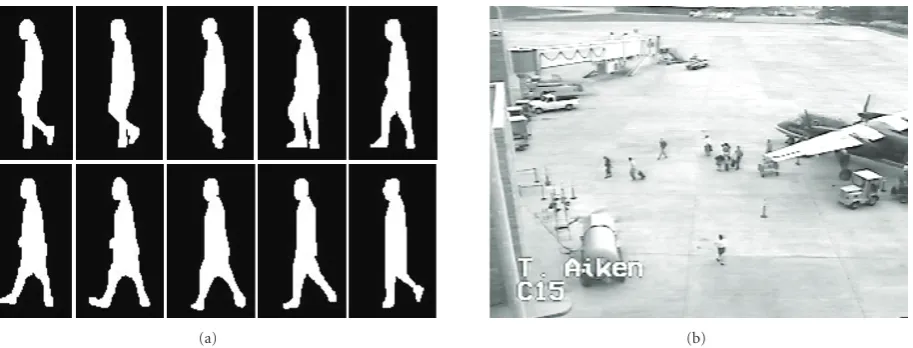
We propose a framework for recognizing activities by first extracting the trajectories of the various points taking part in the activity, followed by a nonrigid 3D shape model fitted to the trajectories. It is based on the empirical observation that many activities have an associated structure and a dynamical model. Consider, as an example, the set of images of a walking person inFigure 1(a)(obtained from the USF database for the gait challenge problem [52]). The binary representation clearly shows the change in the shape of the body for one complete walk cycle. The person in this figure is free to move his/her hands and feet any way he/she likes. However, this random movement does not constitute the activity of walking. For humans to perceive and appreciate the walk, the different parts of the body have to move in a certain synchronized manner. In mathematical terms, this is equivalent to modeling the walk by the deformations in the shape of the body of the person. Similar observations can be made for other activities performed by a single human, for example, dancing, jogging, sitting, and so forth.
(a) (b)
Figure1: Two examples of activities: (a) the binary silhouette of a walking person and (b) people disembarking from an airplane. It is clear that both of these activities can be represented by deformable shape models using the body contour in (a) and the passenger/vehicle motion paths in (b).
Figure 1(b)). Every person after disembarking is free to move as he/she likes. However, this does not constitute the activity of people getting offa plane and heading to the terminal. The activity here is comprised of people walking along a path that leads to the terminal. Again, we see that the activity can be modeled by the shape of the trajectories taken by the passengers. Using deformable shape models is a higher-level abstraction of the individual trajectories, and it provides a method of analyzing all the points of interest together, thus modeling their interactions in a very elegant way.
Not only is the activity represented by a deformable shape sequence, but also the amount of deformation is different for different activities. For example, it is reasonable to say that the shape of the human body while dancing is usually more deformable than during walking, which is more deformable than when standing still. Since it is possible for the human observer to roughly infer the degree of deformability based on the contents of the video sequence, the information about how deformable a shape is must be contained in the sequence itself. We will use this intuitive notion to quantify the deformability of a shape sequence from a set of tracked points on the object. In our activity representation model, a deformable shape is represented as a linear combination of rigid basis shapes [7]. The deformability index provides a theoretical framework for estimating the required number of basis shapes.
3.2. Estimation of deformable shape models
We hypothesize that each shape sequence can be represented by a linear combination of 3D basis shapes. Mathematically, if we consider the trajectories of P points representing the shape (e.g., landmark points), then the overall configuration of thePpoints is represented as a linear combination of the basis shapesSias
S=
K
i=1
liSi, S,Si∈R3×P, l∈R, (1)
wherelirepresents the weight associated with the basis shape Si.
The choice of K is determined by quantifying the deformability of the shape sequence, and it will be studied in detail in Section 4. We will assume a weak perspective projection model for the camera.
A number of methods exist in the computer vision literature for estimating the basis shapes. In the factorization paper for structure from motion [53], the authors considered P points tracked across F frames in order to obtain two F×P matrices, that is,UandV. Each row of Ucontains the x-displacements of all the P points for a specific time frame, and each row of V contains the corresponding y -displacements. It was shown in [53] that for 3D rigid motion and the orthographic camera model, the rank r of the concatenation of the rows of the two matrices [U/V] has an upper bound of 3. The rank constraint is derived from the fact that [U/V] can be factored into two matrices,M2F×r andSr×P, corresponding to the pose and 3D structure of the
scene, respectively. In [7], it was shown that for nonrigid motion, the above method could be extended to obtain a similar rank constraint, but one that is higher than the bound for the rigid case. We will adopt the method suggested in [7] for computing the basis shapes for each activity. We will outline the basic steps of their approach in order to clarify the notation for the remainder of the paper.
Given F frames of a video sequence with P moving points, we first obtain the trajectories of all these points over the entire video sequence. ThesePpoints can be represented in a measurement matrix as
W2F×P= ⎡ ⎢ ⎢ ⎢ ⎢ ⎢ ⎢ ⎢ ⎢ ⎣
u1,1 · · · u1,P v1,1 · · · v1,P
..
. ... ... uF,1 · · · uF,P vF,1 · · · vF,P ⎤ ⎥ ⎥ ⎥ ⎥ ⎥ ⎥ ⎥ ⎥ ⎦
whereuf,p represents thex-position of the pth point in the fth frame andvf,p represents the y-position of the same point. Under weak perspective projection, the P points of a configuration in a frame f are projected onto 2D image points (uf,i,vf,i) as
uf,1 · · · uf,P vf,1 · · · vf,P
=Rf K
i=1 lf,iSi
+Tf, (3)
where
Rf =
rf1 rf2 rf3 rf4 rf5 rf6
Δ
= ⎡ ⎣R(1)f
R(2)f
⎤
⎦. (4)
Rf represents the first two rows of the full 3D camera rotation matrix and Tf is the camera translation. The translation component can be eliminated by subtracting out the mean of all the 2D points, as in [53]. We now form the measurement matrix W, which was represented in (2), with the means of each of the rows subtracted. The weak perspective scaling factor is implicitly coded in the configuration weights{lf,i}.
Using (2) and (3), it is easy to show that
W= ⎡ ⎢ ⎢ ⎢ ⎢ ⎢ ⎣
l1,1R1 · · · l1,KR1 l2,1R2 · · · l2,KR2
..
. ... ... lF,1RF · · · lF,KRF
⎤ ⎥ ⎥ ⎥ ⎥ ⎥ ⎦ ⎡ ⎢ ⎢ ⎢ ⎢ ⎢ ⎣
S1 S2 .. . SK
⎤ ⎥ ⎥ ⎥ ⎥ ⎥
⎦=Q2F×3K·B3K×P, (5)
which is of rank 3K. The matrix Q contains the pose for each frame of the video sequence and the weightsl1,. . .,lK. The matrix B contains the basis shapes corresponding to each of the activities. In [7], it was shown that Q and
B can be obtained by using singular value decomposition (SVD) and retaining the top 3Ksingular values, asW2F×P=
UDVT andQ = UD1/2 andB = D1/2VT. The solution is unique up to an invertible transformation. Methods have been proposed for obtaining an invertible solution using the physical constraints of the problem. This has been dealt with in detail in previous papers [9, 51]. Although this is important for implementing the method, we will not dwell on it in detail in this paper and will refer the reader to previous work.
3.3. Special case: ground plane activities
A special case of activity modeling that often occurs is the case of ground plane activities, which are often encoun-tered in applications such as visual surveillance. In these applications, the objects are far away from the camera such that each object can be considered as a point moving on a common plane such as the ground plane of the scene under consideration. Because of the importance of such configurations, we study them in more detail and present an approach for using our shape-based activity model to
π x
y z
x
Xπ C
Figure2: Perspective images of points in a plane [57]. The world coordinate system is moved in order to be aligned with the planeπ.
represent these ground plane activities. The 3D shapes in this case are reduced to 2D shapes due to the ground plane constraint. The main reason for using our 3D approach (as opposed to a 2D shape matching one) is the ability to match the trajectories across changes of viewpoint.
Our approach for this situation consists of two steps. The first step recovers the ground plane geometry and uses it to remove the projection effects between the trajectories that correspond to the same activity. The second step uses the deformable shape-based activity modeling technique to learn a nominal trajectory that represents all the ground plane trajectories generated by an activity. Since each activity can be represented by one nominal trajectory, we will not need multiple basis shapes for each activity.
3.3.1. First step: ground plane calibration
Most of the outdoor surveillance systems monitor a ground plane of an area of interest. This area could be the floor of a parking lot, the ground plane of an airport, or any other monitored area. Most of the objects being tracked and monitored are moving on this dominant plane. We use this fact to remove the camera projection effect by recovering the ground plane and projecting all the motion trajectories back onto this ground plane. In other words, we map the motion trajectories measured at the image plane onto the ground plane coordinates to remove these projective effects. Many automatic or semiautomatic methods are available to perform this calibration [54,55]. As the calibration process needs to be performed only one time because the camera is fixed, we are using the semiautomatic method presented in [56], which is based on using some of the features often seen in man-made environments. We will give a brief summary of this method for completeness.
Consider the case of points lying on a world plane π, as shown inFigure 2. The mapping between points Xπ = (X,Y, 1)T on the world plane π and their image x is a general planar homography—a plane-to-plane projective transformation—of the form x = HXπ, with H being a 3×3 matrix of rank 3. This projective transformation can be decomposed into a chain of more specialized transforma-tions of the form
H=HSHAHP, (6)
Stage 1: from projective to affine
This is achieved by determining the pure projective transfor-mation matrixHP. We note that the inverse of this projective transformation is also a projective transformationHP, which can be written as
HP=
⎡ ⎢ ⎣
1 0 0 0 1 0
l1 l2 l3
⎤ ⎥
⎦, (7)
where l∞ = (l1,l2,l3)T is the vanishing line of the plane,
defined as the line connecting all the vanishing points for lines lying on the plane.
From (7), it is evident that identifying the vanishing line is enough to remove the pure projective part of the projection. In order to identify the vanishing line, two sets of parallel lines should be identified. Parallel lines are easy to find in man-made environments (e.g., parking space markers, curbs, and road lanes).
Stage 2: from affine to metric
The second stage of the rectification is the removal of the affine projection. As in the first stage, the inverse affine transformation matrix HA can be written in the following form:
HA=
⎡ ⎢ ⎢ ⎢ ⎢ ⎣ 1 β − α β 0
0 1 0
0 0 1
⎤ ⎥ ⎥ ⎥ ⎥
⎦. (8)
Also, this matrix has two degrees of freedom represented byα andβ. These two parameters have a geometric interpretation as representing the circular points, which are a pair of points at infinity that are invariant to Euclidean transformations. Once these points are identified, metric properties of the plane are available.
Identifying two affine invariant properties on the ground plane can be sufficient to obtain two constraints on the values ofαandβ. Each of these constraints is in the form of a circle. These properties include a known angle between two lines, equality of two unknown angles, and a known length ratio of two line segments.
3.3.2. Second step: learning trajectories
After recovering the ground plane (i.e., finding the projective
HPand affineHAinverse transformations), the motion tra-jectories of the objects are reprojected to their ground plane coordinates. Havingmdifferent trajectories of each activity, the goal is to obtain a nominal trajectory that represents all of these trajectories. We assume that all these trajectories have the same 2D shape up to a similarity transformation (translation, rotation, and scale). This transformation will compensate for the way the activity was performed in the scene. We use the factorization algorithm to obtain the shape of this nominal trajectory from all the motion trajectories.
For a certain activity that we wish to learn, letTjbe the jth ground plane trajectory of this activity. This trajectory was obtained by tracking an object performing the activity in the image plane overnframes and by projecting these points onto the ground plane as
Tj=
⎡ ⎢ ⎢ ⎣
xj1 · · · xjn yj1 · · · yjn 1 · · · 1
⎤ ⎥ ⎥
⎦=HAHP ⎡ ⎢ ⎢ ⎣
uj1 · · · ujn vj1 · · · vjn 1 · · · 1
⎤ ⎥ ⎥
⎦, (9)
whereu,vare the 2D image plane coordinates,x,yare the ground plane coordinates, and HP and HA are the pure projective and affine transformations from image to ground planes, respectively.
Assume, except for a noise termηj, that all the different trajectories correspond to the same 2D nominal trajectory Sbut have undergone 2D similarity transformations (scale, rotation, and translation). Then
Tj=HS jS+ηj
= ⎡ ⎢ ⎢ ⎣
sjcosθj −sjsinθj tx j sjsinθj sjcosθj ty j
0 0 1
⎤ ⎥ ⎥ ⎦ ⎡ ⎢ ⎢ ⎣
x1 · · · xn
y1 · · · yn 1 · · · 1
⎤ ⎥ ⎥ ⎦+ηj,
(10)
where HS j is the similarity transformation between the jth trajectory and S. This relation can be rewritten in inhomogeneous coordinates as
Tj=
sjcosθj −sjsinθj sjsinθj sjcosθj
x1 · · · xn
y1 · · · yn
+ tx j ty j
+ηj
=sjRjS+tj+ηj,
(11)
wheresj,Rj, andtjrepresent the scale, rotation matrix, and translation vector, respectively, between the jth trajectory and the nominal trajectoryS.
In order to explore the temporal behavior of the activity trajectories, we divide each trajectory into small segments at different time scales and explore these segments. By applying this time scaling technique, which will be addressed in detail in Section 5, we obtainmdifferent trajectories, each withn points. Given these trajectories, we can construct a measurement matrix of the form
W= ⎡ ⎢ ⎢ ⎢ ⎢ ⎢ ⎣ T1 T2 .. . Tm ⎤ ⎥ ⎥ ⎥ ⎥ ⎥ ⎦= ⎡ ⎢ ⎢ ⎢ ⎢ ⎢ ⎢ ⎣
x11 · · · x1n y11 · · · y1n
..
. ... xm1 · · · xmn ym1 · · · ymn ⎤ ⎥ ⎥ ⎥ ⎥ ⎥ ⎥ ⎦
2m×n
As before, we subtract the mean of each row to remove the translation effect. Substituting from (11), the measurement matrix can be written as
W= ⎡ ⎢ ⎢ ⎢ ⎢ ⎣ s1R1 s2R2 .. . smRm
⎤ ⎥ ⎥ ⎥ ⎥ ⎦S+
⎡ ⎢ ⎢ ⎢ ⎢ ⎣ η1 η2 .. . ηm ⎤ ⎥ ⎥ ⎥ ⎥ ⎦
=P2m×2S2×n+η.
(13)
Thus in the noiseless case, the measurement matrix has a maximum rank of two. The matrix Pcontains the pose or orientation for each trajectory. The matrix S contains the shape of the nominal trajectory for this activity.
Using the rank theorem for noisy measurements, the measurement matrix can be factorized into two matricesP andSby using SVD and retaining the top two singular values, as shown before:
W =UDVT, (14)
and takingP=UD1/2andS=D1/2VT, whereU,D,V are the truncated versions ofU,D,V by retaining only the top two singular values. However, this factorization is not unique, as for any nonsingular 2×2 matrixQ,
W =PS= PQQ−1S. (15)
So we want to remove this ambiguity by finding the matrix Q that would transformP andSinto the pose and shape matricesP = PQ andS = Q−1Sas in (13). To find Q, we use the metric constraint on the rows ofP, as suggested in [53].
By multiplyingPby its transposePT, we get
PPT =
⎡ ⎢ ⎢ ⎣ s1R1 .. . smRm
⎤ ⎥ ⎥ ⎦
s1R1 · · · smRm = ⎡ ⎢ ⎢ ⎣ s2
1I2
. .. s2
mI2
⎤ ⎥ ⎥ ⎦,
(16)
where I2 is a 2×2 identity matrix. This follows from the orthonormality of the rotation matricesRj. Substituting for P=PQ , we get
PPT=PQQ TPT =
⎡ ⎢ ⎢ ⎢ ⎢ ⎢ ⎢ ⎣ a1 b1 .. . am bm ⎤ ⎥ ⎥ ⎥ ⎥ ⎥ ⎥ ⎦
QQTaT
1 bT1 · · · aTm bTm
,
(17)
whereai andbi,i = 1 : m, are the odd and even rows of
P, respectively. From (16) and (17), we obtain the following constraints on the matrixQQT, for alli=1,. . .,m, such that
aiQQTaTi =biQQTbTi =s2i,
aiQQTbTi =0.
(18)
Using these 2m constraints on the elements of QQT, we can find the solution for QQT. Then Q can be estimated through SVD, and it is unique up to a 2×2 rotation matrix. This ambiguity comes from the selection of the reference coordinate system and it can be eliminated by selecting the first trajectory as a reference, that is, by selectingR1=I2×2.
3.3.3. Testing trajectories
In order to test whether an observed trajectoryTxbelongs to a certain learnt activity or not, two steps are needed.
(1) Compute the optimal rotation and scaling matrixsxRx in the least square sense such that
TxsxRxS, (19)
x1 · · · xn y1 · · · yn
sxRx x1y1 · · ·· · · xyn n
. (20)
The matrix sxRx has only two degrees of freedom, which correspond to the scalesxand rotation angleθx; we can write the matrixsxRxas
sxRx=
sxcosθx −sxsinθx sxsinθx sxcosθx
. (21)
By rearranging (20), we get 2nequations in the two unknown elements ofsxRxin the form
⎡ ⎢ ⎢ ⎢ ⎢ ⎢ ⎢ ⎢ ⎢ ⎣ x1 y1 .. . xm ym ⎤ ⎥ ⎥ ⎥ ⎥ ⎥ ⎥ ⎥ ⎥ ⎦ = ⎡ ⎢ ⎢ ⎢ ⎢ ⎢ ⎢ ⎢ ⎢ ⎣
x1 −y1
y1 x1
.. . ...
xm −ym
ym xm
⎤ ⎥ ⎥ ⎥ ⎥ ⎥ ⎥ ⎥ ⎥ ⎦
sxcosθx sxsinθx
. (22)
Again, this set of equations is solved in the least square sense to find the optimalsxRx parameters that minimize the mean square error between the tested trajectory and the rotated nominal shape for this activity.
(2) After the optimal transformation matrix is calcu-lated, the correlation between the trajectory and the transformed nominal shape is calculated and used for making a decision. The Frobenius norm of the error matrix is used as an indication of the level of correlation, which represents the mean square error (MSE) between the two matrices. The error matrix is calculated as the difference between the tested trajectory matrixTxand the rotated activity shape as follows:
Δx=Tx−sxRxS. (23)
The Frobenius norm of a matrixAis defined as the square root of the sum of the absolute squares of its elements:
AF= m
i=1 n
j=1
a2
The value of the error is normalized with the signal energy to give the final normalized mean square error (NMSE) defined as
NMSE= ΔxF Tx
F+sxRxSF
. (25)
Comparing the value of this NMSE to NMSE values of learnt activities, a decision can be made as to whether the observed trajectory belongs to this activity or not.
4. ESTIMATING THE DEFORMABILITY INDEX (DI) In this section, we present a theoretical method for estimat-ing the amount of deformation in a deformable 3D shape model. Our method is based on applying subspace analysis on the trajectories of the object points tracked over a video sequence. The estimation of DI is essential for our activity modeling approach that has been explained above. From one point of view, DI represents the amount of deformation in the 3D shape representing the activity. In other words, it represents the number of basis shapes (k in (1)) needed to represent each activity. On the other hand, in the analysis of ground plane activities, the estimated DI can be used to estimate the number of activities in the scene (i.e., to find the number of nominal trajectories) as we assume that each activity can be represented by a single trajectory on the ground plane.
We will use the word trajectory to refer to either the tracks of a certain point of the object across different frames or to the trajectories generated by different objects moving in the scene in the ground plane scenario.
Consider each trajectory obtained from a particular video sequence to be the realization of a random process. Represent thexandycoordinates of the sampled points on these trajectories for one such realization as a vector y = [u1,. . .,uP,v1,. . .,vP]T. Then from (5), it is easy to show that for a particular example withKdistinct motion trajectories (Kis unknown),
yT=l1R(1),. . .,lKR(1),l1R(2),. . .,lKR(2)
∗ ⎡ ⎢ ⎢ ⎢ ⎢ ⎢ ⎢ ⎢ ⎢ ⎢ ⎢ ⎣
S1 .. . Sk
0
0 S1
.. . Sk
⎤ ⎥ ⎥ ⎥ ⎥ ⎥ ⎥ ⎥ ⎥ ⎥ ⎥ ⎦
+ηT
(26)
that is,
y=q1×6Kb6K×2P T
+η=bTqT+η, (27) whereηis a zero-mean noise process. LetRy=E[yyT] be the
correlation matrix ofyand letCηbe the covariance matrix ofη. Hence
Ry=bTE
qTqb+C
η. (28)
Cηrepresents the accuracy with which the feature points are tracked and can be estimated from the video sequence using
the inverse of the Hessian matrix at each of the points. Sinceη need not be an IID noise process,Cηwill not necessarily have a diagonal structure (but it is symmetric). However, consider the singular value decomposition of Cη = PΛPT, where Λ=diagΛs, 0andΛsis anL×Lmatrix of nonzero singular values ofΛ. LetPsdenote the columns ofPcorresponding to the nonzero singular values. Therefore, Cη = PsΛsPTs. Premultiplying (27) byΛ−s1/2PT
s, we see that (27) becomes
y=bTqT+η, (29)
wherey=Λ−s1/2PTsyis anL×1 vector,b=Λ−s1/2PTsbT is an L×6Kmatrix, andη=Λs−1/2PTsη. It can be easily verified that the covariance ofηis an identity matrixIL×L. This is known
as the process of “whitening,” whereby the noise process is transformed to be IID. Representing byRy the correlation
matrix ofy, it is easy to see that
Ry=bTE
qTqb+I=Δ+I. (30) Now,Δis of rank 6K, whereK is the number of activities. Representing byμi(A) theith eigenvalue of the matrixA, we see thatμi(y)=μi(Δ) + 1 fori=1,. . ., 6Kandμi(y)=1 for
i=6K+ 1,. . .,L. Hence, by comparing the eigenvalues of the
observation and noise processes, it is possible to estimate the deformability index. This is done by counting the number of eigenvalues ofRy that are greater than 1, and dividing that
number by 6 to get the DI value. The number of basis shapes can then be obtained by rounding the DI to the nearest integer.
4.1. Properties of the deformability index
(i) For the case of a 3D rigid body, the DI is 1. In this case, the only variation in the values of the vectory
from one image frame to the next is due to the global rigid translation and rotation of the object. The rank of the matrixΔwill be 6 and the deformability index will be 1.
(ii) Estimation of the DI does not require explicit compu-tation of the 3D structure and motion in (5), as we need only to compute the eigenvalues of the covariance matrix of 2D feature positions. In fact, for estimating the shape and rotation matrices in (5), it is essential to know the value ofK. Thus the method outlined in this section should precede computation of the shape inSection 3. Using our method, it is possible to obtain an algorithm for deformable shape estimation without having to guess the value ofK.
(iii) The computation of the DI takes into account any rigid 3D translation and rotation of the object (as recov-erable under a scaled orthographic camera projection model) even though it has the simplicity of working only with the covariance matrix of the 2D projections. Thus it is more general than a method that considers purely 2D image plane motion.
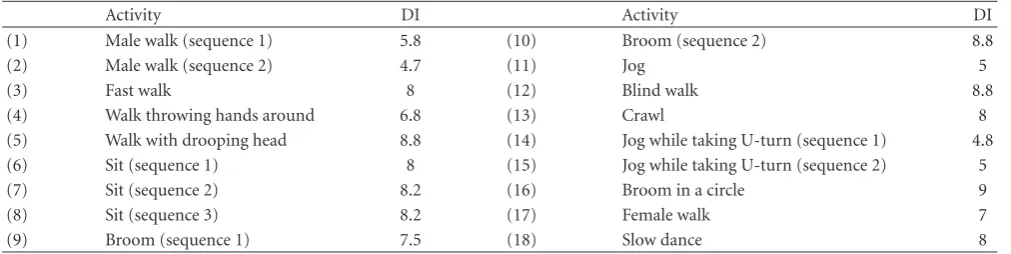
Table1: Deformability index (DI) for human activities using motion-capture data.
Activity DI Activity DI
(1) Male walk (sequence 1) 5.8 (10) Broom (sequence 2) 8.8
(2) Male walk (sequence 2) 4.7 (11) Jog 5
(3) Fast walk 8 (12) Blind walk 8.8
(4) Walk throwing hands around 6.8 (13) Crawl 8
(5) Walk with drooping head 8.8 (14) Jog while taking U-turn (sequence 1) 4.8
(6) Sit (sequence 1) 8 (15) Jog while taking U-turn (sequence 2) 5
(7) Sit (sequence 2) 8.2 (16) Broom in a circle 9
(8) Sit (sequence 3) 8.2 (17) Female walk 7
(9) Broom (sequence 1) 7.5 (18) Slow dance 8
5. EXPERIMENTAL RESULTS
We performed two sets of experiments to show the eff ec-tiveness of our approach for characterizing activities. In the first set, we use 3D shape models to model and recognize the activities performed by an individual, for example, walking, running, sitting, crawling, and so forth. We show the effect of using a 3D model in recognizing these activities from different viewing angles. In the second set of experiments, we provide results for the special case of ground plane surveillance trajectories resulting from a motion detection and tracking system [58]. We explore the effectiveness of our formulation in modeling nominal trajectories and detecting anomalies in the scene. In the first experiment, we assume a robust tracking of the feature points across the sequence. This enables us to focus on whether the 3D models can be used to disambiguate between different activities in various poses and the selection of the criterion to make this decision. However, as pointed out in the original factorization paper [53] and in its extensions to deformable shape model in [7], the rank constraint algorithms can estimate the 3D structure even with noisy tracking results.
5.1. Application in human activity recognition
We used our approach to classify the various activities performed by an individual. We used the motion-capture data [59] available from Credo Interactive Inc. and Carnegie Mellon University in the BioVision Hierarchy and Acclaim formats. The combined dataset includes a number of subjects performing various activities like walking, jogging, sitting, crawling, brooming, and so forth. For each activity, we have multiple video sequences consisting of 72 frames each, acquired at different view points.
5.1.1. Computing the DI for different human activities
For the different activities in the database, we used an articulated 3D model for the body that contains 53 tracked feature points. We used the method described inSection 4 on the trajectories of these points to compute the DI for each of these sequences. These values are shown in Table 1 for various activities. Please note that the DI is used to estimate
the number of basis shapes needed for 3D deformable object modeling, not for activity recognition.
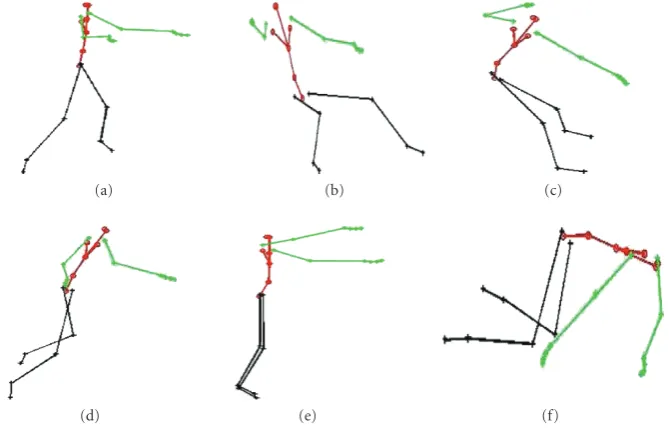
FromTable 1, a number of interesting observations can be made. For the walk sequences, the DI is between 5 and 6. This matches the hypotheses in papers on gait recognition where it is mentioned that about five exemplars are necessary to represent a full cycle of gait [60]. The number of basis shapes increases for fast walk, as expected from some of the results in [61]. When the stick figure person walks doing some other things (like moving head or hands or a blind person’s walk), the number of basis shapes needed to represent it (i.e., the deformability index) increases more than that of normal walk. The result that might seem surprising initially is the high DI for sitting sequences. On closer examination though, it can be seen that the stick figure, while sitting, is making all kinds of random gestures as if talking to someone else, increasing the DI for these sequences. Also, the DI is insensitive to changes in viewpoint (azimuth angle variation only), as can be seen by comparing the jog sequences (14 and 15 with 11) and broom sequences (16 with 9 and 10). This is not surprising since we do not expect the deformation of the human body to change due to rotation about the vertical axis. The DI, thus calculated, is used to estimate the 3D shapes, some of which are shown in Figure 3and used in activity recognition experiments.
5.1.2. Activity representation using 3D models
(a) (b) (c)
(d) (e) (f)
Figure3: Plots of the first basis shapS1for (a)–(c) walk, sit, and broom sequences and for (d)–(f) jog, blind walk, and crawl sequences.
a b c
d e
f g
h i
j
Angles we are using in our correlation criteria (ordered from highest weights to lowest)
1.c→angle between hip-abdomen and vertical axis
2.h→angle between hip-abdomen and chest
3. (a+b)/2→average angle between two legs and abdomen-hip axis
4. (b−a)/2→the angle difference between two upper legs
5. (i+j)/2→average angle between upper legs and lower legs
6. (d+e)/2→average angle between upper arms and abdomen-chest
7. (f+g)/2→average angle between upper arms and lower arms
(a)
1 2 3 4 5 6 7 8 9 10 11 12 13 14 15 16 17 18
1 2 3 4 5 6 7 8 9 10 11 12 13 14 15 16 17 18
(b)
Figure4: (a) The various angles used for computing the similarity of two models are shown in the figure. The text below describes the seven-dimensional vector computed from each model whose correlation determines the similarity scores. (b) The similarity matrix for the various activities, including ones with different viewing directions. The numbers correspond to the numbers inTable 1for 1–16. 17 and 18 correspond to sitting and walking, where the training and test data are from two different viewing directions.
Figure 4(a). The idea of considering joint angles for activity modeling has been suggested before in [45]. We considered the seven-dimensional vector obtained from the angles as shown in Figure 4(a). The distance between the two angle vectors was used as a measure of similarity. Thus small differences indicate higher similarity.
The similarity matrix is shown inFigure 4(b). The row and column numbers correspond to the numbers inTable 1 for 1–16, while 17 and 18 correspond to sitting and walking, where the training and test data are from two different viewing directions. For the moment, consider the upper 13×13 block of this matrix. We find that the different walk
sequences are close to each other; this is also true for sitting and brooming sequences. The jog sequence, besides being closest to itself, is also close to the walk sequences. Blind walk is close to jogging and walking. The crawl sequence does not match any of the rest and this is clear from row 13 of the matrix. Thus, the results obtained using our method are reasonably close to what we would expect from a human observer, which support the use of this representation in activity recognition.
1 0.8
0.6 0.4
0.2 0
Recall 0.5
0.55 0.6 0.65 0.7 0.75 0.8 0.85 0.9 0.95 1
P
recision
(a)
1 0.8
0.6 0.4
0.2 0
Recall 0.2
0.3 0.4 0.5 0.6 0.7 0.8 0.9 1
P
recision
(b)
1 0.8
0.6 0.4
0.2 0
Recall 0.1
0.2 0.3 0.4 0.5 0.6 0.7 0.8 0.9 1
P
recision
(c)
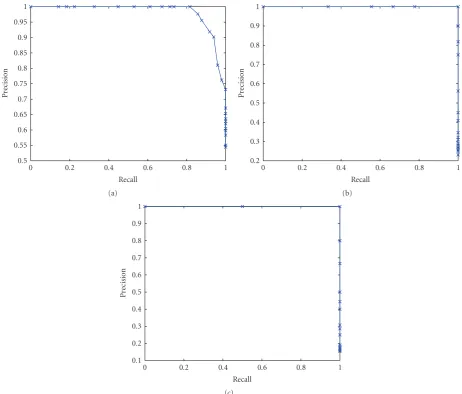
Figure5: The recall versus precision rates for the detection of three different clusters of activities. (a) Walking activities (activities 1–5, 11, and 12 inTable 1). (b) Sitting activities (activities 6–9 inTable 1). (c) Brooming activities (activities 9 and 10 inTable 1).
applied different thresholds on the matrix and calculated the recall and precision values for each cluster. The first cluster contains the walking sequences along with jogging and blind walk (activities 1–5, 11, and 12 inTable 1).Figure 5(a)shows the recall versus precision values for this activity cluster; we can see from the figure that we are able to identify 90% of these activities with a precision up to 90%. The second cluster consists of three sitting sequences (activities 6–8 in Table 1), and the third cluster consists of the brooming sequences (activities 9 and 10 inTable 1). For both of these clusters the similarity values were quite separated to the extent that we were able to fully separate the positive and negative examples. This resulted in the recall versus precision curves as shown in Figures5(b)and5(c).
5.1.3. View-invariant activity recognition
In this part of the experiment, we consider the situation where we try to recognize activities when the training and
(a) (b) (c) (d)
Figure6: (a)-(b) Plot of the basis shapes for jogging and brooming when the viewing direction is different from the canonical one. (c)-(d) Plot of the rotated basis shapes.
The sitting and walking sequences (columns 17 and 18) of the test data are close to the sitting and walking sequences in the training data even though they were captured from different viewing directions.
5.2. Application in characterization of ground plane trajectories
Our second set of experiments was directed towards the spe-cial case of ground plane motion trajectories. The proposed algorithm was tested on a set of real trajectories, generated by applying a motion detection and tracking system [58] on the force protection surveillance system (FPSS) dataset provided by US Army Research Laboratory (ARL). These data sequences represent the monitoring of humans and vehicles moving around in a large parking lot. The normal activity in these sequences corresponds to a person moving into the parking lot and approaching his or her car, or stepping out of the car and moving out of the parking lot. We manually picked the trajectories corresponding to normal activities from the tracking results to assure stable tracking results in the training set.
In this experiment, we deal with a single normal activity. However, for more complicated scenes, the algorithm can handle multiple activities by first estimating the number of activities using the DI estimation procedure inSection 4and then performing the following learning procedure for each activity.
5.2.1. Time scaling
One of the major challenges in comparing activities is to remove the temporal variation in the way the activity is being executed. Several techniques were used to face this challenge as in [62], where the authors used dynamic time warping (DTW) [63] to learn the nature of time warps between different instants of each activity. This technique could have been used in our problem as a preprocessing stage for the trajectories to compensate for these variations before computing the nominal shape of each activity. However, the nature of the ground plane activities in our experiment did not require such sophisticated techniques; so we used a
much simpler approach to be able to compare trajectories of different lengths (different number of samplesn) and to explore the temporal effect. We adopt the multiresolution time scaling approach described below.
(i) Each trajectory is divided into segments of a common lengthn. We pickn=50 frames in our experiment. (ii) A multiscale technique is used for testing different
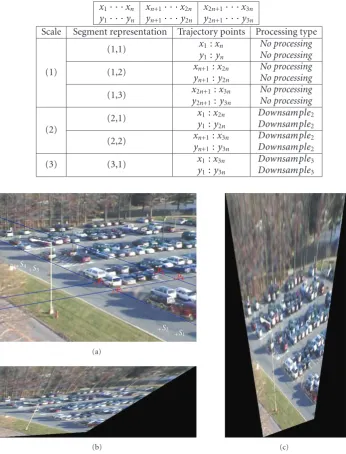
combinations of segments, ranging from the finest scale (the line segments) to the coarsest scale (the whole trajectory). This technique gives the ability to evaluate each section of the trajectory along with the overall trajectory. An example of the different training sequences that can be obtained from a 3ntrajectory is given inTable 2, whereDownsamplemdenotes the process of keeping everymth sample and discarding the rest. We provide a representation of the segments in the form of an ordered pair (i,j), whereirepresents the scale of the segment and jrepresents the order of this segment within the scalei.
An important property of this time scaling approach is that it captures the change in motion pattern between segments because of grouping of all possible combinations of adjacent segments. This can be helpful as the abrupt change in human motion pattern, like sudden running, is a change that is worthy of being singled out in surveillance applications.
5.2.2. Ground plane recovery
This is the first step in our method. This calibration process needs to be done once for each camera, and the trans-formation matrix can then be used for all the subsequent sequences because of the stationary setup. The advantage of this method is that it does not need any ground truth information and can be performed using some features that are common in man-made environments.
Table2: The different trajectory sequences generated from a three-segment trajectory.
x1· · ·xn xn+1· · ·x2n x2n+1· · ·x3n y1· · ·yn yn+1· · ·y2n y2n+1· · ·y3n
Scale Segment representation Trajectory points Processing type
(1)
(1,1) x1:xn No processing
y1:yn No processing
(1,2) xn+1:x2n No processing yn+1:y2n No processing
(1,3) x2n+1:x3n No processing y2n+1:y3n No processing
(2)
(2,1) x1:x2n Downsample2
y1:y2n Downsample2
(2,2) xn+1:x3n Downsample2
yn+1:y3n Downsample2
(3) (3,1) x1:x3n Downsample3
y1:y3n Downsample3
+P1 +P2
+P3 +P4
+S1 +S2 +S3
+S4
(a)
(b) (c)
Figure7: The recovery of the ground plane. (a) The original image frame with the features used in the recovery process. (b) The affine rectified image. (c) The metric rectified image.
The second stage is to recover the ground plane up to a metric transformation, which is achieved using two affine invariant properties. The recovery result is shown in Figure 7(c). In our experiment, we used the right angle between the vertical and horizontal borders of parking space and the equal length of the tire spans of a tracked truck across frame as shown by the white points (S1,S2) and (S3,S4) in Figure 7(a).
5.2.3. Learning the trajectories
For learning the normal activity trajectory, we used a training dataset containing the tracking results for 17 objects of different track lengths. The normal activity in such data
corresponds to a person entering the parking lot and moving towards a car, or a person leaving the parking lot. The trajectories were first smoothed using a five-point moving averaging to remove tracking errors, and then they were used to generate track segments of 50-point length as described earlier, resulting in 60 learning segments.Figure 8(a)shows the image plane trajectories used in the learning process, and each of the red points represents the center of the bounding box of an object in a certain frame.
(a)
60 50 40 30 20 10 0
Trajectory segments 0
0.1 0.2 0.3 0.4 0.5 0.6 0.7 0.8 0.9 1
NMSE
(b)
Figure8: (a) The normal trajectories and (b) the associated normalized mean square error (NMSE) values.
NMSE(1, 1)=0.0225
(a)
NMSE(1, 2)=0.0296 NMSE(2, 1)=0.0146
(b)
NMSE(1, 3)=0.3357 NMSE(2, 2)=0.1809 NMSE(3, 1)=0.1123
(c)
Figure9: The first abnormal test scenario. A person stops moving at a point on his route. We see the increase in the normalized mean square error (NMSE) values when he/she stops, resulting in a deviation from the normal trajectory.¡?layout cmd=”vspace” calue=”2”?¿
(a)
60 50 40 30 20 10 0
Trajectory segments 0
0.1 0.2 0.3 0.4 0.5 0.6 0.7 0.8 0.9 1
NMSE
(b)
5.2.4. Testing trajectories for anomalies
First abnormal scenario
This testing sequence represents a human moving in the parking lot and then stopping in the same location for some time. The first part of the trajectory, which lasts for 100 frames (two segments), is a normal activity trajectory, but the third segment represents an abnormal act. This could be a situation of interest in surveillance scenario.Figure 9shows the different segments of the object trajectory, along with the NMSE associated with each new segment. We see that as the object stops moving in the third segment, the NMSE values rise to indicate a possible drift of the object trajectory from the normal trajectory.
Second abnormal scenario
In this abnormal scenario, several tracked humans drift from their path into the grass area surrounding the parking lot, stop there to lift a large box, and then move the box. Figure 10(a)shows the object trajectory.Figure 10(b)shows a plot of the NMSE of all the segments, in red, with respect to the normal trajectory NMSE, in blue. It can be verified from the figure that the trajectory was changing from normal to abnormal one in the last three or four segments, which caused the NMSE of the global trajectory to rise.
6. CONCLUSIONS
In this paper, we have presented a framework for using 3D deformable shape models for activity modeling and representation. This has the potential to provide invariance to viewpoint and more detailed modeling of illumination effects. The 3D shape is estimated from the motion tra-jectories of the points participating in the activity under a weak perspective camera projection model. Each activity is represented using a linear combination of a set of 3D basis shapes. We presented a theory for estimating the number of basis shapes, based on the DI of the 3D deformable shape. We also explored the special case of ground plane motion trajectories, which often occurs in surveillance applications, and provided a framework for using our proposed approach for detecting anomalies in this case. We presented results showing the effectiveness of our 3D model in representing human activity for recognition and performing ground plane activity modeling and anomaly detection. The main chal-lenge in this framework will be in developing representations that are robust to errors in 3D model estimation. Also, machine learning approaches that take particular advantage of the availability of 3D models will be an interesting area of future research.
ACKNOWLEDGMENTS
M. Abdelkader and R. Chellappa were partially supported by the Advanced Sensors Consortium sponsored by the US Army Research Laboratory under the Collaborative Technol-ogy Alliance Program, Cooperative Agreement DAAD19-01-2-0008. A. K. Roy-Chowdhury was partially supported by
NSF Grant IIS-0712253 while working on this paper. The authors thank Dr. Alex Chan and Dr. Nasser Nasrabadi for providing ARL data and helpful discussions.
REFERENCES
[1] D. Kendall, D. Barden, T. Carne, and H. Le,Shape and Shape Theory, John Wiley & Sons, New York, NY, USA, 1999. [2] I. Dryden and K. Mardia,Statistical Shape Analysis, John Wiley
& Sons, New York, NY, USA, 1998.
[3] T. Cootes, C. Taylor, D. Cooper, and J. Graham, “Active shape models - their training and application,” Computer Vision and Image Understanding , vol. 61, no. 1, pp. 38–59, 1995. [4] W. Mio and A. Srivastava, “Elastic-string models for
represen-tation and analysis of planar shapes,” inProceedings of the IEEE Computer Society Conference on Computer Vision and Pattern Recognition (CVPR ’04), vol. 2, pp. 10–15, Washington, DC, USA, June-July 2004.
[5] T. B. Sebastian, P. N. Klein, and B. B. Kimia, “Recognition of shapes by editing their shock graphs,” IEEE Transactions on Pattern Analysis and Machine Intelligence , vol. 26, no. 5, pp. 550–571, 2004.
[6] A. Srivastava, S. H. Joshi, W. Mio, and X. Liu, “Statistical shape analysis: clustering, learning, and testing,” IEEE Transactions on Pattern Analysis and Machine Intelligence , vol. 27, no. 4, pp. 590–602, 2005.
[7] L. Torresani, D. Yang, E. Alexander, and C. Bregler, “Tracking and modeling non-rigid objects with rank constraints,” in
Proceedings of the IEEE Computer Society Conference on Computer Vision and Pattern Recognition (CVPR ’01), vol. 1, pp. 493–500, Kauai, Hawaii, USA, December 2001.
[8] M. Brand, “Morphable 3D models from video,” inProceedings of the IEEE Computer Society Conference on Computer Vision and Pattern Recognition (CVPR ’01), vol. 2, pp. 456–463, Kauai, Hawaii, USA, December 2001.
[9] J. Xiao, J. Chai, and T. Kanade, “A closed-form solution to non-rigid shape and motion recovery,” inProceedings of the 8th European Conference on Computer Vision (ECCV ’04), vol. 3024, pp. 573–587, Prague, Czech Republic, May 2004. [10] M. Brand, “A direct method for 3D factorization of nonrigid
motion observed in 2D,” inProceedings of the IEEE Computer Society Conference on Computer Vision and Pattern Recognition (CVPR ’05), vol. 2, pp. 122–128, San Diego, Calif, USA, June 2005.
[11] Y. Sheikh, M. Sheikh, and M. Shah, “Exploring the space of a human actionin,” inProceedings of the 10th IEEE International Conference on Computer Vision (ICCV ’05), vol. 1, pp. 144– 149, Beijing, China, October 2005.
[12] A. Veeraraghavan, A. K. Roy-Chowdhury, and R. Chellappa, “Matching shape sequences in video with applications in human movement analysis,” IEEE Transactions on Pattern Analysis and Machine Intelligence , vol. 27, no. 12, pp. 1896– 1909, 2005.
[13] N. Vaswani, A. K. Roy-Chowdhury, and R. Chellappa, ““Shape activity”: a continous-state HMM for moving/deforming shapes with application to abnormal activity detection,” IEEE Transactions on Image Processing , vol. 14, no. 10, pp. 1603– 1616, 2005.
[14] A. K. Roy-Chowdhury and R. Chellappa, “Factorization approach for event recognition,” inProceedings of CVPR Event Mining Workshop, Madison, Wis, USA, June 2003.
of the IEEE Computer Society Conference on Computer Vision and Pattern Recognition (CVPR ’05), vol. 1, pp. 398–404, San Diego, Calif, USA, June 2005.
[16] A. K. Roy-Chowdhury, “Towards a measure of deformability of shape sequences,” Pattern Recognition Letters , vol. 28, no. 15, pp. 2164–2172, 2007.
[17] S. Tsuji, A. Morizono, and S. Kuroda, “Understanding a simple cartoon film by a computer vision system,” inProceedings of the 5th International Joint Conference on Artificial Intelligence (IJCAI ’77), pp. 609–610, Cambridge, Mass, USA, August 1977.
[18] B. Neumann and H. Novak, “Event models for recognition and natural language descriptions of events in real-world image sequences,” inProceedings of the 8th International Joint Conference on Artificial Intelligence (IJCAI ’83), pp. 724–726, Karlsruhe, Germany, August 1983.
[19] H. Nagel, “From image sequences towards conceptual descrip-tions,” Image and Vision Computing , vol. 6, no. 2, pp. 59–74, 1988.
[20] Y. Kuniyoshi and H. Inoue, “Qualitative recognition of ongo-ing human action sequences,” inProceedings of the 13th Inter-national Joint Conference on Artificial Intelligence (IJCAI ’93), pp. 1600–1609, Chamb´ery, France, August-September 1993. [21] C. Dousson, P. Gabarit, and M. Ghallab, “Situation
recog-nition: representation and algorithms,” in Proceedings of the 13th International Joint Conference on Artificial Intelli-gence (IJCAI ’93), pp. 166–172, Chamb´ery, France, August-September 1993.
[22] H. Buxton and S. Gong, “Visual surveillance in a dynamic and uncertain world,” Artificial Intelligence , vol. 78, no. 1-2, pp. 431–459, 1995.
[23] J. Davis and A. Bobick, “Representation and recognition of human movement using temporal templates,” inProceedings of the IEEE Computer Society Conference on Computer Vision and Pattern Recognition (CVPR ’97), pp. 928–934, San Juan, Puerto Rico, USA, June 1997.
[24] B. F. Bremond and M. Thonnat, “Analysis of human activities described by image sequences,” inProceedings of the 20th Inter-national Florida Artificial Intelligence Research InterInter-national Symposium (FLAIRS ’97), Daytona, Fla, USA, May 1997. [25] N. Rota and M. Thonnat, “Activity recognition from video
sequence using declarative models,” inProceedings of the 14th European Conference on Artificial Intelligence (ECAI ’00), pp. 673–680, Berlin, Germany, August 2000.
[26] V. Vu, F. Bremond, and M. Thonnat, “Automatic video interpretation: a recognition algorithm for temporal scenarios based on pre-compiled scenario models,” in Proceedings of IEEE International Conference on Computer Vision Systems (ICCV ’03), pp. 523–533, Graz, Austria, April 2003.
[27] C. Castel, L. Chaudron, and C. Tessier, “What is going on? A high-level interpretation of a sequence of images,” in
Proceedings of the Workshop on Conceptual Descriptions from Images (ECCV ’96), Cambridge, UK, April 1996.
[28] T. Starner and A. Pentland, “Visual recognition of American sign language using hidden Markov models,” inProceedings of the International Workshop on Face and Gesture Recognition, 1995.
[29] A. Wilson and A. Bobick, “Recognition and interpretation of parametric gesture,” inProceedings of the IEEE 6th Interna-tional Conference on Computer Vision (ICCV ’98), pp. 329–336, Bombay, India, January 1998.
[30] W. Grimson, C. Stauffer, R. Romano, and L. Lee, “Using adaptive tracking to classify and monitor activities in a site,” in Proceedings of the IEEE Computer Society Conference on
Computer Vision and Pattern Recognition (CVPR ’98), pp. 22– 29, Santa Barbara, Calif, USA, June 1998.
[31] J. Pearl,Probabilistic Reasoning in Intelligent Systems, Morgan Kaufmann, San Francisco, Calif, USA, 1988.
[32] S. Intille and A. Bobick, “A framework for recognizing multi-agent action from visual evidence,” in Proceedings of the National Conference on Artificial Intelligence (AAAI ’99), pp. 518–525, Orlando, Fla, USA, July 1999.
[33] P. Remagnini, T. Tan, and K. Baker, “Agent-oriented annota-tion in model based visual surveillance,” inProceedings of the International Conference on Computer Vision (ICCV ’98), pp. 857–862, Bombay, India, January 1998.
[34] G. Shaffer, A Mathematical Theory of Evidence, Princeton University Press, Princeton, NJ, USA, 1976.
[35] D. Ayers and R. Chellappa, “Scenario recognition from video using a hierarchy of dynamic belief networks,” inProceedings of the 15th International Conference on Pattern Recognition (ICPR ’00), vol. 1, pp. 835–838, Barcelona, Spain, September 2000.
[36] T. Huang, D. Koller, and J. Malik, “Automatic symbolic traffic scene analysis using belief networks,” inProceedings of the 12th National Conference on Artificial Intelligence (AAAI ’94), pp. 966–972, Seattle, Wash, USA, July 1994.
[37] S. Hongeng and R. Nevatia, “Multi-agent event recognition,” in Proceedings of the 8th IEEE International Conference on Computer Vision (ICCV ’01), pp. 84–91, Vancouver, BC, Canada, July 2001.
[38] G. Johansson, “Visual perception of biological motion and a model for its analysis,” Perception and Psychophysics , vol. 14, no. 2, pp. 201–211, 1973.
[39] E. Muybridge,The Human Figure in Motion, Dover, New York, NY, USA, 1901.
[40] G. Harris and P. Smith, Eds.,Human Motion Analysis: Current Applications and Future Directions, IEEE Press, Piscataway, NJ, USA, 1996.
[41] D. Gavrila, “The visual analysis of human movement: a survey,” Computer Vision and Image Understanding , vol. 73, no. 1, pp. 82–98, 1999.
[42] W. Hu, T. Tan, L. Wang, and S. Maybank, “A survey on visual surveillance of object motion and behaviors,” IEEE Transactions on Systems, Man and Cybernetics Part C: Applications and Reviews , vol. 34, no. 3, pp. 334–352, 2004. [43] N. Vaswani, A. K. Roy-Chowdhury, and R. Chellappa,
“Activ-ity recognition using the dynamics of the configuration of interacting objects,” in Proceedings of the IEEE Computer Society Conference on Computer Vision and Pattern Recognition (CVPR ’03), vol. 2, pp. 633–640, Madison, Wis, USA, June 2003.
[44] A. Veeraraghavan, A. K. Roy-Chowdhury, and R. Chellappa, “Role of shape and kinematics in human movement analysis,” in Proceedings of the IEEE Computer Society Conference on Computer Vision and Pattern Recognition (CVPR ’04), vol. 1, pp. 730–737, Washington, DC, USA, June-July 2004. [45] L. Campbell and A. Bobick, “Recognition of human body
motion using phase space constraints,” in Proceedings of the IEEE 5th International Conference on Computer Vision (ICCV ’95), pp. 624–630, Cambridge, Mass, USA, June 1995. [46] C. Rao, A. Yilmaz, and M. Shah, “View-invariant
represen-tation and recognition of actions,” International Journal of Computer Vision , vol. 50, no. 2, pp. 203–226, 2002.
Recognition (CVPR ’03), vol. 2, pp. 613–619, Madison, Wis, USA, June 2003.
[48] N. Johnson and D. Hogg, “Learning the distribution of object trajectories for event recognition,” Image and Vision Computing , vol. 14, no. 8, pp. 609–615, 1996.
[49] J. Owens and A. Hunter, “Application of the self-organizing map to trajectory classification,” inProceedings of the IEEE International Workshop Visual Surveillance, pp. 77–83, Dublin, Ireland, July 2000.
[50] W. Chen and S. F. Chang, “Motion trajectory matching of video objects,” inStorage and Retrieval for Media Databases, vol. 3972 ofProceedings of SPIE, pp. 544–553, San Jose, Calif, USA, January 2000.
[51] L. Torresani and C. Bregler, “Space-time tracking,” in Pro-ceedings of the 7th European Conference on Computer Vision (ECCV ’02), Copenhagen, Denmark, May-June 2002. [52] P. J. Phillips, S. Sarkar, I. Robledo, P. Grother, and K. Bowyer,
“The gait identification challenge problem: data sets and baseline algorithm,” inProceedings of the 16th International Conference on Pattern Recognition (ICPR ’02), vol. 16, pp. 385– 388, Quebec City, Canada, August 2002.
[53] C. Tomasi and T. Kanade, “Shape and motion from image streams under orthography: a factorization method,” Interna-tional Journal of Computer Vision , vol. 9, no. 2, pp. 137–154, 1992.
[54] Z. Zhang, “A flexible new technique for camera calibration,” IEEE Transactions on Pattern Analysis and Machine Intelli-gence , vol. 22, no. 11, pp. 1330–1334, 2000.
[55] R. Tsai, “A versatile camera calibration technique for high-accuracy 3D machine vision metrology using off-the-shelf TV cameras and lenses,” IEEE Journal of [legacy, pre - 1988] on Robotics and Automation , vol. 3, no. 4, pp. 323–344, 1987. [56] D. Liebowitz and A. Zisserman, “Metric rectification for
perspective images of planes,” in Proceedings of the IEEE Computer Society Conference on Computer Vision and Pattern Recognition (CVPR ’98), pp. 482–488, Santa Barbara, Calif, USA, June 1998.
[57] R. Hartley and A. Zisserman, Multiple View Geometry in Computer Vision, Cambridge University Press, New York, NY, USA, 2000.
[58] M. F. Abdelkader, R. Chellappa, Q. Zheng, and A. L. Chan, “Integrated motion detection and tracking for visual surveil-lance,” inProceedings of the 4th IEEE International Conference on Computer Vision Systems (ICVS ’06), p. 28, New York, NY, USA, January 2006.
[59] Cornegie mellon university graphics lab motion capture database,http://mocap.cs.cmu.edu/.
[60] A. Kale, A. Sundaresan, and A. Rajagopalan, “Identification of humans using gait,” IEEE Transactions on Image Processing , vol. 13, no. 9, pp. 1163–1173, 2004.
[61] R. Tanawongsuwan and A. Bobick, “Modelling the effects of walking speed on appearance-based gait recognition,” in Proceedings of the IEEE Computer Society Conference on Computer Vision and Pattern Recognition (CVPR ’04), vol. 2, pp. 783–790, Washington, DC, USA, June-July 2004. [62] A. Veeraraghavan, R. Chellappa, and A. K. Roy-Chowdhury,
“The function space of an activity,” inProceedings of the IEEE Computer Society Conference on Computer Vision and Pattern Recognition (CVPR ’06), pp. 959–968, Washington, DC, USA, 2006.