http://www.sciencepublishinggroup.com/j/ijssam doi: 10.11648/j.ijssam.20190402.12
ISSN: 2575-5838 (Print); ISSN: 2575-5803 (Online)
Decision-Making Framework Using a Growth Hacking
Model for Computerized Decision Support
Okpala Izunna Udebuana
*, Ikerionwu Charles
Department of Information Technology, Federal University of Technology, Owerri, Nigeria
Email address:
*
Corresponding author
To cite this article:
Okpala Izunna Udebuana, Ikerionwu Charles. Decision-Making Framework Using a Growth Hacking Model for Computerized Decision Support. International Journal of Systems Science and Applied Mathematics. Vol. 4, No. 2, 2019, pp. 24-30.
doi: 10.11648/j.ijssam.20190402.12
Received: August 21, 2019; Accepted: September 6, 2019; Published: September 24, 2019
Abstract:
Strategic decisions positively drive organizational performance and could have a measurable impact on any enterprise. Proper management and resource allocation are relevant to the growth of any organization, and there is an accelerated progression towards a complete overhaul of manual systems leading to the increased proliferation of digital systems. Businesses with less or no computerization create a bridge between users and data, in turn, causes poor decision making, loss of data on transit, time wastage in data extraction, poor data management, improper use of data and erroneous application of organizational data for decision making. This study utilizes information modeling method aimed at studying a decision-making framework and how growth hacking plays a critical role in the implementation of a decision support system for organizational growth. Supporting decision making in a traditional platform consumes time, taking note of the data collection phase, analysis and the choice of alternatives phases but a decision support system digitizes the whole process of data input or extraction, data processing, and the output mechanisms. The paper models the decision-making steps and also suggests that decision-making will take less time in contrast to the use of traditional methods using this growth hacking model. The end product of the implementation of the suggestions from the output stage of this model is growth.Keywords:
Decision-making, Growth-Hacking, Information Modeling, Performance, Decision Support System1. Introduction
The amount of data accessible and manipulated digitally in the last couple of years has grown exponentially and is caused by the upsurge in data generations through the progressive digitization of practically every aspect of our daily life [1]. In an enterprise environment, businesses collect all kinds of business process information such as payroll, financial details, and customer’s sentiments data. The context of decision making is found in all aspects of life, and the underlying component that gives rise to every decision is data.
Williamson defined Growth as an upward movement of an entity or a forward movement of statistical data [2]. Making an interpolation of the terms Growth and Hacking is critical to this work. Hacking can be negative or positive [3]. The understanding of the whole process of hacking is dependent on the hacker. Therefore, hacking in this context is the
process of pruning data acquired from a source to either create a response to the user or send feedback to the receiving end. Growth hacking as a compound term is the process of accelerated testing across different channels of information exchange and product development to identify the most efficient and effective way to grow a startup [4]. It refers to a collection of standard and unconventional marketing exercises that promotes a business.
This does not eliminate human interference, as it is the responsibility of a top manager to enforce the alternative decision. Decision making, therefore, is a “process whereby management determines its goals or objectives and selects amongst alternatives, that which it believes will either procure the best outcome or attain the desired objective with the most economical utilization of resources” [7].
2. Literature Review
Key decisions lead to organizational growth. Growth, therefore, has been the quest of organizations for centuries and as such, if an organization is not improving, it’s as good as declining to the point of death. Growth, is an important discus intertwined with data. Extant works in literature reviews suggest that the word "growth hacking" itself is only about nine years old, but the practice has a much longer history. People have been “growth hacking” before it became a compound term. The core of growth hacking is the constant focus on growth as the only criterion that counts. Mark Zuckerberg had this attitude while growing Facebook [8]. Businesses that have effectively "growth hacked" generally have a viral loop naturally integrated into their onboarding system. New clients usually hear about the product or service through their network and share it with their links by using the product or service. This loop of consciousness, use, and exchange can lead to the company's exponential growth.
Sean Ellis conceived the concept of "growth hacker" in 2010 [9-10]. He described a growth hacker as "a person whose true north is growth, everything they do is scrutinized by its potential impact on scalable growth". The phrase spread quickly, resulting in an upward trend in individuals who google "growth hacking". Andrew Chen launched the concept to a broader audience in an article titled, "Growth Hacker is the new VP Marketing" where he described the word and used the Craigslist inclusion of Airbnb's short-term vacation rental platform as an instance [11]. Also, Aaron Ginn and his co-researchers believed that a growth hacker has a "mindset of data, creativity, and curiosity" [12]. In 2013, a team lead by Sean Ellis began Growth Hackers, an online forum, and software as a service (SaaS) that allows teams to handle the growth experimentation process. Business growth leads to an increase in income growth and thus, drives higher market capitalization profit than margin enhancement [13]. Businesses want growth, and this desire for growth is even more intense for large organizations. Growth decides a startup's life and death [14]. Since the business intelligence system is a machine, it needs to have some level of intelligence to aid human beings.
To understand decision making, we should, first of all, understand the decision-maker and put them in perspective. This often involves modeling the behavioral parameters in the object (in this case, humans). A straightforward perspective of decision-making is that it's a choice issue among several options and many managers may face a choice in which the alternatives are evident. Empirical surveys on rational decision-making, particularly in the context of
probability theory and decision theory, were followed to ascertain whether human behavior complies with the theory [14]. It has been shown rather convincingly in countless empirical research that human judgment and decision making are based on intuitive methods as opposed to theoretically sound reasoning [15]. These intuitive approaches referred to in decision-making as judgmental heuristics, help to reduce the cognitive load, but regrettably at the cost of ideal decision-making. Indeed, unassisted judgment and decision show systematic breaches of probability axioms (referred to as biases). The formal debate of the most significant study outcomes along with experimental statistics [16] can be discovered in an anthology published by Slovic. The study described 3 heuristics; representativeness, availability of instances and adjustment from an anchor. These 3 gives rise to better understanding and can improve decisions in a situation of uncertainty. One could hope that individuals who have acquired knowledge in a domain will not be subject to judgmental biases and will work towards optimal decision-making. While empirical evidence indicates that experts are more precise than novices in their field of knowledge, it also demonstrates that they are also responsible to the same judgmental biases as novices and show obvious mistakes and inconsistencies in their judgment [17]. Experts such as physicians use the same heuristics of judgment and are susceptible to the same biases, although the extent of departure from the recommended judgment seems to reduce with experience. Concerning laboratory proof, there are several expert performance studies in realistic environments, demonstrating that it is inferior even for easy linear models (a casual review of the accessible proof and literature references can be discovered in Dawes' book [17]).
3. Methodology
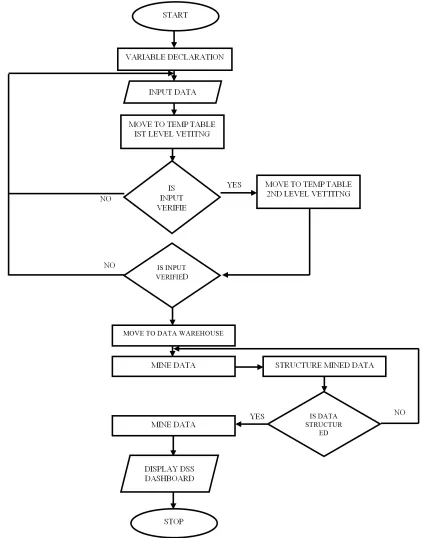
The methodology employed in this research is the model-driven method. The structure in figure 1 depicts the various building blocks that make up a decision support system. It explores a decision-making framework and how growth hacking plays a role in the organizational decision-making process. This study brings to light the hidden ingredients needed for organizational growth while revolutionizing business models for better decision making. It shows the initialization process i.e. when the program starts, how data is fetched, the validation process, what is retained and discarded in temporal memory and lastly how a Growth hacking system elucidates the properties of data fetched to give a precise index that can be used by the decision-maker.
4. Decision Modelling
While arithmetically, a model comprises of variables and functions. Gaol views strategic decisions, the model and variables as constituting the following three components [18]:
a)A measurement of preferences over decision goals. b)Accessible decision options.
c)Measurement of uncertainty over decision-making and outcome-influencing factors.
This is evident in a research by Herbert Simon a Nobel Prize laureate [19] as it connects the 3 components presented by Gaol and his coauthors into usable steps for decision making.
Figure 1. Building blocks of a Decision support system.
4.1. Hebert Simon's Decision-making Process Model
Decision-making is a particular type of data processing aimed at setting up an action strategy under particular
conditions. Nobel prize winner Herbert Simon [19] sees it as a three-step method (Figure 2) as follows:
a)Setting goals.
b)Collecting and analyzing data in order to acknowledge a problem assessment.
c)Actual problem declaration. 2.Design, involving operations like:
a)Identifying (or design of) feasible courses of action termed alternatives.
b)Model construction.
c)Assessment of multiple prospective solutions to the problem.
3.Choice, or preference between viable option, called a decision to release it for execution. Simon in 1977 subsequently launched a fourth phase which consists of implementing the alternative and reviewing the outcomes.
If a decision problem can be fully explained and all feasible solutions to decisions can be fully studied and assessed before a decision is reached, then the issue is said to be completely structured, otherwise, it is said to be unstructured or non-structured. A structured problem happens once the situation is somewhat stable, similar conditions
were met in the past, there is little time and less pressure to take a very crucial decision i.e. an already-made or available decision. In this case, the decision is said to be programmable. In the case of unstructured problems, no comparable conditions have been encountered in the past, the accessible data is sparse, the implications of an incorrect choice are very severe, the time is critical. In such circumstances, "custom-made" non-programmable choices must be made [20]. If the problem is entirely structured, a computerization tool could provide a solution with no human interference and, consequently, it can be assigned the task of selecting the course of action. On the other side, if the issue has no framework, only human psychology can assist. If the problem is non-structured, computer assistance for decision-making can be foreseen. The level of structuration of the problem depends on several objective factors, such as:
a)The characteristics of the decision scenario itself. b)The amount of decision authority at which the
decision-making unit is positioned. It can also rely on subjective factors, including the human decision-maker's time limits, limitations, and even transient mood.
4.2. Growth Hacking Process Model for Decision-making
Most companies can find out which clients are more likely to stick around even before they get onboard by evaluating the historical patterns of comparable users. This model
suggests that sales and marketing efforts be prioritized towards clients that are less likely to jump to your rival as quickly as they see a better deal. This invariably leads to an increase in value over time.
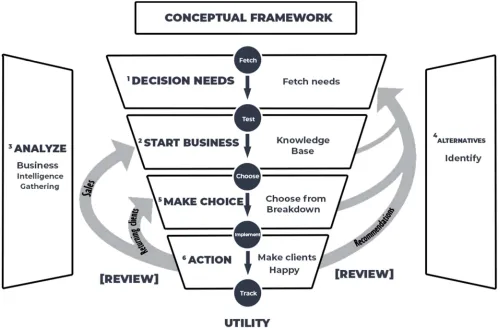
Figure 3. Growth hacking Framework.
The framework in figure 3 follows the steps below: 1.Identification of decision need: There is always an
initial need every business starts off with, and this step seeks to address it. Here we pin down the footprint to how a business started off and how it intends to grow and make profit.
2.Implementing decision based on organizational knowledge: Every organization has mission, vision and drive. The decision here is mainly to drive the business to fulfil its initial objectives to grow.
3.Business Intelligence gathering: Information and business processes done over time are galvanized in this step into a meaningful form that can be used to proffer business solutions.
4.Identifying alternatives: Out of the knowledge retrieved from the intelligence gathering stage, alternatives are modelled or created. Suggestions can be made for new products at this stage or an upgrading for some products.
5.Choosing an alternative that is client oriented: Out of several alternatives, it’s at the discretion of top managers to pick a better alternative based on the one
that maximizes overall profit, reduces cost and satisfies clients optimally.
6. Take action: After a choice is made, an action is taking to implement changes.
7. Review Decision and upgrade: Overtime, decisions made are reviewed and optimized. This review is always geared toward the overall organizational growth.
4.3. Decision Support System
This paper emphasizes the need for organizational growth after a decision has been taken through the use of both the formulated growth hacking framework in figure 3 and the DSS in figure 1. The importance of a Decision support system cannot be less emphasized as they are instinctive computer-based systems that can interface with any client (especially managers) through the front-end [21], though according to [6], they are systems that are preprogrammed with analytics intelligence to be able to measure a variety of facts and offer solutions based on the deciphered information. The DSS architecture contains:
often used as a DSS ledger [22]. It stores large quantities of data.
2.Model-base management system (MBMS). MBMS's function is comparable to that of a DBMS. Its primary function is providing independence between specific models that are used in a DSS from the applications that use them [22].
3.Graphical User interface (GUI). This is also known as the Generation and Management System Dialog (GMSD) and the main product of an interaction with a DSS is insight. As their users are often managers who might not be computer-trained, DSS needs to be equipped with intuitive and easy-to-use interfaces. These interfaces aid in model building, but also in interaction with the model, such as gaining insight and recommendations from it.
5. Results and Discussions
This study has practical relevance for top managers while reducing at least to the barest minimum the time it will take for a decision to be taken. Improvement in any environment results in worthwhile benefits [23]. Below are the business components that’ll the framework improves:
1.Performance Management: Tracking and analyzing KPIs against key business goals to gain a better understanding of how your business is performing today.
2.Market Response: Top managers can view reports daily instead of waiting until the end of the month or quarter, enabling the decision maker to respond quickly to unpredictable situations and market demands.
3.Customers orientation: With a growth hacking solution, organizations can gain valuable insight into their customers’ behavior by certain metrics and analyses. They can create detailed guest profiles that include interests, preferences, history, and more.
4.Day-to-Day Operations: The solution streamlines the whole processes into day-to-day operations thereby improving alignment with a single source for accurate financial and operational information and simplifies collaboration and sharing.
5.Time of Compilation in Multiple Systems: Many organizations throw away valuable time and energy looking for pertinent information from within their different data sources. Much time is invested converting, merging, and reporting data, discussing whether it is accurate, not to mention that desktop spreadsheets do not enable real-time data sharing and updating. With growth hacking system in place, all of the data required comes from one source and can be accessed from one dashboard and converted into a report.
6.Reliance on Tech Teams: Many data tools are so complicated that only a few individuals within the company know how to handle them. By using a growth hacking solution, many key people throughout an
organization can gain easy access to understandable and meaningful data. Research has shown that organizations that democratize the use of these tools across the business by making them more user-friendly achieve a significantly higher ROI [24].
7.Access to Data: With this solution, everyone in the organization, including managers, senior executives, and functional teams, can access and analyze up-to-date information when they need it, wherever they are, on a range of different devices.
6. Conclusion
The role of technology in handling business processes keeps evolving. The new framework demonstrates how a top-manager sees all the activities that happened in the organization at a glance. The system does not implement the action plan but shows the manager various key performance indicators. With this information, the manager can then use the formulated model to make a better judgment. The model has seven distinct traversals and the effective use of the model can aid better decision. Decision making for organizational growth is not just a phenomenon but a concept that can be engrafted into the computer system to aid instantaneous decision mapping, especially when working in tandem with a growth hacking model. To be able to keep up the pace with the evolving nature of computing, enterprise organizations have to key into growth hacking, if growth is their locus.
References
[1] Luna, D., Almerares, A., Mayan, J. C., Gonzalez Bernaldo de Quiros, F., & Otero, C. (2014). Health informatics in developing countries: going beyond pilot practices to sustainable implementations: a review of the current challenges. Healthcare informatics research, 20 (1), 3-10.
[2] Williamson, P. J., Hoenderop, S., & Hoenderop, J. (2018). An alternative benchmark for the validity of China’s GDP growth statistics. Journal of Chinese Economic and Business Studies, 16 (2), 171-191.
[3] Reese M. (2016) Positives and Negatives of Hacking Retrieved December 02, 2018, from https://prezi.com/qvjezimmrqx6/positives-and-negatives-of-hacking/.
[4] Nolan 2017 What is Growth Hacking in 2018? What's Next for Digital Marketers? Retrieved June 13, 2018, from https://clemmons.io/what-is-growth-hacking-in-2017/.
[5] Turban, E., Sharda, R., & Delen, D. (2010). Decision support and business intelligence systems (required).
[6] Kopáčková, H., & Škrobáčková, M. (2006). Decision support systems or business intelligence: what can help in decision making? Scientific Papers of the University of Pardubice. Series D, Faculty of Economics and Administration, 10.
[8] Maxime S. (2017). Mark Zuckerberg on Building a Growth Team at Facebook. Retrieved January 15, 2019, from https://growthhackers.com/articles/mark-zuckerberg-on-building-a-growth-team-at-facebook.
[9] Taylor, G., Burmeister, R., Xu, Z., Singh, B., Patel, A., & Goldstein, T. (2016, June). Training neural networks without gradients: A scalable admm approach. In International Conference on Machine Learning (pp. 2722-2731).
[10] Holiday, R. (2013). Trust me, i'm lying: confessions of a media manipulator. Penguin.
[11] Gandhi, J., Chen, A., Dagur, G., Suh, Y., Smith, N., Cali, B., & Khan, S. A. (2016). Genitourinary syndrome of menopause: an overview of clinical manifestations, pathophysiology, etiology, evaluation, and management. American journal of obstetrics and gynecology, 215 (6), 704-711.
[12] Sarker, A., Ginn, R., Nikfarjam, A., O’Connor, K., Smith, K., Jayaraman, S., & Gonzalez, G. (2015). Utilizing social media data for pharmacovigilance: a review. Journal of biomedical informatics, 54, 202-212.
[13] Kutcher, E., Nottebohm, O., & Sprague, K. (2014). Grow fast or die slow. McKinsey & Company (http://www.mckinsey.com/Insights/High_Tech_Telecoms_Int ernet/Grow _fast_or_die_slow).
[14] Mark Paskin (2006). Lecture note- Introduction to Probability Retrieved from http://ai.stanford.edu/~paskin/gm-short-course/lec1.pdf.
[15] Marek J. D., Roger R. F. (2005). Decision Support Systems.
Retrieved January 16, 2018, from
http://www.pitt.edu/~druzdzel/psfiles/dss.pdf.
[16] Levy, J. S. (2002). Daniel Kahneman: Judgment, decision, and rationality. PS: Political Science & Politics, 35 (2), 271-273.
[17] Bates, M. J. (2012). Understanding Information Retrieval Systems. Taylor & Francis Group, Boca Raton: USA.
[18] Gaol, F. L., Kadry, S., Taylor, M., & Li, P. S. (Eds.). (2014). Recent Trends in Social and Behaviour Sciences: Proceedings of the International Congress on Interdisciplinary Behaviour and Social Sciences 2013. CRC Press.
[19] Simon, H. A. (1960). The new science of management decision.
[20] Soelberg, P. O. (1967). A study of decision-making: Job choice (Doctoral dissertation, Alfred P. Sloan School of Management, MIT).
[21] Goddard, T. D., Huang, C. C., Meng, E. C., Pettersen, E. F., Couch, G. S., Morris, J. H., & Ferrin, T. E. (2018). UCSF ChimeraX: Meeting modern challenges in visualization and analysis. Protein Science, 27 (1), 14-25.
[22] Kureichik, V., & Safronenkova, I. (2017, September). Ontology-Based Decision Support System for the Choice of Problem-Solving Procedure of Commutation Circuit Partitioning. In Conference on Creativity in Intelligent Technologies and Data Science (pp. 467-478). Springer, Cham.
[23] Portela, M. C., Pronovost, P. J., Woodcock, T., Carter, P., & Dixon-Woods, M. (2015). How to study improvement interventions: a brief overview of possible study types. BMJ Qual Saf, 24 (5), 325-336.
![Figure 2. Simon’s process model for decision making [19].](https://thumb-us.123doks.com/thumbv2/123dok_us/979643.1597536/4.595.159.436.335.728/figure-simon-s-process-model-for-decision-making.webp)