R E S E A R C H
Open Access
Explore semantic pixel sets based local
patterns with information entropy for face
recognition
Zhenhua Chai
1*, Heydi Mendez-Vazquez
2, Ran He
1, Zhenan Sun
1and Tieniu Tan
1Abstract
Several methods have been proposed to describe face images in order to recognize them automatically. Local methods based on spatial histograms of local patterns (or operators) are among the best-performing ones. In this paper, a new method that allows to obtain more robust histograms of local patterns by using a more discriminative spatial division strategy is proposed. Spatial histograms are obtained from regions clustered according to the semantic pixel relations, making better use of the spatial information. Here, a simple rule is used, in which pixels in an image patch are clustered by sorting their intensity values. By exploring the information entropy on image patches, the number of sets on each of them is learned. Besides, Principal Component Analysis with a Whitening process is applied for the final feature vector dimension reduction, making the representation more compact and discriminative. The proposed division strategy is invariant to monotonic grayscale changes, and shows to be particularly useful when there are large expression variations on the faces. The method is evaluated on three widely used face recognition databases: AR, FERET and LFW, with the very popular LBP operator and some of its extensions. Experimental results show that the proposal not only outperforms those methods that use the same local patterns with the traditional division, but also some of the best-performing state-of-the-art methods.
1 Introduction
Face recognition is a popular biometric technique, mainly because it is considered as non-intrusive and it can be applied in a wide range of applications such as access control, video surveillance and human computer interac-tion [1]. Feature extracinterac-tion is one of the most important steps in the face recognition process, but to obtain dis-criminative and robust features for describing face images is still an open problem [2]. Several methods have been proposed toward this aim, that can mainly be divided into two groups: local feature-based methods and global appearance-based methods [1]. In general, local feature-based methods exhibit a better behavior and have some advantages over the global ones [3-5]. Among existing local descriptors, Gabor wavelet-based methods are one of the best performing, mainly due to their spatial locality
*Correspondence: [email protected]
1National Laboratory of Pattern Recognition, Institute of Automation, Chinese Academy of Science, P.O. Box 2728, Beijing 100190, People’s Republic of China Full list of author information is available at the end of the article
and orientation selectivity [6]. However, although differ-ent strategies have been proposed, they are still computa-tionally intensive and consume too much time in feature extraction [7], being not suitable for real-time and mobile applications. On the other hand, histograms of local pat-terns, such as Local Binary Patterns and its different extensions, which are also very popular local descriptors [8], are very simple and fast to compute.
The Local Binary Patterns (LBP) operator was first proposed for texture classification and was then applied to face recognition using a regular regions division [9]. Many extensions of the original operator have appeared afterwards [10-16]; however most of them have focused on obtaining more discriminative descriptors, while few methods have been proposed to get a more robust division strategy.
Recently, the semantic pixel set-based LBP (spsLBP) [17] was proposed for this aim. By clustering the pixels in an image region into a number of sets according to their semantic meanings instead of using a regular division, it
makes better use of the spatial information when con-structing the local histograms. It was shown in [17] that this strategy can alleviate to some extent the pixel-shifting problem caused by some face deformations like variations in expression. However, only the original LBP operator was tested with the proposed strategy in [17], while more robust LBP variants can be used for improving the overall performance.
In this paper, we aim at extending the proposal in [17] to a more general framework, in which more robust local operators can be applied, such as Local Ternary Pat-terns (LTP) and Three-Patch LBP (TP-LBP). Moreover, we believe that the amount of information in different face regions is different, then using a fixed number of sets for all regions, like in [17], could not be appropri-ate. Hence, a different number of sets should be used in different regions according to their specific informa-tion quantity. Taking this into account, we propose in this paper a method for automatically learning the num-ber of sets in which each region should be divided, by using information entropy. When including more sets, the feature vector dimensionality increases, so a dimension-ality reduction method is needed. We have considered to apply the Principal Component Analysis with a Whiten-ing process (WPCA) [18] in our framework. This method not only reduces the dimension of the feature vector, making it more compact, but also can be used even on small-sample-size cases [18].
The rest of this paper is organized as follows: in section 2, related work is analyzed; in section 3, the pro-posed framework is introduced, and the strategy to learn the number of clusters in a region is presented; section 4 shows experimental results of the proposed method in comparison with some related state-of-the-art descrip-tors; finally, conclusions are given in section 5.
2 Related work
LBP is one of the most popular face image descriptors [19,20]. It was introduced in this area in 2004, motivated by the fact that faces can be seen as a composition of micro-patterns which can be well described by this opera-tor [9]. The original LBP [21] describes these local texture patterns by thresholding the comparison results between
the intensity value of the center pixel and its 3×3 neigh-borhood. The resulted binary values are then concate-nated together and encoded as an integer. This encoding process is illustrated on Figure 1. The operator is invari-ant to grayscale monotonic variations since it only takes into account if the surrounding pixels values are brighter or darker than the center pixel value. The original method was later extended for using a circular neighborhood of different radius sizes and considering different numbers of equally spaced pixels on the defined circle [22]. In the same work [22], it was shown that more than 90% of the texture information (lines, edges, corners) is contained on 58 patterns which have at most two bitwise 0 to 1 or 1 to 0 transitions; so these patterns were called uniform LBP and, in this case, a single label is assigned to all remaining patterns.
In the past few years, a number of variants of the orig-inal operator have been proposed for improving different aspects of the method [20]. Some of the extensions aim at enhancing the discriminative capability of the operator, such as the improved LBP (ILBP) [10], in which both the pixels in the circular neighborhood and the center pixel are compared against the mean intensity value of them. Another is the extended LBP (ELBP) [23], which encodes the gradient magnitude image in addition to the original image in order to represent the velocity of local variations. There are some extensions that have been proposed for improving the robustness, such as the local ternary pat-terns (LTP) [16] which includes a 3-level generalization coding scheme and is more resistance to noise. How-ever, this operator is no longer invariant to monotonic grayscale transformations. There are also some exten-sions which have concentrated on choosing an appro-priate neighborhood for the encoding process (e.g. the number and distribution of the sampling points as well as the shape and size of the neighborhood). One of the examples is the Multi-scale Block LBP (MB-LBP) [24], in which the average intensity values of neighboring rect-angular blocks are compared rather than single pixels. This allows to capture macro-structures of face images. Three-Patch LBP and Four-Patch LBP [25] are also patch-based operators, and their experimental results are very promising.
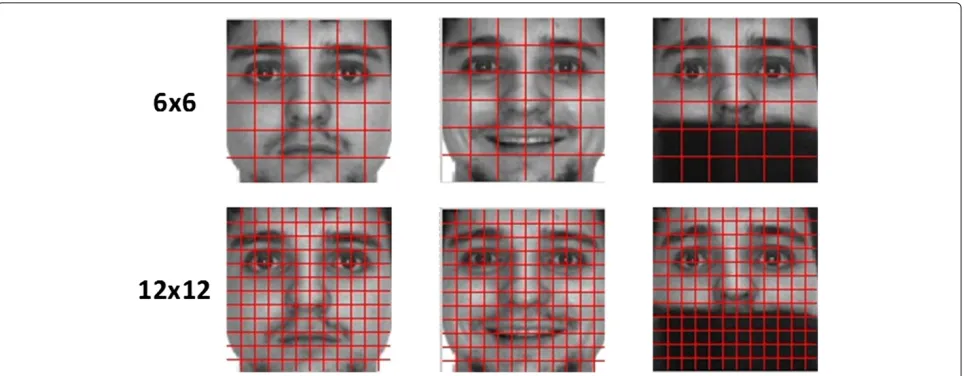
Most of the descriptors mentioned above use the orig-inal strategy of Ahonen et al. [9] for facial representa-tion. The scheme consists of dividing the face image into rectangular regions, from which local histograms of the extracted local patterns are obtained. Afterwards, the his-tograms of all regions are concatenated into a single spa-tially enhanced feature histogram that encodes both the local texture and the global shape of face images. Under this strategy, deciding the number and size of blocks is usually a problem, especially when there are different appearance variations on the face. A finer division usu-ally makes the descriptor more discriminative but some-times, for example when there are expression variations, will bring some problems. This is illustrated on Figure 2, where it can be appreciated that in the case of expression variations, a finer division can affect the recognition pro-cess because small blocks around some face areas, such as mouth and eyes, are shifted to neighbor blocks. Just a few methods on the literature aim at modifying the spa-tial division strategy. In [26] and [27], many subregions are obtained by shifting and scaling a rectangular region over the face image and boosting is used for selecting the most discriminative regions of different sizes at different posi-tions. Overlapped subregions have also been used [28]; as well as circular [29] and triangular [30] regions.
The spsLBP method [17] is another approach proposed to solve the blocks division problem. It uses a simple clus-tering method to segment the pixels in a region by con-sidering their intensity values. In spsLBP, the face image is first divided into a few coarse rectangular regions and then the pixels in each region are regrouped by their semantic meanings. Histograms of LBP codes are computed from
the obtained sets and concatenated as in the traditional scheme. It is a very simple idea in which the local pat-terns are associated with their semantic meaning instead of their spatial position only. This strategy allows to group most of the relevant pixels into corresponding sets even in the presence of some shifting. It should be noticed that, for simplicity, intensity values were used for associating the pixels, but some other attributes such as contrast, lumi-nance, texton, etc., could also be used. It was shown in [17] that this strategy outperforms the traditional regu-lar division. However, more robust LBP variants were not considered in that work. On the other hand, the num-ber of pixel sets for each region was set equal which can be inappropriate in some cases. In Figure 3, it is shown that different face regions can contain a different amount of variable information. By intuition, some regions rich in texture, like areas around eyes, should contain more information; thus, a large number for pixel groups with different semantic meanings should be set while oth-ers, like cheek, can be almost homogenous. Hence, we believe both, more robust descriptors and proper number of sets for each region, can boost the performance of this framework.
3 Face feature extraction using semantic pixel set-based local patterns
The most often used strategy for obtaining face descrip-tors is based on spatial histograms of local patterns. How-ever, the grouping statistical process only considers the spatial information of the pixels, and this may be the reason for non-corresponding sub-blocks matching when there are large expression variations. Hence, we present
Figure 3Illustration of the different amount of information contained in different face regions.The figure shows an example of the amount of information contained in different face regions. It can be seen that in regions around eyes, there are more variations according to pixel intensities than in cheek regions.
a strategy for associating local patterns in a face region by their semantic meaning in an adaptive way, in order to exploit better the information within each rectangular face region.
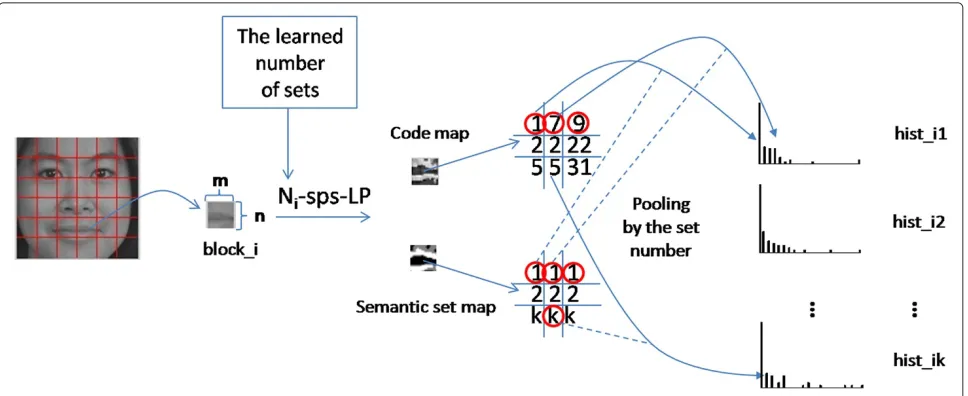
The process of face feature extraction using the general framework of semantic pixel set-based local patterns is illustrated on Figure 4. First, a face image is divided into a few regular blocks of a given size, and the number of pixel sets (Ni) for blocki, is learned according to the informa-tion entropy of the block. Then, pixels in this block are re-grouped intoNisets according to their semantic mean-ing. Once we have different sets of pixels for each block,
histograms of local patterns are extracted from each of them. Finally, all features are concatenated together and enhanced by the WPCA method.
3.1 Learning the number of sets based on the information entropy
The entropy is a term defined in information theory as a measurement of the uncertainty associated with a random variable [31]. It is relevant to the quantity and variability of the information. Here, we assume that the pixel intensity value is a random variable; thus, we can use the his-togram of the intensities in each face block to approximate the probability density function (PDF) for computing the information entropy. Applied to our case, the larger the entropy value is, the more information a face block should contain, and thus more clusters should be set.
The entropy value of the face blockican be then defined as
S(i)= n
k=1
p(xk)log2 1
p(xk)
= −
n
k=1
p(xk)log2p(xk) (1)
wherep(xk)is the probability of the pixelxwith intensity valuekin the histogram of the block.
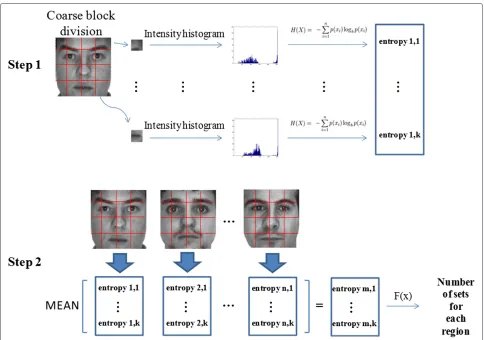
In our proposal, the entropy following Equation 1, is computed from the intensity histograms of the coarse-divided regions for all face images in the training set. Then, the average entropy value of a block in all images is used as the corresponding regional entropy. Although some images in the training set might be affected by noise, the average entropy values can still reflect the informa-tion quantity differences among different facial regions.
Finally, a monotonic transform function is used for map-ping the entropy value to the number of sets. The whole process is described in Figure 5.
The monotonic transform functionF(xi)in this paper, is implemented by using a linear function as follows:
F(xi)=(xi−xmin)/(xmax−xmin)
×(newmax−newmin)+newmin,
(2)
wherexiis the average entropy for blocki,xminandxmax
are the minimum and the maximum entropy values from all regions, newminis the least sets the region should be
divided while newmaxis the maximum number of sets that
can be obtained in a region. If the output ofF(xi)is not an integer number, it can be rounded to be an integer value.
In this work, we have decided to use newmin = 2 and
newmax = 8 and a coarse blocks division of 6×6,
aim-ing at havaim-ing a good trade-off between the computational cost and the proper use of the local spatial information.
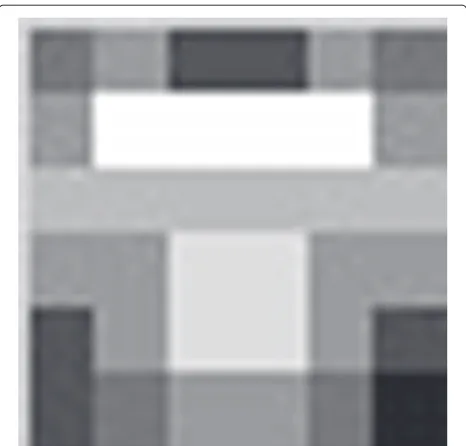
Illustrated in Figure 6 is the number of sets learned with the proposed algorithm, using the mentioned configura-tion, for a given training set. In the image, the brightest parts represent those regions with number of sets equal to 8 and the darkest parts correspond to the number of sets 2, while the gray parts represent integers between 2 and 8. It can be seen that those blocks corresponding to the eyes and nose contain more information than the rest of the parts. This corresponds to our intuition and also obeys the traditional weighted maps used for face recog-nition. Hence, we believe that using different number of sets for each block will enhance the discriminant ability of the method proposed in [17], where a fixed number of sets was used. Besides, it can also help to make better use of the spatial information.
3.2 Semantic pixel sets based local patterns
Once the number of pixel sets (Ni) in each face block is learned on the training phase, the proposed semantic
Figure 6The learning results of set number in each face block.In the figure, the number of sets learned with the proposed algorithm based on entropy, for a given face division, is shown. It can be seen that those blocks corresponding to the eyes and nose contain more information than the rest of the parts.
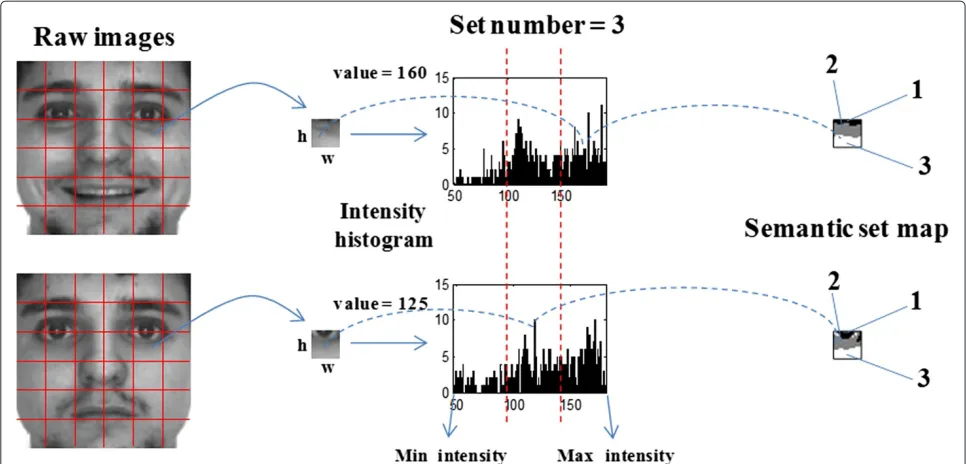
pixel set-based strategy for obtaining the histogram fea-tures can be used in the recognition process. First, the pixel intensity values on blockiare sorted and clustered uniformly inNisets, as it is illustrated in Figure 7. Under this strategy, for a fixed number of sets, the division of a block will always be the same although some have mono-tonic variations; so if the used local pattern operator, such as LBP, is invariant to monotonic grayscale variations, the final descriptor will also inherit this property (Additional file 1).
As was mentioned before, not only the LBP operator but also any other local pattern-based encoding method can be used with our strategy since the final representa-tion will be given by the histograms of codes computed from each pixel set. So, we will have for each coarse block the corresponding semantic set map and the codes map computed by the encoding method (e.g. LBP, LTP, TPLBP, etc.).
Using both, the semantic set map and the computed codes map, the histogram for the set S(i,n), with n ∈ [1, ..,Ni], can be obtained by
Hi,n(l)=
x,y∈S(i,n)
Icodes_map(x,y)=l,l=0, 1,. . .,m−1
(3)
where codes_map(x,y) is the local pattern obtained at position(x,y)andmis the number of code labels.
Finally, all feature vectors from all sets of all blocks (1 :t) will be concatenated together to represent a face image:
X=H1,1H1,2 . . .H1,N1 . . . Ht,Nt
. (4)
In the following, we will call this face image descriptor, semantic pixel set-based local patterns using information entropy (en-spsLP). As have been explained, the local pat-terns (LP) can be any histogram descriptor based on a local operator such as LBP and its different extensions.
3.3 Dimensionality reduction using WPCA
In order to take more advantage of the spatial information, overlapping regions can be used to extract the en-spsLP features. However, this increases the total dimension of the feature vector and can bring the curse of dimensional-ity. Hence, a feature reduction method should be applied in this case, in order to get a more compact representation. There are different methods in the literature for dimen-sionality reduction. Most of the supervised methods usu-ally applied in face recognition like LDA, although have shown good results, require more than two images per person for training, which cannot be always satisfied in real applications. It was proposed in [18] to apply Principal Component Analysis with a Whitening process (WPCA) to solve the so-called ‘Single Sample per Person’ prob-lem. This method has been recently used with different face descriptors such as Local Gabor Binary Patterns [32] and POEM [33], showing a very good performance even when only one or a few images are available per person. For those reasons, we decided to apply WPCA for the dimensionality reduction in our framework.
Under this method, after a feature vector, X, is pro-jected into the lower dimensional feature space found by PCA, u = WPCAX, it is normalized with a whitening
transformation:
w=−M1/2u, (5)
where−M1/2 = diag λ−11/2,λ−21/2,. . .,λ−M1/2
andλiare the eigenvectors of the covariance matrix. This process aims at reducing the negative influences of the lead-ing eigenvectors, as well as magnifies the discriminatlead-ing details encoded in the trailing ones.
4 Experimental evaluation
Figure 7The details of computing the semantic set map.This figure shows the detailed process for clustering the semantic pixel sets in one face block. First, the pixel intensity value distribution is computed. It can be viewed as a simplified sorting process. Then, it is quantified intoksets according to the learned number. Finally, according the raw pixel intensity values and the sets they belong to, a semantic set map for one face block can be obtained.
was applied, and the top-rank recognition rate was used to measure the performance of the methods. In the case of verification on LFW, we have followed the evaluation protocol, and the estimated mean classification accuracy with the standard error (uˆ±SE) was used for the evalu-ation. All images were photometric normalized with the preprocessed sequence proposed by Tan and Triggs [16].
The two databases used for identification are composed by images captured under controlled environments. The FERET database [34] contains images with a lot of vari-ations in expression, lighting and aging, divided into five subsets: Fa (gallery set), composed by frontal images of 1,196 subjects; Fb containing 1,195 face images with vari-ations in expression; Fc subset, which contains 194 images with variations in lighting; Dup-I with 722 face images taken with an elapsed time with respect to the images in the gallery set; and Dup-II, a subset of Dup I, which con-tains 234 images in which the elapsed time is at least 1 year. On the other hand, the AR database [35] was cre-ated to test face recognition methods in front of various expressions, different illuminations and occlusions. It con-tains more than 3,200 face images of 126 people captured on two different sessions. Each person has up to 13 images per session. We randomly selected 100 different subjects (50 males and 50 females) and the neutral expression image of every person in each session was used as gallery and the rest of them with different expressions, lighting and occlusions were used for testing. Images from both
databases were cropped to 114×114. Thus, using a coarse block division of 6×6, the blocks size will be 19×19.
Different from the former two databases, the LFW [36] database contains 13,233 images that were obtained under different unconstrained environments. The images are from 5,749 different individuals, and 1,680 of them have two or more images. In our experiment, we follow the standard training and testing protocol. We have used here the ‘View 1’ for learning the number of sets for each face block, and the ‘View 2’ for the final testing. Under this protocol, 6,000 pairs of images are compared in the eval-uation; the half of them correspond to images from the same person and the other half not. The testing data are divided into 10 evenly distributed sets and the test is repeated 10 times, using one set for testing and the oth-ers for training. It should be noted that our proposal was tested with the original data, without correcting the few labeling errors in the database. Besides, the aligned ver-sion (provided by [37]) of face images was used, and all of them were cropped to 126×110. In this case, overlapped coarse blocks of 18×22 were used.
4.1 The contribution of semantic pixel sets to different LBP based descriptors
appearance. It is expected that by using more robust descriptors, better results can be achieved. In order to make a fair comparison with [17], we use in this experi-ment the same fixed number of sets for each region, i.e. 6 or 8 sets. Besides, the original uniform LBP, the Local Ternary Patterns (LTP) [16] and the Three-Patch LBP (TP-LBP) [25] with the coarse initial division are tested. The obtained results on the FERET database are listed on Table 1. It can be seen that almost on all cases, the sps outperforms the traditional regular division. More-over, the more robust the descriptor, the better the results achieved with our proposal. In general, the best perform-ing descriptor is LTP.
In order to have an in-depth comparison between the sps strategy and the traditional block division, we test the LTP descriptor, with each strategy during histogram estimation. In order to make the comparison fair, we do not use the illumination preprocessing in this experiment. Given a coarse blocks division of 6 × 6, we compare the results of using LTP directly over this division (LTP), dividing those coarse blocks into more nsub-blocks (n -blockLTP) and dividing them intonsets according to our proposal (n-spsLTP). The results obtained in each subset of AR database with different kinds of variations are listed on Table 2.
As was explained in the Introduction, a finer regular block division is good for some cases (e.g. occlusions) but degrades for some others, especially for expression vari-ations. It can be seen from Table 2, that although the blockLTP presents slightly better results than our proposal for occlusion variations, in the case of expressions, the performance drops off by a significant margin, even worse than the original LTP. In general, our sps strategy has a more stable behavior. In any case, we have to admit the disadvantages of our method in the case of unpredicted occlusions. For instance, the pixel intensities of the orig-inal cheek region occluded by sunglasses will not be as dark as the black sunglasses. This will definitely change
Table 1 Top rank recognition rates on the FERET database
Method Fb Fc DupI DupII Average
uLBP 91.96 93.29 58.86 49.14 77.61
6-spsLBP 95.73 95.36 69.52 62.39 84.30
8-spsLBP 95.56 95.36 68.28 60.68 83.66
LTP 95.73 96.90 69.39 61.96 84.34
6-spsLTP 97.07 96.90 72.71 67.94 86.65
8-spsLTP 97.15 96.90 71.88 65.38 86.18
TPLBP 91.54 88.14 65.51 55.55 79.65
6-spsTPLBP 95.73 92.26 71.32 64.10 84.77
8-spsTPLBP 95.56 91.23 70.08 62.39 84.05
The contribution of semantic pixel sets to different LBP-based descriptors.
Table 2 Top rank recognition rates on the AR database
Method Expression Lighting Scarf Sunglasses Average
LTP 88.66 94.66 74.00 64.83 79.70
6-blockLTP 83.50 99.66 93.83 91.16 92.04
8-blockLTP 82.83 99.33 92.66 89.33 91.04
6-spsLTP 90.00 98.66 91.33 88.83 91.83
8-spsLTP 90.66 99.33 92.33 86.66 92.63
The advantage and disadvantage between sps and regular blocks division.
the sorting results of the pixel intensity values. The pool-ing process will thus go wrong. So, in the future, we will try some appearance-based methods for clustering in order to get a more stable block division result.
4.2 The contribution of entropy-based learning algorithm for estimation the number of sets in each block
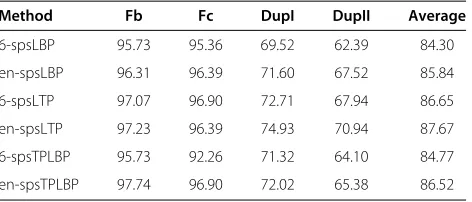
The aim of the this experiment is to demonstrate the con-tribution of using the information entropy for learning the number of sets for each face block. In this case, we com-pare the results of the same three descriptors with a fixed number of sets for each block (best results from Table 1) and using information entropy for learning the number of sets (en-sps). The obtained results are shown on Table 3. It can be appreciated that by using different number of sets for each region, better results are achieved in almost all cases. Besides, it can be said that the proposed learning method is useful for deciding the number of sets in each face block.
4.3 Face recognition using information entropy based spsLTP
In order to further exploit the capabilities of the proposed descriptor and to make better use of the spatial informa-tion, in this experiment we use the overlapping regions to derive the face features. Since in both experiments above, the LTP-based descriptor performs the best, we are going to use it in this experiment. In this case, keep the same blocks size but with five pixels of overlapping between neighbor blocks. When more blocks are involved, the final
Table 3 Top rank recognition rates on the FERET database
Method Fb Fc DupI DupII Average
6-spsLBP 95.73 95.36 69.52 62.39 84.30
en-spsLBP 96.31 96.39 71.60 67.52 85.84
6-spsLTP 97.07 96.90 72.71 67.94 86.65
en-spsLTP 97.23 96.39 74.93 70.94 87.67
6-spsTPLBP 95.73 92.26 71.32 64.10 84.77
en-spsTPLBP 97.74 96.90 72.02 65.38 86.52
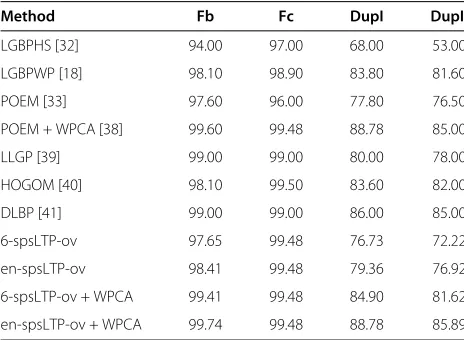
feature vector size becomes many times the original one. Hence, the use of a feature reduction method is needed. As it was explained above, the WPCA method is applied in this case. The obtained results, compared with some other face descriptors on FERET database are shown on Table 4. It can be seen that for spsLTP, better results can be achieved with the overlapping version (spsLTP-ov). Besides, when the learned number of sets for each block is used, the results can get further improvement, compared with the results obtained by using a fixed num-ber of sets for all blocks. Moreover, the benefits of using WPCA are demonstrated. In this database, when using overlapping blocks, we have found a total of 1,298 sets. This means that the descriptor (en-set-spsLTP-ov) has a dimension of 153,164 (1,298×59×2). We have selected only 850 features by using WPCA (en-set-spsLTP-ov-WPCA) and a better result is obtained. So, by apply-ing WPCA, we get a more compact and discriminative descriptor.
It can also be seen on the table that our results are comparable with some of the state-of-the-art methods such as the Local Gabor Binary Patterns Histograms Sequence (LGBPHS) [32], the Learned Local Gabor Patterns (LLGP) [39], the Histograms of Gabor Ordi-nal Measures (HOGOM) [40], the Patterns of Oriented Edge Magnitudes (POEM) [42] and Discriminative Local Binary Patterns (DLBP) [41].
4.4 Descriptors comparison in unconstrained environment
The aim of this last experiment is to show the effective-ness of our proposal in a more challenging face database, the LFW, for the uncontrolled face verification task. Since our method is unsupervised, only related works are com-pared. All images of the aligned version [36] are cropped
Table 4 Top rank recognition rates on the FERET database
Method Fb Fc DupI DupII
LGBPHS [32] 94.00 97.00 68.00 53.00
LGBPWP [18] 98.10 98.90 83.80 81.60
POEM [33] 97.60 96.00 77.80 76.50
POEM + WPCA [38] 99.60 99.48 88.78 85.00
LLGP [39] 99.00 99.00 80.00 78.00
HOGOM [40] 98.10 99.50 83.60 82.00
DLBP [41] 99.00 99.00 86.00 85.00
6-spsLTP-ov 97.65 99.48 76.73 72.22
en-spsLTP-ov 98.41 99.48 79.36 76.92
6-spsLTP-ov + WPCA 99.41 99.48 84.90 81.62
en-spsLTP-ov + WPCA 99.74 99.48 88.78 85.89
Face recognition using entropy based spsLTP-ov + WPCA in controlled environment.
to be 126×110 around the center. Blocks of 18×22 pixels are used to extract the en-spsLTP features, overlapped by six pixels in the rows and eight pixels in the columns. Dur-ing model selection, the trainDur-ing set in ‘View 1’ was used to learn the number of sets for each block by using the infor-mation entropy. For testing in ‘View 2’, the training set is used to train the WPCA axes and find the best thresh-old for determining if a comparison corresponds to the same person or not. In Table 5, we compare our method with other descriptors evaluated in [37] and [43] under the same protocol. We can find that in the list of unsuper-vised methods, our proposed method is comparable with the other descriptors. Since this dataset is very challeng-ing, we believe our method can achieve a better result by using a more complex nonlinear classifier learned from a supervised way.
5 Conclusions
This paper proposes a face representation framework called histogram of semantic pixel set-based local patterns using information entropy (en-spsLP). First, the num-ber of pixel sets is learned according to the information entropy in each face block. Then, during the histogram estimation, the code of the local pattern is pooled accord-ing to the original pixel intensity distribution. Finally, all the histograms are concatenated together and enhanced by the WPCA. The proposed method is easy to implement and the speed of the feature extraction is very fast. At the same time, the results are comparable with some of the state-of-the-art methods. Future work is to try other clus-tering criterion (e.g. by texton) in order to achieve more robustness to unpredicted occlusions. Besides, the opti-mal values for initial block size and position based on face landmarks can be further analyzed.
Table 5 Mean scores on the LFW database on ‘image-restricted configuration’ and aligned images
Method Performance
uLBP [37] 0.6824
Gabor (C1) [37] 0.6849
TPLBP [37] 0.6926
FPLBP [37] 0.6818
SIFT [37] 0.6986
V1-like [43] 0.6421±0.0069
V1-like+ [43] 0.6808±0.0044
LARK [44] 0.7223±0.0049
POEM [33] 0.7520±0.0073
POEM + WPCA [45] 0.8113±0.0053
en-spsLTP-ov + WPCA 0.8050±0.0033
Additional file
Additional file 1: Proof of the monotonic grayscale invariant property of the semantic pixel set strategy.
Competing interests
The authors declare that they have no competing interests.
Acknowledgement
This work is funded by the Strategic Priority Research Program of the Chinese Academy of Sciences (Grant No. XDA06030300), National Basic Research Program of China (Grant No. 2012CB316300), National Natural Science Foundation of China (Grant No. 61075024, 61273272, 61103155) and International S&T Cooperation Program of China (Grant No.2010DFB14110).
Author details
1National Laboratory of Pattern Recognition, Institute of Automation, Chinese
Academy of Science, P.O. Box 2728, Beijing 100190, People’s Republic of China. 2Advanced Technologies Application Center, 7th Avenue #21812 b/ 218 and
222, Havana, Cuba.
Received: 1 November 2012 Accepted: 15 April 2014 Published: 6 May 2014
References
1. AK Jain, SZ Li,Handbook of Face Recognition. (Springer-Verlag New York, Inc., Secaucus, NJ, USA,2005)
2. W Zhao, R Chellappa, PJ Phillips, A Rosenfeld, Face recognition: a literature survey. ACM Comput. Surv.35(4), 399–458 (2003) 3. B Heisele, P Ho, J Wu, T Poggio, Face recognition: component-based
versus global approaches. Comput. Vis. Image Underst.91(1–2), 6–21 (2003)
4. X Tan, S Chen, Z Zhou, F Zhang, Face recognition from a single image per person: a survey. Pattern Recognit.39(9), 1725–1745 (2006)
5. R He, BG Hu, WS Zheng, XW Kong, Robust principal component analysis based on maximum correntropy criterion. IEEE Trans. Image Process. 20(6), 1485–1494 (2011)
6. Á Serrano, IM de Diego, C Conde, E Cabello, Recent advances in face biometrics with Gabor wavelets: a review. Pattern Recognit. Lett.31(5), 372–381 (2010)
7. Z Lei, S Liao, M Pietikäinen, SZ Li, Face recognition by exploring information jointly in space, scale and orientation. IEEE Trans. Image Process.20, 247–256 (2011)
8. M Pietikäinen, A Hadid, A Zhao, T Ahonen,Computer Vision Using Local
Binary Patterns. (Springer-Verlag, London Ltd, 2011)
9. T Ahonen, A Hadid, M Pietikãinen, Face recognition with local binary patterns, inEuropean Conference on Computer Vision (ECCV). Prague, Czech Republic, 11–14 May 2004, pp. 469–481
10. H Jin, Q Liu, H Lu, X Tong, Face detection using improved LBP under Bayesian framework, inInternational Conference on Image and Graphics
(ICIG). Hong Kong, 18–20 Dec 2004, pp. 306–309
11. S Liao, ACS Chung, Face recognition by using elongated local binary patterns with average maximum distance gradient magnitude, inAsian
Conference on Computer Vision (ACCV). Tokyo, 18–22 Nov 2007, pp.
672–679
12. S Liao, X Zhu, Z Lei, L Zhang, SZ Li, Learning multi-scale block local binary patterns for face recognition, inInternational Conference on Biometrics
(ICB). Seoul, 27–29 Aug 2007, pp. 828–837
13. Z Guo, L Zhang, D Zhang, X Mou, Hierarchical multiscale LBP for face and palmprint recognition, inInternational Conference on Image Processing
(ICIP). Hong Kong, 26–29 Sept 2010, pp. 4521–4524
14. S Liao, M Law, A Chung, Dominant local binary patterns for texture classification. IEEE Trans. Image Process.18(5), 1107–1118 (2009) 15. Z Guo, L Zhang, D Zhang, A completed modeling of local binary pattern
operator for texture classification. IEEE Trans. Image Process.19(6), 1657–1663 (2010)
16. X Tan, B Triggs, Enhanced local texture feature sets for face recognition under difficult lighting conditions. IEEE Trans. Image Process.19(6), 1635–1650 (2010)
17. Z Chai, H Mendez, R He, Z Sun, T Tan, Semantic pixel sets based local binary patterns for face recognition, inacepted in Asian Conference on
Computer Vision (ACCV). Daejeon, 5–9 Nov 2012
18. W Deng, J Hu, J Guo, Gabor-eigen-whiten-cosine: a robust scheme for face recognition, inAMFG. Beijing, 16 Oct 2005, pp. 336–349 19. S Marcel, Y Rodriguez, G Heusch, On the recent use of local binary
patterns for face authentication. Tech. Rep, 06–34, Idiap, 2006
20. D Huang, C Shan, M Ardabilian, Y Wang, L Chen, Local binary patterns and its application to facial image analysis: a survey. IEEE Trans. Syst. Man Cybernetics-Part C: Appl. Rev.41(6), 765–781 (2011)
21. T Ojala, M Pietikãinen, D Harwood, A comparative study of texture measures with classification based on featured distributions. Pattern Recognit.29, 51–59 (1996)
22. T Ojala, M Pietikäinen, Mäenpää T, Multiresolution gray-scale and rotation invariant texture classification with local binary patterns. IEEE Trans. Pattern Anal. Mach. Intell.24(7), 971–987 (2002)
23. X Huang, SZ Li, Y Wang, Shape localization based on statistical method using extended local binary pattern, inInternational Conference on Image and Graphics (ICIG), (2004), pp. 184–187
24. S Liao, X Zhu, Z Lei, L Zhang, SZ Li, Learning multi-scale block local binary patterns for face recognition, inInternational Conference on Biometrics
(ICB). Seoul, 27–29 Aug 2007, pp. 828–837
25. L Wolf, T Hassner, Y Taigman, Descriptor based methods in the wild, in Faces in Real-Life Images workshop at the European Conference on Computer Vision (ECCV). Marseille, 12–18 Oct 2008
26. G Zhang, X Huang, S Li, Y Wang, X Wu, Boosting local binary pattern (LBP)-based face recognition, inAdvances in Biometric Person Authentication, Volume 3338 of Lecture Notes in Computer Science, ed. by S Li, J Lai, T Tan, G Feng, and Wang Y (Springer Berlin Heidelberg, 2005), pp. 179–186 27. C Shan, S Gong, Owan McP, Conditional mutual information based boosting for facial expression recognition, inProceedings of British
Machine Vision Conference. Oxford, UK, Sept 2005
28. T Gritti, C Shan, V Jeanne, R Braspenning, Local features based facial expression recognition with face registration errors, inProceedings of IEEE
International Conference on Automatic Face and Gesture Recognition.
Amsterdam, The Netherlands, 17–19 Sept 2008
29. T Ahonen, A Hadid, M Pietikãinen, Face description with local binary patterns: Application to face recognition. IEEE Trans. Pattern Anal. Mach. Intell.28(12), 2037–2041 (2006)
30. H Mendez-Vazquez, E Garcia-Reyes, Y Condes-Molleda, A new image division for LBP method to improve face recognition under varying lighting conditions, inProceedings of International Conference on Pattern
Recognition. Tampa, Florida, 8–11 Dec 2008, pp. 1–4
31. TM Cover, JA Thomas,Elements of Information Theory (Wiley Series in
Telecommunications and Signal Processing). (Wiley, New York, 2006)
32. W Zhang, S Shan, W Gao, X Chen, H Zhang, Local Gabor binary pattern histogram sequence (LGBPHS): a novel non-statistical model for face representation and recognition, inInternational Conference on Computer
Vision (ICCV). Beijing, 17–20 Oct 2005, pp. 786–791
33. NS Vu, A Caplier, Face recognition with patterns of oriented edge magnitudes, inEuropean Conference on Computer Vision (ECCV). Heraklion, Crete, 5–11 Sept 2010, pp. 313–326
34. JP Phillips, H Moon, SA Rizvi, PJ Rauss, The FERET evaluation methodology for face-recognition algorithms. IEEE Trans. Pattern Anal. Mach. Intell. 22(10), 1090–1104 (2000)
35. A Martínez, R Benavente, The AR face database. Tech. Rep. #24, CVC 1998 36. GB Huang, M Ramesh, T Berg, E Learned-Miller, Labeled faces in the wild: a database for studying face recognition in unconstrained environments. Tech. Rep, 07–49, (University of Massachusetts, Amherst, 2007) 37. L Wolf, T Hassner, Y Taigman, Similarity scores based on background
samples, inAsian Conference on Computer Vision (ACCV). Xi’an, China, 23–27 Sept 2009, pp. 88–97
38. NS Vu, A Caplier, Enhanced patterns of oriented edge magnitudes for face recognition and image matching. IEEE Trans. IP.21(3), 1352–1365 (2012) 39. S Xie, S Shan, X Chen, X Meng, W Gao, Learned local Gabor patterns for
face representation and recognition. Signal Process.89(12), 2333–2344 (2009)
40. Z Chai, R He, Z Sun, T Tan, H Mendez-Vazquez, Histograms of Gabor ordinal measures for face representation and recognition, inIAPR
International Conference on Biometrics (ICB),. New Delhi, India, 29 March–1
41. D Maturana, D Mery, A Soto, Learning discriminative local binary patterns for face recognition, inInternational Conference on Automatic Face and
Gesture Recognition (FG). Santa Barbara, CA, 21–25 March 2011, pp.
470–475
42. NS Vu, HM Dee, A Caplier, Face recognition using the POEM descriptor. Pattern Recogn.45(7), 2478–2488 (2012)
43. N Pinto, JJ DiCarlo, DD Cox, Establishing good benchmarks and baselines for face recognition, inFaces in Real-Life Images workshop at the European
Conference on Computer Vision (ECCV). Marseille, 12–18 Oct 2008
44. HJ Seo, P Milanfar, Face verification using the LARK representation. IEEE Trans. Inform. Forensics Secur. (TIFS).6(4), 1275–1286 (2011) 45. NS Vu, A Caplier, Enhanced patterns of oriented edge magnitudes for
face recognition and image matching. IEEE Trans. Image Process.21(3), 1352–1365 (2012)
doi:10.1186/1687-5281-2014-26
Cite this article as:Chaiet al.:Explore semantic pixel sets based local
patterns with information entropy for face recognition.EURASIP Journal on
Image and Video Processing20142014:26.
Submit your manuscript to a
journal and benefi t from:
7Convenient online submission
7Rigorous peer review
7Immediate publication on acceptance
7Open access: articles freely available online
7High visibility within the fi eld
7Retaining the copyright to your article