R E S E A R C H
Open Access
A two-fly tracker that solves occlusions by
dynamic programming: computational
analysis of
Drosophila
courtship behaviour
Christian Schusterreiter
1,2*and Wilfried Grossmann
3Abstract
This paper introduces a two-fly tracker which focuses on an approach to model and to solve occlusions as an optimization problem. Automated tracking of genetic model organisms is gaining importance since geneticists and neuroscientists have biological tools to systematically study the connection between genes, neurons and behaviour by performing large-scale behavioural experiments. This paper is about a fly tracker that provides automated quantification for such functional behaviour studies onDrosophilacourtship behaviour. It enables measurement and visualization of behavioural differences in genetically modified fly pairs. The developed system provides solutions for all major challenges that were identified: arena detection, segmentation, quality control, resolving occlusions,
resolving heading and detection of behaviour events. Among all challenges especially resolving occlusions turned out to be of particular importance and huge effort was invested to resolve that particular problem. Our tests show that our system is capable to identify flies through an entire video with an accuracy of 99.97%. This result is achieved by combining different types of local methods and modeling the global identity assignment as an optimization problem.
Keywords: Fly tracker; Ethogram; Occlusion; Dynamic programming;Drosophila; Courtship behaviour; Quantification; Pattern recognition
1 Introduction 1.1 Motivation and goals
A fundamental question in neuroscience is to understand the relation between genes, brains and behaviour: Genes encode hard-wired neuronal circuits in the nervous sys-tem. For innate behaviours - like reproductive behaviour of insects - such neuronal circuits produce observable stereotypic motor outputs.
The fruit flyDrosophila melanogasterhas a set of innate behaviours that are hard-wired in the nervous system. Several innate behaviours of D. melanogaster are sex-specific. In combination with the availability of genetic and molecular tools, the fruit fly is a common model organism to study how the nervous system generates behaviours.
*Correspondence: [email protected]
1I.M.P. Research Institute of Molecular Pathology, Dr. Bohr-Gasse 7, 1030 Vienna, Austria
2Present address: University of Oxford, Department for Computer Science, Wolfson Building, Parks Road, Oxford OX1 3QD, UK
Full list of author information is available at the end of the article
Drosophila courtship is a robust and sex-specific behaviour that has been characterized through multi-ple genetic screens. Many genes that regulate male and female courtship behaviour have already been identi-fied. It was a big surprise that a complex behaviour like courtship is regulated by a few sets of genes [1,2], and it is strongly believed that these genes interact with cascades of downstream genes that regulate individual parts of the behaviour.
Currently geneticists and neuroscientists perform large-scale experiments in order to systematically identify genes and neurons that are involved in specific steps of courtship behaviour. Quantification of these experiments and classification of different behaviours turned out to be a very time consuming and tedious task; thus, it was the major bottle neck of large-scale behaviour screens for a long time.
Automated tools aim to support such large-scale exper-iments. Saving time is one important factor, but in addi-tion, automation limits human error and extends possibil-ities for robust, objective and reproducible analysis.
This paper describes the development of a system, which translates courtship behaviour videos into formal descriptors using computer vision and statistical methods. The descriptors allow ethogram-like descriptions of com-plex courtship behaviour patterns for each fly. A special feature of our system is the identification of individual flies through the entire video by solving the occlusion problem with very high accuracy.
1.2 Related work
When the project was initiated, only a few trackers [3-6] existed for a different model organism called Caenorhab-ditis elegans. These trackers mainly analyzed the worm’s movements and quantified turn direction versus straight movement. They excluded frames where worms occluded each other. The only published fly tracker [7] analyzed the fly locomotion behaviour.
In 2008 Perona published an automated fly tracker for courtship and aggressive behaviour [8,9] and initiated a transition from manual to automated scoring. Simul-taneously, Schusterreiter developed a tracker [10] that measures the courtship index and captures courtship sub-behaviours.
In particular, the work of Dankert et al. [8] has similar aspects to this paper as it also introduces a two-fly tracker and tackles similar challenges. Our tracker mainly differs in three aspects: It was initially designed to process unseen videos that are not specif-ically recorded for automated tracking and therefore comes with an arsenal of quality boosting and qual-ity control methods. Second, we spend a huge effort to tackle the occlusion problem, which was probably less critical for the application scenarios of [8]. Finally, our system offers top-down and bottom-up classifiers for courtship behaviour, while the other system offers top-down classifiers only but for both courtship and aggressive behaviours.
Branson et al. [9] quantifies behaviour of multiple flies, while our system is specifically optimized for two flies per chamber. Our system deals with flies turning their head up in z-direction and flies occluding each other in z-direction by improved software analysis, while the tracker [9] attacks these problems by improvements of the recording setup [11] that significantly decrease difficult occlusion cases.
Hoyer et al. [12] used a tracker that quantified aggres-sion behaviour by a user-defined lunge counter and required one of the two male flies to be painted with a white dot on the back. Similarly, the identity tracking method introduced in [13] enabled biologists to genet-ically mark flies by a camera-detectable fluorescence marker. In contrary, our system is in principle capable to incorporate detectable color differences but does not
requireto mark flies.
The work introduced within this paper was developed independently from related work; however, some user-defined classifiers of the postprocessor were user-defined after the classifiers in [8] have been studied. Further similar-ities, like choosing the Hungarian algorithm for identity assignment in unoccluded sequences or circular arena detection by the Hough transform, are coincidental.
This paper introduces a two-fly tracker and focuses mainly on resolving occlusions as an optimization prob-lem. It is organized as follows: Section 2 introduces the main components of the entire system. Section 3 starts with the basic definitions for the occlusion problem (Section 3.1) and local methods for occlusion assignments (Section 3.2). The solution of the occlusion problem as an optimization problem is stated in Section 3.3, and a dynamic programming algorithm that solves this opti-mization problem is presented in Section 3.4. Results of the approach will be discussed in Section 3.5. Section 4 shows that the same algorithm is capable to solve the heading problem. Finally, Section 5 provides a summary, discusses properties and results of the optimization algo-rithm and outlines future work.
2 A two-fly tracker
In general, automated tracking is a datadensification pro-cess that takes high amounts of video data having low information content and turns them into low amounts of
relevant features having high information content. Our system comes with two major steps: an image process-ing stepwhere raw video data is transformed into a time series representation and apattern recognition stepwhere biologically relevant events are detected within that time series. The image processing part further subsumes sev-eral data transformation and data cleaning steps while the data is still in its image representation. It thus boosts quality and plausibility of image data before the time series is extracted and ensures that minimum quality standards are met. In case videos are detected to be inap-propriate for downstream computation steps, they are rejected as early as possible in order to save computation time.
The system architecture consists of several modules
named preprocessor, tracker, postprocessor and anno-tationTool. The preprocessor and the tracker cover the image processing part, the postprocessor derives advanced attributes and covers the pattern recognition part. The workflow between modules is straightforward: information flows from the preprocessor through the tracker to the postprocessor module. The only two-way interacting component is the annotationTool; it interoper-ates with postprocessed data (cf. Figures 1 and 2).
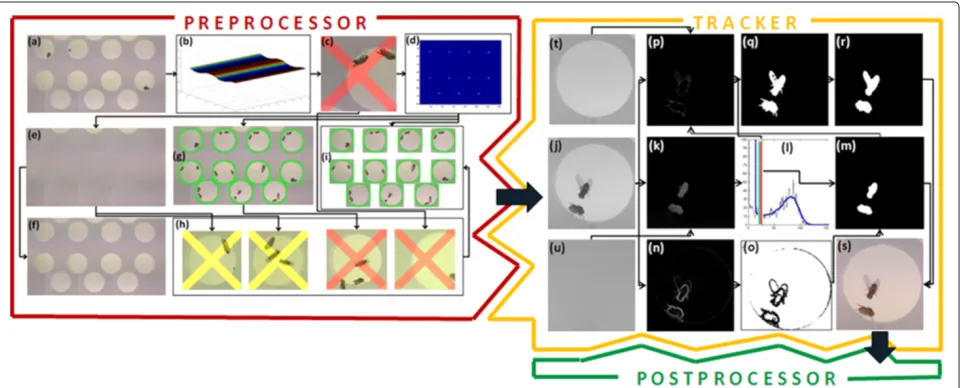
Figure 1Schematic overview of the image processing part.Preprocessor (red shape):(a)extract median background;(b)illumination correction curve;(c)chamber rejected in movement detection step;(d)accumulated peaks for circular arena detection;(e)rigorously smoothed background for body segmentation;(f)cautiously smoothed background for wing segmentation;(g)watched boundary for each detected arena;(h)chambers rejected by quality control, witness pictures capture reason for rejection; and(i)individual chambers after arena splitting step.Tracker (yellow shape): (j)gray values of an original frame of a single chamber video;(k)subtracting rigorously smoothed background for body region segmentation; (l)threshold determination: body region threshold (red line) and wing region threshold (green line) are determined within the gray value histogram (black line), respectively, a smoothed histogram (blue line);(m)binarized fly body region(n)gradient magnitude values, bright values indicate edges;(o)mask region for morphological reconstruction;(p)subtracting cautiously smoothed background for wing region segmentation, body and non-arena regions are black;(q)binarized wing region with legs;(r)fly wing region without legs and with filled holes;(s)original image with segmentation results, body region in red, wing region in blue;(t)cautiously smoothed background; and(u)rigorously smoothed background.
The preprocessor identifies individual arenas (cf. Figure 1a) and boosts video quality for each frame. Qual-ity improvement encompasses illumination correction based on an illumination correction curve (cf. Figure 1b) and elimination of arenas where camera movement, intruding objects or not exactly two flies were detected (cf. Figure 1c,h,i). In this process, approximately 2% to 5% of chamber videos are rejected. For arena detection and all further image processing two gray level pic-tures are essential: the so-called rigorously smoothed background (Figure 1e) and the cautiously smoothed background (Figure 1f ). Arenas are detected by a circular Hough transform which identifies number, position and diameter of the arenas (Figure 1d). Arena boundaries (Figure 1g) are watched by an intrusion detector. Finally, videos are split into individual arenas (Figure 1i), each handed separately to the tracker.
The tracker shown in Figure 1j,k,l,m,n,o,p,q,r,s takes single arena videos and corresponding smoothened back-grounds as input (cf. first column of the tracker figure, Figure 1j,u,t). The second column shows the arena after subtracting the smoothened backgrounds (first and sec-ond rows, Figure 1p,k) and the results of a gradient procedure in the third row (Figure 1n). Further process-ing is based on the gray level histogram shown in the middle of the third column (Figure 1l). Two different thresholds are used for body and wing detection. Using the thresholds for body region together with the gradi-ent pictures for the boundaries, we obtain a picture for the body region (Figure 1m). Using this result in connec-tion with the threshold for wing detecconnec-tion, we obtain from (Figure 1p) the first image of the binarized body-wing region (Figure 1q). This image is further improved by fill-ing holes (Figure 1r). Resultfill-ing body regions (Figure 1m) and wing regions (Figure 1r) are marked in the origi-nal image in Figure 1s. Extraction of primaryattributes directly from images (Figure 1m) and (Figure 1r) con-cludes the image processing step. These attributes build the interface to the postprocessor module. We derive for both body and wing region: the number of pixelsArea, the regionPerimeter and the center of gravityCentroid,
Orientation,MinorAxisLengthandMajorAxisLengthof a covering ellipse.
The tracking process is accompanied by number of quality control steps like checking for intrusions into the watched boundary around a chamber (cf. Figure 1i) and evaluation of tracked primary attributes’ plausibility.
The postprocessorcovers the pattern recognition part of the system and searches for biologically relevant events. As a first step tracking data is normalized such that all attributes are comparable across different videos. From normalized primary attributes we compute secondary attributes that allow definition of behavioural patterns like following, wing extension or copulation. Figure 2 shows
some of these attributes. They capture specific fly con-stellations (Figure 2a,e,f,g,h) or shapes (Figure 2b,c,d). Transformation of these attributes into behaviour patterns requires identification of individual flies in each video frame and detection of each fly’s head and tail. Fly identifi-cation is rather simple as long as the tracker distinguishes separate regions for each fly in so-called unoccluded frames. For sequences of unoccluded frames, fly identi-ties are carried through successive frames by solving an assignment problem for position characteristics with the Hungarian algorithm [14].
In case of occluded frames, the frames where fly bod-ies overlap (occlude) each other, primary and secondary attributes are computed after solving the occlusion prob-lem. A solution assigns a matching for fly identities before and after each occlusion (see Section 3). According to these matchings, occluded primary attributes are approx-imated by interpolations. Having primary attributes for every single frame, the postprocessor then determines the head and tail for each fly body (see Section 4) and computes all other secondary attributes.
The system may then apply machine-learned or user-defined classifiers to detect relevant behaviour events. Detected events are protocolled in color-codedethograms
(cf. Section 5.2) and excel sheets.
The annotationTool interacts with the postprocessed data. It supports attribute inspections and overruling of machine decisions. Manually tweaked postprocessing data is re-postprocessed to ensure consistent data views and to avoid time-consuming recalculations during online annotations.
The screenshot in Figure 2i contains data panels on top that visualize attributes for both flies, video panels that depict video frames with tracked perimeter, auto-matically annotated heading and interpolated ellipses and an occlusion panel that visualizes fly identifica-tion across an occlusion. Control panels on the right are for video navigation, attribute selection and manual annotation.
We further implemented awebinterfaceto bulk-submit processing tasks to a computer cluster and to manage videos and tracking results.
3 Resolving occlusions 3.1 Problem definition
even impossible to allocate individuals correctly after two flies have overlapped completely.
Since it is essential to be able to allocate the individ-ual flies for the behavioural studies, the occlusion problem was a key challenge in system development and huge effort was invested to tackle the occlusion problem.
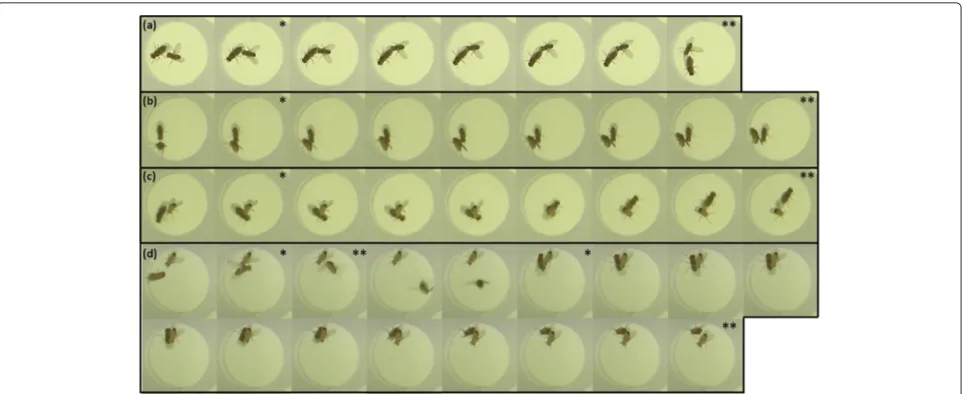
Figure 3 shows four cases of occlusion to further illus-trate the problem. The majority of occlusion cases are very similar to the ones depicted in Figure 3a,b; the one in Figure 3a depicts a social interaction that typically hap-pens in occluded scenes. Our system reliably resolves such occlusions (and also detects the wing extension during occlusion in Figure 3a). A rare case where our system is wrong (Figure 3d) is further discussed in Section 3.5.
For resolving occlusions, the sequence of all video frames V is partitioned into alternating σ and τ
sequences. Whileσsequences contain unoccluded frames where both fly bodies are detected separately,τ sequences contain occluded frames where the two fly bodies are merged into one larger region or where no flies at all were detected.
Formally,σandτ sequences are defined as follows:
Definition 1.Letf be a frame. Functiono(f)is defined aso(f) =1 in casef is occluded ando(f)= 0 otherwise. Letf0refer to an empty frame.o(f0)=1.
Definition 2.LetVbe a sequence of framesfi,fi∈V. A sequenceσ ⊆Vcontains a set of successive framesfiwith ∀fi ∈σ :o(fi) =0; a sequenceτ ⊆Vcontains successive frames with∀fi∈τ :o(fi)=1.
Corollary 1.The border for a partitioningof V that consists of alternating σ and τ sequences is marked by [o(fi)]. The partitioning 0 of V0 = f0 ∪ V ∪ f0 is
guaranteed to start and end with aτsequence.
Definition 3.The occlusion problem is finding the best overall assignment of fly identities in all unoccluded sequences using observable fly attributes.
The problem is solved in two steps. First, we calcu-late local scores for the possible assignments of the fly identities in a subsequence(σi,τi,σi+1), using only infor-mation in the occluded sequenceτiand its two enclosing unoccluded sequencesσi andσi+1. These scores can be
interpreted as probabilities for a matching and are deter-mined by local methods calledt-methods. Different local methods are introduced in Section 3.2. The occlusion sequences in Figure 3a,b depicts rather trivial occlu-sion cases where most local methods are successful. The sequences in Figure 3c,d shows cases that may deliver diverged results from different local methods.
Resolution of such ambiguities is done in the sec-ond step by (a) formalizing the occlusion problem as a global optimization problem in subsection 3.3 and (b) solving it with a dynamic programming approach (see subsection 3.4).
3.2 Local methods
Local methods or t-methods are associated with a τ
sequence and aim to provide an assignment for the identifiers of its enclosing σ sequences. Each t-method
computes at value, respectively, at scorefor each assign-ment that resembles its certainty.
In general, t-methods may be differentiated into
attribute-based methods following a merge-and-split
approach, point-based methods following a straight-throughapproach [15] andcombination methods.
3.2.1 Attribute-based methods
Follow a classical merge-and-split approach. The idea of attribute-based methods is pretty simple: compare the values of known fly attributes before and after the occlusion and assign pre-occlusion flies to best matching post-occlusion flies. The particular set of characteristic attributes that are used to re-identify flies may vary.
Although any attribute can be taken into account, we will first focus on size-based attributes. An initial motiva-tion for size-based methods was the known size difference between male and female flies.
In general, attribute-based methods match flies accord-ing to the mean, maximum, minimum and any other aggregation of sizes before occlusion and after occlusion.
Method siz1 aggregates an eccentricity-corrected
size attribute AreaEC = Area
1−EccentricityC2, EccentricityC = Eccentricity
1+e5·Eccentricity from whole σ sequences and compares probabilities that indicate which fly is big-ger. Figure 2i (blue shape, second and third data panel) visualizes the attributes Area and AreaEC next to each other (particularly note frames 460 to 480 when the larger fly turns up in z-direction). When using attribute AreaEC method siz1 solves all occlusion cases in Figure 3, while straight incorporation of Area would get sequence Figure 3c wrong.
Method posm compares Centroids from the last frame before the occlusion to the first frame after the occlusion and computes a score v ∈ (−1,+1). The score aggre-gates Centroid distances that indicate a matching of fly 1 before the occlusion being fly 1 after the occlusion,
o1bo1
a(and correspondinglyo2bo2a) versus the oppo-site matching. Normalized by all involved distances, the
score v = −(o1boa1)+(o2bo2a)−(o1bo2a)−(o2bo1a).
(o1
bo1a)+(o2bo2a)+(o1bo2a)+(o2bo1a).
is
guaran-teed to be between−1 and+1 and is negated to prefer short distances. Result scoresvindicate an identity assign-ment by sign(v) and the method’s certainty about their assignment by|v|.
3.2.2 Point-based methods
follow the straight-through approach where a point setC that is traced ‘straight through’ the occlusion states. The object’s perimeter turned out to be a good choice forC, it outperformed all other tested point set candidates by solution quality or computation time.
The aim of point-based methods is to assign identi-fiers from the state before the occlusionb, the last frame
where both flies have been identified, to the state after the occlusiona, the first frame where both flies are identified again. For this reason, point setsC are extracted before and after the occlusion and each point is associated with an identifier of the two separately detected flies. Then, for each frame during the occlusion, the point set is extracted and associated identifiers are carried over from its pre-decessor frame by a nearest neighbour assignment using Voronoi diagrams [16]. At the end, the identifier set car-ried through the occlusionCˆais compared with the freshly partitioned point set Cˆa and a score v is derived that resembles how associated identifiers of the characteris-tics inCˆaandCˆamatch. The score particularly aggregates the sum of identifier votes fromCathat indicate mapping identifierso1btoo1aando2btoo2aminus the votes for map-pingo1bto o2aando2btoo1a, normalized by the sum of all votes,v= (o1boa1)+(o2bo2a)−(o1bo2a)−(o2bo1a).
(o1bo1
a)+(o2bo2a)+(ob1o2a)+(o2bo1a).
,v∈(−1,+1). Resulting scores v again indicate a suggested identity assignment and the certainty about this assignment result in sign(v)respectively|v|.
The major weakness of all point-based methods comes with the nearest neighbour assignment. Due to the fact that each pixel takes over the identifier of its nearest pixel in the previous frame, crossing flies are likely to be mis-scored. In fact, all mis-scores and ‘don’t know’ cases that scored with a value of 0 result from this known issue. The latter case especially comes up when the occluded region moves over longer distances. A method variant bocT therefore aims to compensate such movements by applying rigid transformation between successive frames and reduces the effect of that particular weakness.
The boc method and its variants turned out to be particularly reliable for occlusion cases like the ones in Figure 3a,b and are likely to get cases like the one in Figure 3c wrong. Although point-based methods have known difficulties when dealing with crossing flies - they still correctly solve between 90% and 95% of our test case set (see Section 3.5) and typically give low certainty values when they are wrong.
3.2.3 Combining meta-methods
approach; although alternative meta-method approaches performed equally well, the tree approach was chosen because of its intuitive and easy understandable rule-based decisions.
The experiment results in Section 3.5 contain results from a cross-validated CART method where local meth-ods, each having an accuracy of 90% to 95%, are bundled into a combined t-method with about 99% accuracy.
Alternatively, the probability-converted score of inde-pendent methods may be combined by theDempster com-bination[17,18], which allows to mathematically combine evidences from different sources into a combined degree of belief. The Dempster combination is defined as follows:
Definition 4.Let e1 and e2 be two independent
dences. The Dempster combination of these two evi-dences is defined ase1⊗e2= e11−·eK2,K =(1−e1)·e2+e1·
(1−e2).
The definition above allows to cumulatively com-bine evidences from multiple methods into new t-probabilities. The Dempster combination may also be used to combine independent s-methods (s-methods are introduced in Section 3.3 below).
3.3 Occlusions as global optimization problem
Local methods process cases linearly and assess occlusion sequences independently one after another. Therefore a wrong identity assignment is passed on through the entire video as identities are swapped from that wrong assign-ment on and therefore mis-assigned up to the end of the video (cf. in Section 3.3, first example).
In order to overcome this error propagation problem we complement t-methods with so-calleds-methods. While t-methods are associated withτ sequences, s-methods are associated with unoccludedσ sequences where both flies are detected. These s-methods aim to discriminate and re-identify the two detected flies much like in the merge-and-split approaches introduced in Section 3.2. How-ever, while merge-and-split t-methods assess and compare characteristics of theσsequences directly before and after an occludedτsequence, the characteristics for s-methods require to becomparable during the whole video. Similar to the t-methods, a s-method provides as-scorefor each assignment that resembles its certainty.
The comparability of s-methods is a key property to overcome the error propagation problem that comes when using t-methods only and is essential for the opti-mization approach described in this section. The follow-ing two examples underline the difference between s- and t-methods:
The size-based method siz1 (see Section 3.2) aims to match flies before an occlusion (in sequence σb) to flies after an occlusion (in sequenceσa) according to an
observed size difference. The bigger fly is assigned to the bigger fly and the smaller fly is assigned to the smaller fly. Such a size-based method may easily be generalized to become a s-method, since the discriminating characteris-tic - the fly size - is comparable during the whole video. In other words, flies in an arbitrary unoccluded sequence
σk may be matched to flies of every other unoccluded sequenceσi, such that the bigger flies are assigned to each other.
On the contrary, the position-based method posm (see again Section 3.2), which aims to match flies according to their position, isnot suitable for a s-method generaliza-tion. Obviously, longer time spans between two sequences
σkandσiwill lead to improper results.
In general anatomical features, e.g. size or eye color, suggest suitable s-methods implementations. In principle any measurable anatomical or otherwise constant fea-ture (like a painted mark) that discriminates the flies is applicable.
An intuitive combination for s- and t-methods would be to select scores where a s-method is absolutely sure and to then treat corresponding identity assignments as ‘fix points.’ Then t-methods may be used for low-score cases between these fix points only. Such an approach would limit the intrinsic problem coming with t-methods as mis-assignments would only be propagated up to the next fix point. The introduced optimization approach is a gen-eralization of this idea and enables that s-methods and t-methodscorrect each other.
In order to ensure comparability of method results, their scores are converted toprobabilitiesas probability values arecomparableandcombinable with each other.
In theory the conversion is done by empirically deter-mining the distribution of score values per method and then deriving a value pfrom a score and the method’s specifically given score distribution. In practice, using a linear approximation turned out to lead to suffi-ciently accurate results for all incorporated methods (see Section 3.5).
Finally,svalues andtvalues are defined for each meth-ods as logodds which are derived from these (approxi-mated) probability values,v = ln(1−pp). Logodds inherit all comparability and combinability properties and fur-ther provide two desirable mathematical properties: (1) logodds of counter probabilities correspond to an inver-sion in sign, v = ln(1−pp) = −v and (2) logodds are combinable by addition.
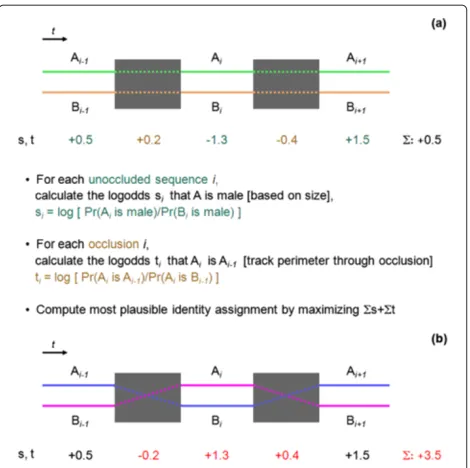
Figure 4a explains the values assignment to σ and τ
Figure 4Sample problem instance for the optimization approach.(a)Identified flies over time: A in green and B in orange. Occluded sequences are marked by gray boxes.svalues associated with non-occluded sequences are in blue;tvalues for occluded sequences are in brown. The text summarizes the computation ofs andtvalues and color-codes keywords and definition in blue and brown fors-respectivetvalues.(b)Visualization of same instance as in(a)after a flip operation; fly identifiers are switched and switched back within the two gray boxes. Red values show the flippedsandt values and their updated sum.
For each unoccluded sequence,σthe two detected flies are arbitrarily named fly Aand flyB and the s-method siz1m - a variant of the sign test that provides good approximations for short sample sizes - computes the probability pthat A is the bigger fly. The logoddss are derived frompand assigned to each unoccluded sequence (see cyan values in Figure 4a). Positive values indicate that fly A is the bigger fly, negative values that it is assumed that B is the bigger fly.
For each occluded τ sequence, the probability that fly A beforethe occlusion remains fly A afterthe occlusion is derived from a t-method. Method boc carries identifier information through the occlusion (cf. point-based meth-ods in Section 3.2 for a more detailed description). Again, the logodds are computed, and the resultingtvalues are assigned to the occluded sequences (see brown values in Figure 4a). Whilesvalues correspond to the probability that fly A is the smaller fly (in Figure 4 written as ‘A is male’),t values correspond to the probability that fly A in theσsequencebeforethe occlusion corresponds to fly A in theσ sequenceafterthe occlusion. The (potentially artificial)τ sequences at the beginning and the end ofV0
are assigned withtvalues of 0.
Having allsvalues andtvalues in place, the occlusion resolvement problem may now be treated as an opti-mization problem. The proposed optiopti-mization algorithm (Section 3.4) uses a dynamic programming approach to compute the most plausible identity assignment by maxi-mizings+tunder aflip operation.
Aflip operationaffects two occluded sequencesτiand τjand all unoccluded sequences between them. But most importantly, it doesnotaffect the identities in sequences
outsidethese two occlusions. All sequences beforeτiand afterτjremain unchanged.
Figure 4b depicts the flow of identifiers in Figure 4a after a flip operation between the two occlusions drawn as gray boxes. In the first occlusion, identities of the flies are swapped, which results in swapped identifiers in the sequence in the middle as well, and in the second occlu-sion, identities are swapped back, making ‘flip’ a local
operation only.
Swapping identities mathematically corresponds to inverting the sign ofsandtvalues.
In Figure 4 the flipped identities in Figure 4b have a total values+t = 3.5 and are therefore more plausible than identities in Figure 4a withs+t=0.5.
Formally, this flip operation is defined as follows:
Definition 5.LetSandT be sequences ofsvalues andt
values associated with sequencesσandτ, such thatsi∈S denotes thesvalue forσiandti∈Tdenotes thetvalue for τi. The operation flip(i,j)onSandT, defined as function (S,T) = flip(i,j,S,T), reverts the signs oftiandtjand of allsk,i≤k<jin between them.
This flip operation comes with a number of desirable mathematical properties. It is obviously commutative and associative.
Definition 6.Let flip(i,j) and flip(k,l) be flip oper-ations on V. The combined operation of both flips is denoted as flip(i,j)∪flip(k,l).
Since flip is commutative, the order of resolving the underlying individual operations does not matter. Flip is obviously semi-idempotent flip(i,j)∪flip(i,j) = ∅ and therefore concatenable flip(i,k)∪flip(k,j)=flip(i,j)since flip(k,k)∪flip(k,k)=∅.
Lemma 1. Let i,j,k,l be indices forVwith i≤j≤k≤l. Then flip(i,k)∪flip(j,l)=flip(i,j)∪flip(k,l).
Proof. flip(i,k)∪flip(j,l)=(concatenable)
(flip(i,j)∪flip(j,k))∪(flip(j,k)∪flip(k,l)) = (associative) flip(i,j) ∪ (flip(j,k) ∪ flip(j,k)) ∪ flip(k,l) = (semi-idempotent)
These properties of flip encourage the definition of a normal formF⊥for a set flip-operations.
Definition 7.Letf be a flip operationf=flip(i,j),f ∈ F, |f| denote the number of sequences affected by flip operation flip(i,j)and|F|therefore be|F| = f∈F|f|. Further, let V = F(V) denote the result of the appli-cation all flip operations in F, and F be the infinite set of all flip operation sets that are equivalent to F, F= {Fi|Fi(V)=F(V)}. The normal form F⊥ of F is defined as the set of flip operations flip(i,j)withi<jthat affects the smallest amount of sequences but still delivers the same result,∀Fi,F⊥∈F:|F⊥| ≤ |Fi|.
Corollary 2.A normal formF⊥ofF does neither con-tain double-flip operations flip(i,j) ∈ F⊥,flip(k,l) ∈ F⊥−→(i,j)=(k,l)nor flip overlaps that would contain double-flip operations, flip(i,j) ∈F⊥,flip(k,l) ∈F⊥,i < l −→ j < k.The properties i < j, k < l and transitively i<k and j<l follow from the convention that i<j for all flip operations flip(i,j)∈F⊥.
Corollary 3.A normal formF⊥ is sufficiently charac-terized by an ordered enumeration of all flip operations indices. A normal form F⊥ = {flip(i,j),flip(k,l)} may therefore be denoted asF⊥= {i,j,k,l}.
Every set of flip operationsF is transformable into its normal formF⊥ by elimination of double flips and flip overlaps and sorting of flip indices.
3.4 Solving occlusions by dynamic programming
This section introduces an algorithm that solves the opti-mization problem modelled in the previous section using a dynamic programming approach that results in a gener-alization of the Viterbi algorithm.
The proposed optimization algorithm computes the most plausible identity assignment throughout the entire video by maximizings+tunder the flip operation. Intuitively, this enables s-methods and t-methods to com-plement and correct each other, especially in cases where an s-method indicates certainty but a t-method does not or vice versa.
The algorithm exploits mathematical properties of the flip operations. When searching for optimal solutions it is sufficient to traverse normal forms of flip operations only. This reduces an infinite search space to an exponential search space. By sorting (commutative, non-overlapping) flip operations in ascending order intermediate results for all flip operations up to a sequenceτkmay be reused. The dynamic programming approach therefore traverses the exponential search space withinlinear timeand still guar-antees to derive the shortest set of flip operations that is required to transform an arbitrary identifier initialization
into the assignment with the highest global plausibility. This enables assignment of local identifiers for flies Aiand Bi to global identifiers 1 and 2 and to sort fly attributes according to global fly identifiers.
Algorithms 1, 2, 3 and 4 below provide a formal defini-tion of the optimizadefini-tion approach.
Algorithm 1initialize
Require: s,t Ensure: S,T
n← |s| T1,−1← −∞
T1,+1←0
fori=1 tondo forc∈ {−1,+1}do
Si,c←Ti,c+c·si{add score if sign positive, subtract if negative}
end for
forc∈ {−1,+1}do
Ti+1,c←max(Si,c+ti+1,Si,−c−ti+1){add to same
score or subtract from flipped score}
end for end for return S,T
Algorithm 2backtrack
Require: S,T,s,t Ensure: flippos
c←1
fori=n+1 down to 2do ifTi,c=Si−1,c+tithen
flipposi←0 else
flipposi←1
c← −c end if end for return flippos
Algorithm 3bulkflip
Require: flippos,s,t Ensure: s,t
fpi ← −(flipposi · 2 − 1) {−1 if flippos true, +1 otherwise}
ti←ti·fpi{−tat flippositions,totherwise}
ki ← ij=1fpj {−1 between flippositions, +1 otherwise}
Algorithm 4optimizeAssignment
Require: s,t Ensure: s,t
S,T ←initialize(s,t)
flippos←backtrack(S,T,s,t) s,t←bulkflip(flippos,s,t) return s,t
The final algorithm listed as Algorithm 4 consists of the following steps:
1. A dynamic programming initialization step (see Algorithm 1), wheres values and t values are traversed once to compute the cumulative scoresS andT, such thatSi,candTi,ccontain the best possible scores up to sequenceσiresp.τi−1and the condition c= −1that the current sequence is flipped and identifiers are swapped, respectively,c=1that they remain unchanged. This step exploits the
mathematical properties of the flip operation in order to model the optimization problem as a dynamic programming problem instance. The cumulative score up to the first occluded sequence is initialized withT1,−1= −∞andT1,+1=0. This
enforces fly 1 of the global assignment to fulfill the property of positives values. The total cost of the global identity assignment is given inTn+1,1.
2. A backtracking step (see Algorithm 2), where the chosen path that lead to the assignment with best score inTn+1,1is reconstructed. This path
determines the flip positions that sufficiently characterizeF⊥, the desired smallest set of flip operations that transforms an arbitrary initialization into the optimal solution.
3. A bulk-flip step (see Algorithm 3), where the result flip operations inF⊥are applied to the initially given s and t values in order to derive the flipped scoress andtof the optimal solution,s+t=Tn+1,1.
The algorithm result is applied by swapping fly objects within the time series data. For each sequenceσi, a value swapi = s
i
si with swapi ∈ {−1,+1}may be computed, in case swapi= −1 the identifiers for sequenceσihave to be swapped.
Finally, three minor improvements are suggested: (1) All s and t values vthat are 0 are replaced by v =
where is the smallest representable floating point num-ber that can carry a sign. This replacement does not affect the algorithm result but instead keeps track of all signs for s and t values and guarantees that all divisions are defined. (2) The maximum impact of a singlesortvalue should be limited, the current implementation guarantees for machine-generateds ortvaluesvthat ≤ |v| ≤
with =20. (3) The bulk-flip step may optionally be sim-plified to compute and return onlykinstead ofsandt, sincekiis equivalent to swapi.
The algorithm runs in linear timeO(m)with regards to the total number of sequences m = |0| = 2|{τi}| −1 and is fast enough for being computed in real time. Man-ually overruledτisequences are assigned with atvalue of
T_MAX= ·m+1 such that machine decisions cannot vote them down and the most plausible global assignment is adapted accordingly.
For occluded scenes, a revised certainty value ci that resembles the global confidence of the algorithm may optionally be computed. This revised value consists of the known local certaintyti and a global certainty valueT that is computed as a difference between global assign-ment costs. The algorithm computes the cost to derive an assignmentTn+1,1, wheretiis guaranteed to be set in opposite directionti= −T_MAX·sign(ti)and computes T = (Tn+1,1− ti) − (Tn+1,1 − ti). The total confi-denceciof the combined certainty valuestiandT can be expressed as a probability measure, the optional com-putation of all confidence values runs in quadratic time
O(m2).
3.5 Experimental results
During our project, we processed more than ten thou-sand multi-chamber videos containing more than a bil-lion single-chamber frames. Our occlusion methods were tested on 8 randomly selected Drosophila courtship videos, each containing 11 chambers with male-female pairs of the same genotype. Each chamber had a diameter of 1 cm and was covered by an anti-reflecting glass plate on top. Videos were recorded from the top at 25 frames per second.
The chamber videos were preprocessed, tracked, post-processed and manually annotated to establish a ground truth. From our 88 original chambers, 5 were rejected by the preprocessor (wrong number of flies) or due to lack of manual annotation. The remaining 83 chambers contained 8,421 occlusions and 610,919 frames of two-fly behaviour before copulation.
25 frames per second and noticed only two such errors during the entire project, which involved tracking about one billion frames. We did not further quantify this error rate due to its rarity and want to denote that recording at higher frame rates would further decrease the error potential.
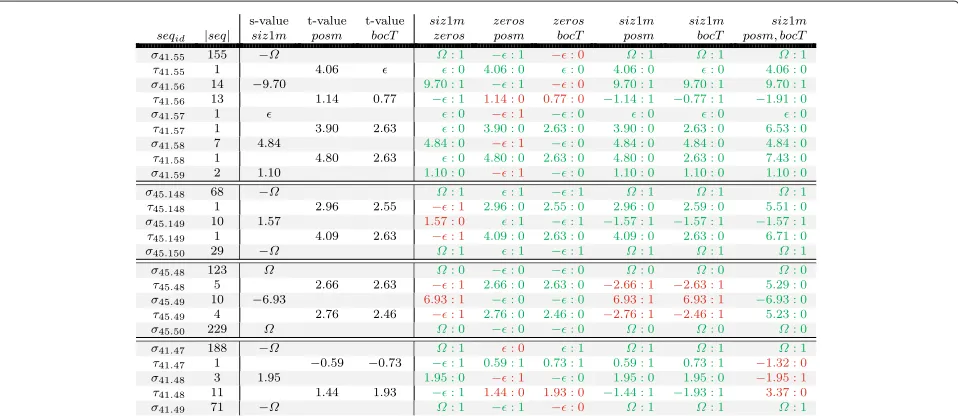
Figure 5 contains four examples that demonstrate error patterns and how different methods complement each other. The table rows contain alternating σ and τ
sequences. The first column contains a sequence iden-tifier; the second column, the length of each sequence in frames. The following three columns contain s val-ues, respectively, t values of s- and t-methods siz1m (deciding based on size differences), posm (deciding based on fly positions) and bocT (deciding based on identifier-containing point sets that are ‘carried through’ an occlusion).
The remaining six columns contain identifier assignment results produced by different methods. The first three columns contain decisions of local methods only: They are combined with nothing but ‘zeros’ and therefore analyzed individually for their assignment decisions. For the last three columns, methods were com-bined with each other. Each assignment entry contains a
<value>and a<decision>(separated by a semicolon), the< value>resembles the s or t value associated with the given < decision > identifier assignment. Entries with correct<decision>s are colored in green, incorrect
assignments are bold and in red. This implicitly encodes the ground truth.
The first example depicts the typical error pattern of local t-methods. The occlusion in τ41.56 is wrongly
resolved by methods posm and bocT. Method posm there-fore mis-assigns identities for its following σ sequence
σ41.57and allσ sequences thereafter, up to the end of the
video or another mis-assignment. Apparently, the bocT method already had a mis-assignment beforeτ41.56since identifiers were swapped inσ41.55andσ41.56before occlu-sionτ41.56. Due to the second mis-assignment, the identi-fiers are swapped back and result in correctσ sequences after the second mis-assignment.
Having the last three columns in green shows that all three of our combining methods are capable of rescuing this case. The main reasons for the combined method’s success are their fundamentally different error patterns. Since combined methods involve both s- and t-methods, a t-method failure may still result in swapped identifiers, but they are typically swapped back immediately since it is not plausible to swap too manyσ sequences despite continuous negative evidence coming from the s-method. Examples three and four depict such ‘double errors’ that are typical for combined methods.
We further want to discuss the robustness of combined methods by examining columnsiz1m : bocT in the first example. Although method siz1m assigns the score of
(don’t know) inσ41.57 right after the sequence that bocT
would get wrong and although bocT assignsinτ41.55, the
occlusion right before the troubled occlusion, the com-bined method still gets the whole assignment right. How is that possible?
In order to mis-assign τ41.56 according to the
evi-dence coming from bocT, the combined methodsiz1m :
bocT would have to do a double-error. The two most obvious options for that would be to either perform a flip(45.55, 45.56) or a flip(45.56, 45.57) operation. How-ever, the costs for flip(45.55, 45.56) are less attractive than for the no-flip case,(−()−9.70+0.77) < ( +
9.70−0.77). Obviously, the high confidence of siz1m in
σ41.56 makes this option unattractive, and similarly for
flip(45.56, 45.57), (0.77−−2.63) < (−0.77++2.63). In this case the higher score for τ41.57 coming from
method bocT itself makes the difference. Flipping even longer sequences, e.g. flip(45.56, 45.58)would be even less attractive for the algorithm. The most plausible identifier assignment is determined correctly - despite wrong evi-dence coming from bocT inτ41.56 and two proximate
values inτ41.55andσ41.57.
The second example depicts a similar case, this time method siz1m mis-assignsσ45.149, but methods posm and
bocT both get this case right. Again, all combined meth-ods come up with the correct assignment as the combined evidence coming from posm or bocT is stronger than the misleading evidence from siz1m.
In the third example, in sequenceσ45.49method siz1m
is wrong and rather confident about it. In this case both combined methodssiz1m:posmandsiz1m:bocTwould fail too, however, methodsiz1m: posm,bocTwhich uses the stronger Dempster-combined evidences from posm
and bocT is still capable of coming up with the correct assignment.
The last example shows a case wheresiz1m :pos,bocT
is wrong. Although methods siz1m, siz1m : posm and
siz1m : bocT would solve the case correctly, the com-bined wrong evidences of posm and bocT outweigh the value coming from siz1m. The video frames of this error instance are depicted in Figure 3d.
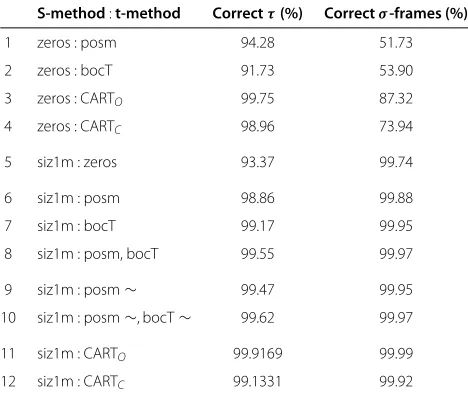
Table 1 summarizes our performance evaluation where all identifier assignment methods introduced in Section 3 were applied to our annotated test set. The table compares local methods and different combined methods, named according to the scheme
< s−method >:< t−method >. Again, a combina-tion with zeros is used to quantify local methods only. All evaluated methods are compared according to two qual-ity measures: (a) the percentage of correct assignments of identifiers before an occlusion to identifiers after that occlusion and (b) percentage of correctly assigned frames in unoccluded sequences.
Methods in Table 1 rows 1 to 4 involve t-methods only. Aside from the local methods posm and bocT, we
Table 1 Performance summary
S-method:t-method Correctτ(%) Correctσ-frames (%)
1 zeros : posm 94.28 51.73
2 zeros : bocT 91.73 53.90
3 zeros : CARTO 99.75 87.32
4 zeros : CARTC 98.96 73.94
5 siz1m : zeros 93.37 99.74
6 siz1m : posm 98.86 99.88
7 siz1m : bocT 99.17 99.95
8 siz1m : posm, bocT 99.55 99.97
9 siz1m : posm∼ 99.47 99.95
10 siz1m : posm∼, bocT∼ 99.62 99.97
11 siz1m : CARTO 99.9169 99.99
12 siz1m : CARTC 99.1331 99.92
Left column:<s-method>:<t-method>; middle column: occlusion accuracy as correctτpercentage; right column: frame accuracy as correctσ-frames percentage.
further evaluated meta-method CART, a machine learn-ing method that uses a classification tree to come up with an assignment based on multiple tvalues and occlusion properties like an occlusions length or its maximum over-lap. Note that CART is still a t-method as it combines multiple t-methods. We provide results for overfitted CARTOand cross-validated CARTC, where 10-fold cross-validation was applied.
Although the accuracy of local methods for correct occlusions are 94.28% and 91.73%, the methods get only 51.73% and 53.90%, respectively, of unoccluded frames correct. This is due to the error propagation problem that is outlined in the first example of Figure 5. As expected, the CART approach alone cannot overcome this problem. Although combined t scores lead to a highly improved occlusion accuracy, the t-intrinsic error pattern still leads to low frame accuracy.
In row 5 the size-based s-method is evaluated. Although it comes with similar occlusion accuracy as the t-methods, its frame accuracy is highly improved. This is because incorporation of s-methods leads to double-error pat-terns where wrong occlusion assignments are immedi-ately swapped back. Therefore, such methods typically get only singleσsequences wrong.
All further rows 6 to 12 contain performance val-ues for combined methods. In 6 to 8 methods siz1m :
sequences, combined methods further minimize the length for mis-assignedσ sequences. Thesvalue coming from siz1m is designed to be dependent on the lengths of observableσ sequences, such that long sequences (on which the method performs well) are given high scores and utterly short sequences (where the method sometimes is wrong) are given low scores. Typical error pattern for combined methods are therefore double errors that con-tain singleshort sequences, typically consisting of one or two frames, which explains the high frame accuracy of these combined methods.
We further evaluated the combination of methods of same type using the Dempster combination [17,18] and it turned out that the use of Dempster-combined t-method posm,bocT in row 8 slightly outperformed simpler dynamic programming combinations in rows 6 and 7.
Finally, the methods evaluated in 9 to 12 turned out to result in little or no improvements. In Section 3.3 we mention that probability values are derived from method scores using a linear approximation. In 9 and 10, we evalu-ate combinations with methods posm∼and bocT∼where nonlinear approximations are used to derive more pre-cise probability values. However, it turned out that these performance improvements betweensiz1m : posm,bocT
andsiz1m : posm ∼,bocT ∼ corrected only nine more frames.
When combining s-methods with CART-methods, it turns out that the overfitted methodsiz1m: CARTO out-performs all other methods; however, the cross-validated method siz1m : CARTC shows a decrease in perfor-mance. This is mostly because the CART-method typ-ically returns very confident scores that are difficult to be corrected by other methods. The method CARTC is a good example for a t-method that outperforms other t-methods in occlusion accuracy (cf. Table 1: rows 1, 2 and 4), but still is outperformed in terms of frame accuracy due to a lack of combinability (cf. Table 1: 8 and 12).
4 Other application: resolving heading
A fly body or an ellipse covering a fly body consists of twoendsA and B where the flies’ axis crosses the flies’ perimeter. Resolving the heading problem means to find out whether end A or end B is the flies head.
Fortunately, there are several evidences from the flies’ anatomy and behaviour. First, flies typically walk in a for-ward direction. The movement direction of a fly may be used to predict at which side to find the head. Sec-ondly, the flies’ wings typically point in backwards direc-tion. Therefore, vector from Centroid to wCentroid may be used as a second independent predictor. Finally, the head does typically not flip by 180° within a single frame.
Interestingly, the heading problem may be reduced to the occlusion problem described in Section 3 and the proposed optimization algorithm of Section 3.3 may be applied to solve the heading problem as well.
The idea is to model every single frame as aσsequence and ‘artificial gaps’ between frames asτ sequences. The evidences from movement and wings are incorporated as s-methods (again s-methods have to operate on attributes that are comparable through the entire video) and a known persistence constraint is incorporated as a t-method. The computedsvalues correspond to probabil-ities for point A being the head of the fly, and t values correspond to probabilities that point A in the frame beforeτ is again point A in the frame afterτ.
Figure 6 depicts how to model the heading problem as a problem instance of the same optimization problem that previously solved the occlusion problem. Note the strong similarities between Figures 4 and 6; the text written in red in Figure 6 marks the few differences.
In order to resolve the heading it is sufficient to define the s- and t-methods that incorporate movement, wing anatomy and persistence evidences, and then re-use the very same algorithm and framework as for occlusions.
For this reason, the coordinates of the two endpointsA
andB(after heading assignment calledHeadandTail) and
the Centroids of the body and the wing regionsCandW
are determined for every frame.
Definition 8.Let Xi denote the value of point X in frame i andXY denote the euclidean distance between points X and Y. The s score scoremove is defined as scoremove = AAiCi−1−BiCi−1
iCi−1+BiCi−1.
Definition 9.The s score scorewing is defined as scorewing= AWAW−+BWBW.
Definition 10. The combined s score is defined as
scoremove⊗wing=max(scoremove, scorewing).
The score scoremove will be positive whenever the fly
moved rather in A- than in B-direction, the score scorewing
will be positive in case A is closer to the centroid of the wing region. Note that −1 ≤ scoremove ≤ +1
and−1≤scorewing≤ +1. Both scores are combined by a
simple maximum aggregation. From the combined score scoremove⊗wing probability approximations and finally
logodd values s may be derived as in the occlusion case.
Definition 11.The t score scorepersist is defined as scorepersist= ABAB++BABA−+AAAA+−BBBBEccentricity.
The persistence score scorepersist is −Eccentricity ≤
scoremove ≤ +Eccentricity, with 0 ≤ Eccentricity ≤ 1.
Rescaling the score by the Eccentricity attribute ensures low persistence scores when flies ‘turn upwards’ and are thus round. From such a position, flies may abruptly change their heading viaz-direction.
The optimization algorithm (see Algorithm 4) will com-pute the most plausibleheadingassignment for all video frames by maximizings+tunder the flip operation introduced in the Section 3.3.
For the heading case, the linear time property of algorithm is essential since heading is typically com-puted for 15, 000+ frames and other, e.g. quadratic algorithms would already become unhandy for these problem instances.
A performance evaluation on 42,870 manually anno-tated heading situations resulted in 99.2% of correct heading assignments. This number fits to the ‘occlusion accuracy’ quality measures that we observed for occlusion problem instances in Table 1 (middle column). The other quality measure in that table is not applicable for heading problem instances.
Typical heading error instances are sequences where flies actuallydowalk backwards for a longer time, e.g. due to a series of evasive maneuvers.
5 Conclusions
5.1 Summary and discussion
This paper introduces a two-fly tracker that provides solu-tions for all major challenges in insect tracking: arena detection, segmentation, resolving occlusions, resolving heading and event detections. It was designed to han-dle legacy videos that were originally not recorded for automated quantification and therefore provides several methods for quality boosting and quality control (see Section 2). The system automates all attention-critical parts. It checks video quality standards, detects arenas and automatically computes video background, and com-putes thresholds for body and wing segmentation and a global identity assignment across occlusions. It is there-fore designed to minimize required user interactions which makes it suitable to support analysis of large-scale experiments. Compared to manual behaviour scoring, it provides high-throughput, robust and objective quantifi-cation for courtship behaviour videos; overcomes lacks of behaviour quantification; and enables systematic iden-tification of genes and neurons that are critical for this behaviour. This may lead to better understanding of how nervous systems regulate stereotypic behaviours. Com-pared to existing tracking softwares, our system is capable to deal with quality issues that result from video contam-ination or human error and automatically boosts video quality beyond possible recording conditions. We put huge effort into the occlusion problem and automatically identifying flies without any requirements of marking them. Our system is not limited to specific behaviours and computes a large number of attributes for both identified flies that encourage definition or training of behaviour classifiers. It comes with machine-learned and user-defined classifiers forDrosophilacourtship behaviour and its sub-behaviours (cf. Figure 7). The software includes tools for result inspection and bulk submission of videos to a computer cluster.
The identification of the two flies through the entire video was essential for the detection and assignment of biologically relevant events and the resolvement occlu-sions with highest possible accuracy turned out to be of particular importance. Since manual correction of occlusion assignments requires lots of user interaction (and user attention), some efforts were invested to come up with an automated solution for that problem (see Section 3).
Figure 7Automatically generated ethograms.Behaviour visualization for 54 flies in 6 min by color coding of identified courtship sub-behaviour. (a)Wild-type male behaviour.(b)Wild-type female behaviour.
meta-methods may further include observable features further characterizing occlusions.
An intrinsic problem of t-methods or combinations of them comes with their limited local perspective that causes mis-assignments to be propagated until the end of the video. Section 3.3 introduces an optimization approach that incorporates context information. It com-plements t-methods by s-methods that base on charac-teristics of unoccluded sequences that are comparable during the whole video. The certainty scores of s- and t-methods are turned into logodd values that are compa-rable to each other such that the most plausible identity assignment for the entire video is achieved by maximiz-ing the sum of these logodd values under a flip operation (cf. Section 3.3). The optimization algorithm introduced in Section 3.4 solves that optimization problem in linear time.
Within a test set of 11 male-female courtship videos with manually annotated ground truth, the introduced local methods scored 90% to 95% of the cases cor-rectly, the combining meta-methods correctly assigned about 99% and the optimization approach assigned up to 99.62% of occlusions correctly. When it comes to cor-rectly assigned identities in unoccluded frames, naive meta-methods suffer from the error propagation problem while the optimization approach improves its accuracy to 99.97%. In other words, from about 6 h and 45 min of the unoccluded video frames, the frames with wrong identity assignment are together about 7 s.
These results are achieved as the algorithm implic-itly minimizes the number of mis-assigned unoccluded frames. This property is inherited from the approximation of the sign test that is used as s-method.
Further, the algorithm ‘self-corrects’ its mistakes. Poten-tial errors typically occurpair-wise, one real error imme-diately followed by a second one that compensates the first
error, as it isnotplausible that identities are wrong from a given point to the end of the video. Wrongly assigned identities are therefore alocalproblem and do not affect the rest of the video.
These two error patterns, pair-wise errors ensuringlocal
mis-assignments only andshort non-occluded sequences as potential error domains, explain the low number of unoccluded frames that are mis-identified and result in desirable properties of the algorithm.
In many occasions, users accidentallydowngradedthe quality of ground truth that was previously automatically pre-annotated. This suggests that the automated occlu-sion resolvement method may, in many cases, be more reliable than a human annotator. However, the automati-cally derived occlusion assignments may still be manually inspected and overruled, and an annotating user may sort occlusions by machine-given confidence values.
Another desirable property of the algorithm is that it runs very efficiently (in linear timeO(|0|)). This enables
its applications on large problem instances. Section 4 describes how heading assignments can be modelled as an instance of the very same optimization problem. The very same optimization algorithm then derives the most plausible heading assignment for every frame.
5.2 Future work
We have a system that identifies flies and extracts var-ious attributes; we implemented more than 1,000 auto-matically observable shape and constellation descrip-tors. The system currently comes with classifiers for courtship behaviour and its sub-behaviours that allow to visualize observed behaviours as automatically generated ethograms.
right) and deliver expected results for known mutants (cf. [10]).
We aim to support definition and training for classifiers that capture further meaningful behaviours.
The overall system is currently being transcoded from Matlab to C++ and is optimized for performance such that it runs on a standard laptop within a reasonable computation time.
Competing interests
The authors declare that they have no competing interests.
Author details
1I.M.P. Research Institute of Molecular Pathology, Dr. Bohr-Gasse 7,
1030 Vienna, Austria.2Present address: University of Oxford, Department for Computer Science, Wolfson Building, Parks Road, Oxford OX1 3QD, UK. 3University of Vienna, Fachdidaktik- und Lernforschungszentrum Informatik,
Währinger Strasse 29, 1090 Vienna, Austria.
Received: 19 February 2013 Accepted: 31 October 2013 Published: 17 December 2013
References
1. BS Baker, BJ Taylor, JC Hall, Are complex behaviors specified by dedicated regulatory genes? Reasoning fromDrosophila. Cell105, 13–24 (2001) 2. BJ Dickson, Wired for sex: the neurobiology ofDrosophila, mating
decisions. Science322, 904–909 (2008)
3. JT Pierce-Shimomura, M Dores, SR Lockery, Analysis of the effects of turning bias on chemotaxis inC. elegans. J Exp Biol.208(Pt 24), 4727–4733 (2005)
4. CJ Cronin, JE Mendel, S Mukhtar, YM Kim, RC Stirbl, J Bruck, PW Sternberg, An automated system for measuring parameters of nematode sinusoidal movement. BMC Genet.6(1), 5 (2005)
5. Z Feng, CJ Cronin, JH Wittig Jr, PW Sternberg, WR Schafer, An imaging system for standardized quantitative analysis ofC. elegansbehavior. BMC Bioinformatics5, 115 (2004)
6. JH Baek, P Cosman, Z Feng, J Silver, WR Schafer, Using machine vision to analyze and classifyCaenorhabditis elegansbehavioral phenotypes quantitatively. J Neurosci. Methods.118(1), 9–21 (2002)
7. JR Martin, A portrait of locomotor behaviour inDrosophiladetermined by a video-tracking paradigm. Behav Processes.67(2), 207–219 (2004) 8. H Dankert, L Wang, ED Hoopfer, DJ Anderson, P Perona, Automated
monitoring and analysis of social behavior inDrosophila. Nature Methods 6, 297–303 (2009)
9. K Branson, AA Robie, J Bender, P Perona, MH Dickinson, High-throughput ethomics in large groups ofDrosophila. Nature Methods6, 451–457 (2009) 10. C Schusterreiter, Computational analysis ofDrosophilacourtship
behaviour. Thesis, University of Vienna (2011)
11. JC Simon, MH Dickinson,A new chamber for studying the behavior of
Drosophila. PLoS One5(1), e8793 (2010)
12. SC Hoyer, A Eckart, A Herrel, T Zars, SA Fischer, SL Hardie, M Heisenberg, Octopamine in male aggression ofDrosophila. Curr. Biol.18(3), 159–167 (2008)
13. PP Ramdya, T Schaffter, D Floreano, R Benton, Fluorescence Behavioral Imaging (FBI) tracks identity in heterogeneous groups ofDrosophila. Plos One7(11) (2012)
14. HW Kuhn, The Hungarian method for the assignment problem. Naval Res. Logistics Q.2(1–2), 83–97 (1955)
15. P Gabriel, J Verly, J Piater, A Genon, The state of the art in multiple object tracking under occlusion in video sequences. Advanced Concepts for Intelligent Vision Systems (2003), pp 166–173
16. F Aurenhammer, Voronoi diagrams—a survey of a fundamental geometric data structure. ACM Comput. Surv. (CSUR)23(3), 345–405 (1991)
17. AP Dempster, Upper and lower probabilities induced by a multivalued mapping. Ann. Math. Stat.38(2), 325–339 (1967)
18. G Shafer,A Mathematical Theory of Evidence(Princeton University Press, 1976)
doi:10.1186/1687-5281-2013-64
Cite this article as:Schusterreiter and Grossmann:A two-fly tracker that solves occlusions by dynamic programming: computational analysis of
Drosophilacourtship behaviour.EURASIP Journal on Image and Video Processing 20132013:64.
Submit your manuscript to a
journal and benefi t from:
7Convenient online submission
7 Rigorous peer review
7Immediate publication on acceptance
7 Open access: articles freely available online 7High visibility within the fi eld
7 Retaining the copyright to your article