O R I G I N A L R E S E A R C H
Arti
fi
cial Neural Network (ANN) Approach to
Predict an Optimized pH-Dependent Mesalamine
Matrix Tablet
This article was published in the following Dove Press journal: Drug Design, Development and Therapy
Asad Majeed Khan1,2
Muhammad Hanif1
Nadeem Irfan Bukhari 3
Rahat Shamim 3
Fatima Rasool3
Sumaira Rasul4
Sana Shafique5
1Faculty of Pharmacy, Bahauddin Zakriya
University, Multan, Pakistan;2Lahore
Pharmacy College, Lahore Medical and Dental College, Lahore, Pakistan;
3University College of Pharmacy,
University of the Punjab, Lahore, Pakistan;4Institute of Molecular Biology
and Biotechnology, Bahauddin Zakriya University, Multan, Pakistan;5Faculty of
Pharmacy, Rippha International University, Lahore, Pakistan
Video abstract
Point your SmartPhone at the code above. If you have a QR code reader the video abstract will appear. Or use:
https://youtu.be/AP32Kh16ZpU
Background:Severe bleeding and perforation of the colon and rectum are complications of ulcerative colitis which can be treated by a targeted drug delivery system.
Purpose: Development of colon-targeted delivery usually involves a complex formulation process and coating steps of pH-sensitive methacrylic acid based Eudragit®. The current work was purposefully designed to develop dicalcium phosphate (DCP) facilitated with Eudragit-S100-based pH-dependent, uncoated mesalamine matrix tablets.
Materials and Methods:Mesalamine formulations were compressed using wet granulation technique with varying compositions of dicalcium phosphate (DCP) and Eudragit-S100. The developed formulations were characterized for physicochemical and drug release profiles. Infrared studies were carried out to ensure that there was no interaction between active ingredients and excipients. Artificial neural network (ANN) was used for the optimization of
final DCP-Eudragit-S100 complex and the experimental data were employed to train a multi-layer perception (MLP) using quick propagation (QP) training algorithm until a satisfactory root mean square error (RMSE) was reached. The ANN-aided optimized formulation was compared with commercially available Masacol®.
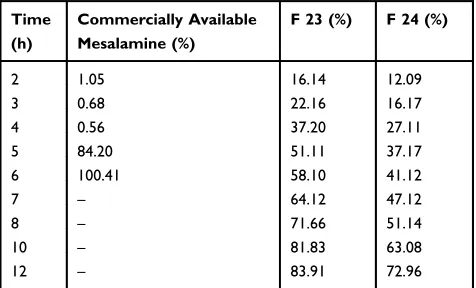
Results: Compressed tablets met the desirability criteria in terms of thickness, hardness, weight variation, friability, and content uniformity, ie, 5.34 mm, 7.7 kg/cm2,585±5 mg (%), 0.44%, and 103%, respectively. In-vitro dissolution study of commercially available mesa-lamine and optimized formulation was carried out and the former showed 100% release at 6 h while the latter released only 12.09% after 2 h and 72.96% after 12 h which wasfitted to Weibull release model with b value of 1.3, indicating a complex release mechanism.
Conclusion:DCP-Eudragit-S100 blend was found explicative for mesalamine release with-out coating in gastric and colonic regions. This combination may provide a better control of ulcerative colitis.
Keywords: ulcerative colitis, DCP-Eudragit-S100 complex, phosphatidylserine, Weibull release model
Introduction
Ulcerative colitis (UC) is a chronic inflammatory condition characterized by de-regulated immune response of intestinal microflora which ultimately limits the mucosal layer of the colon and rectum and is known for its remission and relapse throughout life.1,2Untreated ulcerative colitis may cause severe bleeding, hole in the colon (perforated colon), severe dehydration, and increased risk of colon cancer. Oral treatment in UC treatment is preferred as compared to suppositories due to its ease of manufacturing, storing conditions, and patient compliance. 5-aminosalicylic
Correspondence: Muhammad Hanif; Nadeem Irfan Bukhari
Email [email protected]; [email protected]
Drug Design, Development and Therapy
Dove
press
open access to scientific and medical research
Open Access Full Text Article
Drug Design, Development and Therapy downloaded from https://www.dovepress.com/ by 118.70.13.36 on 27-Aug-2020
acid (5-ASA), an anti-inflammatory agent has gained the status of drug offirst choice in the treatment of active mild to moderate UC.3Among many advantages of oral dosage, dissolution and absorption of drugs in the small intestine reduces its concentration in the colon which results in failure of minimum effective concentration (MEC) of drugs.4
UC can be treated successfully by targeted localized drug delivery to the colon, avoiding systemic concentration. It has been established that therapeutic effect of mesalamine is concentration-dependent, which led to the development of dosage forms which deliver the drug directly to the inflamed tissue with relatively low side effects.5 For the past two decades, delayed release mesalamine has been used for treating UC.6 But colon-targeted drug delivery systems involve difficult preparation procedures and certain management, thereby making the system complex and expensive. Different strategies like pro-drug, enteric coat-ing and pH/time-dependent modified release, microfl ora-activated system, pressure controlled drug delivery system (PCDCS), osmotic controlled drug delivery to colon (OROS-CT), and pulsatile drug delivery have gained attention.7 Based upon these strategies, the different pro-ducts of 5-aminosalicylic acid (5-ASA) available are Pentasa® MR coated timed release microgranules, Asacol® and Aspiro® CR double layered enteric coated tablets, Lialda®XL Multimatrix SR hydrophilic/lipophilic matrix core tablets, Octasa®MR pH sensitive coated tablets and Salofalk® gastric-resistant granules coated by pH-independent polymer.8–13 But their polymer-dependent behavior and predicted drug release in the colon remained debatable. Besides taking large dose orally, prodrug has the disadvantage of linking moiety which may cause non-drug related side effects. In time-dependent systems, gastric emptying time and GI transit time limit predicted drug release in the colon. pH-dependent systems which involve enteric coating cannot be easily engineered due to interac-tion of enteric coated polymeric mixture with hydrophobic additives like magnesium stearate.
Therefore, a pH-dependent targeted drug delivery system was designed by simple wet granulation and without coating, with the advantages of minimum release of drug in upper GIT and enhanced local delivery of drug to the colon.14 Eudragit-S100 is used as a coating agent in delayed release formulations and preferred in colon-targeted delivery due to its sensitivity to alkaline pH of 7.2. Eudragit-S100 is an anionic copolymer based on methacrylic acid and methyl methacrylate with the ratio of 1:2. Use of Eudragit-S100
alone for delayed release is restricted due to its gel forming and diffusion behavior. Dual nature of di-calcium phosphate (DCP), ie, as a binder and release retardant, can facilitate the combination of Eudragit-S100. The resultant complex of Eudragit-S100 and DCP can create the delayed release char-acteristic not only in the colon but can also prevent the GIT degradation of drugs.14–16
Therefore, attempts were made to develop Eudragit-S100 and DCP complex in uncoated delayed release matrix tablets of 5-ASA.17Two different types, un-milled and milled form, of DCP were used as diluent previously but presently only the latter was employed.16Drug release was controlled by varying compositions of the ingredients. Computer-aided technique; Artificial Neural Network (ANN) was employed to catechize the effect of different compositions in twenty-three formulations to optimize a delivery system with desired dissolution profile of mesalamine. ANN is an effective approach to estimate the quantity of the formulation ingre-dients which may meet the desirability criteria.18 In-vitro dissolution study was carried out to note the drug release up to 70% until 12 h which ensured a delayed release dosage form. The designed delayed release tablets of mesalamine will provide the required concentration of the drug at the site of inflammation to treat UC successfully.
Materials and Methods
Mesalamine was kindly gifted by Getz Pharma, Karachi. Eudragit-S100 was obtained from Highnoon Pharmaceuticals, Lahore. Dicalcium phosphate (DCP), poly-vinyl-pyrrolidone-K30 (PVP-K30), magnesium stearate, iso-propyl alcohol (IPA), potassium chloride, potassium monohydrogen phosphate, sodium hydroxide, and hydrochlo-ric acid were all purchased from Sigma Aldhydrochlo-rich, Germany, sodium starch glycolate (SSG) and ethyl cellulose (EC) were obtained from Merck®Darmstadt Germany. All the chemicals used in the study were of analytical grade.
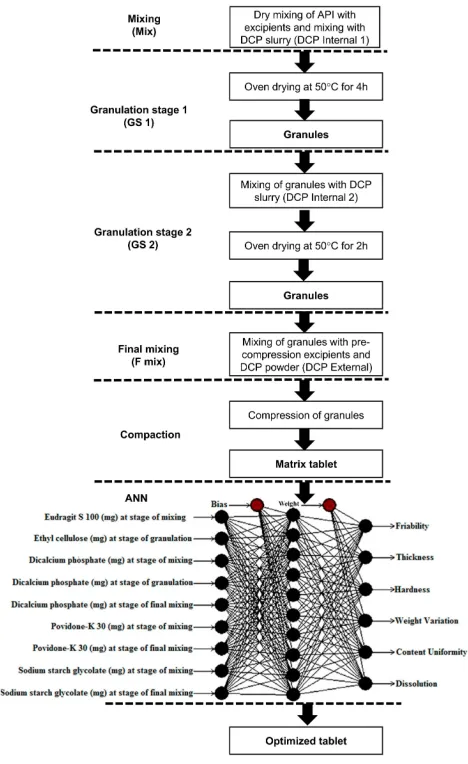
Wet granulation technique was used for the compression of mesalamine tablets as described elsewhere.19 Briefly; compression was divided intofive stages for the successful application of ANN. Stage 1 was mixing (Mix), stage 2 was granulation stage 1 (GS-1), stage 3 was granulation stage 2 (GS-2), stage 4 wasfinal mixing (F-mix), and stage 5 was compaction. Total quantity of DCP used was divided into almost two equal parts, part A and B. In mix stage, mesala-mine, Eudragit-S100, and PVP-K30 were geometrically mixed with a mortar and pestle for 10 min followed by addition of approximately half of DCP of part A as slurry with IPA (termed as DCP internal 1) until uniform wet mass
Drug Design, Development and Therapy downloaded from https://www.dovepress.com/ by 118.70.13.36 on 27-Aug-2020
was obtained. Wet mass was passed through sieve#16 fol-lowed by GS-1 which comprised only oven drying for a period of 4 h at 50°C.20 In GS-2, dried granules were mixed again with the remaining half of DCP part A (termed as DCP internal 2) and were passed through sieve#22. The granules were dried in a tray drier (IMS corporation Lahore, Pakistan) at 50°C for 2 h.21In F-mix stage, these granules were mixed with part B of DCP as dry powder (termed as DCP external) and magnesium stearate.22 These granules were then compressed into tablets and were stored in con-trolled airtight containers and compared with Masacol® (mesalamine by Getz Pharma Karachi, Pakistan). The five stages of compression along with details of each step have been shown inFigure 1.
Characterization of Matrix Tablets
The prepared tablets were evaluated for their friability, thick-ness, hardthick-ness, weight variation, and drug content assay. Friability of twenty tablets was determined in Roche Friabilator (IMS Corporation, Lahore, Pakistan) for 4 min at 25 rpm. Thickness of tablets was measured by digital screw gauge (Galvano Scientific Ltd, Lahore, Pakistan) by taking 20 tablets from each combination.23Hardness of ten tablets was measured using digital hardness tester (Erweka, Germany). Weight variation was determined by taking aver-age weight of twenty tablets using digital weight measuring balance (Sartorius Germany). For drug content assessment, 10 tablets were crushed and the aliquot of powdered tablet equivalent to 400 mg of drug was dissolved in 50 mL of phosphate buffer pH 7.2. The solution wasfiltered through 0.45 µm membranefilter. Sample was precisely diluted and analyzed on UV-spectrophotometer at 234 nm. Percentage of mesalamine present in solution was calculated from the standard calibration curve.24
Drug Dissolution and Release Study
USP dissolution II paddle apparatus (Vision®, California) rotated at 100 rpm was used for two stage mesalamine delayed release studies.4 Two different dissolution med-iums, 0.2 M HCl pH 1.2 (simulation of stomach pH) for 2 h and phosphate buffer 0.2 M of pH 7.2 (simulation of colon pH) for further 6 h at 37 ± 0.5°C, were used.25–27 5 mL aliquot was withdrawn which was replaced with fresh acidic medium forfirst 2 h and with basic phosphate buffer pH 7.2 for remaining 6 h.28Collected samples were filtered through 0.45 µm Milliporefilters and mesalamine concentration was measured at 234 nm after appropriate dilutions of samples.
Kinetics of Drug Release
Release kinetic modeling was carried out using Microsoft Excel based adds in program DD Solver Ver 1.0. The kinetic models were applied by using the following equations:29
Qt¼K0t (1)
Qt¼lnQ0K1t (2)
QH ¼ KH
ffiffi
t p
(3)
Where Qtand QHare the mean percentage of drug release, t is time in h, K0, K1KHare zero,first and Higuchi order release constant expressed in concentration/time respectively.
Mt=M1¼ Ktn (4)
WhereMt=M1 is a fraction of drug released at time t, k is
the release rate constant and n is the release exponent. In Peppas (Fickian diffusion) model, mechanisms of drug release are characterized using the release exponent (“n”value). An “n”value of 1 corresponds to zero-order release kinetics (case II transport); 0.5 < n < 1 means an anomalous (non-Fickian) diffusion release model; n= 0.5 indicates Fickian diffusion, and n > 1 indicates a super case II transport relaxational release.30 The regression analysis data evaluate the kinetics of drug release from the prepared formulations.31
ffiffiffiffiffiffi
W0
3 p
3 ffiffiffiffiffiffiWt
p
¼κt (5)
In Hixson-Crowell model, W0 is the initial amount of
drug in pharmaceutical dosage form, Wt is the remaining amount of drug in pharmaceutical dosage form at timet
and ƙ (kappa) is a constant incorporating the surface-volume relation.
log½ln 1ð mÞ ¼ blog½tTi loga (6)
In Weibull model,ais the scale parameter which describes the time dependence,bdescribes the shape of dissolution curve dependence andmis the amount of drug dissolved. The model which showed the highest value of coefficient of determinants (R2) and lowest value of Akaike informa-tion criterion (AIC) was categorized as best model that described the release.
Drug Design, Development and Therapy downloaded from https://www.dovepress.com/ by 118.70.13.36 on 27-Aug-2020
ANN-Assisted Colonic Delivery System
of Mesalamine
ANN Neural Power® version 3.1 was used to study the relative effects of Eudragit-S100, DCP and PVP-K30 on hardness and in-vitro dissolution for 2–8 h.32Quick propaga-tion (QP) method was employed for the data learning algo-rithm with Tanh as transfer function until a satisfactory root mean square error (RMSE), less than 1 was reached.33 Multilayer perception (MLP) structure was used in the study where the class of structure was feed forward. The total number of inputs, outputs and hidden layers was 5, 8, and 1, respectively, shown inFigure 1. Surface responses for the importance of excipients against hardness and in-vitro release were generated.34For the prediction of the best levels of polymers to further retard the drug release until 12 h“What if” approach of ANN was used. On the basis of ANN predicted composition, F24 was compressed with some adjustments as shown in Table 1 to confirm the ANN prediction.
Characterization of ANN Assisted
Formulation
The ANN assisted formulation was characterized in terms of friability, thickness, hardness, weight variation, dissolu-tion and kinetics of release. Kinetics of drug release was studied by model independent approaches using already described DDSolver. The values of dissimilarity factor f1
and similarity factorf2for F23 and F24 were calculated on
the basis of release profile as reported in literature35 and compared with commercially available mesalamine, by using the following equations.
f1¼ ∑
n
t¼1ðRt TtÞ ∑n
t¼1Rt
100 (7)
f2 ¼50log 1þ
1
n ∑
n
t¼1 ðRtTtÞ2
0:5
100
" #
(8)
where n is the sample number, and Rt and Tt are the percentage of the reference and test drug release, respec-tively, at different time intervals.
Fourier Transform Infrared Spectroscopy
(FTIR)
Infrared (IR) spectra for the pure drug, selected excipients and ANN assisted formulation were recorded on attenuated total reflectance (ATR) attached FTIR spectrophotometer
(FTIR-Agilent Technologies). Spectrum was taken from the wavelength of 500–4000 cm−1.36
Results
Different ratios of Eudragit-S100 and DCP were used suc-cessfully and 24 formulations were compressed by wet gran-ulation method. Physicochemical properties of the powder blend and compressed tablets were within the limits (Table 2). Out of 24 formulations, F1 to F23 were prepared stepwise by controlling the composition of ingredients for desired outputs. The 24th formulation (F24) was prepared by the optimized levels of the ingredients predicted by ANN approach.
In-vitro Drug Release
In-vitro dissolution of prepared formulations was con-ducted in acidic medium for initial 2 h followed by
Figure 1Scheme of study showingfive stages of compression: Mix, GS-1, GS-2, F-mix and compression and structure of ANN applied using quick propagation method for data learning algorithm.
Drug Design, Development and Therapy downloaded from https://www.dovepress.com/ by 118.70.13.36 on 27-Aug-2020
T able 1 Mesalamine F ormulations by W et Granulation Method Ingr edient Sta g e F ormulation Code F1 F2 F3 F4 F5 F6 F7 F8 F9 F10 F11 F12 F13 F14 F15 F16 F17 F18 F19 F20 F21 F22 F23 F24 Mesalamine (mg) Mix 400 400 400 400 400 400 400 400 400 400 400 400 400 400 400 400 400 400 400 400 400 400 400 400 Eudragit-S100 (mg) Mix 110 110 120 110 110 110 110 90 110 70 70 70 ––– 10 10 10 10 10 10 15 10 15 Eth yl cellulose (mg) Mix 10 10 5 – – – – – – ––––––––––– – – – – Dicalcium phosphate (mg) Mix (DCP Int 1) 20 40 20 25 25 25 25 25 25 35 35 25 70 35 40 35 35 35 35 35 35 35 35 25 GS-2 (DCP Int 2) 2 0 -2 0 2 5 2 5 2 5 2 5 2 5 2 5 3 53 52 57 03 54 03 53 53 53 53 5 3 5 3 5 3 5 4 0 F-Mix (DCP Ext) ---7 0 -6 0 6 0 6 0 6 0 6 0 6 0 6 0 6 0 5 5 P ovidone-K30 (mg) Mix 20 20 20 10 -10 -20 15 10 5 5 10 10 10 10 20 20 40 40 40 40 40 40 F-Mix -10 10 -10 -15 10 5 5 10 10 10 10 -10 -Sodium star ch glycolate (mg) at M ix - ---2 .9 2 .9 1.47 0.2 F-Mix ---5 .9 -T ablet w eight (mg) 580 580 585 580 570 570 570 560 590 560 550 530 560 560 500 560 560 570 580 585.9 582.9 587.9 581.47 575.2
Drug Design, Development and Therapy downloaded from https://www.dovepress.com/ by 118.70.13.36 on 27-Aug-2020
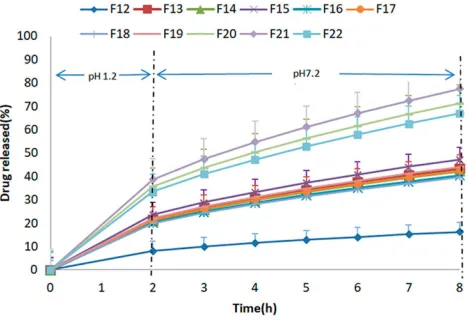
evaluation in basic medium for further 6 h, except F23 which was studied for 12 h using the same tablets due to its 71.66% release within the first 8 h. The graphical representation of drug release data of formulations F1-F22 due to the effect of formulation variables is shown in Figures 2 and 3. Prepared formulations did not show an adequate release in acidic media during first 2 h of this study, therefore, the release data for 1 h had not been given in any graphical and tabular representation. It was observed that formulations F1-F3 containing varying concentrations of DCP, Eudragit-S100, and EC had shown less than 9% drug release in 8 h. This high drug retardation might be attributed to the EC due to its binding effect that increased tablet hardness.35 For this reason, EC was excluded from the next set of formula-tions F4-F12 which were prepared by varying concen-trations of DCP and Eudragit-S100 in pre-decided ratio (Table 1). Non-desirable release pattern in F4 to F12 was observed throughout the study. The mesalamine release retardation might be attributed to the presence of Eudragit-S100.37 Another set of formulations were prepared by excluding Eudragit-S100 and using DCP as bulking agent in F13-F15 to maintain the desired
tablet weight. Thefindings of release of drug from F13-F15 demonstrated a breakthrough in the role of DCP, as release retardant. This set met the desirability of release criteria until 4 h but failed to exhibit required release until 8 h. For formulation F16 and onwards, Eudragit-S100 was included in combination with DCP which exaggerated a smooth drug release pattern to help obtain the desired sustained drug release characteristics which enabled the dosage form to target the colon without coating the dosage form. For the set of formulations F16-F19, PVP K30 was varied but desired release pat-tern was not achieved. It was noted that in this set of formulations, a small amount of Eudragit-S100 (2%) in combination with DCP helped to control the initial 2 h release and DCP External for smooth delayed release in 3–8 h. In this combination, the required amount of Eudragit-S100 was less than which has been reported.37 Sodium starch glycolate was added as the superdisinte-grant in F20-F23 to further enhance the smooth release pattern. Outcomes of all formulations were still not considered acceptable in terms of sustained drug deliv-ery specifically from 2–5 h in small intestine, since drug release deviated from the desired profile.
Table 2Physicochemical Characteristics of Mesalamine Formulations (Mean ± S.D)
Code Friability (%) Thickness (mm) Hardness (kg/cm2) Weight Variation (mg) Content Uniformity (%)
F1 0.15±0.03 4.05±0.02 16.93±2.37 591.4±3.95 100.66±1.24
F2 0.17±0.05 4.23±0.01 26.45±1.63 587±3.87 91.66±2.86
F3 0.35±0.19 4.31±0.01 25.16±1.86 596.7±3.25 95.33±2.86
F4 0.32±0.11 4.24±0.02 23.53±4.77 590.9±4.01 90±2.44
F5 0.17±0.07 4.14±0.01 22.86±1.97 576.5±4.5 92±2.44
F6 0.25±0.11 4.22±0.01 16.41±0.64 584.5±2.29 90±4.32
F7 0.35±0.15 4.55±0.05 12.56±0.58 576.1±3.7 100.33±2.49
F8 0.04±0.09 5.15±0.02 9.06±0.24 574.4±4.54 102±1.41
F9 0.11±0.01 5.24±0.03 8.16±0.73 603.8±4.37 103.66±0.94
F10 0.21±0.04 5.18±0.02 7.03±1.13 574.1±4.3 102.33±2.05
F11 0.25±0.09 5.05±0.05 7.25±1.15 577.4±4.24 97.33±1.69
F12 0.05±0.08 5.23±0.01 7.55±1.25 577.5±4.08 102.66±2.62
F13 0.43±0.30 4.56±0.05 10.22±1.17 574.8±4.21 104.33±3.29
F14 0.21±0.26 4.03±0.01 12.63±0.75 573.3±4.42 106.66±1.24
F15 0.33±0.14 4.13±0.01 8.53±1.26 573.2±4.53 101.33±2.49
F16 0.33±0.15 4.04±0.01 9.13±0.33 573.8±4.77 100.66±1.69
F17 0.42±0.08 4.04±0.02 11.76±2.09 578.3±3.9 103.66±1.24
F18 0.20±0.05 4.24±0.02 12.46±0.37 579.8±3.78 99.33±1.24
F19 0.22±0.10 4.24±0.02 10.36±0.49 579.4±4.38 97.33±1.69
F20 0.23±0.04 5.33±0.01 7.5±1.44 588.8±4.06 101.33±1.24
F21 0.18±0.04 5.05±0.02 7.9±0.61 589.7±3.31 102.66±1.69
F22 0.16±0.05 5.43±0.01 7.7±0.57 587.2±4.11 101.33±1.24
F23 0.20±0.04 5.35±0.02 7.83±0.84 584.4±4.24 103.33±1.24
Drug Design, Development and Therapy downloaded from https://www.dovepress.com/ by 118.70.13.36 on 27-Aug-2020
Release Kinetics and Mechanism
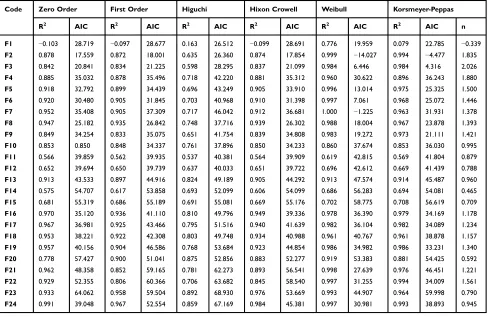
The kinetic mechanisms for the drug release from all the formulations were plotted, and the coefficients of the drug release (R2) were calculated as presented inTable 3. In the present study, most of the formulations exhibited n value greater than 1, indicative of super case II transport release. R2 for Hixson Crowell cube root indicated uniform exhaustion of the drug delivery system.38The drug release profiles with highest R2and lowest AIC values among all kinetics models indicated that the release data for majority of the formulations were bestfitted to Weibull model.
ANN-Assisted Colon-Targeted
Formulation
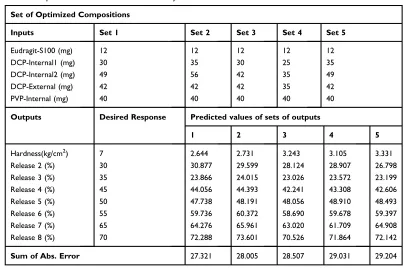
Based on the inputs given, ANN foretold five sets of the compositions with their characteristics (outputs) predicted
(Table 4). Among these five sets, set 4 was selected for preparing optimized formulation (F24). The composition of this set was close to the composition of F23 which had shown best release (Figure 4) against the desirability criteria.35 F24 was prepared after minor adjustments to amounts such as 3 mg of Eudragit-S100, 5 mg of DCP-Internal 2 and 20 mg of DCP-External as mentioned (Table 1).
The adjustment in composition regarding DCP-External was based on the maintenance of the tablet weight in accordance with the previous formulations, regardless of the final weight of the tablet formulations. The physicochemical and release profile for formulation F24 were measured. The release profile and characteristics of the colon-targeted formulation matched the predicted outputs given (Table 4).
Characteristics of ANN Predicted
Formulation
The physicochemical characteristics of the ANN predicted mesalamine formulation (F24) showed friability 0.44%, thickness 5.34 mm, hardness 7.73 kg/cm2, weight varia-tion 585±3.42 and drug content 103%. The release kinetic analysis of all formulations and comparative release of F23 and F24 have been given in Table 3 and Figure 4 respectively.
Comparative Release Pro
fi
les
Desired released criteria for Colon-Targeted Drug Delivery System from delayed release matrix tablets have been cited in literature.35 In the present study, it was found that F23 was close to the desired release of 70% but this release occurred earlier in 8 h. ANN pre-dicted composition F24 produced further retardation in mesalamine release and clearly indicated a sustained smooth drug release from 0–12 h. The drug release pattern of F23 and F24 along with desired release criteria have been illustrated inFigure 4.
In terms of release, dissimilarity (f1) and similarity (f2)
data from DDSolver showed that formulation 24 was simi-lar to that of the desired release profile of the delayed release formulations having f1 10.14 and f2 63.86.
Formulation F23 lost its closeness from the desired profile due to difference of release at time intervals of 3–7 h. F24 was also compared with mesalamine in terms of release and it showedf168.12 andf223.32 which proved to be different
from the available market product.
Figure 2Percentage release studies of mesalamine from formulation F1-F11 using 0.2 M HCl for 2 h at pH 1.2 and 0.2 M phosphate buffer at pH 7.2 for further 6 h.
Figure 3Percentage release studies of mesalamine from formulation F12-F22 using 0.2 M HCl for 2 h at pH 1.2 and 0.2 M phosphate buffer at pH 7.2 for further 6 h.
Drug Design, Development and Therapy downloaded from https://www.dovepress.com/ by 118.70.13.36 on 27-Aug-2020
Fourier Transform Infrared Studies
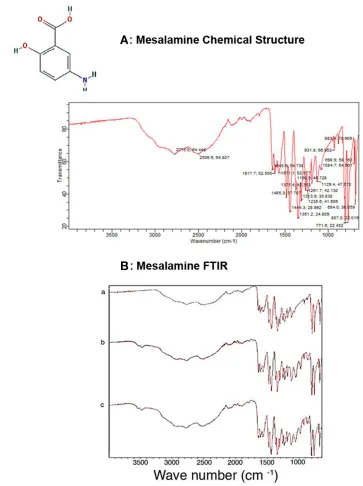
FTIR study indicated that the drug maintained its integrity; mesalamine displayed all the major peaks inside the fi n-gerprint region of 500–2000 cm−1.
Discussion
On average, an oral dosage form may remain in the stomach for 2 h and in the intestine for 4 h, thus the average time for a formulation to arrive at the colon is 6 h.39The rapid and extensive absorption of mesalamine in the small intestine causes a minor local action on mucosa and substantial systemic side effects.9Therefore, a delivery system was designed to retard drug release until 6 h and to liberate at least 70% drug by 12 h. In the present study, the milled form of DCP was used during three stages, ie, Mix, GS-2, and F mix according to the literature.40The weights of ingredients in a pharmaceutical formulation are relative to each other, ie, when weight of one is changed, at least weight of one other ingredient has to be changed to keep thefinal weight of the tablet constant. The change in the relative weights in formulation of the individual ingredients is usually compensated with that of the bulking agent to achieve afixed weight of the formulation. In this study,
though DCP was used as a bulking agent, when it was com-bined with Eudragit-S100, it was found to act as a modulator for release, in line with literature, according to which the DCP, despite acting as a diluent in direct compression, might also retard drug release, a potential of DCP that had not been well explored.16Hence, the amount of DCP was not adjusted to make up for achieving afixed weight of all formulations. Thus, thefinal weight of the tablet formulations depended upon the amount of DCP and Eudragit-S100 in the blend.Table 1shows the differentfinal weights of the tablets. Keeping the foregoing discussion in mind, another bulking agent should have to be added in formulations, but keeping the formulation with least numbers and quantity of ingredients was also an intention. The formulation F24 was the optimized tablet, itsfinal weight was 575.2 mg. Unlike statistical approach such as design of experi-ment, the ANN is based on the learning of the patterns in the data, it is capable of capturing the effect of the change, parallel or unparallel in the ratios of the inputs on thefinal properties of the formulation. In this study, tablets’final weights were not entered as the properties so prediction of the optimized for-mulation was not affected by the different weights of the tablet formulations. Moreover DCP can be a source of Ca++ and Heemskerk et al41and Jing et al42have separately shown that Table 3Dissolution Kinetic Modeling of All Selected Formulations
Code Zero Order First Order Higuchi Hixon Crowell Weibull Korsmeyer-Peppas
R2
AIC R2
AIC R2
AIC R2
AIC R2
AIC R2
AIC n
F1 −0.103 28.719 −0.097 28.677 0.163 26.512 −0.099 28.691 0.776 19.959 0.079 22.785 −0.339
F2 0.878 17.559 0.872 18.001 0.635 26.360 0.874 17.854 0.999 −14.027 0.994 −4.477 1.835
F3 0.842 20.841 0.834 21.225 0.598 28.295 0.837 21.099 0.984 6.446 0.984 4.316 2.026
F4 0.885 35.032 0.878 35.496 0.718 42.220 0.881 35.312 0.960 30.622 0.896 36.243 1.880
F5 0.918 32.792 0.899 34.439 0.696 43.249 0.905 33.910 0.996 13.014 0.975 25.325 1.500
F6 0.920 30.480 0.905 31.845 0.703 40.968 0.910 31.398 0.997 7.061 0.968 25.072 1.446
F7 0.952 35.408 0.905 37.309 0.717 46.042 0.912 36.681 1.000 −1.225 0.963 31.931 1.378
F8 0.947 25.182 0.935 26.842 0.748 37.716 0.939 26.302 0.988 18.004 0.967 23.878 1.393
F9 0.849 34.254 0.833 35.075 0.651 41.754 0.839 34.808 0.983 19.272 0.973 21.111 1.421
F10 0.853 0.850 0.848 34.337 0.761 37.896 0.850 34.233 0.860 37.674 0.853 36.030 0.995
F11 0.566 39.859 0.562 39.935 0.537 40.381 0.564 39.909 0.619 42.815 0.569 41.804 0.879
F12 0.652 39.694 0.650 39.739 0.637 40.033 0.651 39.722 0.696 42.612 0.669 41.439 0.788
F13 0.913 43.533 0.897 44.916 0.824 49.189 0.905 44.292 0.913 47.574 0.914 45.487 0.960
F14 0.575 54.707 0.617 53.858 0.693 52.099 0.606 54.099 0.686 56.283 0.694 54.081 0.465
F15 0.681 55.319 0.686 55.189 0.691 55.081 0.669 55.176 0.702 58.775 0.708 56.619 0.709
F16 0.970 35.120 0.936 41.110 0.810 49.796 0.949 39.336 0.978 36.390 0.979 34.169 1.178
F17 0.967 36.981 0.925 43.466 0.795 51.516 0.940 41.639 0.982 36.104 0.982 34.089 1.234
F18 0.953 38.221 0.922 42.308 0.803 49.748 0.934 40.988 0.961 40.767 0.961 38.878 1.157
F19 0.957 40.156 0.904 46.586 0.768 53.684 0.923 44.854 0.986 34.982 0.986 33.231 1.340
F20 0.778 57.427 0.900 51.041 0.875 52.856 0.883 52.277 0.919 53.383 0.881 54.425 0.592
F21 0.962 48.358 0.852 59.165 0.781 62.273 0.893 56.541 0.998 27.639 0.976 46.451 1.221
F22 0.929 52.355 0.806 60.366 0.706 63.682 0.845 58.540 0.997 31.255 0.994 34.009 1.561
F23 0.933 64.062 0.958 59.504 0.892 68.930 0.976 53.669 0.993 44.907 0.964 59.998 0.790
F24 0.991 39.048 0.967 52.554 0.859 67.169 0.984 45.381 0.997 30.981 0.993 38.893 0.945
Drug Design, Development and Therapy downloaded from https://www.dovepress.com/ by 118.70.13.36 on 27-Aug-2020
blood clotting is expedited when cytosol Ca++ is increased. This increased cytosolic Ca++in µM range, even for minutes, can evoke platelet membrane blebbing and phosphatidylserine (PS) exposure leading to coagulation of bleeding scars.
Being sans statistical-intensive approach, the predictivity and suitability of the ANN model is assessed through RMSE; RMSE < 1 indicates appropriateness of data training and adequacy of model for a reliable prediction.18 ANN predicted the relative importance of each of the ingredients shown in Figure 5 for overall properties of formulation
which were ranked as Eudragit-S100> DCP internal 1> used in pre-granulation stage DCP internal 2 > used in intra-granulation stage DCP external > PVP internal used in extra-granulation stage as explained earlier. Thus, the summary of combined effect of Eudragit-S100, DCP internal 1 (mixed during GS1), DCP internal 2 (mixed during GS2), DCP-external and PVP-Internal only has been shown inTable 5. DCP, being an insoluble filler, was mainly focused on because of its earlier reported release retardant property,43 goodflowability, and its action by reducing Fickian diffusion with increasing erosion rate of matrix for sustained release drug delivery from a simple uncoated matrix tablet.43,44The desired hardness of less than 8 kg/cm2was obtained by varying amounts of Eudragit-S100 and DCP-internal 1 (Figure 6A), showing that the concentrations of both excipients played a critical role in hardness parameter. The maximum amount of drug was released with the highest concentration of DCP-internal 1. The desired 30% release was obtained at a point with the minimum amount of Eudragit- and maximum amount of DCP-internal 1. This showed the least effect of Eudragit- on release at 2 h (Figure 6B).
The desired 35 and 45% release at 3 h and release at 4 h were not obtained with this amount of excipients. The pre-dicted pattern gives the maximum amount of drug released 25 and 40% at 3 and 4 h at the highest concentration of and least effect of DCP-Internal 1. This showed that
Eudragit-Figure 4Comparative % release studies of mesalamine from formulation F23-F24 with reference release data using 0.2 M HCl for 2 h at pH 1.2 and 0.2 M phosphate buffer at pH 7.2 for further 10 h.
Table 4Optimized Formulations Predicted by ANN
Set of Optimized Compositions
Inputs Set 1 Set 2 Set 3 Set 4 Set 5
Eudragit-S100 (mg) 12 12 12 12 12
DCP-Internal1 (mg) 30 35 30 25 35
DCP-Internal2 (mg) 49 56 42 35 49
DCP-External (mg) 42 42 42 35 42
PVP-Internal (mg) 40 40 40 40 40
Outputs Desired Response Predicted values of sets of outputs
1 2 3 4 5
Hardness(kg/cm2) 7 2.644 2.731 3.243 3.105 3.331
Release 2 (%) 30 30.877 29.599 28.124 28.907 26.798
Release 3 (%) 35 23.866 24.015 23.026 23.572 23.199
Release 4 (%) 45 44.056 44.393 42.241 43.308 42.606
Release 5 (%) 50 47.738 48.191 48.056 48.910 48.493
Release 6 (%) 55 59.736 60.372 58.690 59.678 59.397
Release 7 (%) 65 64.276 65.961 63.020 61.709 64.908
Release 8 (%) 70 72.288 73.601 70.526 71.864 72.142
Sum of Abs. Error 27.321 28.005 28.507 29.031 29.204
Drug Design, Development and Therapy downloaded from https://www.dovepress.com/ by 118.70.13.36 on 27-Aug-2020
Figure 5Relative significance of ingredients for the mesalamine colonic system for overall properties of formulation which were ranked as Eudragit-S100> DCP internal 1 used in pre-granulation or Mix stage> DCP internal 2 used in intra-granulation stage or GS-2> DCP external used in F-Mix stage > PVP internal used in extra-granulation stage.
Figure 6Response surface plots of: (A) hardness: showing that desired hardness of less than 8 kg/cm2
was obtained by varying amount of Eudragit-S100 and DCP-Internal1. (B) Release at 2 h: showing the least effect of Eudragit-S 100 on release at 2 h (C) and (D) release at 3 h and 4 h: showing that Eudragit-S100 and DCP Internal 1 did not impart a significant effect on drug release at 3 h and 4 h. (E) and (F) release at 5 h and 6 h: showing the least effect of DCP-Internal 1 on drug release at 5 h and 6 h. (G, H) Release at 7 h and 8 h: showing the maximum amount of drug was released with the higher amount of Eudragit-S100 and minimum amount of DCP-Internal 1 at 7 h and 8 h.
Drug Design, Development and Therapy downloaded from https://www.dovepress.com/ by 118.70.13.36 on 27-Aug-2020
S100 and DCP-Internal 1 have not imparted a significant effect on drug release at 3 and 4 h (Figure 6CandD).
The maximum amount of drug was released with the high-est concentration of Eudragit- and minimum concentration of DCP-Internal 1 for release at 5 and 6 h. The desired 50 and 55% release at 5 and 6 h respectively were obtained at the minimum level of DCP-Internal 1 and maximum level of Eudragit-. This shows the least effect of DCP-Internal 1 on Release 5 & 6 (Figure 6EandF).
The desired 65 and 70% drug release at 7 and 8 h, respectively were obtained at highest concentration of Eudragit-. The maximum amount of drug was released with the higher amount of Eudragit- and minimum amount of DCP-Internal 1 (Figure 6G andH).
The predicted graphical representation of hardness and 2–8 h release study from ANN,34showed that Eudragit-S100 has a critical effect on physicochemical factor, ie, hardness and in-vitro drug dissolution release profile at 2, 3, 4, 5, 6, 7, and 8 h. The effect of DCP-Internal 1 showed a more
pronounced effect on hardness of tablets rather than on the drug release, as summarized inTable 5.
Dissolution profile of commercially available mesala-mine have shown 100% release until 6 h, instead, F23 and F24 (Table 6) have shown a marked difference among their respective release data at different time intervals and retarded the drug release until 12 h. Pulsatile release pattern of com-mercially available mesalamine validates our delayed release formulation which showed 70% release until 12 h.45
Weibull model is more useful in comparing the release profiles of matrix type drug delivery that has been described for different types of dissolution processes.30
Weibull model, log [-ln (1-m)] = b log [t–Ti]–log a, fitted the data of optimized formulation. This model explains the dissolution process of matrix type of drug delivery in the following equation 9:
M¼M0 1e ðtTÞb
a
(9)
where M is the amount of drug dissolved as a function of time t. M0is total amount of drug being released, and T is the lag time. The equation parameter“a”is a scale para-meter that describes the time dependence and “b” deter-mines the progression of shape of the dissolution curve. If b = 1, the rise in curve corresponds to an exponential profile with a constant k = 1/a and the previous equation could be rewritten as:
M¼M0 1ekðtT
h i
(10)
The b value higher than 1 yields a sigmoidal curve with a turning point, while b lower than 1 produces a steeper increase. Using the inverse function of the previous equation, T50%and T90%is calculated. The b value of the formulation Table 5Summary of Effect of Ingredients on Parameters
Parameters Ingredients
Eudragit-S100 DCP-Internal1 DCP-Internal2 DCP-External PVP-Internal
Hardness ↑a ↑ ↑ ↓b ↓
Release 2(h) ↓ ↑ ↑ ↑ ↑
Release 3(h) ↔c ↔ ↔ ↔ ↔
Release 4(h) ↔ ↔ ↔ ↑ ↑
Release 5(h) ↑ ↓ ↓ ↑ ↑
Release 6(h) ↑ ↓ ↓ ↑ ↑
Release 7(h) ↑ ↓ ↑ ↑ ↑
Release 8(h) ↑ ↓ ↑ ↑ ↑
Notes:a
Increase;b
decrease;c
no effect.
Table 6 Dissolution Profile of Commercially Available Mesalamine, F-23 and F-24
Time (h)
Commercially Available Mesalamine (%)
F 23 (%) F 24 (%)
2 1.05 16.14 12.09
3 0.68 22.16 16.17
4 0.56 37.20 27.11
5 84.20 51.11 37.17
6 100.41 58.10 41.12
7 – 64.12 47.12
8 – 71.66 51.14
10 – 81.83 63.08
12 – 83.91 72.96
Drug Design, Development and Therapy downloaded from https://www.dovepress.com/ by 118.70.13.36 on 27-Aug-2020
F24 was found to be 1.3, greater than 1 generating a sigmoidal curve with a minor lag time.
The characteristic peaks of mesalamine functional groups were found in both spectra of mesalamine matrix tablets and granules. The –NH2 functional group bending peak and C=O functional group stretch-ing was observed at 1615–1700 cm−1, along with C-O stretch at 1215 cm−1, indicating that mesalamine
was stable during granulation and tableting procedure and there was no indication of any excipient-drug incompatibility nor denaturation of drug during manu-facturing procedure. The chemical structure of mesala-mine and its chemical peaks have been shown (Figure 7A and B) respectively. The FTIR spectra of mesalamine, mesalamine granules and tablets are shown (Figure 7C (a–c)).
Figure 7FTIR spectra. (A) Mesalamine chemical structure. (B) Mesalamine FTIR peaks showing the–NH2functional group bending peak and C=O functional group
stretching at 1615–1700 cm−1
, along with C-O stretch at 1215 cm−1
. (C) FTIR spectra of (a) mesalamine; (b) mesalamine granules; (c) mesalamine tablet showing characteristic peaks of mesalamine functional groups in spectra of mesalamine, mesalamine matrix tablets, and granules with indication of no excipient-drug incompatibility.
Drug Design, Development and Therapy downloaded from https://www.dovepress.com/ by 118.70.13.36 on 27-Aug-2020
Conclusion
The combination of Eudragit-S100 and dicalcium phos-phate, was used to develop the delayed release matrix tablet with the aid of artificial neural network (ANN) which helped to control the release of the mesalamine. The optimized uncoated matrix tablet surpass the stomach and intestinal conditions without any major drug release for 2 h and 6 h respectively and the drug maintained its integrity until 12 h up to 70%. FTIR spectra showed that mesalamine did not show any interaction with the pre-viously mentioned novel combination. DCP is used as a critical excipient in terms of multiple purposes, ie, as bulking agent and mainly as release retardant which has not been used in previous colon-specific drug delivery systems. Formulations F-23 and F-24 are the candidates for in-vivo evaluation in comparison to any of the products available on the market. Comparative dissolution study of the commercially available mesalamine and our newly developed matrix tablet showed a sustained drug release until 12 h of the latter. This sustainability of mesalamine along with increased residence time in the colon with comfortable dosage form signify its novelty as compared to the enteric coated products. The role of Ca++provided by DCP needs further exploration in reducing blood clot-ting time of bleeding scars in the colon in-vivo.
Acknowledgment
The authors are thankful to the management of Lahore Medical and Dental College and Department of Pharmaceutics, Faculty of Pharmacy, Bahauddin Zakariya University, Multan for their kind support in com-pletion of this project.
Disclosure
The authors report no conflicts of interest in this work.
References
1. Cuffari C, Pierce D, Korczowski B, et al. Randomized clinical trial: pharmacokinetics and safety of multimatrix mesalamine for treatment of pediatric ulcerative colitis. Drug Des Devel Ther. 2016;10:593. doi:10.2147/DDDT.S95316
2. Perrotta C, Pellegrino P, Moroni E, et al. Five-aminosalicylic acid: an update for the reappraisal of an old drug.Gastroenterol Res Pract.
2015;2015:9. doi:10.1155/2015/456895
3. Pierce D, Corcoran M, Martin P, et al. Effect of MMX®mesalamine coadministration on the pharmacokinetics of amoxicillin, ciprofloxacin xr, metronidazole, and sulfamethoxazole: results from four randomized clinical trials.Drug Des Devel Ther.2014;8:529. doi:10.2147/DDDT. S55373
4. Khan AM, Bashir S, Hanif M, Abbas N, Ahsan M. Colon specific formulation of mesalamine: preparation and in vitro evaluation.Lat Am J Pharm.2016;35(6):1391–1398.
5. Jin L, Ding Y-C, Zhang Y, Xu X-Q, Cao Q. A novel pH– enzyme-dependent mesalamine colon-specific delivery system. Drug Des Devel Ther.2016;10:2021.
6. Jakate A, McNamee B, Burkindine D. Bioavailability and swallow-ability of an age-appropriate, delayed-release mesalamine formula-tion in healthy volunteers.Clin Pharmacol.2019;11:93.
7. Trivedi DH, Puranik KP. Colon targeted delivery system (CODESTM): propitious approaches in targeting colon. World J Pharm Pharm Sci.2017;6(4):768–789.
8. Elbary AA, Aboelwafa AA, Al Sharabi IM. Once daily, high-dose mesa-lazine controlled-release tablet for colonic delivery: optimization of for-mulation variables using box–behnken design. AAPS PharmSciTech.
2011;12(4):1454–1464. doi:10.1208/s12249-011-9708-9
9. Deck D, Winston L, Katzung B, Masters S, Trevor A. Basic & Clinical Pharmacology. McGraw-Hill Medical;2012.
10. Goyanes A, Hatton GB, Merchant HA, Basit AW. Gastrointestinal release behaviour of modified-release drug products: dynamic disso-lution testing of mesalazine formulations. Int J Pharm. 2015;484 (1–2):103–108. doi:10.1016/j.ijpharm.2015.02.051
11. Feagan BG, Chande N, MacDonald JK. Are there any differences in the efficacy and safety of different formulations of oral 5-ASA used for induction and maintenance of remission in ulcerative colitis? Evidence from cochrane reviews. Inflamm Bowel Dis. 2013;19 (9):2031–2040. doi:10.1097/MIB.0b013e3182920108
12. Nagaraju R, Swapna Y, Babu RH, Kaza R. Design and evaluation of delayed and extended release tablets of mesalamine. J Pharm Technol.2010;2(1):103–110.
13. Edmunds MW. Introduction to Clinical Pharmacology-e-Book. Elsevier Health Sciences;2015.
14. Bourgeois S, Harvey R, Fattal E. Polymer colon drug delivery sys-tems and their application to peptides, proteins, and nucleic acids.Am J Adv Drug Deliv. 2005;3(3):171–204. doi:10.2165/00137696-200503030-00003
15. Herrlich S, Spieth S, Messner S, Zengerle R. Osmotic micropumps for drug delivery. Adv Drug Deliv Rev. 2012;64(14):1617–1627. doi:10.1016/j.addr.2012.02.003
16. Rowe RC, Sheskey PJ, Quinn M. Handbook of pharmaceutical exci-pients–7th edition.Pharm Dev Technol.2013;18:544.
17. Aulton ME, Taylor KM.Aulton’s Pharmaceutics e-Book: The Design and Manufacture of Medicines. Elsevier Health Sciences;2017. 18. Bukhari NI, Julianto T, Valente Pereira RE, et al. Computer-aided
prediction of cefotaxime sodium stability in aqueous solution at different pH from sparse data.Lat Am J Pharm.2018;37(3):571–578. 19. Patel Jayvadan K, Patel Nirav V, Shah Shreeraj H. Formulation and in-vitro evaluation of mesalamine matrix tablets using chitosan for colonic drug delivery.J Pharm Res.2009;2(7):1319–1323. 20. Chiesi P, Ventura P, Mezzadri R, Brambilla G, Acerbi D.
Pharmaceutical Compositions Containing an Effervescent Acid-Base Couple. Google Patents;2004.
21. Kawakami Y, Sato N, Hoshino M, Kouyama T, Shiiki Z.Controlled Release Formulations Using Intelligent Polymers. Google Patents;
2005.
22. Harish G, Bhargavi C, Riyajune A, et al. Effect of different disin-tegrants on ciprofloxacin conventional tablets.IJRPB.2013;1(3):281. 23. Ratnaparkhi MP, Mohanta G, Upadhyay L. Review on: fast
dissol-ving tablet.J Pharm Res.2015;2:5–12.
24. Pawar KP, Gautam C. Design, optimization and evaluation of mesa-lamine matrix tablet for colon drug delivery system.Int J Pharm Investig.2016;46(1):67–78. doi:10.1007/s40005-015-0214-z 25.United States Pharmacopeia 35 - National Formulary 30 (USP
35-NF 30). Rockville: United States Pharmacopeial Convention; 2011. Available from: https://www.uspnf.com/purchase-usp-nf/usp-nf-archive.
Drug Design, Development and Therapy downloaded from https://www.dovepress.com/ by 118.70.13.36 on 27-Aug-2020
26. Bendas ER, Christensen JM, Ayres JW. Development and in vitro evaluation of mesalamine delayed release pellets and tableted reservoir-type pellets. Drug Dev Ind Pharm. 2010;36(4):393–404. doi:10.3109/03639040903213717
27. Stolk L, Rietbroek R, Wiltink E, Tukker J. Dissolution profiles of mesalazine formulations in vitro. Pharm Weekbl Sci. 1990;12 (5):200–204. doi:10.1007/BF01980047
28. Jain S, Yadav S, Patil U. Preparation and evaluation of sustained release matrix tablet of furosemide using natural polymers. Res J Pharm Technol.2008;1(4):374–376.
29. Dash S, Murthy PN, Nath L, Chowdhury P. Kinetic modeling on drug release from controlled drug delivery systems. Acta Pol Pharm.
2010;67(3):217–223.
30. Lokhandwala H, Deshpande A, Deshpande S. Kinetic modeling and dissolution profiles comparison: an overview.Int J Pharm Bio Sci.
2013;4(1):728–773.
31. Zhang Y, Huo M, Zhou J, et al. Ddsolver: an add-in program for modeling and comparison of drug dissolution profiles. AAPS J.
2010;12:263–271. doi:10.1208/s12248-010-9185-1
32. Hussain A, Syed MA, Abbas N, et al. Development of ann optimized mucoadhesive buccal tablet containingflurbiprofen and lidocaine for dental pain. Acta Pharm. 2016;66(2):245–256. doi:10.1515/acph-2016-0020
33. Manda A, Walker RB, Khamanga SM. An artificial neural network approach to predict the effects of formulation and process variables on prednisone release from a multipartite system. Pharmaceutics.
2019;11(3):109. doi:10.3390/pharmaceutics11030109
34. Ibric S, Jovanovic M, Djuric Z, et al. Artificial neural networks in the modeling and optimization of aspirin extended release tablets with Eudragit- l 100 as matrix substance. AAPS PharmSciTech. 2003;4 (1):62–70. doi:10.1208/pt040109
35. Rehman K, Amin MC, Muda S. Influence of beta-cyclodextrin and chitosan in the formulation of a colon-specific drug delivery system.
Drug Res.2013;63:657–662. doi:10.1055/s-0033-1349129
36. Elzein T, Nasser-Eddine M, Delaite C, Bistac S, Dumas P. FTIR study of polycaprolactone chain organization at interfaces.J Colloid Interface Sci.2004;273(2):381–387. doi:10.1016/j.jcis.2004.02.001 37. Mehta R, Chawla A, Sharma P, Pawar P. Formulation and in vitro
evaluation of Eudragit- s-100 coated naproxen matrix tablets for colon-targeted drug delivery system.JAPTR.2013;4(1):31. 38. Chen S, Zhu J, Cheng J. Preparation and in vitro evaluation of
a novel combined multiparticulate delayed-onset sustained-release formulation of diltiazem hydrochloride. Pharmazie. 2007;62 (12):907–913.
39. Tugcu-Demiroz F, Acarturk F, Takka S, Konus-Boyunaga O. In-vitro and in-vivo evaluation of mesalazine–guar gum matrix tablets for colonic drug delivery. J Drug Target. 2004;12(2):105–112. doi:10.1080/10611860410001693751
40. Lachman L, Lieberman HA, Kanig JL.The Theory and Practice of Industrial Pharmacy. Lea & Febiger Philadelphia;2010.
41. Heemskerk JW, Bevers EM, Lindhout T. Platelet activation and blood coagulation. Thromb Haemost. 2002;88(08):186–193. doi:10.1055/ s-0037-1613209
42. Jing J, Sun Y. AnαIIbβ3-and phosphatidylserine (PS)-binding recom-binant fusion protein promotes ps-dependent anticoagulation and integrin-dependent antithrombosis. J Biol Chem. 2019;294 (17):6670–6684. doi:10.1074/jbc.RA118.006044
43. Bharate SS, Bharate SB, Bajaj AN. Interactions and incompatibilities of pharmaceutical excipients with active pharmaceutical ingredients: a comprehensive review.J Excip Food Chem.2016;1(3):1131. 44. Jimini M, Kothari HA. Sustained release matrix type drug delivery
system: a review.J Drug Deliv Ther.2012;2(6).
45. Schellekens RC, Stuurman FE, van der Weert FH, Kosterink JG, Frijlink HW. A novel dissolution method relevant to intestinal release behaviour and its application in the evaluation of modified release mesalazine products. Eur J Pharm Sci. 2007;30(1):15–20. doi:10.1016/j.ejps.2006.09.004
Drug Design, Development and Therapy
Dove
press
Publish your work in this journal
Drug Design, Development and Therapy is an international, peer-reviewed open-access journal that spans the spectrum of drug design and development through to clinical applications. Clinical outcomes, patient safety, and programs for the development and effective, safe, and sustained use of medicines are a feature of the journal, which has also
been accepted for indexing on PubMed Central. The manuscript management system is completely online and includes a very quick and fair peer-review system, which is all easy to use. Visit http://www. dovepress.com/testimonials.php to read real quotes from published authors.
Submit your manuscript here:https://www.dovepress.com/drug-design-development-and-therapy-journal
Drug Design, Development and Therapy downloaded from https://www.dovepress.com/ by 118.70.13.36 on 27-Aug-2020