1561 |
P a g e
TILTING TRAIN TECHNOLOGY
Khedkar Sudesh B .
1, Kasav Sayali M.
2, Jadhav Vishal S.
3,
Katkade Santosh D.
4, Gunjal Shrikant U.
51,2,3,
U. G. Student,
4,5Asst. Prof , Department of Mechanical Engineering,
Sandip Foundation’s- SITRC, Mahiravani, Nashik (India)
ABSTRACT
As a train goes into a curve, it produces substantial centrifugal force towards the outside of the curve. By tilting the train, this centrifugal force is balanced by a force into the inner curve and passenger discomfort is reduced. Modern tilting trains allow operators to achieve higher speeds on existing curved routes without costly track improvements or the need to consider completely new high speed lines. Signals from an accelerometer that measures train speed and curvature are analyzed by a computer, which tilts the individual cars as the first car goes onto the curve.
Keywords: Accelerometer, Centrifugal Force, Curve, Higher speeds, Passenger discomfort, Tilting
I. INTRODUCTION
A train and its passengers are subjected to lateral forces when the train passes horizontal curves. Car body roll
inwards, however, reduces the lateral acceleration felt by the passengers, allowing the train to negotiate curves
at higher speed with maintained ride comfort [1]. Trains capable of tilting the car bodies inwards in curves are
called tilting trains. Tilting trains can be divided in two groups: the naturally tilted trains and the actively tilted trains Natural tilt relies on physical laws with a tilt center located well above the Center of gravity of the car body. In a curve, under the influence of lateral acceleration, the lower part of the car body then swings outwards.
Active tilt may have car body center of gravity and rotation center at about the same height. This form of tilt does not normally have an impact on the safety of the train, since the center of gravity does not essentially
change its (lateral) position. Active tilt relies upon control technology involving sensors and electronics and is
executed by an actuator, usually hydraulic or electric, without actuation there is no significant tilt action.
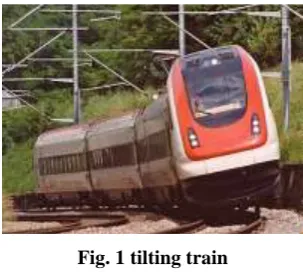
Fig. 1 tilting train
The first tilting train in regular public service was the 381 series electric multiple unit train operated by Japanese
National Railways (JNR), which entered revenue service from 10 July 1973 on the Shinano limited express
1562 |
P a g e
the marginally increased curve speeds did not justify the extra expense and technology in many cases. TheBritish Advanced Passenger Train (being operational from 1984 to 1985) was the first to successfully implement
active tilt, enabling significantly increased speeds on tight rail curves. Active tilting is the mechanism most
widely used today.
II. HISTORY
The first considerations and experiments to reduce the lateral force felt by the passengers and thereby allow
higher speeds in curves date back to the late 1930s, Deischl and Van Dorn & Beemer. In 1938, Pullman built an
experimental pendulum coach for the Atchison, Topeka and Santa Fe Railway which became the first tilting
coach in service .The novel designs were based on natural tilt [2]. The first series of tilting trains were the
Japanese class 381, which entered service between Nagoya and Nagano in 1973.Active technology was
introduced in 1965 when Deutsche Bahn (DB) converted a diesel multiple unit series 624 for tilt, the first
actively tilted train in commercial service. One important development chain for actively tilting trains was the
development of the Pendolino trains, which began in 1969 with a prototype tilting railcar, the Y0160. The
break-through for actively tilted trains came around 1990 with the introduction of large series commercial trains,
like the ETR450 in Italy and the X2 in Sweden. In 2007 the Shinkansen Series N700 became the first tilting
train with a maximum speed above 250 km/h in service.
Fig.2 An ICE TD in regular service in 2002
Deutsche Bahn started tests with tilting trains in Germany with its class 634 in 1967 when some class 624
DMUs were equipped with passive tilting systems. As the passengers experienced motion sickness, the tilting
technology was disabled and later removed. The tests continued with the prototypes of the following class 614
units, but due to the again unsatisfying results the serial types were delivered without tilting system.
Another early train with tilting technology was Deutsche Bahn's class 403 (today this number is used by ICE 3)
high speed EMU. Following its InterCity services until 1979, it was also used for airport transfers between
Düsseldorf and Frankfurt (see also: AiRail Service). Class 403 was able to tilt 4°, but the fixed pantographs
limited this to 2°. Shortly after the train had gone into service the tilting technology was disabled as many
passengers experienced motion sickness because the pivotal point was too low.
The next attempt was made with DMUs and the well proven Italian hydraulic active tilting system. Between
1988 and 1990 DB commissioned 20 class 610 units for fast regional traffic. This time the results were quite
satisfying and allowed a significant reduction of running times. Class 610 was followed by class 611 which
basically was built for the same purpose (fast regional traffic with up to 160 km/h (99 mph) on twisting
non-electrified lines). Class 611's tilting system was electric, with a maximum 8° tilt, based on military technology
from the Leopard tank. However, after coming into service in 1996 this 50-unit class experienced problems both
1563 |
P a g e
system was out of service until 2006, when hardened axles and system updates finally solved the problems. Inconsideration of these problems DB ordered a full re-engineering, resulting in the development of class 612.
Starting in 1998, a total of 192 units were commissioned by DB.
The tilting system was reliable, but when in 2004 cracks were detected in a number of wheel sets, again wheels
and axles had to be replaced. Today class 612 is back to tilting operation and forms the backbone of DB's fast
regional service on non-electrified lines. Additional units were sold to Croatia, where they are used for intercity
services.
III.PRINCIPLE
“The basic principle of tilting trains is to roll the car body inwards during curve negotiation in order to reduce the lateral acceleration perceived by the passengers”.
Fig.3 Working Principle of Tilting train
A train and its passengers are subject to centrifugal forces when the train passes horizontal curves. Roll inwards
reduces the centrifugal force felt by the passengers allowing the train to pass curves at enhanced speed with
maintained ride comfort. Trains capable to tilt the bodies inwards is often called tilting trains. The tilting trains
can be divided in two groups; the natural tilted trains, and the actively tilted trains.
The natural tilt relies on natural laws with a tilt center located well above the center of gravity of the car body.
On a curve, under the influence of centrifugal force, the lower part of the car body swings outwards [4]. It
should be noted that natural tilt has a negative impact on safety due to the lateral shift of center of gravity of the
car body.
The active tilt relies on active technology, controlled by a controller and executed by an actuator. The basic
concept of tilting trains is the roll of the vehicle bodies inwards the curve in order to reduce the lateral force
perceived by the passenger.
IV. WORKING
Fig.4. shows how this solution is applied to control natural tilt. An on board computer stores data and the location of the curves. The control system is able to start the tilting motion before entering the curves by means
of preview control using the on board database [5]. This reduces the tilting delay significantly and thereby also
1564 |
P a g e
Modern tilting trains are profiting from state-of-the-art signal processing which senses the line ahead and is ableto predict optimal control signals for the individual carriages. Complaints about nausea have by and large
become a thing of the past.
Some tilting trains run on narrow gauge railways. In Japan there are many narrow gauge lines in mountainous
regions, and tilting trains have been designed to run on these. In Australia the service between Brisbane and
Cairns by the QR Tilt Train claims to be the fastest narrow-gauge train in the world, running at 160 km/h
(99 mph).
Fig.4 Structure of controlled natural tilting
IV. TILTING TRAIN AROUND THE WORLD
1. Acela Express (United States), a Bombardier-built high-speed tilting train operating between Boston and
Washington, D.C.
2. Advanced Passenger Train (United Kingdom), a British Rail project for high-speed inter-city tilting trains
that saw limited service in the 1980s, from London Euston to Glasgow.
3. British Rail Class 390 "Pendolino" (United Kingdom), a high-speed train runs by Virgin Trains from
London Euston to Liverpool/ Manchester / Glasgow / Birmingham and Wolver Hampton.
4. Alfa Pendular (Portugal)
5. ElettroTreno (Italy)
6. ICE-T, also called ICT (Germany), a tilting version of the ICE
7. ICN (Switzerland), a new generation of tilting trains operated by Swiss Rail, a Bombardier-built high-speed
tilting train operating between Zurich and Geneva.
8. Jet Train (North America), Bombardier's experimental non-electric high-speed train
9. NSB Class 73 (Norway)
10. SŽ series 310 (Inter City Slovenija), a high-speed tilting train operating between Ljubljana, Maribor and
Koper
V. FUTURE SCOPE
The attempt to find the sources, and their relative contributions, of motion sickness in the present work was not
so successful and it is unlikely that any simple answer exists. It is probably more worthwhile to work on tilt
1565 |
P a g e
suppliers; this will be beneficial for both ride comfort and reduction of the risk of motion sickness. It is likelythat independent research organisations, such as universities, can contribute to further optimization of the tilt
algorithms. Naturally tilting trains in Japan. This development was forced by requirements concerning ride
comfort and low risk of motion sickness. Knowing the train position is the key to perfect tilt control. In the
on-track test that concluded the present work the design took advantage of global positioning systems to obtain the
absolute position and dead reckoning to find the relative position with reference to the last absolute position
given. Train position and track data information constitutes a good basis for an advanced tilt control, which is a
good match to some of the means to reduce the risk for motion sickness suggested below.
Improving the performance of the tilting trains will in the present network increase the speed relative to other
trains on the network. On double-track lines this will be negative for the line capacity and building a new line
becomes an alternative when the present line is close to its maximum capacity. For services with short distances
between stops, improved tractive performance may be a better choice than tilt.
The influence on average ride comfort from increased speed and cant deficiency compared to today’s trains can
be compensated by improved vehicle suspension. The influence on curve related quantities, such as lateral
acceleration and lateral jerk, can be compensated by tilt but possibly at the expense of increased vertical and roll
motions.
VI. CONCLUSION
Car body tilting has today become a mature technology accepted by most operators. There are different reasons
behind this fact; the non-tilting trains have increased their speed in curves (however at a reduced level of ride
comfort), reducing the potential for travelling time reduction by tilting trains to approximately 10 to 15%.
Reduction of motion sickness may be important for the competitiveness of tilting trains and comfort too. This
thesis has dealt with subjects important for improving the competitiveness of tilting trains compared to
non-tilting ones this work has contributed to the body of knowledge of non-tilting trains and this chapter presents the
overall conclusions.
Tilting trains can be divided into two groups, depending on whether active force is needed to create tilt or not,
called actively tilted trains and naturally tilting trains. However, many of today’s naturally tilting trains do have
an active system to improve control of the tilt motion. As early as the late 1980s control systems utilizing
wayside information was introduced in
REFERENCES
[1] Rickard Persson, “Tilting trains Enhanced benefits and strategies for less motion sickness”
[2] W. Deischl, “Linienverbesserungen Oder gesteuerte
Achsen”Verkehrstechnische Woche.Volume 31, No 9, pp 97-108, Berlin 1937
[3] Das Geheimnis deer Achse. In: Süddeutsche Zeitung, 22. November 2008
[4] "New study shows how to eliminate motion sickness on tilting trains ", Icahn School of Medicine at
Mount Sinai, 4 August 2011.]
[5] K. Sasaki, “ Position Detection System Using GPS for Carbody Tilt Control” ,Quarterly Report of RTRI.