University of Pennsylvania
ScholarlyCommons
Publicly Accessible Penn Dissertations
Fall 12-7-2009
Collaborative Data Sharing with Mappings and
Provenance
Todd J. Green
University of Pennsylvania, [email protected]
Follow this and additional works at:
http://repository.upenn.edu/edissertations
Part of the
Databases and Information Systems Commons
This paper is posted at ScholarlyCommons.http://repository.upenn.edu/edissertations/58 For more information, please [email protected].
Recommended Citation
Collaborative Data Sharing with Mappings and Provenance
Abstract
A key challenge in science today involves integrating data from databases managed by different collaborating
scientists. In this dissertation, we develop the foundations and applications of collaborative data sharing
systems (CDSSs), which address this challenge. A CDSS allows collaborators to define loose confederations
of heterogeneous databases, relating them through schema mappings that establish how data should flow from
one site to the next. In addition to simply propagating data along the mappings, it is critical to record data
provenance (annotations describing where and how data originated) and to support policies allowing
scientists to specify whose data they trust, and when. Since a large data sharing confederation is certain to
evolve over time, the CDSS must also efficiently handle incremental changes to data, schemas, and mappings.
We focus in this dissertation on the formal foundations of CDSSs, as well as practical issues of its
implementation in a prototype CDSS called Orchestra. We propose a novel model of data provenance
appropriate for CDSSs, based on a framework of semiring-annotated relations. This framework elegantly
generalizes a number of other important database semantics involving annotated relations, including ranked
results, prior provenance models, and probabilistic databases. We describe the design and implementation of
the Orchestra prototype, which supports update propagation across schema mappings while maintaining data
provenance and filtering data according to trust policies. We investigate fundamental questions of query
containment and equivalence in the context of provenance information. We use the results of these
investigations to develop novel approaches to efficiently propagating changes to data and mappings in a CDSS.
Our approaches highlight unexpected connections between the two problems and with the problem of
optimizing queries using materialized views. Finally, we show that semiring annotations also make sense for
XML and nested relational data, paving the way towards a future extension of CDSS to these richer data
models.
Degree Type
Dissertation
Degree Name
Doctor of Philosophy (PhD)
Graduate Group
Computer and Information Science
First Advisor
Zachary G. Ives
Second Advisor
Val Tannen
Keywords
Subject Categories
COLLABORATIVE DATA SHARING WITH
MAPPINGS AND PROVENANCE
Todd J. Green
A DISSERTATION
in
Computer and Information Science
Presented to the Faculties of the University of Pennsylvania in Partial
Fulfillment of the Requirements for the Degree of Doctor of Philosophy
2009
Zachary G. Ives, Associate Professor, Computer and Information Science Supervisor of Dissertation
Val Tannen, Professor, Computer and Information Science Supervisor of Dissertation
Jianbo Shi, Associate Professor, Computer and Information Science Graduate Group Chairperson
Dissertation Committee
Susan B. Davidson, Professor, Computer and Information Science
Sanjeev Khanna, Professor, Computer and Information Science
Jeffrey F. Naughton, Professor, Computer Science, University of Wisconsin-Madison
COPYRIGHT
Todd J. Green
ABSTRACT
COLLABORATIVE DATA SHARING WITH MAPPINGS AND PROVENANCE
Todd J. Green
Supervisors: Zachary G. Ives and Val Tannen
A key challenge in science today involves integrating data from databases managed by
differ-ent collaborating scidiffer-entists. In this dissertation, we develop the foundations and applications of
collaborative data sharing systems (CDSSs), which address this challenge. A CDSS allows
collab-orators to define loose confederations of heterogeneous databases, relating them through schema
mappings that establish how data should flow from one site to the next. In addition to simply
propagating data along the mappings, it is critical to record data provenance (annotations
describ-ing where and how data originated) and to support policies allowdescrib-ing scientists to specify whose
data they trust, and when. Since a large data sharing confederation is certain to evolve over time,
the CDSS must also efficiently handle incremental changes to data, schemas, and mappings.
We focus in this dissertation on the formal foundations of CDSSs, as well as practical issues
of its implementation in a prototype CDSS called Orchestra. We propose a novel model of data
provenance appropriate for CDSSs, based on a framework of semiring-annotated relations. This
framework elegantly generalizes a number of other important database semantics involving
an-notated relations, including ranked results, prior provenance models, and probabilistic databases.
We describe the design and implementation of the Orchestra prototype, which supports update
propagation across schema mappings while maintaining data provenance and filtering data
ac-cording to trust policies. We investigate fundamental questions of query containment and
equiv-alence in the context of provenance information. We use the results of these investigations to
develop novel approaches to efficiently propagating changes to data and mappings in a CDSS.
Our approaches highlight unexpected connections between the two problems and with the
prob-lem of optimizing queries using materialized views. Finally, we show that semiring annotations
also make sense for XML and nested relational data, paving the way towards a future extension
Contents
1 Introduction 1
1.1 Overview of CDSS and Orchestra . . . 3
1.2 Overview of Technical Contributions . . . 12
1.3 Roadmap . . . 25
2 Provenance Semirings 27 2.1 Queries on Annotated Relations . . . 28
2.2 Positive Relational Algebra . . . 30
2.3 Polynomials for Provenance . . . 34
2.4 A Hierarchy of Provenance . . . 36
2.5 Datalog onK-Relations . . . 39
2.6 Formal Power Series for Provenance . . . 44
2.7 Computing Provenance Series . . . 46
2.8 Application to Incomplete/Probabilistic Databases . . . 49
2.9 Provenance-Annotated Queries . . . 49
3 Update Exchange in Orchestra 53 3.1 CDSS Update Exchange . . . 55
3.2 Update Exchange Formalized . . . 60
3.3 Performing Update Exchange . . . 67
3.4 Implementation . . . 75
3.5 Experimental Evaluation . . . 77
4 Optimizing Queries on Annotated Relations 85 4.1 Preliminaries . . . 87
4.2 Containment Mappings . . . 89
4.4 Main Results . . . 91
4.5 Datalog . . . 103
5 Ring-Annotated Relations and Differences 106 5.1 Applications of Differences . . . 109
5.2 Z-Relations . . . 111
5.3 Reformulation Using Views . . . 114
5.4 Finding Query Rewritings . . . 123
5.5 Applications to Bag and Set Semantics . . . 125
5.6 Built-in Predicates . . . 128
5.7 Z[X]-relations . . . 129
6 Semiring-Annotated XML 131 6.1 Semiring Annotations . . . 133
6.2 Annotated and Unordered XML . . . 134
6.3 A Security Application . . . 142
6.4 Incomplete and ProbabilisticK-UXML . . . 144
6.5 Semantics via Complex Values . . . 146
6.6 Commutation with Homomorphisms . . . 152
6.7 Semantics via Relations . . . 154
7 Related Work 158 7.1 Paradigms for Data Integration . . . 158
7.2 Provenance and Annotated Data Models . . . 164
7.3 Update Exchange . . . 165
7.4 Query Containment and Equivalence . . . 166
7.5 Ring-Annotated Relations and Updates . . . 167
7.6 Semiring-Annotated XML . . . 168
7.7 Further Work on Orchestra . . . 168
8 Conclusions and Future Directions 170 8.1 Immediate Next Steps . . . 171
8.2 Longer-Term Directions . . . 172
List of Figures
1.1 Mappings among three bioinformatics databases . . . 5
1.2 Bioinformatics database instances before and after data exchange . . . 7
1.3 Two views of provenance for bioinformatics example . . . 11
1.4 Tabular provenance representation using system of equations . . . 16
1.5 Complexity of containment and equivalence with provenance annotations . . . 21
1.6 Update propagation and query reformulation . . . 22
1.7 Mapping evolution and query reformulation . . . 22
1.8 Representing and computing updates with ring-annotated relations . . . 23
1.9 Semiring-annotated XML example. . . 25
2.1 A maybe-table and a query result . . . 29
2.2 Result of Imielinski-Lipski computation . . . 29
2.3 Bag semantics example . . . 30
2.4 Probabilistic example . . . 30
2.5 Lineage and provenance polynomials . . . 34
2.6 Comparison of provenance annotations . . . 37
2.7 Provenance hierarchy . . . 39
2.8 Datalog with bag semantics . . . 39
2.9 Datalog example . . . 42
2.10 Derivation trees for Datalog example . . . 43
2.11 Probabilistic data integration example . . . 52
3.1 Mappings among three bioinformatics databases . . . 55
3.2 Dataflow at a single peer in a CDSS . . . 57
3.3 Local edit logs and update translation . . . 59
3.4 Provenance graph for bioinformatics example . . . 60
3.6 Provenance graph for derivability testing example. . . 71
3.7 Example provenance graph showing relationships between tuples. . . 74
3.8 Relative performance of deletion propagation algorithms . . . 80
3.9 Time to join and relation instance sizes . . . 81
3.10 Scalability of incremental update propagation algorithms . . . 82
3.11 Scalability for increasing base data sizes . . . 83
3.12 Effects of mapping fan-in/fan-out on storage overhead and performance . . . 84
4.1 Complexity of containment and equivalence . . . 86
4.2 Logical implications of containment and equivalence . . . 88
5.1 Algebraic identities for the difference operator underZ-semantics . . . . 113
6.1 SimpleforExample. . . 135
6.2 K-UXQuery Syntax. . . 135
6.3 K-UXQuery Typing Rules. . . 136
6.4 XPath Example. . . 137
6.5 Relational (encoded) example. . . 138
6.6 Extended Annotations Example. . . 139
6.7 Translation from positive relational algebra toK-UXQuery . . . 140
6.8 Security Clearance Example. . . 143
6.9 Syntax and Typing rules forNRC. . . 147
6.10 Semantic Equations forNRCK+srt. . . 150
6.11 Compilation of UXQuery . . . 151
6.12 Compilation of XPath toNRCK+srt . . . 151
7.1 Data warehouse architecture . . . 159
7.2 Feature comparison of data integration paradigms . . . 160
7.3 Virtual data integration architecture . . . 161
7.4 Peer-to-peer data integration architecture . . . 162
Acknowledgments
I would like to thank my advisers, Zack Ives and Val Tannen, for their generous support and
guidance during my studies at Penn. It was a privilege to have been able to work with them.
Most of the work described in this dissertation was performed in collaboration with others,
including my advisors and my fellow PhD students Grigoris Karvounarakis and Nate Foster. I
would like to thank them here, and emphasize that many of the contributions presented in the
present document were shaped by several of us working together. In particular, the material in
Chapter2 is based on a paper [62] by the author with Grigoris Karvounarakis and Val Tannen,
as part of the larger Orchestraproject headed by Zack Ives; Chapter3is based on a paper [60]
by the author with Grigoris Karvounarakis, Zack Ives, and Val Tannen; Chapter5 is based on a
paper [59] by the author with Zack Ives and Val Tannen; and Chapter6is based on a paper [48]
by the author with Nate Foster and Val Tannen.
The work described in this dissertation benefited at many points from useful feedback and
suggestions from others. I would like to thank in particular Olivier Biton, James Cheney, Jan
Chomicki, Sarah Cohen-Boulakia, Nilesh Dalvi, Floris Geerts, Giorgio Ghelli, Ren´ee Miller, Tova
Milo, Kristoffer Rose, J´er ˆome Sim´eon, Nicholas Taylor, Stijn Vansummeren, and the members of
the Penn database group. I also would like to thank the members of my dissertation committee
for their thoughtful feedback and comments that helped improve this document.
Finally, I would like to thank my wife, Elisabeth Dubin, for her love and support over the past
Chapter
1
Introduction
Sharingstructureddata is one of the most basic yet persistently vexing problems of data manage-ment, and has been studied since the earliest days of database research. In recent years, with the
growth of the Internet and explosion of data on the Web, there has been a renewed and sustained
push to develop solutions for integrating data from heterogeneous sources, translating data
be-tween different schemas, and other forms of data sharing. Much progress has been made in both
establishing solid theoretical foundations and developing practical systems. These efforts range
from pre-loading all data into a single database instance after transforming it to a common
for-mat, then answering queries over this instance (as with data exchange [45]); to transforming data
“on demand” or “on the fly” to answer specific queries (as with virtual data integration [135]).
Commercially available tools using these techniques are available in several forms, including data
warehousing systems and enterprise information integration systems.
Despite this progress, the practical impact of data sharing solutions proposed to date has been
surprisingly modest, limited mainly to relatively small-scale efforts centralized inside a single
corporation or controlling entity. At the same time, the need for sharing data across broader
communities is increasing, especially in the sciences, which have become highly data-driven as
they attempt to tackle larger questions. In bioinformatics, for example, there is a plethora of
different databases, each providing a different perspective on a collection of organisms, genes,
proteins, diseases, and so on. The data in these databases is highly interrelated — e.g., there are
links between genes and proteins, and gene homologs between species — but the databases have
proved very difficult to integrate using existing technologies.
One major reason for this is that conventional data integration tools require the development
of a single global schema and assume that the data is globally consistent. In practice, both
many revisions, and requires a central administrator. Data from different sources can be often
contradictory, reflecting different points of view, while current data integration tools assume there
should be a consensus or “clean” version of the data. Moreover, users of integrated data often
prefer to carefullycurateit, manually or semi-automatically, rejecting some items and modifying
others. The goals of curation are to eliminate inconsistencies, to fit data to user assumptions, as
well as to enforce different degrees oftrustin the sources. Tolerating inconsistency and
support-ing curation requires a measure of decentralization in data sharsupport-ing.
Another key requirement in many data sharing scenarios, not supported by current tools, is
to track and record where data has come from and how it has come to be where it is, in other
words, itsprovenance. In scientific data sharing scenarios, this is not optional: data provenance
is an essential part of the scientific record as well as crucial information used in curation.
How-ever, as data sharing typically involves complex transformations across the different schemas of
participants, formulating the “right” notion of data provenance to capture these complexities is a
challenging problem in itself.
Finally, most data sharing scenarios have importantdynamicaspects. Data is constantly being
updated – refined, corrected, expanded – and the participants naturally desire the most recent
version of it. As has been observed since the earliest data integration investigations, this creates
a tension between the efficiency of answering queries and the freshness of the obtained answers,
with data warehousing favoring the former and virtual integration the latter. Moreover, it is not
just the data that is dynamic, but also the set of participants, their schemas, and the relationships
among them (as we shall see, the mappingswhich relate data sources). Especially in the “boot-strapping” phase of a collaboration — where the complex relationships among participants and
data are only partially understood — such changes can occur as often as changes to the source
data. We need a platform which copes with changes both to data and to the mappings among
data sources.
To address these practical requirements, Ives, Khandelwal, and Kapur [82] described a vision
for acollaborative data sharing system(CDSS), an approach that supports looser, decentralized
confederations of participants (peers) with local curation abilities and tolerates inconsistencies in
the data while still preserving a notion of semantic consistency. The goal of this dissertation is to
realize this vision through a host of novel concepts and algorithms, developing both theoretical
foundations and implementation techniques for supporting data provenance, dealing efficiently
with the dynamic aspects of data and mappings through incrementality and optimization, and
finally, evaluating these ideas in a prototype system called Orchestra.
• We develop a powerful formal model of provenance for relational data that fulfills CDSS
requirements and captures as special cases many other provenance models proposed in
earlier work.
• We implement these ideas in the Orchestraprototype CDSS, solving key engineering
chal-lenges such as the representation of provenance and efficient propagation of data updates in
an off-the-shelf DBMS, and we also validate experimentally the feasibility of our approach.
• We make a systematic study of the fundamental questions of query containment and
equiv-alence in the presence of provenance information, and obtain positive decidability results
and complexity characterizations for five different models of provenance.
• We use these results to develop algorithms for efficient propagation of updates to mappings
in a CDSS. The algorithms highlight unexpected connections with the problem of data
up-date translation, and make fundamental use of provenance information. We also implement
and evaluate these algorithms in the Orchestraprototype.
• We show that our provenance model extends to richer data models such as XML and nested
relations, giving further evidence of the robustness of our approach and paving the way
towards a future extension of CDSS to these data models.
The development of Orchestra and CDSS has itself been a collaborative effort, and we
em-phasize that most of the contributions described here were developed in collaboration with others,
including Nate Foster, Zack Ives, Grigoris Karvounarakis, Val Tannen, and the members of the
Penn database group. We provide a more detailed attribution of the shared contributions in
Section1.2.
In the remainder of this chapter, we will give an informal overview of the the main
function-alities of the OrchestraCDSS, touching on the key issues mentioned above (Section 1.1), then
elaborate on the technical contributions of the dissertation (Section1.2). We finish with an outline
of the rest of this dissertation (Section1.3).
1
.
1
Overview of CDSS and Orchestra
The CDSS model builds upon the fundamentals of data integration, peer data management
sys-tems [73] (PDMS), and data exchange [45], while incorporating major new functionalities. As in
a PDMS, the CDSS contains a set ofpeers, each representing an autonomous domain of control. Each peer’s administrator has full control over a local DBMS, its schema, and the conditions
schemas, but our model extends naturally to other data models such as XML or nested relations
(see Chapter 6). In this section, we give first an overview of how the peers’ data is related by
schema mappings, as used in PDMS and data exchange. Then we discuss the semantics of query
answers where Orchestrafollows the principles ofdata exchange[45]. Most importantly, we
de-scribe Orchestra’s fundamentally novel features regardingupdate exchange, data provenance,
and dynamic update strategies through incrementality and optimization.
The topology of data sharing: specifying how peers are related
Earlier work on PDMS pioneered the notion of supporting multiple mediated schemas, thereby
relaxing some aspects of administration, and we adopt this perspective as a starting point in
CDSS. As in PDMS, a CDSS collaboration begins with a set ofpeerdatabases, each with their own schema and local data instance.
Example1.1. Consider (see Figure1.1) a bioinformatics collaboration scenario based on databases
of interest to affiliates of the Penn Center for Bioinformatics. In general, GUS, the Genomics
Unified Schema1
covers gene expression, protein, and taxon (organism) information; BioSQL,
affiliated with the BioPerl project2
, covers very similar concepts; and a third schema, uBio3 ,
es-tablishes synonyms among taxa. Instances of these databases contain taxon information that is
autonomously maintained but of mutual interest to the others. For the purposes of our
exam-ple we show only one relational table in each of the schemas, as follows. Peer GUS associates
taxon identifiers, scientific names, and what it considers canonical scientific names via relation G(gid,nam,can); peerBioSQLassociates its own taxon identifiers with scientific names via
rela-tionB(bid,nam); and peeruBiorecords synonyms of scientific names via relationU(nam1,nam2).
Again as in PDMS, the participants of the CDSS collaboration specify the relationships among
their databases usingschema mappings.
Example1.2. Continuing with Example1.1, suppose it is agreed in this collaboration that certain
data inGUSshould also be inBioSQL. This represented in Figure1.1by the arc labeledm1. The
specificationG(g,n,c)→ ∃b B(b,n)associated withm1 is read as follows: if(g,n,c)in table G,
the valuenmust also be in some tuple(b,n)of table B, although the valuebin a such a tuple is not determined. The specification just says that there must be such aband this is represented by the existential quantification∃b. Herem1is an example ofschema mapping. Two other mappings
appear in Figure1.1. PeeruBioshould also have some ofGUS’s data, as specified bym2. Mapping 1
http://www.gusdb.org
2
http://bioperl.org
3
G(gid,nam,can)
GUS
B(bid,nam)
BioSQL
U(nam1,nam2)
uBio
m3
m1
m2
(m1) G(g,n,c)→ ∃b B(b,n)
(m2) G(g,n,c)→U(n,c)
(m3) B(b,n1)∧U(n1,n2)→B(b,n2)
Figure1.1: Mappings among three bioinformatics databases
m3is quite interesting: it stipulates data inBioSQLbased on data inuBiobut also on dataalready
inBioSQL. As seen inm3, relations from multiple peers may occur on either side. We also see that
individual mappings can be “recursive” and that cycles are allowed in the graph of mappings.
Schema mappings are logical assertions that the data instances at various peers are expected
to jointlysatisfy. We shall see (Section1.2) that they correspond to the well-known formalism of
tuple-generating dependencies(tgds) [7]. We shall also see (Chapter3) that, as in data exchange [45],
a large class of mapping graph cycles can be handled safely, while certain complex examples
cause problems.
Thus, every CDSS specification begins with a collection of peers/participants, each with its
own relational schema, and a collection of schema mappings between some of these peers. Like
the schemas, the mappings are designed by the participants’ administrators. By joining Orches
-tra, the participants agree to share the data from their local databases. The sharing can be further
modulated through the mappings, which should therefore be subject to agreement between
par-ticipants.
The semantics of query answers
Given a CDSS configuration of peers and schema mappings, the question arises of how data
should be propagated using the mappings, and what should be the answer to a query asked by
one of the peers. The whole point of data integration is for such an answer to use data from
all the peers. In CDSS, we wish to accomplish this by materializing at every peer an instance containing not only the peer’s locally contributed data, but also additional facts thatmustbe true, given the data at the other peers along with the constraints specified by the mappings. Queries
at a peer will be answering using this local materialized instance. However, while the mappings
relating the peers tell us which peer instances are together considered “acceptable,” they do not
In CDSS we follow established practice in data integration, data exchange and incomplete
information databases [1,45] and usecertain answerssemantics: a tuple is “certain” if it appears
in the query answer no matter what data instances (satisfying the mappings) we apply the query
to. In virtual data integration, the certain answers to a query are computed by reformulating the
query across all peer instances using the mappings, and combining the answers together from the
local results computed at each peer. In CDSS, as in data exchange, we materialize special local
instances that can be used to compute the certain answers. This makes query evaluation a fast,
local process.
We illustrate this with our running example.
Example1.3. Suppose the contents ofG,U, and B are as shown in Figure 1.2(a). Note that the
mappings of Figure1.1are not satisfied: for example,Gcontains a tuple
(828917, “Oscinella frit”, “Drosophila melanogaster”)
but B does not contain any tuple with “Oscinella frit” which is a violation ofm1. Let us patch
this by adding toBa tuple(⊥1, “Oscinella frit”)where⊥1represents the unknown value specified
by∃b in the mapping m1. We call⊥1a labeled null. Adding just enough patches to eliminate
all violations results in the data in Figure1.2(b). (Note that sometimes patching one violation
may introduce a new violation, which in turn must be patched; hence this process is generally
an iterative one, however under certain constraints it always terminates.) Observe that we can
replace⊥1and the other labeled nulls with combinations of arbitrary values and we get an entire
class of data instances that satisfy the mappings.
Now, consider two relational algebra queries:
Q1 def= σnam=“Oscinella frit”(B) Q2
def
= πnam(σnam=“Oscinella frit”(B))
and let us see which answers arecertainwhen we apply these queries to the data instances ob-tained by replacing the labeled nulls with various values. There is no tuple in common among the
various answersQ1produces, hence its certain answer semantics is empty. However, all answers
produced byQ2, have the tuple(“Oscinella frit”)in common. This is a certain answer forQ2.
The procedure we used in the example to resolve mapping violations by patching instances is
intuitive but it is not clear that (1) it always works, and (2) the data instances obtained by replacing
labeled nulls with arbitrary values are representative ofallinstances satisfying the mappings and therefore give us the certain answers. In fact, the theory of data exchange [45] has resolved
G:
gid nam can
828917 Oscinella frit Drosophila melanogaster 2616529 Musca domestica Musca domestica
U: nam1 nam2
B: bid nam
4472 Periplaneta americana
(a) Tables fromGUS,uBio, andBioSQLbefore data exchange (Uis empty)
U:
nam1 nam2
Oscinella frit Drosophila melanogaster Musca domestica Musca domestica
B:
bid nam
4472 Periplaneta americana
⊥1 Oscinella frit
⊥1 Drosophila melanogaster ⊥2 Musca domestica (b) Updated tables after data exchange. Shaded rows indicate newly-inserted tuples. (Gis unchanged.)
Figure1.2: Bioinformatics database instances before and after data exchange
convenient query answering algorithm: to obtain the certain answers to a query it suffices to
evaluate the query over a specifically computed data instance with labeled nulls (as if the labeled
nulls were ordinary values) and then to discard any tuples in the result containing labeled nulls.
As a consequence, Orchestra works with peer instances in which tuples may contain labeled
nulls (actually, in the slightly more complicated form ofSkolem terms; see Section1.2).
Dynamic operation and update exchange
We have seen that Orchestra performs query answering on locally stored instances rather than
on-the-fly. This raises the question of data freshness in the peer instances built via data exchange.
Data exchange is essentially a static procedure: it focuses on the one-time computation of entire
peer instances satisfying the mappings. Across an entire CDSS this can be disruptive, as not all
peers may wish to refresh their data at the same time.
In contrast, the CDSS design sees data sharing as a fundamentally dynamic process, with frequent “refreshing”data updatesthat need to be propagated efficiently. This process of dynamic update propagation is calledupdate exchange. It is closely related to the classicalview maintenance problem, and we shall discuss these connections at length in later chapters.
Operationally, CDSS functions in a manner reminiscent of revision control systems, but with peer-centric conflict resolution strategies. The users located at a peer P query and update the
local instance in an “offline” fashion. Their updates are recorded in alocal edit log. Periodically, upon the initiative ofP’s administrator, Prequests that the CDSS perform an update exchange
(since the last timePparticipated in an update exchange). To determine these effects, the CDSS
performs incremental update translation using the schema mappings to compute corresponding updates overP’s local instance: the translation finds matches of incoming tuples to the LHS of
the mapping, and applies these matchings to the RHS to produce outgoing tuples (recall the
“patching” process in Example1.3).
Doing this only on updates means performing data exchange incrementally, with the goal of
maintaining peer instances satisfying the mappings. Therefore, in CDSS the mappings are more
than just static specifications. They can be seen as underlying the dynamic process ofpropagation of updates.
Example1.4. Refer again to Figure 1.2(b), and suppose now that the curator ofuBioupdates her
database by adding another synonym for the fruit fly:U(“Oscinella frit”, “Oscinella frit Linnaeus”). When this update is published, it introduces a violation of mapping m3 that must again be
“patched.” The update translation process therefore inserts a corresponding tuple intoBioSQL:
B(⊥1, “Oscinella frit Linnaeus”).
Local curation and trust policies
The CDSS paradigm also differs from traditional data exchange in its incorporation of mechanisms
allowinglocal curation of database instances. This allows CDSS users to “override” the system and modify or delete any data in their local database, even data that has been imported from
elsewhere via schema mappings. In this way, CDSS users retain full control over the contents
of their local database. The technical obstacle in supporting such a feature is how to preserve
a notion of semantic consistency with respect to the mappings, when such modifications may
introduce violations of the mappings.
Example 1.5. Refer again to Figure 1.2(b), and suppose that the curator of BioSQL decides that
she is not interested in house flies, and wishes to delete tupleB(⊥2, “Musca domestica”)from her
local instance. Since as we have seen, the presence of this tuple wasforcedby the mappings, the deletion of the tuple leads to a violation of the mappings.
To allow such local curation, CDSS stores deleted tuples inrejection tables, and converts user-specified mappings into internal mappings that take the rejection tables explicitly into account.
The notion of “solution” adopted in CDSS is with respect to these converted mappings. Details
are discussed in Chapter3. Note that, sometimes, local curation correctsmistakesin the imported
data, and it is desirable for the corrections to be propagated back to the sources from which
mappings. We do not discuss bidirectional mappings in this dissertation, but the interested reader can refer to [87,61,86] for details.
CDSS incorporates a second mechanism for local control of database instances in the form of
provenance-based trust policies. These are essentially selection predicates, but of a special kind that operates ondata provenance. They allow CDSS administrators to specify which data is “trusted,” depending on its provenance (Orchestra’s mechanism for managing data provenance is
dis-cussed in Section1.2).
Example1.6. Some possible trust policies in our bioinformatics example:
• PeerBioSQLdistrusts any tupleB(b,n)if the data came fromGUSandn=“Musca domestica”, and trusts any tuple fromuBio.
• PeerBioSQLdistrusts any tupleB(b,n)that came from mappingm2.
Once specified, the trust policies are incorporated in the update exchange process: when the
updates are being translated into a peerP’s schema they are accepted or rejected based onP’s
trust conditions.
The example above illustratesBoolean trust policies, which specify a black-or-white classification of tuples as either (completely) trusted or (completely) untrusted, depending on their provenance
and contents. In fact, CDSS also allows richer forms ofranked trust policiesin whichtrust scoresare computed for tuples indicating various “degrees of trust.” When a conflict is is detected among
data from multiple sources (for example, by a primary key violation), these scores can be used
to resolve the conflict by selecting the tuple with the highest trust score and discarding those
with which it conflicts. We focus mainly on Boolean trust policies in this dissertation, but briefly
discuss ranked trust policies in Chapter3.
Provenance
A major novel feature of CDSS, and a central focus of this dissertation, is the tracking of data provenance. This is the information which records “how data was propagated” during the update exchange process. Data provenance is needed for several purposes in CDSS: as the foundation of
provenance-basedtrust policies, forupdate exchangeitself, as a means of guiding efficient incremen-tal algorithms, and as additional information that can be displayed and searched by CDSS users
as they perform data curation and other manual tasks. Chapter2develops the formal machinery
of the provenance model used in CDSS; here we just give an informal overview highlighting the
The most intuitive way to picture CDSS provenance is as agraphhaving two kinds of nodes: tuple nodes, one for each tuple in the system, andmapping nodes, where several such nodes can be labeled by the same mapping name. Edges in the graph representderivationsof tuples from other tuples using mappings. Special mapping nodes labeled “+” are used to identify original source
tuples.
Example1.7. Refer to Figure1.3, which depicts the provenance graph corresponding to the
bioin-formatics example from Figure 1.2 (we have abbreviated the data values to save space).
Ob-serve there is a “+” mapping node pointing to G(26,Musc.,Musc.); this indicates that it is one of the source tuples from Figure1.2(a), present before data exchange was performed. Next,
ob-serve that G(26,Musc.,Musc.) is connected to U(Musc.,Musc.) via a mapping node labeled m2.
This indicates thatU(Musc.,Musc.)was derived using G(26,Musc.,Musc.)with m2. Also, notice
that B(⊥2,Musc.) has a derivation from G(26,Musc.,Musc.) via mapping m1. Finally, note that
B(⊥2,Musc.)also has a second derivation, from itself andU(Musc.,Musc.)via mappingm3. The
graph is thus cyclic, with tuples involved in their own derivations. In general, when mappings
are recursive, the provenance graph may have cycles.
The graphical model of provenance is convenient for several purposes in CDSS, including the
system implementation that we shall describe in Chapter 3. However, most of the theoretical
development in this dissertation will focus on another, equivalent perspective on CDSS
prove-nance based on a powerful framework ofsemiring-annotated relations. As we will explain in
Section1.2(and Chapter2),semiringsare algebraic structures that arise naturally with database
provenance. This framework has the virtue of uniformly capturing as special cases many other
provenance models that have been proposed in the literature (such as thewhy-provenanceof [17],
thedata warehousing lineageof [35], theTrio lineageof [8], and theevent tablesused in probabilistic
databases [50,138]), as well as the traditional set and bag semantics. By putting all these models
on equal footing, we are able to make precise comparisons of various kinds — we can compare
their relativeinformativeness, for example, or study their various interactions with thequery opti-mizationprocess. In particular, it allows us to explain precisely why the Orchestra provenance
is strictly more informative than any of these. Provenance annotations also turn out to be useful
in formulating efficient algorithms for update exchange and mapping evolution (as overviewed
in Section1.2).
Briefly, the main idea in the semiring-annotations framework is as follows. Tuples in source
relations are annotated with elements from some domain of annotationsK. During query process-ing, when tuples are joined together to produce another tuple, their annotations are combined
+
+
G:
82 Osci. Dros.
26 Musc. Musc.
m2
m2
U:
Osci. Dros.
Musc. Musc. m1
m1
m3
m3
B:
44 Peri.
⊥1 Osci.
⊥1 Dros.
⊥2 Musc.
+
(a) Graphical provenance representation
G:
gid nam can
82 Osci. Dros. g1
26 Musc. Musc. g2
U:
nam1 nam2
Osci. Dros. m2⊗g1
Musc. Musc. m2⊗g2
B:
bid nam
44 Peri. b1 ⊥1 Osci. m1⊗g1
⊥1 Dros. m3⊗(m1⊗g1)⊗(m2⊗g1)
⊥2 Musc. (m1⊗g2)⊕(m3⊗(m1⊗g2)⊗(m2⊗g2))⊕ · · ·
(b) Tabular provenance representation
Figure1.3: Two views of provenance for bioinformatics example
as via union or projection operators), the alternatives are recorded using an abstract⊕operation.
Example1.8. Refer to Figure 1.3(b), which shows the tables corresponding to Figure 1.3(a) with
their semiring provenance annotations. Observe that the annotation of G(26,Musc.,Musc.)isg2,
indicating that this is a source tuple (cf. the “+” in Figure1.3(a)). Next observe that the
annota-tion ofU(Musc.,Musc.)ism2⊗g2, indicating that the tuple was derived fromG(26,Musc.,Musc.)
using mapping m2. Finally, observe that the annotation of B(⊥2,Musc.) is an infinitesum
(us-ing ⊕), one term for each of the (infinitely many) derivations of that tuple (cf. the cycle in the
provenance graph for that tuple). The first term in the sum, m1⊗g2, indicates its derivation
fromG(26,Musc.,Musc.) using mappingm1. The rest of the terms in the sum correspond to the
derivations using the tuple itself andU(Musc.,Musc.)repeatedly with mappingm3.
Mapping evolution
One of the most difficult tasks for users of a CDSS is to formulate the mappings that relate the
peers. In practice, mappings are not static, but are subject to frequent revisions, corrections,
time, and as the understanding of relationships among peers becomes clarified over time. This
phenomenon has been referred to asmapping evolutionin [136], and handling mapping evolution
efficiently (i.e., updating instances in an incremental fashion as mappings change) is another key
requirement in CDSS. In early phases of a collaboration’s development, changes to mappings can
occur at least as often as changes to data in the peers, while in later phases, changes are less
frequent but potentially even more disruptive (we would prefer to avoid recomputing instances
from scratch every time, e.g., a new peer joins a collaboration).
Example1.9. Consider the bioinformatics example from Figure1.1, and suppose that the
adminis-trator ofBioSQLnotices that mapping m1 is incorrect, because the “id” field ofGUSneeds to be
translated into the style used inBioSQL. To accomplish this, she introduces acorrespondence table4 T(gid, bid)and modifies mappingm1to translate ids usingT:
(m01) G(i,n,c)∧T(i,b)→B(b,n)
In order to process this update, note that some – but not all! – of the data inB will need to be updated (only those tuples which came fromG), and since the mapping fromBtoUdrops the id field, the data inUshould be wholly unaffected.
Handling mapping evolution efficiently in a CDSS is closely related to the so-calledview adap-tation problem [65], in which a materialized view must be updated after the view definition
changes.
1
.
2
Overview of Technical Contributions
Having surveyed the main functions of Orchestra and CDSS in the previous section, let us
now examine some of the details of how these functionalities are accomplished. These details
constitute the novel technical contributions of this dissertation. For the contributions resulting
from joint work, we give paper references in each section below.
Before covering the technical contributions, we first need to recall some necessary background
concepts from previous work on data exchange.
Background: data exchange, chase, and universal solutions
We saw in Example1.3that a basic task in data exchange and CDSS involves “patching” database
instances related by schema mappings, in order to satisfy the mappings. We begin this section by
4
explaining more about the kind of schema mappings used in CDSS, and how this fundamental
task of “patching” is accomplished.
Tuple-generating dependencies (tgds) are a widely-used means of specifying constraints and
mappings [45,38] in data integration and data exchange.5 A tgd is a first-order logical assertion
of the form
∀x¯∀y¯(ϕ(x, ¯¯ y)→ ∃z¯ψ(x, ¯¯ z)),
where the left hand side (LHS) of the implication, ϕ, is a conjunction of relational atoms over
variables ¯xand ¯y, and the right hand side (RHS) of the implication,ψ, is a conjunction of relational
atoms over variables ¯xand ¯z. For readability, we will generally omit the universal quantifiers and simply write
ϕ(x, ¯¯ y)→ ∃z¯ψ(x, ¯¯ z),
as in the mappings in Figure1.1. The tgd expresses a constraint about the existence of tuples in
the relations on the RHS, given a particular combination of tuples satisfying the constraint of the
LHS.
Tgds by themselves merely describe the database instances which together are considered
“acceptable.” To put the mappings to work in data sharing, CDSS builds upon earlier work
in data exchange where the well-known chase procedure can be used to propagate data among databases, in accordance with the schema mappings, until the mappings are satisfied. Essentially,
this procedure involves repeatedly looking for violations of mappings, and adding new tuples to the database instances to repair the violations. If mappings contain existentially quantified
variables, the new tuples will contain special placeholderlabeled nullvalues. The addition of new tuples may in turn introduce new violations, so the procedure must be repeated until all the
mappings are satisfied. This process is guaranteed to terminate in time polynomial in the size of
the input database instances, so long as the topology of the mappings isweakly acyclic(explained in Chapter3).
The peer database instances computed by the chase together constitute a solution: a (joint) database instance satisfying the mappings which is obtained from the starting (joint) database
instance by adding tuples to it.6
In general, for a given starting joint instance and set of mappings,
there are infinitely many possible solutions. The one that is computed by the chase, however, has
a special property: it is auniversal solution, essentially, a solution that can be homomorphically embedded in any other solution. Because of this, a universal solution can be used to obtain the
certain answers to positive relational algebra queries (Section1.1).
5
Tgds are related to so-calledglobal-local-as-view orGLAVmappings [49,73], which in turn generalize the earlier global-as-view(GAV) andlocal-as-view(LAV) mapping formulations [100].
6
Contribution
1
: mappings as Datalog programs
(with Karvounarakis, Ives, and Tannen [60])
Although so far we have focused on mappings as logical constraints, another point of view proves
useful in developing much of the theoretical machinery for CDSS, as well as its practical
imple-mentation. This is the perspective where we interpret a set of tgds as a Datalog program. Recall the tgds of Figure1.1(b):
(m1) G(g,n,c)→ ∃b B(b,n)
(m2) G(g,n,c)→U(n,c)
(m3) B(b,n1)∧U(n1,n2)→B(b,n2)
We can interpret these tgds as Datalog rules (possibly withSkolem functions), where the RHS of the implication becomes theheadof the rule, and the LHS becomes thebody. Thus the set of mappings above corresponds to the Datalog program:
(r1) B(f(n),n):-G(g,n,c)
(r2) U(n,c):-G(g,n,c)
(r3) B(b,n2):-B(b,n1),U(n1,n2)
Note that rule r1contains a Skolem function f. This corresponds to the existential quantifier in
m1. Intuitively, the Skolem function introduces a unique labeled null f(n)whose value depends
on f andn.
Although it was not illustrated in the above example, some tgds may have multiple relational
atoms in the RHS. For example, we could have written a mapping like
(m4) G(g,n,c)→ ∃b B(b,n),C(b,c)
whereCis also a relation of peerBioSQL, used to store canonical names. In this case,m5would
be interpreted as apairof Datalog rules
(r4) B(g(n,c),n):-G(g,n,c)
(r5) C(g(n,c),c):-G(g,n,c)
wheregis a Skolem function. Note that both rules use thesameSkolem functiong, with the same parameters; this ensures that the association between scientific names and canonical names inG andCis recorded and can be recovered later by a query joiningGwithC.
The key fact supporting this Datalog-based perspective on mappings is that, given a set of
enables us to move freely between the two perspectives. Most of this dissertation will adopt the
Datalog-based perspective.
Contribution
2
: semiring-annotated relations and provenance
(with Karvounarakis and Tannen [62])
Provenance information plays a central role in many of the basic tasks of collaborative data
shar-ing, including the specification of trust policies and algorithms for efficient propagation of updates
to data and mappings. Here we outline some more of the details of the novel semiring-based
model used in Orchestra.
As already mentioned in Section1.1, the main idea in the semiring-annotations framework is
to decorate tuples in source relations with annotations from a domainKand combine these anno-tations during relational algebra query processing using abstract⊗(joint use) and ⊕(alternative
use) operators. Additionally, to model selection predicates, the⊗operation is used together with
distinguished elements 0 and 1 fromK. Finally, we observe that certain identities on relational algebra queries (needed for compatibility with standard DBMS query optimizers) hold exactly
when the structure(K,⊕,⊗, 0, 1)is acommutative semiring.
By plugging in the Boolean semiring (B,∨,∧,false,true) we obtain the usual set semantics
(where tuples “in” a relation are annotated true, and tuples “not in” a relation are annotated
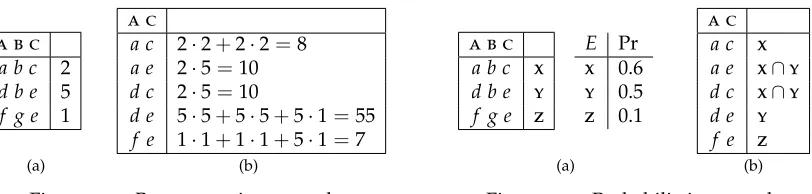
false). By plugging in the semiring of natural numbers (N,+,·, 0, 1), we obtain the usual bag
semantics (where a relation with duplicate entries is modeled as a set relation with annotations
representing tuple multiplicities). Still other semirings can be used to capture the various
prove-nance models listed earlier. The “most informative” kind of proveprove-nance annotations in this
frame-work is the semiring ofprovenance polynomials: this is the commutative semiring(N[X],+,·, 0, 1)
of polynomials with natural number coefficients over a set of uninterpreted variablesX.
For recursive queries, such as Datalog programs corresponding to cyclic sets of tgds, a technical
difficulty arises because provenance annotations may become infinite. Indeed, we have already seen this phenomenon illustrated in Example1.8. The annotations in that example (cf. Figure1.3)
are not polynomials; rather they areformal power series.
As a practical matter, working directly with infinite formal power series is infeasible. However,
as we shall see in Chapter2, it turns out that the formal power series which arise in provenance
computations have a natural, finite representation as asystem of algebraic equations. The main idea is fairly intuitive. For each tuple t in the output of a recursive Datalog query, we associate a variablex and write an equation x = . . . whose RHS represents the alternative ways in which
G:
gid nam can
82 Osci. Dros. g1=g1
26 Musc. Musc. g2=g2
U:
nam1 nam2
Osci. Dros. u1=m2⊗g1
Musc. Musc. u2=m2⊗g2
B:
bid nam
44 Peri. b1=b1 ⊥1 Osci. b2=m1⊗g1 ⊥1 Dros. b3=m3⊗b2⊗u1
⊥2 Musc. b4= (m1⊗g2)⊕(m3⊗b4⊗g2)
Figure1.4: Tabular provenance representation using system of equations
the output, we obtain a system of algebraic equations whose least fixpoint is exactly the (possibly
infinite) formal power series annotations.
Example 1.10. Refer to Figure 1.4, which shows the same provenance-annotated tables of
Fig-ure1.3(b), but this time represented using a system of equations. Note that the annotation for the
source tupleG(82,Osci.,Dros.)is nowg1, which is trivially equal tog1. TupleU(Osci.,Dros.)was
obtained as an immediate consequence ofG(82,Osci.,Dros.) using mappingm2, so the equation
for its annotation isu1 = m2⊗g1; by plugging ing1 = g1 we obtain the annotation m2⊗g1, as
in Figure1.3(b). The interesting case in the example is the annotationb4forB(⊥2,Musc.), whose
equation involves the tuple itself: b4= (m1⊗g2)⊕(m3⊗b4⊗g2)(representing the two
alterna-tive ways of deriving the tuple as an immediate consequence). The solution forb4 is the infinite
formal power series
b4= (m1⊗g2)⊕(m3⊗(m1⊗g2)⊗(m2⊗g2))⊕ · · ·
shown in Figure1.3(b).
The representation of provenance annotations as a system of algebraic equations is equivalent
to the graphical representation we saw earlier in this section.
Note that in the examples, variables representing mapping names themselves participate in the
provenance calculations. To support this, the semiring framework includes ascalar multiplication construct that can be used freely in mappings and queries. Thus, for the tgd
(m2) G(g,n,c)→U(n,n)
from the example above, we would employ the corresponding Datalog rule
(r2) m2⊗U(n,n):-G(g,n,c)
which multiplies its output in the head by the uninterpreted variablem2. This effectively “tags”
Contribution
3
: Orchestra system implementation
(with Karvounarakis, Ives, and Tannen [60])
The Orchestraprototype described in this dissertation consists of two main components: a client
layer, installed at each peer, which performs functions including update translation, provenance
recordkeeping, and transaction log crawling (in order to extract edit logs); and a distributed
storage component, used to keep catalog-level information such as mapping definitions, as well
as archives of published updates.
Orchestrauses a modified distributed hash table implementation for its distributed storage
component [131,132], hence most of the complexity of the implementation is in the client
compo-nent. This is a middleware layer implemented in around100,000lines of Java code that sits atop
each peer’s local DBMS. Chapter3 describes this layer in detail, but we overview here how one
of the key implementation issues is addressed, namely the encoding and storage of provenance
information.
A basic philosophy in the Orchestra implementation is to push as much work as possible
down into the underlying DBMS, with the Java layer acting mainly as a coordinator for its
activ-ities. This allows the system to benefit from the existing DBMS facilities for storage and scalable
query processing over large data sets. At the same time, Orchestra attempts to remain
rela-tively agnostic as to the particular DBMS implementation underneath — in particular, it avoids
as much as possible the use of user-defined functions, which are generally not portable across
implementations.
In keeping with this philosophy, Orchestra uses an relational encoding schema for
prove-nance that allows the information to be maintainedusing only SQL queries(without user-defined functions). This is done by adopting the graph-based perspective on provenance (cf. Figure1.3(a)),
and encoding the graph usingprovenance tables. For each mappingmi, we use a separate prove-nance tablePi recording the edges through nodes labeledmi.
For example, to store the graph in Figure1.3(a), Orchestrauses three edge tablesP1,P2, and
P3. P3contains one tuple for each occurrence ofm3in the graph:
P3:
b1.bid b1.nam u.nam1 u.nam2 b2.bid b2.nam
⊥1 Osci. Osci. Dros. ⊥1 Dros. ⊥2 Musc. Musc. Musc. ⊥2 Musc.
Note that the table above contains a number of redundancies, due to the fact that the mapping
forces equivalences among some of the columns. In particular, the values in columnsb1.bidand
b2.bidare always the same, as are those inb1.namandu.nam1, and those inu.nam2andb2.nam.
elimi-nated, producing (in the case ofP3above):
b1.bid b1.nam u.nam2
⊥1 Osci. Dros. ⊥2 Musc. Musc.
Additional information such as key constraints can be used to compress these tables even further.
A major benefit of this encoding scheme is that the mapping tables can be constructed and
maintained using ordinary queries which are derived from the mapping definitions. Continuing
with the example, recall that mappingm3corresponds to the Datalog rule:
(r3) B(b,n2):-B(b,n1),U(n1,n2)
From this, we derive two rules:
(r30) P3(b,n1,n2):-B(b,n1),U(n1,n2)
(r003) B(b,n2):-P3(b,n1,n2)
The first rule joins tuples from B and U, putting the result in P3 (the compressed version); the
second takes tuples fromP3and projects the relevant columns, putting the result inB.
The translated rules for all the mappings together form a Datalog program that can be executed
to populate the peer instances and their mapping tables. Since mainstream commercial database
systems support only limited forms of recursive queries, the Orchestraclient layer also includes
a Datalog engine, which uses the ordinary DBMS query and update facilities in combination with
Java control logic for iteration to fixpoint.
Contribution
4
: algorithms for incremental update exchange
(with Karvounarakis, Ives, and Tannen [60])
A major technical challenge in CDSS is how to implement update exchange incrementally. In-tuitively, the CDSS operating mode resembles deferred view maintenance across a set of views;
and indeed, as we shall see, classical techniques from view maintenance can be applied usefully
in update exchange. However, the presence of provenance information also provides a kind of
“index” that can be exploited to improve on the classical techniques.
Classical view maintenance techniques are essentially based onquery reformulation. The pre-mier examples of this approach in view maintenance are thecountandDReDalgorithms of [66],
each of which is based the so-calleddelta rulesfor a Datalog program. These are another Data-log program, obtained from the original, that can be used used to compute sets of insertions or
discuss delta rules further in the next section (and later in Chapters3and5); for now, we illustrate
with a simple example that gives the flavor of the technique.
Example1.11. LetQbe the conjunctive query
Q(x,y):-R(x,z),S(z,y)
which returns paths of length2throughRandS. Suppose thatRandSare modified by inserting
some tuples, stored in relationsR+ andS+. Thedelta rules queryforQis the following union of conjunctive queries, which computes the setQ+of corresponding insertions in Q:
Q+(x,y) :- R+(x,z),S(z,y)
Q+(x,y) :- R(x,z),S+(z,y)
Q+(x,y) :- R+(x,z),S+(z,y)
These rules compute all combinations of joins of tuples in Rand S with newly-inserted tuples fromR+andS+, and also joins of newly-inserted tuples fromR+ andS+.
As we show in Chapter3,countandDReDcan be adapted to perform CDSS update exchange
as well. (A priori, this fact is not obvious, because in CDSS we are not just maintaining materialized
views, but also their accompanying provenance information.)
Classical techniques such asDReDdo not perform very well, however, in one important case:
incremental propagation of tuple deletions with recursive mappings. ForDReD, this is because
the approach involves computing a loose over-estimate of the corresponding deletions in
mate-rialized views (using delta rules), then attempting to re-derive those tuples from other existing
tuples (hence its name:DReDstands for “delete and re-derive”). This over-estimate can be large,
leading to poor performance as many tuples may need to be re-derived.
To overcome this limitation, we observe that provenance annotations can be exploited as the
basis of a much more efficient algorithm for propagating tuple deletions in the presence of
re-cursive mappings. Intuitively, the idea is quite simple: the provenance annotations explain how
output tuples were derived from source tuples; hence the effects of a source tuple deletion can be
computed by examining the provenance annotations of output tuples. Roughly speaking, given a
deletion of source tuple with provenance token p, we replace all occurrences of p by 0 in prove-nance expressions of derived tuples, and then simplify the expressions. Derived tuples whose
provenance expressions simplify to 0 are then discarded.
Example 1.12. Suppose R(a,b) is a derived output tuple with provenance u⊗v, and we delete
provenance (u⊗v)⊕r. After the deletion, its provenance expression becomes (0⊗v)⊕r = r, hence we see that the tuple should not be deleted because it has another derivation.
For recursive views, the procedure also involves an extra step needed to detect and delete
tuples whose provenance expressions do not seem to simplify to 0 only because of cycles in
the provenance graph. This extra step carries some cost; still, the provenance-based algorithm
turns out to be the method of choice for propagating tuple deletions in CDSS, as validated by
experimental results in Chapter3.
Contribution
5
: query containment and equivalence
Semiring annotated relations are compatible with the standard optimizations used in DBMS query
optimizers, as we show in Chapter2. However, for more advanced optimizations based on
elim-inatingredundant joinsfrom conjunctive queries [22] (orredundant conjunctive queriesfrom unions
of conjunctive queries [123]), this is not necessarily the case. Indeed, this phenomenon was
al-ready observed for the case of bag semantics, where eliminating a “redundant” self-join from a
query actually changes the query’s meaning [24]. As a simple example, consider the following
two conjunctive queries:
Q1(x,y):-R(x,y),R(x,z) Q2(x,y):-R(x,y)
Under set semantics, these two queries are equivalent; henceQ1can be optimized by eliminating
the redundant join predicate, producingQ2. However, under bag semantics, the queries are not
equivalent: the “redundant” join predicate inQ1has the effect of increasing the multiplicities of
output tuples.
Motivated by these observations, we make a thorough study of the interplay between
prove-nance annotations and the fundamental problems of checking querycontainmentandequivalence, which underly advanced query optimizations (Chapter4). We study these problems for
conjunc-tive queries and unions of conjuncconjunc-tive queries, for five different kinds of provenance information
that can be captured using semiring annotations (including the provenance polynomials used
in CDSS), leading to four different hierarchies among these semantics. We show that, for each
form of provenance we consider, all four problems turn out to be decidable, and we identify the
complexity in each case (see Figure1.5). Several of these results are surprising because, for
exam-ple, provenance polynomials are closely related to bag semantics, and containment of unions of
conjunctive queries under bag semantics is known to be undecidable [81]. We also identify a
fun-damental tradeoff between informativeness of provenance information and query optimization:
B PosBoolX Lin(X) Why(X) Trio(X) B[X] N[X] N
CQs cont np-c np-c np-c np-c np-c np-c np-c ? (Π p
2-hard)
equiv np-c np-c np-c gi-c gi-c gi-c gi-c gi-c
UCQs cont np-c np-c np-c np-c inpspace np-c inpspace undec
equiv np-c np-c np-c np-c gi-c np-c gi-c gi-c
In the table, non-shaded boxes indicate contributions of this dissertation.np-c is short fornp-complete. gi-c is short forgi-complete (i.e., complete for the class of problems polynomial time reducible to graph
isomorphism).
Figure1.5: Complexity of containment and equivalence with provenance annotations
most informative model possible in the framework, provenance polynomials, we show that
equiv-alence of unions of conjunctive queries with provenance polynomial annotations holds exactly
when bag equivalence holds, hence any query reformulation which is sound for bag semantics
(and therefore might be employed by a commercial DBMS optimizer) is sound with respect to all
forms of semiring annotations. As a corollary, we also obtain a new proof of the decidability of
bag equivalence of unions of conjunctive queries.
The theoretical results on the decidability of query equivalence with provenance annotations
play a crucial role in the subsequent development of techniques for handling CDSS evolution in
Chapter5.
Contribution
6
: ring-annotated relations for updates
(with Ives and Tannen [59])
We have already seen that a major focus of CDSS is on the efficient handling of the dynamic
aspects of data sharing, in particular, handling updates to data (update exchange) and to mappings
(mapping evolution). And we have already mentioned that for update exchange, Orchestraadapts
techniques based on the so-calleddelta rulestechnique [66], and improves upon them by exploiting
the presence of provenance annotations.
Mapping evolution seems on the face of it a very different problem than update exchange.
Somewhat surprisingly, then, it turns out that both problems (along with their classical cousins,
view maintenance and view adaptation) can be attacked uniformly by the same approach, where
we view each as a special case of a more general problem ofoptimizing queries using materialized views[101,23]. This is the problem which asks, given a queryQand a setVof materialized views,
to find areformulationofQusing the materialized views which can be executed more efficiently.
R0(x,y) :- R(x,y)
R0(x,y) :- R∆(x,y)
V(x,y) :- R(x,y),R(y,z)
(a) Materialized view definitions
V0(x,y) :- R0(x,y),R0(y,z)
V∆(x,y) :- V0(x,y)
−V∆(x,y) :- V(x,y)
(b) New view definition, and difference with old
V∆(x,y) :- R∆(x,z),R(z,y)
V∆(x,y) :- R(x,z),R∆(z,y)
V∆(x,y) :- R∆(x,z),R∆(z,y)
(c) A delta-rules style reformulation
Figure1.6: Update propagation and query reformulation
Q(x,y) :- R(x,u),R(u,v),R(v,y)
Q(x,y) :- R(x,z),R(z,y)
(a) Old mappings
Q0(x,y) :- R(x,u),R(u,v),R(v,y)
Q0(x,y) :- R(x,y)
(b) New mappings
Q∆(x,y) :- Q(x,y)
−Q∆(x,y) :- Q0(x,y)
(c) Their difference
Q∆(x,y) :- R(x,y)
−Q∆(x,y) :- R(x,z),R(z,y)
(d) A reformulated plan
Figure1.7: Mapping evolution and query reformulation
and a collectionR∆ of updates to R (consisting of tuple insertions and deletions), which when applied to R yields the relation R0. R0 can be thought of as a materialized view over R and R∆ whose definition is given in Figure1.6(a). Now, consider the materialized viewV overRwhose
definition is also given in Figure1.6(a). To reflect the updates made toR, we need to compute the
new versionV0ofV, shown in Figure1.6(b). Moreover, to perform this computationincrementally,
we would like to compute just thedifference V∆ betweenV0 and V, also defined in Figure1.6(b),
where the leading “−” indicates a difference operation. This could then be applied toVto produce V0. Note that the definition ofV∆involves first computingV0, then subtractingVfrom it, a rather inefficient approach! A better plan is thedelta rules reformulationof V∆ shown in Figure 1.6(b),
which we can imagine as having been produced via a general process of reformulatingV∆using the materialized viewsVandR0.
Example1.14. To illustrate mapping evolution / view adaptation, Figure1.7(a) shows a
materi-alized view definition Q which is modified (by changing its second rule) to produce the view definition Q0 shown in Figure1.7(b). To compute Q0 incrementally, we might prefer to compute
the differenceQ∆ betweenQandQ0, shown in Figure 1.7(c). As with the previous example, the
definition does not produce a very efficient plan! Instead, we can reformulateQ∆using material-ized viewQ, producing the plan shown in Figure1.7(d).
R:
a b 2 b c 1 a d 1 d c 1 d e 3
R∆:
a b −2 b c −1 e f 1
R0:
a d 1 d c 1 d e 3 e f 1
V: a ca e 3 3 V
∆: a c −2 d f 3 V
0
:
a c 1 a e 3 d f 3
(a) Delta rules example withZ-relations
R:
a b p b c r c d s
Q:
a d p·r·s a c p·r b d r·s
Q0 :
a d p·r·s a b p b c r c d s
Q∆:
a c −p·r b d −r·s a b p b c r c d s
(b) Mapping evolution example withZ[X]-relations
Figure1.8: Representing and computing updates with ring-annotated relations
make essential use of thedifferenceoperator, not present in the framework of semiring-annotated relations, and not usually considered in previous work on optimizing queries using
material-ized views. Second, both involveupdates (tuple insertions and deletions) being represented and manipulated as ordinary relations.
To handle these requirements, we propose the use ofring-annotated relationsto represent data and updates uniformly, and with thedifferenceoperator defined in the natural way using inverses in the ring. We study two concrete instantiations of this framework. The first isZ-relations, where
tuples are annotated with (positive or negative) integers. This is the ring-annotated analog of
bag semantics, with positive multiplicities representing insertions and negative ones representing
deletions. The second isZ[X]-relations, the ring-annotated analog of the provenance polynomials, where we allow positive or negative integer coefficients.
Example1.15. Figure1.8(a) shows an example of Z-annotated relations corresponding to
Exam-ple1.13. Note thatR∆has tuples with positive and negative multiplicities, e.g., the annotation of (a,b)is−2 indicating that a deletion of two copies of that tuple. V∆corresponds to the result of evaluating the query from Figure1.6(c) over R, R0, and Vunder theZ-semantics, and note that
V∆ also has tuples with positive and negative multiplicities. By applying V∆ to V via a union operation (which sums tuple multiplicities), we obtainV0.
Example1.16. Figure1.8(b) shows an example ofZ[X]-annotated relations corresponding to
Ex-ample1.14. Note thatQ∆ shows the result of evaluating the plan in Figure1.7(d) over theZ[X]
-relationsQandR, and by applyingQ∆toQ(by union, which again sums tuple annotations), we obtain the tableQ0shown in the figure.
The extension to ring-annotated relations and relational queries using difference gives us a
rich framework for representing and computing updates, but we still need a general procedure