
University of Pennsylvania
ScholarlyCommons
Publicly Accessible Penn Dissertations
2017
Distributed Query Execution With Strong Privacy
Guarantees
Antonios Papadimitriou
University of Pennsylvania, [email protected]
Follow this and additional works at:https://repository.upenn.edu/edissertations Part of theComputer Sciences Commons
Recommended Citation
Papadimitriou, Antonios, "Distributed Query Execution With Strong Privacy Guarantees" (2017).Publicly Accessible Penn Dissertations. 2514.
Distributed Query Execution With Strong Privacy Guarantees
Abstract
As the Internet evolves, we find more applications that involve data originating from multiple sources, and spanning machines located all over the world. Such wide distribution of sensitive data increases the risk of information leakage, and may sometimes inhibit useful applications. For instance, even though banks could share data to detect systemic threats in the US financial network, they hesitate to do so because it can leak business secrets to their competitors. Encryption is an effective way to preserve data confidentiality, but eliminates all processing capabilities. Some approaches enable processing on encrypted data, but they usually have security weaknesses, such as data leakage through side-channels, or require expensive cryptographic computations.
In this thesis, we present techniques that address the above limitations. First, we present an efficient
symmetric homomorphic encryption scheme, which can aggregate encrypted data at an unprecedented scale. Second, we present a way to efficiently perform secure computations on distributed graphs. To accomplish this, we express large computations as a series of small, parallelizable vertex programs, whose state is safely transferred between vertices using a new cryptographic protocol. Finally, we propose using differential privacy to strengthen the security of trusted processors: noise is added to the side-channels, so that no adversary can extract useful information about individual users. Our experimental results suggest that the presented techniques achieve order-of-magnitude performance improvements over previous approaches, in scenarios such as the business intelligence application of a large corporation and the detection of systemic threats in the US financial network.
Degree Type
Dissertation
Degree Name
Doctor of Philosophy (PhD)
Graduate Group
Computer and Information Science
First Advisor
Andreas Haeberlen
Keywords
data, distributed systems, privacy, query execution
Subject Categories
DISTRIBUTED QUERY EXECUTION
WITH STRONG PRIVACY GUARANTEES
Antonis Papadimitriou A DISSERTATION
in
Computer and Information Science
Presented to the Faculties of the University of Pennsylvania in Partial Fulfillment of the Requirements for the
Degree of Doctor of Philosophy 2017
Andreas Haeberlen, Assistant Professor of Computer and Information Science Supervisor of Dissertation
Lyle Ungar, Professor of Computer and Information Science Graduate Group Chairperson
Dissertation Committee:
Jonathan Smith, Professor of Computer and Information Science
DISTRIBUTED QUERY EXECUTION WITH STRONG PRIVACY GUARANTEES
COPYRIGHT
2017
Acknowledgments
First of all, I would like to thank my advisor Andreas Haeberlen for the time and effort he put to teach me and mentor me throughout these five years. Moreover, I would like to thank the members of my thesis committee for their insightful com-ments, useful suggestions, and their help in improving this document.
I would also like to thank my collaborators in the three projects that comprise this dissertation. Chapter2 describes work done during an internship at MSR India in collaboration with Ranjita Bhagwan, Nishanth Chandran, Ram Ramjee, Harmeet Singh, Abhishek Modi, and Saikrishna Badrinarayanan. Chapter 3 was joint work with Arjun Narayan, a senior PhD student at the time, who identified two of the most prominent systemic risk algorithms from the economics literature, and per-formed the sensitivity and utility analyses in the application of differential privacy in that domain. e work in Chapter 4 was done jointly with Min Xu and Ariel Feldman from the University of Chicago. In particular, Min implemented the pri-vate memory abstraction, he carried out the experiments, and we jointly developed the oblivious operators and the experimental design.
ABSTRACT
DISTRIBUTED QUERY EXECUTION WITH STRONG PRIVACY GUARANTEES
Antonis Papadimitriou
Andreas Haeberlen
As the Internet evolves, we find more applications that involve data originat-ing from multiple sources, and spannoriginat-ing machines located all over the world. Such wide distribution of sensitive data increases the risk of information leakage, and may sometimes inhibit useful applications. For instance, even though banks could share data to detect systemic threats in the US financial network, they hesitate to do so because it can leak business secrets to their competitors. Encryption is an effec-tive way to preserve data confidentiality, but eliminates all processing capabilities. Some approaches enable processing on encrypted data, but they usually have secu-rity weaknesses, such as data leakage through side-channels, or require expensive cryptographic computations.
Contents
Acknowledgements iii
Abstract v
List of Tables x
List of Figures xiii
1 Introduction 1
1.1 Existing approaches . . . 2
1.2 Seabed . . . 4
1.3 DStress . . . 5
1.4 Hermetic . . . 6
1.5 Contributions and road map . . . 7
2 Queries on data from a single source 9 2.1 Introduction . . . 9
2.2 Overview . . . 12
2.4 Design . . . 22
2.5 Applications . . . 32
2.6 Evaluation . . . 33
2.7 Related Work . . . 44
2.8 Conclusion . . . 46
3 Queries under the non-collusion assumption 47 3.1 Introduction . . . 47
3.2 Overview . . . 50
3.3 e DStress system . . . 53
3.4 Case studies . . . 65
3.5 Evaluation . . . 71
3.6 Related work . . . 78
3.7 Conclusion . . . 81
4 Queries under the trusted hardware assumption 82 4.1 Introduction . . . 82
4.2 Overview . . . 85
4.3 Oblivious Execution Environments . . . 90
4.4 Oblivious operators . . . 93
4.5 Privacy-aware Query Planning . . . 97
4.6 e Hermetic System . . . 100
4.7 Implementation . . . 103
4.8 Evaluation . . . 105
4.9 Related Work . . . 113
4.10 Conclusion . . . 115
5 Discussion 116 5.1 reat model. . . 116
5.3 Security guarantees . . . 120
6 Conclusion 122
6.1 Summary . . . 122
6.2 Future work . . . 124
Appendix A Seabed 141
A.1 Encryption Schemes . . . 141
A.2 Analysis of MDX queries supported by Seabed . . . 153
Appendix B DStress 157
B.1 Proof of Message Privacy . . . 157
B.2 Edge privacy in DStress . . . 163
B.3 Evaluating Models of Contagion . . . 169
Appendix C Hermetic 172
C.1 Determining the timing bound of an OEE . . . 172
List of Tables
2.1 Cost of operations on a 2.2 GHz Xeon core. . . 25
2.2 Examples of query translation. x(1)corresponds to table columna,
x(2) to b, x(3)to splayed a for value10, and x(id) to the identifier
column used by ASHE. . . 27
2.3 ID list encoding techniques used in Seabed. . . 28
2.4 Different categories of queries that Seabed supports. . . 29
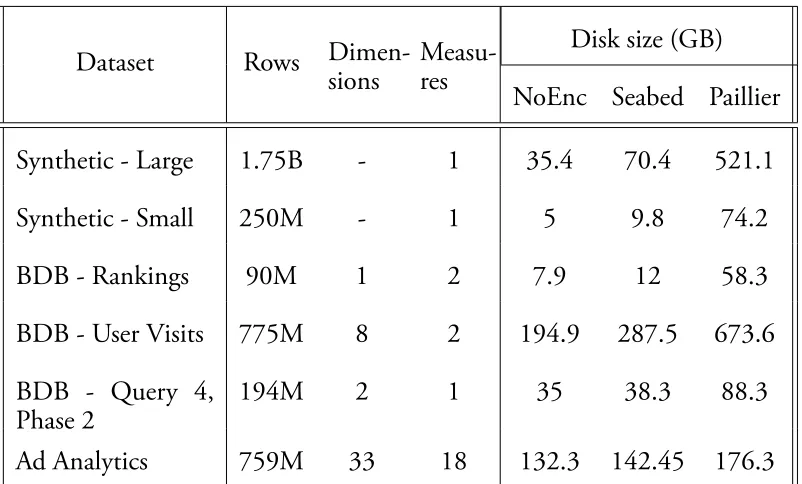
2.5 Characteristics and disk size of our synthetic dataset, the Big Data
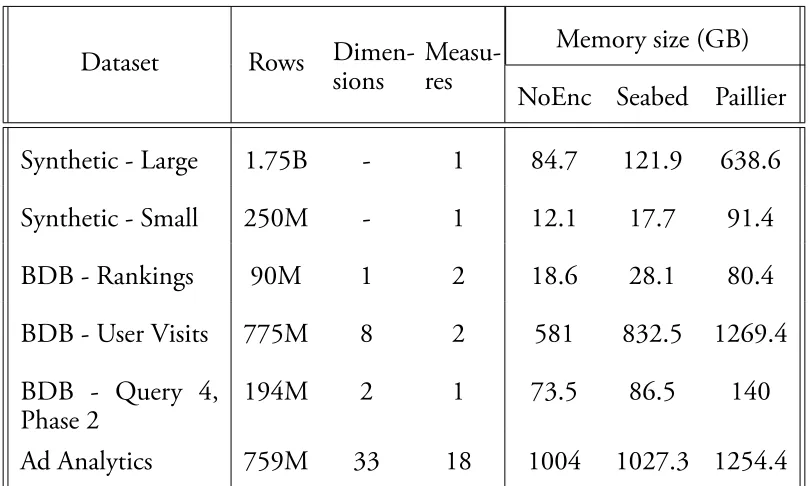
Benchmark (BDB) and the Ad Analytics dataset (AdA). . . 30
2.6 Characteristics and memory size of our synthetic dataset, the Big
Data Benchmark (BDB) and the Ad Analytics dataset (AdA). . . . 31
4.1 Performance model for the main relational operators in Hermetic. 99
4.2 L1 hit and miss latencies formerge-sort, as reported by Intel’s
spec-ifications (lL1, lL3), and as measured on different datasets (lL1∗ , lL3∗ ). e last columns show the values we used in our model. All values
4.3 e schema and statistics of the relations used for our end-to-end
experiments. e synthetic relation was generated for a variety of
rows and multiplicities. . . 106
4.4 Experimental configurations and their resilience to different side
channels. MS stands for merge-sort, BS for batcher-sort, HS for
hybrid-sort,CPfor cartesian product, andSMJfor sort-merge join.
* denotes that the primitive was modified as described in Section 4.4.106
5.1 A comparison of the threat models of Seabed, DStress, and
Her-metic. . . 117
5.2 Security guarantees provided by Seabed, DStress, and Hermetic. . 120
A.1 Aggregate details of MDX queries that Seabed supports. . . 155
List of Figures
2.1 Motivating scenario. . . 12
2.2 Seabed components and the ASHE scheme. . . 17
2.3 SPLASHE instead of deterministic encryption. . . 18
2.4 Enhanced SPLASHE example. . . 20
2.5 Seabed system design . . . 23
2.6 Median latency for aggregation vs data size. . . 35
2.7 Median latency for aggregation vs cores. . . 37
2.8 Result size vs selectivity over1.75billion rows. . . 37
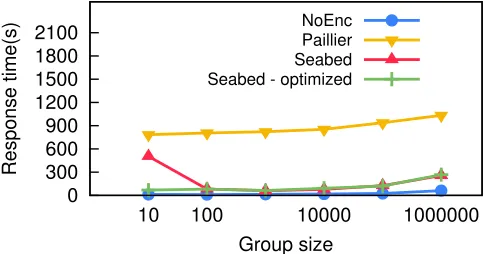
2.9 Response time vs selectivity over1.75billion rows. . . 38
2.10 Response time vs selectivity over 1.75billion rows, for OPE. . . 38
2.11 Microbenchmark results for group-by queries. . . 39
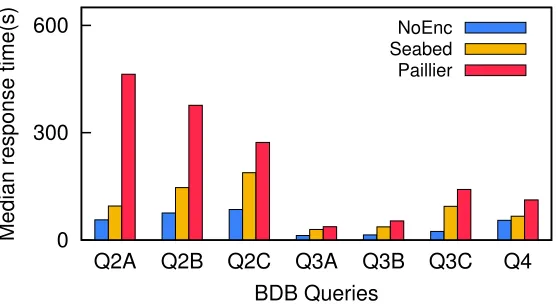
2.12 Response time for the Big Data Benchmark queries (part 1).. . . . 39
2.13 Response time for the Big Data Benchmark queries (part 2).. . . . 40
3.1 A message transfer example between two blocks of three nodes.
[. . .]j′x denotes a ciphertext encrypted with the randomized public
key of jx, and[. . .]jx denotes a ciphertext encrypted with the
origi-nal key. . . 60
3.2 Computation time spent on MPC, with different block sizes (top),
and different values forDandN (bottom). . . 73
3.3 Per-node traffic generated by MPC computation steps with
differ-ent block sizes. . . 74
3.4 Computation time (top) and per-node traffic (bottom) for an
end-to-end run on N =100 vertexes (with maximum degree D=10),
while performingI=7iterations of Eisenberg-Noe (EN) and
Elliot-Golub-Jackson (EGJ). . . 75
3.5 Projected computation cost (top) and per-node traffic (bottom) for
end-to-end runs of EN on networks of different sizes. e red circles are validation points from two actual runs on EC2, with N=20 and
N=100 nodes, respectively, and with D=10. . . 77
4.1 Example scenario. Analyst Alice queries sensitive data that is
dis-tributed across multiple machines, which are potentially owned by multiple participants. An adversary has complete control over some
of the nodes, except the CPU. . . 85
4.2 Different plans for query ”SELECT count(*) FROM C, T, P WHERE
C.cid=T.cid AND T.location = P.location AND C.age≤27 AND
P.category='hospital'”. . . 97
4.3 Hermetic’s workflow. . . 100
4.4 Cycle-resolution measurements of the actual timing of merge-sort
and linear-merge inside the OEE, and their padded timing,
4.5 Latency of merge-sort(MS),linear-merge(LM) andhybrid-sort
(HS) with increasing un-observable memory size, compared to the
batcher-sort(BS). . . 110
4.6 Performance of select(S1),groupby(S2) andjoin(S3) for different
data sizes and join attribute multiplicities. . . 111
4.7 (a) e performance of all experimental configurations for queries
Q4-Q6. (b) e performance of Hermetic II forQ4-Q6, but for plans
1
Introduction
Privacy concerns are often a stumbling block to using sensitive data, in domains like healthcare [93, 52], finance [66], and social science [104,64]. Analysis of this type of data can provide important insights, which could be used to provide high-quality user experiences, or to assist social life in diverse ways. However, this data conveys information regarding people’s private lives, or corporations’ business se-crets. erefore, it is reasonable for involved parties to hesitate to contribute their data for analysis, at least without getting strong guarantees that their data will not be exposed.
application has yet to be realized. Similar settings emerge in other domains too; for example, users might be hesitant to contribute their medical history, even though this could allow medical researchers, government agencies, or even the general public, to understand nationwide health trends [93,52].
ese privacy concerns are often aggravated by the way data is distributed among many different parties. For example, in the applications described above, data may be stored at multiple locations (e.g., banks, or user devices), queries may originate from multiple sources (e.g., researchers, agencies), and computations may be executed using one or more third-party cloud services. e security of such a distributed system is as good as its weakest link, so security guarantees are harder to attain: even if one of the servers involved gets compromised by an attacker, sensitive data of all parties can be exposed.
erefore, the key question this dissertation tries to address is how to build dis-tributed data analytics systems, that can perform queries without leaking sensitive data, even when the involved parties are untrusted. ese systems should have two important properties: (1) they should provide strong privacy guarantees, and (2) they should have practical performance by today’s standards.
1.1
Existing approaches
One of the most widely-used ways of protecting the confidentiality of data is encryp-tion. However, encryption severely limits the ways one can process ciphertext data. In this section, we examine four existing approaches for running computations on encrypted data.
Encrypted databases [138, 157, 118] is the second approach one could consider using to run computations on encrypted data. Encrypted databases combine several
partially homomorphic encryptionschemes to support a subset of SQL queries directly
on encrypted data. Unlike FHE, partially homomorphic schemes cannot support general computations, but they are efficient enough to be practical in certain settings. However, some of the encryption schemes used in encrypted databases have some disadvantages – some of them provide weaker security guarantees, and some others incur costs that render them inefficient for large databases.
e third way to run computations on untrusted machines is to use secret shar-ing [148] andmulti-party computation (MPC)[77, 30]. In a secret-sharing scheme, data is split intoN random shares, and each of the shares is given to a different party.
Secret sharing provides confidentiality when at mostN−1parties can collude in the system (non-collusion assumption) because the data requires all N shares to
recon-struct. More importantly, the parties holding the shares can use an MPC protocol to perform any desired computation directly on the distributed shares, without ever decrypting the original value. Unfortunately, MPC protocols prevent information leakage during the execution of the protocol; if the result of a computation is pub-lished, sensitive information could still leak. Additionally, MPC quickly becomes impractical for large computations or number of parties.
e final approach for processing encrypted data istrusted hardware[116]. In this approach, secret cryptographic keys are integrated into the circuitry of a processor during its manufacturing, and these keys are used to establish a trusted execution
environment (TEE) on an untrusted platform. Such an environment, sometimes
called a trusted enclave, makes sure that data is always encrypted before it leaves the CPU boundaries, and access to the plaintext data inside the CPU is explicitly protected by the hardware itself. Assuming that adversaries do not have the expertise to decapsulate the CPU package and mount a circuit-probe attack (trusted hardware
by untrusted software running on the same machine, no matter what its privilege level is. In spite of making a stronger assumption, trusted hardware solutions seem unable to deliver strong privacy guarantees either; recent attacks have shown that they suffer from side-channel attacks [162, 42, 106], that is, attacks that exploit data-dependent differences in the execution of a trusted enclave to infer sensitive information.
1.2
Seabed
In Chapter 2, we target the setting of encrypted databases, where data and queries come from a single trusted party. As explained earlier, encrypted databases use sev-eral encryption schemes to support different kinds of operations on encrypted data. In our work, we identify that the performance bottleneck of encrypted databases lies in the asymmetric cryptographic scheme that enables additions on encrypted data. To overcome the bottleneck, we describe additive symmetric homomorphic
en-cryption (ASHE), a scheme which leverages symmetric cryptographic primitives to
support much faster aggregation on encrypted data. Furthermore, we observe that the efficiency of some of the remaining cryptographic schemes comes at the cost of weakened security guarantees. Indeed, recent work [125] has shown how to ex-ploit these weaker schemes: one can examine certain patterns that emerge in the encrypted database, and use them to recover sensitive information. To mitigate this problem, we devise a scheme called SPLASHE, which transforms the database in a way that enables a large class of queries using only semantically secure encryption schemes. is is enough to prevent the emergence of ciphertext patterns, and the attacks described in [125].
encrypted dataset from Microsoft’s Bing-Ads infrastructure. Our evaluation showed that encryption in Seabed incurs minimal overhead (at most 44%) compared to the plaintext version, whereas previous approaches would incur an overhead of about one order of magnitude. Moreover, in this application, Seabed completely avoids the use of weaker encryption schemes, thereby providing strong semantic security.
1.3
DStress
In the second part of the dissertation (Chapter 3), we consider the general setting, where data and queries originate from multiple sources. In particular, we focus on performing graph computations, where graphs are distributed across multiple par-ties, but the computations require access to the entire graph. In this setting, we make the non-collusion assumption, and use secret sharing to distribute the sensi-tive graph data, and MPC to run graph computations on the secret-shares. To make MPC scale for real-world graphs, we express complex graph computations as simple vertex programs; these small programs are very efficient in MPC, and they can be parallelized to speed up execution. To prevent the result of the graph computation from leaking sensitive information about the graph, we add noise to the result, and
use differential privacy [60] to select the appropriate amount of noise, so as to get
strong privacy guarantees.
these computations on the entire US financial network in just a few hours, without leaking sensitive bank data to any participant. e same computation would take years, if banks were to perform the large graph computation in one monolithic MPC run.
1.4
Hermetic
Finally, in Chapter 4, we consider database query processing in the multiple-data-source setting, and under the trusted hardware assumption. In joint work with Min Xu and Ariel Feldman from the University of Chicago, we developed two techniques that aim at closing the side channels of trusted processors.
e fist technique is to create an oblivious execution environment inside the trusted CPU, which eliminates side channels that may leak sensitive information to untrusted processes running in the trusted CPU. To accomplish this, we use a trusted hypervisor to realize a private memory abstraction, where computations can be performed with strict isolation.
Our second technique aims at defending against traffic-analysis attacks: recent research has shown that observing the traffic produced by a distributed application can leak information [129]. Unfortunately, even though such attacks could be ad-dressed by always padding the output of programs to the maximum possible size, this approach induces worst-case performance at all times – for example, join re-sults should always have the cartesian product’s size. To avoid this overhead, we use
differentially private padding; with this approach, one adds just enough fake records
present a query planner which finds optimal query plans in terms of both privacy and performance.
To evaluate our design, we built a system called Hermetic, which uses the above techniques. Min implemented the Hermetic hypervisor that realizes the private memory abstraction, and provided an initial implementation of the relational prim-itives from [13] that we based our work on. e Hermetic runtime that executes queries and obliviously adds differentially-private noise to intermediate results, and the privacy-aware planner of Hermetic were implemented by myself. We evaluated our Hermetic prototype on a relational database of taxi trips with sensitive geoloca-tion data, and we found out that Hermetic can complete a three-way join query in about15minutes, whereas the same query on a system using full padding could not
complete in7hours. A paper with our results is currently in submission [133].
1.5
Contributions and road map
In this dissertation proposal, we make the following contributions:
• We introduce additive symmetric homomorphic encryption (ASHE) to enable fast aggregation on encrypted data (Section2.3.1).
• We describe splayed additive symmetric homomorphic encryption (SPLASHE) to support an important class of aggregation queries without leaking informa-tion (Secinforma-tion2.3.3).
• We report on the implementation and evaluation of Seabed, a system that leverages ASHE and SPLASHE to support big data analytics on encrypted data (Sections2.4and2.6).
• We present a way to express graph algorithms as vertex programs, so that we can optimize their execution in MPC (Section3.3.1).
distributed graph to the participants of the computation (Section3.3.5). • We implement DStress, a system for privacy-preserving computations on
sen-sitive graphs distributed across multiple parties (Section3.3), and we demon-strate that breaking up the graph computations can bring great performance benefits in real-world applications (Section3.5).
• We describe how one can use a thin hypervisor to realize a private memory abstraction on modern processors (Section4.3).
• We use this private memory to implement relational operators whose outputs can be padded with fake records based on principles from the differential pri-vacy literature (Section4.4).
• We show how differentially private padding creates new challenges in query planning, and describe a query planner that can optimize query performance and privacy (Section4.5).
• We present the design of a system called Hermetic which uses the private mem-ory abstraction and differentially-private padding (Section4.6).
• We experimentally verify the security properties of an implementation of Her-metic, and report on its performance characteristics (Sections4.7 and4.8).
2
Queries on data from a single source
2.1
Introduction
Consider a retail business that has customer and sales records from various store lo-cations across the world. e business may be interested in analyzing these records – perhaps to better understand how revenue is growing in various geographic locations, or which demographic segments of the population its customers are coming from. To answer these questions, the business might rely on a Business Intelligence (BI) system, such as PowerBI [2], Tableau [5], or Watson Analytics [6]. ese systems can scale to large data sets, and their turnaround times are low enough to answer interactive queries from customers. Internally, they rely on the cloud to provide the necessary resources at relatively low cost.
little or no damage. Systems like CryptDB [138] and Monomi [157] can accom-plish this by using a mix of different encryption schemes, including deterministic encryption schemes [28] and partially homomorphic cryptosystems; this allows cer-tain computations to be performed directly on encrypted data. However, this ap-proach has two important drawbacks. First, these cryptosystems have a high com-putational cost. is cost is low enough to allow interactive queries on medium-size data sets with perhaps tens of gigabytes, but many businesses today collect terabytes of data [31,94,105,156]. Our experimental results show that, at this scale, even on a cluster with 100 cores, it would take hundreds of seconds to process relatively sim-ple queries, which is too slow for interactive use. Second, deterministic encryption is vulnerable to frequency attacks [125], which can cause some data leakage despite the use of encryption.
is Chapter makes two contributions towards addressing these concerns. First, we observe that existing solutions typically useasymmetric homomorphic encryption schemes, such as Paillier [132]. is is useful in scenarios where the data is produced and analyzed by different parties: Alice can encrypt the data with the public key and upload it to the cloud, and Bob can then submit queries and decrypt the results with the private key. However, in the case of business data, the data producer and the analyst typically have a trust relationship – for instance, they may be employees of the same business. In this scenario, it is sufficient to usesymmetricencryption, which is much faster. To exploit this, we construct a newadditively symmetric homomorphic
encryptionscheme (or, briefly, ASHE), which is up to three orders of magnitude more
efficient than Paillier.
data, she can trivially decode this column based on which ciphertext is the most common. We introduce an encryption scheme called Splayed ASHE (SPLASHE), that protects against such attacks by splaying sensitive columns to multiple columns, where each new column corresponds to data for each unique element in the orig-inal column. For columns with larger cardorig-inality, SPLASHE uses a combination of splaying and deterministic encryption padded with spurious entries to defeat fre-quency attacks while still limiting the storage and computational overhead.
We also present a complete system calledSeabed that uses ASHE and SPLASHE to provide efficient analytics over large encrypted datasets. Following the design pattern in earlier systems, Seabed consists of a client-side planner and a proxy. e planner is applied once to each new data set; it transforms the plain-text schema into an encrypted schema, and it chooses suitable encryption schemes for each column, based on the kinds of queries that the user wants to perform. e proxy transparently rewrites queries for the encrypted schema, it decrypts results that arrive from the cloud, and it performs any computations that cannot be performed directly on the cloud. Seabed contains a number of optimizations that keep the storage, bandwidth, and computation costs of ASHE low, and that make it amenable to the hardware acceleration that is available on modern CPUs.
We have built a Seabed prototype based on Apache Spark [4]. We report re-sults from an experimental evaluation that includes running both AmpLab’s Big Data Benchmark [1] and a real, advertising-based analytics application on the Azure cloud. Our results show that, compared to no encryption, Seabed increases the query latency by only 8% to 45%; in contrast, state-of-the-art solutions that are based on Paillier (such as Monomi [157]) would cause an increase by one to two orders of magnitude in query latency.
To summarize, we make the following four contributions in this Chapter:
Cloud
Operator (untrusted)
Data collector Analyst
Encrypted data
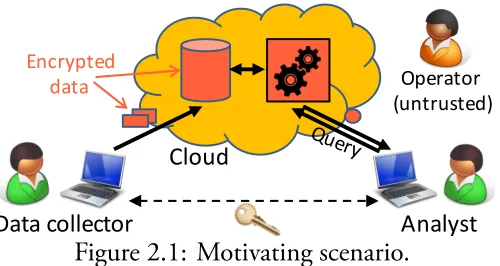
Figure 2.1: Motivating scenario.
• SPLASHE, an encryption scheme that protects against frequency-based attacks for fields that require deterministic encryption (Sections2.3.3+2.3.4);
• Seabed, a system that supports efficient analytics over large-scale encrypted data sets (Section2.4); and
• a prototype implementation and experimental evaluation of Seabed (Sec-tion2.6).
2.2
Overview
Figure 2.1 shows the scenario we are considering in this Chapter. A data collector
gathers a large amount of data, encrypts it, and uploads it to an untrusted cloud plat-form. Ananalyst can issue queries to a query processor on the cloud. e responses will be encrypted, but the analyst can decrypt them with a secret key she shares with the data collector.
2.2.1 Background
One common approach to solving the above problem is to usehomomorphic encryp-tion. For instance, there are cryptosystems with an additive homomorphism, such as Paillier [132], which means that it is possible to “add” two ciphertextsC(x)andC(y)
to obtain a ciphertextC(x+y) that decrypts to the sum of the two encrypted val-ues. is feature allows the cloud to perform aggregations directly on the encrypted data. ere are other systems with different homomorphisms, and evenfully
homo-morphic systems [71] that can be used to compute arbitrary functions on encrypted
data (Section2.7).
Homomorphic encryption schemes are typically randomized, that is, there are many different possible ciphertexts for each value. ese schemes enjoy standard semantic (or CPA) security, which informally means that no adversary can learn any information about the plaintext, even given the ciphertext.
However, there are situations where it is useful to let the cloud see some property of the encrypted values (property-preserving encryption). For instance, to compute a join, the cloud needs to be able to match up encrypted values, which randomiza-tion would prevent. In this case, one can use deterministic encryption [28], where each value v is mapped to exactly one ciphertextC(v). However, such schemes are susceptible to frequency attacks[125]: if a column can only take a small number of values (say, country), and the cloud knows that some value (say, Canada) will be the most common in the data, it can look for the most common ciphertext and infer that this ciphertext must decrypt to that value. Another example of an operation achievable by a property-preserving encryption scheme is selecting rows based on a range of values (say, timestamps) in an encrypted column. Here, one can use an
order-preserving encryption (OPE) [36], which can be used to decide whether x<y,
2.2.2 Threat Model
In this part of the dissertation, we resolve the above tradeoff in favor of confidentiality and performance. We assume an adversary who is honest but curious (HbC), that is, the adversary will try to learn facts about the data but will not actively corrupt data or otherwise interfere with the system. We do, however, assume that the adversary will attempt to perform frequency attacks as discussed above; this is motivated by recent work [125], and it is the reason we developed SPLASHE.
We are aware that there are much stronger threat models that would prevent the adversary from learning anything at all about the data. However, current solutions for these models, such as using oblivious RAM [131, 76] and fully homomorphic encryption, tend to have an enormous runtime cost (fully homomorphic encryp-tion [71] causes a slowdown by nine orders of magnitude [73]). Our goal is to provide a practical alternative to today’s plaintext-based systems (which offer very little security), and this requires keeping the runtime overhead low.
2.2.3 Alternative approaches
As discussed in Section 2.2.1, one possible approach to this problem is to use ho-momorphic encryption. is approach is taken by systems like CryptDB [138] and Monomi [157], which use Paillier as an additive homomorphic scheme. While Paillier ismuch faster than fully homomorphic encryption, it is still expensive. For example, a single addition in Paillier on modern hardware takes about 4 µs (Sec-tion 2.4), so the latency for operations on billions of rows can easily reach several minutes.
An alternative approach is to rely on trusted hardware, such as Intel’s SGX [116] or ARM’s TrustZone [15]. is approach has a much lower computational overhead, but it introduces new trust assumptions that may not be suitable for all scenarios [49,
2.2.4 Our approach
In Seabed, we solve this problem by replacing Paillier with a specially designed
addi-tively symmetric homomorphic encryption(ASHE) scheme. Since symmetric
encryp-tion schemes tend to be much more efficient than asymmetric schemes, this yields a big performance boost (Section2.4). Symmetric encryption imposes a restriction that the encrypted data can only be uploaded by someone who has the secret key but this is not a constraint for the typical BI scenario. us, the additional protections of asymmetric cryptography are actually superfluous, and the performance gain is essentially “free”.
Additionally, in order to protect against frequency attacks that occur when using deterministic or order preserving encryption, we construct a randomized encryption scheme − SPLayed ASHE, or SPLASHE that can still enable us to perform many queries on encrypted data that in prior work required deterministic encryption, but without leaking any information on frequency counts. Finally, for those queries that SPLASHE cannot support (e.g., joins), we support deterministic and OPE schemes that leak (a small amount of ) information about the underlying plaintext values; we take this decision with the performance of the system in mind.
2.3
Seabed Encryption Schemes
2.3.1 ASHE
ASHE assumes that plaintexts are from the additive groupZn:={0,1, . . . ,n−1}. It
also assumes that the entities encrypting and decrypting a ciphertext (the sender and the recipient, respectively) share a secret keyk, as well as a pseudo-random function (PRF)Fk:I→Znthat takes an identifier from a setI and returns a random number
fromZn.
One possible choice for the PRF is Fk :=H(i||k)modn for i∈I, where H is a
cryptographic hash function (when modeled as a random function),||denotes con-catenation and the size of the range ofH is a multiple ofn. Another choice is AES,
when used as a pseudo-random permutation.
Suppose Alice wants to send a value m ∈Zn to Bob. en Alice can pick an
arbitrary, unique, number i∈ I – which we call the identifier – and encrypt the message by computing:
Enck(m,i):= ((m−Fk(i) +Fk(i−1))modn,{i})
In other words, the ciphertext is a tuple(c,S), wherecis an element of the groupZn
andSis a multiset of identifiers. Note that the ciphertextcconsists of the plaintext value m plus some pseudo-random component, hence it appears to be random to anyone who does not know the secret keyk.
To create the additive homomorphism, we define a special operation ⊕ for “adding” two ciphertexts:
(c1,S1)⊕(c2,S2):= ((c1+c2)modn,S1∪S2)
at is, the group elements are added together and the multisets of identifiers are combined. To decrypt the ciphertext, Bob can simply compute
Deck(c,S):= (c+
∑
i∈S
(Fk(i)−Fk(i−1)))modn
us, after the homomorphic operation,
Client Data Source Cloud Store
(HDFS) Encrypt Untrusted Trusted Trusted Decrypt Compute SUM 1
Encryption EncK(m) of m on row i: {m–Fk(i)+Fk(i-1), i}
3 Sum ESUMis:
m1+…+mn- Fk(n)-Fk(0),
{1...n} Compute SUM 2 4 Result is: ESUM+Fk(n)–
Fk(0)
Cloud Compute
Data Source
Encrypt Database
m1–Fk(1)+Fk(0),1 m2–Fk(2)+Fk(1),2
mn–Fk(n)+Fk(n-1),n
. . .
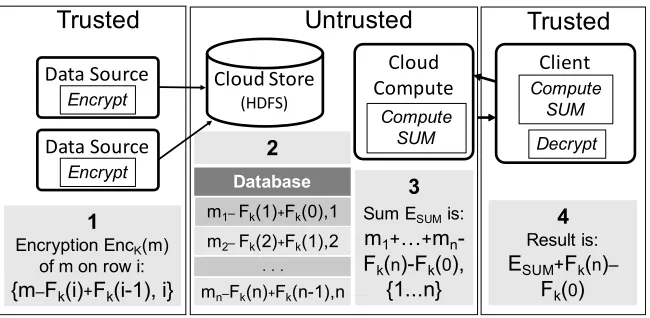
Figure 2.2: Seabed components and the ASHE scheme.
Figure2.2 gives a high-level overview of ASHE in the context of Seabed. We show that the above scheme satisfies the standard notion of semantic (CPA) security in AppendixA.1.1.
2.3.2 Optimizations for ASHE
e reader may wonder why the first element of the ciphertext is computed as(m− Fk(i) +Fk(i−1))modn and not simply as (m−Fk(i))modn. e reason is that we have optimized ASHE for computing aggregations on large data sets. Suppose, for instance, that Alice wants to give Charlie a large table of encrypted values, with the intention that Charlie will later add up a range of these values and send them to Bob. en Alice can simply choose the identifiers to be the row of numbers (1,2, . . . ,x).
Later, if Bob receives an encrypted sum(c,S) with S={i, . . . ,i+t}(i.e., the sum of rowsitoi+t), he can decrypt it simply by computing(c+Fk(i+t)−Fk(i−1))modn,
since the otherFk values will cancel out. us, it is possible to decrypt the sum of a
country salary
Male 1000
Female 2000 Female 200
genderMale genderFemale salaryMale salaryFemale ASHE(1) ASHE(0) ASHE(1000) ASHE(0) ASHE(0) ASHE(1) ASHE(0) ASHE(2000) ASHE(0) ASHE(1) ASHE(0) ASHE(200)
sender salary DET(Male) ASHE(1000) DET(Female) ASHE(2000) DET(Female) ASHE(200) Plaintext Schema
Schema with Basic SPLASHE
Encrypted Schema
Figure 2.3: SPLASHE instead of deterministic encryption.
2.3.3 Basic SPLASHE
SPLASHE is motivated by frequency attacks on deterministic encryption [125]. Re-call that, unlike ASHE, in deterministic encryption, there is only one possible ci-phertext value for each plaintext value. is enables the server to perform equality checks but also reveals frequency of items. e attacker combines the frequency of ciphertexts with auxiliary information to decode them.
We begin by describing a basic version of our approach. Consider a columnC1
that can take one of d discrete values and let the value of C1 in row t be C1[t]. If
we anticipate counting queries of the formSELECT COUNT(C1) WHERE C1=x, we can replace the columnC1 with a family of columnsC1,1, . . . ,C1,d. When the value of C1[t]isv, we setC1,v[t] =1and setC1,w[t] =0for w̸=v. If the resulting columns are
encrypted using ASHE, the ciphertexts will look random to the adversary, but it is nevertheless possible to compute the count: we can simply rewrite the above query toSELECT SUM(C1,x)and then compute the answer using homomorphic addition.
A similar approach is possible for aggregations. Consider a pair of columns C1
andC2, whereC1again takes one ofddiscrete values andC2contains numbers that we
might later wish to sum up using a predicate onC1 (and possibly other conditions).
In other words, we anticipate queries of the form SELECT SUM(C2) WHERE C1=x.
C2,v[t]:=C2[t]and setC2,w[t]:=0forw≠ v. C1andC2can then be omitted. us, the
above query can be rewritten into SELECT SUM(C2,x), which can be answered using
homomorphic addition. An example of SPLASHE is shown in Figure2.3forC1as GenderandC2 asSalary.
2.3.4 Enhanced SPLASHE
Basic SPLASHE increases a column’s storage consumption by a factor ofd, which is
expensive ifd is large. Next, we describe an enhancement that addresses this. Consider again a pair of columnsC1 (say, country) andC2 (say, salary), where C1 takes one ofd discrete values andC2 contains numbers that we might later wish
to sum up using a predicate on C1. Suppose k of the d values are common (e.g.,
a Canadian company with offices worldwide but with most employees located in
USAorCanada;k=2,d =196). en we can replaceC2 byk+1columns – one for
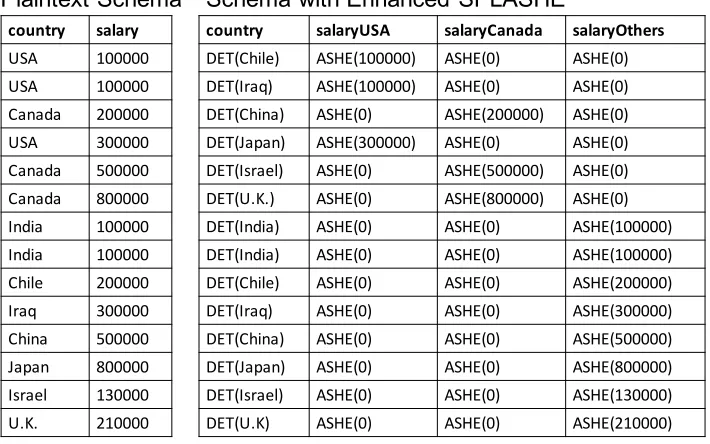
each of the common values (salaryUSAandsalaryCanada) and a single column for the uncommon values (salaryOther). Figure 2.4shows an example. As before, for each row, we place the ASHE encrypted value of salary fromC2 in the appropriate
salary column, while we fill the otherksalary columns with ASHE-encrypted zeros.
We then encryptC1deterministicallyfor each of the uncommon countries to enable
equality checks against encrypted values.
At this point it is possible to compute aggregations on C2 for all valuesv ofC1:
if the value v is common (USA orCanada), we can compute a sum over the special column for v; otherwise we can select the rows wherecountryinC1 equals the
de-terministically encrypted value ofvand compute the sum oversalaryOther. However,C1 now is susceptible to frequency attacks. To prevent this, inC1, we
ensure that all ciphertexts occur at the same frequency. How is this possible? Note that the cells corresponding to common countries in C1 were so far unused. We
country salary USA 100000 USA 100000 Canada 200000 USA 300000 Canada 500000 Canada 800000 India 100000 India 100000 Chile 200000 Iraq 300000 China 500000 Japan 800000 Israel 130000 U.K. 210000
country salaryUSA salaryCanada salaryOthers
DET(Chile) ASHE(100000) ASHE(0) ASHE(0) DET(Iraq) ASHE(100000) ASHE(0) ASHE(0) DET(China) ASHE(0) ASHE(200000) ASHE(0) DET(Japan) ASHE(300000) ASHE(0) ASHE(0) DET(Israel) ASHE(0) ASHE(500000) ASHE(0) DET(U.K.) ASHE(0) ASHE(800000) ASHE(0) DET(India) ASHE(0) ASHE(0) ASHE(100000) DET(India) ASHE(0) ASHE(0) ASHE(100000) DET(Chile) ASHE(0) ASHE(0) ASHE(200000) DET(Iraq) ASHE(0) ASHE(0) ASHE(300000) DET(China) ASHE(0) ASHE(0) ASHE(500000) DET(Japan) ASHE(0) ASHE(0) ASHE(800000) DET(Israel) ASHE(0) ASHE(0) ASHE(130000) DET(U.K) ASHE(0) ASHE(0) ASHE(210000)
Plaintext Schema Schema with Enhanced SPLASHE
Figure 2.4: Enhanced SPLASHE example.
are set to ASHE encrypted values of zero, this approach preserves correctness while preventing frequency attacks.
When is this approach possible? Letn1≥n2. . .≥ndbe the number of occurrences
of each of the d values. en the number of splayed columns should be chosen to be the minimum k such that ∑ki=1ni ≥ ∑di=k+1(nk+1−ni) : this is because ∑ki=1ni
are enough unused cells in column C1 that can be used to make the number of
occurrences of all non-splayed values at least nk+1. Such a k will always exist; the
more heavily skewed the distribution of values is, the smaller thek will be, and the more storage will be saved. is approach can be followed even if the exact number of occurrences is unknown; we do, however, need to know the distribution of the values.
Figure 2.4shows an enhanced SPLASHE example withk=2and d=9. Notice how the first six rows of the deterministically encrypted column have been reused to equalize the frequency of all elements in that column while still ensuring the correctness of aggregation queries on any of the country predicates.
secu-rity properties in AppendixA.1.2. Briefly, enhanced SPLASHE satisfies simulation-based security; the adversary learns only the number of rows in the database, and the number of infrequently and frequently occurring values.
2.3.5 Limitations
ASHE: Homomorphic encryption schemes have traditionally been defined with
a compactness requirement, which says that the ciphertext should not grow with
the number of operations that are performed on it. is is done to rule out triv-ial schemes: for instance, one could otherwise implement an additive “homomor-phism” by simply concatenating the ciphertextsEnc(m1)andEnc(m2)and then have
the client do the actual addition during decryption. ASHE does not strictly satisfy compactness, but the evaluator (the cloud) still does perform the bulk of the com-putation on ciphertexts; also, the techniques in Section2.4ensure that the length of ASHE’s ciphertexts does not grow too much.
In terms of performance, growing ciphertexts can create memory stress at the workers. In the case of a system without encryption, the worker nodes only need enough memory to hold the dataset. When using ASHE, the workers need to have some extra memory to construct the ID lists. is should not be a big problem in practice: as we will show in Section2.6, the overhead is small enough for real-world big data applications that involve billions of rows. Nevertheless, this extra memory requirement can become a problem if workers have very limited memory, or if the dataset is very large (e.g., if it has trillions of records).
SPLASHE: SPLASHE has three main drawbacks: (1) its requirement for a-priori knowledge of query workload or data distribution, (2) its difficulty in handling data with rapidly changing distribution, and (3) its storage overhead.
(DET). In addition, to get the storage reduction of enhanced SPLASHE, we need to know the distribution of values that a column can take. If this information is not available, only basic SPLASHE can be used.
Second, enhanced SPLASHE is most appropriate for columns whose distribu-tion does not change dramatically. For columns whose distribudistribu-tion fluctuates sig-nificantly, data insertions will start skewing the distribution of the DET column (C1in our example) away from the uniform distribution SPLASHE constructs. is
happens because a significant change in distribution will require reusing more cells than those available in the rows that were previously common. However, even in such an extreme case, SPLASHE is still better than using plain DET; DET reveals the exact distribution of values, whereas SPLASHE reveals a noised version of it.
Finally, both basic and enhanced SPLASHE increase storage needs. Section2.6.6 shows that a real-world ad analytics database can be supported with enhanced SPLASHE at a storage overhead of about10x.
2.4
Design
We now provide a functional overview of Seabed, and then describe each system component in more detail. For simplicity, we describe the design using the example of only one data source and one client. In practice, multiple data sources and users can share the same system as long as they share trust.
2.4.1 Roadmap
Planner
ASHE SplASHE OPE
Decryption Module
Query Code Translator Encryption Module Create Plan
(plaintext schema, sample queries)
Upload Data
Query Data
Schema
Spark Compute Data (HDFS) DET USER (trusted) CLIENT-SIDE PROXY (trusted) SERVER (untrusted)
Figure 2.5: Seabed system design
Create Plan: First, the user supplies a plaintext schema and a sample query set to the Seabed planner. e planner uses these and the procedure specified in Section2.4.2 to determine the encryption schemes for the columns.
Upload Data: Next, the user sends plaintext data to the Seabed encryption mod-ule described in Section 2.4.3. e data is encrypted with the required encryption scheme and records are appended to the table stored in the Cloud. is is a contin-uing process; database insertions are handled in the same way.
Query Data: During analysis, the user sends a query script to the Seabed query translator, which modifies queries to run on encrypted data before sending them to the server (Section 2.4.5). e server runs the queries and responds to the proxy’s decryption module (Section2.4.6). After decryption and further processing (if any), the results are sent back to the user.
2.4.2 Data Planner
can take and the frequency distribution of these values.
By parsing the sample query set, the planner first classifies each sensitive column
as adimension, ameasure, or both. A measure is a column (e.g.,Salary) over which
a query computes aggregate functions, such as sum, average and variance. A di-mension is a column (e.g., Country) that is used to filter rows based on a specified predicate before computing aggregates. After the classification, the planner uses the following strategies to determine which encryption schemes to use.
ASHE:If a sensitive measure is aggregated using linear functions, such as sum and av-erage, we encrypt it using ASHE. If a sensitive measure is aggregated using quadratic functions (e.g., variance), we compute the square of the values on the client side and add it to the database as a separate column, so it can be used in computations on the server side. Whenever we use ASHE on a column, we give a unique ID to each row, which is used in the encryption as discussed in Section 2.3.1; to enable com-pression, we assign consecutive row IDs. We choose a different secret keykfor each
new column we encrypt.
SPLASHE:If a sensitive dimension is used in filters, and if no query uses joins on this dimension, then the dimension is a candidate for SPLASHE. However, given the storage costs, we determine whether to use SPLASHE for the dimension as fol-lows. First, we determine the measure columns that are used in conjunction with this dimension in the queries: only these measure columns need to be SPLASHE-encrypted. Based on this subset of measure columns, the planner uses the algorithm described in2.3.4to compute the storage overhead. en, if a user specifies a max-imum storage overhead, the planner prioritizes the dimensions that use SPLASHE based on their cardinality (lowest cardinal dimension first, in order to maximize protection against frequency attacks). We show how this approach works with a real dataset in Section2.6.6.
Operation Time (nanoseconds)
AES counter mode 47
Paillier encryption 5,100,000
ASHE encryption/decryption 12-24
Plain addition 1
Paillier addition 3800
Paillier decryption 3,400,000
Table 2.1: Cost of operations on a 2.2 GHz Xeon core.
the dimension requires range queries in query filters, then we use order-preserving encryption (OPE). We require an OPE scheme that works on dynamic data and hence the OPE scheme of CryptDB [138] is not suitable in our case. We use the recent scheme from [46], which is efficient (based on any PRF) and has low leakage: for any two ciphertexts, in addition to the order of the two underlying plaintexts, it reveals the first bit where the two plaintexts differ and nothing more. For more details, please see AppendixA.1.
Note that some queries (such as averages) cannot be directly executed on the server because they are not supported by Seabed’s encryption schemes. In such cases, the Seabed planner borrows techniques from prior work [157] to divide the query into a part the server can compute (e.g., a sum and a count), and a part that the client/proxy will need to compute after decryption (e.g., the final division).
2.4.3 Encryption Module
e Encryption Module encrypts plaintext records into the encrypted schema. Note that ASHE encryption and decryption are quite lightweight compared to Paillier operations. As shown in Table2.1, one AES counter operation (implemented using hardware support on a Intel Xeon 2.2GHz processor) takes 47 ns whereas one Paillier encryption takes 5.1 ms, a difference of five orders of magnitude. Hence, by using ASHE instead of Paillier, we reduce the encryption load on the client significantly.
vectors. Numeric data types are typically much smaller: 32-bit or 64-bit integers are common. One AES operation can therefore generate two or four pseudo-random numbers for 64-bit or 32-bit data types, respectively.
Also, note that unlike conventional cryptographic techniques, ASHE encryp-tion and decrypencryp-tion are inherently parallelizable because multiple AES operaencryp-tions can be computed simultaneously in a multi-core environment. We therefore run a multi-threaded version of the encryption and decryption algorithm, and this further reduces latency.
If the system needs a way to revoke the access privileges of individual users, the proxy can additionally implement an access control mechanism, analogous to the approach in CryptDB. Typically, revocation is difficult when symmetric encryption schemes are used: once a symmetric key is shared, the only way to invalidate it is to re-encrypt the data. However, since the proxy handles all queries, it does not need to share the secret keys with the clients, so it can revoke or limit their access without re-encryption.
2.4.4 Query Translator
e goal of the Query Translator is to intercept the client’s unmodified queries, and rewrite them in a way appropriate for the schema of the encrypted dataset. Our design follows the principles introduced by CryptDB and Monomi: we en-crypt constants with the appropriate enen-cryption scheme, and we replace operators with the custom functions that implement ASHE aggregation, or DET/OPE checks. One technical difference to the previous systems is that these operated on relational databases, so both the source and target language of the translator was SQL. How-ever, Seabed works on Spark, so the target language is Scala and the Spark API.
Query type Query
ID preservation
SQL SELECT sum(tmp.a)
FROM (SELECT a FROM table WHERE b > 10) tmp
Spark API table.filter(x => x(2) > 10). map(x =>x(1)).reduce((x,y) => x+y)
Seabed table.filter(x => OPE.leq(x(2),Encmap(x =>(x(id), x(1))). OPE(10)).
reduce((x,y) => ASHE(x,y))
SPLASHE
SQL SELECT count(*) FROM table WHERE a = 10
Spark API table.filter(x=>x(1) == 10).count()
Seabed table.map(x=>(x(id),x(3))). reduce((x,y)=>ASHE(x,y))
Group-by optimization
(and ID preservation)
SQL SELECT a, sum(b) FROM table GROUP BY a
Spark API table.map(x=>(x(1),x(2)). reduceByKey((x,y)=>x+y)
Seabed table.map(x=>(x(1)+":"+r.nextInt%10,(x(id),x(2))).reduceByKey((x,y)=>ASHE(x,y))
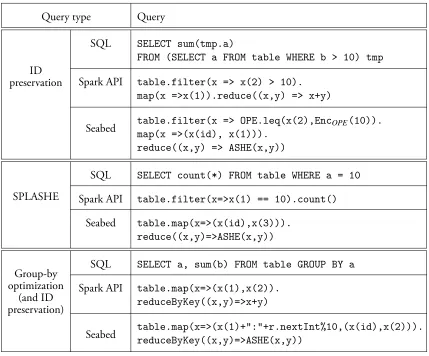
Table 2.2: Examples of query translation. x(1)corresponds to table column a,x(2)
tob,x(3)to splayedafor value10, andx(id)to the identifier column used by ASHE.
Technique Example
Integer/List Encoding
Range encoding [2. . .14,19. . .23] [2-14,19-23]
Diff. encoding [2,3,4,9,23] [2,1,1,5,14]
Combination [2. . .14,19. . .23] [2-12,5-4]
VB-encoding Encoded with minimum
#bytes
Table 2.3: ID list encoding techniques used in Seabed.
2.4.5 Seabed Server
Performing aggregations using ASHE requires the server to manage growing cipher-texts. is can result in need for large in-memory data structures and high band-width. We now describe how we optimize these overheads.
Reducing ID list size: To keep the size of the ID list small, we evaluated several integer list encoding techniques [107], including bitmaps [44], for good compres-sion rates, low memory usage and high encoding speed. We eventually decided that a combination of the techniques listed in Table 2.3 were the most appropriate for Seabed. We begin with range encoding, which compresses contiguous sequences of integers by specifying the lower and upper bound. Next, we apply differential (Diff) encoding, which replaces the (potentially large) individual numbers with the (hopefully small) difference to the previous number; the result of this second step is labeled “Combination” in Table2.3. Finally, we apply variable-byte (VB) encoding, which uses fewer bytes to represent smaller numbers.
Query set Total Purely on Server
Client Pre-processing
Client Post-processing
Two Round-trips
Ad Analytics 168,352 134,298 0 34,054 0
TPC-DS 99 69 2 25 3
MDX 38 17 12 4 5
Table 2.4: Different categories of queries that Seabed supports.
Reducing server-to-client traffic: Every Spark job consists of one driver node and several worker nodes. e workers send their partial results to the driver which then aggregates and sends the combined result to the client. To further reduce the size of ID lists, we applied standard compression. However, there are two options here: applying compression at the worker nodes or applying compression after aggregation at the driver node. e latter can lead to higher compression rates, but we found that this caused a bottleneck at the driver. Instead, we found that applying compression at each of the worker nodes benefits from parallelization and results in lower overall latency.
Handling group-by queries: Group-by queries are in general challenging for ASHE, because all row IDs are included in the final result, which can grow quite large. Moreover, using range encoding seems to incur unnecessary costs for group-by queries: when the result of a group-group-by query contains many groups, the ID lists of each group tend to be very sparse. As we noted earlier, range encoding is wasteful for sparse ID lists, so we decided to use only VB and Diff encoding for group-by queries.
Dataset Rows Dimen-sions
Measu-res
Disk size (GB)
NoEnc Seabed Paillier
Synthetic - Large 1.75B - 1 35.4 70.4 521.1
Synthetic - Small 250M - 1 5 9.8 74.2
BDB - Rankings 90M 1 2 7.9 12 58.3
BDB - User Visits 775M 8 2 194.9 287.5 673.6
BDB - Query 4, Phase 2
194M 2 1 35 38.3 88.3
Ad Analytics 759M 33 18 132.3 142.45 176.3
Table 2.5: Characteristics and disk size of our synthetic dataset, the Big Data Bench-mark (BDB) and the Ad Analytics dataset (AdA).
will remain idle in the reduce phase. is means that more data (because of denser ID lists) is shuffled between fewer workers (because of idle workers). is can create a bottleneck for very large datasets where ID lists are large.
To make use of more worker nodes in the reduce phase and to mitigate the above effect, we artificially increase the number of returned groups. We accomplish this by appending a random identifier to each value of the group-by column. For example (table 2.2), if a query returns 10 groups {g1, . . . ,g10}, and there are 100 workers
available, then we can append a random identifier to the group-by column, which takes values from0to9. is means that the result will contain10∗10=100groups
{g1:0, . . . ,g1:9, . . . ,g10:0, . . . ,g10:9}, the computation will utilize all available workers
in the reduce phase, and we will avoid the bandwidth bottleneck. Of course, the client has to perform the remaining aggregations to compute the sum of the actual groups (e.g., add results for groups {g1:0, . . . ,g1:9} to get the result for group g1).
Dataset Rows Dimen-sions
Measu-res
Memory size (GB)
NoEnc Seabed Paillier
Synthetic - Large 1.75B - 1 84.7 121.9 638.6
Synthetic - Small 250M - 1 12.1 17.7 91.4
BDB - Rankings 90M 1 2 18.6 28.1 80.4
BDB - User Visits 775M 8 2 581 832.5 1269.4
BDB - Query 4, Phase 2
194M 2 1 73.5 86.5 140
Ad Analytics 759M 33 18 1004 1027.3 1254.4
Table 2.6: Characteristics and memory size of our synthetic dataset, the Big Data Benchmark (BDB) and the Ad Analytics dataset (AdA).
2.4.6 Decryption Module
e Decryption Module uncompresses the ID lists, uses the techniques from
Sec-tion 2.4.3to calculate the pseudo-random numbers to add to the encrypted value,
and returns the result to the user. If the query has some part that cannot be com-puted at the server, the Decryption Module can additionally perform that part before presenting the final answer to the user. Since we have assumed that the adversary is honest but curious, the Decryption Module performs no integrity checks; thus, an active adversary could return bogus data without being detected by Seabed itself.
2.5
Applications
An important question is whether Seabed supports a wide range of big data analytics applications. To understand this, we performed three studies. First, we systemat-ically analyzed two common interfaces that BI applications use at the back-end: MDX (the industry standard) and Spark. Second, we evaluated a month-long query log made on a custom-designed advertising analytics OLAP platform to determine how effectively Seabed can support the functionality of these systems. Finally, we analyzed the TPC-DS query set. Detailed results of our MDX/Spark analysis can be found in AppendixA.2. Briefly, the analysis revealed that Seabed’s functionality support falls into four categories:
Support fully on the server: Seabed’s encryption techniques can fully support oper-ations with no client support. Examples of such operoper-ations are computing the sum, average, count, and min.
Support with client pre-processing: Seabed can support quadratic computation necessary for more complex analytics such as anomaly detection, linear regression in one dimension, and decision trees that are supported by Watson Analytics [6] and Tableau [5]. To support this, the Seabed client has to compute squared values of the necessary columns, and encrypt them with ASHE.
Support with client post-processing: All applications and APIs we studied allow users to specify arbitrary functions of data. When these functions are complex, Seabed cannot perform them at the server and data has to be post-processed at the client. is is similar to how Monomi splits queries into server- and client-side com-ponents.
Support with two client round-trips: Some queries require the client to com-pute an intermediate result, re-encrypt it and send it back to the server for further processing.
query sets we analyzed. We analyzed the MDX API/TPC-DS query set manually; for the ad analytics query set, we used heuristics based on the query structure. For Ad Analytics and TPC-DS, about 75-80% of the queries can be supported purely on the server. is implies that these query sets mostly use simple aggregation functions. About 20-25% need client-side support. e TPC-DS query set and MDX API have a few queries (5-15%) that require two round-trips.
2.6
Evaluation
In this section, we report results from our experimental evaluation of Seabed. Ta-ble 2.5 summarizes the datasets used in our experiments. We evaluate the system with microbenchmarks (Synthetic), an advertising analytics data workload and query set (AdA), and the AmpLab Big Data Benchmark (BDB).
Our evaluation has two high-level goals. First, we evaluate the performance
ben-efits of Seabed over systems that use the Paillier cryptosystem. Second, we quantify
the performance and storage overhead incurred by Seabed as compared to a system
with no encryption.
2.6.1 Implementation and Setup
We built a prototype implementation of Seabed on the Apache/Spark platform [4] (version 1.6.0). We chose Spark because of its growing user-base and performant memory-centric approach to data processing. e server-side Seabed library was written in Scala using the Spark API. e Seabed client uses Scala combined with a C++ cryptography module for hardware accelerated AES (with Intel AES-NI in-structions). We implemented Paillier in Scala using the BigInt class. Data tables are stored in HDFS using Google Protobuf [3] serialization. In total, our Seabed prototype consists of 3,298 lines of Scala and 2,730 lines of C++.
GHz processor and 112 GB of memory. Machines were running Ubuntu (14.04.4
LTS) and job scheduling was done through Yarn. In our experiments, we compare the following system setups:
NoEnc: Original Spark queries over unencrypted data,
Paillier: Modified Spark queries over encrypted data; measures are encrypted using Paillier, and dimensions with DET and/or OPE, and
Seabed: Modified Spark queries over encrypted data; measures are encrypted using ASHE, and dimensions with DET and/or OPE.
For our microbenchmarks, we generated a synthetic dataset (see Table2.5). e NoEnc and Paillier datasets consist of one column of plaintext integers and 2048-bit ciphertexts, respectively. e ASHE dataset consists of two columns: an ID and an integer value encrypted with ASHE (IDs are contiguous). In order to model predicates that choose selected rows of a table, we use a parameter called selectivity
that varies between 0 and 1 and use it to chooseeach rowrandomly with the corre-sponding probability. Note that this random selection model allows us to study the various system trade-offs in these schemes, e.g., the total length of ID lists, and it also enables us to understand the worst-case behavior. (At first glance, a query that selects all even or odd rows may appear to be the worst case for Seabed, since range encoding with such a non-contiguous set of IDs will double the size of the resulting ID list. However, in this case, the ID list is in fact highly compressible because the differences between consecutive IDs is always two, so stock compression techniques work very well.)
All experiments, unless otherwise mentioned, used 100 cores and 1.75 billion
0 5 10 15 20 25
0 500 1000 1500 2000
Number of rows (millions) (a) End-to-end response time (s)
(NoEnc & Seabed)
NoEnc ASHE(sel=100%) ASHE(sel=50%) 0 200 400 600 800 1000 1200
0 500 1000 1500 2000 Number of rows (millions) (b) End-to-end response time (s)
(Paillier)
Paillier
Figure 2.6: Median latency for aggregation vs data size.
2.6.2 Microbenchmark: End to End Latency
We first compare end-to-end latency for the three approaches with varying input sizes (250 million to 1.75 billion rows). In Figure 2.6, we show the median latency after running10queries for each input size. For Seabed, we show two lines: one with
selectivity100% and the other with selectivity50%. We shall show in Section2.6.4 that the former gives best-case latency while the latter gives worst-case latency for Seabed. For NoEnc and Paillier, we use a selectivity of100% (their performance is linear with respect to selectivity).
Figure 2.6(a) shows the results for NoEnc and Seabed. NoEnc has a constant latency of approximately 0.6s. is is because addition is a simple operation and
the overall latency is dominated by task creation costs. Seabed’s aggregation is more complex, so latency for both Seabed selectivity50%and100%increases linearly with
the dataset size. Nevertheless, the cost of aggregation in Seabed is still small even for large datasets, varying between1.8s to 11s in the worst-case as the number of rows
increase. On the contrary, Paillier results in a latency of over 1000s when aggregating 1.75 billion rows.
For Seabed selectivity 100%, about 80% of time is due to server-side compute,
selectivity 50%, the server-side contributes55% of the latency, the decryption
con-tributes 35%and network transfer contributes the remaining 10%.
We observed occasional stragglers, i.e., tasks that took longer to complete and delayed the entire job, for all three systems. e underlying cause of these stragglers was usually garbage collection being triggered at some node in the cluster. Pail-lier jobs took several hundreds of seconds to complete, so the comparative effect of stragglers was small. However, NoEnc and Seabed jobs took only few seconds at the server, so whenever there was a straggler task, the delay was more pronounced.
2.6.3 Microbenchmark: Server Scalability
One important aspect of big data systems is how they scale with larger clusters. Since using a larger cluster can only speed up the server side, we considerserver-side latency
as we evaluate Seabed’s scalability. Fixing the dataset at 1.75 billion rows, we varied the number of cores from 10 to 100. Figure 2.7 shows how Seabed, NoEnc and Paillier scaled with the number of cores. NoEnc reached its best latency, which is approximately1s, with 20 cores. Both Seabed selectivity100%and Seabed selectivity
50% achieved their best latency of 1.35s and 8.0s respectively with only 50 cores.
Even with 100 cores, Paillier’s server latency was close to 1000s, which is more than two orders of magnitude higher than Seabed’s. is implies that, for large datasets, Paillier would require increasing the number of cores by orders of magnitude in order to achieve latencies that are comparable to Seabed. Seabed’s overhead over NoEnc primarily comes from managing the ID lists. Next, we look into this in more detail.
2.6.4 Microbenchmark: Seabed Overhead
In this section we examine the server-side overheads incurred by Seabed’s ASHE and the use of OPE.

![Figure 3.1: A message transfer example between two blocks of three nodes. [...]jx′denotes a ciphertext encrypted with the randomized public key of jx, and [...]jxdenotes a ciphertext encrypted with the original key.](https://thumb-us.123doks.com/thumbv2/123dok_us/9263259.1465079/75.612.116.535.71.238/transfer-ciphertext-encrypted-randomized-jxdenotes-ciphertext-encrypted-original.webp)
