© Universiti Tun Hussein Onn Malaysia Publisher’s Office
IJIE
Journal homepage: http://penerbit.uthm.edu.my/ojs/index.php/ijie
The International
Journal of
Integrated
Engineering
Neural-Network Based Adaptive Proxemics-Costmap for
Human-Aware Autonomous Robot Navigation
Chik Sheng Fei
1, Yeong Che Fai
2*, Eileen Su Lee Ming
1, Lim Thol Yong
3,
Duan Feng
4, Patrick Chin Jun Hua
51School of Electrical Engineering, Faculty of Engineering, Universiti Teknologi Malaysia, Johor Bahru, 81310, MALAYSIA
2Centre for Artificial Intelligence and Robotics, Faculty of Engineering, Universiti Teknologi Malaysia, Johor Bahru, 81310, MALAYSIA
3Malaysia Japan Institute of Technology (MJIIT), Universiti Teknologi Malaysia, Kuala Lumpur, 54100, MALAYSIA
4Department of Automation, College of Computer and Control Engineering, Nankai University, Tianjin, 300071, CHINA
5DF Automation and Robotics Sdn. Bhd, Johor Bahru, 81300, MALAYSIA
*Corresponding Author
DOI: https://doi.org/10.30880/ijie.2019.11.04.011
Received 25 April 2019; Accepted 31 July 2019; Available online 5 September 2019
1. Introduction
Over the years, with the emergence of robots into the manufacturing industry, the manufacturing efficiency have increased. The continuous advancement of robot technologies in the field of navigation including localization, path planning, costmap design, obstacle sensing and tracking have drove revolutions to the industry. In the recent effort of transforming the industry towards Industry 4.0 [1], robot navigation remains a crucial part for a robot to co-exist with human co-workers. Humans prefer to maintain a certain proxemic distance [2] between themselves and robots for safety
Abstract: In the revolution of Industry 4.0, autonomous robot navigation plays a vital role in ensuring intelligent cooperation with human workers to increase manufacturing efficiency. Human prefers to maintain a proxemic distance with other subjects for safety and comfort purposes, where the human personal-space can be represented by a costmap. Current proxemic costmaps perform well in defining the proxemic boundary to maintain the human-robot proxemic distance. However, these approaches generate static costmaps that are not adaptive towards different human states (linear position, angular position and velocity). This problem impacts the robot navigation efficiency, reduces human safety and comfort as the autonomous robot failed to prioritize avoiding certain humans over the other. To overcome this drawback, this paper proposed a neural-network based adaptive proxemic-costmap, named as NNPC, that can generate different sized personal-spaces at different human state encounters. The proposed proxemic-costmap was developed by learning a neural-network model using real human state data. A total of three human scenarios were used for data collection. The data were collected by tracking the humans in video recordings. After the model was trained, the proposed NNPC costmap was evaluated against two other state-of-art proxemic costmaps in five simulated human scenarios with various human states. Results show that NNPC outperformed the compared costmaps by ensuring human-aware robot manoeuvres that have higher robot efficiency and increased human safety and comfort.
and comfortability purposes. Humans are governed by invisible social rules, and these affect their movement during Human-Robot-Interaction (HRI). Hall [2] separates human personal-space into intimate, personal, social and public. Human personal-space are governed by complex rules, and it is vital for robot designers to ensure their robots abide to these rules to gain acceptance from human.
In the context of human-aware robot navigation, the human personal-space is represented by a costmap with high cost cells surrounding a human. Human-aware robot navigation is distinct from conventional navigation as it considers human safety, comfortability and path smoothness in the search of an optimum robot path without trading off navigation efficiency. There are various human-aware navigation methods [3]. This research focuses on improving the costmap method, where an adaptive Neural-Network based Proxemic Costmap (NNPC) is proposed. The rest of the article is organized as follows: Section 2 presents the literatures related to human-aware costmaps, Section 3 introduces the methods used to design, develop and evaluate NNPC, the result of NNPC performance evaluation is discussed in Section 4, and this article is concluded in Section 5.
2.
Literature Review
Human-aware costmaps typically use self-defined or learnt proxemic model to generate human personal-space boundaries to prevent a robot from traversing too close to a human or human group. Papadakis et al. [4] proposed a costmap that represents different types of human social-zone using velocity and orientation dependent proxemic model. Gómez et al. [5] designed a costmap that uses various Gaussian models to generate personal-spaces for individuals and human-groups. Vega-Magro et al. [6] group individuals into human-group based on their relative distances and define a boundary surrounding the group to avoid a robot from interrupting the group formation. These prior mentioned methods excel in categorizing humans into different human groups and assign personal-space to respective formations. This prevents a robot from interrupting the human group activities. However, the methods are designed in static human contexts where when moving humans are encountered, a robot can still fail to maintain an appropriate human-robot proxemic distance.
Some researches focus solely on the costmap generation for the personal-space of an individual. Kirby et al. [7] used 2 Gaussian functions to represent the front and rear sides of a personal-space. They also utilized a pass-on-the-right proxemic model [8] to ensure a robot to always pass-by a human on a socially preferable side. Scandolo and Fraichard [9] designed a costmap that has a proxemic model dependent on the Hall’s proxemic model [2], human motion and interaction between humans and other objects in an environment. Patompak et al. [10] introduced Social Relationship Model (SRM), an extended version of Social-Force Model (SFM) [11] to assign different sized personal-space to humans in an environment, based on the human position, velocity and social relationship. These proxemic costmaps only define the personal-space boundary for individuals, which can cause a robot to interrupt a group personal-space. Besides, their limited capability on human trajectory prediction can also cause poor navigation performance when a moving human or human group is encountered.
There are some approaches involve human path prediction capability to reason about human future movements. By assuming linear human motions, Kollmitz et al. [12] utilized a multi-layered costmap that populates human predicted trajectories using Gaussian functions with linear decaying amplitudes from the current human position. Karageorgas [13] reasons about human future paths using the Bayesian Human Motion Intentionality Prediction (BHMIP) [14], and represented the paths using a series of Gaussian function. These costmaps serve the purpose of maintaining a human-robot proxemic distance and to allow early preparation for collision avoidance.
In overall, the main drawback of these current proxemic costmap approaches are not adaptive towards different human states (linear position, angular position and velocity). In simple, same sized personal-spaces are generated even though the humans are located far or near a robot, moving towards or away a robot and moving fast or slow relative to a robot. Although certain costmaps [4, 7, 10] took consideration of human states, but those approaches are designed for less complex scenarios like static individuals and small human group encounters. This drawback causes a robot to not able to prioritize avoiding certain human over the other, which impacts the human-aware navigation performance in terms of human comfortability and navigation efficiency and even potentially causes safety issues such as increase in human-robot collisions. Hence, this research proposed the NNPC, an adaptive costmap that can adapt to different human states to overcome the drawback of current approaches. NNPC utilizes a learnt neural-network model to generate appropriately sized personal-space for encountered humans at different states. The neural-network model was trained using real human motion data.
3.
Methodology
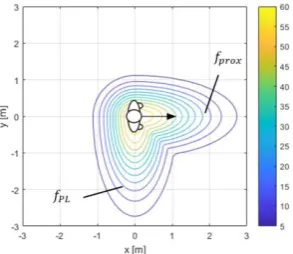
Fig. 1 – human personal-space costmap generated by 𝒇𝒑𝒓𝒐𝒙𝑷𝑳.
The first part, 𝑓𝑝𝑟𝑜𝑥𝑃𝐿 (Fig. 1) is used in the design of NNPC because it provides a smooth exponential increasing cost from the personal-space boundary towards the center of a human position, thus allowing smooth robot paths to be planned in avoiding a human. 𝑓𝑝𝑟𝑜𝑥𝑃𝐿 can further be broken down into 2 minor parts. The first minor part is the proxemic function as follows:
𝑓𝑝𝑟𝑜𝑥= 𝐴𝑒𝑥𝑝(−(𝐹1+ 𝐹2)) (1)
where
𝐹1=
(cos(𝜙 − 𝜃) √(𝑥𝑐− 𝑥0)2+ (𝑦𝑐− 𝑦0)2) 2
2𝜎𝑥2
𝐹2=
(sin(𝜙 − 𝜃) √(𝑥𝑐− 𝑥0)2+ (𝑦𝑐− 𝑦0)2) 2
2𝜎𝑦2
𝜙 = atan (𝑦𝑐− 𝑦0 𝑥𝑐− 𝑥0)
𝜎𝑥= {
𝜎𝑦2(1 + 𝛾𝑣)
𝜎𝑦2
, 𝑖𝑓 |𝜙 − 𝜃| < 90°
, 𝑜𝑡ℎ𝑒𝑟𝑤𝑖𝑠𝑒
(2)
(3)
(4) (5)
and 𝐴 is the amplitude, 𝜎𝑥2 and 𝜎𝑦2 are the variances, 𝛾 is the velocity dependent factor and |𝜙 − 𝜃| is the absolute value of the shortest angular difference. The second minor part is the passing layer, 𝑓𝑃𝐿. 𝑓𝑃𝐿 is included in the design of NNPC to ensure the robot pass-by a human on a socially acceptable side. 𝑓𝑃𝐿 has the same equation as 𝑓𝑝𝑟𝑜𝑥 except for 𝜃 in Equation 2, 3 and 5 is changed to 𝜑 with the following equation:
𝜑 = {𝜃 + 90° 𝜃 − 90°
, 𝑖𝑓 𝑝𝑎𝑠𝑠 𝑜𝑛 𝑡ℎ𝑒 𝑟𝑖𝑔ℎ𝑡
, 𝑜𝑡ℎ𝑒𝑟𝑤𝑖𝑠𝑒
(6)
Combining 𝑓𝑝𝑟𝑜𝑥 and 𝑓𝑃𝐿 (Equation 7) results in the first part of NNPC (𝑓𝑝𝑟𝑜𝑥𝑃𝐿) that generates a human personal-space boundary shown in Fig. 1.
𝑓𝑝𝑟𝑜𝑥𝑃𝐿= max {𝑓𝑝𝑟𝑜𝑥, 𝑓𝑃𝐿} (7)
The second part of NNPC is HI. HI is vital in the design of NNPC as it predicts the human future trajectory for a robot to have early preparation for collision avoidance. HI computes the most probable human destination using Hidden Markov Models (HMM) [15] where Karageorgas [13] provided a detail explanation on the algorithm. Then, using A* [16] algorithm, a shortest path is planned from the human current position towards the most probably destination to represent the predicted human trajectory. The human trajectory is then populated with a series of Gaussian function (𝑓𝑝𝑟𝑜𝑥𝑃𝐿) using the following equation:
𝑓𝑝𝑟𝑜𝑥𝐻𝐼𝑃𝐿= max {𝑓𝑝𝑟𝑜𝑥𝑃𝐿1, 𝑓𝑝𝑟𝑜𝑥𝑃𝐿2… 𝑓𝑝𝑟𝑜𝑥𝑃𝐿𝑁} (8)
where
𝑁 =𝑟𝑒𝑙𝑎𝑡𝑖𝑣𝑒_𝑑𝑖𝑠𝑡𝑎𝑛𝑐𝑒 𝑣𝑞× 𝑓
and 𝑁 is the total number of populated personal-space, which is influenced by the human-robot relative distance, robot’s velocity, 𝑣𝑞 and the velocity dependent factor, 𝑓. Fig. 2 shows the costmap generated by 𝑓𝑝𝑟𝑜𝑥𝐻𝐼𝑃𝐿.
Fig. 2 – human personal-space costmap generated by 𝒇𝒑𝒓𝒐𝒙𝑯𝑰𝑷𝑳.
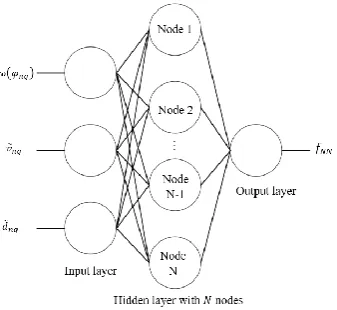
The third part of NNPC is 𝑓𝑁𝑁, the neural-network proxemic model. 𝑓𝑁𝑁 is designed to take in 3 input human states which relates to angular position, velocity and linear position, and have an output as a weight to control the size of the personal-space generated by 𝑓𝑝𝑟𝑜𝑥𝐻𝐼𝑃𝐿. These inputs are selected based on several costmap approaches [4, 7, 10]. NNPC has the following equation:
𝑓𝑁𝑁𝑃𝐶= 𝑓𝑁𝑁× 𝑓𝑝𝑟𝑜𝑥𝐻𝐼𝑃𝐿 (10)
Fig. 3 – robot 𝒒 encounters human 𝒏.
In the context of robot 𝑞 and human 𝑛 as shown in Fig. 3, (let 𝑛 be the general notation to represent any human), the first input is the angular position, which is represented by anisotropic factor, 𝜔(𝜑𝑛𝑞) [17]. The second input is the normalized human-robot relative velocity (𝑣̃𝑛𝑞) while the third input is the normalized human-robot relative distance (𝑑̃𝑛𝑞), both are normalized to the range of 0 to 1 using the min max normalization [18] method. 𝑓𝑁𝑁 is a feedforward multilayer perceptrons neural-network model as shown in Fig. 4.
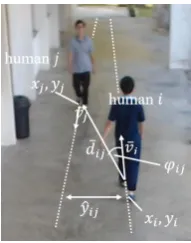
Fig. 4 – human 𝒊 encounters human 𝒋.
As mentioned earlier, NNPC was designed where 𝑓𝑁𝑁 was trained using real human state data, as in several human-aware navigation literatures [19-22] suggested human is an appropriate demonstrator to teach a robot to react in a human environment. The human movements were recorded using video recording method and the human state data were collected by tracking the human movements in the footages. The input data and the training data have the same formula, but the latter relate to the states of humans 𝑖 and 𝑗 as shown in Fig. 5 instead of human 𝑛 and robot 𝑞. The first training data is 𝜔(𝜑𝑖𝑗), the anisotropic factor, the second training data is the normalized relative velocity (𝑣̃𝑖𝑗) and the third training data is the normalized relative distance (𝑑̃𝑖𝑗). The target data is the lateral distance between humans 𝑖 and 𝑗 (𝑦̃𝑖𝑗). 𝑦̃𝑖𝑗 is chosen as the target data as it represented the proxemic distance humans prefer to maintain during interaction.
a b c
Fig. 6 - (a) Scenario 1 (S1); (b) Scenario 2 (S2) (c); Scenario 3 (S3).
Three human scenarios (Fig. 6) were used to collect the human state data. These scenarios are scenarios used by previous literatures. Scenario 1 (S1): face-to-face encounter [9, 12, 13, 21, 23, 24] (Fig. 6a), Scenario 2 (S2): walking-away [19] (Fig. 6b), Scenario 3 (S3): overtaking (Fig. 6c) [12]. A total of 16 human subjects were involved, only male subjects with age between 19 to 24 years old (young adult group [25]) were chosen to remove the dependence of the training data on demographic factors (gender and age). The subjects were randomly split into 2 groups, one representing human 𝑖 while the other represents human 𝑗. Each subject from the groups were then randomly assigned a label from 1 to 8. The data collection started with S1 where subjects with label 1 from each group were positioned at 𝑠̅𝑖 and 𝑠̅𝑗 respectively. The subjects were instructed to walk towards their respective goal 𝑔̅𝑖 and 𝑔̅𝑗 and their movements were recorded. This was repeated for 3 times before changing the subjects to the consecutive labels. Data collection for S1 was completed when all subjects from label 1 to 8 were involved, and the same procedures were repeated for S2 and S3.
The human state data were then collected by tracking the human in the video footage using Kernelized Correlation Filters (KCF) [26] in OpenCV. The neural-network model was then trained using Levenberg-Marquardt backpropagation algorithm [27]. The output of the trained model, 𝑓𝑁𝑁 is then used to adaptively scale the size of the personal-space when different human states are encountered.
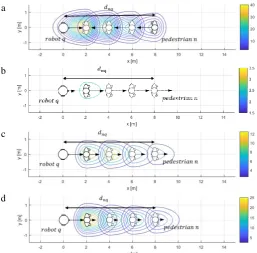
(0.0 < 𝑣̃𝑛𝑞< 0.5). These changes in the size of personal-space allow a robot to adapt to different human states and prioritize avoiding certain human over the other to improve navigation performance.
a
b
c
d
Fig. 7 - (a) 𝝎(𝝋𝒏𝒒) ≥ 𝟎. 𝟓 at varying 𝒅̃𝒏𝒒; (b) 𝝎(𝝋𝒏𝒒) ≤ 𝟎. 𝟓 at 𝒗̃𝒏𝒒= 𝟎. 𝟎 and varying 𝒅̃𝒏𝒒; (c) 𝝎(𝝋𝒏𝒒) ≤ 𝟎. 𝟓 at 𝟎. 𝟎 < 𝒗̃𝒏𝒒< 𝟎. 𝟓 and varying 𝒅̃𝒏𝒒; (d) 𝝎(𝝋𝒏𝒒) ≤ 𝟎. 𝟓 at 𝒗̃𝒏𝒒> 𝟎. 𝟓 and varying 𝒅̃𝒏𝒒.
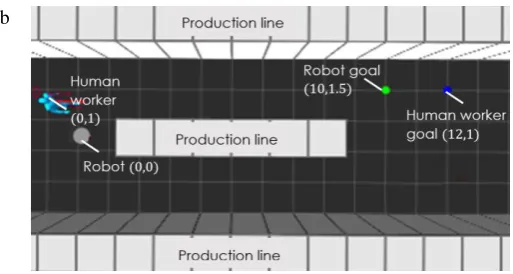
To evaluate whether the proposed NNPC can improve the navigation performance, several human-robot scenarios were involved. The evaluation was carried out in a human-robot simulator [28] using manufacturing scenarios and were designed by benchmarking several human-aware navigation literatures [12, 13, 19, 23]. The scenarios were also setup to include a robot encountering human at different states, to test whether NNPC can adapt to changes in states. The first to forth scenarios involve robot encountering a human worker in a factory with several production lines as obstacles. The first scenario (SS1) as shown in Fig. 8a was a face-to-face human-robot encounter. Fig. 8b, the second scenario (SS2) involved a human walking parallel to and eventually away from the robot. The robot behaviour in SS1 and SS2 were used for evaluating NNPC towards the change in human angular position. Scenario 3 (SS3) was setup similar to SS2, but with a decreased in human velocity from 1.4 𝑚𝑠−1 [29] to 0.25 𝑚𝑠−1 and the human initial and goal positions were setup as (0,1) and (7,1) respectively. The robot behaviors in SS2 and SS3 were used to evaluate whether NNPC can adapt to changes in human velocity. The forth scenario was designed similar to SS3, but with an increased in the initial human-robot distance where the human initial and goal positions were setup as (7,1) and (12,1) respectively. The robot behaviors in SS3 and SS4 were utilized to test whether NNPC can adapt to human at different linear positions.
b
Fig. 8 - (a) face-to-face human-robot encounter; (b) human facing away from robot encounter.
The fifth scenario (SS5) as shown in Fig. 9 was used to test whether NNPC can handle higher human density scenario where a robot can possibly encounter in real life, for example, groups of workers exiting a factory through a pathway during recess time. The performance of NNPC was compared against two prior mentioned human-aware costmap methods: proxPL (Equation 7) by Kirby et al. [7] and proxHIPL (Equation 8), a combination of methods by Kirby et al. [7] and Karageorgas [13]. The performance metrics used were based on three criteria: human safety and comfort, path smoothness and navigation efficiency. The criteria and their respective metrics are shown in Table 1.
Fig. 9 - robot encounters human worker groups.
Table 1 - Performance criteria and their respective metrics.
Criteria Metrics Symbol
Human safety and comfort
Minimum relative human-robot distance
𝑑𝑟𝑒𝑙 𝑚𝑖𝑛
Path smoothness Average integral of linear jerk
𝐼𝑗 𝑙𝑖𝑛
Average integral of angular jerk
𝐼𝑗 𝑎𝑛𝑔
Navigation efficiency Execution time 𝑡𝑡𝑎𝑠𝑘
Path length 𝐿𝑝
4.
Results and Discussion
a b
Fig. 10 - robot behaviours in SS1 using (a) proxPL; (b) proxHIPL/ NNPC.
human with 𝑑𝑟𝑒𝑙𝑚𝑖𝑛 value of 1.97 𝑚 and 2.08 𝑚 respectively. For path smoothness, in terms of 𝐼𝑗 𝑙𝑖𝑛, NNPC
(1.25 𝑚𝑠−3) was significantly better (𝑝 > 0.05) than proxPL (1.43 𝑚𝑠−3) because the robot with proxPL had to come to an emergency stop when the human suddenly appeared around the corner of the bottom lane. NNPC had no significant difference (𝑝 > 0.05) in terms of 𝐼𝑗 𝑎𝑛𝑔 as compared to other methods. NNPC and proxHIPL had greater execution time
and path length as compared to proxPL because the top lane was chosen to provide better human safety and comfort.
a b
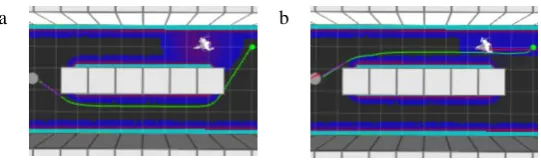
Fig. 11 - robot behaviours in SS2 using (a) proxPL/ proxHIPL; (b) NNPC.
For SS2, Fig. 11a shows the robot behaviour of proxPL where the robot chose the longer path because the large size of the generated human personal-space was blocking the top lane. The non-adaptive proxHIPL also had the similar issue as shown in Fig. 11a. NNPC however managed to adapt to the human angular position, generated a smaller sized personal-space which allowed the robot to plan a shorter path through the top lane (Fig. 11b). 𝑑𝑟𝑒𝑙 𝑚𝑖𝑛 is not used in SS2, SS3 and SS4 as all costmaps would have the similar values which equate to either the initial or final human-robot distance. In terms of 𝐼𝑗 𝑙𝑖𝑛, NNPC (0.96 𝑚𝑠−3) had an improvement of 9.44 % as compared to proxPL (1.06 𝑚𝑠−3) and 12.32 % as
compared to proxHIPL (1.09 𝑚𝑠−3). In terms of 𝐼
𝑗𝑎𝑛𝑔, NNPC (10.03 𝑚𝑠−3) had a significant improvement (𝑝 ≤ 0.001) of 20.96 % as compared to proxPL (12.69 𝑚𝑠−3) and 19.40 % as compared to proxHIPL (12.44 𝑚𝑠−3). For navigation efficiency, NNPC had significant improvements in both 𝑡𝑡𝑎𝑠𝑘 and 𝐿𝑝. For 𝑡𝑡𝑎𝑠𝑘, NNPC (22.22 𝑠) had an improvement of 16.62 % and 16.87 % as compared to proxPL (26.65 𝑠) and proxHIPL (26.73 𝑠) respectively. For 𝐿𝑃, NNPC (10.66 𝑚) had an improvement of 12.26 % as compared to both proxPL and proxHIPL (12.15 𝑚). These improvements show that the by adapting to human angular position, the navigation performance can be improved.
a b
Fig. 12 - robot behaviours in SS3 using (a) proxPL; (b) proxHIPL/ NNPC.
For SS3 where the human encountered was walking slowly, the personal-space generated by proxPL (Fig. 12a), proxHIPL and NNPC in Fig. 12b generated similar sized personal-space. This shows that NNPC was able to adapt to the slow-moving human and generate a larger sized personal-space as compared to the one in SS2 (Fig. 10b). This allowed the robot to select a faster path when the slow-moving human was blocking the top lane and at the same time avoid getting too close to the human for safety and comfort purposes. NNPC performed as well as proxPL and proxHIPL in SS3 where the performance metrics (Table 2) of NNPC show no significant difference (𝑝 > 0.05) as compared the other approaches.
a b
Fig. 13 - robot behaviours in SS4 using (a) proxPL/ proxHIPL; (b) NNPC.
towards the goal. NNPC significantly outperformed (𝑝 ≤ 0.001) proxPL and proxHIPL in all metrics. In terms of 𝐼𝑗𝑙𝑖𝑛,
NNPC (0.82 𝑚𝑠−3) was 23.36 % and 18.00 % lower than proxPL (1.07 𝑚𝑠−3) and proxHIPL (1.00 𝑚𝑠−3) respectively. For 𝐼𝑗𝑎𝑛𝑔, NNPC (9.85 𝑟𝑎𝑑𝑠−3) had improvements of 25.72 % and 24.58 % as compared to proxPL
(13.26 𝑟𝑎𝑑𝑠−3) and proxHIPL (13.06 𝑟𝑎𝑑𝑠−3) respectively. For navigation efficiency, in terms of 𝑡
𝑡𝑎𝑠𝑘, NNPC (22.10 𝑠) improved by 17.01 % as compared to proxPL (26.63 𝑠) and 17.44 % as compared to proxHIPL (26.77 𝑠). NNPC (10.63 𝑚) also had shorter 𝐿𝑝, 12.51 % shorter than proxPL (12.15 𝑚) and 12.73 % shorter than proxHIPL (12.18 𝑚). These improvements show that the adaptive behaviour of NNPC towards human linear position can improve the path smoothness and navigation efficiency.
a b
Fig. 14 - robot behaviours in SS5 using (a) proxPL/ proxHIPL; (b) NNPC.
In a higher human density scenario (SS5), Fig. 14a shows that proxPL overpopulated the costmap with human personal-space, where the robot wrongly avoided the 𝐺1 which was initially closer to the robot. This caused the robot to detour towards the wrong side and moved too close to 𝐺2. The non-adaptive proxHIPL also had similar behaviour as shown in Fig. 14a. NNPC however, was able to reduce the size of the personal-space for 𝐺1that was moving towards the same direction as the robot, but not the oncoming 𝐺2. This helped the robot to prioritized in avoiding the oncoming group and joined the other group to navigate towards the goal. For human safety and comfort (𝑑𝑟𝑒𝑙 𝑚𝑖𝑛), NNPC (0.68 𝑚) outperformed proxPL (0.38 𝑚) by 78.95 % and proxHIPL (0.47 𝑚) by 44.68 %. For 𝐼𝑗𝑙𝑖𝑛, NNPC (1.79 𝑚𝑠−3) had
significant improvement (𝑝 ≤ 0.001), where it was 36.07 % better than proxPL (2.80 𝑚𝑠−3) and 37.63 % better than proxHIPL (2.87 𝑚𝑠−3). In terms of 𝑡
𝑡𝑎𝑠𝑘, NNPC (22.72 𝑠) also significantly improved (𝑝 ≤ 0.001) by 21.03 % as compared to proxPL (28.77 𝑠) and 24.84 % as compared to proxHIPL (30.23 𝑠). In terms of 𝐼𝑗 𝑎𝑛𝑔 and 𝐿𝑝, NNPC had
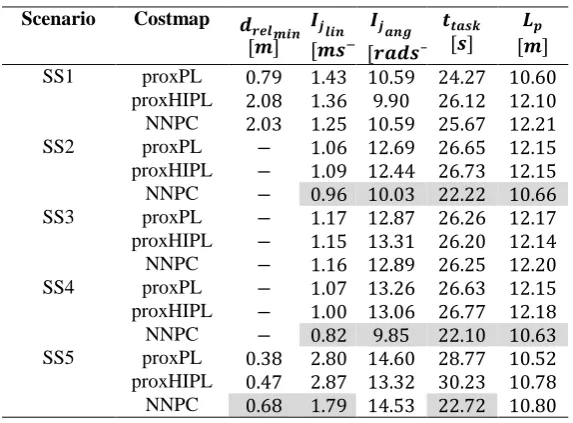
no significant difference as compared to other methods as all methods caused the robot to make certain detours, that increased angular jerk and path length, but the robot with NNPC detoured to the correct side while the robot with proxPL and proxHIPL detoured to the wrong side. These improvements show that the adaptive capability of NNPC improved the navigation performance in a multiple human scenario. Table 2 shows the navigation performance for each costmap in all human scenarios, with highlighted improvements made by NNPC.
Table 1 – Navigation performance
Scenario Costmap 𝒅 𝒓𝒆𝒍𝒎𝒊𝒏 [𝒎]
𝑰𝒋𝒍𝒊𝒏 [𝒎𝒔−𝟑]
𝑰𝒋𝒂𝒏𝒈
[𝒓𝒂𝒅𝒔−𝟑] 𝒕𝒕𝒂𝒔𝒌
[𝒔]
𝑳𝒑 [𝒎] SS1 proxPL 0.79 1.43 10.59 24.27 10.60
proxHIPL 2.08 1.36 9.90 26.12 12.10 NNPC 2.03 1.25 10.59 25.67 12.21 SS2 proxPL − 1.06 12.69 26.65 12.15 proxHIPL − 1.09 12.44 26.73 12.15 NNPC − 0.96 10.03 22.22 10.66 SS3 proxPL − 1.17 12.87 26.26 12.17 proxHIPL − 1.15 13.31 26.20 12.14 NNPC − 1.16 12.89 26.25 12.20 SS4 proxPL − 1.07 13.26 26.63 12.15 proxHIPL − 1.00 13.06 26.77 12.18 NNPC − 0.82 9.85 22.10 10.63 SS5 proxPL 0.38 2.80 14.60 28.77 10.52
proxHIPL 0.47 2.87 13.32 30.23 10.78 NNPC 0.68 1.79 14.53 22.72 10.80
In this study, a neural-network based adaptive proxemic costmap, named NNPC is introduced to overcome the drawbacks of current human-aware costmap methods. The neural-network proxemic model of NNPC was trained using human state data from real human subjects. NNPC then used the model output to generate different sized personal-space based on various human state encounters. By adapting to the changing human states, NNPC managed to significantly outperform two other costmap methods in both single and multiple human scenarios, in terms of human safety and comfort, path smoothness and navigation efficiency. Future works can take account of human demographic and social relationship as model input to further improve the human-aware navigation performance.
Acknowledgement
The authors are grateful to Universiti Teknologi Malaysia for providing facilities to conduct this research and this work is supported by the Universiti Teknologi Malaysia Research Grant (04G42 and 16H47). Besides, the authors also thank to DF Automation & Robotics Sdn Bhd for supplying the test robotic platform.
References
[1] Bahrin, M. A. K., Othman, M. F., Azli, N. N. and Talib, M. F. (2016). Industry 4.0: A review on industrial automation and robotic. JURNAL TEKNOLOGI, 78(6-13),137-143.
[2] Hall, E. T. (1990). The Hidden Dimension. 27th ed. Anchor Books.
[3] Chik, S. F., Yeong, C. F., Su, E. L. M., Lim, T. Y., Subramaniam, Y. and Chin, P. J. H. (2016). A Review of Social-Aware Navigation Frameworks for Service Robot in Dynamic Human Environments. Journal of Telecommunication, Electronic and Computer Engineering (JTEC). 8(11), 41-50.
[4] Papadakis, P., Spalanzani, A. and Laugier, C. (2013). Social mapping of human-populated environments by implicit function learning. Proceedings of the 2013 IEEE/RSJ International Conference on Intelligent Robots and Systems. Tokyo Big Sight, Tokyo, 1701-1706.
[5] Gómez, J. V., Mavridis, N. and Garrido, S. (2013). Social path planning: Generic human-robot interaction framework for robotic navigation tasks. Proceedings of the 2nd Intl. Workshop on Cognitive Robotics Systems: Replicating Human Actions and Activities. Tokyo, Japan.
[6] Vega-Magro, A., Manso, L., Bustos, P., Núñez, P. and Macharet, D. G. (2017). Socially acceptable robot navigation over groups of people. Proceedings of the 2017 26th IEEE International Symposium on Robot and Human Interactive Communication (RO-MAN). Lisbon, Portugal, 1182-1187.
[7] Kirby, R., Simmons, R. and Forlizzi, J. (2009). COMPANION: A Constraint-Optimizing Method for Person-Acceptable Navigation. Proceedings of the 18th IEEE International Symposium on Robot and Human Interactive Communication (RO-MAN 2009).Toyama International Conference Center, Japan, 607-612.
[8] Bitgood, S. and Dukes, S. (2006). Not Another Step! Economy of Movement and Pedestrian Choice Point Behavior in Shopping Malls. Environment and Behavior. 38(3), 394-405.
[9] Scandolo, L. and Fraichard, T. (2011). An anthropomorphic navigation scheme for dynamic scenarios. Proceedings of the 2011 IEEE International Conference on Robotics and Automation (ICRA). Shanghai International Conference Center, Shanghai, China, 809-814.
[10] Patompak, P., Jeong, S., Chong, N. Y. and Nilkhamhang, I. (2016). Mobile robot navigation for human-robot social interaction. Proceedings of the 2016 16th International Conference on Control, Automation and Systems (ICCAS). HICO, Gyeongju, Korea, 1298-1303.
[11] Helbing, D. and Molnar, P. (1995). Social force model for pedestrian dynamics. Physical review E. 51(5), 4282. [12] Kollmitz, M., Hsiao, K., Gaa, J. and Burgard, W. (2015). Time dependent planning on a layered social cost map for
human-aware robot navigation. Proceedings of the 2015 European Conference on Mobile Robots (ECMR). Lincoln, UK, 1-6.
[13] Karageorgos, D. (2017). Human-Aware Autonomous Navigation of a Care Robot in Domestic Environments. Masters Thesis. Delft University of Technology.
[14] Ferrer, G. and Sanfeliu, A. (2014). Bayesian Human Motion Intentionality Prediction in urban environments. Pattern Recognition Letters. 44,134-140.
[15] Rabiner, L. R. (1989). A tutorial on hidden Markov models and selected applications in speech recognition. Proceedings of the IEEE. 77(2), 257-286.
[16] Hart, P. E., Nilsson, N. J. and Raphael, B. (1968). A Formal Basis for the Heuristic Determination of Minimum Cost Paths. IEEE Transactions on Systems Science and Cybernetics. 4(2), 100-107.
[17] Johansson, A., Helbing, D. and Shukla, P. K. (2007). Specification of the social force pedestrian model by evolutionary adjustment to video tracking data. Advances in complex systems. 10(supp02), 271-288.
[18] Al Shalabi, L., Shaaban, Z. and Kasasbeh, B. (2006). Data mining: A preprocessing engine. Journal of Computer Science. 2(9), 735-739.
[20] Vasquez, D., Okal, B. and Arras, K. O. (2014). Inverse reinforcement learning algorithms and features for robot navigation in crowds: an experimental comparison. Proceedings of the 2014 IEEE/RSJ International Conference on Intelligent Robots and Systems (IROS). Chicago, Illinois, US, 1341-1346.
[21] Ratsamee, P., Mae, Y., Kamiyama, K., Horade, M., Kojima, M. and Arai, T. (2015). Social interactive robot navigation based on human intention analysis from face orientation and human path prediction. ROBOMECH Journal. 2(1), 11.
[22] Kretzschmar, H., Spies, M., Sprunk, C. and Burgard, W. (2016). Socially compliant mobile robot navigation via inverse reinforcement learning. The International Journal of Robotics Research. 35(11), 1289-1307.
[23] Lu, D. V. and Smart, W. D. (2013). Towards more efficient navigation for robots and humans. Proceedings of the 2013 IEEE/RSJ International Conference on Intelligent Robots and Systems. Tokyo Big Sight, Tokyo, 1707-1713. [24] Nishitani, I., Matsumura, T., Ozawa, M., Yorozu, A. and Takahashi, M. (2015). Human-centered X-Y-T space path
planning for mobile robot in dynamic environments. Robotics and Autonomous Systems. 66, 18-26.
[25] Geifman, N. and Rubin, E. (2012). The Age-Phenome Knowledgebase: an example to handling abstraction and expressiveness in a knowledge domain. Proceedings of the Conference: Conference: Conference on Semantics in Healthcare and Life Sciences (CSHALS). Cambridge, Massachusetts, United States.
[26] Henriques, J. F., Caseiro, R., Martins, P. and Batista, J. (2015). High-Speed Tracking with Kernelized Correlation Filters. IEEE Transactions on Pattern Analysis and Machine Intelligence. 37(3), 583-596.
[27] Hagan, M. T. and Menhaj, M. B. (1994). Training feedforward networks with the Marquardt algorithm. IEEE Transactions on Neural Networks. 5(6), 989-993.
[28] Okal, B. and Arras, K. O. (2014). Towards Group-Level Social Activity Recognition for Mobile Robots. Proceedings of the 2014 IEEE/RSJ International Conference on Intelligent Robots and Systems (IROS). Chicago, Illinois, US.