DOI: http://dx.doi.org/10.15282/ijsecs.3.2017.11.0033
146
AN EVALUATION OF IMPROVED CLUSTER-BASED ROUTING PROTOCOL IN AD-HOC WIRELESS NETWORK
Adekiigbe Adebanjo1, Awotidebe M. Lanre1, Ekuewa J. Bamidele1, Ayeleso C. Emmanuel1, Onyeka N. Camilia1, Abu Bakar Kamalrulnizam2
1Department of Computer Science
The Federal Polytechnic Ede, Nigeria 2Department of Computer Science
Universiti Teknologi Malaysia [email protected]
ABSTRACT
In this paper we presents a performance comparison of Dynamic Source Routing (DSR), Ad hoc On Demand Vector (AODV), Cluster Based Routing Protocol (CBRP) and Improved Cluster Based Routing Protocol (i-CBRP) routing protocols which builds upon a cluster based wireless network infrastructure. This evaluation is necessary due to unique enhancement made to traditional CBRP by way of implementing congestion control scheme as part of the structure establishing i-CBRP. First, we introduce the network infrastructure on which the routing protocols are to send packets. We simulates Mobile Ad-Hoc Network (MANET) network infrastructure using NS2 network simulator. DSR, AODV, CBRP and i-CBRP routing protocols are implemented to generate various simulation results. The results shows that i-CBRP performs better in terms of average packet delay, throughput, volume of traffic controls and average packet delivery ratio when compared with CBRP, while DSR performs better in terms of total volume of control traffic. AODV is the overall best in terms of average packet delay.
Key words: Node Density, Evaluation, MANET, Cluster, Routing
INTRODUCTION
147
e-learning within campuses, this network has shown to perform adequately well even under various scenarios (Lee, Belding-Royer, & Perkins, 2003).
The success of implementing wireless ad-hoc network brings a challenge in which the implementation of this type of network poses different burdens upon the traditional wireless systems or wired networks (Frikha, 2013). On the other hand, a MANET is anticipated to be of enormous size when compared with the radio range of wireless antenna, for this reason, it requires that the traffic be routed through multihops. Unfortunately, the dynamism of MANET manifests rapid changes of network topology which invariably add more traffic data to the mandatory traffics for the data routing procedure. MANET also offers wireless transmission channel which is shared by nodes. Hence, the consequence of limited bandwidth in a large network topology is congestion. Another major challenge militating against ad-hoc network is energy constraints. Most often, ad-hoc nodes are powered by batteries. Consequently, these nodes quickly get exhausted during data traffic if no efficient power consumption techniques are adopted for these autonomous mobile nodes (Mohsin et al., 2012).
Generally, routing protocols in ad-hoc networks can be classified into Reactive (on-demand routing protocol), Proactive (table driven routing protocol) and Hybrid routing protocol. The principal objective of an ad-hoc network routing protocol is to provide correct and efficient route setup between various nodes so that messages may be delivered as at when due (Salunkhe & Sankpal, 2013). Some on-demand and table driven routing protocols are in the class of flat routing protocols, where all nodes are saddled with equal function in transferring packets from source to destination.
In table-driven protocol, each node maintains a routing table, containing routing information on reaching every other node in the network. All nodes update these tables so as to maintain a consistent and up-to-date view of the network. Whereas proactive routing protocol uses periodic broadcast to establish routes and maintain those routes. The advantage of table driven protocol is that routes to any destination are always available without the overhead of a route discovery. In on-demand routing, all up-to-date routes are not maintained at every node, instead the routes are created when required, hence minimal routing overheads when compared with table driven protocol. In case of hybrid protocols, it combines the benefits of both table driven and on-demand protocols approaches together. These protocols are scalable to network size. Various routing protocols such as Dynamic Source Routing (DSR)(Johnson, Maltz, & Broch, 2001) and Ad-Hoc On-demand Distance Vector (AODV)(Chakeres & Belding-Royer, 2004) are some of the routing protocols that were designed to work with ad-hoc networks.
148
Cluster based routing protocol (CBRP) is a routing protocol with hierarchical-based design (Jiang, 1999). The network area is divided into smaller sizes of cluster by the protocol. Due to mobility of client nodes, sometimes node with lowest ID with high mobility is selected as cluster head. In the same vein, more energy is dispensed by cluster head to actively perform its roles, therefore, the cluster head energy runs down too often. To improve on the functionality of CBRP, work presented in Adekiigbe and Abu Bakar (2013) proposed a fuzzy logic approach for the selection of cluster heads for cluster based routing protocol (i-CBRP), this work produces a routing protocol which shows better performance over the traditional CBRP. Though, this protocol was only implemented on wireless mesh client network, it was not bench-marked with relatively popular AODV and DSR on Ad Hoc mobile network.
We are motivated by the need to domesticate i-CBRP in virtually all wireless networks since it has been successfully implemented in wireless client mesh network. Hence, the quest to do performance evaluation of i-CBRP in mobile Ad-hoc network. In doing this, we aim to evaluate the performances of AODV, DSR, CBRP and i-CBRP, under varying network sizes using simulation approach in mobile ad hoc networks. It is expected that the performance comparison will show the weaknesses and strengths of various routing protocols under comparison, the outcome is expected to help practitioners in making decision when implementing ad-hoc networks.
The remainder of the paper is organized as follows: In section 2, a summarized review of the differences in implementation techniques of DSR, AODV, CBRP and i-CBRP routing protocols are given. Section 3 evaluate related works while section 4 discusses the simulation environment and the parameters for evaluation of the protocols under varying network sizes. Section 5 discusses the analysis of the simulation results while section 6 draws conclusion on the performance comparison of these routing protocols.
IMPLEMENTATION TECHNIQUES OF DSR, AODV, CBRP AND i-CBRP
Dynamic Source Routing protocol (Johnson et al., 2001) (DSR) is one of the flat routing protocols proposed for ad-hoc networks. It is a simple and efficient routing protocol designed specifically for use in multi-hop and ad-hoc wireless networks. DSR permits the network to be completely self-organizing and self-configuring devoid of need for any existing network infrastructure. DSR is an on-demand routing protocol which uses source routing to send packets. Source routing techniques ensure that source node must know the complete hops sequence to the destination. All nodes maintain a route cache in which all routes leading to destination are kept. Route discovery process can only be started if and only if the desired route cannot be located within the route cache. In other to reduce the number of route requests broadcast, a node processes the route request message only if it has not previously received the message and its address is not present in the route record of the message.
149
route discovery by broadcasting a route request to its neighbors. The route request carries destination sequence number. Destination sequence number prevents old routing information being used as reply to the previous request, therefore safeguards the routing protocol against looping problem. During process of packets transfer from a node to a particular destination node, if the node does not have a valid route in its routing table for that destination, it therefore initiates a route discovery process. The source node broadcasts a route request (RREQ) packet to its nearest neighbors; these neighbors also transfer the request to their neighbors until its get to the destination node. All the neighboring nodes that receive the route request sends back a route reply (RREP) using unicast to source node. In the process of route reply along reverse path, intermediate nodes along this path set up forward path entries to the destination in its route table. When the RREP reaches the source node, a route from source to destination is established. Once the route is established, packets transfer can commence earnestly.
One of the common cluster based routing scheme basically designed for ad-hoc networks is CBRP (Jiang, 1999). CBRP is an on-demand routing protocol which uses source routing. CBRP is similar to DSR in that it also avoids formation of loops when routing packets. In the protocol, nodes in the network are divided into several clusters, using a clustering algorithm of lowest ID (LID) (Perkins & Royer, 1999). Event-driven approach is used in the cluster structure maintenance in CBRP, this is comparable to what is available in Least Cluster Change algorithm (Chiang, Wu, Liu, & Gerla, 1997) (LCC). Once the clusters are formed, every node creates neighbour table in which information about other neighbours nodes is kept; apart from independent neighbour table maintained by cluster heads, they also have another table called cluster heads neighbour where information about neighbouring cluster heads are kept.
In CBRP, a route discovery process begins with the source node broadcasting a route request to its neighbours, of which the cluster head is also a neighbour. Afterward, the route request is flooded to the entire neighbouring cluster heads via cluster gateway when no direct communication links exist between cluster heads. This process goes on until the route request gets to the cluster head that is hosting destination node. The destination clusterhead unicasts route request to destination node. All clusterheads that participated in route request will only be recorded and this will be made available to destination node on arrival. The real route is worked out when the destination node returned route reply. Every cluster head on the route reply path finds minimum hop-by-hop route path from earlier node to subsequent cluster head along the path. Once the route request and route reply process is completed, every other process in CBRP such as packet transfer is similar to how data packets are transferred in DSR.
150
In i-CBRP, some properties that enhance the chances of successful data packet delivery such as high node degree and low hop count are defined. Whenever a clusterhead is classified as weak or very weak, the clusterhead is not as much likely to be involved as part of routing path for RREQ. For the purpose of clarification, if a clusterhead has low node degree, the chances are that such clusterhead drops packet when its energy is low and the fewer available nodes cannot hold forth for the dying clusterhead. A route path cannot at all-time be made of clusterheads with strong chances of data packet delivery due to many wireless network dynamic characteristics, therefore it is expedient to find a perfect mix of metrics for the selection of routing path by using fuzzy logic controller. Once the clusters are formed, every node maintained all data structures that are needed for the purpose of route construction and maintenance. The data generated are the list that provides the mapping between clusters with their client node membership composition. In the same manner, it gives nodes the link that joins different clusters to each other.
The information in the cluster and cluster gateway lists are used to generate the routing table information that needs to be kept by each node in the network. The routing table usually has the following information to route data packets from source to destination: Destination address, Source address, Address of next hop, Hop counts and route life time.
RELATED WORKS
Ashish K. Maurya (2010) evaluated AODV, FSR and ZRP for Scalable Networks. The work performs simulations with the following two different scenarios for the performance evaluation of AODV, FSR and ZRP routing protocol. Network designed make use of random waypoint mobility model with different pause time and variable number of nodes. Performance of AODV, FSR and ZRP routing protocol is assessed by considering four performance metrics which includes average end to end delay, packet delivery ratio and throughput. The result depicts AODV as having better performance when compared with FSR and ZRP in terms of packet delivery ratio and throughput. AODV delivers well over 60% of packets sent when network is presented as a function of pause time and delivers well over 80% of all CBR packets when network is presented as a number of nodes.
In Yassein and Hijazi (2010), Vice Cluster Based Routing Protocol (VCHCBRP) was proposed to enhancing CBRP, it was specifically designed to assist self-healing of clusters. In other to enable self-healing, the concept of a vice cluster heads was introduced. In the proposal, once a cluster head and its vice are elected, the cluster head will notify every member of the cluster about its vice. In case, the cluster head dies due to power exhaustion and or moves away from the cluster, the vice cluster announces itself as the de-facto cluster head. Both SERC and VCHCBRP increases network stability and improve the clustering performance, however, selection of secondary clusterheads increase routing overhead.
151
Jahanbakhsh and Hajhosseini (2008) proposal was intended to also use cross-layer design to optimize CBRP. They exploited parameters that are characterized and shared by Physical, MAC and Network layers and use the signal strength to determine the mobility speed of nodes that was used in selecting the cluster head node. It was noted that cluster head change rate is reduced, hence superior protocol performances with respect to original CBRP. However, it was noted that the cross layer design increases design complexity (Dana et al., 2008; Jahanbakhsh & Hajhosseini, 2008). Apart from the complexity of design, other limitations of the abovementioned algorithms are that they consider one node metricfor selection of cluster heads. In a highly dynamic and scalable topology, consideration should be given to various parameters exhibited by node in order to form highly stable and reliable clusters. A cluster formed with a single parameter consideration can affect the stability and the organization of the clusters, hence poor routing performance.
i-CBRP as proposed in Adekiigbe and Abu-Bakar (2015) made some changes to the cluster head table and the data packet header of CBRP to validate the proposed congestion avoidance mechanism. This yielded a new improved CBRP that is fortified with a congestion avoidance mechanism. In the first instance, we add transmission rate information to the packet header from the transmitting cluster head to be able to notify the receiving cluster head of the present traffic rate state and also we add the present traffic rate to the cluster heads table to provide immediate access for comparison by the packet receiving cluster head.
Due to significance improvement made to CBRP in CBRP, the intention here is to benchmark i-CBRP with some established routing protocols.
METHODOLOGY
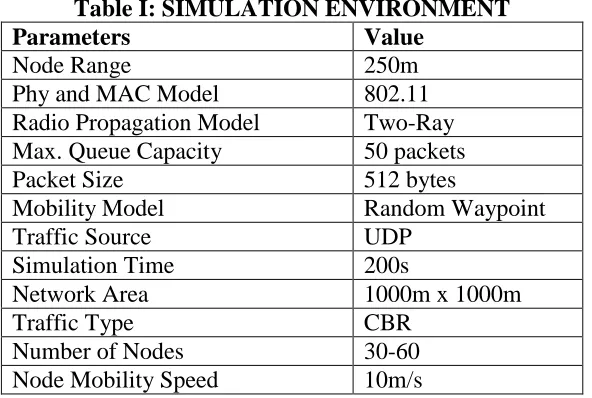
In this paper, performance of each of the protocol under consideration is studied using simulation techniques. It is adequate to simulate in a situation where the real test-bed is a bit costlier to bring together. We simulated a MANET network of 1000 x 1000 meters with varying number of nodes which ranges between 30 and 60 using network simulator 2 (ns-2). We examined the behavior of these protocols under varying network densification. Table I depicts the simulation environment in which the experiments were carried out.
In order to moderate the node mobility within the network, the velocity of nodes is stationed at 10m/s while the pause time was set to zero in the simulation.
152
Table I: SIMULATION ENVIRONMENT
Parameters Value
Node Range 250m
Phy and MAC Model 802.11
Radio Propagation Model Two-Ray Max. Queue Capacity 50 packets
Packet Size 512 bytes
Mobility Model Random Waypoint
Traffic Source UDP
Simulation Time 200s
Network Area 1000m x 1000m
Traffic Type CBR
Number of Nodes 30-60
Node Mobility Speed 10m/s
Among the various parameters evaluated are average packet delay, packet delivery ratio, traffic overhead and network throughput. The choice of parameters for evaluation are based on some related works presented in Adekiigbe and Abu-Bakar (2015), Ng, Ng, Ali, and Noordin (2013), and Salunkhe and Sankpal (2013). Average packet delay gives the average time necessary to transfer a data packet from one node to another. The packet delivery ratio compute the percentage of packets sent within the networks that are successfully delivered to the destination. The volumes of traffic generated by routing protocols are evaluated by the traffic overhead parameter. The throughput is the total volume of data packets delivered within the simulation time.
ANALYSIS OF RESULTS AND RESULT DISCUSSIONS
The parameter values are selected as highlighted in Table I. i-CBRP’s performance is compared with DSR, AODV, and CBRP routing schemes while the various performance measures for mobile wireless ad hoc networks are evaluated.
Performance Evaluation under Varying Network Density
In this section, we used the following performance metrics under varying node densification: average packet delay (APD), packet delivery ratio (PDR), traffic overheads (TO) and average throughput (ATP) for DSR, AODV, CBRP and i-CBRP.
153
In AODV routing protocol, hop-by-hop initiation helps reduce end-to-end delay. While the delay for AODV is higher at a start in case of 30 nodes but it reduces in subsequent stages until end of simulation. Since DSR uses cached routes more often, it sends traffic to out-of-date routes which causes re-transmission and leads to too much delays. Delay for CBRP is higher because of its route discovery process. It takes a lot of time to discover and to make decision on a route through which data can be transferred.
The average end to end delay increases as the density of nodes increases for all routing protocols under comparison. CBRP and i-CBRP behaves similarly as per the increased in end-to-end delay. This is as a result of the fact that more nodes are connected as network density increases. However, the end-to-end delay increment noticed in i-CBRP is lower than that of CBRP.
Figure 1: Average Packet Delay in Varying Node Density
154
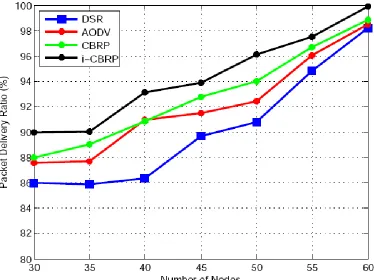
Figure 2: Packet Delivery Ratio in Varying Node Density
155
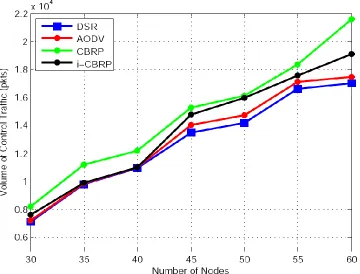
Figure 3: Traffic Overheads in Varying Node Density
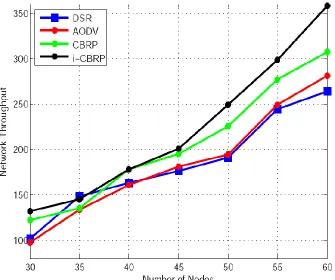
Average Throughput (ATP): The total throughput in all cases is highest for i-CBRP as compared with other protocols. This is due to availability of routing paths for data to be sent from source to destination. The total throughput for i-CBRP is higher, this is as a result of the clustering algorithm adopted in i-CBRP (Adekiigbe et al., 2014). AODV performs better in network with relatively high number of traffic sources and higher mobility. The noticeable increment in ATP was due to the number of nodes that make up the network area. If the number of nodes is slightly increased, the throughput generation might reach a saturation point. The DSR throughput is very low in the network in all cases. However, i-CBRP performs better than all other protocols under comparison. This is due to low end-to-end delay enjoyed by the protocol which results in high packet delivery rate.
CONCLUSION
156
Figure 4: Throughput in Varying Node Density
REFERENCES
Adekiigbe, Adebanjo, & Abu-Bakar, Kamalrulnizam (2015). Implementing Congestion Avoidance Mechanism in Cluster Based Routing Protocol for Wireless Mesh Client Networks. Wireless Personal Communications. Wireless Personal Communications, 81(2), 725-743. doi: 10.1007/s11277-014-2155-7
Adekiigbe, Adebanjo, & Abu Bakar, Kamalrulnizam. (2013). Using Fuzzy Logic to Improve Cluster Based Routing Protocol in Mesh Client Networks. International Journal of Innovative Computing, 3(2), 1-11.
Adekiigbe, Adebanjo, Abu Bakar, Kamalrulnizam, & Umelo, Nnamdi Henry. (2014). Multiple Metrics Fuzzy Based Clustering Algorithm for Wireless Mesh Client Networks.
International Journal of Innovative Computing, 4(2), 7-18.
Ali Safa Sadiq, Kamalrulnizam Abu Bakar , Kayhan Zrar Ghafoor, Jaime Lloret,and Mohammed Adam Ibrahim Fakhreldin. (2015). A Developed Network Layer Handover Based Wireless Networks. International Journal of Software Engineering & Computer Sciences. Vol1. pp.113-122. DOI: http://dx.doi.org/10.15282/ijsecs.1.2015.9.0009
Alotaibi, E., & Mukherjee, B. (2012). A survey on routing algorithms for wireless ad-hoc and mesh networks. Computer networks, 56(2), 940-965.
157
Chakeres, Ian D, & Belding-Royer, Elizabeth M. (2004). AODV routing protocol implementation design. Paper presented at the 24th International Conference on Distributed Computing Systems Workshops.
Cheng, Sheng-Tzong, Li, Jian-Pan, & Horng, Gwo-Jiun. (2013). An Adaptive Cluster-Based Routing Mechanism for Energy Conservation in Mobile Ad Hoc Networks. Wireless Personal Communications, 1-19.
Chiang, Ching-Chuan, Wu, Hsiao-Kuang, Liu, Winston, & Gerla, Mario. (1997). Routing in clustered multihop, mobile wireless networks with fading channel. Paper presented at the IEEE SICON.
Dana, A., Yadegari, A. M., Hajhosseini, M., & Mirfakhraie, T. (2008). A Robust Cross Layer Design of Cluster Based Routing Protocol for MANET. International Conference on Advanced Communication Technology 2008, 2, 1055-1059.
Frikha, Mounir. (2013). Ad Hoc Networks: Routing, Qos and Optimization: Wiley-ISTE.
Jahanbakhsh, Kazem, & Hajhosseini, Marzieh. (2008). Improving Performance of Cluster Based Routing Protocol using Cross-Layer Design. arXiv preprint arXiv:0802.0543.
Jiang, M. (1999). Cluster based routing protocol (CBRP). draft-ietf-manet-cbrp-spec-01. txt. Johnson, David B, Maltz, David A, & Broch, Josh. (2001). DSR: The dynamic source routing
protocol for multi-hop wireless ad hoc networks. Ad hoc networking, 5, 139-172.
Lee, S.J., Belding-Royer, E.M., & Perkins, C.E. (2003). Scalability study of the ad hoc on‐ demand distance vector routing protocol. International Journal of Network Management, 13(2), 97-114.
Mohsin, A.H., Bakar, K.A., Adekiigbe, A., & Gafoor, K. (2012). A Survey of Energy-aware Routing protocols in Mobile Ad-hoc Networks: Trends and Challenges. Network Protocols and Algorithms, 4(2), 82-107.
Ng, Wei Lun, Ng, Chee Kyun, Ali, Borhanuddin Mohd, & Noordin, Nor Kamariah. (2013). Performance evaluation of wireless controller area network (wcan) using token frame scheme. Wireless Personal Communications, 1-27.
Perkins, C.E., & Royer, E.M. (1999). Ad-hoc on-demand distance vector routing. Paper presented at the 2nd IEEE Workshop on Mobile Computing Systems and Applications (WMCSA'99).
Salunkhe, AS, & Sankpal, SV. (2013). Performance Evaluation Using Cluster Based Routing Protocol for MANET. International Journal of Application or Innovation in Engineering & Management 2(1), 328-335.
Yassein, Muneer Bani, & Hijazi, Neveen. (2010). Improvement on cluster based routing protocol by using vice cluster head. Paper presented at the Next Generation Mobile Applications, Services and Technologies (NGMAST), 2010 Fourth International Conference on.