GREEN CONSUMER PROFILES: INFLUENCE OF ENVIRONMENTAL
CONCERN AND SPECIFIC PRODUCT ATTRIBUTES: PROPOSED
THEORETICAL FRAMEWORK
Aasha Sharma
Symbiosis Institute of Operations Management, Nashik Symbiosis International University, India
ABSTRACT
The paper presents some fresh insights in green profiling of consumers. Based on literature review the author posits profiles to be investigated where consumers with high level of environmental concern make unconditional purchase while consumers with low level of environmental concern give more importance to product attributes (benefits & risks associated with the products) and hence make conditional purchase. Some unconcerned consumers make accidental purchase due to parity with green and non- green products attributes.
Keywords: Green Consumerism, Environmental Concern, Green product attributes, Green profiles
INTRODUCTION
and when they understood how a green product could help to solve environmental problems.
Mainieri (et al. 1997) posited that consumers with a stronger concern for the environment are more likely to purchase products as a result of their environmental claims, than those who are less concerned about the environmental issues. Several authors have found an individual’s environmental concern level to be a useful predictor in an environmentally conscious recycling behavior (Arbuthnot, 1975) while many found it useful predictor for green buying behavior. (Ricky Y.K. Chan, 2000) while earlier studies have majorly researched environmental behavior as a function of Intention which in turn is outcome of environmental knowledge and environmental attitude, very few researchers have explored the importance of product attributes in understanding consumer behavior and green purchase decision. The author proposes green profiles based on the importance given to product attributes in purchase decisions by otherwise acclaimed environmentally conscious and concerned consumers.
2. RESEARCH QUESTIONS
Do consumers with high concern purchase green products?
Do consumers with high concern compromise with quality, price functionality and make unconditional purchase?
Does level of environmental concern impact type of purchase made?
Do consumers with moderate concern make conditional purchase that is only when their primary need for performance quality convenience and affordability are met?
Do consumers not concerned at all also make green purchase?
Do perceived benefits lead to green purchase?
Do perceived risks associated with green products hinder green product acceptance?
Do consumers accidentally make green purchases as some products are at Par with Non green products?
Can new consumer profiles emerge out of answers to these questions?
3. GREEN CONSUMER PROFILES
studies based on Green purchase behavior of consumers confirm that purchasing criteria for these consumers goes beyond the usual consuming models (Ioannis et al).Prominent purchase behavior amongst others is showing disapproval of even technically sound products which otherwise would have adverse consequences in the environment (Drucker, 1973; Bernstein, 1992; Peattie, 1995; Peattie, 1999).
Most of the profiling attempts have been to label the consumers according to demographic, socioeconomic and psychographic characteristics.
Demographic characterization of consumers has not been enough to determine profiles of consumers (D’Souza et al, 2007) but useful information in terms of gender influences, relation between age and green behavior, Income and environmental attitudes (Kinner et al, 1974) and literary levels and their sensitivity towards environmental issues have been studied by various authors (Straughan & Roberts, 1999)Demographic profiling generally showed consumers educated, with higher income, women as greener than men and young consumers greener (Peattie, 1992).
Psychographic and behavioral influences have been very popular mainly Attitude, Knowledge, Intention paradigm. Theory of reasoned action and its improved version theory of planned behavior have been the most sought after theories on which various authors have built their theoretical frameworks. Conclusion drawn from most of these studies is that environmental Intent does not lead to actual behavior claiming consideration of many factors which have been neglected. (Bodur & Sarigollu, 2005)As pointed out by some authors in emerging economies where consumer population is complex and actually diverse contextual and situational determinants shape choices. Depending on their overall behavior some researchers have developed new intermediate categories of green consumers such as ‘light ‘versus ‘dark green’ or ‘shallow’ versus ‘Deep greens’ (Dermody,1999).Consumers have also been classified as green or grey (Etzioni, 1998) as recyclers and non-recyclers (De young; 1989 )based on their behaviors. Some researchers have made categories of Intention based hypothetical behaviors while some have made actual purchase based profiles.
Purchase Patterns: Few authors (Gunter, 1992) have examined green profiles based on consumer purchase patterns. The Consumers are divided into four groups, heavy user, medium users, light users and non -users .Other aspects like purchase patterns of brand loyal consumers in terms of frequency of purchase, substitution products, product usage are also examined. (Art Weinstein, 1994) Previous research has indicated that there are clear segments of green consumers based on level of greenness.
consumers’. The product price factor has always been an important factor in consumer buying process and consumers always examine price and brand name information to compare products and to make judgments along with dimensions of other product attributes. So even if the consumer is environmentally concerned his purchase decision will be considerably influenced not by his knowledge or attitude but by the perceived product attributes of green product.
This study proposes that level of environmental concern may determine the level of greenness in terms of green purchase behavior. Though environmental concern has been considered as important predictor of environmentally conscious behavior its correlation with presence of specific product attributes leading to conditional or unconditional purchase has not been explored so far. The author proposes fresh profiles based on this proposition to be investigated.
4. PROFILES PROPOSED
Environmental Concern and product attributes: Consumers in general will purchase products and services with a mix of attributes including environmental attributes that maximizes their utility (Christopher Gan, 2008)Consumers’ willingness and decision to act green are based on perceived economic benefits and economic costs(mainieri,1997) so consumers will act green only if they perceive that individual benefits exceed costs (Hansla et al; 2008).Green hardly matters to consumers when compared to price, quality and convenience(mainieri,1997) generally perceived risks and costs associated with green products in terms of quality, price, lack of information (D’Souza et al 2007),lack of credibility, lack of confidence, Inconvenience, distrust, low functionality are reasons identified for reluctance towards green products. Only highly concerned consumers and not all consumers are willing to purchase the environmentally friendly products within certain constraints (Christopher Gan, 2008) implying that consumers will generally derive greater utility from price and quality attributes than environmental attributes alone. Also, even if the consumers are concerned about the environment, huge differentials and inconveniences associated (Christopher Gan, 2008) with green products may deter consumers from buying them. Based on these contentions the following profiles are proposed.
4.1 Proposed Green Consumer Profiles
Degree/Level of
concern Basis of Purchase Type of purchase
Table no. 1 Proposed Green Consumer Profiles based on degree of concern, basis of purchase and type of purchase.
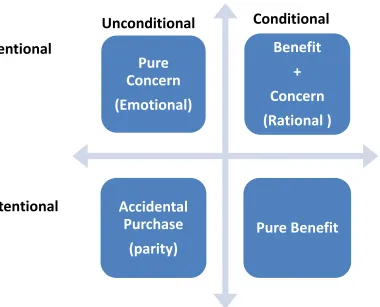
(Refer Fig 1) The first 2 profiles are impacted by environmental concern, but the degree of concern determines the influence of product attributes on purchase intention. Where the degree environmental concern is moderate rational purchase is likely to occur. Even though the consumer is concerned, the purchase will be based on the perceived benefit associated and presence of specific attributes rather than concern. If the environmental concern is high the consumer will indulge into emotional and unconditional purchase. The next 2 profiles are not impacted by environmental concern at all, but by the presence of specific product attributes .Even if the environmental concern is low the consumer purchases green products because of pure benefit associated with it. For example a consumer not concerned about the environment may purchase a CFL bulb due to energy efficiency or may purchase a hybrid car due to fuel efficiency and not environmental concern. The last profile is not impacted by environmental concern and is negatively influenced by risks associated with green product attributes and hence rejects green purchase. (The last profile is not depicted as purchase is not made)
4.1.2 Consumer profile matrix:
Fig. no.1 Consumer profile matrix (Proposed by author)
Pure
Concern
(Emotional)
Benefit
+
Concern
(Rational )
Accidental
Purchase
(parity)
Pure Benefit
Unconditional
Conditional
Intentional
4.1.3 (First Profile) Rational Purchase (Benefit+ Concern) (Refer Model A)
This profile is of consumers who are concerned about the environment and may want to buy green products provided certain conditions specific to product attributes are fulfilled by green products. They may make Intentional but conditional purchase and are not willing to make any compromises. They may have high to moderate environmental knowledge, have positive attitude but make conditional purchase. So the moderating impact of specific product attribute is assumed to be significant. We term these purchases as Intentional, Conditional, Benefit plus Concern Rational purchase.
Model A- Profile 1 Intentional, Conditional benefits plus concern purchase
Profile 2 Intentional-Unconditional, Pure Environmental Concern Purchase.
HIGH CONCERN (UNCONDITIONAL PURCHASE)
LOW/MODERATE CONCERN (CONDITIONAL)
Moderating variables (Model Proposed by author)(Intentional but conditional purchase)
4.1.4 (Second profile) Pure Concern
Purchase Intention
Product Attributes (Condition)
Perceived Benefit
Cost benefit
Parity with Non Green Product attributes—
Price/quality/Convenience
Perceived risks
Discomfort/Inconvenience
Trade off/expensiveness
Low Functionality of the product
Green purchase Environmental
The next profile posited is that of highly concerned consumers who make an intentional and unconditional purchase .The moderating influence of product attributes is assumed to be insignificant. Nothing deters them from buying green products .These consumers may be high on environmental knowledge, possess highly positive attitude, and may be convinced that their actions can make a difference .They are ready to compromise and face inconvenience associated with green products .We term these purchases as Intentional, Unconditional and Pure Concern Emotional Purchase.
Model B -Profile 3. Unintentional- Conditional Pure benefits purchase (No Concern) - Profile 4. No Concern- Accidental –Purchase due to Parity with Non green products
-Profile 5. No Concern - Intentional Non Purchase—due to perceived risks
NO CONCERN BUT BENEFITS AND PARITY
Moderating variables
(Model proposed by author)(Unintentional green purchase) 4.1.5 (Third profile) Unintentional-Pure Benefit
Third profile is of consumers who are not concerned about the environment but are buying green products as there is certain cost benefit associated with it, like fuel or energy efficiency. This is purely benefit and conditional purchase made. Specific product attributes have significant influence on them. Moderate or low environmental
No green Purchase Intention
Product Attributes
Perceived benefits
Cost benefit
Parity with Non Green Product attributes—
Price/quality/Convenience
Perceived risks
Discomfort/Inconvenience
Trade off/expensiveness
Low Functionality of the product
knowledge, negative attitude towards environment are some characteristics which may be identified with these types of consumers. We term these as Unintentional,
Conditional and Pure benefit purchase. 4.1.6 (Fourth profile) Accidental Purchase- Parity of products
Fourth profile is that of consumers who are not aware about the environmental issues, have low environmental knowledge but still have made purchases as the green products were in Parity with Non green products. Moderating influence of Specific product parity has significant influence on purchase. These are Accidental, Unintentional and No concern Purchase.
4.1.7 (Fifth profile) -No purchase- This profile is of Consumers not concerned about the environment, are influenced negatively by risks associated with the products and so don’t buy green.
5. CONCLUSION
The proposed model is to be investigated on actual purchase. By undertaking an analysis into actual purchase, different approaches that consumers take for green consumption and factors that are responsible for green purchases can be uncovered. The study would further give insights whether consumers only make rational purchases or does emotionality of environmental concern trigger green purchase. Does degree of concern temper compromise, tradeoff and unconditional purchase. Overall the importance of product attributes in green purchase decision will also be investigated. Environmental concern and its role as a moderating variable with various degrees of levels and its influence on Purchase Intention and ultimately actual purchase is an unexplored proposition of the proposed model. Further intervention of product attributes and its impact on type of purchase that is conditional or unconditional purchase is also unique.
REFERENCES
Journals
Admantios Diamantopoulosa, Bodo. B. Schlegelmich (2003). Can socio-demographics still play a role in profiling green consumers? A review of the evidence and an empirical investigation.
Journal of Business Research DOI: 10.1016/SO148-2963(01)00241-7.
Arbuthnot, Jack and Sandra Lingg (1975). A Comparison of French and American Environmental Behaviors, Knowledge, and Attitudes. International Journal of Psychology, 10 (October), 275-281.
Ali, A., & Ahmad, I. (2012). Environment Friendly Products: Factors that Influence the Green Purchase Intentions of Pakistani Consumers, 2(1), 84–117.
Bodur & Sarigollu 2005, Environmental sensitivity in a developing country: consumer classification and implications. Environment and Behavior 37(4):487-510.
Christopher Gan, Han Yen Wee, Lucie Ozanne, Tzu-Hui Kao, 2008. Consumers’ purchasing behavior towards green products in New Zealand Innovative Marketing, 4(1), 2008.
Chan, R.Y.K. (2001). Determinants of Chinese Consumers Green Purchase Behavior‘ Psychology & Marketing.18 (4), 389-402.
D’Souza, C., Taghian, M., Lamb, P., Pretiatko, R. (2007). Green decisions: demographics and consumer understanding of environmental labels. International Journal of Consumer Studies, 31.
De young; 1989 cited in P.Wesley Schultz , Stuart Oskamp, Tina Mainieri Who recycles and when? A review of personal and situational factors. Journal of Environmental Psychology June 1995,
105–121, 15, ( 2)
Dermody, 1999. cited in Seonaidh McDonalda*, Caroline J. Oatesb, Panayiota J. Alevizoub, C. William Young & Kumju Hwangd Individual strategies for sustainable consumption. Journal of Marketing Management 28, 3-4, 2012
Etzioni 1998. cited in Seonaidh McDonalda*, Caroline J. Oatesb, Panayiota J. Alevizoub, C. William Youngc & Kumju Hwangd (2012). Individual strategies for sustainable consumption
.Journal of Marketing Management 28, 3-4.
Hansla, A., Gamble, A., Juliusson, A. and Ga¨rling, T. (2008). Psychological determinants of attitude
towards and willingness to pay for green electricity. Energy Policy, 36 (2), 768-74.
Henion K.E (1976). Ecological Marketing. Columbus: Ohio Grid Inc. Afzaal Ali & Israr Ahmad: Environment Friendly Products: Factors that Influence the Green Purchase Intentions of Pakistani Consumers. Pak. j. eng. technol. sci., 2(1), 2012, 84-117
Ioannis Papadopoulos, Glykeria Karagouni, Marios Trigkas and Evanthia Platogianni, Green Marketing. The case of Greece in certified and sustainable managed timber products; EuroMed
.Journal of Business, 5 (2).
Kinnear, T. C., Taylor, J. B., & Ahmed, S. A. (1974). Ecologically concerned consumers: Who are they? Journal of Marketing, 38(2), 20-24.
Mainieri et al; 1997 cited in Tahir Albayrak, Meltem Caber and Şafak Aksoy ; 2010 Clustering Consumers According to their Environmental Concerns and Scepticisms. International Journal of
Trade, Economics and Finance, 1 (1), June, 2010-023X.
McCarty, J.A. and Shrum, L.J. (1994). The recycling of solid wastes: personal values, value Orientations, and attitudes about recycling as antecedents of recycling behavior. Journal of Business Research, 30( 1), 53 – 62.
Ottaman (1992) cited in Mohammad Tariq Intezar, M. Yaseen Khan (2014). Effect of Green Products on Consumer Attitude – A Sustainable Approach. American Journal of Business, Economics and Management, 2(6), 2014,
P Sparks, R Shepherd - Self-Identity and the Theory of Planned Behavior: Assessing the Role of Identification with" Green Consumerism" Social Psychology Quarterly, 1992 – JSTOR
Peattie, K. (1995) Environmental Marketing Management. Meeting the Green Challenge (London: Financial Times).
Peattie, K. (1999) Trappings versus substance in the greening of marketing planning. Journal of Strategic Marketing, 7(2), 131–148
Straughan, R. D., Roberts, J. A. (1999). Environmental segmentation alternatives: A look at green Consumer behavior in the new millennium. Journal of Consumer Marketing, 16, 558-575.
Ricky Y.K. Chan, Lorett B.Y. Lau, (2000). Antecedents of green purchases: a survey in China.
Journal of Consumer Marketing, 17 (4), 338 – 357.
Barrie Gunter, Adrian Furnham, 1992 Consumer Profiles (RLE Consumer Behaviour): An introduction To psychographics Routledge library editions
Art Weinstein 1994. Market Segmentation: Using Demographics, Psychographics, and Other Niche Marketing Techniques to Predict and Model Customer Behavior; Probus Publishing Company, 1994: ISBN 1557384924, 9781557384928
Proceedings
Mainieri (et al. 1997) cited in Loo, Wee Hong; Yeow, Paul H.P.; and Eze, Uchenna Cyril, "Responsible Consumption Behaviour: A Framework for Acquisition, Use & Disposal of