_________
Extraction of Protein from Microalgae Using
Low Pulsed Electric Field
Salamah Samsu1, Fouziah Md Yassin1 and Jedol Dayou1*
1Energy, Vibration & Sound Research Group (e-VIBS), Faculty of Science & Natural
Resources, Universiti Malaysia Sabah, Jln UMS, 88400 Kota Kinabalu, Sabah.
Extraction of specific biological components from microalgae is often prevented by the intrinsic rigidity of the cell wall. Therefore, cell disruption is required to permit access to the internal components of the cells. The purpose of this study is to extract protein from microalgae using low Pulsed Electric Field (PEF). Chlorella vulgaris, Scenedesmus sp. and Chlorococcum sp. were treated with PEF (80 V/cm) in silver/silver and stainless-steel/stainless-steel parallel electrodes treatment chambers for 10 minutes. Treated samples went through solid/liquid separation by centrifugation and the supernatants were further analyzed by Fourier Transform infrared (FTIR) spectroscopy. Results showed that overheating occurred at the negative terminal of the electrode causing damages to cells during treatment. Low pulse duty cycle was able to reduce the overheating effect during PEF treatment. From FTIR spectra, cellulose and protein were detected in the supernatant, indicating that the cells were successfully lysed and some protein managed to diffuse out of the cells during the treatment.
Keywords: Cell Disruption, Protein Extraction, Parallel Electrodes, FTIR Spectroscopy
I. INTRODUCTION
Microalgae have been exploited for decades for its capacity of accumulating protein (Safi et al., 2014). It is known as an efficient biological producer of oil and a versatile source of biomass due to its higher photosynthetic efficiency, biomass productivities and growth rate compared to other mainland crops (Pragya et al., 2013). It grows in an open pond or a closed photo-bioreactor (PBR) (Chisti, 2007; Suali & Sarbatly, 2012). Many studies mainly investigate on lipids extraction for biofuel purposes (Gouvela & Olivera, 2009; Cooney et al., 2009; Foltz, 2012; Azad et al., 2015; Ribeiro
et al., 2015; Guo et al., 2015), thus, neglecting the potential of microalgae as a source of other valuable biological components (Cooney et al., 2009; Kempkes, 2016).
homogenizer (Safi et al., 2014) and pulsed electric field (PEF) (Foltz, 2012). Among these, PEF has the greatest potential as it is a non-invasive method that minimizes solution contamination and avoids excessive heating to enable successive cell wall disruption (Kempkes, 2016).
The present study focuses on extracting protein from microalgae by using PEF method, a non-thermal method that involves treatment of samples by applying continuous electrical pulses across a liquid to open the cell membranes of plant cells (Kempkes, 2016).
II. MATERIALS AND METHODS
In this study, Chlorella vulgaris,
Scenedesmus quadricauda and Chlorococcum sp. were used. They were cultivated using Bold Basal Medium (BBM) in an indoor 1L conical PBR
at pH value range between 6.4 – 7.0 and
temperature between 23 – 28°C (Abdullah et al.,
2007; Krohn et al., 2011). Culture mixing was
achieved by air pump installed on the top of the PBR to generate current that ensure the microalgae to stay afloat for easier gas exchange
at the surface of the culture solution (Persoone et
al., 1980). Microalgae were harvested and
concentrated by centrifugation at 10,000 rpm for 10 minutes.
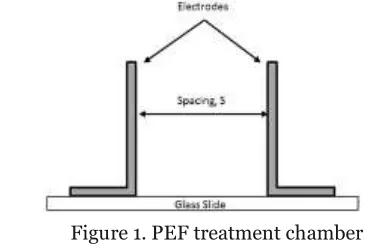
The treatment chamber (see Figure 1) consists of two parallel flat electrodes separated 0.5 cm, fixed on glass plate using non-conductive glue. Two types of chambers were used in this study with Silver (Ag) and Stainless
Steel (SST) electrodes pair of parallel Ag/Ag and SST/SST as the disruption process of the microalgae is influenced by the type of electrode
material (Daghrir et al., 2014).
Figure 1. PEF treatment chamber
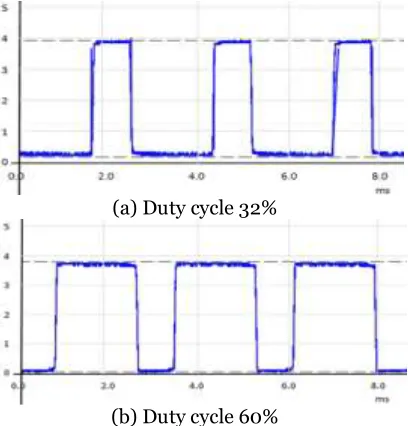
Concentrated microalgae culture was diluted in distilled water as treatment media. The mixture was then put in the space between the two electrodes. Continuous square electrical pulses of 80 V/cm with duty cycles of 32% and 60% were applied across the parallel electrodes of the treatment chamber for 10 minutes. After that, liquid/solid separation was conducted by centrifugation at 10,000 rpm for 10 minutes at
room temperature for 90% efficiency (Pragya et
al., 2013). A Perkin Elmer 2000 Series Fourier
transform infrared (FTIR) spectrometer was used for scanning all samples (supernatant) for
protein detection (Bartosova et al., 2015). The
spectrum resolution was set at 4 cm-1 and the
scanning range was selected from 650 to 4000
cm-1. Each sample (~100µL) was placed onto the
FTIR sample holder and spectra were collected.
III. RESULTS AND DISCUSSIONS
There were voltage drops caused by the loss of energy and resistance of electrodes during the treatment. The treatment was carried out under
lab temperature of 22°C.
Bubbles were formed at the negative terminal of both chambers after 1 minute into the treatment which may indicate microalgae cell damages (Foltz, 2012) when using PEF at 60 % duty cycle. Slight increase in temperature was
also detected, reaching to 27°C. The bubbles
formation were reduced when lower duty cycle (32%) was used with temperature increasing
only to 25°C (see Figure 3). This shows lower
pulse duty cycle has reduced the damages to the microalgae cells.
(a) Duty cycle 32%
(b) Duty cycle 60%
Figure 2. PEF waveforms during treatment
(a) Duty cycle 32%
(b) Duty cycle 60%
Figure 3. Bubbles formed during PEF treatment
During treatment, more microalgae cells were collected to the positive terminal of the treatment chamber (see Figure 4). Longer exposure of PEF caused inhomogeneity of the algal sample and later formed a non-uniform field. This non-uniform field led to the occurrence of dielectro-poretic force causing more algal cells to move to the positive terminal. Additionally, algal shifting to the positive terminal was also due to the bubble formation on the negative terminal of the electrodes.
Before treatment During treatment a) Ag/Ag electrodes
Before treatment During treatment b) SST/SST electrodes
Figure 4. Chlorella vulgaris during PEF treatment at e-field of 80 V/cm for 10 minutes
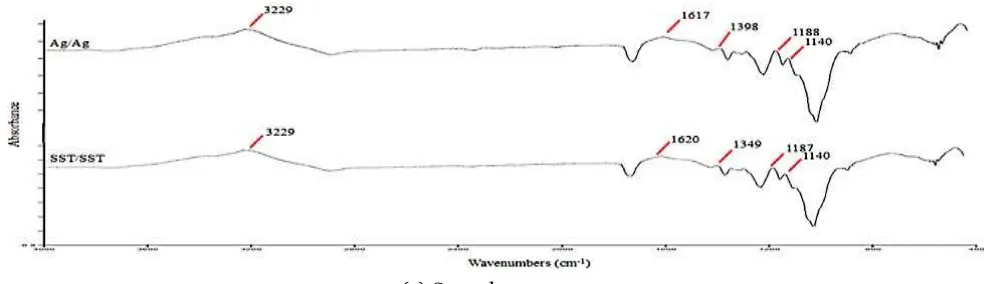
protein bands (3029-3639 cm-1), amide I and
amide II bands representing proteins (around
1660 cm-1 and around 1540 cm-1) and the
carbohydrate region (1200 -900 cm-1) (Figure 5).
Major peak at 3229 cm-1 was due to O─H
stretching (Bartosova et al., 2015) of the water
content in the extracted supernatant. The supernatant extracted from the treated sample contained water as it was used as liquid media during the PEF treatment. Carbohydrate
absorption also occurred at 1187 cm-1 and 1140
cm-1 peaks mainly due to C─O─C of
polysaccharides (Bartosova et al., 2015). One of
the main components of the selected microalgae cell wall was cellulose and therefore the presence of polysaccharides may represent this cellulose
cell wall. This was a major indication that the cell wall of the treated microalgae undergone lysis and some part of the cell wall may have been ruptured during the PEF treatment.
The protein spectra could be characterized by
the 1617-1620 cm-1 and 1349-1398 cm-1 peaks.
These peaks were due to mainly C=O stretching
vibration and the combination of N─H bending and C─N stretching vibrations in the amide
bands, respectively (Bartosova et al., 2015). This
indicated that some protein managed to diffuse out from the cells during the cell disruption treatment as the cell wall was lysed and ruptured. This diffusion of protein out of cell was additionally supported by the presence of cellulose in the extracted supernatant.
(a) Chlorella vulgaris
(c) Scenedesmus sp.
Figure 5 FTIR spectra of treated microalgae for 10 minutes (80 V/cm; 32% duty cycle
IV. SUMMARY
The present study shows additional insight into understanding the PEF method of cell disruption for protein extraction from
Chlorella vulgaris, Chlorococcum sp. and
Scenedesmus sp.. FTIR spectra show presence
of protein and cellulose in all the extracted supernatant of the samples. At 80 V/cm PEF,
lower duty cycle was shown to be a better choice for cell wall disruption using PEF method as less bubbles was formed which indicates less cell damage.
V. ACKNOWLEDGMENT
[1] Abdullah AZ, Razali N, Mootabadi H &
Salamatinia B 2007, ‘Critical technical areas for future improvement in biodiesel technologies’,
Environmental Research Lett, vol. 2, 034001.
[2] Azad AK, Rasul MG, Khan MMK, Sharma SC &
Hazrat MA 2015, ‘Prospect of biofuels as
alternative transport fuel in Australia’,
Renewable and Sustainable Energy Reviews, vol. 43, pp. 331-351.
[3] Bartosova A, Blinova L & Gerulova K 2015,
‘Characterisation of polysaccharides and lipids
from selected green algae species by FTIR–ATR
spectroscopy’, Research Papers of Faculty of
Materials Science and Technology In Trnava, vol. 23.
[4] Chisti Y 2007, ‘Biodiesel from microalgae’,
Biotechnology Advances, vol. 25, pp. 294-306.
[5] Cooney M, Young G & Nagle N 2009,
‘Extraction of bio-oils from microalgae’,
Separation & Purification Reviews, vol. 38, pp. 291-325.
[6] Daghrir R,. Igounet L, Brar SK & Drogui P 2014,
‘Novel electrochemical method for the recovery
of lipids from microalgae for biodiesel
production’, Journal of the Taiwan Institute of Chemical Engineers, vol. 45, pp. 153–162.
[7] Foltz G 2012, ‘Algae lysis with pulsed electric fields’ Master Thesis. California State
Polytechnic University, San Luis Obispo.
[8] Gouvela L & Olivera AC 2009, ‘Microalgae as
a raw material for biofuels production’,
Journal of Industrial Microbiology and Biotechnology, vol. 36, pp. 269-274.
[9] Guo M, Song W & Buhain J 2015,
‘Bioenergy and Biofuels: History Status and perspective’, Renewable and Sustainable Energy Reviews, vol. 42, pp. 712-725.
[10] Kempkes MA 2016, Pulsed electric fields for algal
extraction and predator control’ In
Handbook of Electroporation, Springer International Publishing, pp. 1-16.
[11] Krohn BJ, McNeff CV, Yan B & Nowlan D
2011, ‘Production of algae-based biodiesel using the continuous catalytic Mcgyan
Process’, Bioresource Technology, pp. 94 -100.
[12] Persoone G, Morales J, Verlet H & De Pauw
N 1980, ‘Air-lift pumps and the effect of
mixing on algal growth’, Algal Biomass, pp.
505-522.
[13] Pragya N, Pandey KK & Sahoo PK 2013, ‘A
review on harvesting, oil extraction and biofuels production technologies from
microalgae’, Renewable and Sustainable
Energy Reviews, vol. 24, pp.159-171.
[14] Ribeiro LA, da Silve PP, Mata TM &
Martins AA 2015, ‘Prospects of using
microalgae for biofuels production: Results of a Delphi study’, Renewable Energy, vol.
75, pp. 799-804.
[15] Safi C, Ursu AV, Laroche C, Zebib B &
Merah O 2014, ‘Aqueous extraction of
proteins from microalgae: Effect of different cell disruption methods’,
Algal Research, vol. 3,pp. 61-65.
[16] Suali E & Sarbatly R 2012, ‘Conversion of
microalgae to biofuel’, Renewable