E-SUPPLY CHAIN
Yuanlue Fu
Center for Accounting Studies of Xiamen University in China
Abstract
Strategic cost management of the E-supply chain is one new concept which integrates three fields: strategic cost management, supply chain management and internet application, and develops one of the most important tools about how to apply E-supply chain to the improvement of the competence in creating wealth for firm shareholders and market competitive capacity. This study has two objectives: one is to discover the cyber-value chain coordinating mechanism which is one new mechanism other than market mechanism and firm mechanism; the other one is to construct the framework model of strategic cost management accounting of E-supply chain based on the new mechanism. More specifically, this paper develops three main methods of strategic cost management (including sharing information beyond one company boundary, the synergic management of the product design, and synergic utilization and management of intellectual assets), in order to improve the competitive capacity and to solve some current problems in the cost management beyond company boundary.
Keywords: Strategic cost management, E-supply chain, Cyber-value chain, Cyber-value chain coordinating mechanism, Value chain
Introduction
management in supply chain? Some papers (Simmonds,1981; Allen,1985; Shank and Govindarajan,1992; Yu,1997; Anderson, 2006) suggest applying strategic cost management methods to help accountants to have a better grasp of strategic cost management methods for improving competitive competence.
Since the earliest book of strategic management accounting having been published (Simmonds, 1981) for more than 20 years, there are several different definitions about strategic management accounting in prior literature. Such as, strategic management accounting played a key role in strategic description, strategic announcing, strategic implement and strategic control1 (Shank and Govindarajan,1992). strategic decision-making should be based on predictive information, investment information and future cash flow instead of the traditional accounting information and historical cost information (Allen,1985), and strategic management accounting provides management accounting information for competitive strategy, firm development, market changes, corporate strategic program, strategic implementation and strategic control, and strategic management accounting combines strategic management and management accounting (Ward, 1992).2 Yu, X. (1997) conducts that strategic management accounting not only must pay attention to provide external environment information for decision making, but also need to evaluate the situation of globally competitive strategy correctly.3 The other definition is given by the IMA (Institute of Management Accountant in the USA 1998): strategic management accounting is an accounting model as follows: in the conception of strategic management accounting, decision makers pay attention to non-financial information and traditional financial information, and they must pay attention to the information about external factors of a firm as well. But there is no a concept which can cover strategic cost management and E-supply chain.
In additional, in cost management, there are new demands upon the increasing complexity of inter-firm cost management in E-supply chains. Yet, despite the increasing interest in inter-firm cost management and coordinating beyond the firm boundaries and their potential implications for the field of management accounting, the topic has been largely ignored in the accounting research literature (Hopwood, 1996; Van der Meer-Kooistra and Vosselman, 2000). In this paper, I seek to address this limitation by exploring the theoretical basis, framework model and some application method in the research on strategic cost management in E-supply chain. Especially, the main purposes of this study are:
1. To extend the E-supply chain and value chain to the Cyber-value chain. 2. To define the new concept: Cyber-value chain coordination mechanism. 3. To explore how to integrate the virtual value chain and real value chain into
4. Based on the new concept – Cyber-value chaincoordination mechanism, to build the framework model of strategic cost management in E-supply chain. 5. To develop some new synergic strategic cost management methods in
E-supply chains to solve some emerging management accounting issues.
This paper is organized as follows. The introduction shed light to the background of strategic cost management in E-supply chain and the objectives of the study. Section 2 provides a brief literature review. Section 3 argues that a new theoretical basis for scientific research in strategic cost management is needed to meet the challenges of the fast changes in business firms and environments. Section 4 briefly analyzes the interaction in creating value from the virtual value chain and real value chain in the cyber-value chain. The fifth section discloses several main problems in E-supply chain, and what are the positions of these problems in strategic cost management. The sixth section designs an E-supply chain strategic cost management framework based on the coordination mechanism of cyber-value chain. The seventh section conducts some synergic management methods in E-supply chain strategic cost management. Finally, the last section concludes the main contributions of this paper and some research directions in the future.
Literature Review
Strategic cost management, in theoretical framework, methods and contents, compare with traditional cost management, is more challenging and systematic. But, whether the school theory research can go into practice depends on how to develop an accounting model from strategic cost management and on how to apply the model to enhance the competitive capacity of the specific company. Recent proliferation of papers on strategic cost management and supply chain management related topics explain the increasing interest of researchers for this area. This paper draws upon three research main streams to define the scope of this review.
Shank Research Main Stream
company should choose a suitable cost management approach to match the competitive strategy. Thirdly, after having determined the competitive strategy, company should carry on cost driver analysis to find out what factors induce cost change, and seek reducing cost strategic approach reducing cost to match the specific competitive strategy of the specific company. Moreover, Ward (1992) emphasized that strategic management accounting not only provides decision information for competitive strategy management, but also should be extended to the period strategy accounting ( product period: development stage, growth stage, mature stage and decline stage). Tomkins and Carr’s (1996) model of strategic investment (which draws upon work by Shank and Govindarajan (1992, 1994)) provides an important linkage among strategy formulation, value chain analysis, and cost driver analysis. Anderson (2006) argue that strategic cost management research must be extended from the executional cost management to structural cost management.
Cooper & Slagmulder Research Main Stream
Professor Robin Cooper is one of ABC (Activity Base Costing) initiators. He and His coworker conduct the strategic cost management model (Cooper and Slagmulder (1998a-1998d) in a series of articles about “Management Accounting”. The key idea of this model is to apply ABC to the strategic management. He believes that ABC should be the applicable for strategic management, such as to build the optimal strategy and to provide all services for the strategic program implementation. Furthermore, Cooper and Slagmulder (1998a) argued that strategic cost management is “the application of cost management techniques so that they simultaneously improve the strategic position of a firm and reduce costs”. Those research results attempt to derive the relations between a firm’s strategy, cost structure, and the causal relation between activity levels and the resources that are required (i.e., “cost drivers”). Similar research results are achieved by Anderson (1995), Banker and Johnston (1993), Ittner et al. (1997), Maher and Marais (1998). Furthermore, Cooper and Slagmulder (1998b, 1998c, 1998d) extended strategic cost management of an intra-firm to the strategic cost management beyond the boundaries of the firm, and Cooper and Slagmulder (2004) explore the strategic cost management techniques that cross the organizational boundary between buyers and suppliers and to realize their objective which is to reduce costs through collaborative efforts. We think that the paper of Cooper and Slagmulder (2004) is an innovation result of frontier research topic in strategic cost management.
Kaplan Research Main Stream
linked to performance measures through an integrated performance management process. Kaplan and Norton (1996) extend the cost management to performance management in four perspectives (financial, customer, internal processes, learning and growth). An important feature of their models is introducing the metrics of performance as defined by multiple stakeholders (i.e., employees, suppliers, alliance partners, customers, shareholders, governments and society at large). Furthermore, Kaplan and Norton (2004) build architecture of cause and effect by linking the four perspectives, where a strategy map is developed to force an organization to clarify the logic of how to create value and for whom. Their recent book (Kaplan and Norton, 2006): Alignment: Using the Balanced Scorecard to Create Corporate Synergies, shows that how the whole organization can be aligned vertically and horizontally by executing fully strategy performance management.
Kaplan research stream extend the strategic cost management to strategic performance management of four perspectives, but they do not consider extra-firm cost management in E-supply chain. Therefore, we argue that the extra-firm can not enjoy long-term sustainable profits unless all critical stakeholders enjoy adequate returns (financial or otherwise) while participating in E-supply chains as compared to their alternative opportunities. Thus strategic cost management demands that the firm spend cost as little as possible to achieve the financial objective, but create value as much as needed to meet the desired result of all key stakeholders in E-supply chain. Our research in this field further discovers that many opportunities for optimizing the cost structure of the enterprise lie at the firm boundaries and beyond the firm boundaries. Together these propositions mean that strategic cost management must extend the firm’s current cost management to more distant future periods and beyond the firm boundaries.
According to the three research main streams mentioned above, we argue that strategic cost management in E-supply chain lacks a general conceptual framework model. This conclusion similar to that Tomkins and Carr (1996) concluded that strategic management accounting lacks a general conceptual framework, and Roslender and Hart (2003) conclude that there is still little agreement about what constitutes “strategic management accounting”.
Based on above literature review, we can argue that much of what constitutes modern cost management is mainly depended on the choices about organizational strategy and inter-firm cost structure. In agreement with Cooper and Slagmulder’s (2004) findings, we think that these choices, which are often taken by general managers rather than cost accountants, typically have not been studied by traditional management accounting.
comprehensive views about strategic cost management accounting such as Cooper and Slagmulder (2004) and Anderson (2006).
The Theoretical Basis of Strategic Cost Management in
E-supply Chain: Cyber-value Chain Coordination
Mechanism
In the 1990s, E-commerce, E-fund transfer, high speed data communication techniques and computer decision support systems have been applied to cost management, supply chain management and extended the terminal users of E-supply chain to customers and suppliers. In such environment, could you find a new integrated value chain which can cover value chain (virtual and real), E-supply chain, and value network and so on? Is there a new coordinating mechanism to support and explain the strategic cost management? We try to answer these two main problems in this section.
E-supply Chains and Cyber-value Chains
In the internet environment, Ma5 (2000) conducts that supply chain is a model of network chain structure, which is the integrating control of the information flows, goods flows and fund flows in firm chain. And the model integrates raw material purchasing, product manufacturing, marketing and distribution, supplier, manufacturer, distributor and customer into a network system model. In another word, in this case, integrate supply chain and internet application into one integrated system. We call this the E-supply chain.
In recent years, the management practices of E-supply chain have been developed to the relationship of long term cooperation in all alliance firms and beyond some simple economic activities of the short term cooperation in some firms of supply chain in the past, and integrated network information system into E-commerce so that supply chain management has become a management methodological system of E-supply chain from the simple activity management tool of supply chain6. Furthermore, there are many new concepts, such as E-supply chain, virtual value chain, value network, and so on. However, our researches in the field need a synthesis concept that could cover above those new concepts. Thus, this paper proposes a new synthesis concept – cyber-value chain, which refers to the integration of all business processes (including virtual processes) from end users through original suppliers that provide products, services, and information that add value for customers and other stakeholders in the E-supply chain.
on this synthesis concept, it is easy for us to study what the strategic cost management model of E-supply chain will be beyond the limitation of single firm. The synthesis concept puts emphasis on combining single firm strategies with E-supply chain strategies, and then sets up a decision support system for top management team ether in the core firm or in a coordinating group with their financial information and non-financial information, so that the strategic goal of the core firm and the competitive advantage of the E-supply chain can be achieved.
Cyber-value Chain as the Object Of Strategic Cost Management
The object of traditional management accounting is the internal cash flow in an economical entity, but it greatly depends on internal financial information and is limited to the internal cash flow of a firm. In cyber-value flow, the cash flow is only one tree of a forest (value flow). For example, continuously stable profit comes from the competitive position of a firm and the contribution of other firms in E-supply chains. Thus, we must pay closer attention to the strategic information in E-supply chain. However, few firms make use of the strategic information in the internal management reports. Business market is like the battle field. If only your firm should master the related information about your competitive opponents and the external environment, your firm will lead in the competitive business. Therefore, since strategic management accounting serves in strategic management, its object must not be limited to the internal cash flow, but must include various value flows in strategic decisions and strategic implementations. Furthermore, cyber-value chain includes not only internal value flows but also external value flows and related information, such as national industry policies, product market status, the situation of competitive opponent, value flow information and non-financial information.
The Development of Traditional Market Mechanism and Company Hierarchical Mechanism: Cyber-value Chain Coordinating Mechanism
What mechanism a firm will choose depends on the cost in market transaction or internal production and the cost-effect of producing scale economic from internal production or from outsourcing.
Malone and Benjamin (1987) think that because IT makes market mechanism and company hierarchical mechanism done with higher efficiency and lower market transaction cost, the economical coordination and governance structure based on E-supply chain is superior to that of traditional market. Thus, a famous e-market hypothesis is brought about: the coordination of economic activity would preferably choose the model of market coordination which turns out to be the better trend of market mechanism. There are two important evidences: one is to extend the sale scope of products and to reduce the transaction cost by breaking through the block of time and space; the other one is to reduce the coordination cost.
In fact, the two theoretical evidences mentioned above also stems from forming a cyber-value chain system. Thus, I believe that cyber-value chain will become a new hot topic of theoretical research in management science. Furthermore, there are two other facts to support my viewpoint. One fact is that, in the internet environment, if firm’s value chain is extended to the cyber-value chain which integrates E-supply chain, value flow, virtual value chain, value network and intellectual capital into one value system. The firm must need a new coordinating mechanism to manage the cyber-value chain (including E-supply chain). The other one fact is that, with the theoretical research development of E-supply chain management, the new theoretical basis (cyber-value chain coordinating mechanism) will play a key role in the studies of E-supply chain strategic cost management. In summary, cyber-value chain coordinating mechanism is one inter-firm governance structure and inter-inter-firm management system in cyber-value chain.
Hence, we can infer that cyber-value chain coordinating mechanism will be a new concept in cost management science. This new mechanism is different from the market mechanism and company hierarchical mechanism, as it is more effective and efficient.
The Explanation Power of Extra-firms Cost Management in E-supply Chain by Cyber-value Chain Coordinating Mechanism
means that they can realize their dominant position in price negotiation in the specific products. Furthermore, outsourcing firms bear the lower cost of cooperation transformation in some activities, as they could adjust the cooperation partner based on their needs.
Powell (1990) describes that network model of organization is different from market mechanism and company hierarchical mechanism. Network model is more complex and more flexible than company hierarchical structure. Comparing with market mechanism, cyber-value chain coordination mechanism could provide firms with more chances of information communication, learning and integration, and we could get more much information from cyber-value chain than from market mechanism.
As firms concerning about strategic cost management upstream and downstream firms in E-supply chain, they develop relational contexts that do not fall into the simple dichotomy of markets and hierarchy (Williamson, 1975, 1979, 1985). Instead, these relationships represent intermediate or hybrid modes of governance that enable firms to access the economies of scale and scope of their trading partners in more efficient ways than are possible through either pure arm’s length transactions or through vertical integration (Powell, 1990; Sheppard and Tuchinsky, 1996; Williamson, 1991). Many different forms of relational context between buyers and suppliers have been observed, ranging from relationships in which the interactions are close to market driven, to strategic partnerships in which the firms have signaled their desire to work together closely over the long-term (Heide and John, 1990). Thus, in E-supply chain, market mechanism, company hierarchical mechanism and cyber-value chain coordinating mechanism form a mutual connection network system which penetrates the business processes reengineering among these companies. It is very difficult for traditional market mechanism and hierarchical mechanism to answer the increasingly informatization and network integration. So we must promote the two tiered mechanism (including traditional market mechanism and company hierarchical mechanism) to the new three tiered mechanism (including traditional market mechanism and cyber-value chain mechanism and company hierarchical mechanism) in which we develop a new mechanism – cyber-value chain coordinating mechanism, on the purpose of improving the explanation power of the extra-firms cost management in cyber-value chain.
Integrating the Virtual Value Chain and Real Value Chain
into One Cyber-value Chain
the development of competitive advantage, and it consists of a series of activities that create and build value. There are two kinds of value chains: real value chain and virtual value chain. How to integrate two kinds of value chains is key problem to be solved in this section.
Interactive Value Creation Between Real and Virtual Value Chain
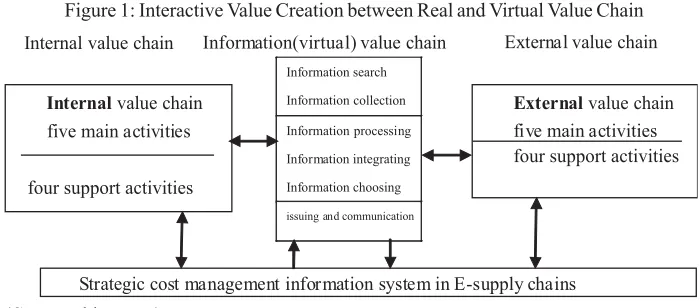
We put forward and develop an integration concept of information (virtual) value chain based on the virtual value chain of Rayport and Sviokla (1995). It clearly describes that information as an independently flowing resource in e-market activities, and information value chain includes information searching and collecting, organizing, choosing, processing, issuing and communicating. Information value chains have not only become a new process (model) of value creation, but also related with real value chain, and make some cycles of traditional value chain automated, so that there are more efficient and flexible activities and processes, and a firm can set up a new customer relation which provides the new value model for customers. The value creating process of interaction in real and virtual value chain is as the following Figure 1.
As shown in the above figure, we can see that both internal and external chain in a company consist of five main activities ( inbound logistics, manufacturing, sale and marketing, outbound logistics, customer service) and four support activities (infrastructure (including information system), human resources, technology support, purchasing), which connects with information value chain to form a value network. In the internet environment, the value network increasingly transform into a dynamic cyber-value chain. There are many interactions between virtual value chain and real value chain through the traditional market space and information space, which connect with other entity value chain to form a value
Figure 1: Interactive Value Creation between Real and Virtual Value Chain
(Source: this paper)
system and continuously interaction and optimization. For the market participants (including companies and customers), the value chain analysis has become main method to make E-supply chain strategies and to organize manufacturing and operations.
Forming strategic information on the basis of the virtual value chain analysis is the premise and foundation of the E-supply. The virtual value chain shows that information has become an independent force to create value in E-supply chain (e-market space). Information is a resource which could be reused, released, processed and shared utilization again and again, but it does not reduce its value, and sometimes increase its value on the contrary. Thus, information is a very important resource. Based on analyzing and building the virtual value chain and scientific programming, a company can form an efficient information strategy to realize the objectives of a company by directing and organizing the information resource which be processed, communicated and utilized.
To Integrate the Virtual Value Chain into Cyber-value Chain
In information virtual value chain, there are three key activities: communication and interaction with customers, cooperation and synergic activities with suppliers, real time connection with third party – market information service, intermediary service and transaction service. Thus, this paper argue that because each company is a node of market value chains system, a company in E-supply chain could apply all information resource through information virtual in network system (as in Figure 1). Therefore, it is obvious that developing the better relation between suppliers, customer and other entities by information virtual value is the key to keep companies more flexible and effective.
information resource and cyber-value coordination mechanism to develop and utilize the external high-quality resources to create its added value. In this course, not only having a new process of value creation and utilizing virtual value chain, but also forming a value matrix and the virtualization of some cycles of real value chain, the core company can make E-supply chain have quick, flexible and effective activities, and build a kind of customer relation system and supplier management system and create value for customers and suppliers in new approach.
To be Solved Several Emerging Problems in Strategic Cost
Management
The representative of the integrated value chain in cyber-value chain is the E-supply chain, which closely connect firm nodes with customers, so that every cycle in E-supply chain should be considered how to coordinate strategic cost management. Thus, there are several main problems to be considered as follows.
The Cost Management in Quick-response for Customer Needs
Quick response for customer can bring your products to market more quickly and secure your business prospects by helping your changing manufacturing arena in time. It will increase profitability by reducing non–value–added time (i.e. cost), cutting inventory cost and increasing return on investment. The objective of quick-response in marketing usually is to satisfy customer needs and to improve cost management and competitive capacity in market. Under the objective, every cycle which could create value in E-supply chain should be helpful for increasing the product value. In E-commerce circumstances, on the one part, customers could use the web homepage of the company’s web homepage to take part in the product design, and to order customer-made personality product to satisfy specific needs. Meanwhile, customers can consult or complain about some products on line and then get response in real time. Moreover, customers also can take part in the discussion on web forum. On the other part, company could apply the count calculator to record the frequency of customer browsing in a specific product and could answer customers’ question on line. However, main problems to be resolved by strategic cost management are how to utilize the real time feedback information that customers present in internet, and how to reflect and integrate those information to some measurement indicators and related value flows. Hence we could build the product design database model for strategic cost management, in order to service for developing and designing of product.
The Strategic Cost Control in Manufacturing and Design in E-supply Chain
to realize the production automation, and be introduced into JIT (Just-in-time) Production System to realize real time planning and controlling models – daily production plan detailing in every production section and JIT control in production processes. The integrated production system can get the zero inventory objectives, and realize that all workers take part in cost management. Thus, product line workers change professional operator into intelligent operator, and they can get those information about their every operation that impacted on the product cost and quality by intranet information system. At the same time, every worker also could present his or her rational suggestions about improving cost management and quality control, also could actively develop and utilize his or her capability on cost management. In this cycle, strategic cost managers pay more attention on how to keep the advantages on product techniques, the higher product quality and the lower product cost, could be presented by the following: 1) how to build value flow database and how to integrate production and product design database into this database system, so that strategic cost management system could use those information from the integrated database at all time; 2) how to realize real time analysis for activity cost in all production section; 3) how to execute strategic control in just in time, including product design, manufacturing processes improving and strategic position during entire product life under strategic cost controlling.
To Extend the Strategic Cost Control to all Activities in E-supply Chain
In the internet environment, company will completely utilize the co-shared advantage resource of E-supply chain and even put some cycles of the other company nodes of E-supply chain into a cyber-value chain, so that it meet the objectives:
1. To reduce the financial cost
In the e-commerce condition, company can quickly search the suitable raw materials from the suppliers’ web homepage. Based on the online analysis information about raw material price and quality, the company can enrich the useful information about purchasing decision, and improve the negotiation capacity for purchasing price, so as to get the lower price of raw materials under certain quality guarantee.
2. To build a closely cooperative relation between purchaser (manufacturer) and supplier in developing and designing some products
3. To seek the cooperation company that has the complementary resources
The relationship between a company and other companies is not purely competitive. Under guidance of strategic plan, the company analyzes the deficient resources in itself, and seeks the cooperation company possesses mutually complementary resources, all companies in E-supply chain can share the advantage of the resources so that these companies could reduce the cost and increase profit in maximum benefit under certain company resources and actual advantages
Real Time Control and Tracking Control in Distribution and Logistics
In the e-commerce condition , logistic and distribution and their tracking control have being an important cycle of E-supply chain, a company applies computer network and database management system to record every path of the product transfer from a place to the other places and its correspondence expenses in real time. How to apply these real time data and information to solve the problems: to coordinate and to control the direction and cost of product flow, and to report the status of customer goods flow, and to draw up the best route based on those statistic analysis data, are important problems of real time and tracking controls in E-supply chain management.
Management Control in Credit Management and Sale Service
Credit management has become an important management activity, and sale service is an important cycle of the strategy of satisfying customers’ need. Of course, company must take full responsibility for solving all problems about credit and product services, but executing this responsibility being execute must pay some expenses. Thus, E-supply chain strategic cost management has to consider these problems: 1) to coordinate the relation between credit management, sale service and strategic objective; 2) to analyze the value of customer creation; 3) to utilize the resource of customer network and the resource of credit management system in synergic sharing.
Strategic Cost Management Implementation and Risk Management in E-supply Chain
the other one model is that extend a company to upstream nodes and to low-stream nodes in E-supply chain by approach of merger and acquisition or cooperation. Hence, the company realize mutually complementary in individual advantage, and diversifies its risks effectively. In the strategic program, there are two key basic premises in risk management decision: one is how to build up the management procedures of risk about important business activities and important investment projects, and in the strategic plan implementation; the other is how to apply risk management models and trade off strategic objective and risk return. Given the above two premises, decision makers could evaluate, test and analyze those alternative projects of investment and business operation processes, and could suitably control those risks, so that the investment projects and business activity plans of the strategic program could be implemented in accordance with the company’s strategic objectives of the company.
Synergic Cost Management and Intellectual Assets Application
In the new economic age, intellectual assets has become a new production important element following the earlier three important elements – land, labor and capital. Thus how to utilize the resource of intellectual assets to create firm value in E-supply chains is a emerging key problems in our research. Strategic cost management, as a decision support system, should be able to provide the related information about intellectual assets to satisfy decision makers’ needs, and then to realize the objective of strategic cost management. In strategic cost management accounting, the management core of intellectual assets is to encourage every people to make maximum contribution for creating value by efficient incentives in an organization. Furthermore, it is the most important thing for firms to make sufficient use of those different advantages of intellectual asset in different company nodes of E-supply chain to enhance the value of E-supply chain, and to attain the multi-win objective of E-supply chain for node companies.
E-supply Chain Strategic Cost Management Framework
Model Based on the Cyber-value Chain Coordination
Mechanism
Defining the Strategic Cost Management in E-supply Chain
Strategic cost management in E-supply chain is important to organizations because it is a philosophy, an attitude and a set of techniques to create more value at lower cost. The critical success factors for strategic cost management not only encompass financial factors, such as costs and revenues, but also non-financial factors that are like new product development, product quality, customer satisfaction. Therefore, the definition for strategic cost management in E-supply chain is a integrated cost management, which integrates cyber-value chain management system into strategic cost management system. It provides non-financial information, traditional financial information, and external information for decision maker in order to get the strategic goal and the competitive advantage of the core firm and node firms in the E-supply chain. Thus it builds a future new framework with four management functions:
1. Strategic management is such management activities which the company chooses its product lines, manufacturing methods, marketing techniques, and other issues of development in long run. Also it supports management decisions by identifying and measuring the cost and value of alternative decisions that potentially affect strategic objectives and operation plans in all parts of the organization.
2. Planning and decision-making in real value chain management and virtual value chain management like managing cash flow, budgeting, purchase of raw materials, production scheduling, pricing, and inter-firms cost management.
3. Management control and operational control in cyber-value chain to increase customer value by identifying opportunities to eliminate non-value adding practices and processes but reward and support effective managers. 4. To prepare financial statements not only for accurate purposes but also to
comply with reporting requirements. These financial statements are mainly used by other three management functions.
In this paper, we will focus on mentioned above seven problems in E-supply chain, and emphasize that internet and Cyber-value chain have a very important effect on strategic cost management that has been forgotten frequently: the coordination and integration aspects.
To Build the E-supply Chain Strategic Cost Management Framework Model
section 2 of this paper, we can see that the research of the strategic cost management in E-supply chain is beyond the traditional management accounting research. Could we directly choose a suitable model from those current models of strategic cost management to satisfy our need in this paper? The answer is no. But, we can choose one model from current models and extend this specific chosen model to the model we need, of course, we could choose the model – strategic cost management based on Cyber-value chain – and extend it to the following model (see Figure 2).
The description of the above model: based on the Cyber-value chain coordinating mechanism, taking the strategic objectives and financial objectives as basic goals of the system, taking the strategic plans as the action guidance of strategic cost management, and integrating virtual value chains and real value chains into an integrated system – Cyber-value chain cost management subsystem, which are utilizing all resources effectively and efficiently (tangible assets, intellectual assets, information etc.) in E-supply chain to create value for a specific firm. The system is emphasized that inter-firms cost synergic management and strategic cost management should match with strategic position of the specific firm. The system does not only pay attention to the cost drivers of a stand-alone company but also pay attention to the cost drivers of other node companies in E-supply chain and macro-economic policies, so that it make up the deficiency which the earlier
Figure 2: The Framework Model of Strategic Cost Management System in E-supply Chain
(Source: this paper)
model of strategic cost management only consider those factors of single company. The system emphasizes that to set up an systematical connection between strategic objective (such as lower product cost strategy and product technique differentiation) and suppliers, company purchasing, design, manufacturing, sale, distribution and logistic, furthermore, to integrate financial management, accounting, risk management, information system and human resource management into the system of strategic cost management in E-supply chain (see Figure 2). Moreover, traditional standard cost, overall budgeting, pricing and cost analysis have become ones of the basic parts which are integrated into the system (including the real time control and management of logistic and fund flow, financial report and other decision information report, performance evaluation and incentive, strategy management decision support subsystem, and so on). Thus, the system emphasizes the cost synergic management for suppliers and customers. In the implementation course of strategic plan (program), of course, the company which chooses cost superiority strategy pays more attention to the cost control and management. That is, in strategic cost management of E-supply chain, company pays even more attention to business processes control and cost management matching with strategic objective and strategic position based on Cyber-value chain coordinating mechanism (see Figure 2).
The Basic Characteristics of E-supply Chain Strategic Cost Management System
Strategic cost management system of E-supply chain being a strategy decision support system, it goes beyond the traditional cost management, and is hoped to solve the complex problem which deal with multi-disciplines (strategy management, financial management, economics, supply chain management, system engineering, cost management system and computer application) synthesis application. In additional, it emphasizes information sharing and synergic management. This new strategic cost management system at least includes several subsystems (show in figure 2: each square frame is a subsystem), and its characteristics are simply described as follows.
1. Higher Degree Integrated
this database to the value flow database. By applying the database to produce the specific decision information for real time analyzing and controlling the activity cost of all production stages and other business processes, to the system can discover the problems and to solve them in time.
2. Real Time Synergic Control beyond the Firm Boundary
Controlling and monitoring in the strategy implementation could be extended to upstream and lower stream in E-supply chain, and could be emphasized on matching with the company’s strategic position. This paper argues that synergic control does not only pay attention to the cost control in micro-level (company internal), but also balance off the cost driver in mid-level (including up-stream and lower-stream of E-supply chain), so that the system could carry on all synergic monitoring and controlling for the entire course of strategy implementation. Comparing with cost control of traditional management accounting, real time synergic control pay more attention to control the external (mid-level) cost and to reduce every cycle cost in E-supply chain.
3. Quick-response in Market
The strategic cost management in E-supply chain could quickly respond to customer need, and improve the competitive capacity by satisfying customer requirement. Under the quick-response objective guidance, every activity of each cycle in E-supply chain which could create value could help to add value to the product. In the e-commerce environment customers could login the company’s web-homepage to take part in product design and make some suggestions for product and sale service. The other one is competitive quick-response to make the company get competitive advantages in the long term. This competitive quick-response also is the main objective of strategic cost management, which determines that the system should be paying attention to the information of competitive opponents. Company should collect those information, such as pricing, cost, scale, and related information about market share ratio in order to analyze the competitive opponents. That external information is helpful for sensitivity analysis of sale price and adjusting the price in specific company, so that the company can increase the operation profit. Furthermore, some real time control decision can automatically make quick response to customers and competitive opponents by the system in accordance with pre-determined decision rules in the control application software.
4. Synergic Utilizing Intellectual Assets and Information Resource
in long run. Therefore, when the company makes some strategies, the decision maker must consider the development in long run instead of the short term profit. In the informatization of the company, data is a kind of intellectual assets, and is very complex and very rich and colorful. To process a large amount of data into useful decision information, accountants and financial analyst possess well experience of using information and analyzing data, and they should become capable men (or women) who could using those data or information to create value for company stockholders.
5. JIT Performance Evaluation
The effectiveness of every activity done by us must be measured and evaluated, on which we can decide the performance and value of this activity. Similarly, in E-supply chain, it is very important that a company scientifically and fully analyzes and evaluates the performance in order to make supply chain develop well. In this paper, based on the characteristics of E-supply chain, we put forward that the performance evaluation of E-supply chain is not simply totaling each company performance in supply chain, but evaluating the overall operation performance and the JIT synergic relation between up-stream and lower-up-stream companies in E-supply chain.
The Synergic Management Methods in E-supply Chain
Strategic Cost Management
In the section six of this paper, the framework of strategic cost management system beyond the boundary of the core company, extend main strategic management processes to external node companies beyond core company boundary in order to seek the approach of reducing the cost of the entire E-supply chain. The Core Company and node companies can utilize sufficiently the synergic opportunity and synergic effect among partners of E-supply chains by means of coordinating the cost management projects between manufacturer and supplier.
Cost Information Co-shared Beyond the Company Boundary Promotes Synergic Cost Management
course, such as the component cost of raw material, manufacturing processes and direct labor.
In addition, in the cost control course, besides paying attention to the information about cost drivers which can be measured in money, we must consider that non-financial information about the cost drivers. For example, in the course of product design, company must firstly trade off material quality and material cost in order to not only satisfies for the customers’ need and product function and to achieve the objective of reducing the cost of the product. This cost information can be separated into three kinds of cost – supplier cost, manufacturer cost and customer cost – based on the cost driver, and these cost information can be further broken into product cost, raw material choosing cost, design cost, manufacturing cost, logistic cost, distribution cost and sale service cost. The core company of E-supply chain should set up a synthesis cost management information system beyond the company boundary to classify and process those cost information, and apply them to coordinate relavant synergic management activities. This cost control method is to control the cost of raw material production beyond the boundary of a company in just in time.
Emphasizing the Synergic Management on the Entire Course of Product Component Design Among Companies
In the past, companies usually only paid attention to those internal cost drivers in the design cycle itself, but company hardly considered to help suppliers to design product components. In order to improve the model of the traditional research and development of a product, this paper proposes to integrate the design distribution of product components, synthesis choice of design alternations and synergic cost control into a synergic design system based on strategic cost management
Figure 3: JIT Control and Management Beyond the Boundary of a Company
accounting system beyond the boundary of the core company (see Figure 4). In the product design project in E-supply chain, the core company should have a set of improving ideas for the basic framework of synergic cost control on design plans, design requirements, design techniques, product structure model and design processes (see Figure 4). Thus, in this subsystem (Figure 4), all design engineers of every company in the E-supply chain could use the information about product functions and quality which can satisfy customer requirement, reduce product cost and apply product cost synergic management, to decide the function scheme and cost structure of the product. Therefore, in the stage of product design, the synergic cost management beyond the company boundary requires all design teams (including core company and other related companies) cooperating closely to complete the design work of the specific product, ton the purpose of getting the goal to seek the design project with better design scheme and the lower cost than any independent design scheme completed by single company. This new model design, in which multi-companies design teams can communicate and discuss the design scheme and decide the optimal product design scheme online in the system (Figure 4), on the purpose of satisfying customer requirements and attaining the multi-win objective.
Synergic Management Efficiency of Intellectual Assets
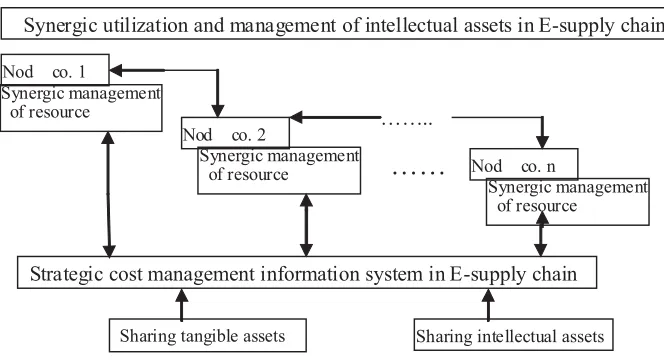
To seek the efficient synergic utilization approach of intellectual assets is one of the most important synergic management of asset resources beyond the company boundary, and is also a key management innovation to improve the capacity of creating firm value. In the internet era, synergic management core group can apply the strategic cost management information system in E-supply chain to the utilization course of intellectual assets to get multi-win objective, which includes customer network sharing, information sharing, advanced management system
Figure 4: The Cost Synergic Management of Product Components Design Beyond the Company Boundary
(Source: this paper)
methods utilizing, famous brand common using, and special techniques communicating and so on. For example, firm brand and information asset can create a great amount of value.
All different node companies could build and utilize one famous brand together, brand value generally show the differential price of the same product with different brand. Especially, when customers (purchasers) take the famous brand as product quality guarantee, a famous brand could create added value for the product with the brand. When one brand is very famous, other company with a usual brand may not create the added value and can not enhance the competitive power. The famous brand could attract more customers so as to realize more sales and to reduce the marketing cost. Thus the famous brand can make more profit for its company.
Information is one of the most important intellectual assets, which could directly influence the business behavior of the company and the response to the market. For example, Wal-Mart super-market alliance stores can make the product portfolio satisfy customers’ needs and provide some loving care service for customers in accordance with the information about customers’ consuming behavior and habit. The suppliers of the supply chain also could use the information to adjust their product mix for making more profit. American Wal-Mart supper-market allied corporation have grown up from a small grocer store in the small town to the biggest supper market corporation with revenue $256 billion and profit 9 billion in 2003 in the world. Wal-Mart’s global purchase strategy, distribution and logistic system, goods management, information system, and the every day lowest price
Figure 5: Synergic Utilization and Management of Intellectual Assets
strategy are world’s well-known successful business cases. Generally speaking, all successful strategies of the Wal-Mart is based on two key aspects: one is the successful IT application to set up a high speed information system; the other is to utilize sufficiently the information from the network information system, to maintain close ties between customers and suppliers, and to realize sharing the management innovation value. Therefore, Wal-Mart could create an amazing great amount of value from information assets.
The above-mentioned three methods could be applied to improve the competitive capacity and to solve those current problems of the cost management beyond company boundary, so as to show the positive effect of cyber-value chain coordinating mechanism.
Conclusions
There are four main contributions in this paper:
1. To put forward a new mechanism: cyber-value chain coordinating mechanism, which is thought as an intermediate mechanism lying between market mechanism and company hierarchical mechanism. This new coordinating mechanism is the theoretical basis of building strategic cost management system, and we can apply this theory to research and discover those deep issues of strategic cost management: quick-response to market, multi-companies synergic cost control and management, multi-multi-companies coordinating the product design, synergic control of logistic and fund flow.
2. This paper argues that strategic cost management in E-supply chain must break through the firm boundary limitation and emphasizes combining single firm strategies with E-supply chain strategies, Besides, based on the financial set up a decision support framework for top management team from the core firm and coordinating group in E-supply chain management based on their financial and non-financial information in order to reach the core firm’s strategic goal and the competitive advantage in E-supply chain.
4. This paper develops three main methods of strategic cost management accounting of E-supply chain. These methods, including sharing information beyond company boundary, the synergic management of the product design, synergic utilization and intellectual assets management, could be applied to improve the competitive capacity and to solve current problems of the cost management beyond company boundary, so as to show the positive effect of cyber-value chain coordinating mechanism.
We expect that the number of research paper in strategic cost management will increase significantly in the next years, given the increased interest in this research field by academicians and practitioners. Some directions for further research that this paper has identified are: (1) to study further theoretical framework on strategic cost management in E-supply chain; (2) to conduct empirical studies about the impact of Internet on strategic cost management; (3) to develop some decision models and technologies and to apply those decision models to the strategic cost management in E-supply chain.
Notes
1 J . Shank and V. Govindarajan : Stragetic Cost Management and Value Chain, Journal of Cost
Management, Winter, 1992.
2 Ward, Keith: Strategic Management Accounting, Butterworth-Heinemann, 1992.
3 Yu, Xuying on the application of “strategy of Sunzi” in Strategic management accounting,
Accounting Rresearch (China), 1997 (12)
4 Shank, J. K. and Govindarajan, V. Strategic cost management : the value chain perspective.
Management Accounting Research[J ], 1992, fall : 179 - 198.
5 Ma, Zhihua (2000). Supply chain management, China mechanic industry Press, 2000. 6 Tan, K. C., Kannan, V. J., Handfield, R. B. and Ghosh, S., 1999. Supply chain management: an
empirical study of its impact on firm performance. International Journal of Operations and Production Management 19 10, pp. 1034-1052.
References
Allen, D. (1985). Strategic Management Accounting. Management Accounting [J], 1985, March: 25-27
Anderson, S. W. (2006). Managing Costs and Cost Structure throughout the Value Chain: Research on Strategic Cost Management, in Chapman, C., Hopwood, A. and Shields, M. (editor) Handbook of Management Accounting Research. Vol 2. Oxford: Elsevier.
Bradley Stephen P. and Nolan, Richard, L. (Editors, 1998). Sense and Respond: Capturing the Value in the Net-work Era, Harvard Business School Press.
Bromwich, M. (1990). The Case for strategic management accounting: The role of accounting information for strategy in competitive markets. Accounting, Organizations and Society, 15 (1/2): 27-46.
Bromwich, M. and Bhimani, A. (1989). Management Accounting: Evolution not revolution. London: CIMA Publications.
Coase, R. H. (1937). The Nature of the Firm. Economica, 1937, 4(13-16): 386-405.
Cooper, R. (1988). The Rise of Based Costing - Part One: What is an Activity-Based Costing? Journal of Cost Management, Vol. 7, No. 3, 45-54.
Cooper, R. (1994). Cost Management in a Confrontation Strategy: Lessons from Japan, casebook. Harvard Business School Publishing, Boston, Massachusetts.
Cooper, R. (1996a). Costing Techniques to Support Corporate Strategy. Management Accounting Research, Vol. 74, No. 2: 219-246.
Cooper, R. (1996b). The Changing Practice of Management Accounting. Management Accounting (UK), Vol. 74, No. 3: 26-35.
Cooper, R. and Chew, Chew, W. B. (1996). Control tomorrow’s costs through today’s designs. Harvard Business Review, 1, 88-97.
Cooper, R. and Kaplan, R. (1988). How Cost Accounting Distorts Product Costs. Management Accounting, Vol. 69, Issue 10, 20-27.
Cooper, R. and Kaplan, R. (1991). Profit Priorities from Activity-Based Costing. Harvard Business Review, May/June 1991, Vol. 69, Issue 3, 130-135.
Cooper, R. and Kaplan, R. (1992). Activity-Based Systems: Measuring the Costs of Resource Usage. Accounting Horizons, Vol. 6, Issue 3, 1-13.
Cooper, R. and Kaplan, R. (1998). Cost and Effect: Using Integrated Cost Systems to Drive Profitability and Performance. Harvard Business School Press, Boston, MA.
Cooper, R. and Kaplan, R. (1999). The Design of Cost Management Systems: Text and Cases. 2nd ed., Prentice Hall, Upper Saddle River, New Jersey.
Cooper, R. and Kaplan, R. S. (1999). The Design of Cost Management Systems, Prentice Hall.
Cooper, R. and Slagmulder, R. (1999). Supply Chain Development for the Lean Enterprise. Inter-organizational Cost Management. Portland, OR: Productivity Press.
Cooper, R. and Yoshikawa, T. (1994). Inter-organizational Cost Management Systems: the Case of the Tokyo-Yokohama-Kamakura supplier chain. International Journal of Production Economics, 37, 51-62.
Cooper, R. and Slagmulder, R. (2004). Inter-organizational Cost Management and Relational Context. Accounting, Organizations and Society 29 (2004): 1-26.
Cooper, R. and Slagmulder, R. (1997a). Target Costing and Value Engineering. Productivity Press, Portland, Oregon.
Cooper, R. and Slagmulder, R. (1997b). Factors Influencing the Target Costing Process: Lessons from Japanese Practice. Working Paper Series, No. 97/30, University of Ghent.
Cooper, R. and Slagmulder, R. (1998a). Strategic Cost Management: What is Strategic Cost Management? Management Accounting, Jan. Vol. 79 No. 7, 14-16.
Cooper, R. and Slagmulder, R. (1998b). Strategic Cost Management: The Scope of Strategic Cost Management. Management Accounting, Vol. 79 No. 8, 16-18.
Cooper, R. and Slagmulder, R. (1998c). Strategic Cost Management: Extra-Organizational Cost Analysis. Management Accounting, Vol. 80, No. 1, 14-16
Cooper, R. and Slagmulder, R. (1998d). Strategic Cost Management: Cost Management Beyond the Boundaries of the Firm. Management Accounting, Vol. 79, No. 9, 18-20.
Cooper, R. and Slagmulder, R. (1999). Develop Profitable New Products With Target Costing. MIT Sloan Management Review, Vol. 40, No. 4, 23-33.
Cooper, R. and Slagmulder, R. (2004). Achieving Full-Cycle Cost Management. MIT Sloan Management Review, Vol. 46, Issue 1, 45-52.
Cooper, R. and Slagmulder, R. (2004), Inter-organizational Cost Management and relational context. Accounting, Organizations and Society 29 (2004): 1-26.
Cooper, R. and Turney, P. (1990): Internally Focused Activity-Based Cost Systems. In: Kaplan, R. (ed.): Measures for Manufacturing Excellence. Harvard Business School Press, Boston, MA, P. Chapter 10, 291-305.
Fu,Y. (2004). The New Method of Value Management: Strategic Management Accounting Based on Value Flow. Accounting Research (china), 2004 (6).
Fu,Y. (1999). Accounting Information System of Supporting for Strategic Management: System Analysis and System Framework Design. Management Accounting Application Topic, Chinese Finance and Economic Press 2000.
Fu,Y. and Yu, X. (2005). The Study on Related Issues about Firm Innovation and Management Accounting Innovation. Research Report (working Paper), Center for Accounting Studies of Xiamen University.
Guilding, C., Cravens, K. S. and Tayles, M. (2000). An International Comparison of Strategic Management Accounting Practices. Management Accounting Research [J], 2000 (11): 113-135.
Gimenez, C. and Louren, H. R. (2005). E-Supply Chain Management: Review, Implications and Directions for Future Research. Available at SSRN: http://ssrn.com/abstract=848424
Hopwood, A. G. (1996). Looking Across Rather Than up and down: on the Need to Explore the Lateral Processing of information. Accounting, Organizations and Society, 21(6), 569-590.
Jarillo, J. C. (1988). On Strategic Networks. Strategic Management Journal, 9 (1): 31-41.
Kaplan, R. S. and Norton, D. P. (1996). The Balanced Scorecard: Translating Strategy into Action, Harvard Business School Press, Harvard.
Kaplan, R. S. and Norton, D. P. (2004). Strategy Maps: Converting Intangible Assets into Tangible Outcomes, Harvard Business School Press, Harvard.
Kaplan, R. S. and Cooper, R. (1997). Cost and Effect, Harvard Business School Press, Boston.
Lamming, R. (1993). Beyond Partnership: Strategies for Innovation and Lean Supply, Prentice Hall, New York.
Lord, B. R. (1996). Strategic Management Accounting :the Emperor’s New Clothes? Management Accounting Research [J ], 7: 347-366.
Ma, Z. (2000). Supply Chain Management, China Mechanic Industry Press.
Malone, T. W., Yates, and Benjamin, R. I. (1987). Electronic Markets and Electronic Hierarchies. Communications of the ACM, 30(6): 484-497.
Miles R. E. and Snow C. C. (1986). Network organizations: New Concepts for New Forms. California Management Review, 28(3): 62-73.
Mitchell, J. C. (1969). The Concept and Use of Social Networks, Social Networks in Urban Situations, Manchester University Press, 1-50.
Nicolaou, A. I. (2002). Adoption of Just In Time and Electronic Data Interchange Systems and Perceptions of Cost Management Systems Effectiveness. International Journal of Accounting Information Systems, 3: 35-62.
Porter, M. (1980). Competitive Strategy: Techniques for Analyzing Industries and Competitor, New York: The Free Press.
Porter, M. (1985). Competitive Advantage: Creating and Sustaining Superior Performance (New York: The Free Press).
Powell, W. W. (1990). Neither Market nor Hierarchy: Network Forms of Organization. Research in Organizational Behavior, Vo1. 12: 295-336.
Rayport, J. F. and Sviokla, J. R. (1995). Exploiting the Virtual Value Chain. Harvard Business Review, November-December: 21-36.
Shank, J. K. and Govindarajan, V. (1989). Strategic Cost Analysis: The Evolution from Managerial to Strategic Accounting. Homewood, Richard Irwin Inc.
Shank, J. K. and Govindarajan, V. (1992a). Strategic Cost Management: Tailoring Controls to Strategies. Journal of Cost Management, Fall, 14-24.
Shank, J. K. and Govindarajan, V. (1992b). Strategic Cost Management: The Value Chain perspective. Journal of Management Accounting Research, Fall, 179-198.
Shank, J. K. and Govindarajan, V. (1993a). What “Drives” Cost? A Strategic Cost Management Perspective. Advances in Management Accounting, 2, 27-46.
Shank, J. K. and Govindarajan, V. (1993b). Strategic Cost Management: The New Tool for Competitive Advantage, Free Press, New York.
Simmonds, K. (1981). Strategic Management Accounting. Management Accounting, April: 26-29.
Van der Meer-Kooistra, J. and Vosselman, E. G. J. (2000). Management Control of Inter-firm Transactional Relationships: the Case of Industrial Renovation and Maintenance. Accounting, Organizations and Society, 25(1), 51-77.
Wang, H. and Yang, J. (1997). On Strategic Management Accounting. Accounting Rresearch (China), 1997 (10).
Ward, K. (1992). Strategic Management Accounting, Butterworth-Heinemann.
Williamson, O. E. (1975). Markets and Hierarchies – Analysis and Antitrust Implications. New York: Free Press.
Williamson, O. E. (1979). Transaction Cost Economics: the Governance of Contractual Relations. Journal of Law and Economics, 22, 233-261.
Williamson, O.E. (1985). The Economic Institutions of Capitalism. New York: The Free Press.
Yu, X. (1997). On the Application of “Strategy of Sunzi” in Strategic Management Accounting, Accounting Research (China), (12).
Appendix A:
Value chain: Itconsists of a series of activities that create and build value. Supply chain: It is a model of network chain structure, which is the integration control of the information flows, goods flows and fund flows in firm chain. And the model integrates raw material purchasing, product manufacturing, marketing and distribution, supplier, manufacturer, distributor and customer into a network system model.
E-supply chain: It integrates supply chain and internet application into one integrated system.
Cyber-value chain: which refers to the integration of all business processes (including virtual processes) from end users through original suppliers that provides products, services, and information that add value for customers and other stakeholders in the E-supply chain. We can infer that this new concept including value chain, virtual value chain, supply chain and E-supply chain from the definition of cyber-value chain.
Virtual value chain. In this paper, virtual value chain is an information value chain. Everyone knows that information is a independently flowing resource chain in e-market activities, which include information searching and collecting, organizing, choosing, processing, issuing and communicating. Information value chains have not only become a new process (model) of value creation, but also relate with real value chain, and make some cycles of traditional value chain automated, so that there are more efficient and flexible activities and processes, and a firm can set up a new customer relation which provides the new value model for customers
Cyber-value chain coordinating mechanism is one inter-firm governance structure and inter-firm management system in cyber-value chain. We believe that cyber-value chain coordinating mechanism will be a new conception of management science because the new mechanism is different from and more effective and efficient than market mechanism and company hierarchical mechanism.
Call for Papers
The editors invite submission of papers for the second issue of the Asia-Pacific Management Accounting Journal (APMAJ). APMAJ publishes high quality papers on management accounting issues once per annum, covering a broad range of subject matter and method. The main criteria for acceptance of a paper are technical correctness and substantive contribution to the management accounting literature. However it is necessary that all papers be well written, up to professional standards. Submitted papers that do not pass the last criteria will not be entered into the review process.
EDITORIAL POLICY
z An objective of APMAJ is to publish research papers that address relevant and contemporary issues in the field of management accounting which are useful to the academia and community at large.
z APMAJ seeks to communicate with a wide audience and will accept for consideration manuscripts that are theoretical in nature, empirical, conceptual or behavioural and have direct implications for present or future practice. APMAJ has a broad focus and the scope of acceptable manuscripts is also broad, and papers may include but are not limited to:
Management Accounting Innovations Management Accounting Control System Financial-based Management Accounting
Systems
Contemporary Management Accounting Practices
Evolution of Management Accounting Management Accounting Practices Strategic Management Accounting Integrated Management Accounting Enterprise Governance
Management Accounting History
Comparative Studies on Management Accounting
z From time to time, contributed papers on special themes relevant to the development of management accounting will be commissioned. These and all submitted articles will be refereed. The journal employs the double-blind review process, where reviewers and authors remain anonymous throughout the review process.
z All contributions must be in the English language. Emphasis is placed on direct and clearly understood communication, originality and scholarly merit.
EDITORIAL GUIDELINES FOR CONTRIBUTORS
z Authors should submit three paper copies of their manuscript. Alternatively submissions may be made in the form of MS Word files by email to the chief editors. Only original papers will be accepted and copyright of published
z Manuscripts submitted should be typed with double spacing and should not exceed 30 pages in length (including endnotes, references, supporting exhibits and any appendices). Margins should be appropriate to facilitate editing and duplication.
z Authors are required to include a cover page indicating the name(s), affiliation, address, contact numbers and email addresses. An abstract not exceeding 150 words should be enclosed on a separate sheet, at the beginning of the text. The abstract should provide a statement of the purpose and procedures of the study, including major conclusions of the research. Figures and tables should also be on separate pages at the end of the text. Endnotes should be kept to a minimum. References should be complete and placed at the end of the manuscript. Samples of entries are as follows: Book: Williamson, O. (1993) The Nature of the Firm, New York: Oxford Press
Journal: Zhou, Z. H. (1998) “Chinese Accounting Systems and Practices”, Accounting, Organizations and Society, 13, 2; 207-224.
z Manuscripts submitted to the journal will be initially screened by the chief editors, to determine its appropriateness. Those considered inappropriate for any reason will be returned to the author(s).
z Only those manuscripts considered appropriate by the managing editors will be refereed. Editorial Board members as well as additional appointed experts will then review the manuscripts to ascertain suitability for publications.
z Manuscript and case submissions should be sent to:
Assoc. Prof. Dr. Wee Shu Hui APMAJ Administrator Faculty of Accountancy
Universiti Teknologi MARA (UiTM) Level 11, Menara SAAS
40450 Shah Alam Tel: 03-55444975 Fax: 03-55444921
APMAJ & APMAA
The Asia-Pacific Management Accounting Journal (APMAJ) is a refereed international journal published by the Asia-Pacific Management Accounting Association (APMAA) in collaboration with the CIMA-UiTM Asian Management Accounting Research Centre (AMARC). The mission of APMAJ is to publish research that addresses management accounting principles and management accounting best practices as strategic tools for organizations, especially in today’s competitive business environments with special focus in the Asia-Pacific region. The journal aspires to stimulate quality researches through smart collaborations between universities, professional accounting bodies and the industries.
The Asia-Pacific Management Accounting Association (APMAA) was established in 2004 as an international academic organization with special focus on management accounting of the Asia-Pacific region. The proposal to form the Asian Management Accounting Association was first mooted at the convention of Asian Management Forum, which was held on 3rd and 4th November 2002 in Japan. Since that time, the participants from different countries continued to share the same vision of advancing management accounting research and practices with particular reference to the Asia-Pacific region. As a result, when the second convention, Asia-Pacific Management Accounting Forum was held on 24-25, November 2004 in Malaysia, it was unanimously decided that the time had arrived to establish the Asia-Pacific Management Accounting Association with two main objectives.
1. The objective of APMAA is to promote the advancement of management accounting theory and practices with particular reference to Asia-Pacific accounting issues.
2. For this purpose, APMAA shall undertake to organise forums and conferences, and the publication of the journal: Asia-Pacific Journal of Management Accounting.
The 3rd Asia-Pacific Management Accounting Forum was held in Fukuoka, Japan in March 30-31, 2006. The main theme of the Forum was Present and
Future of Management Accounting. The forum attracted more than 40
ASIA-PACIFIC MANAGEMENT ACCOUNTING JOURNAL
Subscription
Annual subscription rates, 2007
International Individuals US$25, per issue Institutions US$50, per issue
Back issues International Individuals US$30, per issue
Institutions US$60, per issue
The price includes postage and covers one issue of the journal for the current year. APMAA has the right to determine the appropriate number of issue/ s per year. Subscriptions will not be accepted from Institutions at the Individual rate. Discounts are not provided to subscription agencies.
Payment
Please forward payment Prof/Dr/Mr/Ms via bank drafts marked
attention to: Address Professor Akira Nishimura,
Chief Editor
Asia-Pacific Management Accounting Journal (APMAJ)
Beppu University, 82, Kita Ishigaki, Beppu 874-8501, JAPAN
Tel. 09 77-67-0101
Fax: 0977-66-9696 Email Email: