© Penerbit UTHM
DOI: https://doi.org/10.30880/ijie.2018.10.02.018
*Corresponding author: [email protected] 2018 UTHM Publisher. All right reserved.
penerbit.uthm.edu.my/ojs/index.php/ijie
93
Study on effect of variations of meta-kaolin addition on
Self-Compacting parameter of High Strength Concrete
Wibowo
1*, Mediyanto A
1, E A Dharmawan
11Department of Civil Engineering
Universitas Sebelas Maret, Jl. Ir. Sutami 36A 575125, INDONESIA.
Received 01 January 2018; accepted 15 April 2018, available online 07 May 2018
1. Introduction
Generally, a high strength concrete has a high durability and low cement water factor ratio compared to conventional concrete that has only a compressive strength of 30 MPa - 40 MPa. To obtain a compressive strength till 60 MPa or equivalent to 650 kg/cm2 can use the type of concrete self-compacting concrete. Self-compacting concrete is a very plastic and easy-flowing fresh concrete because its own weight can fill up throughout the mold. This concrete has the properties to solidify itself without the need for the aid of a vibrator commonly used in concrete compaction. SCC concrete is often called a flowing concrete because it has a very high slump value. Self-compacting concrete must have a homogeneous, cohesive, non-segregated, and no bleeding properties.
HSSCC is one of the concrete innovations that have high quality standards. This type of concrete has a high compressive strength and can solidify without the aid of tools. High quality concrete tends to have high viscosity, so the use of super-plasticizer is required to improve workability and maintain SCC parameters. In order to achieve high workability super plasticizer can be used as an added ingredient that is directly mixed into the mortar of concrete. Then to reach high compressive strength concrete, from previous research, adding pozzolan material able to increase the ultimate strength. Added material (admixture) is a powder or liquid material, which is added to the mixture of concrete during stirring in order to alter the nature of the mortar or its concrete.
The use of meta-kaolin in normal concrete can make more homogeneous concrete paste because of reaction between meta-kaolin which is pozzolan with
calcium hydrate of cement hydration. Meta-kaolin is a highly reactive pozzolan that is useful in improving the quality of concrete by increasing the compressive strength and reducing the time of concrete settings [11].
The more the amount of addition of meta-kaolin in the concrete, the decreased workability caused by the surface area of meta-kaolin is greater than the cement. This can be overcome by the addition of super-plasticizer so that concrete SCC parameters can be maintained. According to Parameters to be studied in this research is compressive strength and self-compacting concrete parameters. According to another study, the replacement of cement with meta-kaolin decreases the workability of concrete [1], [4]. To obtain concrete with meta-kaolin-added materials that have high compressive strength with good workability, further research is needed.
In this research used meta-kaolin as admixture. Meta-kaolin is a pozzolan used as admixture or a cement replacement to improve the quality of HSSCC and reduce the weaknesses found in conventional concrete. Meta-kaolin derived from kaolin that is heated at a temperature of 500 - 900 o C, in the form of a powder size of 0.5 to 5 microns and is white. Although in Indonesia its use is still scarce, in other countries, meta-kaolin be an alternative to silica fume because it is cheaper and can reach a compressive strength such as silica fume. In this study, meta-kaolin is expected to increase the compressive strength and durability of concrete, reduce the porosity and permeability of concrete.
Abstract: High strength self-compacting concrete (HSSCC) is one of the concrete innovations that have a high quality standard. This type of concrete has a high compressive strength and can compact without tools. Meta-kaolin (MK) is used in this research as an addition (admixture) to increase the quality of HSSCC and to meet criteria of SCC. Meta-kaolin (MK) is made from kaolin which a white powder is measuring 0.5 to 5 micron that then heated at 500– 900oC. Parameters that are studied in this research are setting time, workability, and the compressive strength of HSSCC. Final results of the research shows that the addition of MK decrease workability of HSSCC. Only MK addition at 5%, 7.5%, and 10% fulfils filling ability and passing ability parameter of SCC, otherwise the compressive strength increases linearly.
94
2.
Experimental program
There are two properties (1) Fresh properties (2) Hardened Properties for studying of SCC. Fresh concrete will be measured for observing self-compacting parameters. Hardened concrete gave the values of compressive strength that affected by meta-kaolin addition.
2.1. Mix Proportion
In this study, repeated trial mixed design to obtain the proportion or composition of materials in accordance with the target research [9]. Table 1 shows the composition design of HSSCC used for testing in laboratory.
Table 1. Composition of HSSCC
Material used Control material
cement (kg) 696.03
Fine aggregates/sand (kg) 651.17
Coarse (kg) 785.01
Water (ml) 187.93
Super plasticizer (ml) 11.11
Tabel 2. Dosage of meta-kaolin
Material used Dosage of meta-kaolin
5% 7.5% 10% 12.5%
cement (kg) 657.17 657.17 657.17 657.17 Fine
aggregates/sand
(kg) 651.17 651.17 651.17 651.17 Coarse (kg) 785.01 785.01 785.01 785.01 Water (ml) 187.93 186.54 186.08 185.62 Super
plasticizer (ml) 11.06 11.03 11.00 10.97 Meta-kaolin
(ml) 34.63 51.82 68.92 85.94
Specimen code HSSCC MK5 HSSCC MK7.5 HSSCC MK10 MK12.5 HSSCC
3.
Results and Discussion
3.1. Tests of Parameters of Self-Compacting
Concrete (SCC)
Basically fresh concrete testing is performed to see mixed concentration as a basis for ease of work. Fresh concrete tests for SCC include testing of flow table, L-box, and V-funnel
a.
L-Box testing
.In this research L-box testing is done to know the passing-ability of self-compacting concrete.
1
2
(%)
h
PA
h
(1)Where:
PA: The initial high difference divided by the concrete end of the flow (passing Ability)
h1: Initial level of concrete flows (cm) h2: The final height of the concrete flows (cm)
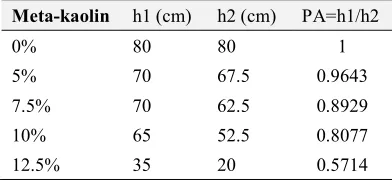
Tabel 3 Passing Ability testing results
Meta-kaolin h1 (cm) h2 (cm) PA=h1/h2
0% 80 80 1
5% 70 67.5 0.9643
7.5% 70 62.5 0.8929
10% 65 52.5 0.8077
12.5% 35 20 0.5714
The content of meta-kaolin in the concrete material gives a significant influence of compliance to the nature of SCC. Range of passing ability according EFNARC: 0.8 to 1.0 as shown in Table 3, addition of meta-kaolin from 5% to 10%, passing ability parameters is still suitable, but in addition of 12% then the concrete is no longer classified as SCC.
b.
Slump flow testing
Flow Table Testing is done to determine the filling-ability of self-compacting concrete.
Table 4. Filling Ability testing results.
Meta-kaolin d1 (mm) d2 (mm) Time (s)
0% 740 750 05.64
5% 680 690 10.10
7.5% 670 720 11.30
10% 640 670 21.38
12.5% 500 530 22.76
95
ability of cement base material influenced by duration of setting time.
c.
V-Funnel testing
V-funnel testing is done to determine segregation resistance of self-compacting concrete. The test kit is made of a V-shaped steel plate and there is an opening valve at the bottom [8].
Table 5. Result of segregation resistance of self-compacting concrete
Dosage of admixture
Time (s) Super plasticizer Meta kaolin
1.70% 0% 8.00
1.70% 5% 13.01
1.70% 7.5% 14.18
1.70% 10% 29.11
1.70% 12.5% 39.71
Result of the V-funnel test showed that meta-kaolin influence performance of self-compacting concrete in term of segregation resistance, it could be understand that the duration of setting time increase sharply when amount of meta-kaolin raised.
From Table 4, it is shown that the addition of meta-kaolin dosage causes the concrete does not meet the criteria as SCC. According to The European Federation of Specialist Construction Chemicals and Concrete Systems (EFNARC) the flow time requirement in the V-funnel test ranges from 6 to 12 seconds in order to be stated to meet the criteria as SCC
. The addition of meta-kaolin increases the duration of setting time but increases the viscosity of fresh concrete. This results in fresh concrete flow time measurements rising, thereby reducing segregation resistance, and then reducing the quality of concrete.
d.
V-funnel T 5second testing
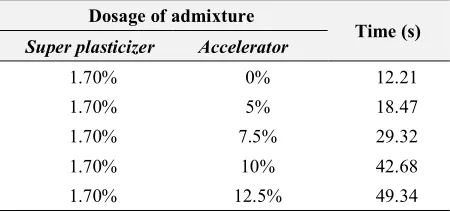
V-funnel T5 minute test was conducted to determine segregation resistance of self-compacting concrete in 5 second after mixing. Using same instrument as V-funnel test but adding time lag 5 minutes after mixing. Table 5 illustrate the result of V-funnel T 5 second.
Table 6. Result of V-funnel T5
Dosage of admixture
Time (s) Super plasticizer Accelerator
1.70% 0% 12.21
1.70% 5% 18.47
1.70% 7.5% 29.32
1.70% 10% 42.68
1.70% 12.5% 49.34
V-funnel test T5 second is the most important result, because addition of meta-kaolin has to limit no more than 5 second time lags. Hence, all above result is out of range from minimal requirements SCC properties.
One of the effects of the addition of meta-kaolin on concrete is the decrease in the workability of concrete which can be seen from all the above SCC parameter test data. The more meta-kaolin levels used, the more decreased the workability of the concrete. The decrease in workability due to meta-kaolin size used is very small and has a larger surface area than cement. The large surface area and than its clay-like properties that absorb water leads to an increase in the water requirement of the concrete mix. The addition of meta-kaolin causes a mixture of dry concrete due to the amount of water absorbed by meta-kaolin causing decreased workability of concrete [9].
3.2. Compressive strength of
self-compacting concrete
Compressive strength was measured use cylindrical specimen with diameter 15 cm and height 30 cm, where this specimen will be crushed by Compression Testing Machine (CTM) at age 14 and 28 days. Content variations of meta-kaolin used are 5%, 7.5%, 10% and 12.5%. The following table shows the detail various type of specimen used in this research.
The dosage of meta-kaolin is varied, because objective of testing is determining trend and optimum dosage that satisfy with the properties of SCC and also giving an optimum of compressive strength. But dosage of plasticizer is constant in order for minimizing plasticizer influence towards compressive strength of concrete.
In this test, specimen classified to be two group: specimen tested on 14 days and 28 days after remoulding and curing. Variations of mixed meta-kaolin dosage added with super plasticizer presented in table form as follows:
Table 7. Compressive strength of self-compacting concrete
Compre ssive Strength
(MPa)
Dosage of Meta-kaolin
0% 5% 7.5% 10% 12.5%
14 days 37.82 28.11 30.84 33.58 49.99 28 days 41.87 41.69 46.30 57.12 61.09
96
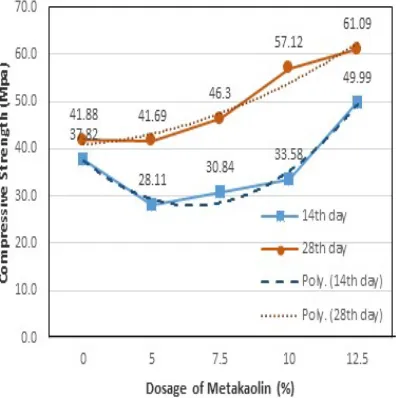
Fig. 1 shows that the control specimens meet the requirement of high strength concrete. At the age of 14 days, specimen has value of compressive strength about 37.8 MPa, while at 28 days reached 41.87 MPa. Base on the previous observation and measurement of passing ability and filling ability, these specimens also meet the requirement of self-compacting concrete
Fig 1. Compressive strength of SCC with addition meta-kaolin and super-plasticizer
Fig 2. Compressive strength with variation of meta-kaolin addition
The addition of meta-kaolin at 14 days does not increase the initial compressive strength of the concrete due to the highly concentrated mixture of high strength self-compacting concrete (HSSCC) so there is very little empty space between cement and aggregate. The density of this mixture causes meta-kaolin to be inhibited in filling the empty space. This imperfect filler effect causes a low initial compressive strength [9]. Another possible cause with the addition of additives that interfere with compounds in the cement that play to increase the initial
compressive strength of concrete is Three calcium Silicate 3Cao SiO2 (C3S) and three calcium Aluminate 3CaO Al2O3 (C3A) compounds. The pozzolanic reaction of 14 days old concrete and low pozzolan content has not been able to react with CH optimally as it did in the 28-day-old concrete [4]. Concrete with 12.5% meta-kaolin addition at 14th day of age the compressive strength is higher than the reference concrete. In addition to this 12.5% meta-kaolin content, the pozolanic reaction is more visible than the lower level in increasing the compressive strength of the concrete.
The 28-day-old concrete compressive strength increases steadily along with the high levels of meta-kaolin used. This increase in compressive strength is in accordance with other studies caused by the reaction of pozzolanic meta-kaolin, filler effect, and ball effect [10].
4.
Summary
From data of test result, data analysis, and discussion of high quality concrete condensate independently with variation of meta-kaolin composition, the following conclusion can be drawn
The addition dosage of meta-kaolin in high strength concrete mixtures significantly increases the compressive strength of concrete in linear pattern, but from this research got the fact that meta-kaolin greatly affect the fulfillment of self-compacting concrete standard, so only dosages ranged 5% to 10% which meet all SCC specifications.
Adding until 10% dosage of meta-kaolin, HSSCC testing for passing-ability and filling-ability parameters meets EFNARC standard, while for segregation resistance parameter does not meet EFNARC. It is clear when the problem of viscosity at the time of addition of meta-kaolin can be solved it will be obtained concrete with high strength and meet the criteria as SCC. When we increase the percentage of meta-kaolin until 12.5 % so, the concrete material is not classified as SCC.
In terms of the effect of the compressive strength of concrete, the addition of meta-kaolin contributes significantly to raising the compressive strength of concrete.
References
[1] Sunarmasto, Kristiawan S, Putri N, & Basuki A 2013 Studi Eksperimental Mengenai Sifat Segar dari Beton Mandiri yang Menyertakan Flyash dalam Volume Tinggi Journal Teknik Sipil, (2013) Universitas Sebelas Maret.
[2] Barbhuiya, S., Chow, P., Memon, S.,“Microstructure, hydration and nano mechanical properties of concrete containing meta-kaolin”.,(2015) Curtin University, Australia.
97
[4] El-Din, H.K.S., et al. “Mechanical performance of high strength concrete made from high volume of Metakaolin and hybrid fibers”.(2017) Structural Engineering Department, Faculty of Engineering, Zagazig University, Egypt
[5] Tan H, Bauguo M A, Xianguo L, Jian S, Yang H., Effect of competitive adsorption between Sodium Tripolyphospate and Napthalene Superplasticizer on fluidity of cement paste, (2014), ©Wuhan University of Technology and SpringerVerlag Berlin Heidelberg
[6] Betancourt G H., Journal Material and Structure, ,Volume 21, (1998) pp 286-288
[7] S Chandra J, Bjornstro M 2002 Journal Cement and concrete research, Volume 32: 1, (2002) pp. 605- 611
[8] Ozawa K, Sakata N, and Okamura H 1995 JSCE Concrete Library, Volume 25 (1995), pp. 59-75 [9] Norhasri, M.S.M., et al., “Inclusion of nano
metakaolin as additive in ultra-high performance concrete (UHPC)”, (2016), Faculty of Civil Engineering, Universiti Teknologi MARA (UiTM), Shah Alam, Selangor, Malaysia
[10]Srivastava, V., Kumar, R., Agarwal, V.C., “Metakaolin Inclusion: Effect on Mechanical Properties of Concrete”, (2012) Civil engineering department MNNIT, Allahabad, India