R E S E A R C H
Open Access
A new method of generating hard random
lattices with short bases
Chengli Zhang
1,2*, Wenping Ma
1, Hefeng Chen
3and Feifei Zhao
1Abstract
This paper first gives a regularity theorem and its corollary. Then, a new construction of generating hard random lattices with short bases is obtained by using this corollary. This construction is from a new perspective and uses a random matrix whose entries obeyed Gaussian sampling which ensures that the corresponding schemes have a wider application future in cryptography area. Moreover, this construction is more specific than the previous constructions, which makes it can be implemented easier in practical applications.
Keywords:Cryptography, Gaussian distribution, Hard random lattices, Short bases
1 Introduction
A lattice has a typical linear structure and some problems about it have been proven to be NP-hard. Many exciting developments in lattice-based cryptography have occurred in the past few years [1–10], and there has been renewed interest in lattice-based cryptography as prospects for a real quantum computer improve. As is well known, some lattice-based cryptosystems can be resistant to attack by both classical and quantum computers. But the basic problems about short bases and short vector are studied in only a few papers [11–14]. But such problems occupy an important place in the study on lattice-based cryptog-raphy. And more researches are based on these basic problems.
Ajtai’s seminal work [15] in the lattice-based cryptog-raphy demonstrated a random class of lattice whose ele-ments could be generated along with a short vector in them for which finding a short nonzero vector in the random lattice is at least as hard as finding the length of a shortest nonzero vector for any random lattice, and is at least as hard as finding a basis for the random lattice in 1996. And he showed how to generate a hard random lattice with knowledge of one relatively short nonzero lattice vector which can be used as secret information in cryptography applications. In addition, Ajtai also had
given the reductions of some hard problems on the lattice.
In 1999, Ajtai also demonstrated an entirely different method of generating a random lattice along with a short basis based on his previous studies [11]. His algorithm had an important property that the resulting lattice is drawn, under the appropriate distribution, from the hard family defined in [15]. Interestingly, the algorithm appar-ently went without application until recappar-ently, when Gen-try, Peikert, and Vaikuntanathan constructed several provably secure cryptographic schemes that crucially use the short bases as the secret keys [16].
Alwen and Perkert revisited the problem of generating a hard random lattice with a relatively short basis [12] in 2011. They elucidated and modularized Ajtai’s basic ap-proach for generating a hard random lattice with a rela-tively short basis. They endeavored to give a top-down exposition of the key aspects of the problem and the techniques. They have based the algorithm around the concept of the Hermite normal form.
Micciancio and Peikert then gave the methods for
gen-erating and using “strong trapdoors” in cryptographic
lattices [7]. Their methods involved a kind of trapdoor and included specialized algorithms for inverting LWE, randomly sampling SIS preimages, and securely delegat-ing trapdoors. The trapdoor generator strictly subsumed the prior ones of [11,12], in that it proves the main the-orems from those works.
We construct a new hard random lattice together with a relatively short basis from a new perspective in this
© The Author(s). 2019Open AccessThis article is distributed under the terms of the Creative Commons Attribution 4.0 International License (http://creativecommons.org/licenses/by/4.0/), which permits unrestricted use, distribution, and reproduction in any medium, provided you give appropriate credit to the original author(s) and the source, provide a link to the Creative Commons license, and indicate if changes were made.
* Correspondence:[email protected]
1
State Key Laboratory of Integrated Services Networks, Xidian University, Xi’an, Shaanxi 710071, People’s Republic of China
2Department of Mathematics, Xi’an Polytechnic University, Xi’an, Shaanxi 710048, People’s Republic of China
paper. Firstly, we give and demonstrate a useful theorem called regularity theorem, which plays an important role in the cryptography area. Before this, we get that after proper matrix elementary transformations, any random matrix uniformly on Zkl1
q can be written a special
matrix whose first k columns consist an identity matrix
and the other columns are uniformly on Zk
q.
Further-more, we can learn from the theorem that the result matrix of the above special matrix right multiplied by a matrix whose entries follow Gaussian distribution is a uniform matrix. Then, by using the regularity theorem, we give our simple, wider applied, and more particular algorithm in which Gaussian distribution is used. Then, the concrete expression of each matrix in our algorithm is given. Lastly, we give the analysis of the short basis in our algorithm.
2 Preliminaries
Some notations are given in this section that will be used throughout the paper. We denote the integer ring byZ and the modular q residue ring byZq. For any real x, the largest integer not greater than x is denoted by
⌊x⌋. For a vector x= (× 1, ···,xn),⌊x⌋is defined as (⌊× 1⌋, ···, ⌊xn⌋). We write log for the logarithm to the base 2, and logqwhen the base q is any number possibly
differ-ent from 2. A negligible amount in n is defined as an
amount that is asymptotically smaller than n−c for any constant c> 0. Also, when we say that an expression is
exponentially small in n, we mean that it is at most
2−Ω(n). Finally, when we say that an expression is expo-nentially close to 1, we mean that it is 1−2−Ω(n).
All the k-dimensional vectors over a domain D are written by Dk. Similarly, (D)m×n denotes all m by n
matrices whose entries belong toD. The Euclidean norm
of a vectorx= (x1,⋯, xn)∈Rnis kxk ¼
ffiffiffiffiffiffiffiffiffiffiffiffiffi X
i x2i
r
, and the
associated distance of two vectors x and y is dist(x,y)=
‖x−y‖. The distance function is extended to sets in a customary way: dist(x, S) = dist(S, x)= miny∈S dist(x, y)
where x is a point, S is a set, and y∈S. We often use matrix notation to denote sets of vectors. For example, the matrixS∈Rn×mrepresents the set of n-dimensional vectors s1,⋯, sm, where s1,⋯, smare the columns ofS.
[A| B] denotes a block matrix whose left part is Aand
the right part is B. We denote the maximum norm of
the column vectors in S by ‖S‖ and the number of all
elements in S by |S|. For the vectors x= (x1,⋯,xn) and y= (y1,⋯,yn) inRn,〈x,y〉denotes the inner product ofx
and y, that is, 〈x,y〉=∑ixiyi. The linear space spanned
by a set S of m vectors s1, ⋯, sm is denoted by span
(S) = {∑ixisi:xi∈Rfor 1≤i≤m}. For any set of n linearly
independent vectors inS, we define the half-open paral-lelepiped as PðSÞ ¼ fPixisi:0≤xi<1for 1≤i≤ng .
Random matrix is a matrix whose each entry is chosen randomly from some set.
We now review some basic definitions of lattice. A lat-tice inRnis defined as the set of all integer combinations of n linearly independent vectors. This set of vectors is known as a basis of the lattice and it is not unique.
Definition 21. [15] An n-dimensional lattice Ais the set of all integer combinations
Λ¼Lð Þ ¼B X
n
i¼1
xibi:xi∈Zfor 1≤i≤n
( )
ofnlinearly independent vectorsb1,⋯,bninR
n
.
The set of vectors b1, ⋯, bn is called a basis for the
lattice. A basis can be represented by the matrixB= (b1,
⋯,bn)∈R n×n
having the basis vectors as its columns. The lattice generated by B is denotedL(B). Notice that L(B) = {Bx:x∈Zn}, where Bx is the usual matrix-vector multiplication.
For any lattice basis B B and point x, there exists a unique vectory∈P(B) such thaty−x∈L(B). This vector
is denoted by y=xmodB, and it can be computed in
polynomial time when givenBandx.
The dual of a latticeΛinRn, denotedΛV, is the lattice given by the set of all vectors y∈Rn such that〈x,y〉∈Z for all vectorsx∈Λ.
We now recall some about Gaussian measures.
Definition 22. [17] For any vectorsc,xand anyr> 0, let
ρr;cð Þ ¼x e−πkðx−cÞ=rk 2
be a Gaussian function centered in c scaled by a factor ofrand normally letc=0.
Note that
Z
x∈Rn
ρr;cðxÞ ¼rn. Hence, Gaussian
distribu-tion around c with parameter r can be defined as its
probability density function
∀x∈Rn
ð ÞDr;cð Þ ¼x ρr;cð Þx
rn :
We know that the expected square distance from cof
a vector chosen from the distribution isnr2/(2π). SoDr,c
can be seen as a sphere of radius rpffiffiffiffiffiffiffiffiffiffiffiffiffiffiffin=ð2πÞ centered
aroundc. Notice that a sample from the above Gaussian
distribution can be obtained by taking n independent samples from the 1-dimensional Gaussian distribution.
For any vector c, real r > 0, and lattice L, define the probability distributionDL,r,cover L by
∀x∈L
ð ÞDL;r;cð Þ ¼x Dr;cð Þx Dr;cð ÞL
¼ρr;cð Þx ρr;cð ÞL :
We refer to DL, r, c(x) as a discrete Gaussian
respects like the continuous Gaussian distribution Dr, c.
In particular, vectors distributed according to DL, r, c
have an average value which is very close to the centerc and the expected squared distance from the vector c is very close to nr2/(2π). The center vector is zero some-times and is omitted.
We give the definition of smoothing parameter intro-duced by Micciancio and Regev.
Definition 23. [17] For a lattice Λ and a positive real
ε> 0, the smoothing parameter ηε(Λ) is the smallest s
such that
ρ1=sðΛvnf g0 Þ≤ε:
Lemma 24. [17] For any lattice Λ, real ε> 0 and s≥ ηε(Λ), andc∈H, we haveρs(Λ+c)∈[1 ±ε]sndet(Λ)−1.
3 New hard random lattice
We will give a new method of generating a hard random lattice along with short bases by using our regularity the-orem in this section. On the topic of hard random lattice with short bases, the large hard random matrix and its corresponding short base are required simultaneously in cryptography to ensure the security. But the matrix in our regularity theorem needs to be a special form, that is, the left part is an identity matrix and the right part is a random matrix. So we must first transform the hard random matrix into the special form matrix.
We now describe our basic framework for construct-ing our new hard random lattice and the correspondconstruct-ing short basis.
Firstly, we must ensure that the large hard random matrix contains an invertible submatrix, and we will
prove that anyk×l1random matrixAuniformly chosen
from ðZqÞkl1, with very great probability, containsk
in-dependent column vectors, that is,Acontains an invert-ible submatrix.
Secondly, our regularity theorem, which can be ex-tended a useful corollary, will be constructed and be proved. Moreover, an effective parameter will be calcu-lated in the regularity theorem which ensures that our hard random lattice with a short basis is generated.
Thirdly, we will give the new construction of generat-ing the hard random lattice with a short basis and the framework of our algorithm by using the fact in the first part of this section and the regularity in the second part of this section.
Fourthly, the concrete expression of each matrix in the algorithm is given.
Finally, the quality of the short basis S will be
analyzed.
3.1 Generate a random matrix containing an invertible submatrix
Letqbe an integer andZqbe a modularqresidue ring. Let A∈ðZqÞkl1 be a random matrix wherek,l1∈Zwhose en-tries are chosen randomly fromZq.
Case 1: Letpbe a prime integer andq¼pk be an inte-ger for some inteinte-ger k. It is obvious that a submatrix on (Zq)k×kcontained inAis invertible if and only if the
sub-matrix modpis invertible.
Firstly, we choose a k-dimensional vector on Zqk
ran-domly and the probability that the vector can be one
col-umn of the invertible submatrix ofAisðpk−1Þpqkkðk−1Þ¼
pk−1 pk . Then we let this column be the first column ofA.
After fixing the first column of A, we choose a
k-dimensional vector randomly on Zk
q again and the
probability that this vector can be another column of the
invertible submatrix of Ais ðpk−pÞpqkkðk−1Þ¼ pk−p
pk .Similarly,
we let this column be the second column ofA.
And so on, after fixing the first k−1 columns of A, the probability that a vector is chosen randomly can be thekth column of the invertible submatrix ofAispk−ppkk−1.
Thus, we choose a matrixArandomly onðZqÞkl1, the
probability that A contains an invertible submatrix is
Qk
i¼1ð1−p1iÞ.
Case 2: From another perspective, let q¼pk1
1 p
k2
2 ⋯p
kt t ,
where each pi is a prime and ki∈Z(i = 1, 2,⋯, t).
Simi-larly, the probability of generating a random matrix on
ðZqÞkl1 which contains an invertible submatrix in t
steps isQts¼1Qki¼1ð1−1
psiÞ.
If l1≫k, then any k×l1 random matrix A uniformly chosen from ðZqÞkl1, with very great probability,
con-tains k independent column vectors, and we suppose
these columns are the firstkcolumns ofA. After proper
elementary matrix transformations, Acan be written as
ðIjAÞ, where I is a k × k identity matrix and A is a
k× (l1−k) uniformly random matrix onðZqÞkðl1−kÞ. And
the columns ofAgenerate all of the Zqk.
3.2 Regularity
We will construct a theorem called “Regularity
The-orem”and the proof also will be given in this subsection. The regularity theorem can be widely used into cryptog-raphy applications, who gives an important property that a special matrix being multiplied by a vector sampled from Gaussian distribution, with great probability, pro-duces a uniform vector.
Λ⊥ð Þ ¼A z∈Zl1 :Az¼0modqZ:
Then, we give our regularity theorem on integer lattice as following:
Theorem 31. Letzbe an integer andq≥2 be an inte-ger. LetA ¼ ðIkjAÞ∈ðZqÞkl1, where Ik∈(Zq)k×kis
iden-tity matrix and A∈ðZqÞkðl1−kÞ is a uniformly random
matrix. Then, for all r ( ffiffiffiffil1
p
<r< ffiffiffiffil1
p
gs), EA½ρ1=rðΛ⊥
ðAÞVÞ≤1þ2−ΩðkÞ.
ProofFor anyA∈ðZqÞkl1, the dual lattice ofΛ⊥(A) is
Λ⊥ð ÞA
ð ÞV¼
Zl1þ 1 qA
Ts:s∈Zk q
:
Then, we have
EA ρ1=rðΛ⊥ð ÞA ÞV
h i
¼X
s∈Zk q
EA ρ1=r Zl1þ1 qA
Ts
¼X
s∈Zk q
ρ1=r Zkþ
s q
þEa ρ1=r Zþ
a;s
h i
q
l1−k
where a is chosen uniformly from Zk
q. For any s
¼ ðs1;⋯;skÞT∈Zkq , let hs= gcd(s1,⋯, sk, q) and define
the ideal
Is¼ðhsZÞ ¼s1Zþ⋯þskZþqZ⊆Z:
Letj Is
qZj ¼gs¼q=gcdðs1;⋯;sk;qÞ. Note that〈a,s〉is
uniformly random on Is
qZ. Then
Ea ρ1=r Zþ
a;s
h i
q
¼ Is
qZ
‐1ρ1=r Is
q
Then, the expectation is
EA ρ1=rðΛ⊥ð ÞA ÞV
h i
¼X
s∈Zk q
ρ1=r Z kþs
q
þEa ρ1=r Zþ
a;s
h i
q
l1−k
¼ρ1=rZl1þ
X
s∈Zk q;s≠0 modq
ρ1=r Zkþ
s q
þEa ρ1=r Zþ
a;s
h i
q
l1−k
≤ρ1=rZl1þ
X
Is;s≠0 modq
Is
qZ
−ðl1−kÞ
ρ1=r
Is
q
l1−k
ð Þ
ρ1=r
Is
q
k
−1
!
≤ρ1=rZl1
þ X
Is;s≠0 modq
Is
qZ
−ðl1−kÞ ρ1=r
Is
q
l1
−1
!
¼1þX
Is
Is
qZ
−ðl1−kÞ ρ1=r
Is
q
l1
−1
!
≤1þX
s
gs −ðl1−kÞ ρ1=r Z
gs
l1
−1
!
≤1þX
s
gs −ðl1−kÞ η
r
l1
gs l1 ρ1=η Zl1 −1
Let η> r
gs
≤1þX
s
gs k η
r
l1 ρ1=η Z
l1 −1
Becauseq¼pk1
1 p
k2
2 ⋯p
kt
t . So we have
X
s
gs k
¼Y
t
i¼1
1þpki þp2ki þ⋯þpkik
i
¼Yt
i¼1
1−pkðkiþ1Þ
i 1−pk
i
≤Yt
i¼1 pkki
i 1−p−ki
¼qkY
t
i¼1 1−p−ki
−1
¼qkeln
Yt i¼1 1−p−
k i
ð Þ−1
¼qke
Xt
i¼1 ln 1þ 1
pki−1
≤eqk:
So the above expectation is as the following
1þX
s
gs k η
r
l1
ρ1=η Zl1 −1
≤1þqke η r
l1
ρ1=η Zl1 −1
≤1þeqk
ffiffiffiffi
l1
p
r
l1
2−2l1 Let η¼ ffiffiffiffil1
p
≤1þ2−Ωð Þk ffiffiffiffil1
p
<r< ffiffiffiffil1
p
gs
Corollary 32. LetZ, q, t, k, and l1be as in Theorem 31. Assume that A ¼ ðIkjAÞ∈ðZqÞkl1 is chosen as in
Theorem 31. Then, with probability 1–2−Ω(k) over the choice of A, the distribution of Ax ∈(Zq)k, where each
coordinate ofx ∈ðZqÞl1 is chosen from a discrete
Gauss-ian distribution with parameterr( ffiffiffiffil1
p
<r< ffiffiffiffil1
p
gs) over Z, satisfies that the probability of each of the possible outcomes is within statistical distance 2−Ω(k)of the uni-form distribution over (Zq)k.
Therefore, any random matrix A′ chosen uniformly
from Zqkl1, after proper matrix elementary
transforma-tions, with great probability, can be written as the special formal ðIjAÞ where A∈Zqkðl1−kÞ is a uniformly random
matrix. That is, A0T¼cA¼ ðIjAÞ∈Zqkl1, whereT is the
product of the proper elementary transformation matri-ces. Similarly, for a matrix R∈Zql1l2 whose entries are
chosen from Gaussian distribution with parameterffiffiffiffi r ( l1
p
<r< ffiffiffiffil1
p
gs), we know thatARis a uniformly ran-dom matrix onZkl2
q .
3.3 Framework of our new algorithm
By using the regularity theorem and its corollary ob-tained in the previous subsection, the algorithm for con-structing a hard random lattice with a short basis is given in this subsection. Also, our construction is simple and guaranteed bound on basis quality.
Now we will give the common framework in Table1.
GS
¼ IAjA1
I−RP −ðRþFÞB
P B
¼0modq
Let l=l1+l2 for some sufficiently large dimensions l1 and l2. Before discussing our algorithm, we first give a uniformly random matrix A0∈Zkl1
q and then using the
proper elementary transformation matrices, we can
obtain the special form matrix A¼ ðIjAÞ, where Ais a
uniformly random matrix with great probability.
Our algorithm for constructing a hard random lattice with a short basis is given, where the input of the algo-rithm is the uniformly random matrixA∈Zkðl1−kÞ
q .
and Acan be extended to the matrixG¼ ðAjA1Þ ¼ ðI
jAjA1Þ∈Zkql by generating A1∈Zkql2 together with some
short basisS¼ I−PRP −ðRþBFÞB
∈Zllof∧⊥(G). From Table1, we can see that the output matrixShas a block structure, which contains four component matri-ces B, F, P, and R. The properties of the four matrices are as following:
– Bis nonsingular and typically unimodular;
– Fhas entries that grow geometrically, which is a relationship to the parameterqand the special matrixA;
– Pis a short matrix depending onFsuch thatFPis
short;
– Ris a randomly short matrix whose entries are from
Gaussian distribution with the parameterffiffiffiffi rwhere
l1
p
<r< ffiffiffiffil1
p
gs.
The matrixA′is uniformly random matrix on Zkl1, then the matrixA′Tis also uniformly random matrix which fol-lows from the uniformity ofA′. We have the matrix (A'T|
A'T(R+F))=(A|A(R+F)) is near-uniformly random
be-cause of random choice ofRwhose entries from Gaussian
distribution by Theorem 3.1 and its corollary. Since the matrix A¼ ðIjAÞ∈Zkl1
q , and let Λ⊥ðAÞ ¼ fx
:x∈Zl1;Ax¼0modqg. Obviously, the basis matrix of the latticeΛ⊥(A) can be obtained, that is,H¼ qI −A
0 I
.
LetD=R+F, then we can get that
Aj0
ð Þ 0 II D
I −D
0 I
H 0 0 I
¼0modq;
That is,
AjAD
ð Þ H0 −ID
¼0modq;
and we let the matrix Bbe a nonsingular matrix, then the block matrix P BI 0
is also a nonsingular matrix, so we can get that
AjA Rð þ FÞ
ð Þ H0 −ðRIþFÞ
I 0 P B
¼0modq;
that is,
AjA Rð þ FÞ
ð Þ H−ðRPþFÞP −ðRþBFÞB
¼0modq;
Because the entries of the short random matrix Rare
from Gaussian distribution which leads to the matrix (A|A(R+F)) is uniformly random with great probability. Furthermore,His the basis ofΛ⊥(A) andIis the identity matrix, thus we have that
H−ðRþFÞP −ðRþFÞB
P B
¼ I−RPP −ðRþBFÞB
is a nonsingular matrix.
In the block structure, we know the matricesP, B, and
Rare short matrices and so are the matricesRPandRB. But the norm ofFis large, so we must useBto reduce the norm of the block matrix, such that the matrixFBis also
short. Then, the block matrix I−PRP −ðRþBFÞB
is
short. Simultaneously, we must ensure that the matrix equationI+FP=His correct.
Lemma 33. The algorithm shows that if I+FP⊂ Λ⊥(A), we have S⊂Λ⊥(G). Moreover, S is a basis of
Λ⊥(G) if and only ifI+FPis a basis ofΛ⊥(A).
Proof It is obvious that A(I + FP) = 0 mod q implies
GS = 0modq, that is,I+FP⊂Λ⊥(A), impliesS⊂Λ⊥(G). By the block structure ofS, the determinant ofSis
S
j j ¼I−RPP −ðRþBFÞB¼jIþFPjj jB
Since the matrix Bis nonsingular, that is |B|≠0, then
we have that the block matrix S is nonsingular if and
only if the matrix I+FP is nonsingular. Because all the columns of A1=A(R+F) can be linearly represented by
the columns ofA, we have that the additive subgroup G
⊆Zn
q generated by the columns of Ais exactly the
sub-group generated by the columns of G= (A| A1).
Therefore,
detðΛ⊥ð ÞGÞ ¼j j ¼G detðΛ⊥ð ÞAÞ
Then S is a basis of Λ⊥(G) exactly when I+FP is a basis ofΛ⊥(A).
Now, we know that the block matrix S is the basis of
Λ⊥(G), then the remaining problem is thatSmust be
rela-tively short. By the above discussion, we know that the
matricesBandRare short, whereBis unimodular andR
is chosen from Gaussian distribution onZl1l2; moreover,
the matrixPmust be short and the columns ofI+FPis
ensured to be nontrivial vectors inΛ⊥(A). So a part of the
matrix F should be long. Simultaneously, the matrix FB
must be short because it is a part of−(R + F)Bwhere R andRare short or a part of the block matrixB.
3.4 Concrete expression
The framework of our algorithm for constructing the hard random lattice with a short basis was given in the previous subsection. In this subsection, the concrete ex-pression of each matrix in our algorithm will be shown as follows.
Given any random matrixA' uniformly onZqkl1, after
proper matrix elementary transformations, A' can be
written as ðIjAÞ where A is uniformly matrix on
Zqkðl1−kÞ with great probability. The chosen uniformly
random matrixA' corresponds to the formal A¼ ðIjAÞ
whereA is uniformly random. So we can giveA. By the
discussion in the last subsection,His the basis ofΛ⊥(A),
and let H=I+FP. So FP=H−I= ðq−1ÞI −A
0 0
. Let d
be an integer andm= logdq.
Definition ofF: The matrixFhas the formal
F¼Fð Þ1jFð Þ2j⋯jFð Þl1j0∈Zl1l2;
which has l1+ 1 blocks containing l1 blocks F(i)(i = 1, 2,
⋯, l1), each of which has m columns, and one zero block
having remaining l2−l1m columns. The first k blocks
have the structure that the vector f¼ ðf1;f2;⋯;fmÞ
¼ ðbdq−1m−1c;bdq−1m−2c; ⋯;bq−1dc;q−1Þ is theith row in F(i)(i= 1, 2,⋯,k) and other rows are zero vectors. The other l1
−kblocks have the structure that FðkþiÞ¼ ðbd−mað−1iÞc;b−a ðiÞ dm−2c;
⋯;b−aðiÞ
d c;−aðiÞÞ ði¼1;2;⋯;l1−kÞ where a
(i)
denotes the
ith column ofA. We can get that the entry off1in each
F(i)
is in the range [0,r−1].
Definition ofP:The columns of the matrixP¼ ðp1;p2
;⋯;pl1Þ∈Zl2l1 are some identity vectors which are writ-ten as pj¼ejm∈Zl2 wherej= 1, 2,⋯,l1. This construc-tion of P guarantees that FP=H−I and‖pj‖2= 1(j = 1, 2,
⋯,l1).
Definition ofB:Let the matrixB∈Zl2l2be a unimodu-lar matrix such that FB is short. Let Bm∈Zm×m be the
unimodular matrix whose diagonal entries are 1, upper diagonal entries are−d, and zero entries elsewhere, that is,
Bm¼
1 −d 0 ⋯ 0 0
0 1 −d ⋯ 0 0
0 0 1 ⋯ 0 0
⋮ ⋮ ⋮ ⋱ ⋮ ⋮
0 0 0 ⋯ 1 −d
0 0 0 ⋯ 0 1
0 B B B B B B @
1 C C C C C C A
:
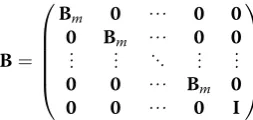
Then define B∈Zl2l2 to be a block-diagonal matrix
consisting of l1 the block Bm and one identity matrix
B¼
Bm 0 ⋯ 0 0
0 Bm ⋯ 0 0
⋮ ⋮ ⋱ ⋮ ⋮
0 0 ⋯ Bm 0
0 0 ⋯ 0 I
0 B B B B @
1 C C C C A
and we can learn that‖bi‖2≤d2+ 1(j = 1, 2,⋯, l2).
Then, FB¼ ðFð1ÞBmjFð2ÞBmj⋯jFðl1ÞBmj0Þ∈Zl1l2; and
all the entries of FBare in the range [0,d]. So the norm of each column ofFBis less than or equal to d ffiffiffiffil1
p
and
FBis short.
Definition ofR:The entries of the matrix R∈Zl1l2 are chosen randomly from Gaussian distribution with the parameter r where ffiffiffiffil1
p
<r< ffiffiffiffil1
p
gs. Then by the The-orem 3.1, the entries of (I|A)Rare uniformly onZqwith
great probability. Because the parameter r is relatively large, we have that the vectors distributed according to Gaussian distribution have an average value very close to zero and expected squared distance from zero very close toffiffiffiffiffiffiffiffiffiffiffiffiffiffiffir2l1/(2π). So the norm of Ris less than or equal to r
l1=ð2πÞ
p
.
The above discussion in this subsection shows that our algorithm for constructing the hard random lattice with a short basis is reasonable, and the basis of the dual lattice is indeed short. We will analyze the quality of the
basis matrix S to prove the advantage of short in the
next subsection.
3.5 Analysis and comparison
We analyze the norm of the basis matrix S in this
sub-section. Firstly, we have that
S
k k2
≤ maxkI−RPk2þk kP 2;ðkRBk þkFBkÞ2þk kB 2
From the discussion in the previous subsection, we know that ‖P‖2= 1 and kI−RPk2≤ðr ffiffiffiffiffiffiffiffiffiffiffiffiffiffiffil1=ð2πÞ
p
þ1Þ2 . Then,
I−RP
k k2þk kP 2≤
2r2l1=ð Þ2π :
Then we consider the other part,‖FB‖2≤l1d2,‖RB‖2≤ (d + 1)2r2l1/(2π), and‖B‖2≤d2+ 1. So we have
RB
k k þkFBk
ð Þ2þk kB 2
≤4kRBk2
≤4 dð þ1Þ2r2l1=ð Þ2π
Our construction for generating a hard random lattice with a short basis was from a new perspective and our algorithm in the construction first used a random matrix whose entries were obeyed Gaussian distribution, not an
independent {0, ±1}-valued random variable in [12] or
uniform distribution from the set {0,1} in [11] as shown in Table2, and the parameterq is a large regular, which ensure that our algorithm has a wider application future
in cryptography area. Moreover, our construction is more specific than the previous constructions which makes our construction be implemented easier in prac-tical applications. What is more, the problem we dis-cussed is the basis of lattice-based cryptograph, so it can resist the attack by quantum computers.
4 Conclusion
In this paper, we firstly have proved a fact that a uni-formly random matrix contains an invertible submatrix and using elementary transformations the uniformly ran-dom matrix can be transformed into the special matrix which contains two parts, an identity matrix part and a uniform matrix part. Secondly, a useful regularity
the-orem and its corollary on Zq has been proved and the
useful parameters could be obtained. Thirdly, using the above fact and corollary, a new construction of hard ran-dom lattice with a short basis have been proposed, and then we have given the framework of our algorithm. Fourthly, the concrete expression of our construction, that is the concrete form of the matrices in our algo-rithm, has been given. Lastly, we have analyzed the qual-ity of the short basisS, which shows that the quality of the short basis in our algorithm is as same as the Alwen and Peikert algorithm.
Acknowledgements
This work is supported by National Key R&D Program of China (no. 2017YFB0802400), National Science Foundation of China (no. 61373171) and the 111 Project (no. B08038).
Funding
This work is supported by National Key R&D Program of China No. 2017YFB0802400, National Science Foundation of China under grant no. 61373171 and the 111 Project under grant no. B08038.
Availability of data and materials
The datasets used and/or analyzed during the current study are available from the corresponding author on reasonable request.
Authors’contributions
All authors actively participated in the discussions, and read and approved the final manuscript.
Competing interests
The authors declare that they have no competing interests.
Publisher’s Note
Springer Nature remains neutral with regard to jurisdictional claims in published maps and institutional affiliations.
Author details
1State Key Laboratory of Integrated Services Networks, Xidian University,
Xi’an, Shaanxi 710071, People’s Republic of China.2Department of Mathematics, Xi’an Polytechnic University, Xi’an, Shaanxi 710048, People’s Republic of China.3Computer Engineering College, Jimei University, Xiamen, Fujian 361021, People’s Republic of China.
Received: 22 January 2019 Accepted: 16 April 2019
References
1. C. Peikert, inAnnual Cryptology Conference. An efficient and parallel Gaussian sampler for lattices (Springer, Berlin, 2010), pp. 80–97
2. Z. Brakerski, V. Vaikuntanathan, inAdannces in Cryptology -CRYPTO 2011. Fully homomorphic encryption from ring-LWE and security for key dependent message (2011), pp. 505–524
3. S. Dov Gordon, J. Katz, V. Vaikuntanathan, inAdvances in cryptology -ASIACRYPT 2010, Lecture Notes in Computer Science. A group signature scheme from lattice assumptions, vol 6477 (2010), pp. 395–412 4. V. Lyubashevsky, C. Peikert, O. Regev, inAdvances in Cryptology C
EUROCRYPT 2010. On ideal lattices and learning with errors over rings (2010), pp. 1–23
5. V. Lyubashevsky, C. Peikert, O. Regev, inAdvances in Cryptology C EUROCRYPT 2013. A Toolkit for Ring-LWE Cryptography (2013), pp. 35–54 6. S. Ling, K. Nguyen, D. Stehl, et al., inPublic-Key CryptographyCPKC 2013.
Improved zero-knowledge proofs of knowledge for the ISIS problem, and applications (Springer, Berlin, 2013), pp. 107–124
7. D. Micciancio, C. Peikert, inAdvances in Cryptology C EUROCRYPT 2012. Trapdoor for lattices: simpler, tighter, faster, smaller (2012), pp. 700–718 8. O. Regev, Lattice-based cryptography[C]. Annual International Cryptology
Conference. (Springer, Berlin, Heidelberg, 2006), pp. 131–141
9. C. Peikert, B. Waters, Lossy trapdoor functions and their applications[J]. SIAM J. Comput.40(6), 1803–1844 (2011)
10. T. Poppelmann, Efficient implementation of ideal lattice-based cryptography. Inf. Technol.59(6), 305–309 (2017)
11. M. Ajtai, inInternational Colloquium on Automata, Languages, and Programming. Generating hard instances of the short basis problem (1999), pp. 1–9 12. J. Alwen, C. Peikert, Generating shorter bases for hard random lattices.
Theory Comput. Syst.48(3), 535–553 (2011)
13. V. Lyubashevsky, D. Micciancio, inAdvances in Cryptology-CRYPTO 2009. On bounded distance decoding, unique shortest vectors, and the minimum distance problem (2009), pp. 577–594
14. T. Laarhoven, M. Mosca, J. Van De Pol, Finding shortest lattice vectors faster using quantum search. Des. Codes Crypt.77(2–3), 375400 (2015) 15. M. Ajtai, inACM Symposium on Theory of Computing -STOC. Generating hard
instances of lattice problem-s (1996), pp. 99–108
16. C. Gentry, C. Peikert, V. Vaikuntanathan, inProceedings of the fortieth annual ACM symposium on Theory of computing. Trapdoors for hard lattices and new cryptographic constructions (2008), pp. 197–206