R E S E A R C H A R T I C L E
Open Access
Replica placement to mitigate attacks on
clouds
Filipe Araujo
1*, Serhiy Boychenko
1, Raul Barbosa
1and António Casimiro
2Abstract
Execution of critical services traditionally requires multiple distinct replicas, supported by independent networks and hardware. To operate properly, these services often depend on the correctness of a fraction of replicas, usually over 2/3 or 1/2. Defying the ideal situation, economical reasons may tempt users to replicate critical services onto a single multi-tenant cloud infrastructure. Since this may expose users to correlated failures, we assess the risks for two kinds of majorities: a conventional one, related to the number of replicas, regardless of the machines where they run; and a second one, related to the physical machines where the replicas run. This latter case may exist in multi-tenant virtualized environments only.
To assess these risks, under crash and Byzantine failures of virtual and physical machines, we resort to theoretical and experimental evaluation. Contrary to what one might expect, we conclude that it is not always favorable to distribute replicas evenly over a fixed number of physical machines. On the contrary, we found cases where they should be as unbalanced as possible. We systematically identify the best defense for each kind of failure and majority to preserve. We then review the most common real-life attacks on clouds and discuss thea prioriplacement of service replicas that minimizes the effects of these attacks.
Keywords: Cloud computing; Fault-Tolerance; Dependability; Virtualization
1 Introduction
To cut costs, companies increasingly outsource informa-tion technology to cloud providers. However, with this movement, they lose much of the control they could exert on their most critical services. Popular strategies such as replication may not work well on the cloud, because providers may take advantage of virtualization tech-niques [1-5] to concentrate some of (or all) the replicas in the same physical machine (PM). Recent research has explored affinities among virtual machines (VMs) to con-solidate according to traffic [6,7] or memory pages [8,9], for example. We could think of a cluster of application servers responding to HTTP requests, or a remote storage service [10-12].
Common sense will tell us that one should not use a virtualized infrastructure to run replicas of the same ser-vice, because a single fault on a single PM could tear down many replicas at once. Ideally, each new replica should run
*Correspondence: [email protected]
1CISUC, Department of Informatics Engineering, University of Coimbra, Polo II, 3030-290 Coimbra, Portugal
Full list of author information is available at the end of the article
on a different PM, preferably at distant physical locations, served by different networks, using diverse software, oper-ating systems, and so on. However, the costs and com-plexity of doing this are enormous and cutting these costs is certainly very tempting for clients. Market offers, like Rackspace’s or Microsoft’s [13] tend to focus on avail-ability, providing specific advise and Service Level Agree-ments (SLAs) for more common non-Byzantine faults. Critical Byzantine fault-tolerant (BFT) services have been studied in more academic contexts, including research projects [14-18]. For example, the Archistar project [19] considers a storage system replicated across multiple cloud providers to overcome Byzantine failures. The most well-known system requiring BFT is perhaps Bitcoin [20], although Bitcoin resorts to brute computational force for correctness.
In this paper we consider a setting where clients chose a single cloud provider. They may do this for a num-ber of reasons, being simplicity the most important: it is easier to manage a single cloud contract than three, for example. It is also easier to deploy a service only once, especially in Platform-as-a-Service clouds (PaaS), where
development is closely tied to the provider. Although ide-ally the client should have different implementations to ensure diversity, this may be difficult to achieve in prac-tice. Replicating data to different providers may also be undesirable, due to the risks involved in such higher expo-sure. Additionally, as we show in this paper, even when using different providers, the client may need to prop-erly decide the number of replicas to run on each of the providers.
From the point of view of providers, offering BFT ser-vices using a small fraction of their resources seems like a very reasonable step. Nevertheless, BFT services have some specificities and may not require features like elas-ticity. Many BFT protocols assume a fixed number of players and cannot cope with new peers or with the depar-ture of more than a fixed numberf of peers (e.g. [21]). To change these settings, the service must stop, before the new group of replicas resumes operation, but this idea may be unreasonable in a critical replicated environ-ment. The cloud provider must therefore provide support for a fixed number of replicas and should ideally allo-cate these replicas to different servers, availability zones or even regions, to minimize correlated failures.
Given the contradicting goals of consolidating to save money and dispersing to ensure robustness, we focus on a compromise. The provider fixes the number of PMs to a some satisfactory level and then (s)he needs to find the best distribution of VMs (i.e., replicas) by these PMs. We qualitatively try to mitigate the disadvantage of not using more PMs, by giving a single defense to the cloud provider: the distribution of the VMs by the available PMs. Depending on the service, the defender may care for the number of PMs or the number of VMs that stand after each failure. In particular, motivated by many consensus-based algorithms, including Byzan-tine fault-tolerant ones, e.g. [22] or [21], we count the number of attacks that are necessary before the ser-vice loses the majority of machines, physical or virtual. We also assume that the attacker resources are limited (otherwise, the defense would be helpless). Neverthe-less, defining the best defensive strategy for the cloud provider is a complex task, because PMs and VMs may fail in many different ways, from crashes to arbitrary Byzantine failures caused by fragilities in hardware or software.
To determine the best placement of VMs, we consider two fundamental goals, of ensuring a majority of VMs
or PMs and resisting to a large spectrum of attacks to the infrastructure. These might start and be confined to a single VM, or attacks may spread to other VMs, to the hypervisor, or to the PM hosting the service. Conse-quences range from a perceived reduction in the quality of service to erroneous responses, due to interferences or complete machine crashes. Attackers may be able to
select specific targets, or they might be limited to per-form malicious actions over random targets handed by some scheduler of the cloud service. Based on actual evi-dence of past attacks, we try to model a large spectrum of realistic settings. Based on these settings, we resort to theoretical and experimental analysis to determine the best distribution of VMs against possible attacks. We use a balls and urns and other probabilistic approaches when possible, and experimentally evaluate the remaining cases.
While intuition suggests that we should balance the VMs among the PMs, a deeper analysis shows cases where other options are better. Depending on the kind of attack and majority to keep, the distribution of VMs might be irrelevant or should even be as unbalanced as possible, given thesame number of PMs. For example, to ensure a majority of PMs, the defender should concentrate the VMs as much as possible: one VM for each but the last PM, and all the remaining VMs in the last PM. This is the best way of restricting the attacker to the smallest possible number of PMs.
Hence, the main contribution of this paper is to deter-mine the appropriate strategy to defend a majority from different types of failures, including Byzantine. This knowledge is important, especially in a setting where migrating VMs can help the cloud provider to consoli-date resources in favorable ways. If the provider is not bound to a balanced or extremely unbalanced solution, he may take advantage of traffic correlation to consolidate machines and reduce network traffic, for example. We take our conclusions to real-life attacks and threats hang-ing over cloud infrastructures. Knowledge of the most common attacks and their consequences lets us break the tie between opposing strategies to place service replicas. This conclusion goes beyond the theoretical and exper-imental analysis we did in [23]. Our study can be use-ful both for the cloud provider and for the client, as it tells them what to do or expect from the service. E.g., this may help the provider to create more precise and safer SLAs.
2 Model
2.1 Failure models
In our analysis we deal with crash failures and Byzantine failures caused by attackers. Crash failures may stop a VM or the entire PM. Byzantine failures may produce these and other arbitrary deviations from the correct service. In this paper we try to consider a representative number of entry points and behaviors for attackers. Attackers may target a specific PM, if they can, or they might depend on some fragility or assignment from the cloud provider, thus being unable to pick their concrete target. We assume the same for VM attacks (limited or unlimited targets). A faulty PM may compromise all its VMs. Conversely, once the attacker controls a VM, he might be able to escalate the attack to control the hypervisor, disturb somehow the PM or co-located VMs (“interference”), or, in the most benign case, he might be limited to shut down the VM.
We consider a service withmPMs andvVMs. Each of the m PMs may run one or more of thevVMs. When appropriate, we consider a balls and urns problem: the urn is a PM; the VMs are the balls. VM failures correspond to drawing a ball from an urn. In some cases, the attacker will put the ball again in the same urn, sometimes he or she will simply remove the ball. For example, consider a clus-ter of application servers responding to HTTP requests, or a remote storage service [10-12]. Subsequent requests to the service may end up in the same application server, making this a case without removal. Contrary to this, if the attacker may not find the same replica, because he disrupted the previous one, we have removal. This model does not cover all the cases if, for instance, the attacker manages to shut down the entire PM (this would remove all balls from the urn).
2.2 Goal
Depending on the service, we may want to ensure a major-ity of correct VMorPM replicas. Some consensus algo-rithms, as the one in [22], use special hardware devices, such as a Trusted Platform Module (TPM), to improve the tolerance to Byzantine nodes. To ensure multi-tenancy, sharing the TPM by multiple VMs through virtualization, as in vTPM [24], emerges as a natural step. Therefore, it becomes important to ensure a majority of correct PMs. When we consider crash failures, we assume that the PM is in the group until the last VM crashes.
We assume that, as soon as one VM in the service is under control of the attacker, all co-located VMs and the respective PM might be compromised and out of the majority of correct (physical or virtual) machines. What we do not consider is the case where the attacker manages to create more machines to participate and corrupt the BFT protocol. We consider this kind of attack to be out-side the scope of this paper, as this problem is orthogonal to the cloud and exists in BFT protocols in general.
The set of attacks we consider falls into a moderate number of cases. We may have crash and other arbitrary effects, which we refer to as interference and Byzan-tine, although crashes may have intentional causes. The attacker may or may not be able to pick his or her targets; VMs or PMs may fail; and we may want to preserve VM or PM majority. Overall we have a total of 14 meaningful cases that we discuss throughout the paper and wrap up in Section 5.
3 Theoretical analysis
3.1 Independent VM failures
We start our theoretical analysis by considering that faults are independent: a fault causing the failure of a VM does not affect any other co-located VM. This may be the case of a crash failure. We also assume that to participate in some replicated protocol, the PM needs to have at least one operational VM. The PM becomes unusable as soon as the last VM fails. This could happen if at least one VM is necessary to operate some shared resource, like a TPM, e.g., to sign messages. I.e., given the failure ofn≤vVMs, we can calculate the probability that a PM withvi VMs fails. We compute this value in Equation 1, for 1 ≤ vi ≤
n ≤ v, using the Hypergeometric distribution.Pi(vi,n,v) is the probability that PMifails due to the failure of all its
viVMs.Pi(vi,n,v)=0, forn<vi≤v. That is, at least one VM of PMiwill survive thenfailures.
Pi(vi,n,v)=
vi
vi
v−vi
n−vi
v
n
= n×(n−1)×. . . (n−vi+1)
v×(v−1)×. . . (v−vi+1)
(1)
Since we assume a fixed number ofncrash failures, and a total ofvVMs, we analyze the impact of varyingviand use the notationPi(vi). We first show in Equation 2 that forvi ∈ {1,. . .,n−2},Pi(vi)−Pi(vi+1) >Pi(vi+1)−
Pi(vi+2). That is, the marginal gain (in terms of reducing the probability of failure of a PM) achieved by an incre-ment of the number of VMs allocated to one PM decreases as the number of VMs in that PM approaches the number of possible failures, n.
Pi(vi)−Pi(vi+1)−Pi(vi+1)+Pi(vi+2)=
Pi(vi)
1− n−vi
v−vi −
n−vi
v−vi +
(n−vi)(n−vi−1) (v−vi)(v−vi−1)
=
Pi(vi)·
·
1− 2(n−vi)(v−vi−1)−(n−vi)(n−vi−1) (v−vi)(v−vi−1)
≥Pi(vi)
1− (n−vi)(n−vi−1) (v−vi)(v−vi−1)
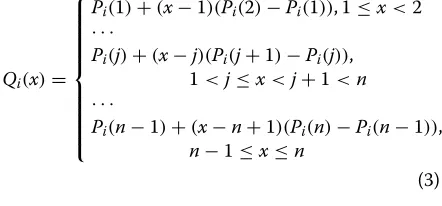
Since v ≥ n, the denominator of the subtrahend is greater or equal than the numerator, which makes the overall expression greater or equal than 0. In Equation 3, we define a new function Qi(x)that “extends”Pi for the domain [1,n].PiandQiare equal in the domain{1,. . .,n}, butQihas line segments connecting consecutive points of
Piin [1,n]\ {1,. . .,n}.
Qi(x)=
⎧ ⎪ ⎪ ⎪ ⎪ ⎪ ⎪ ⎪ ⎪ ⎨ ⎪ ⎪ ⎪ ⎪ ⎪ ⎪ ⎪ ⎪ ⎩
Pi(1)+(x−1)(Pi(2)−Pi(1)), 1≤x<2 · · ·
Pi(j)+(x−j)(Pi(j+1)−Pi(j)), 1<j≤x<j+1<n
· · ·
Pi(n−1)+(x−n+1)(Pi(n)−Pi(n−1)),
n−1≤x≤n
(3)
From Equation 2, it follows thatQi(x)is convex in the domain. Now, the number of failed machines can be com-puted as an expectationE=iPi(vi)=iQi(vi). From Jensen’s inequality:
Q
ivi
m
≤
iQi(vi)
m (4)
where equality occurs when all thevi’s are equal. Since we want to minimize the right side of the equation we should evenly balance the VMs by the PMs (assuming that the division is integer).
3.2 VM failure contaminates other VMs
We now consider Byzantine attacks, where a malicious user may take over all the co-located VMs, once he or she successfully attacks the first one (malware injection, side-channel or protected environment escape attacks). In mathematical terms, we can treat this problem as an urns and balls problem, and use known results, such as [25]. Urns represent a PM, while balls represent the VMs. To distinguish between correct and compromised VMs we may assign colors to balls: white balls represent correct machines, whereas black balls represent compro-mised machines. The objective of our analysis in this section is to show that there is a proper way of ini-tially distributing white balls, which minimizes the num-ber of urns that end up having black balls as a result of malicious actions successively changing the color of balls from white to black. Our assumption in this par-ticular case is that the previously white ball returns to the same urn as black and the attacker has no option concerning the urn from where it picks a ball. This represents a case where the service is apparently run-ning and the attacker might find the same (possibly compromised) VM.
The option left to the cloud provider is to select a dis-tribution of VMs by the PMs and, in this particular case, we care about the number of urns that do not have black balls, which we denote by the random variableX.P(X ≥ k) is the probability thatk or more urns have no black balls.
Theorem 1.Assume that we have v white balls
dis-tributed by1 < m < v urns, such that each urn has at least one ball. Assume that the attacker works in successive turns, picking one ball at a time from an urn, and always putting back a black ball in the same urn. The attacker does not select the ball or the urn. ∀ k ∈ {1,. . .,m}, P(X ≥ k) is maximized when m−1 urns have 1 ball, and the remaining urn has the remaining v − m + 1
balls.
Proof. Refer to Figure 1. Note that white urns have only 1 ball, gray urns have at least 1, but less thanv−m+1 balls, and black urns have v − m + 1 balls. Consider setting A, where only 1 urn has more than 1 ball. I.e.,
m − 1 urns have 1 ball, whereas the last urn in the figure has v − m + 1 balls. Setting B represents any other case, with the same number of urns, m, but with a different distribution of balls. Let us match pair-wise the urns in setting A with the urns in setting B
(original), starting by the 1-ball urns (on the left side of the figure). After this first set of urns, we define another setO, with the urns that have more than 1 ball inB, but only one ball inA. This definition excludes the first urns that have 1 ball in A and B, as well as the last urn of A, which has more than 1 ball. Note that 1≤ |O| ≤m−1.
We now resort to an artificial division of set O in B. We split each one of the |O| urns in B into two other urns: one with 1 ball, and the other with the remain-ing balls. This makes for a total of m − 1 urns with only 1 ball, just like in setting A. The remaining v − m+1 balls are spread over|O| +1 urns (in gray in the “imaginary B”), each having one or more balls. In the rest of our reasoning, we should refer to settingsAand “imaginary B”, with m and m+ |O| urns, respectively. In both cases there are m − 1 urns with only 1 ball. We first observe that these urns have exactly the same probability of having a black ball. What about the sin-gle black and |O| + 1 gray urns in A and “imaginary
B”, respectively? Since the number of balls is the same,
1 ... 1 1 ... 1 v-m
+1
>1
b1-1 b2-1 b|O|
-1
...
1 ... 1 1 ... 1
A
imaginary
B
v-m
+1 = ...
m urns
1
1
1 ... b1>1 b2>1 b|O|
>1
... >1
original
B
1urns in set O
split urns
Figure 1Distributions of balls by urns in settingsAandB.
To calculateP(X ≥ k), we can use a result from ([25], Equation (3.5)), which we restate here:
P(X≥k)=
(k)
a
⎛ ⎝1−
k
j=1
paj
⎞ ⎠
n
−
−
k k−1
(k+1)
a
⎛ ⎝1−
k+1
j=1
paj
⎞ ⎠
n
+
+
k+1
k−1
(k+2)
a
⎛ ⎝1−
k+2
j=1
paj
⎞ ⎠
n
−
. . .
+(−1)m−k
m−1
k−1
m
j=1
pjn (5)
The murns define a set of integers {1, 2,. . .,m}. The variable pj is the probability that we assign a black ball to urnj. From this set, we define subsets withkelements {a1,a2,. . .,ak}.
(k)
a denotes a summation over all these subsets. Thus, there aremkterms in this sum. For a better
understanding of this formula, we should realize that sum-mation (ak) concerns the probability of having k urns without black balls whennblack balls have been dropped in the urns. The summation that follows in the formula considers the probability of havingk +1 empty for the samenballs and so on.
3.3 Keeping a majority of virtual machines
The next question we consider is the impact of machine failures on the number of VMs that stay alive in a correct state. In many cases, this number might be more impor-tant than the number of different PMs where the replicas run. One may ask whether concentrating many VMs in the same (or few) machine(s) could reduce the average num-ber of VMs that survive (other) PM crashes. Interestingly, the answer is no. AssumeZ(t) to be a random variable that represents the number of VMs that are running at timet. Variableviis the number of VMs running on PMi;
Yi(t)is a random variable that assumes the value 0 if PM
by the PMs is not relevant from the point of view of the average:
E[Z(t)]= m
i=1
vi·P[Yi(t)=1]=P[Y(t)=1]v (6)
However, one should notice that other metrics may be relevant as well. On the few occasions when the most loaded PM fails, much fewer replicas will be available. I.e., the unbalanced setting will most of the time keep a few more VMs running, but sometimes, it will have much less.
4 Experimental evaluation
Since we cannot evaluate all the interesting scenarios using analytical expressions, in this section we partially resort to simulation. To evaluate the likelihood of keep-ing a majority of correct PMs, we start with m = 5 PMs andv = 10 VMs in Figure 2. We considered four cases: in one of them, all the machines (urns) have the same probability of receiving an attack (black ball) and this probability remains constant. We call this case “bal-anced without removal”. We also consider the case where a single machine has a probability of 60% of receiving an attack, while the remaining 40% probability is equally distributed among the remaining machines. This cor-responds to running 6 VMs in a single PM, while the remaining 4 VMs run in the other 4 PMs, in a one-to-one correspondence. To this case we call “unbalanced (60%) without removal”. We also consider removals of the VMs once the attacker dominates them. This corresponds to a scenario where the attacker is successively requesting some instance of a service from a limited set. Each time it gets a new instance, the attacker will not get the same, but a new one (e.g., a new VM). These are the two cases with removal.
In the plots without removal, we use Equation 5 to com-pute the probability that at most 2 out of 5 PMs have black balls, as the number of attacks grows. We can see a clear difference between the balanced and unbalanced cases. The chances of keeping a majority significantly improve for the latter case. For instance, after 5 attacks, there is still more than 40% chances of conserving the majority in the unbalanced case, while in the balanced case, this prob-ability is below 10%. To plot the lines with removal we resorted to Monte Carlo simulation. We show error bars that correspond to a 99% confidence interval of the aver-age, assuming a normal distribution. Since we used 10,000 trials to get these plots, the intervals are very small and the error bars are barely visible. As we expected, removal makes it easier for the attacker to reach a larger number of different PMs, thus negatively affecting the probabil-ity of keeping a majorprobabil-ity of correct PMs. The four plots of the figure actually depict two extreme pairs of cases: the one without removal approximates a scenario where we have a very large number of VMs, or where the same VM can be handed to the attacker. The pair of lines with removal corresponds to the other extreme case, where we have a small number of VMs (10) for the available PMs (5).
Next, we try a larger number of PMs,m = 21, to com-pare against the smaller set of 5. For this larger set, the advantage of unbalancing the distribution of VMs is even more visible, as we depict in Figure 3. For the case with-out removal, given by Equation 5, after a little more than 20 attacks, there is nearly no chance that the majority of the PMs is still correct for the balanced option. This takes more than 60 attacks in the case of the unbalanced scenario. The difference in the removal case is also impor-tant. Note that in this setting we assumed that the entire PM is compromised once the attacker penetrates the first VM, either because he or she managed to control the
0 0.2 0.4 0.6 0.8 1
0 5 10 15 20
P[X >= 3]
Number of attacks
Unbalanced (60%) w/out removal Balanced w/out removal Unbalanced (60%) w/ removal Balanced w/ removal
0 0.2 0.4 0.6 0.8 1
10 20 30 40 50 60
P[X >= 11]
Number of attacks
Unbalanced (60%) w/out removal Balanced w/out removal Unbalanced (60%) w/ removal Balanced w/ removal
Figure 3Probability of conserving majority for 21 physical machines (PM or all VM contamination).
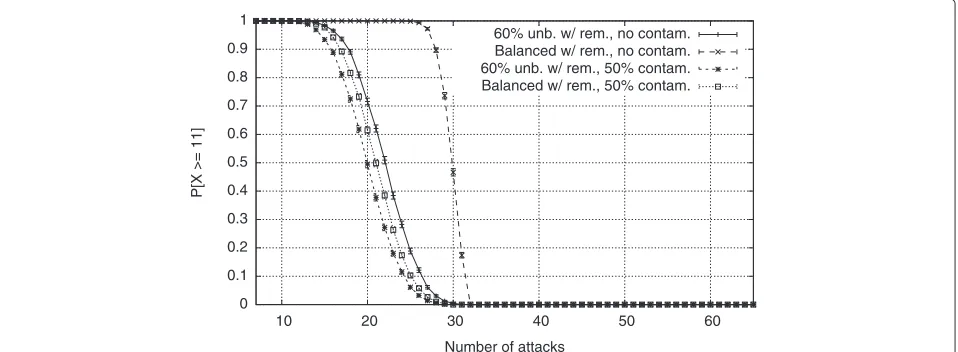
hypervisor or because he or she gained control of all the VMs in the same physical machine. Unlike this, in Figure 4 we consider other cases: a 50% and a 0% chance (no con-tamination) of controlling the service via hypervisor or other machines. We can see that as the chance of domi-nating the entire service in the PM decreases, balancing becomes increasingly better. This is not surprising, if we think that this case is more similar to crash cases, where the attacker cannot engage more co-located resources in arbitrary behaviors. Hence, by unbalancing the VMs, it becomes more likely that PMs with only one VM are left empty when their single VM fails.
These plots raise the question of determining the num-ber of attacks that it takes until the attacker succeeds in (probabilistically) holding the majority of the machines. We do this evaluation in Figure 5, for the balanced and unbalanced (60%) cases, without removal, for a varying
number of PMs. In both cases, the growth seems to be approximately linear, but the slope is much higher in the unbalanced case, thus making it much more difficult to break.
Finally, in Figure 6 we evaluate the unbalance factor. We use 11 machines and make the balance change from 1/11 (balanced) to 1−1/1191% (most unbalanced) in steps of 1/11. For all these unbalanced factors, we plot the number of attacks until the attacker gets the majority of machines with probability greater than 50%. There is no removal.
5 Placement strategies of the defense
We now identify the best strategies to distribute the VMs by the PMs. Should the defender use a balanced approach or an unbalanced one? We assume that failures render the target unusable either because it crashed or because it
0 0.1 0.2 0.3 0.4 0.5 0.6 0.7 0.8 0.9 1
10 20 30 40 50 60
P[X >= 11]
Number of attacks
60% unb. w/ rem., no contam. Balanced w/ rem., no contam. 60% unb. w/ rem., 50% contam. Balanced w/ rem., 50% contam.
0 10 20 30 40 50 60
5 10 15 20 25 30
Rounds until majority is lost with probab. > 50%
Number of physical machines Unbalanced (60%)
Balanced
Figure 5Evaluation of the rounds the attacker needs until it probabilistically gets the majority as a function of the number of physical machines.
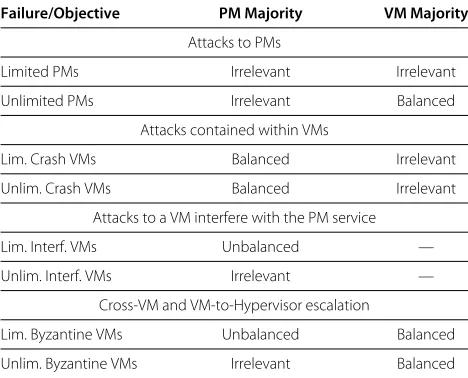
ceased to follow the protocol. Then, we consider multiple contamination models: an attack to one VM may or may not become an attack to co-located VMs and PM. We also consider that attacks might be “limited” or “unlimited”, to VMs, or directly to the PMs. “Limited” means that the attacker selects a target at random with uniform prob-ability. “Unlimited” is the extreme opposite case, where the attacker may select the target he wants. In the next sections we consider different scenarios of attacks and contamination models. Table 1 shows the best distribu-tion of VMs by PMs for each attack and contaminadistribu-tion model.
5.1 Attacks to PMs
In this section we consider attacks to PMs regardless of their source. They could well begin in a VM and escalate
to affect the entire PM. If we assume that the targeted PM disappears from the service or acts incorrectly, the distribution of VMs by the PMs is not relevant for a PM majority. On the other hand, if we consider VM majori-ties, the distribution of VMs might be relevant. If the attacker can pick his targets (“unlimited” case), it is better to evenly distribute the machines, otherwise the attacker will select PMs with more VMs. If not (“limited” case), the distribution of VMs is irrelevant, as we saw in Section 3.3.
5.2 Attacks contained within VMs
Now, consider VM targets, but assume that the attacker cannot leave the borders of the VM, i.e., the VM might misbehave somehow, but it cannot tamper with other VMs, the PM or any other device related to the service, like a TPM. Crashes are a typical cause for this behavior.
0 10 20 30 40 50 60 70
0 0.2 0.4 0.6 0.8 1
Rounds until majority is lost with probab. > 50%
Unabalance factor
Table 1 Distribution of VMs by PMs as a function of the failure and the objective to achieve by the defender
Failure/Objective PM Majority VM Majority
Attacks to PMs
Limited PMs Irrelevant Irrelevant
Unlimited PMs Irrelevant Balanced
Attacks contained within VMs
Lim. Crash VMs Balanced Irrelevant
Unlim. Crash VMs Balanced Irrelevant
Attacks to a VM interfere with the PM service
Lim. Interf. VMs Unbalanced —
Unlim. Interf. VMs Irrelevant —
Cross-VM and VM-to-Hypervisor escalation
Lim. Byzantine VMs Unbalanced Balanced
Unlim. Byzantine VMs Irrelevant Balanced
In this case, the distribution is irrelevant to keep a major-ity of VMs, as only one VM is faulty after each successful attack. Keeping a PM majority might be different. If the PM is out of the service when the last VM it holds stops, balancing is better to avoid PMs without VMs.
5.3 Attacks affect the replicated service, but not other
VMs or the PM
Now, we assume that attacks to VMs do not cross the frontier of the VM, except to disrupt the service pro-vided by that PM. This corresponds to a case where the corrupted VM manages to control the service, at least sometimes, e.g., by responding first to requests enter-ing the machine. However, this model assumes that the attacker cannot invade other VMs or the PM from the VM (e.g., to shut down other VMs). From the perspective of keeping a majority of VMs, we omit this case from our analysis, because it is similar to the contained VM attacks. For a PM majority, in the “Limited” case, the best thing to do is to unbalance the VMs, as we saw in Sections 3.2 and 4. In the “Unlimited” case, where an attacker can dis-turb the service in any PM (s)he wants, the distribution is irrelevant. It is interesting to note the striking differ-ence to the case where attacks do not cross VM borders, where we balance the VMs, to ensure that, say, crashes do not leave a PM without VMs. We reviewed a similarly interesting case, where balancing may be a better option in Section 4, Figure 4: as the probability of affecting the service decreases to zero, balancing becomes better.
5.4 Cross-VM or VM-to-hypervisor attacks
We now consider attacks that can cross VM boundaries to take over other VMs (cross-VM) or the PM (VM-to-Hypervisor attack). This case ends up being the same as
the “Unlimited PMs”, and thus gets the same distribution. However, it includes some subtleties worth discussing, as it may happen that an attacker is unable to reach arbitrary VMs, but he might end up shutting down the PM or many co-located VMs to reach other VMs and PMs in future interactions. In other words, an attacker with limited access to VMs might end up affecting other co-located VMs, to reach a different set of victims. Although this would not be purely “Unlimited Byzantine”, the same dis-tributions (Irrelevant/Balanced) would hold. However, if the attacker cannot improve his chances of reaching arbi-trary VMs and is constrained by the provider (“Limited Byzantine VMs”), we have the same case as the “Limited Interference” for the PM majority. For a VM majority we need a Balanced distribution of VMs, or, otherwise, the attacker would have a higher probability of reaching VMs with more co-located VMs.
6 Classification of real attacks
In this section we identify and describe attacks found in the literature that may affect virtualized cloud infras-tructures. We categorize real attacks and the resulting failures that we found in the literature, namely described by Jensenet al.[26], Zhanget al.[27], Gruschkaet al.[28], and Verizon [29], onto the classes of Table 1. Our anal-ysis intends to support selection and prioritization of the placement strategies, according to the main security concerns and impact of attacks.
6.1 Denial of service
One of the most attractive features of cloud systems is their on-demand provision of computing power for legiti-mate users. However, this feature may raise serious secu-rity problems if it is exploited with the wrong intentions. Attackers may flood a service with requests, inducing the infrastructure, to create countless VMs in response to those requests, thereby exhausting the available hardware resources. This leads to a Denial of Service (DoS), not only on the specific service under attack, but also on other services that share the infrastructure.
they perform I/O operations, thus opening the door to DoS problems, although cloud providers are evidently reluctant to disclose these cases.
6.2 Malware injection
The malware injection attack consists of installing some malicious service implementation or VM into the cloud. The adversary deceives the cloud system to accept mali-cious software as a valid instance of the attacked ser-vice. Successful invasion allows the infected instance to execute user requests. The effects of malware injection may vary from eavesdropping to completely disabling or changing functionality of the attacked service. Compa-nies like Intel are actively developing solutions against this kind of threat. This is the case of the “Trusted Execution Technology” (TXT).
One of the most notorious injections of malicious soft-ware occurred against the Google password system [32]. Vulnerabilities of Internet Explorer 6, which was still used by some workers, allowed hackers to inject malicious soft-ware that enabled them to access the company’s internal network. Although Google claimed that no passwords were stolen, it is difficult to evaluate all the consequences of the attack.
6.3 Metadata spoofing
In metadata spoofing, attackers modify the Web Services’ metadata descriptions. Attackers may modify the syntax and operation of some functions described in the WSDL. Unaware of the fraudulent modification, an unknowing user will invoke functions that execute unexpected oper-ations on the server. A successful attack could allow the adversary to manipulate service operations or even to obtain user credentials, to perform a broader range of attacks.
Although we were not able to find reported cloud-related incidents involving metadata spoofing, we found descriptions of such attacks on web-service based resources. For example, hackers were able to configure administrative settings (without having privileged user access) in an attack to D-Link routers [33], using vulner-abilities of the SOAP-based device control protocol. In some models of the D-Link routers, the attackers were able to execute the SOAP actionGetDeviceSettings
without authentication. This action alone did not allow the adversary to obtain any sensitive data, but it could be used to bypass the authentication requirements for other SOAP actions.
6.4 XML signature wrapping
The XML signature wrapping attack modifies authenti-cated SOAP messages. Several different variants of this attack exist. In one of the variants, after obtaining the orig-inal signed SOAP packet, the attacker moves the message
body to a wrapping element inside the SOAP header and creates a new body with a different operation. This may deceive some servers to accept the signature, because the original signed contents still exist inside that wrapping element. However, the new function in the SOAP body of the message may harm the server. As a result, the attacker could execute arbitrary operations on the cloud system as a legitimate user, influencing the availability of the services.
Some studies revealed potential vulnerabilities of cloud providers to XML Signature Wrapping attacks. A group of researchers from the Ruhr-University Bochum demon-strated this fragility in the Amazon Web Services (AWS) [34]. Using this approach, the researchers managed to delete and create new images on the customer’s EC2 instance and hijack AWS sessions to get sensitive data, including plaintext passwords. Despite being restricted to AWS, researchers believe that other cloud providers might be affected by the same type of vulnerabilities.
6.5 VM-to-hypervisor attack
The VM-to-Hypervisor attack is based on exploiting secu-rity vulnerabilities of the hypervisor. The complexity of the virtualization software may leave some open pos-sibilities for adversaries to escape from the protected environment and gain full access to the hosting physi-cal machine [35]. Consequences of the VM-to-Hypervisor attacks may vary from creation of rogue VMs to complete interruption of the attacked hardware, both of which may compromise multiple services in many different ways.
The media continuously reports privilege escalation vulnerabilities of different virtualization technologies. In a recent case [36], a major vulnerability in the 64-bit Xen hypervisor running 64-bit para-virtualized guests on Intel CPUs was disclosed and patched before any hacker managed to exploit it. Successful attack would allow the adversary to escape from guest status and gain admin-istrative access on the host machine. After breaking the protected environment, the adversary could run arbitrary code in privileged mode, install and run new programs, and create new accounts with administrative rights.
6.6 Cross-VM side-channel attack
We are not aware of any cloud providers that have been victims of cross-VM side-channel attacks. Nonethe-less, a research team managed to collect and reconstruct cryptographic keys from information leaked by the CPU cache. This allowed them to take control over a victim VM [37].
6.7 Hacking
Hacking consists of obtaining illegitimate access to a sys-tem by circumventing security mechanisms, either by exploiting security vulnerabilities or by obtaining access credentials. Some of the most common forms of attack include stealing login credentials, brute force attacks, SQL injection and backdoor exploitation. The main goals of hacking generally are data stealing or damaging.
These types of attack have become increasingly com-mon in recent years, as reported by Verizon [29], regard-ing network infrastructures and data centers. One may expect hacking to be one of the main forms of attack on cloud infrastructures as well, given that the applications running in the cloud make use of common technologies and security mechanisms, and are therefore vulnerable to the same strategies. According to the Verizon study, hack-ing along with malware injection are the most widespread forms of attack.
6.8 Defending against real attacks
In Table 2 we go through the list of attacks and identify the potential consequences. Since a given attack type can have a range of different effects on a victim, our classification considers the most serious documented consequences of each type of attack. Fortunately, the most serious con-sequences of attacks are not always the most frequently observed ones. As we shall see, this does not have an impact on the choice of placement strategy regarding PM majorities nor VM majorities.
Based on information about each attack’s outcome we assign it to one of the classes listed in Table 1. For exam-ple, if the adversary may take full control of one particular
Table 2 Classification of the attacks according to the worst consequences documented
Class of Attack Real Case
Limited PMs Denial of Service
VM-to-Hypervisor Attack
Limited Crash VMs VM Software Faults
Lim. Byzantine VMs
Cross-VM Side-Channel
XML Signature Wrapping
Metadata Spoofing
Unlim. PMs/Byzant. VMs Malware Injection
Hacking
PM, he could make it stop, which would be a crash failure. However, since the attacker may also disrupt the service in some other subtler way, we consider this failure as Byzan-tine instead. After classifying attacks we determine the appropriate defense strategy, taking into account a set of factors explained below.
Let us start with the situations in which resource dis-tribution is irrelevant. Two kinds of attacks share this result: Denial of Service and VM-to-Hypervisor Attacks. The main reason why the distribution is irrelevant in case of a DoS attack has to do with how resources are used with virtualization and cloud computing. Since the phys-ical resources are shared, an attacker, even by targeting one specific VM, may prevent the other co-located VMs from operating properly. In an even more difficult sce-nario, on-demand resource provisioning may lead to VM instance flooding, congesting the infrastructure of the cloud provider.
While the replica placement strategy for DoS attacks is straightforward, the strategy to defend against VM-to-Hypervisor attacks requires some additional discussion. Although the adversary starts malicious actions from one VM (randomly assigned by the cloud provider), the attack to the target service occurs only when the hypervisor gives in. In fact, intrusion into the target service occurs from a successfully hacked PM (hypervisor). This intru-sion method and its potentially serious effects lead us to associate VM-to-Hypervisor attacks with the Limited (Byzantine) PM category, and in this case the placement of VMs for majority preservation is irrelevant. Hence, the first line of Table 3 shows the distribution of replicas as being irrelevant regardless of the kind of majority that is to be assured.
Despite not being necessarily of intentional nature, we include in our analysis VM software faults as one of the causes of VM crashes. This is an interesting case because software faults leading to accidental crashes are quite common. In this case, if we assume that any VM might be affected with uniform probability, the distribution of VMs
Table 3 Placement strategies according to attack type and majority goal
PM Maj. VM Maj. Real Case
Irrelevant Irrelevant Denial of Service
VM-to-Hypervisor Attack
Balanced Irrelevant VM Software Faults
Unbalanced Balanced
Cross-VM Side-Channel
XML Signature Wrapping
Metadata Spoofing
Irrelevant Balanced Malware Injection
is only relevant to ensure a PM majority. We do not show PM crashes in the tables, as they would fall in the “Limited PMs” attacks, which we covered already.
We proceed with the discussion of Limited Byzantine VM attacks, where the placement of replicas has great impact on defender’s success. There are several char-acteristics of this attack class corresponding to failures described in Section 6. The analysis of adversary lim-itations, targets and intrusion consequences lead us to classify XML Signature Wrapping, Metadata Spoofing and Cross-VM Side-Channel as Limited Byzantine VM attacks. Usually the target of these attacks are the VMs hosting the victim’s service. The adversary, despite hav-ing some information about the victim, does not seem capable of picking the attack starting point and target at will. Nonetheless, a broken service instance may enable the hacker to compromise other service replicas running on the shared resource. The placement strategy in this case greatly depends on the desired majority. When the goal is keeping the majority of VMs, a balanced place-ment strategy should be adopted, otherwise unbalancing is better.
The classification of Malware Injection and Hacking as Unlimited PMs or Unlimited Byzantine VMs, which ends up being the same, is based on the worst possible consequences achieved by an adversary (partial or total access to the infrastructure). Possible scenarios include exploitation of the same vulnerability in many nodes to start a full scale attack. In the real case we described in Section 6.2, hackers seemed to have accessed the entire intranet of the cloud provider. The analysis performed in Section 5 suggests a balanced placement strategy for Unlimited (Byzantine) PM attacks when VM majority is the goal, whereas the distribution is irrelevant otherwise.
By analyzing Malware Injection and Hacking attacks, along with information provided by the Verizon report [29], the most harmful consequences of these attacks are likely to be uncommon. Although such an attack may provide unlimited access to a cloud infras-tructure (e.g., leaked or stolen administration passwords) one may consider that an attacker will in general be more successful in obtaining illegitimate access into a single application and its VMs rather than the whole infrastruc-ture. This would, in fact, suggest that most malware and hacking attacks should be classified as Limited Byzantine VMs.
A careful analysis of the relation between attack types and placement strategies on lines three and four of Table 3 helped us to solve this ambiguous situation. We noted that the replica distribution methods are not contradictory for any of the majorities. When the defender wants to keep a VM majority, both lines suggest a balanced strategy. When the defender’s goal is to keep a PM majority under inten-tional attacks, the irrelevant indications suggest that the
unbalanced placement strategy should be used, allowing the defender to protect against a larger fraction of attacks.
7 Conclusion and future perspectives
Clouds are changing the surface of information technolo-gies. As a consequence, the concentration of resources in the same region, network, or even machine poses an evi-dent challenge to designers of dependable systems. In this paper we evaluate the problem of distributing resources over physical machines. We adopt the perspective of the cloud provider that needs to distribute VMs by a given fixed set of PMs. While intuition could perhaps suggest that a balanced distribution of VMs would make a more dependable system for most scenarios, this is not the case. Based on real evidence of security incidents, the behav-ior of a defender should consider whether he or she needs to keep a majority of PMs or VMs. Whereas balancing is indeed better for the latter case, unbalancing is the best option for the former. In any case, it is wise to adopt a strategy for placing replicas, rather than leaving the distribution uncontrolled, given that there are relatively few cases in which replica placement may be considered irrelevant.
An interesting perspective for the future is to include probabilities in our analysis. For example, given the proba-bility of having a compromised VM, what is the probaproba-bility that other co-located VMs might become compromised as well? The same for the hypervisor: given a compromised VM what is the probability that the attack escalates to affect the hypervisor? Standing on figures owned by cloud providers, this may give an idea of the probability that an attack manages to control a majority of VMs or PMs, thus helping providers to select the best defensive strategy.
Competing interests
The authors declare that they have no competing interests.
Authors’ contributions
FA carried out the theoretical evaluation in Section 3, the experimental evaluation of Section 4, wrote most part of these sections and contributed in all others. SB carried out most of the research for real attacks. SB and RB were the main contributors to Sections 5 and 6. AC reviewed and rewrote parts of the manuscript. All authors contributed to the conclusions and all authors read and approved the final manuscript.
Acknowledgments
This work has been supported by the FCT, Fundação para a Ciência e a Tecnologia, funded in the scope of Programa Operacional Temático Factores de Competitividade (COMPETE) and Fundo Comunitário Europeu FEDER, through projects EXPL/EEI-ESS/2542/2013, DECAF, An Exploratory Study of Distributed Cloud Application Failures, and CMU-PT/RNQ/0015/2009, TRONE, Trustworthy and Resilient Operations in a Network Environment.
Author details
1CISUC, Department of Informatics Engineering, University of Coimbra, Polo II,
3030-290 Coimbra, Portugal.2Faculty of Sciences, University of Lisbon, Campo
Grande, 1749-016 Lisboa, Portugal.
References
1. Barham P, Dragovic B, Fraser B, Hand S, Harris T, Ho A, Neugebauer R, Pratt I, Warfield A (2003) Xen and the art of virtualization. In: Proceedings of the nineteenth ACM Symposium On Operating Systems Principles, SOSP ‘03. ACM, New York, pp 164–177
2. Technical White Papers — VMWare. http://www.vmware.com/resources/ techresources/. Retrieved on May 6, 2014
3. Papers — Oracle VM VirtualBox. https://www.virtualbox.org/wiki/Papers. Retrieved on May 6, 2014
4. Bellard F (2005) QEMU, a fast and portable dynamic translator. In: Proceedings of the annual conference on USENIX Annual Technical Conference, ATEC ‘05. USENIX Association, Berkeley, pp 41–41
5. Camargos FL, Girard G, des Ligneris B (2008) Virtualization of Linux servers. In: Proceedings of the Linux symposium. http://ols.fedoraproject.org/ OLS/Reprints-2008/camargos-reprint.pdf.
6. Meng X, Isci C, Jeffrey J, Zhang L, Bouillet E, Pendarakis D (2010) Efficient resource provisioning in compute clouds via vm multiplexing. In: Proceedings of the 7th International Conference on Autonomic Computing, ICAC ‘10. ACM, New York, pp 11–20
7. Sonnek J, Greensky J, Reutiman R, Chandra A (2010) Starling: minimizing communication overhead in virtualized computing platforms using decentralized affinity-aware migration. In: Proceedings of the 2010 39th International Conference on Parallel Processing, ICPP ‘10. IEEE Computer Society, Washington, DC, pp 228–237
8. Wood T, Tarasuk-Levin G, Shenoy P, Desnoyers P, Cecchet E, Corner MD (2009) Memory buddies: exploiting page sharing for smart colocation in virtualized data centers. In: Proceedings of the 2009 ACM
SIGPLAN/SIGOPS International Conference on Virtual Execution Environments, VEE ‘09. ACM, New York, pp 31–40
9. Gupta D, Lee S, Vrable M, Savage S, Snoeren AC, Varghese G, Voelker GM, Vahdat A (2010) Difference engine: harnessing memory redundancy in virtual machines. Commun ACM 53(10):85–93
10. Heroku | Cloud application platform. http://www.heroku.com. Retrieved on May 6, 2014
11. Ruby On rails and PHP cloud hosting PaaS | Managed rails development | Engine yard platform as a service. http://www.engineyard.com. Retrieved on May 6, 2014
12. Google App Engine — Google Developers. https://developers.google. com/appengine/. Retrieved on May 6, 2014
13. McKeown M, Kommalapati H, Roth J Disaster recovery and high availability for windows azure applications. Web page http://msdn. microsoft.com/en-us/library/windowsazure/dn251004.aspx visited on December 5th 2013
14. Bessani AN, Alchieri EP, Correia M, Fraga JS (2008) DepSpace: a byzantine fault-tolerant coordination service. SIGOPS Oper Syst Rev 42(4):163–176 15. Prieto E, Diaz R, Romano L, Rieke R, Achemlal M (2011) MASSIF: a
promising solution to enhance olympic games IT security. In: Georgiadis CK, Jahankhani H, Pimenidis E, Bashroush R, Al-Nemrat A (eds) ICGS3/e-Democracy, volume 99 of Lecture Notes of the Institute for Computer Sciences, Social Informatics and Telecommunications Engineering. Springer, pp 139–147. http://link.springer.com/chapter/10. 1007%2F978-3-642-33448-1_20.
16. Bessani A, Cutillo LA, Ramunno G, Schirmer N, Smiraglia P (2013) The TClouds platform: concept, architecture and instantiations. In: Proceedings of the 2nd international workshop on Dependability Issues in Cloud Computing, DISCCO ‘13. ACM, New York, pp 1:1–1:6 17. SECFUNET - Security for Future Networks - Home. http://www.secfunet.
eu. Accessed on 6 May 2014
18. CloudFit. http://cloudfit.di.fc.ul.pt/index.php?title=Public:Main_Page. Accessed on 6 May 2014
19. Slamanig D, Hanser C (2012) On cloud storage and the cloud of clouds approach. In: Internet technology and secured transactions, 2012 international conferece for, pp 649–655. http://ieeexplore.ieee.org/xpl/ login.jsp?tp=&arnumber=6470897&url=http%3A%2F%2Fieeexplore.ieee. org%252.
20. Bitcoin - Open source P2P money. http://bitcoin.org/. Accessed on 6 May 2014
21. Castro M, Liskov B (2002) Practical byzantine fault tolerance and proactive recovery. ACM Trans Comput Syst 20(4):398–461
22. Correia M, Veronese GS, Lung LC (2010) Asynchronous Byzantine consensus with 2f+1 processes. In: Proceedings of the 2010 ACM
Symposium on Applied Computing, SAC ‘10. ACM, New York, pp 475–480
23. Araujo F, Barbosa R, Casimiro A (2012) Replication for dependability on virtualized cloud environments. In: Proceedings of the 10th international workshop on Middleware for Grids, Clouds and e-Science, MGC ‘12. ACM, New York, pp 2:1–2:6
24. Berger S, Cáceres R, Goldman KA, Perez R, Sailer R, van Doorn L (2006) vTPM: virtualizing the Trusted Platform Module. In: Proceedings of the 15th conference on USENIX security symposium - Volume 15, USENIX-SS’06. USENIX Association, Berkeley
25. Johnson NL, Kotz S (1977) Urn models and their application — an approach to modern discrete probability theory. John Wiley & Sons, New York, Chichester, Brisbane, Toronto
26. Jensen M, Schwenk J, Gruschka N, Iacono LL (2009) On technical security issues in cloud computing. In: Proceedings of the 2009 IEEE International Conference on Cloud Computing, CLOUD ‘09. IEEE Computer Society, Washington, DC, pp 109–116
27. Zhang Y, Juels A, Reiter MK, Ristenpart T (2012) Cross-VM side channels and their use to extract private keys. In: Proceedings of the 2012 ACM conference on computer and communications security. ACM, New York, pp 305–316
28. Gruschka N, Iacono LL (2009) Vulnerable cloud: SOAP message security validation revisited. In: ICWS, pp 625–631. http://ieeexplore.ieee.org/xpl/ login.jsp?tp=&arnumber=5175877&url=http%3A%2F%2Fieeexplore.ieee. org%252.
29. Verizon (2013) Data breach investigations report. http://www. verizonenterprise.com/DBIR/2013/. Retrieved on May 6, 2014 30. CloudFlare blog - The DDoS That Almost Broke the Internet. http://blog.
cloudflare.com/the-ddos-that-almost-broke-the-internet. Retrieved on May 6, 2014
31. Domingues P, Araujo F, Silva L (2009) Evaluating the performance and intrusiveness of virtual machines for desktop grid computing. In: Proceedings of the 2009 IEEE International Symposium on Parallel & Distributed Processing, IPDPS ‘09. IEEE Computer Society, Washington, DC, pp 1–8
32. SFGate.com blog - The Google Attack Scenario Offense and Defense. http://blog.sfgate.com/ybenjamin/2010/04/20/the-google-attack-scenario-offense-and-defense/. Retrieved on May 6, 2014
33. Hacking D-Link Routers With HNAP. http://www.sourcesec.com/Lab/ dlink_hnap_captcha.pdf. Retrieved on May 6, 2014
34. Computerworld - Researchers Demo Cloud Security Issue with Amazon AWS Attack. http://www.computerworld.com/s/article/9221208/ Researchers_demo_cloud_security_issue_with_Amazon_AWS_attack/. Retrieved on May 6, 2014
35. Szefer J, Keller E, Lee RB, Rexford J (2011) Eliminating the hypervisor attack surface for a more secure cloud. In: Proceedings of the 18th ACM conference on computer and communications security, CCS ‘11. ACM, New York, pp 401–412
36. InformationWeek - New Virtualization Vulnerability Allows Escape To Hypervisor Attacks. http://www.informationweek.com/security/ application-security/new-virtualization-vulnerability-allows/240001996/. Retrieved on May 6, 2014
37. Dark Reading - Researchers Develop Cross-VM Side-Channel Attack. http://www.darkreading.com/attacks-breaches/researchers-develop-cross-vm-side-channel-attack/d/d-id/1138623? Retrieved on May 6, 2014
doi:10.1186/s13174-014-0007-z