Original Research Article
Premarital sexual activities among adolescents in prostitution
circumstance and influencing factors
Dedik Sulistiawan*
INTRODUCTION
Globalization and modernization have contributed to the acceleration of multisector development, such as social, economic, science and technology, health, and education. Increasing the interconnectivity and accelerating the flow of information between people as a result of globalization has resulted in massive social and cultural changes. Positively, from a public health perspective globalization has improved the health status of the population and life expectancy, eradicated several types of diseases, and reduced child mortality.1,2 Globalization in Indonesia also gives some impacts, such as increasing education
participation, knowledge, and skills of the population. This eventually led to an increase in the median of first marriage age from 19.2 years (IDHS 2002-2003) to 19.8 years (IDHS 2007), and continues to increase 20.1 years in the 2012 IDHS, resulting in child mortality falling by 40 per 1,000 live births (IDHS 2007: 44 per 1,000 live births, IDHS 2003: 46 per 1,000 live births).3
Nevertheless, globalization also harms adolescents. The gap between the age of menarche and marriage, which increasingly wide encourages an increase in premarital sexual activity as one of the problems of adolescent sexual and reproductive health.4 Surveys conducted on
ABSTRACT
Background: Lifestyle in globalization era gives negative impacts on adolescent's premarital sexual activities. The wide gap between the age of menarche and marriage encourages an increase in premarital sexual activities, especially in socially vulnerable areas. This research presented premarital sexual activities among adolescents in the prostitution area and the influencing factors.
Methods: This study was an analytical observational study with a cross-sectional design, involving as many as 70 adolescents who lived in the Dolly prostitution area of Surabaya, the second biggest city in Indonesia. The dependent variable in this study was adolescent premarital sexual activities. The independent variables were age, sex, education level, knowledge towards reproductive health, attitude, social-economic status, the onset of puberty categories, closeness to parents, access to sexual media, and peer pressure. Data were analyzed using simple and multiple logistic regressions.
Results: The results showed that sociosexual behavior (sexual activity with partners) was significantly influenced by knowledge (OR=59.05; 95% CI=1.12-3114.22; p= 0.04). Adolescents who had less knowledge of reproductive health were more likely to engage in sociosexual behavior.
Conclusions: The right knowledge about reproductive health is essential for adolescents. The government must implement a more effective intervention in order to increase adolescent’s knowledge about the accurate reproductive health information in socially vulnerable areas.
Keywords: Adolescent, Free sex, Prostitution, Risky behavior
Department of Reproductive Health, Faculty of Public Health, Universitas Ahmad Dahlan, Yogyakarta, Indonesia
Received: 27 July 2019
Revised: 03 September 2019
Accepted: 04 September 2019
*Correspondence:
Dr. Dedik Sulistiawan,
E-mail: [email protected]
Copyright: © the author(s), publisher and licensee Medip Academy. This is an open-access article distributed under the terms of the Creative Commons Attribution Non-Commercial License, which permits unrestricted non-commercial use, distribution, and reproduction in any medium, provided the original work is properly cited.
2,138 men and women aged 15-59 in one of the provinces experiencing urbanization in Thailand produced strong evidence of early sexual debut and a higher level of acceptance of premarital sexual behavior among adolescents. The initiation of sexual behavior increased significantly from around 40% to around 70% in 20s young adolescents.5 Another study in Thailand also concluded that around 72% of single men aged 18-24 years tend to engage in premarital sexual activity, while in single women of the same age only around 22%.6 A study conducted in 1996 involving 30,000 school-age adolescents in Malaysia showed that the prevalence of premarital sexual activities was around 1.8%. The first debut of sexual activity began at the age of 9 to 24 years, with the age mode 17-18 years.4
Although there is no reliable data about the incidence of premarital sexual activity in Indonesia, the Indonesian Adolescent Reproductive Health Survey (SKRRI) 2007 reported incidents of premarital sexual activity of around 1.3% among female adolescents aged 15-19 years and 1.4% among 20-24 years old. The incidence among male adolescents aged 15-19 years and 20-24 years are higher than female; 3.7% and 10.5% respectively.7 In the next five years, Demographic and Health Survey of Indonesia - Adolescent Reproductive Health (SDKI-KRR) 2012 reported incidents of premarital sexual activity of around 6.0% and 2.4% in girls aged 15-19 years and 20-24 years respectively. The incidence in boys aged 15-19 years and 20-24 years was higher than girls; 4.5% and 14.6% respectively.3 Consistent with SDKI-KRR result, a study conducted by Rahyani, Utarini, Wilopo and Hakimi (2012) in Bali reported that premarital sexual activity of male adolescents was around 7.8%, higher than female adolescents at 1.8%.8 The incidence of premarital adolescent sexual activity is reported to be higher by Purdy (2006), which is about 51% of adolescents in four big cities in Indonesia experienced premarital sexual activities.9
In the era of globalization, adolescents sexual activity is higher in urban areas. The SDKI-KRR 2012 reported the premarital sexual activity of male adolescents in urban areas around 8.7%, higher than in rural areas, which were around 7.8%. Their curiosity about the experience of having sexual relations drives most (57.5%) of these behaviors. This fact shows that adolescents in urban areas are more permissive than those who live in rural. It is because sexual exposure is relatively significant in urban areas. The study by Utomo and McDonald (2009) explains that permissive attitudes related to sexual activity can be related to media stimulation, social environment, and diversity of ethnic groups.10 Based on these facts, it is essential to identify sexual behavior among adolescents in urban areas, especially those who live in hazardous environments or socially vulnerable areas such as prostitution areas which are one of the urban landscapes of the community. In this study, we identified sexual activity among adolescents living around Dolly localization (the largest prostitution area in Surabaya).
Not only the largest in Surabaya but also assumed to be the largest in Southeast Asia, Dolly localization is noted to have around 52 registered brothels. In the period January to September 2013, 72 out of 1,025 female sex workers were suffered from HIV and other sexually transmitted infections. In the previous year (2012), Putat Jaya public health center reported that around 118 female sex workers had HIV and sexually transmitted infections. Besides, HIV and other sexually transmitted diseases were also found in children under five as reported by Putat Jaya public health center. It is assumed that around 10% of female sex workers in the Dolly localization Area have the potential to transmit HIV and other STIs to customers.11 Considering the enormous potential risks, efforts to prevent the impact of prostitution areas for the premarital sexual behavior of unsafe adolescents are critical. Therefore, this study aims to identify premarital sexual behavior among adolescents who are live around the prostitution area and the influencing factors. Furthermore, recommendations are taken to provide input for the government to develop appropriate health promotion programs.
METHODS
This study was an analytical observational study with a cross-sectional design. It was conducted in the Dolly localization area Surabaya from May to November 2014. The target population of this study was 248 adolescents aged 16-21 years who lived in Putat Jaya Village, Sawahan Sub-District, Surabaya City. A sample of 70 adolescents was selected by two-stage cluster sampling. The first sampling unit (primary sampling unit/PSU) was nine units of Neighborhood (Rukun Tetangga; RT) (out of a total of 17 RTs). The second sampling unit (secondary sampling unit/SSU) was adolescents in each RT who’s determined proportionally. The exclusion criteria were: adolescents who were already married, were not present during the time of the data collection, and were not willing to participate in the study.
The dependent variable in this study was the premarital sexual activity of adolescents who were categorized as premarital sexual activity, autoerotic activity (masturbation), and socio-sexual activities (sexual activity with a partner). The independent variables in this study were age, gender, education level, reproductive health knowledge, attitudes towards sexuality, socioeconomic status, early puberty categories, closeness to parents, access to sexual media, and peer support. Data were analysed using simple and multiple logistic regressions
RESULTS
Characteristics of respondents
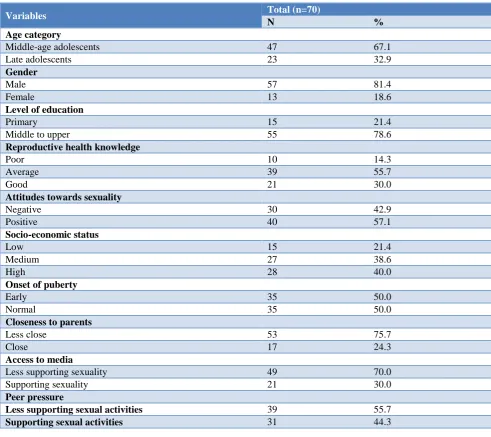
knowledge, attitudes towards sexuality, socioeconomic status, early puberty categories, closeness to parents, access to sexual media, and peer support. As many as 81.4% (n=57) respondents were male and 18.6% (n=13) were women, and the majority were classified as middle-age adolescents. The majority of respondents were at the level of middle to upper education level (high school/ equivalent). Overall, as many as 55.7% of subjects had
moderate knowledge about reproductive health and positive attitudes related to reproductive health problems. Based on socioeconomic status, as many as 40% of respondents came from the upper socioeconomic family. Half of all respondents experienced abnormal puberty (too early). The majority of respondents were less close to their parents; almost half of them (44.3%) experienced peer pressure that supports sexual activity (Table 1).
Table 1: Characteristics of respondents.
Variables Total (n=70)
N %
Age category
Middle-age adolescents 47 67.1
Late adolescents 23 32.9
Gender
Male 57 81.4
Female 13 18.6
Level of education
Primary 15 21.4
Middle to upper 55 78.6
Reproductive health knowledge
Poor 10 14.3
Average 39 55.7
Good 21 30.0
Attitudes towards sexuality
Negative 30 42.9
Positive 40 57.1
Socio-economic status
Low 15 21.4
Medium 27 38.6
High 28 40.0
Onset of puberty
Early 35 50.0
Normal 35 50.0
Closeness to parents
Less close 53 75.7
Close 17 24.3
Access to media
Less supporting sexuality 49 70.0
Supporting sexuality 21 30.0
Peer pressure
Less supporting sexual activities 39 55.7
Supporting sexual activities 31 44.3
Table 1: Respondents sexual activities.
Sexual Activities Total (n=70)
N %
No sexual life 26 37.1
Autoerotic (masturbation) 23 32.9
Socio-sexual 21 30.0
Respondents’ sexual activities
This study succeeded in identifying as many as 37.1% of respondents never engaging in any sexual activity.
and 30% of respondents did the sexual activity with their partners or referred as a socio-sexual activity. The types
of sexual activities carried out by respondents were shown in Table 2.
Table 2: Respondents types of socio-sexual activities.
Types of sexual activities Total (n=70)
N %
Masturbation 23 32.9
Kissing (with the opposite or same-sex) 30 42.9
Necking (with the opposite or same-sex) 23 32.9
Breast kissing (with the opposite or same-sex) 11 15.7
Touching or being touched the genitals/sensitive body (with the opposite or same-sex) 15 21.4
Petting/swiping genitals (with the opposite or same-sex) 8 11.4
Touching or being touched genitals, oral sex, and masturbation (with the opposite or same-sex) 7 10.0
Sexual intercourse (penetrating the genitals to the vagina or anus) 9 12.9
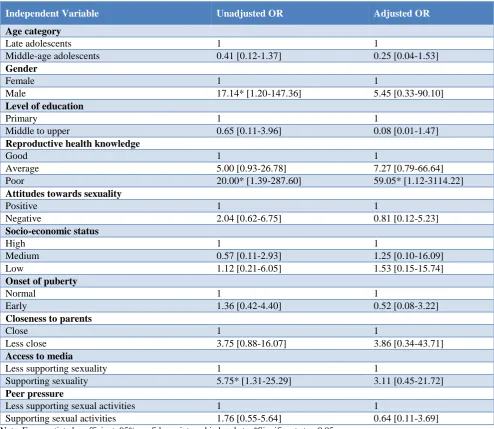
Table 3. Unadjusted and adjusted odds ratio factors influencing premarital sociosexual activities.
Independent Variable Unadjusted OR Adjusted OR
Age category
Late adolescents 1 1
Middle-age adolescents 0.41 [0.12-1.37] 0.25 [0.04-1.53]
Gender
Female 1 1
Male 17.14* [1.20-147.36] 5.45 [0.33-90.10]
Level of education
Primary 1 1
Middle to upper 0.65 [0.11-3.96] 0.08 [0.01-1.47]
Reproductive health knowledge
Good 1 1
Average 5.00 [0.93-26.78] 7.27 [0.79-66.64] Poor 20.00* [1.39-287.60] 59.05* [1.12-3114.22]
Attitudes towards sexuality
Positive 1 1
Negative 2.04 [0.62-6.75] 0.81 [0.12-5.23]
Socio-economic status
High 1 1
Medium 0.57 [0.11-2.93] 1.25 [0.10-16.09]
Low 1.12 [0.21-6.05] 1.53 [0.15-15.74]
Onset of puberty
Normal 1 1
Early 1.36 [0.42-4.40] 0.52 [0.08-3.22]
Closeness to parents
Close 1 1
Less close 3.75 [0.88-16.07] 3.86 [0.34-43.71]
Access to media
Less supporting sexuality 1 1
Supporting sexuality 5.75* [1.31-25.29] 3.11 [0.45-21.72]
Peer pressure
Less supporting sexual activities 1 1
Supporting sexual activities 1.76 [0.55-5.64] 0.64 [0.11-3.69]
Note: Exponentiated coefficient; 95% confidence interval in brackets; *Significant at p<0,05.
The socio-sexual activity in this study was not limited to genital penetration but varied from lip kissing to sexual intercourse (kissing, necking, petting, and sexual intercourse). Therefore, the researcher presented in more
of sexual activities conducted by respondents were lip kissing (42.9%), kissing the neck (32.9%) and touching or being touching the genital area (21.4%).
Drivers of sociosexual activities conducted by respondents
The risk of transmission of sexually transmitted infections and unwanted pregnancies had a tremendous opportunity in adolescents who engaged in sociosexual activities compared to those who did autoerotic activities. Therefore, it was necessary to identify what factors were associated with the sociosexual activity. Sexual drivers of sexual activity in adolescents with their partners can be caused by factors that originated in the adolescents itself (personal factors) and because of supporting environmental factors (environmental factors). Based on the bivariate analysis between personal and environmental factors with sociosexual activities conducted by respondents, it was known that gender, knowledge about reproductive health, and access to sexual media were associated with sociosexual activities conducted by respondents as shown in Table 4. Premarital sociosexual activities tend to be carried out by male respondents, respondents with low reproductive health knowledge, and respondents who had access to sexual media (Table 4).
Using multiple logistic regression analysis, the researcher seeks to identify the significant factors that encourage respondents' sociosexual activity by conducting multivariate analysis. Based on the analysis, it was known that the poor knowledge about reproductive health was the significant factor which encouraged respondents to conduct sociosexual activities (OR=59.05; 95% CI=1.12-3114.22; p=0.04). Respondents who had a low level of reproductive health knowledge had the opportunity to conduct sociosexual activities about 59 times compared to whose had good knowledge.
DISCUSSION
Some previous studies have shown that adolescent knowledge about reproductive health and sexuality was still low. Adolescents did not understand the signs of puberty, the fertile period, and the risk of sexual intercourse such as abortion, STIs, and HIV. As a result, poor knowledge about reproductive health encouraged adolescents to engage in premarital sexual activities.12 The better the reproductive health knowledge, the lower the premarital sexual activity of adolescents. Conversely, the lower the reproductive health knowledge, the higher the chance of adolescents to engage in premarital sexual activity.
The study conducted by Wardhani, Tamtomo, and Demartoto stated that knowledge about sexuality was directly related to risky sexual behavior in adolescents.13 Unwanted pregnancies, unsafe abortions, and sexually transmitted infections in adolescents occurred due to
inadequate knowledge about reproductive health. Another study stated that the high risk of transmission of sexually transmitted infections was associated with low adolescent knowledge regarding reproductive health. The gap between the need for sexuality information and available information sources was claimed to be a trigger for the high risk of transmission of sexually transmitted infections among adolescents. The knowledge gap in adolescents as identified by Morales et al caused by several reasons, such as lack of access to critical information sources, the lack of discussion about sexual health or even the problem of miscommunication/ misunderstanding about reproductive health information.14
The high probability of sociosexual activity in adolescents who had poor knowledge about reproductive health was also primarily dominated by male adolescents (Table 4). Previous studies also found the same thing, that adolescents who had permissive attitudes and fall into risky sexual activity were male adolescents aged less than 17 years who had poor knowledge of sexually transmitted infections and HIV.12 Besides, respondents who conducted sociosexual behavior were those who had exposure to sexuality media. The exposures to sexuality were experienced from real-life experience on daily activities of prostitution environment and of course, because of the massive internet penetration among adolescents. The study conducted by Prabamurti et al revealed that sexual activity ranging from “fingering” to sexual intercourse was felt like a common thing done by adolescents who live in environments that had a high permissivity level.15
These conditions were supported by social learning theory proposed by Albert Bandura, which stated that a person’s personality develops through a process of observation of the behavior of others. The adolescence phase was identical to the process of searching for identity, so they tended to imitate the behavior that occurred in the surrounding environment.16 Adolescent sexual activity was not a direct effect of good or bad knowledge possessed, but an assessment process that involved the adoption of knowledge, attitudes, and environment, so that all three things encouraged the formation of such behavior.16 So, it was not surprising that the daily environment was a factor that paid a role in the formation of character and sexual behavior of adolescents. Previous studies also suggested that there was an increased susceptibility to risky sexual behavior for adolescents who live in adverse environments. These conditions were often beyond the control of individuals, so the effectiveness of health promotion efforts that only focus on changing individual behavior became less optimal.17
fulfilled the entire population of adolescents, which currently account for a quarter of Indonesia's population. A study in Semarang showed that reproductive health information services were only 30% that were in line with adolescents' expectations. On the other hand, adolescents also have not been able to utilize services optimally, because most adolescents went to health facilities only for self-examination because of illness, not for counselling or seeking information about reproductive health and sexuality.12
Globally, there were indeed many adolescents, especially in marginalized areas. The program has not reached even vulnerable areas. Besides, the managers of government reproductive health programs still used classical patterns in order to increase adolescent understanding of reproductive health through youth centers, peer education, and high-level meetings even though these activities proved to be ineffective. For example, peer education programs provided more benefits for peer educators than for their goals. It showed that sexuality and reproduction education were comprehensively practical but weak at the implementation level.18 Whereas adolescent-friendly reproductive health services should be accessible, acceptable, appropriate and fair and had a comfortable environment, friendly staff, and a mechanism for delivering information that was following the characteristics of adolescents such as time and place that allowed adolescents to access confidential services.19,20
CONCLUSION
This study provides information that a third of adolescents in the prostitution area engage in sexual activity with their partners (sociosexual activities); which is categorized as risky behavior. This risky behavior is known to be caused predominantly by the factor of the lack of knowledge related to reproductive health. The low level of knowledge in permissive daily environmental conditions and directly exposing sexual activities encourages adolescents to engage in risky sexual activities. Interventions to increase adolescent knowledge about correct reproductive health in socially prone areas should be given with more frequent and continuous intensity to support sustainability, therefore, achieves effectiveness.
ACKNOWLEDGEMENTS
The authors would like to thank the Ministry of Research, Technology, and Higher Education, the Republic of Indonesia for the grants and Dr. Windhu Purnomo together with Dr. Rachmat Hargono from Faculty of Public Health Universitas Airlangga as the substantial advisory.
Funding: This research was funded by the Ministry of Research, Technology, and Higher Education, Republic of Indonesia
Conflict of interest: None declared
Ethical approval: The study was approved by the Health Research Ethics Committee of the Faculty of Public Health, Universitas Airlangga with Number: 175-KEPK
REFERENCES
1. McMichael AJ, Beaglehole R. The changing global context of public health. Lancet. 2000;356:495–9. 2. Ergin E, Akin B. Globalization and its Reflections
for Health and Nursing. Int J Caring Sci. 2017;10(1):607–13.
3. BPS BKKBN Kementerian Kesehatan dan ICF International. Survei Demografi dan Kesehatan Indonesia 2012: Kesehatan Reproduksi Remaja. Jakarta, Indonesia: BPS, BKKBN, Kemenkes and ICF International; 2013. Available at: https://dhsprogram.com/pubs/pdf/FR281/FR281.pdf Accessed on 10 July 2019.
4. Low WY. Malaysian youth sexuality: Issues and challenges. J Heal Transl Med. 2009;12(1):3–14. 5. Techasrivichien T, Darawuttimaprakorn N,
Punpuing S, Musumari PM, Lukhele BW, El-saaidi C, et al. Changes in Sexual Behavior and Attitudes Across Generations and Gender Among a Population-Based Probability Sample From an Urbanizing Province in Thailand. Arch Sex Behav. 2016;45(2):367–82.
6. Fuller TD, Chamratrithirong A, Apipornchaisakul K. The correlates and gender differences of sexual behavior of single young adults in Thailand. J Popul Soc Stud. 2017;25(4):328–42.
7. BPS dan Macro International. Survei Kesehatan Reproduksi Remaja Indonesia 2007. Calverton, Maryland, USA: BPS dan Macro International; 2008.
8. Rahyani KY, Utarini A, Wilopo SA, Hakimi M. Perilaku Seks Pranikah Remaja. Kesmas Natl Public Heal J. 2012;7(4):180.
9. Purdy CH. Fruity, Fun, and Safe: Creating a Youth Condom Brand in Indonesia. Reprod Health Matters. 2006;14(28):127–34.
10. Utomo ID, McDonald P. Adolescent reproductive health in Indonesia: Contested values and policy inaction. Stud Fam Plann. 2009;40(2):133–46. 11. Tempo.co. Waspada, 10 persen PSK Dolly Penular
HIV/AIDS. 2013. Available at: http://www.tempo.co/read/news/2013/10/12/173521 277/Waspada-10-persen-PSK-Dolly- Penular-HIVAIDS. Accessed on 10 July 2019.
12. Shaluhiyah Z, Suryoputro A, Setyawati A. The Needs of Information Services on Reproductive Health, STIs, and HIV in Middle Adolescence. J Kesehat Masy. 2017;12(2):96–105.
family intimacy, on sexual behaviors among adolescents in Surakarta. J Heal Promot Behav. 2017;2:138–47.
14. Morales A, Vallejo-medina P, Abello-luque D, Saavedra-roa A, García-roncallo P, Gomez-lugo M, et al. Sexual risk among Colombian adolescents : knowledge, attitudes, normative beliefs, perceived control, intention, and sexual behavior. BMC Public Health. 2018;18(1377):1–13.
15. Putri S, Shaluhiyah Z, Prabamurti PN. Faktor - Faktor yang Berhubungan dengan Perilaku Seksual Remaja yang Tinggal di Lingkungan Resosialisasi Argorejo Kota Semarang. J Kesehat Masy. 2017;5:1092–101.
16. Bandura A. Social Learning Theory. New Jersey: Prentice-Hall Inc; 1977.
17. Sommer M, Mmari K. Addressing Structural and Environmental Factors for Adolescent Sexual and Reproductive Health in Low- and Middle-Income Countries. Am J Public Health. 2015;105(10):1973– 81.
18. Chandra-mouli V, Lane C. What Does Not Work in Adolescent Sexual and Reproductive Health : A Review of Evidence on Interventions Commonly Accepted as Best Practices. Glob Heal Sci Pract. 2015;3(3):333–40.
19. Denno DM, Hoopes AJ, Chandra-Mouli V. Effective Strategies to Provide Adolescent Sexual and Reproductive Health Services and to Increase Demand and Community Support. J Adolesc Heal. 2015;56(1):22–41.
20. Godia PM, Olenja JM, Lavussa JA, Quinney D, Hofman JJ, van ven Broek N. Sexual reproductive health service provision to young people in Kenya ; health service providers ’ experiences. BMC Health Serv Res. 2013;13(476):1–13.
Cite this article as: Sulistiawan D. Premarital sexual activities among adolescents in prostitution