Original Research Article
Immunization coverage under universal immunization programme
in Kozhikode district, Kerala
Sreedevi C.*
INTRODUCTION
Immunization is the single most effective child survival strategy to date. Its role in reducing the child morbidity and mortality by reducing the burden of infectious diseases especially in the developing countries cannot be overlooked though basic life needs should get prime importance. Children are the prime resource for the future. It is their right to have a healthy childhood, and the responsibility of the society is to provide them the
best available facilities and provisions to have a healthy life. Immunization acts by strengthening the host defenses, augmenting the herd immunity and decreasing the number of susceptible in the community and makes the spread of infection more difficult.1 It is one of the most cost-effective investments, with proven strategies that make it accessible to even the most difficult-to-reach areas and vulnerable populations.2 It had played a major role in global eradication of smallpox and elimination of polio from most parts of the world.
ABSTRACT
Background: Immunization is an important cost effective tool for preventing the morbidities and mortalities caused by vaccine preventable diseases. The objectives of this study were to assess the universal immunization programme coverage of children of 12–23 months of age in Kozhikode district and to study the factors associated with immunization coverage.
Methods: A cross sectional study was conducted in 30 randomly selected electoral wards of Kozhikode district which were selected using multi stage cluster sampling technique during April 2013 to May 2014.
Results: 469 children were studied from 30 clusters. 75.5% was fully immunized while 1.5% was unimmunized. Dropout rate for DPT 3 to Measles was the highest accounting to 20.2%. Most common reason for failure of immunization among unimmunized was that the parents didn’t feel the need (57.1%) and for partially immunized was the illness of the child (27.8%) followed by lack of awareness of the time of immunization (22.2%). Religion, early age of the mother at marriage and first delivery and high birth order were significantly associated with a higher proportion of partially immunized while higher education of the parents (>12th standard), health worker’s home visit in the first year of the child and presence of immunization card were significantly associated with a high full immunization coverage (p<0.05).
Conclusions: Immunization coverage of 75.5% is far behind the target to be achieved. 1.5% of the children didn’t get any of the vaccinations. It is very important to increases the coverage to prevent the re-emergence of vaccine preventable diseases.
Keywords: Immunization coverage, Universal immunization programme, Fully immunized, Partially immunized, Unimmunized
Department ofCommunity Medicine, Government Medical College, Palakkad, Kerala, India
Received: 15 July 2019
Accepted: 31 July 2019
*Correspondence:
Dr. Sreedevi C.,
E-mail: [email protected]
Copyright: © the author(s), publisher and licensee Medip Academy. This is an open-access article distributed under the terms of the Creative Commons Attribution Non-Commercial License, which permits unrestricted non-commercial use, distribution, and reproduction in any medium, provided the original work is properly cited.
In 1974, the World Health Organization (WHO) established the Expanded Programme on Immunization.3 It was introduced In India in 1978. Later universal immunization programme was launched in 1985-86.1
Despite the long-standing commitment to “Universal Coverage”, vaccination coverage in India remains far from complete. In India NFHS 1 shows immunization coverage of 35%, NFHS 2 shows 42% and NFHS 3.4 shows 43.5%. Though a slight increase is seen, it is far behind the goals, while in Kerala immunization coverage is 75.3% in NFHS 3 and 82.1% in NFHS 4.5 In Kozhikode, one of the northern district of Kerala has shown a coverage of 65% according to DLHS 3 and 70% in DLHS 4. This was lower than that of state coverage. The coverage in Kozhikode according to DLHS 2 was 93.3% and a rapid decline was seen in DLHS 3. As with the decline in coverage, threat of vaccine preventable diseases also increases in Kerala. Many vaccine preventable diseases like diphtheria are re-emerging and some are remaining static for many years.6
There are many proven factors associated with immunization coverage which include sex of the child, residence, income, socio economic status, education of the parents especially mothers etc. The factors can be different in each area according to the socio-demographical, sociocultural and political situation existing there.
Caution has to be taken about the scenario of decreasing immunization coverage; in the context of re-emergence of vaccine preventable diseases in Kerala. Immunization coverage of Kozhikode is below the state coverage. So it is also important to find out the reasons for low coverage so that specific issues can be addressed and strategies can be planned so as to reach the unreached and leave no one behind.
This study aims to assess the universal immunization programme coverage of children of 12–23 months of age in Kozhikode district and to study the factors associated with immunization coverage.
METHODS
It was a community based cross-sectional study done in Kozhikode district during April 2013 to May 2014. Inclusion criteria included children of 12-23 months of age who were permanent residents of Kozhikode district. Children whose parents were not willing to give informed consent were excluded. Multistage cluster sampling technique was used considering electoral wards in the selected areas as clusters. 469 children were studied from 30 clusters; 15 each from rural and urban area of Kozhikode district. Houses were selected from the ward by spinning a pen from a major junction as suggested by WHO. Parents were interviewed using a pre-tested semi-structured questionnaire and also by checking the immunization card. Data was coded and entered in
Microsoft Excel sheet and analyzed using SPSS statistical software.
RESULTS
All the study participants belonged to the age group 12 to 23 months. Mean age was 18.1±4.3 months. Of the 469 subjects, 50.5% were males & 49.5% were females, with a sex ratio of 979 for 1000 males. Majority of the children (72.7%) belonged to the middle socio economic class followed by lower socio economic class (25%) as per modified Kuppuswamy classification.7 71.3% of the mothers belonged to the age group of 20-29 years. But most of the fathers (66.9%) belonged to the age group of 30–39 years. 99.7% of the mothers and 98.1% of the fathers were literate. Fathers of majority (80.8%) of the children and mothers of most (93.5%) of the children had ten or more years of schooling. Majority of the mothers 433 (92.3%) were house wives. Mean age of the father at marriage was 27.3±3.8 years and of the mother were 20.5±3 years.
98.7% of the children were delivered in the hospital, which corresponds to the high rate of hospital delivery in Kerala. 10.4% had a birth weight less than 2.5kg and mean birth weight was 2.9±0.47 kg.
Immunization coverage according to the information got by card or history is given in Table 1.
Table 1: Immunization coverage as per vaccination card or mothers report.
Fully immunized Partially
immunized Unimmunized
354 (75.5%) 108 (23%) 7 (1.5%)
Most individual vaccines had the coverage higher than 90% except Measles vaccine. It indicates a good awareness of the parents, good field work by health workers and good access to health system. BCG shows the highest coverage which indirectly points to the fact that Kerala has achieved almost 100% hospital deliveries and for most of the children BCG is given at the birth place itself. The coverage for Measles vaccine (75.5%) was the lowest.
Dropout rates increases from BCG to DPT 1, to DPT1 to DPT3 and highest for DPT3 to Measles vaccine which was 20.2%. It indicates that dropout rate increases as the time duration between vaccines increases.
child and inconvenience of the mother. Mean delay for BCG was 4.4 days, DPT1- 2 days, DPT2- 9 days, DPT3- 18 days and Measles vaccine -1.9 months.
For majority of the parents, (85%) health workers were the source of information regarding vaccination including JPHN, ASHA and Anganwadi worker. It was followed by Relatives and Neighbours. Doctors were the informant only for 29.6% of parents. 86.8% of parents were informed about last immunization session by any of the health worker. 96.2% of children were brought by mothers for immunization. In 12.1% mother and father together brought the child which is a factor to be promoted as involvement and concern of fathers in child’s preventive health. For majority (65.8%) decision about immunization of the child was taken together by both parents. Father was the decision maker for 22.6% of children. Others (2.5%) mainly include the in laws and other close relatives. All the study participants had a government immunization centre (including the outreach centre) within 1-2 km distance from their house.
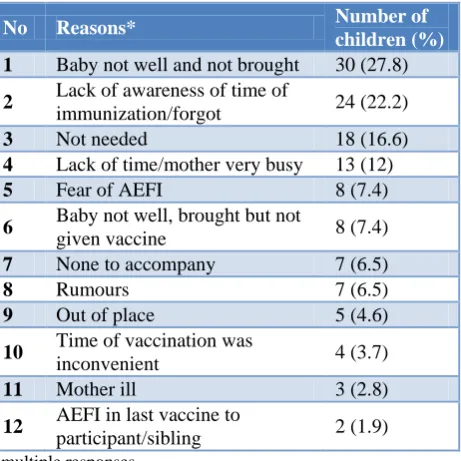
There were 7 unimmunized and 108 partially immunized children. The important reasons for failure of immunization among unimmunized is given in Table 2 and for partially immunized is given in Table 3.
Table 2: Reasons for failure of immunization among unimmunized children.
Reasons Number of children (%)
No need of vaccination 4 (57.1)
Rumours 3 (42.9)
Fear of AEFI 1 (14.3)
Table 3: Reasons for failure of immunization among partially immunized children.
No Reasons* Number of
children (%)
1 Baby not well and not brought 30 (27.8)
2 Lack of awareness of time of
immunization/forgot 24 (22.2)
3 Not needed 18 (16.6)
4 Lack of time/mother very busy 13 (12)
5 Fear of AEFI 8 (7.4)
6 Baby not well, brought but not
given vaccine 8 (7.4)
7 None to accompany 7 (6.5)
8 Rumours 7 (6.5)
9 Out of place 5 (4.6)
10 Time of vaccination was
inconvenient 4 (3.7)
11 Mother ill 3 (2.8)
12 AEFI in last vaccine to
participant/sibling 2 (1.9)
*multiple responses.
Various factors including baseline characteristics, child and parental factors and health system factors associated with immunization coverage is given in Table 4.
Table 4: Factors associated with immunization coverage.
Factors
Fully immunized (%)
Not fully immunized (%)
P value#
Gender
Male 73.8 26.2
0.4 Female 77.2 22.8
Socioeconomic status
Upper 90.9 9.1
0.421 Middle 74.5 25.5
Lower 76.9 23.1
Mother’s age at marriage in years
<18 61 39
0.002* 18-21 76.1 23.9
>21 82.3 17.7
Mother’s age at first delivery
<20 66.7 33.3
<0.0001* >20 82.4 17.6
Mother’s education
≤12 72.9 27.1
0.033* >12 82.3 17.7
Father’s education
≤12 (404) 73.3 26.7
0.005* >12 (65) 89.2 10.8
Birth order
1-2 77.1 22.9
0.031* 3-4 71.9 28.1
>4 33.3 66.7
Relevant medical history in 1st year
Present 46.2 53.8
0.013* Absent 76.3 23.7
Frequency of health workers visit
Nill 60.8 39.2
0.001 1-2 81.2 18.8
3 or more 79.1 20.9
Immunization card
Present 78 22
0.002 Absent 60 40
(#p value calculated from chi-square test, *shows the significant p value of <0.05).
DISCUSSION
BCG which was taken during the hospital delivery. Many others had skipped or delayed Measles vaccine. This group is of particular interest as they need constant motivation. The fact that measles vaccine has lowest coverage compared to other vaccines indicated the need of constant and repeated motivation of mothers regarding immunization. High dropout rate was also seen for measles vaccine. Similar results were obtained in studies conducted by Govindrajan et al, Bhhuwan Sharma et al, and Kadri et al.8-10
Regarding centre of vaccination, Government facility was the main centre for all vaccines except BCG. Government centres include outreach centres, primary health centres, Community health centres and Medical colleges. According to coverage evaluation survey it has been found that only 21% of children received most vaccination from a private hospital or clinic while the rest got it from Government sector in Kerala.11 All the study subjects had a government immunization centre (including the outreach centre) within 1–2 km distance from their house. This shows the easy accessibility of immunization services to almost all of its beneficiaries.
For 22.6% of children father was the decision maker regarding immunization. Decision maker is important as the resistance to immunization depends on the decision maker. It is important for the health worker to interact and provide health education to the decision maker regarding the necessity of immunizing the child.
Considering the reasons for unimmunized children Majority thinks that there is no need of vaccination. One didn’t take vaccine fearing the AEFI and because of rumors about untoward effects of vaccines. One was a Naturopathy follower and they have no faith in immunization thinking that vaccines will do more harm than good.
For partially immunized children the major reason for not taking or delaying immunization was the illness of the baby but this can’t be taken as a real contra indication as the mother hasn’t taken the child for immunization session. Mild fever, diarrhoea and other mild illness are not a contra indication for taking vaccination. Most of the children with missed opportunity didn’t utilize the next opportunity of immunization because of lack of motivation. Either they forgot or postponed the vaccination for another time. Repeated motivation by health workers can avert the failure of immunization to a larger extend. Other important reasons for partially immunized children were lack of awareness of time of immunization, not feeling the need of immunization, lack of time for the mother, fear of AEFI and lack of people to accompany mother to immunization site. In a study conducted in Uttarakhand by Banerji, fear of fever following immunization and lack of proper communication about this by health workers was found to be a reason to deter the immunization.12
An age at marriage of <18 years for mothers, mother’s age at first delivery <20 years and presence of any relevant medical history in the first year of the study subject were significantly associated with a lower coverage of fully immunized children. Higher education of parents (>12th standard), one or two home visits by the health worker in the first year of the child, higher birth order and presence of immunization card have shown a significant association with a high full immunization coverage. Association of parent’s education with fully immunized was obtained in NFHS3, in a study about Immunization in urbanized villages of Delhi by Chhabra et aland in another study by Vohra et al in Lucknow.13,14 Being informed about next immunization day and getting advice from an ASHA worker was associated with higher coverage according to a study by Ahmad et al in rural Uttar Pradesh.15
There was no significant association between gender, socio economic status and parent’s occupation with immunization coverage. In contrast with this findings a higher coverage in males were seen in DLHS 3 India, in a study conducted by Mahyavanshi et al in Surendranagar, Sheth et al in rural Gandhinagar and Wagh et al in Maharashtra.16-18 Difference in findings may be due to the fact that in Kerala gender discrimination is lesser when compared to other states of India.
As the low immunization coverage may predispose to the re-emergence of many lethal vaccine preventable diseases it is very important to take measures to improve the coverage. Awareness of the community should be raised by health education. Health workers should be more vigilant to tackle the rumours going on among people against immunization. They should provide constant motivation to the parents for taking all the vaccines. Due stress should be given for Measles vaccine. They should be trained to effectively manage any adverse events occurring following immunization and to properly communicate to regain the trust of the community. Along with these direct interventions other factors like improving the general education level of the community and preventing early marriages should be given adequate attention.
CONCLUSION
availability in the area was good. Health workers were the main source of information about immunization and mainly mothers brought the children to immunization session. Most important reasons for failure of immunization were illness of the child, lack of awareness of time of immunization, parent’s belief that vaccine is not needed.
Higher education of parents (>12th standard), one or two home visits by the health worker in the first year of the child and presence of immunization card have shown a significant association with a high full immunization coverage. Considering these it is important to give constant motivation for the parents to complete the immunization. Due stress should be given for Measles vaccine as there is a long gap between DPT 3 and Measles vaccine and the dropout was very high. Proper awareness should be given that mild illness is not contraindications for immunization and health workers should take care to correct all the missed opportunities.
ACKNOWLEDGEMENTS
Dr. C. Prabhakumari, Professor and Head, Department of Community Medicine, Govt. Medical College Thrissur (retired), Dr. Thomas Bina, Professor and Head, Department of Community Medicine, Govt. Medical College Kozhikode, Dr. Lucy Raphel, Professor, Department of Community Medicine, Govt. Medical College Thrissur (retired), Dr. Asma Rahim, Professor and Head, Department of Community Medicine, Govt. Medical College Manjeri, Dr. Priya, Professor, Department of Community Medicine, Govt. Medical College Kozhikode, Dr. Biju George, Associate Professor, Department of Community Medicine, Govt. Medical College Kozhikode, Dr. Jayakrishnan, Professor, Department of Community Medicine, Govt. Medical College Kozhikode, Dr. Jayakrishnan, Associate Professor, Department of Community Medicine, Govt. Medical College Manjeri, Dr Sivakumar, Associate Professor, Department of Community Medicine, Govt. Medical College Kozhikode.
Funding: No funding sources Conflict of interest: None declared
Ethical approval: The study was approved by the Institutional Ethics Committee,Government Medical College, Kozhikode
REFERENCES
1. Park K. Park’s Textbook of Preventive and Social medicine. 22nd ed. 1167, Prem Nagar, Jabalpur 482001 (M.P.) India: M/s Banarsidas Bhanot Publishers; 2013:6-11.
2. World Health Organization. Immunization. Available at: https://www.who.int/topics/ immunization/en/. Accessed on 16 March 2019.
3. Keja K, Chan C, Hayden G, Henderson RH. Expanded programme on immunization. World Health Statistics Quarterly Rapport Trimestriel De Statistiques Sanitaires Mondiales. 1987;41(2):59-63. 4. Government of India, Ministry of Health and Family welfare; International Institute for Population Sciences (IIPS) and Macro International. National Family Health Survey (NFHS-3); 2005–06: India: Volume I, Mumbai: IIPS.
5. Government of India, Ministry of Health and Family welfare; International Institute for Population Sciences (IIPS). National Family Health Survey (NFHS-4); 2015-16: state fact sheet Kerala.
6. Murhekar M, Bitragunta S. Persistence of Diphtheria in India. Indian J Community Med. 2011;36(2):164.
7. Kumar BPR, Dudala SR, Rao AR. Kuppuswamy socio-economic status scale a revision of economic parameter for 2012. Int J Res Dev Health. 2012;1(1):2-4.
8. Govindarajan PK, Senthilmurugan TK. Study on immunization coverage in urban population in Tamilnadu. Nat J Res Com Med. 2012;1(4):220-2. 9. Sharma B, Mahajan H, Velhal GD. Immunization
Coverage: Role of Sociodemographic Variables. Adv Prevent Med. 2013;5.
10. Kadri AM, Singh A, Jain S, Mahajan RG, Trivedi A. Study on immunization coverage in urban slums of Ahmedabad city. Health and Population: Perspectives Issues. 2010;33(1):50-4.
11. Ministry of health and Family Welfare Government of India. Kerala Fact Sheet 2009, Coverage Evaluation Survey, UNICEF India Country Office. 2009.
12. Banerji S. The Pertinence of Maternal Education on Child Immunization in Rural Uttarakhand: More Than Just Increased Rates. 2013. Available at: https://digitalcollections.sit.edu/isp_collection/1703. Accessed on 16 March 2019.
13. Chhabra P, Nair P, Gupta A, Sandhir M, Kannan AT. Immunization in urbanized villages of Delhi. Indian J Pediatr. 2007;74(2):131-4.
14. Vohra R, Vohra A, Bhardwaj P, Srivastava JP, Gupta P. Reasons for failure of immunization: A cross-sectional study among 12-23-month-old children of Lucknow, India. Adv Biomed Res. 2013;2:71.
15. Ahmad J, Khan ME, Hazra A. Increasing complete immunization in rural Uttar Pradesh. J Family Welfare. 2010;56:65-72.
16. Mahyavanshi DK, Nagar SS, Patel MG, Nagar SS, Purani SK, Kartha GP. Evaluation of Immunization coverage among children aged 12-23 months in Surendranagar city. Int J Basic Clin Pharmacol. 2013;2(3):286.
18. Wagh S, Mehendale A, Raut M, Wagh S, Sharma D. Evaluation of Primary Immunization Coverage and Reasons for Partial/Non immunization in Maharashtra. Int J Cur Res Rev. 2013;5(15):66-72.