Original Research Article
A study of menstrual hygiene among rural adolescent school girls in
rural field practice area of a medical college, Davangere- a cross
sectional study
Vidya Basavaraju
1, Chetan Lakshmikantha Bukanakere
2*, Madonna J. Dsouza
1,
Ashok Kumar Shivakumar Mallenahalli
1INTRODUCTION
Adolescence in girls signifies the transition from girlhood to womanhood, one fifth of world population is between 10 and 19 years old. Menstruation is a phenomenon unique to the females. The onset of menstruation is one of the most important changes occurring among the girls during the adolescent years. The first menstruation (menarche) occurs between 12 and 17 years with a mean of 14-15 years.1 Menstrual hygiene is an issue that every girl and woman has to deal with once she enters adolescence around the age of 12 years and until she
reaches the menopause somewhere in her 40’s. Overall, a woman spends approximately 2,100 days menstruating which is equivalent to almost six years of her life. Menstruation is a monthly occurrence that requires access to appropriate materials and facilities, without which, females suffer from poor menstrual hygiene which restricts their movement and self-confidence.1,2 Hygiene-related practices of women during menstruation are of considerable importance, as it has a health impact in terms of increased vulnerability to Reproductive tract infections (RTI). Women having better knowledge regarding menstrual hygiene and safe practices are less vulnerable to
ABSTRACT
Background: Adolescence in girls signifies the transition from girlhood to womanhood; one fifth of world population is between 10 and 19 years old. Menstruation is a phenomenon unique to the females. Menstruation is a monthly occurrence that requires access to appropriate materials and facilities, without which, females suffer from poor menstrual hygiene which restricts their movement and self-confidence. Increased knowledge about menstruation right from childhood may escalate safe practices and may help in mitigating the suffering of millions of women.
Methods: A cross sectional study was conducted among 200 adolescent girls in a rural field practice area of S. S. Institute of Medical Sciences. Data on socio-economic variables and menstrual characteristics were collected using pre-tested questionnaires for a period of two months from September to October 2018.
Results: Total of 200 girls was interviewed. 87.6% of the girls were aware about menstruation prior to the attainment of menarche. Mothers were the first informants in about 56.5% girls. Overall 51.5% adolescent girls were using sanitary napkins as menstrual absorbent, while 45.6% were using used cloths. 97.6% girls practiced different restrictions during menstruation. Some of the sociodemographic factors like religion, type of family and mother’s education, SES were significantly associated with menstrual hygienic practices.
Conclusions: There is a need to educate the girls about menstruation, its importance and hygiene maintenance; to enable them to lead a healthy reproductive life in future.
Keywords: Adolescent girl, Menstrual hygiene, Sanitary pad
1Department ofCommunity Medicine, S.S. Institute of Medical Sciences Davangere, Karnataka, India 2
Department of Dermatology, JJM Medical College and Hospital, Davangere, Karnataka, India
Received: 20 August 2019
Accepted: 13 September 2019
*Correspondence:
Dr. Chetan Lakshmikantha Bukanakere, E-mail: [email protected]
Copyright: © the author(s), publisher and licensee Medip Academy. This is an open-access article distributed under the terms of the Creative Commons Attribution Non-Commercial License, which permits unrestricted non-commercial use, distribution, and reproduction in any medium, provided the original work is properly cited.
RTI and its consequences. Therefore, increased knowledge about menstruation right from childhood may escalate safe practices and may help in mitigating the suffering of millions of women.3,4
In several cultures there are (cultural and religious) taboos concerning blood, menstruating girls and women and menstrual hygiene. In recent years’ importance of health counselling for adolescents has been appreciated, but there are no large-scale community based studies to assess awareness about menarche and reproduction in Indian adolescent girls. In India, problems are more difficult and complicated because of marked socioeconomic diversity.5 This is an important sanitation issue, which has been in the closet, and still there is a long-standing need to openly discuss it. Good menstrual hygiene is therefore crucial for the health, education and dignity of girls and women. With the above background, this study was undertaken to elicit the knowledge on source of information regarding menstruation, restrictions and customs or rituals practiced during menstruation among the study population.
Objectives
The objectives of the present study were to study the socio-demographic profile of study population and to study the knowledge and practices regarding menstruation among the study population.
METHODS
Type of study
A cross-sectional study.
Study setting
The present study was undertaken among the adolescent high school girls in four high schools coming under Lokikere, primary health centre, a rural field practice area of S. S. Institute of Medical Sciences, Davangere.
Study subjects
The present study was conducted on adolescent high school girls between the age group 10-19 years.
Inclusion criteria
All adolescent girls who are willing to give informed consent to participate in the study.
Exclusion criteria
All the adolescent girls who are mentally challenged.
Study duration
The study period was duration of two months (September to October 2018).
Sample size
All the adolescent girls in 4 high schools coming under Lokikere, primary health centre area (200).
Study instrument
A pre-designed, semi-structured questionnaire.
Method of data collection
The school authorities were contacted and explained about the study. After obtaining the permission from the school authorities, the participants were explained regarding the purpose of the study. The study variables include general information, questions regarding the knowledge and practice of menstrual hygiene.
Written informed consent was taken prior to the data collection. Girls were administered a pre-designed, semi-structured questionnaire which was in local language, Kannada. The girls were instructed on how to fill the questionnaire and explained about each question.
Adequate time was given to fill up the questionnaire. This was followed by a session educating the girls about the normal physiology of menstruation, the importance of maintaining hygiene and safe hygienic practices during menstruation. Questions and concerns of the participants, if any were also addressed at the end of the session.
Statistical analysis
Data obtained from the study was entered in MS Excel sheet and analysed using Statistical package for social science (SPSS) package version 20.0.
The descriptive statistics were that all qualitative variables are presented as frequency and percentages. Chi-square test of significance was used and p value of less than 0.05 was considered statistically significant. MS Word and Excel have been used to generate graphs, tables.
RESULTS
Sociodemographic profile of the study participants showed that, the age of menstruating girls ranged from 12 to 17 years, (74.5%) girls being between 14 and 15 years of age group, Majority of respondents 156 (78%) were Hindus, 73 (36.5%) girls belonged to class III socioeconomic status (BG Prasad classification.) and nuclear family 85(42.5%) (Table 1).
Table 1: Sociodemographic profile of the study participants (n=200).
Variables Frequency
N (%) Age
(in years)
12-14 99 (49.5)
15-17 101 50.5)
Religion
Hindu 156 (78)
Muslim 26 (13)
Christian 18 (9)
Type of family
Nuclear 95 (42.5)
Joint 60 (30)
Three generation 55 (27.5)
Socio-economic status
I 52 (26)
II 44 (22)
III 73 (36.5)
IV 22 (11)
V 9 (4.5)
Mother’s literacy Literate 72 (37.7)
Illiterate 128 62.3)
Mother’s occupation Housewife 123 64.4)
Labourer 77 (35.6)
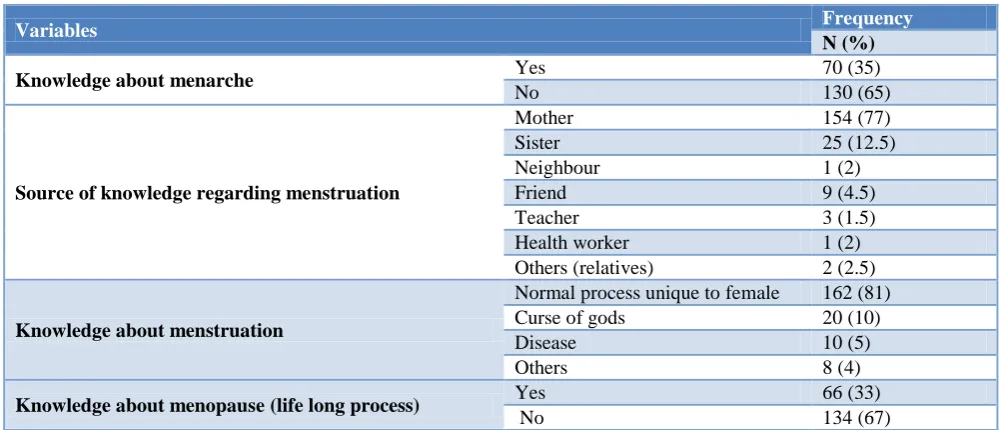
Table 2: Knowledge of study participants about menstruation (n=200).
Variables Frequency
N (%)
Knowledge about menarche Yes 70 (35)
No 130 (65)
Source of knowledge regarding menstruation
Mother 154 (77)
Sister 25 (12.5)
Neighbour 1 (2)
Friend 9 (4.5)
Teacher 3 (1.5)
Health worker 1 (2) Others (relatives) 2 (2.5)
Knowledge about menstruation
Normal process unique to female 162 (81) Curse of gods 20 (10)
Disease 10 (5)
Others 8 (4)
Knowledge about menopause (life long process) Yes 66 (33)
No 134 (67)
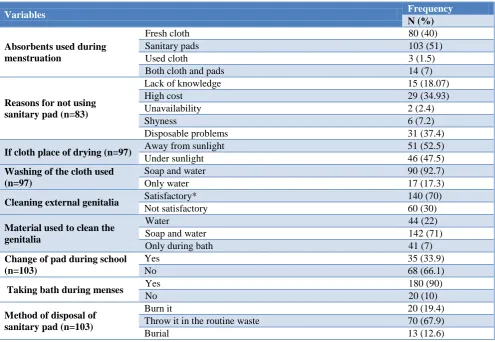
Majority of the study participants 134 (67%) did not know that menstruation is a lifelong process and 162 (81%) knew that menstruation in a normal process unique to females, 20 (10%) thought it was curse of Gods (Table 2). Regarding practices, overall 103 (51.5%) adolescent girls were using sanitary napkins as menstrual absorbent, while 80 (40%) were using fresh cloths. Majority 31 (37.4%) mentioned disposing problems and high cost 29 (34.93%), being the reason for not using sanitary pads. 51 (52.5) of them dried the cloth away from sunlight, while, 46 (47.5) dried under the sunlight. 90 (92.7%) of them washed the used cloth with soap and water.
Majority of them 180 (90%) of study participants take bath during their menses and 80 (40%) of them clean their
external genitalia twice daily and 60 (30%) clean thrice daily during menses, 142 (71%) use soap and water to clean their genitalia and 44 (22%) of them use just water. 68 (66.1%) do not change pads during school hours. (Table 3).
Study participants had many health problems during menstruation, 113 (56.5%) had pain abdomen, 34 (17%) of them had leg cramps and back pain, 16 (8%) had nausea and vomiting during menstruation (Table 4).
Table 3: Distribution of study participants according to practices during menstruation (n=200).
Variables Frequency
N (%)
Absorbents used during menstruation
Fresh cloth 80 (40)
Sanitary pads 103 (51)
Used cloth 3 (1.5)
Both cloth and pads 14 (7)
Reasons for not using sanitary pad (n=83)
Lack of knowledge 15 (18.07)
High cost 29 (34.93)
Unavailability 2 (2.4)
Shyness 6 (7.2)
Disposable problems 31 (37.4)
If cloth place of drying (n=97) Away from sunlight 51 (52.5)
Under sunlight 46 (47.5)
Washing of the cloth used (n=97)
Soap and water 90 (92.7)
Only water 17 (17.3)
Cleaning external genitalia Satisfactory* 140 (70)
Not satisfactory 60 (30)
Material used to clean the genitalia
Water 44 (22)
Soap and water 142 (71)
Only during bath 41 (7)
Change of pad during school (n=103)
Yes 35 (33.9)
No 68 (66.1)
Taking bath during menses Yes 180 (90)
No 20 (10)
Method of disposal of sanitary pad (n=103)
Burn it 20 (19.4)
Throw it in the routine waste 70 (67.9)
Burial 13 (12.6)
*: Satisfactory cleaning of external genitalia: cleaning for more than 2 times a day during menstruation; Unsatisfactory cleaning of external genitalia: cleaning less than or equal to 2 times a day during menstruation.
Table 4: Health problems during menstruation (n=200).
Health problems during menstruation Frequency %
Pain in abdomen 113 56.5
Nausea, vomiting 16 8
Headache and irritation 14 7
Palpitation and giddiness 6 3
Leg cramps and back pain 34 17
Loss of appetite 7 3.5
Body ache 10 5
Total 200 100
*: Multiple responses.
Table 5: Distribution of study subjects w.r.t the cultural restriction practiced during menstruation. (n=180).
Restriction practiced Frequency %
Avoid religious functions 72 40
To remain separate 14 7.77
Not to touch food 8 4.44
Not to sleep on routine bed 7 3.88
Sit outside the house 13 7.22
Do not touch other family members 20 11.11
Not play or work outside 26 14.44
Not attend school 6 3.33
Restriction practiced Frequency %
Not eat certain food 4 2.22
Not perform any householdwork 5 2.77
Not strenuous physical activity 5 2.77
Total 180 100
The usage of sanitary napkins during menstruation was significantly associated with the participant’s religion, type of family and mother’s education. Satisfactory cleaning of external genitalia was significantly associated with the participant’s age, socioeconomic status and mother’s education (Table 6).
The hygienic practices of changing sanitary pads regularly and even at school and using adequate number of pads/day was significantly associated with the participant’s religion, type of family and socioeconomic status (Table 7).
Table 6: Association between sociodemographic factors and menstrual hygienic practices.
Variables Use of material during menstruation Cleaning of external genitalia
Age
Sanitary pad
Old cloth
Both Unsatisfactory Satisfactory
12-14 48 16 37 X2=15.11; 0.44
68 32 X2=18.87; 0.047
15-17 55 12 32 69 31
Religion
Hindu 80 14 38 X2=24.48; 0.04
108 48
X2=9.30; 0.15
Muslim 23 37 3 34 5
Christian 1 0 4 5 0
Family
Nuclear 27 7 31
X2=21.3; 0.011
46 14
X2=9.11; 0.167
Joint 26 7 16 32 19
Three generation
50 14 21 60 29
SES
I 25 7 23
X2= 20.1; 0.17
45 7
X2=11.2; 0.00
II 28 8 7 28 16
III 26 7 30 46 27
IV 12 9 10 18 4
V 1 6 2 2 7
Mothers education
Illiterate 37 15 29 X2=8.83; 0.05
69 12 X2=16.7; 0.00
Literate 66 13 40 77 42
Table 7: Association between sociodemographic factors and menstrual hygienic practices.
ariables Change of pad or cloth at school Number of absorbents used per
day
Age
Yes No <2 >2
12-14 32 62 X2=3.47; 0.62
58 37 X2=19.3; 0.19
15-17 41 65 55 50
Religion
Hindu 52 107
X2=9.46; 0.024
91 65
X2=8.64; 0.04
Muslim 15 21 20 19
Christian 1 4 2 3
Family
Nuclear 15 45
X2=5.4; 0.01
32 38
X2=28.30; 0.001
Joint 19 36 51 19
Three generation 31 54 41 19
SES
I 30 31
X2=10.5; 0.01
24 28
X2=11.2; 0.00
II 21 23 25 19
III 15 58 40 33
IV 8 14 15 16
V 0 1 1 0
Mothers education
Illiterate 23 58 X2=2.87; 0.5
48 33 X2=7.72; 0.08
DISCUSSION
The present study shows that the age of menstruating girls ranged from 12 to 17 years, maximum 74.5% number of girls being between 14 and 15 years of age group. In a study done by Sowmya et al the age of menstruating girls ranged from 14 to 17 years, maximum (76.25%) number of girls being between 14 and 15 years of age group.6
Among 200 respondents in the present study, 156 (78%) were Hindus, 26 (13%) girls were Muslims, 10 (5%) were Christians and others were 8 (4%). Majority belonged to extended family 85 (42.5%) and nuclear family 60 (30%). In a study by Ramachandra et al, 92.1% were Hindu, while 7.1% were Muslims and 85% were from nuclear family.7
Majority of our study participants belong to class III socioeconomic status. According to a study by Bhattacharyya et al, 275 (60%) were from low socioeconomic status.8
Among 200 respondents in our study 130 (65%) were not aware of menstruation before menarche. In a study done by Sowmya et al showed that 12.4% girls were not aware about menstruation prior to attainment of menarche.6
In our study, mother was the first informant in case of 154 (77%) girls. Other sources of information were sister 25 (12.5%) and friend 9 (4.5%). In a study done by Nagaraj et al, mother was the source of information 47.03% of study subjects; similarly, mother was prime source of information in studies conducted by Thakre et al (71.3%) and Arora et al (43.3%) among adolescent girls.9-11
In our study 103 (51.5%) girls used sanitary pads during menstruation, 3 (1.5%) girls used old cloth pieces, 80 (40%) girls used fresh cloth pieces, and 14 (7%) girls used both cloth pieces and sanitary pads during menstruation. Majority of the participants, 35 (36.08%) mentioned disposing problems, high cost 34 (35.05%) being the reason for not using sanitary pads. In a study by Dugani et al 26.3% of study subjects were using sanitary pads.12 Thakre et al also observed low prevalence (30.8%) of usage of sanitary pads in their study conducted among adolescent girls in a rural area of Nagpur district.10
In our study, majority of the participants 180 (90%) take bath during their menses, 80 (40%) of the participants clean their external genitalia twice daily, 142 (71%) use soap and water to clean their genitalia and 44 (22%) of them use just water.
In the study by Juyal et alreported that most of the girls took bath daily and 64.78% of girls cleaned their external genitalia with soap and water regularly during the days of menstruation.13 Different studies from India and abroad have reported that 34-42.2% adolescent cleaned their external genitalia with soap and water during menstruation. Dasgupta et al reported that 156 out of 160
(97.5%) rural adolescent girls cleaned their external genitalia with soap and water.14
In our study majority of the participants 113 (56.5%) have pain abdomen, 34 (17%) of them have leg cramps and back pain, 16 (8%) have nausea and vomiting during menstruation. In a study by Nagaraj et al dysmenorrhea was reported by 183 (60.19%) study subjects.9 159 (52.30%) subjects reported PMS. Among the subjects who suffered from PMS, the most common somatic symptom was pain abdomen, which was observed in 115 (72.5%) study subjects. Among the psychological symptoms, depression was most common PMS symptom, which was noted in 71 (44.65%) study subjects.
Among 180 who practice cultural restrictions in our study, 72 (40%) avoid religious functions, 26 (14.44%) do not play or work outside, 20 (11.11%) do not touch other family members. In a study by Dugani et al 12,166 (97.6%) girls practiced different restrictions during menstruation, among them 84 (49.4%) girls did not attend any religious occasion, 13 (7.6%) girls did not eat certain foods such as sour foods, banana, radish and palm, (17.1%) girls did not play, 32 (18.8%) girls did not perform any household work and 8 (4.7%) girls did not attend school.
Among 200 participants in our study, only 81% (162) knew menstruation is a normal process unique to females, rest thought it’s a curse of God or disease. In a similar study done in rural Gujarat, which showed that only 31% felt it was a normal phenomenon. There are other similar studies, with similar results with most of the girls thinking that it is a curse of God or sin or a disease.
CONCLUSION
Although knowledge was better than practice, both were not satisfactory. Therefore, the girls should be educated about the significance of menstruation, use of proper sanitary pads or absorbents and its proper disposal. This can be achieved by giving them proper training and health education by teachers, family members, health workers, and media so that there won't be any misconception to the adolescent girls regarding menstrual hygiene.
Recommendations
ACKNOWLEDGEMENTS
We acknowledge all the girls who participated in the study and doctors Dr. Raksha R. Palled, Dr. Repaka Nikitha, Dr. Sabreen Fathima, Dr. Sahana Ravikumar, Dr. Suren Reddy, Dr. Srinivas B., Dr. Sonali Jagati.
Funding: No funding sources Conflict of interest: None declared
Ethical approval: The study was approved by the Institutional Ethics Committee
REFERENCES
1. Devi DK, Ramaiah VP. A study on menstrual hygiene among rural adolescent girls. Indian J Med Sci. 1994;48:139-43.
2. Kamath R, Ghosh D, Lena A, Chandrashekaran V. A study on knowledge and practices regarding menstrual hygiene among rural and urban adolescent girls in Udupi Taluk, Manipal, India. 2003;2(4):1-9.
3. Deo DS, Ghattargi CH. Perceptions and practices regarding menstruation: a comparative study in urban and rural adolescent girls. Indian J Community Med. 2005;30:33-4.
4. Mudey AB, Keshawani N, Mudey GA, Goyal RC. A cross-sectional study on awareness regarding safe and hygienic practices amongst school going adolescent girls in rural area of Wardha District, India. Glob J Health Sci. 2010;2: 225-30.
5. Department of Ministry of Health and Family Welfare, IEC Division. NRHM. Orientation Programme: For medical officers to provide adolescent friendly reproductive and sexual health services- facilitator’s guide; 2006.
6. Sowmya BC, Manjunatha S, Kumar J. Menstrual hygiene practices among adolescent girls: a cross sectional study. J Evol Med Dent Sci. 2014;3(28):7955-61.
7. Ramachandra K, Gilyaru S, Eregowda A, Yathiraja S. A study on knowledge and practices regarding menstrual hygiene among urban adolescent girls. Int J Contemp Pediatr. 2016;3:142-5.
8. Bhattacharyya M, Sen P, Hazra S, Sinha RN, Sahoo S. A study of menstrual hygiene among adoles-cent school girls in a slum area of Kolkata. Nat J Community Med. 2015;6(3):345-8.
9. Nagaraj C, Konapur KS. Effect of Health Education on Awareness and practices related to menstruation among rural adolescent school girls in Bengaluru, Karnataka. Int J Prevent Public Health Sci. 2016;2(1):18-21.
10. Thakre SB, Thakre SS, Reddy M, Rathi N, Phathak K, Ughade S. Menstrual hygiene: Knowledge, and practices among adolescent school girls of Saoner, Nagpur district. J Clin Diagn Res. 2011;5:1027-33. 11. Arora A, Mittal A, Pathania D, Singh J, Mehta C,
Bunger R. Impact of health education on knowledge and practices about menstruation among adolescent school girls of rural part of district Ambala, Haryana. Indian J Community Health. 2012;25:492-7.
12. Dugani VS, Angolkar M, Baliga SS, Mallapur MD, Katti SM. Awareness of menstrual abnormalities amongst pre University College girls (15–18 yrs) in Belgaum, Karnataka State: a cross-sectional study. Indian J Prev Med. 2015; 3:5-9.
13. Juyal R, Kandpal SD, Semwal J, Negi KS. Practices of menstrual hygiene among adolescent girls in a district of Uttarakhand. Indian J Community Health. 2012; 24(2):124-8.
14. Dasgupta A, Sarkar M. How hygienic is the adolescent girl?. Indian J Community Med. 2008;33(2):77-80.
15. Verma PB, Pandya, Ramanju VA, Singh MP. Menstrual pattern of adolescent school girls of Bhavnagar (Gujarat). NJIRM. 2011;2(1): 38-40. 16. Ministry of Health and Family Welfare Government
of India Nirman Bhavan, New Delhi. Operational Guidelines- promotion of menstrual hygiene among adolescent girls (10-19 years) in rural areas.