Original Research Article
Coverage and compliance towards mass drug administration
programme against lymphatic filariasis in Vijayapura
(Bijapur) district, Karnataka, India
Praveen Kulkarni
1, Amoghashree
1*, Krishnaveni Y. S.
1,
M. R. Narayana Murthy
1, K. Ravi Kumar
2INTRODUCTION
Lymphatic filariasis or elephantiasis is the most debilitating and disfiguring scourge among all diseases. Parasites are transmitted to humans through the bites of infected Culex, Anopheles, Mansonia and Aedes mosquitoes.1 The spectrum of illness ranges from acute lymphangities to long term physical consequences like
painful and disfiguring of limbs (lymphoedema or elephantiasis), hydrocele in males, due to the obstruction of lymphatic vessels by the adult worms. Lymphoedema and hydrocele adversely affect personal and social life, and limit occupational activities. According to WHO, currently, more than 856 million people in 52 countries worldwide remain threatened by lymphatic filariasis.2 80% of them reside in Bangladesh, DRC, Ethiopia, India,
ABSTRACT
Background: Lymphatic filariasis or elephantiasis is the most debilitating and disfiguring scourge among all diseases. The National Health Policy (2017) has set the goal of elimination of lymphatic filariasis in endemic pockets in India by 2017. The concept of MDA is to approach every individual in the target community and administer annual single dose of anti-filarial drugs. The objectives of the study were to assess the coverage, compliance and causes for noncompliance towards MDA in Vijayapura district and to assess the rates of directly observed treatment, source of information on MDA and incidence of side effects related to MDA Programme.
Methods: This cross-sectional study was conducted in one urban and three rural clusters in Vijayapura district of Karnataka. Totally 120 houses were covered with minimum of 30 houses in each of the cluster. Data was collected in a structured proforma by interview technique and entered in Microsoft Excel-2010 and analyzed with SPSS version 22.
Results: Out of 120 houses visited in 4 clusters consisting of 398 beneficiaries, the coverage of MDA was 80.3% and 72.5% had consumed the tablets. The coverage compliance gap was 7.8%. 71.7% of the respondents, had awareness regarding elephantiasis. The most common reason quoted by the beneficiaries for not consuming the tablet was lack of information of MDA programme/ Lf (13%) followed by fear of drugs (10%).
Conclusions: BCC is the essence of the hour to fulfil the goal of elimination of lymphatic filariasis; there is need for intensive IEC activities addressing the misconceptions among beneficiaries regarding adverse reactions of MDA through mass media, interpersonal communications.
Keywords: Elephantiasis, Lymphatic filariasis, Compliance, Coverage, MDA, Vijayapura district 1Department of Community Medicine, JSS Medical College, Mysuru, Karnataka, India
2
Ministry of Health and Family Welfare department, Government of Karnataka, Karnataka, India
Received: 13 June 2018
Revised: 06 August 2018
Accepted: 08 August 2018
*Correspondence:
Dr. Amoghashree,
E-mail: [email protected]
Copyright: © the author(s), publisher and licensee Medip Academy. This is an open-access article distributed under the terms of the Creative Commons Attribution Non-Commercial License, which permits unrestricted non-commercial use, distribution, and reproduction in any medium, provided the original work is properly cited.
Indonesia, Myanmar, Nigeria, Nepal and Philippines. In India, although North Western states are known to be free from the disease, 256 districts in 21 states/Union Territories are endemic for the disease.3 Whereas Bihar has highest endemicity of 17% and Goa showed the lowest endemicity of less than 1%. In Karnataka, 13.28 Million people live in the endemic area of which 10.14 million are from rural areas. Five districts namely Bagalkot, Bidar, Bijapur, Gulbarga and Raichur, are considered as endemic for filariasis. Mass drug administration is being implemented in India since year 2004. In 2007 India changed its strategy from delivering of DEC alone to delivery of DEC plus albendazole.4 The National Health Policy (2017) has set the goal of Achieve and maintain elimination of lymphatic filariasis in endemic pockets in India by 2017.2 The strategy aiming to achieve this goal is twofold. First, interrupt transmission using combinations of two medicines delivered to entire populations at risk, a strategy known as mass drug administration (MDA). Second, alleviate suffering and disability by introducing basic measures, such as improved hygiene and skin care, to people with lymphoedema and by providing surgery for men with hydrocele. The concept of MDA is to approach every individual in the target community and administer annual single dose of anti-filarial drugs (DEC or DEC+Albendazole). The strategy for achieving elimination goal is by annual mass drug administration of DEC once a year for at least 5 years to the entire population of an endemic district (excluding children under 2 years, pregnant women and severely ill patients) and morbidity management of lymphoedema.5 The transmission of infection can be stopped by treating the entire eligible population living in filarial endemic areas with Mass Drug Administration (MDA) with DEC given once a year for 5-7 years.6 9 rounds of MDA have already been completed in the Karnataka State. Vijayapura, being one of the 5 endemic districts of LF in Karnataka, had observed 14th round of MDA in first week of August 2017. With the instructions from Regional Health Office, Government of India, Bangalore, we conducted the evaluation of MDA programme in the district between 2nd and 3rd of September 2017 with the aim of evaluating 14th round of Mass Drug Administration Programme for elimination of lymphatic filariasis in Vijayapura district, Karnataka with the objectives of assessing the coverage, compliance and causes for noncompliance towards MDA in the district and also to assess the rates of directly observed treatment, source of information on MDA and incidence of side effects related to MDA Programme.
METHODS
This cross-sectional study was conducted as per the guidelines provided by regional office of Health and Family Welfare, Government of India during September 2017 for a period of one month. Total four clusters were selected of which one in the urban and three in the rural settings. The line listing of lymphodema cases for the year 2016-17 was collected from the district filaria office.
There are five talukas in Vijayapura viz. Vijayapura, Indi, Sindagi, Muddebihal and Basavana Bagewadi out of these Sindagi and Muddebihal were two Talukas which were endemic for lymphatic filariasis in the district. One PHC in each of these talukas were selected randomly by lottery method. Subsequently from each of these PHCs one Subcentre and a village pertaining to it was selected by lottery method for the household survey. For selection of urban clusters all 15 wards in Talikoti town were line listed and one ward was randomly selected by lottery method.
Collection of data at village level
Center of the village was identified by taking the help of a resident of the village; from there the four directions were identified and numbered. One direction was chosen randomly and a walkthrough survey was done to note the average number of houses in the street. Then the houses were visited and the information regarding socio-demographic characteristics, knowledge about elephantiasis, coverage, compliance, adverse drug reactions was obtained from the adult responsible respondent aged between 18-60 years on a structured survey proforma by interview technique after explaining the purpose of the survey and showing a flashcard containing a picture of elephantiasis case, DEC and albendazole tablets. Totally 120 houses were covered with minimum of 30 houses in each of the cluster.
Data analysis
The data was entered in Microsoft Excel-2010 and analyzed with SPSS version 22. The results were expressed in the form of descriptive tables and relevant pictorial representations. Chi square test was applied for finding out association between locality with coverage and compliance.
RESULTS
General characteristics
Among 120 houses comprising 398 beneficiaries (excluding children aged less than 2 years, pregnant women, and elderly suffering from chronic illnesses) surveyed, 212 (53.3%) were males and 186 (46.7%) were females. Majority, i.e. 277 (69.6%) were in the age group of more than 15years.
Coverage and compliance of MDA
Table 1: Distribution of respondents according to drug received (coverage rate) and drug consumed
(compliance rate).
Drugs received
Response Frequency Percentage (%)
Yes 320 80.4
No 78 19.6
Total 398 100.0
Drugs consumed
ECR* Frequency Percentage (%)
Yes 289 72.6
No 109 27.4
Total 398 100.0
ECR*- Effective coverage rate
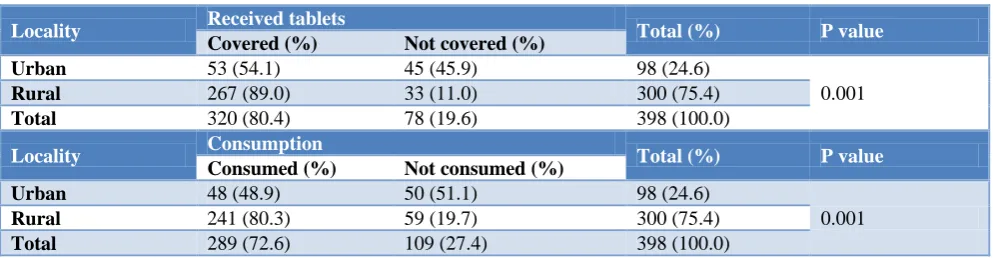
The coverage of MDA was higher in rural areas 267 (89%) compared to urban area 53 (54.1%) and this difference was found to be statistically significant with p=0.001. The compliance among those who had consumed the tablet was also higher in rural areas 241 (80.3%) compared to urban area 48 (48.9%) and the difference was found to be statistically significant with the p=0.001 (Table 2).
The coverage (93.0%) and compliance (87.0%) were maximum in Tumbagi village of Kannur PHC and minimum in Tippu Sultan Colony of Muddebihal (54.1% and 48.9% respectively). The compliance was found to be more in rural compared to urban setting. The coverage
compliance gap which is the difference between people who receive the tablets and those who actually consume it was 7.8%.
Among those who had consumed tablets, 211 (66%) of them had consumed in front of drug distributors (DD). Based on DD persuade to consume tablets, 200 (62.5%) had consumed tablets.
The most common reason quoted by the beneficiaries for not consuming the tablet was lack of information of MDA programme/ Lf (13%), followed by fear of drugs (10%), why to take drugs when not suffering from Lf (7%) and empty stomach (1%).
Figure 1: Distribution of subjects those who had not consumed tablets based on the reasons for
non-consumption.
Table 2: Comparison of coverage and compliance of MDA between urban and rural areas.
Locality Received tablets Total (%) Pvalue
Covered (%) Not covered (%)
Urban 53 (54.1) 45 (45.9) 98 (24.6)
0.001
Rural 267 (89.0) 33 (11.0) 300 (75.4)
Total 320 (80.4) 78 (19.6) 398 (100.0)
Locality Consumption Total (%) P value
Consumed (%) Not consumed (%)
Urban 48 (48.9) 50 (51.1) 98 (24.6)
0.001
Rural 241 (80.3) 59 (19.7) 300 (75.4)
Total 289 (72.6) 109 (27.4) 398 (100.0)
Among those who consumed tablets, 7 (2.4%) had developed adverse effect. Among them, 4 (57.8%) had developed nausea/ vomiting and 3 (42.2%) had developed dizziness. All the events lasted for less than 24 hours. None of them required any medication and the illness was self-limiting.
Awareness of filariasis and MDA among beneficiaries
Majority of the respondents, 86 (71.7%) had awareness regarding elephantiasis and 49 (40.8%) had seen a case of elephantiasis in their vicinity. 77 (64.2%) of the respondents had awareness about MDA programme and
41 (34.2%) respondents were aware about MDA programme before the day of distribution.
Most common source of information was by Anganwadi workers/ Accredited Social Health Activist (ASHA) followed by Auxiliary Nurse Midwife (ANM) and majority of respondents opinion that Anganwadi workers/ ASHAshould be the drug distributor.
DISCUSSION
The present study was a cross sectional study conducted in one of the endemic district for lymphatic filariasis covering 398 beneficiaries who has given an idea
13 10 1
7
0 2 4 6 8 10 12 14
No information of MDA/LF Fear of drugs Empty stomach Not suffering from LF why to
take?
Percentage
Rea
so
ns for
no
n
-co
nsum
regarding coverage and compliance of MDA at both rural and urban settings. The coverage of MDA observed in this study was 80.4% which is below the expected national standards. The sustained high level of coverage (85%) for a minimum of 5 years is essential to achieve the interruption of transmission and elimination of disease.7
The coverage observed was almost similar (81.63%) to the study conducted by Waseem et al in Bijapur (Vijayapura) district previously but it was lower than the results of the studies conducted by B.G. Ranganath (85.6%) in the neighbouring district Gulbarga (Kalburgi) and Kulkarni et al in Uttara Kannada district 82.3%.8-10 But on the other hand coverage of MDA in Bidar district was 62.3% according to Dharukaswami et al.11 The more sensitive indicator was compliance of MDA because this indicates the actual consumption of tablets by the beneficiaries than the coverage. The compliance of MDA in the present study was 72.6%. This is in contrast to the observations made by Ranganath (32.7%), Kulkarni et al (52.1%), Dharukaswami et al (60.4%).9-11 On the other hand the compliance was high in the study conducted by Kumar et al (85.6%).12 The best strategies to improve the compliance were to consumption of the tablets in front of drug distributors. Many beneficiaries had attributed to the reasons for non-consumption as they have lack of information of MDA programme/ Lf followed by fear of drug reactions.
The coverage compliance gap which is the difference between people who receive the tablets and those who actually consume it was 7.8%. According to Kulkarni et al Effective coverage rate was 42.8% and 11% according to Kumar.10,13 These findings can be attributed to the fact that there is no seriousness about the disease as well as the strategy among beneficiaries.
In the present study significant results are seen with coverage and compliance rate of MDA in rural areas than urban area. Similar observations are seen with Waseem et al, Ranganath, Dharukaswami and Kumar.8,9,11,13 These significant results are due to the efforts of Anganwadi workers and ASHAs in sensitizing the community in rural areas which is lacking in urban areas.
The most common reason quoted by the beneficiaries for not consuming the tablet was lack of information of MDA programme/Lf followed by fear of drugs whereas, reason quoted in Kulkarni study was that they Don’t want, followed by the fear of adverse drug reactions and in Waseem et al and Kumar, the reason was fear of adverse drug reaction, and in Dharukaswami study, the reason was fear of adverse drug reaction, followed by doubtful benefit on consumption.10,8,13,11 This can be effectively addressed by proper advocacy and behaviour change communication (BCC) activities.
In the present study most common source of information was by Anganwadi workers/ ASHA followed by ANM. In Kulkarni and Dharukaswami study, most common source of information was miking in urban areas and by Anganwadi /ASHA workers in rural areas.10,11
In the present study the awareness regarding filariasis among the beneficiaries was 71.7%. This in contrast with the observation made by Kulkarni (56%) and awareness was more in observation made by Dharukaswami (75%).10,11 40.8% of the respondents had seen a case of filariasis in their vicinity whereas 32% and 74% had seen a case of filariasis in their vicinity as observation made by Kulkarni and Dharukaswami respectively.10,11 The reason for the high level of awareness in the present study could be the endemicity and visible disfiguration and deformities caused by the diseases.
CONCLUSION
The overall coverage of MDA in Vijayapura district was 80.4% and compliance rate was 72.6%. Gap between coverage and compliance gap was 7.8% which is higher in rural clusters compared to urban. Drug distributors were the major source of information in both rural and urban areas. There was an impact of village level health workers like Junior Health Assistants and ASHAs in mobilizing community towards MDA, which is specifically lacking in urban areas. Most common reason quoted by the beneficiaries for non-consumption of tablets was that they did not have information about MDA programme and lymphatic filariasis. Frequency of adverse drug reactions was 2.4%. All the reactions were non-serious and self-limiting.
Funding: No funding sources Conflict of interest: None declared
Ethical approval: The study was approved by the Institutional Ethics Committee
REFERENCES
1. Kishore J. J Kishore’s National Health Programmes in India. 7th edition. New Delhi: Century Publications; 2007.
2. WHO. Lymphatic filariasis. WHO. Available at: http://www.who.int/mediacentre/factsheets/fs102/en /. Accessed on 01 February 2018.
3. NVBDCP. National Vector Borne Disease Control Programme. Available at: http://www.nvbdcp.gov. in/filariasis.html Accessed on 01 February 2018. 4. Park K. Park’s Text Book of Preventive and social
Medicine.20th edition. Jabalpur: M/s Banarasidas Bhanot; 2009.
6. Bhalwar R. Text Book of Public Health and Community Medicine. 1st ed. Department of Community Medicine, AFMC: Pune; 2009.
7. Government of India. Operational guidelines on elimination of lymphatic Þ lariasis. 2005, Directorate NVBDCP, 22. Shamnath Marg, Delhi 110054
8. Waseem A, Dorle AS, Mannapur BS, Vetri S. Coverage and compliance of mass drug administration for elimination of lymphatic filariasis in Bijapur District, Karnataka. Ann Community Health. 2014;2:6-10.
9. Ranganath BG. Coverage survey for assessing mass drug administration against lymphatic filariasis in Gulbarga district, Karnataka, India. J Vector Borne Dis. 2010;47:61-4.
10. Kulkarni P, Kumar R, Rajegowda RM, Channabasappa HG, Ashok NC. MDA Program against lymphatic filariasis: Are we on the path to success? Experience from Uttara Kannada District, Karnataka. Int J Med Public Health. 2014;4:243-6.
11. Koradhanyamath DM, Kulkarni P, Holla R. Coverage and compliance MDA programme for lymphatic filariasis in Bidar district, Karnataka, India. Asian Pac J Trop Dis. 2012;2(4):290-2. 12. Kumar A, Kumar P, Nagaraj K, Nayak D, Ashok L,
Ashok K. A study on coverage and compliance of mass drug administration programme for elimination of filariasis in Udupi district, Karnataka, India. Vector Borne Dis. 2009;46:237–40.
13. Kumar P, Prajapati PB, Saxena D, Kavishwar AB, Kurian G. An Evaluation of Coverage and Compliance of Mass Drug Administration 2006 of Elimination of Lymphatic Filariasis in Endemic Areas of Gujarat. Indian J Community Med. 2008;33(1):38-42.
Cite this article as: Kulkarni P, Amoghashree, Krishnaveni YS, Narayana Murthy MR, Kumar KR. Coverage and compliance towards mass drug