http://www.ijcmph.com pISSN 2394-6032 | eISSN 2394-6040
Original Research Article
Knowledge, attitude and practice of oral healthcare among pregnant
women in Assiut, Egypt
Shimaa Abdelrahim Khalaf
1, Safaa Rabea Osman
1, Ahmed M. Abbas
2*,
Taghreed Abdul-Aziz M. Ismail
3INTRODUCTION
Emphasizing on oral health care during pregnancy has been recognized as an important public health issue worldwide. Many researches and guidelines have been published emphasizing improvement of oral health care during pregnancy.1
Hormonal changes in pregnancy such as the increased levels of circulating progesterone combined with neglected oral hygiene tend to increase the incidence of oral diseases like gingivitis and periodontitis which are
manifested by redness, edema and higher tendency toward bleeding. Moreover, studies continue to reveal the presence of relationship between periodontitis and adverse pregnancy outcomes. In addition to this, it has been shown that mothers with improper oral health care practices may be at a higher risk of infecting their children by passing cariogenic bacteria through poor feeding practices.2,3
Periodontitis is a destructive inflammation of the periodontium affecting approximately around 30% of child bearing age women. The process involves
ABSTRACT
Background: Pregnancy is an important time in a woman's life with many complex physiological changes that may occur. These changes may negatively affect their oral health. The study aimed to assess oral health knowledge, attitude and reported practices among pregnant women in Assiut Governorate.
Methods: A descriptive cross-sectional study design was used. A structured interview questionnaire was used; included two tools: Tool (I); part (1) personal data, part (2): assessment of knowledge about oral health, part (3): reported practices of oral health and tool (II): included pregnant women attitude toward oral health.
Results: the study revealed that: 79.7% of the interviewed women were aged ≤30 years, 82.5% of them were from rural area. Illiterate women represented 33.2% of the studied group. 85.5% of the pregnant women were housewives. Positive attitude toward oral hygiene was significantly higher among urban, educated, working and primigravidae (p=0.007, 0.03, <0.0001 and 0.04 respectively). Practices of daily cleaning of the teeth was higher among urban than rural residents (79.7% versus 46.8% respectively), university educated (89.3%) than other groups, and working women than housewives (84.9% versus 47.1%)with statistical significant difference while neither age nor number of pregnancies affected daily teeth cleaning.
Conclusions: Being highly educated, working and of urban residence positively affected both the oral hygiene attitude and practices among interviewed pregnant women.
Keywords: Oral health, Pregnant women, Knowledge, Attitude, Practice
1
Department of Community Medicine, Faculty of Nursing, 2Department of Obstetrics and Gynaecology, Faculty of Medicine, 3Department of Community Medicine and Public Health, Faculty of Medicine, Assiut University, Egypt
Received: 26 December 2017
Accepted: 01 February 2018
*Correspondence:
Dr. Ahmed M. Abbas, E-mail: [email protected]
Copyright: © the author(s), publisher and licensee Medip Academy. This is an open-access article distributed under the terms of the Creative Commons Attribution Non-Commercial License, which permits unrestricted non-commercial use, distribution, and reproduction in any medium, provided the original work is properly cited.
infiltration of the periodontium with toxin producing bacteria, lead to chronic inflammatory process which results in a breakdown of the periodontium making infected pockets resulting in mobility of the teeth.4,5 Gingivitis is an inflammation of the soft tissues surrounding a tooth or gingiva not causing loss of periodontal attachment. Pregnancy induced gingivitis may occur without changes in plaque levels, which increases significantly from the first to the third trimester.6,7
On the light of many researches; it had been revealed that periodontal diseases during pregnancy are associated with adverse complications such as preeclampsia, low birth weight and prolonged newborn hospitalization in the neonatal intensive care unit. Despite these evidences and the known complications of periodontal infections for mothers and their newborns, this important topic has received less than due attention.8
Pregnancy by itself is not an obstacle to postpone routine dental care and necessary treatment for oral health problems. Diagnosis and treatment, including dental X-rays can be undertaken safely during the first trimester of pregnancy. The ideal time for treatment can be provided throughout pregnancy between the 14th and 20th weeks. Oral health care in pregnancy is often avoided and misunderstood by physicians, dentists and patients.4,9
Many of periodontal disease can be prevented and treated. The achievement of optimal oral health in pregnant women has its own benefits, however in the past it has been hindered by myths inclosing the safety of dental care during pregnancy. Many women fail to understand the importance of oral care in pregnancy while others experience barriers to care. Collection of such data could also be a precious tool for policy makers. The existing data indicate moderate to poor knowledge related to oral health and adverse pregnancy outcomes, poor dental attendance and oral health related practices.10,11
Pregnancy is characterized by many interrelated physiological changes, which can adversely affect oral health. Oral health screening is not a routine procedure in many antenatal clinics. A few studies have demonstrated that periodontal disease may be associated with adverse pregnancy outcomes, such as premature birth and low birth weight. However, while oral health is now accepted as an important component of general wellbeing of pregnant women in developed countries it remains an underrated component in developing countries.12
Prevention of oral and dental problems and their complications during pregnancy is possible through having pregnant women expressing appropriate knowledge, attitude and practices. This study provides a small insight into the current situation of oral and dental healthcare practices among pregnant women and it will also help in raising awareness about the importance of
good oral and dental healthcare during pregnancy. The study aimed to assess the knowledge, attitude and practice of oral health during pregnancy in Assiut district, Egypt.
METHODS
Research design
A descriptive cross-sectional study. Settings of the study
Assiut Women Health hospital contains one antenatal care clinic which receives pregnant women from all areas in Assiut Governorate. Assiut district contains (29) health care units. The present study was conducted at antenatal care clinics from Assiut Women Health Hospital and one rural health care unit (Al-Moteaa) in Assiut District which was selected by simple random sample.
Sample size calculation
Sample size was calculated using EPI info 7, using expected frequency of good knowledge to be 12% as reported by Ibrahim et al., 2016, confidence level 99%, confidence limit 5%, design effect (1) and clusters (1), the calculated sample size was 278. A Total number of 365 pregnant women were included in the current study. Sample size equation n= [DEFF*Np(1-p)]/ [(d2/Z2 1-α/2*(N-1)+p*(1-p)];Where N=population size, P=
Hypothesized% frequency of outcome factor in the population, d= Confidence limits as 5%, DEFF= Design effect and Z= standard normal deviation (2.58 at 99% confidence interval).
Sampling technique
Two-phases sampling method was used to select participants:
Phase 1
Simple random sampling method (rounded table) was used to select two out of five days per week used for antenatal clinic in the hospital and health care unit while the rural health unit was providing antenatal care services only one day per week.
Phase 2
Systematic sampling method was used to select the respondents on each selected clinic day. A sampling interval of 3 was obtained.
were interviewed from that attending outpatient clinic at Assiut Women Health Hospital.
Tools of the study
Interview questionnaire
The details regarding personal data, knowledge, attitude and reported practices were obtained by using interview questionnaire, which was designed by the researchers after reviewing the related literature; it contains two tools; tool (I) was structured into three parts:
Part (1): It included pregnant women's personal data such as: name; age; educational status; no. of pregnancies; parity...etc. Part (2): It included questions regarding knowledge about oral health such as: causes of dental care; causes of gum diseases; symptoms of gum diseases and food that protect teeth and gums. Part (3): It included questions regarding oral hygiene practices as reported by the pregnant women such as; daily cleaning of the teeth timing of teeth cleaning.
Tool (II): It included oral health care Likert attitude scale which consisted of 12 statements was used to measure pregnant women's attitudes toward oral health
The responses to the 12 statements were based on a three-point Likert Scale (agree, uncertain and disagree). Items were scored (3, 2 and 1) respectively; the score was reversed for negative statements. Total score was calculated which ranged from 12-36, the higher the score, the better the attitude toward oral health
Validity of the tool (II)
Contents of the tool were evaluated by three experts from Community Health Nursing Department, Faculty of Nursing, Assiut University and Gynecological and Obstetrics Medicine Department, Faculty of Medicine, Assiut University; according to their directions and modifications, corrections in the sheet's contents were done.
Study period
Data was collected during the period from January to June 2017.
Ethical considerations
Research proposal was approved from ethical committee in the Faculty of Nursing, Assiut University. There was no risk for study subjects from conducting the research. The study was following common ethical principles in clinical research. Oral consent obtained from the pregnant women who were willing to participate in the study after explaining the nature and purpose of the study. Confidentiality and anonymity was assured. Study
subjects had the right to refuse to participate or withdraw from the study without any rationale at any time and study subjects' privacy was considered during data collection.
Statistical analysis
All data processes (entry, cleaning and recoding) were done using Data the Statistical Package for Social Science (SPSS Inc., Chicago, IL, USA) version 20. Statistical analysis on data was done using:
Univariate descriptive analysis: frequency and percentage for qualitative variables, mean ± SD for quantitative variables.
Bivariate analysis using:
o Pearson's X2 test was used to test the difference between frequencies of qualitative data.
o Student t test /one-way ANOVA was used to compare the mean different groups.
Statistical significance was considered when p<0.05 in all tests.
RESULTS
Table 1 reveals that most of the interviewed pregnant women (79.7%) aged ≤30 years with a mean age 26.6±5.5 year. Rural residents represented 82.5% of the study group and 33.2% were illiterate. Most of the pregnant women (85.5%) were housewives. Only 7.7% of them got pregnant for more than 3 times. Table 2 shows that regarding knowledge about causes of dental/gum problems, bad dental hygiene, eating much sweets and pregnancy hormones were mentioned by 52.3%, 34.8% and 8.8% respectively while 41.6% didn’t know about causes. As regards symptoms of dental/gum diseases, pain was the most commonly mentioned symptom (63.0%). In referral to foods that protect against dental/gum diseases, 53.7% reported that they know regarding the types of foods. Of those, 47.5%, 36.7%, 6.1% mentioned vitamin D, C and A rich foods respectively. As regards the importance of teeth cleaning, just less than half of women (47.4%) did not know about the importance of teeth cleaning and the same percent were not aware by the suitable time for dental follow up during pregnancy.
Table 1: Personal characteristics of the interviewed pregnant women.
Criteria No. (n=365) %
Age group (years)
≤30 291 79.7
>30 74 20.3
Mean±SD 26.6±5.5
Residence:
- Rural 301 82.5
- Urban 64 17.5
Educational level:
-Illiterate 121 33.2
-Basic education 63 17.3
-Secondary education 125 34.2
-University education 56 15.3
Occupation:
-Housewife 312 85.5
-Employee 53 14.5
No. of pregnancies:
-Primigravida 98 26.8
-2-3 pregnancies 239 65.5
-More than 3 pregnancies 28 7.7
Table 2: Knowledge about oral health among pregnant women.
Items No. (N=365) %
(#)
Causes of dental caries / gum diseases:
- Don’t know 152 41.6
- Bad dental hygiene 191 52.3
- Eating much sweets 127 34.8
- Pregnancy hormones 32 8.8
- Smoking 31 8.5
- Some diseases (e.g. DM) 15 4.1
(#)
Symptoms of gum diseases:
- Pain 230 63.0
- Difficult mastication 103 28.2
- Bleeding gums 92 25.2
- Bad mouth odor 57 15.6
- Gum swelling 50 13.7
- Redness in the gum 42 11.5
Food protect against dental and gums diseases: (No.= 365)
- Yes 196 53.7
- No 44 12.1
- Don’t know 125 34.2
Types of food that protect teeth/gums: (No.= 196)
- Vitamin D rich foods (egg, fish) 93 47.5
- Vitamin C rich foods (citrus fruits) 72 36.7
- Vitamin A rich food (carrots, mango) 12 6.1
- Don’t know 19 9.7
(#)
Importance of teeth cleaning: (No.= 365)
- Don’t know 173 47.4
- Just to have a clean tooth 173 47.4
- Prevent dental cares 150 41.1
- Good odor of the mouth 125 34.3
Items No. (N=365) %
Most suitable time for dental follow up during pregnancy: (No.= 365)
- I don’t know 173 47.3
- In early pregnancy 65 17.8
- In mid-pregnancy 52 14.2
- In late pregnancy 75 20.5
(#)
More than one answer was allowed
Table 3: Oral health care Likert attitude scale among the pregnant women.
Statements Agree (%) Equivocal (%) Not agree (%)
True believes
- Regular dental checkup is important even if there wasn’t
any dental problem. 238 (65.2) 3 (0.8) 124 (34.0)
- Tooth brushing is important for the milky teeth after its
appearance. 250 (68.5) 19 (5.2) 96 (26.3)
- Think that dental problems can lead to other health
problems. 325 (89.0) 9 (2.5) 31 (8.5)
- Think that it is important to keep the child mouth healthy
and clean. 353 (96.7) 3 (0.8) 9 (2.5)
- Regular dental checkup is important for the milky teeth. 239 (65.5) 9 (2.5) 117 (32.1)
False believes
- Think that the fetus is responsible for teeth loss during
pregnancy as he/she absorbs calcium from his mother. 277 (75.9) 20 (5.5) 68 (18.6) - No relation between oral & dental health of the mother
and the child health during and after delivery. 223 (61.1) 41 (11.2) 191 (52.3) - It is necessary to extract any painful tooth. 163 (44.7) 11 (3.0) 191 (52.3) - Taking fruits & vegetables has no role in the dental and
oral health. 116 (31.8) 44 (12.1) 205 (56.2)
- No need for management of cavities or caries of the child
milky teeth if they are not painful. 224 (61.4) 14 (3.8) 127 (34.8) - It is possible to lose teeth because of pregnancy. 298 (81.6) 11 (3.0) 56 (15.3) - It is unsafe for the pregnant women to visit the dentist
even for regular checkup. 232 (63.6) 20 (5.5) 113 (31.0)
True believes
- Regular dental checkup is important even if there wasn’t
any dental problem. 238 (65.2) 3 (0.8) 124 (34.0)
- Tooth brushing is important for the milky teeth after its
appearance. 250 (68.5) 19 (5.2) 96 (26.3)
- Think that dental problems can lead to other health
problems. 325 (89.0) 9 (2.5) 31 (8.5)
- Think that it is important to keep the child mouth healthy
and clean. 353 (96.7) 3 (0.8) 9 (2.5)
- Regular dental checkup is important for the milky teeth. 239 (65.5) 9 (2.5) 117 (32.1)
False believes
- Think that the fetus is responsible for teeth loss during
pregnancy as he/she absorbs calcium from his mother. 277 (75.9) 20 (5.5) 68 (18.6) - No relation between oral & dental health of the mother
and the child health during and after delivery. 223 (61.1) 41 (11.2) 191 (52.3) - It is necessary to extract any painful tooth. 163 (44.7) 11 (3.0) 191 (52.3) - Taking fruits & vegetables has no role in the dental and
oral health. 116 (31.8) 44 (12.1) 205 (56.2)
- No need for management of cavities or caries of the child
milky teeth if they are not painful. 224 (61.4) 14 (3.8) 127 (34.8) - It is possible to lose teeth because of pregnancy. 298 (81.6) 11 (3.0) 56 (15.3) - It is unsafe for the pregnant women to visit the dentist
Table 4: Mean score of attitude of pregnant women toward oral health according to personal characteristics.
Variable Attitude score Statistical test P value
Age group (years)
T= 1.1 0.3
- ≤30 24.9±3.9
- >30 25.4±4.1
Residence
- Rural 24.7±3.9
2.7 0.007
- Urban 26.2±3.8
Educational level
- Illiterate 24.6±3.8
F= 3.2 0.03*
- Basic education 25.1±3.9
- Secondary education 24.7±4.0
- University education 26.4±4.0
Occupation
T= 3.5 <0.0001
- Housewife 24.7±3.9
- Employee 26.7±4.0
No. of pregnancies
3.2 0.04*
- Primigravida 25.8±4.0
- 2-3 pregnancies 24.7±3.9
- More than 3 pregnancies 24.9±3.9
*Significance was between university education, primigravidae and the other groups as revealed by t test between each two groups.
Table 5: Reported oral health related practices among pregnant women.
Variable No. %
Daily cleaning of the teeth N=365
- Yes 192 52.6
- No 173 47.4
Visiting the dentist during the last 6 months N= 365
- Yes 92 25.2
- No 273 74.8
Causes of the visit N= 92
- Painful teeth 49 53.3
- Tooth extraction 18 19.6
- Routine visit 9 9.8
- Dental cares 8 8.7
- Painful gums 8 8.7
Visiting the dentist during the current pregnancy N = 365
- Yes 36 9.9
- No 329 90.1
(#)
Causes for not going to the dentists during pregnancy N= 329
- Dental checkup is not important during pregnancy 248 68.0
- Feeling lazy to go 81 24.6
- High cost 78 23.7
- Far distance 41 12.5
- Feeling fear &irritable 31 9.4
Table 5 shows that more than half of the pregnant women (52.6%) were cleaning their teeth daily. About one quarter (25.2%) of the women visited the dentist during the last 6 months. Of those, only 9.8% of the visits were for routine checkup. Moreover, only 9.9% of the pregnant women visited their dentist during the current pregnancy. More than two thirds of those who didn’t visited the dentist (68.0%) considered routine dental checkup is not important during pregnancy.
Table 6: Reported teeth daily cleaning practices among the interviewed pregnant women according to their personal characteristics.
Criteria
Daily cleaning of the teeth
X2 P value
Yes No.
No. (192) % (52.6%) No. (173) % (47.4%)
Age group
0.3 0.6
- ≤ 30 years 155 53.3% 136 46.7%
- > 30 years 37 50.0% 37 50.0%
Residence
- Rural 141 46.8% 160 53.2%
22.8 <0.00001*
- Urban 51 79.7% 13 20.3%
Educational level
- Illiterate 43 35.5% 78 64.5%
44.4 <0.00001*
- Basic education 33 52.4% 30 47.6%
- Secondary education 66 52.8% 59 47.2%
- University education 50 89.3% 6 10.7%
Occupation
26 <0.00001*
- Housewife 147 47.1% 165 52.9%
- Employee 45 84.9% 8 15.1%
No. of pregnancies
3.7 0.16
- Primigravida 55 56.1% 43 43.9%
- 2-3 pregnancies 127 53.1% 112 46.9%
- More than 3 pregnancies 10 35.7% 18 64.3%
* Statistical significant difference
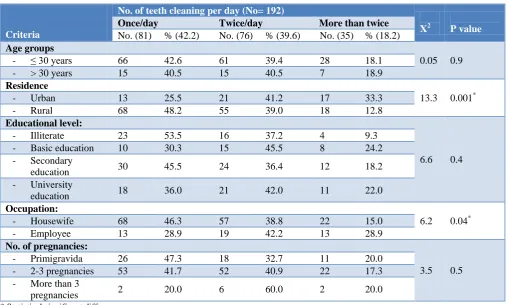
Table 7: No. of teeth cleaning per day among pregnant women according to personal characteristics of pregnant women, Assiut Governorate.
Criteria
No. of teeth cleaning per day (No= 192)
X2 P value
Once/day Twice/day More than twice
No. (81) % (42.2) No. (76) % (39.6) No. (35) % (18.2)
Age groups
0.05 0.9
- ≤ 30 years 66 42.6 61 39.4 28 18.1
- > 30 years 15 40.5 15 40.5 7 18.9
Residence
13.3 0.001*
- Urban 13 25.5 21 41.2 17 33.3
- Rural 68 48.2 55 39.0 18 12.8
Educational level:
6.6 0.4
- Illiterate 23 53.5 16 37.2 4 9.3
- Basic education 10 30.3 15 45.5 8 24.2
- Secondary
education 30 45.5 24 36.4 12 18.2
- University
education 18 36.0 21 42.0 11 22.0
Occupation:
6.2 0.04*
- Housewife 68 46.3 57 38.8 22 15.0
- Employee 13 28.9 19 42.2 13 28.9
No. of pregnancies:
3.5 0.5
- Primigravida 26 47.3 18 32.7 11 20.0
- 2-3 pregnancies 53 41.7 52 40.9 22 17.3
- More than 3
pregnancies 2 20.0 6 60.0 2 20.0
Table 8: Relationship between number of pregnancies and self-assessment of oral health during the current pregnancy among pregnant women.
Criteria
No. of pregnancies
X2 P- value
Primigravida 2-3 pregnancies More than 3 pregnancies
Self-assessment of dental health No. % No. % No. %
- Good 67 68.4 113 47.3 14 50.0
12.5 0.002*
- Bad 31 31.6 126 52.7 14 50.0
Self-assessment of gum health
- Good 67 77.6 143 59.8 18 64.3
9.6 0.008*
- Bad 22 22.4 96 40.2 10 35.7
Presence of unhealthy gum changes during the current pregnancy
- Yes 24 24.5 101 42.3 10 35.7
9.4 0.009*
- No 74 75.5 138 57.7 18 64.3
Figure 1: Sources of knowledge about dental health care among pregnant women.
Figure 2: Times of teeth cleaning as mentioned by pregnant women.
Table 6 reports practices of daily cleaning of the teeth showed statistical significant difference regarding residence (79.7% among urban versus 46.8% among rural areas), education (higher among university educated women) and occupation (84.9% among employed women versus 47.1% among housewives). Neither age nor number of pregnancies showed any statistical significant difference regarding reported practices of daily teeth cleaning. Table 7 shows that cleaning teeth more than
twice/day was significantly higher among urban residents 33.3% versus 12.8% for rural residents and among employed women 28.9% versus 15.0% for housewives. Neither age, educational level nor number of pregnancies showed statistical significant difference regarding the number of teeth cleaning per day. Table 8: shows that primigravidae reported better self-assessment of their own dental and gum health (68.4% and 77.6% respectively) than the other group. On the other hand, primigravidae reported the least percentage (24.5%) of unhealthy gum changes during the current pregnancy with statistical significant difference.
Figure 3: Tools of cleaning teeth as mentioned by pregnant women.
DISCUSSION
In referral to personal characteristics of the participated pregnant women, about four fifths of them were aged ≤30 years. This finding is conformed to Gupta et al., 2015 who reported that four fifth of the pregnant women were aged 20-29 years old.13 Moreover, Amit et al reported that majority of the pregnant women were between 20–30 years old, while Ramamurthy and Irfana, 2016 reported that three fifth of the studied women were in the age group 18-25 years old.5,7 Regarding place of residence, more than four fifths of the participated pregnant women were from rural area. On the contrary,Amit et al reported
65.30%
53.10%
29.00%
17.20%
0.00% 10.00% 20.00% 30.00% 40.00% 50.00% 60.00% 70.00%
Media Physicians Dentists family member
51.6%
21.4%
39.6%
9.4%
0% 10% 20% 30% 40% 50% 60%
- In the morning
- After each meal
- Before sleep
- After breakfast &
dinner
85.9%
24.0%
12.0% 9.4% 8.9% 2.6% 0%
10% 20% 30% 40% 50% 60% 70% 80% 90% 100%
Tooth brush
Mouth wash
Meswak Soap & water
Dental floss
that the majority of the studied pregnant women were belonged to urban area.5
Regarding to the level of education; about one third of the pregnant women in the present study had secondary education (34.2%) and another one third (33.2%) were illiterate. Gupta et al recorded that less than half of pregnant women had secondary education.13 While Ramamurthy and Irfanareported that three thirds of the pregnant women had university education.7 On the other hand; Amit et aldisclosed that less than two third of the participated women were illiterate.5 Moreover; Shabbir et alobserved that more than half of pregnant women had primary education.14
Regarding employment status, the majority of pregnant women in the present study were housewives; this finding is going well together with Gupta et al who reported that the majority and three thirds respectively of the pregnant women were unemployed.13 Also, Ibrahim et alreported that the vast majority of the women were housewives.4 Regarding knowledge of the pregnant women about oral health; more than two fifths of them didn’t know causes of dental caries/gum diseases, and about one third mentioned that eating much sweets/sugar is the cause. Our findings are much less than those disclosed by Ibrahim et al and Amit et al who reported that most women understood that consuming too much sweet is the main cause of tooth decay.4,5 Also, Shabbir et al recorded that slightly more than three quarter of the pregnant women perceived that sugar/sweet foods are the main cause of dental caries.14
The results of the present study cleared that less than half of the pregnant women didn’t know the most suitable time for visiting the dentist during pregnancy. This can be explained by that most of the pregnant women didn’t pay attention to their oral health beside they didn’t prefer dentist visiting during pregnancy. The present study showed that mass media was the main source of knowledge about dental health care. This is conformed to Ibrahim et al and Karimi Afshar et al who explored that television and radio were the main knowledge source.4,15 Regarding importance of teeth cleaning, about two fifths of the participated women mentioned prevention of tooth decay while about one third mentioned good mouth odor as the cause for teeth cleaning. Ibrahim et alrecorded that the majority of the women answered that tooth brushing prevents tooth decay, gum diseases and a bad smell.4 Regarding pregnant women attitude toward dental health care, less than two thirds of them agreed that regular dental checkup is important even if there weren’t any dental health problems. This was in the same line with Amit et al who reported that less than two thirds of the interviewed pregnant women considered oral health should be a priority. Boggess et al reported that only less
than one third of the pregnant women agreed on importance of visiting the dentist.5,16
On the other hand, more than 60% of the pregnant women in the present study agreed that it is unsafe for the pregnant women to visit the dentist even for regular checkup. Less frequent finding was reported by George et al who mentioned that more than one quarter of the women felt that dental treatment should be avoided during pregnancy unless it is an emergency.17
This result wasn’t in the same line with Amit et al who reported that the majority of pregnant women agreed that women should have a dental checkup during pregnancy.5 Also, Shabbir et al found that less than three quarters of pregnant women disagreed on that dental visit are unnecessary during pregnancy.14 As well as, Agrawal et al who reported that less than half of the pregnant women agreed that oral and dental treatment should not be avoided during pregnancy.18
In the present study; the majority of the pregnant women agreed that it is possible to lose teeth because of pregnancy. This is not in congruent with Shabbir et al who reported thatthe majority of women disagreed on that pregnancy predisposes to tooth loss.14 Also, Boggess et al reported that less than half of women strongly disagreed on that they can lose a tooth just because pregnancy.16
Results of the present study disclosed that more than half of the pregnant women were cleaning their teeth daily. More than half of these women were cleaning their teeth in the morning. This finding agreed with Amit et al who recorded that more than half of the participated women cleaned their teeth only once daily.5 Also, Afshar et al reported that less than half of pregnant women cleaned their teeth once daily.15 Moreover; Shabbir et al recorded that less than two thirds of the pregnant women cleaned their teeth once daily while Nogueira et al recorded that the vast majority of the pregnant women brushed their teeth every day.14,19 On the other hand; Chawla et al reported that only less than one tenth of the pregnant women brushed their teeth twice a day.12
In the present study; the majority of the pregnant women didn’t visit the dental clinic during pregnancy as a periodical checkup. This could be due to lack of knowledge about the importance of oral health in pregnancy and also lack of encouragement from their obstetric provider. In the same line; Nogueira et al observed that about four fifths of the participated women did not attend dental clinic during pregnancy.19 In referral to cause of not visiting dentist during pregnancy; more than two thirds of the pregnant women (68.0%) answered that dental checkup is not important during pregnancy. This may be due to that most of pregnant women keep on antenatal appointment to check fetus health status and they are not aware about the negative effect of bad oral health on their fetal health.
The current results disclosed that there was a significant relationship between practices of teeth cleaning daily and women's educational level, occupation and residence. This agreed with Afshar et al who reported that there is a significant relationship between oral health behavior and educational level.15 Moreover, Amin and Shetty noticed that there was an association between occupation & education and dental hygiene.20
Low educational level and unawareness lead to improper oral hygiene practices. Regarding occupation, social relations and meeting with people may increase the positive attitude toward oral health and having fresh breath, moreover, working status is also correlated to higher education and awareness.
In the current study results revealed that there was a significant relationship between number of pregnancies and self-assessment of dental health, self-assessment of gum health and presence of unhealthy gum changes during the current pregnancy. In a study carried out by Rakchanok et al found that pregnant women were more likely to have dental caries and gingivitis compared to non-pregnant women.21 Three-quarter of pregnant women had dental caries. Moreover, it was found that most of pregnant women had gingivitis in comparison to less than three quarters among non-pregnant women. Also, Ibrahim et al recorded that more than one fifth of the pregnant women felt that their current oral health was poor.4
In conclusion, based on the result of the current study, it can be concluded that both positive attitude and practices of oral hygiene were significantly associated with urban residence, higher education and women employment. More over primigravidae had significantly higher attitude than multigravidae while women's age didn’t affect neither attitude nor practices of oral hygiene.
ACKNOWLEDGEMENTS
The researchers would like to thank all the personnel working in the antenatal clinics selected in the present
study; also, many thanks for all the participated pregnant women who accepted to be enrolled in this study.
Funding: No funding sources Conflict of interest: None declared
Ethical approval: The study was approved by the Institutional Ethics Committee
REFERENCES
1. Gambhir RS, Nirola A, Gupta T, Sekhon T, Anand S. Oral health knowledge and awareness among pregnant women in India: A systematic review. J Indian Soc Periodontol. 2015;6(19): 612-7.
2. Hemalatha V, Manigandan T, Sarumathi T, Aarthi Nisha V, Amudhan A. Dental Considerations in Pregnancy-A Critical Review on the Oral Care. J Clin Diagn Res. 2013;7(5):948-53.
3. Singh S, Dagrus K, Kariya P, Singh S, Darmina J, Hase P. Oral Periodontal Health Knowledge and Awareness among Pregnant Females in Bangalore, India. Int J Dent Med Res. 2015;1(6):7-10.
4. Ibrahim HM, Mudawi AM, Ghandour IA. Oral health status, knowledge, attitudes and practice among pregnant women attending Omdurman maternity hospital, Sudan. East Mediterr Health J. 2017;22(11):802-9.
5. Amit, Mital P, Hooja N, Mital P, Salvi A, Fatima A. Oral and dental health knowledge, attitude and practice among pregnant women. Sch Acad J Biosci. 2014;2(9):627-32.
6. Gupta R, Acharya AK. Oral Health Status and Treatment Needs among Pregnant Women of Raichur District, India: A Population Based Cross-Sectional Study. Scientifica (Cairo). 2016;9860387. 7. Ramamurthy J, Irfana F. Assessment of knowledge
and awareness about periodontal oral health among pregnant women- a questionnaire study, Int J Cur Res Rev. 2017;9(1):9-12.
8. Bahri N, Tohidinik HR, Bahri N, Iliati HR, Moshki M, Darabi F. Educational intervention to improve oral health beliefs and behaviors during pregnancy: a randomized-controlled trial. J Egypt Public Health Assoc. 2015;90(2):41-5.
9. Shamsi M, Headarnia A, Niknami S, Rafiee M. Development and psychometric assessment of an oral health instrument based on Health Belief Model in pregnant women [In Persian]. Arak Med Univ J. 2012;15(65):45–56.
10. Sajan P, Pattansetti J, Padmini C, Nagathan VM, Sajjanar M. Oral health related awareness and practices among pregnant women in Bagalkot district, Karnataka, India. J Int Oral Health. 2015;7(2):1-5.
11. Bashiru B, Anthony IN. Oral health awareness and experience among pregnant women in a Nigerian tertiary health institution. J Dent Res Rev. 2014;1(2):66-9.
of Pregnant Women regarding Oral Health Status and Treatment Needs following Oral Health Education in Pune District of Maharashtra: A Longitudinal Hospital based Study. J Contemp Dent Pract. 2017;18(5):371-7.
13. Gupta S, Jain A, Mohan S, Bhaskar N, Walia P. Comparative Evaluation of Oral Health Knowledge, Practices and Attitude of Pregnant and Non-Pregnant Women, and Their Awareness Regarding Adverse Pregnancy Outcomes. J Clin Diagn Res. 2015;9(11):26-32.
14. Shabbir S, Masooma Zahid, Qazi A, Younus SM. Oral hygiene among pregnant women; practices and knowledge. Professional Med J. 2015;22(1):106-111.
15. KarimiAfshar SA, Hakimehhoseynrezaei, Najmi F, Molooktorabi. Self-Reported Oral Health Behavior among Pregnant Women (Kerman, Iran). IOSR J Dental Med Sci. 2017;16(6):85-8.
16. Boggess KA, Urlaub DM, Moos MK, Polinkovsky M, ElKhorazaty J, Lorenz C. Knowledge and beliefs regarding oral health among pregnant women. J Am Dent Assoc. 2011;142(11):1275-82.
17. George A, Johnson M, Blinkhorn A, Ajwani S, Bhole S, Yeo AE et al. The oral health status, practices and knowledge of pregnant women in
south-western Sydney. Aust Dent J. 2013;58(1):26-33.
18. Agrawal N, Gupta N, Tewari R, Garg A, Yadav P. knowledge, attitude and practice of oral health care in pregnant women in north India cross sectional survey, University J Dent Scie. 2017;3(1):22-5. 19. Nogueira BML, Nogueira BCL, Fonseca RRS,
Brandão GAM, Menezes TOA, Tembra DPS. Knowledge and attitudes of pregnant women about oral health. Int. J. Odontostomat. 2016;10(2):297-302.
20. Amin R, Shetty P. Oral health status during pregnancy in mangalore. Nitte Univ J Health Sci. 2014;4:114-7.
21. Rakchanok N, Amporn D, Yoshida Y, Harun-Or-Rashid M, Sakamoto J. Dental caries and gingivitis among pregnant and non-pregnant women in Chiang Mai, Thailand. Nagoya J Med Sci. 2010;72:43–50.