Volume 4 Issue 2 ǁ March 2019.
www.ijahss.com
The Validity of a Single Question about Life Satisfaction
Jonathan Fonberg, Andrew P Smith
Centre for Occupational and Health Psychology, School of Psychology, Cardiff University, 63 Park Place, Cardiff CF10 3AS, UK
Abstract: Research on wellbeing has often used life satisfaction as the outcome measure. Large scale international surveys (e.g. the World Values survey) often use single measures of such variables and it is important to assess the validity of them. Two studies were carried out, one in the UK and one in the USA, to investigate congruent validity by examining correlations between a single life satisfaction question and a multi-item established measure. Convergent validity was assessed by examining positive correlations between single and multi-item life satisfaction measures, positive personality (self-efficacy, self-esteem and optimism) and positive affect and happiness. In addition, discriminant validity was assessed by examining the negative associations between the life satisfaction measures and negative affect and anxiety/depression. Implications for assessing competing conceptualizations of wellbeing are discussed.
I. Introduction
What makes a person better off? As interest in wellbeing has increased so too has debate concerning its conceptualization. Broadly speaking, theories of wellbeing can be placed into one of two categories: subjective and objective. While the former emphasizes the importance of pro-attitudes and values in determining the predictors of wellbeing, the latter proposes that they are universal. In assessing their merits ,the use of an objective conceptualisation of wellbeing as an outcome variable is inappropriate as it presupposes universality in the predictors of wellbeing and ignores alternatives. If objectivism is correct, then this universality will be reflected in the predictors of a subjective measure of wellbeing.
As both researchers and large-scale survey programmes attempt to reduce response burden, single-item measures of subjective wellbeing have become increasingly common. Due to this shift in methodology, researchers interested in investigating the respective merits of subjectivism and objectivism in wellbeing research may find themselves reliant on data collected using single-item measures. As such, the goal of this paper is to provide a brief overview of the shared heritage of psychological theories of wellbeing and assess the validity of their measurement with single-items.
There are three major contemporary philosophies of wellbeing: hedonism, desire, and objectivism. Hedonism and desire theories are subjective: they rest on the premise that the value of “goods” and their relationship with wellbeing are determined by an individual's attitudes. Objectivists propose that certain "goods" have inherent value and will improve quality of life independent of attitudes.
Hedonistsbelievethat quality of life is determined by the balance between two forces: pleasure will improve wellbeing, while pain will worsen it (Crisp, 2016). As only a desired good can bring pleasure, its value is determined by an individual‟s attitude towards it. Similarly, desire theorists posit that a person's life is going well when they get the things that they want, and wellbeing is the satisfaction of these desires. Heathwood (2006) argued that hedonism and desire theories are one of the same. To him, net pleasure in hedonism can be understood as follows: “The intrinsic value of a life for the one who lives it equals the sum of the values of all the instances of intrinsic attitudinal pleasure and pain contained therein.” Here, the attitude an individual has towards a “good” determines its ability to produce pleasure and pain. According to Heathwood (2006), desire theories rest on the same premise: “the intrinsic value of a life for the one who lives it equals the sum of the values of all the instances of intrinsic attitudinal pleasure and pain contained therein." These summaries are nearly identical, and Heathwood (2006) proposed that the attitudinal pleasure of hedonism is equivalent to the subjective desire satisfaction of desire theories. Assuming his argument is correct, these theories can be understood as subjectivism: that the predictors of wellbeing are a function of an individual‟s values.
and appropriate basic and cross-cultural education. Others have fixated on moral goodness, rational activity, the development of one‟s abilities, having children and being a good parent, knowledge and the awareness of true beauty (Varelius, 2004). Accepting the argument proposed by Heathwood (2006), there are two theories of wellbeing. Subjectivism proposes that the predictors of wellbeing vary as a function of values, while objectivists claim that certain “goods” with inherent value will do so universally.
In assessing these theories, the use of an objective conceptualisation of wellbeing as an outcome variable is inappropriate as it assumes that certain “goods” have inherent value while ignoring alternatives. If objectivism is correct, then “goods” with intrinsic value will universally predict subjective conceptualizations of wellbeing.Further complicating matters are themany competing psychological conceptualizations of subjective wellbeing, with some of the most commonly cited components being life satisfaction, happiness, and positive and negative affect. Diener, Emmons, Larsen, and Griffin (1985) noted that life satisfaction refers to a cognitive, judgmental process wherein an individual forms a global assessment of the quality of their life, according to their chosen criteria. Individuals use their own standards when forming satisfaction judgements. In the context of wellbeing, positive and negative affect are two dimensions which can be understood as the frequency and degree to which an individual experiences emotion. The former refers to the extent to which a person feels enthusiastic, active and alert" ; individuals with high levels of positive affect will experience high energy, full concentration, and pleasurable engagement (Watson, Clark, & Tellegen, 1988). In contrast, negative affect is perceived as a state of distress: one characterised by aversive mood states including anger, contempt, disgust, guilt, fear, and nervousness; lower levels are associated with calmness and serenity (Watson et al., 1988).
Life satisfaction and positive/negative affect are relatively straightforward concepts, but the same cannot be said of happiness. Oishi, Graham, Kesebir, and Galinha (2013) noted that defining the concept has been difficult, despite decades of investigation. One of the more commonly cited definitions is a balance of positive and negative affect, derived from the concept of Eudemonia as proposed by Aristotle. However, Ryff and Singer (2008) argued that this is a mistranslation, instead suggesting the idea of striving toward excellence based on one's unique potential. Further complicating matters are varying culture-bound definitions. Historically, happiness was seen as experiencing favourable external circumstances, particularly in East Asian nations. In the modern Western World, focus has shifted to positive individual feelings (Oishi et al., 2013). One commonly held belief is that wellbeing is a combination of life satisfaction, affect and happiness. For example, Diener, Emmons, Larsen & Griffin (1985) proposed it to be a balance between life satisfaction, and positive and negative effect.
In the context of assessing subjectivism and objectivism in wellbeing research, life satisfaction is the construct most appropriate for analysis. As noted in the preceding paragraphs, it is an individual's cognitive evaluation of the quality of their life. Accepting the argument put forth by Heathwood (2006), subjectivism can be reduced to the premise that a person's life is better off when their desires are satisfied. As such, the best way to address subjectivism is through life satisfaction, i.e. the degree to which an individual‟s desires are satisfied. Though some might argue that this approach is too narrow, it is important to consider that in certain populations life satisfaction is strongly correlated with several proposed components of wellbeing. These include, but are not limited to, happiness (Gamble & Gärling, 2012; Nemati & Maralani, 2016; Piccolo, Judge, Takahashi, Watanabe, & Locke, 2005), positive and negative affect (Diener et al., 1985; Headey, Kelley, & Wearing, 1993), and anxiety and depression (Arrindell, Meeuwesen, & Huyse, 1991; Ghazwin et al., 2016; Headey et al., 1993).
Past research has often used single-item questions to assess components of the wellbeing process. Their use is supported by both their validity (Cheung & Lucas, 2014; Diener, Inglehart, & Tay, 2013) and reliability (Lucas & Donnellan, 2012). A broad review of this literature was performed by Williams (2014), who noted promising results across a variety of wellbeing components ranging from depression and anxiety to positive personality traits (extraversion, self-esteem and agreeableness). Though Williams (2014) concluded that some single-item measures allow for accurate representations of constructs, he cautioned that this finding could not be generalized across all wellbeing components. He emphasized that the simplicity of the construct and degree of understanding respondents had would likely determine which variables can be accurately assessed using single-item measures.
Life satisfaction is one of the most commonly measured conceptualizations of subjective wellbeing, perhaps because it is such a straightforward concept. These two factors make it ideal for single-item assessment; a conclusion supported by recent research (Cheung & Lucas, 2014; Lucas & Donnellan, 2012). Williams (2014) noted that validity is typically considered to be more important than reliability (Nunally & Bernstein, 1978), which is rarely measured for single-items (Wanous & Hudy, 2001). As such, single-item methodology in life satisfaction research needs to be assessed through congruent and construct validity.
Satisfaction with Life Scale (Diener, Emmons, Larsen, & Griffin, 1985). Which is a psychometrically robust tool (Diener, 1994; Pavot & Diener, 1993) and perhaps the most frequently administered measurement of life satisfaction. As such, robust correlations between the single and multi-item measures would support the validity of the former. Construct validity is an assessment as to whether a test measures what it intends to, and is composed of two subtypes: convergent and discriminant validity (Matsumoto, 2009). These are used to determine whether a measurement is positively related to theoretically similar variables and negatively related to dissimilar ones (Matsumoto, 2009). Both measures of life satisfaction will be compared to happiness, positive and negative affect, and anxiety and depression in order to assess the psychometric validity properties of the single-item scale. These proposed components of wellbeing share strong correlations with life satisfaction in certain populations. Similarly, self-esteem, self-efficacy and optimism are robust predictors of wellbeing and theoretically relevant. As such, these variables are ideal for assessing the convergent validity of a single-item measure of life satisfaction.
As an extension of this assessment, the direction and strength of the associations that these variables share with life satisfaction should be reasonably consistent across both the single and multi-item measures. Such findings would further validate the use of single-item measures in wellbeing research, expanding the data sources that researchers can use to assess the respective merits of subjectivism and objectivism in wellbeing research. The congruent and construct validity of the single-item measure were assessed in two samples: one collected by Williams (2014) and another through Mechanical Turk.
The following hypotheses were tested.
Hypothesis One: Correlations between single and multi-item measures of life satisfaction will be high, demonstrating congruent validity.
Hypothesis Two: Correlations between both single and multi-item measures of life satisfaction and positive affect, happiness, self-esteem, self-efficacy and optimism will be similarly positively related, demonstrating convergent validity.
Hypothesis Three: Correlations between both single and multi-item measures of life satisfactions and negative affect, anxiety and depression will be similarly negatively related, demonstrating discriminant validity.
II. Method
Recruitment and Participants
The data from the first sample was collected by Williams (2014), and consisted of 120 Cardiff University staff members, with ages ranging from 20 to 64. 63% were married or living with a partner, 33% earned £10,000-£19,999 a year, and 73% had a degree. The second was an opportunity sample drawn from Mechanical Turk, an online crowd-sourcing website. While relatively new in the field of psychological research, the merits of Mechanical Turk for participant recruitment have already been noted by several authors (for a detailed review, see Paolacci, Chandler, and Ipeirotis, 2010,and Buhrmester, Kwang, &Gosling, 2011). The participants were linked to the Qualtrics website to complete a questionnaire. The sample consisted of 119 participants from the United States.
Materials
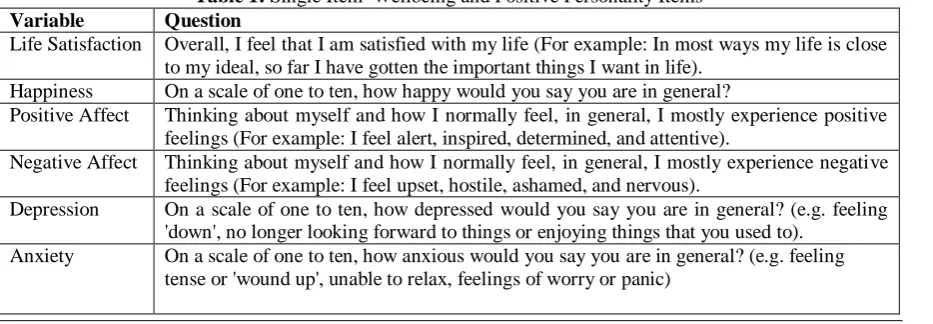
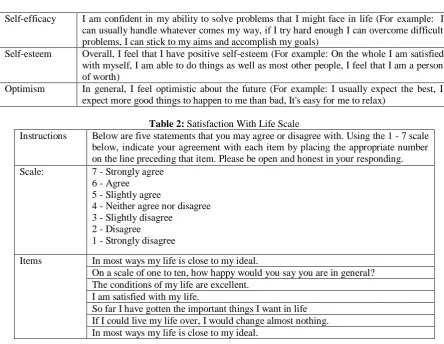
Single item measures developed by Williams (2014) were used to assess all variables: life satisfaction, happiness, positive effect, negative effect, depression, anxiety, self-efficacy, optimism, and self-esteem. The items, which use a 10-point Likert-type response scale, include sample items from the longer questionnaires from which they were developed (Table 1). The Satisfaction with Life Scale (SWLS) was the multi-item questionnaire used to address life satisfaction (Table 2).
Table 1: Single Item Wellbeing and Positive Personality Items
Variable Question
Life Satisfaction Overall, I feel that I am satisfied with my life (For example: In most ways my life is close to my ideal, so far I have gotten the important things I want in life).
Happiness On a scale of one to ten, how happy would you say you are in general?
Positive Affect Thinking about myself and how I normally feel, in general, I mostly experience positive feelings (For example: I feel alert, inspired, determined, and attentive).
Negative Affect Thinking about myself and how I normally feel, in general, I mostly experience negative feelings (For example: I feel upset, hostile, ashamed, and nervous).
Depression On a scale of one to ten, how depressed would you say you are in general? (e.g. feeling 'down', no longer looking forward to things or enjoying things that you used to).
Self-efficacy I am confident in my ability to solve problems that I might face in life (For example: I can usually handle whatever comes my way, if I try hard enough I can overcome difficult problems, I can stick to my aims and accomplish my goals)
Self-esteem Overall, I feel that I have positive self-esteem (For example: On the whole I am satisfied with myself, I am able to do things as well as most other people, I feel that I am a person of worth)
Optimism In general, I feel optimistic about the future (For example: I usually expect the best, I expect more good things to happen to me than bad, It's easy for me to relax)
Table 2: Satisfaction With Life Scale
Instructions Below are five statements that you may agree or disagree with. Using the 1 - 7 scale below, indicate your agreement with each item by placing the appropriate number on the line preceding that item. Please be open and honest in your responding. Scale: 7 - Strongly agree
6 - Agree 5 - Slightly agree
4 - Neither agree nor disagree 3 - Slightly disagree
2 - Disagree 1 - Strongly disagree
Items In most ways my life is close to my ideal.
On a scale of one to ten, how happy would you say you are in general? The conditions of my life are excellent.
I am satisfied with my life.
So far I have gotten the important things I want in life If I could live my life over, I would change almost nothing. In most ways my life is close to my ideal.
Analysis strategy
Pearson correlations were used to test all hypotheses. Power analysis for a Pearson correlation was conducted in G*Power to determine a sufficient sample size with a 2-tail alpha of 0.05, a power of 0.80, a medium effect size (ρ = .3), and two tails (Faul et al., 2013). Based on the aforementioned assumptions, both samples exceeded the desired size of 82.
III. Results
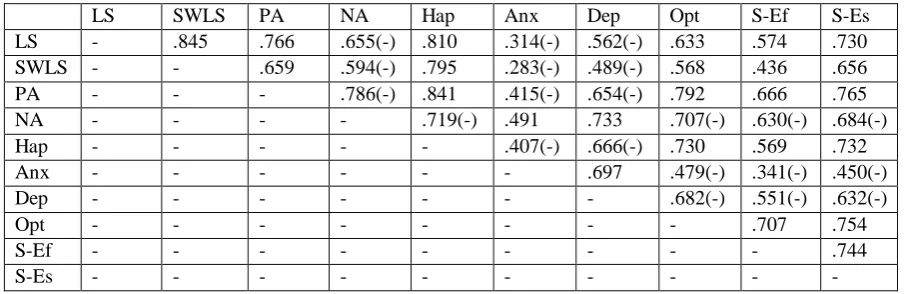
The results of the correlational analyses are reported in Table 3 and Table 4.
Table 3: Summary of Life Satisfaction Pearson Correlations in the Cardiff Staff Sample
LS SWLS PA NA Hap Anx Dep Opt
S-Ef
S-Es
LS - - - -
SWLS .764 - - - -
PA .620 .661 - - - -
NA .492(-) .557(-) .852(-) - - - -
Hap .705 .753 .740 .671(-) - - - -
Anx .200*(-) .253**(-)
.371(-) .490 .341(-) - - - - -
Dep .576(-) .643(-) .733(-) .762 .824(-) .485 - - - - Opt .647 .631 .776 .692(-) .759 .376(-) .657(-) - - - S-Ef .466 .464 .560 .476(-) .592
.270**(-)
.525(-) .53 6
- -
S-Es .486 .518 .765 .737(-) .648 .429(-) .646(-) .66 3
.54 4
-
Unless otherwise noted, all correlations were significant at p < .001. ** Indicates significance at .01, and * at .05.
Table 4: Summary of Life Satisfaction Pearson Correlations in the Mechanical Turk Worker Sample
LS SWLS PA NA Hap Anx Dep Opt S-Ef S-Es
LS - .845 .766 .655(-) .810 .314(-) .562(-) .633 .574 .730 SWLS - - .659 .594(-) .795 .283(-) .489(-) .568 .436 .656 PA - - - .786(-) .841 .415(-) .654(-) .792 .666 .765 NA - - - - .719(-) .491 .733 .707(-) .630(-) .684(-)
Hap - - - .407(-) .666(-) .730 .569 .732
Anx - - - .697 .479(-) .341(-) .450(-)
Dep - - - .682(-) .551(-) .632(-)
Opt - - - .707 .754
S-Ef - - - .744
S-Es - - - -
LS=single item life satisfaction, SWLS= satisfaction with life scale, PA =positive affect, NA=Negative Affect, Hap=Happiness, Anx=anxiety, Dep=Depression, Opt=Optimism, S-Ef=Self-efficacy, S-Est=Self-esteem. Unless otherwise noted, all correlations were significant at p < .001. ** Indicates significance at .01, and * at .05.
Correlations between the single and multi-item measures of life satisfaction were high, indicating congruent validity (hypothesis one). The positive relationships between both measures of life satisfaction and positive affect, happiness, optimism, self-efficacy and self-esteem indicated convergent validity (hypothesis two). Finally, the negative relationships between both measures of life satisfaction and negative affect, anxiety and depression suggested discriminant validity (hypothesis three). In regards to hypotheses two and three, the relationships between the relevant variables and life satisfaction were consistent across both single and multi-item measures with minimal differences being noted. Finally, the pattern and strength of these associations were remarkably similar across the two samples.
IV. Discussion
The results supported all 3 hypotheses. Williams (2014) noted that, in assessing congruent validity, a correlation of .65 is considered acceptable. Though relationships between the single and multi-item measures of life satisfaction varied across samples, both were well beyond this threshold: .845 and .764 in the Turk and Cardiff staff samples, respectively. Similarly, Williams (2014) concludes that although a threshold of .50 can be used to assess convergent and discriminant validity, relationship patterns are more telling. In this regard, these results hold up quite well. Finally, as noted above, these correlations were remarkably similar regardless of whether single or multi-item measures of life satisfaction were used. As the Satisfaction with Life scale has undergone vigorous psychometric testing, these findings further support the use of single-item methodology in wellbeing research.
As discussed in the introduction to this paper, assessing subjectivism and objectivism in wellbeing research requires a subjective outcome measure. While an objective outcome presupposes universality in the predictors of wellbeing and leaves no alternatives, both subjectivism and objectivism can be assessed through analysis of the predictors of an appropriate subjective measure of wellbeing. As these results indicate that life satisfaction can be assessed using a single-item question, researchers who are interested in addressing subjectivism and objectivism in wellbeing research should feel more confident making use of data sources which employ this methodology.
The cross-national nature of the two samples may provide an additional benefit, as it demonstrates the validity of the single-item approach in two culturally distinct samples. Though some might argue that the United States and Great Britain are culturally homogenous, it is important to consider that they appear to differ on at least some value dimensions (Inglehart & Welzel, 2010). Beyond this, past research has shown that single items are appropriate for assessing a wide variety of constructs cross-nationally. Examples include happiness (Abdel-Khalek, 2006), mood (Hürny et al., 1996), need for consistency (Nichols & Webster, 2014), need to belong (Nichols & Webster, 2013) and personality (Konstabel, Lönnqvist, Walkowitz, Konstabel, & Verkasalo, 2012).
References
[2]. Arrindell, W., Meeuwesen, L., & Huyse, F. (1991). The Satisfaction With Life Scale (SWLS): Psychometric properties in a non-psychiatric medical outpatients sample. Personality andIndividual Differences, 12(2), 117-123.
[3]. Buhrmester, M., Kwang, T., & Gosling, S. D. (2011). Amazon's Mechanical Turk A New Source of Inexpensive, Yet High-Quality, Data? Perspectives on Psychological Science, 6(1), 3-5.
[4]. Cheung, F., & Lucas, R. E. (2014). Assessing the validity of single-item life satisfaction measures: results from three large samples. Quality of Life Research, 1-10.
[5]. Crisp, R. (2016). Well-Being. The Stanford Encyclopedia of Philosophy. Summer 2016. Retrieved from
http://plato.stanford.edu/archives/sum2016/entries/well-being/
[6]. Diener, E. (1994). Assessing Subjective Well-Being Progress and Opportunities. Social Indicators Research, 31, 103- 157.
[7]. Diener, E., Emmons, R. A., Larsen, R. J., & Griffin, S. (1985). The satisfaction with life scale. Journal of personality assessment, 49(1), 71-75.
[8]. Diener,E.,Inglehart,R.,&Tay,L.(2013). Theoryandvalidityof lifesatisfactionscales.Social IndicatorsResearch,112(3), 497-527.
[9]. Doyal, L., & Gough, I. (1991). A theory of human need.Basingstoke: Palgrave Macmillan.
[10]. Faul, F., Erdfelder, E., Buchner, A., & Lang, A.-G. (2013). G*Power Version 3.1.7 [computer software]. Uiversität Kiel, Germany. Retrieved from:
[11]. http://www.psycho.uni-duesseldorf.de/abteilungen/aap/gpower3/download-and-register
[12]. Gamble, A., & Gärling, T. (2012). The relationships between life satisfaction, happiness, and current mood. Journal of Happiness Studies, 13(1), 31-45.
[13]. Ghazwin, M. Y., Kavian, M., Ahmadloo, M., Jarchi, A., Javadi, S. G., Latifi, S., & Tavakoli, S. A. H. (2016). The Association between Life Satisfaction and the Extent of Depression, Anxiety and Stress among Iranian Nurses: A Multicenter Survey. Iranian Journal of Psychiatry, 11(2), 120-127.
[14]. Headey,B.,Kelley,J., &Wearing,A. (1993). Dimensionsof mentalhealth:Lifesatisfaction, positiveaffect,anxietyanddepression.SocialIndicatorsResearch,29(1), 63-82. doi:10.1007/BF01136197 [15]. Headey, B., Veenhoven, R., & Wearing, A. (1991). Top-down versus bottom-up theories of subjective
well-being. Social Indicators Research, 24(1), 81-100.
[16]. Heathwood, C. (2006). Desire satisfactionism and hedonism.Philosophical Studies, 128(3), 539-563. [17]. Hürny, C., Bernhard, J., Coates, A., Peterson, H. F., Castiglione-Gertsch, M., Gelber, R. D.,
&Goldhirsch, A. (1996). Responsiveness of a single-item indicator versus a multi-item scale: assessment of emotional well-being in an international adjuvant breast cancer trial. Medical Care, 34(3), 234-248.
[18]. Inglehart, R., & Welzel, C. (2005). Modernization, cultural change, and democracy: The human development sequence. Cambridge: Cambridge University Press.
[19]. Konstabel, K., Lönnqvist, J. E., Walkowitz, G., Konstabel, K., & Verkasalo, M. (2012). The „Short Five‟(S5): Measuring personality traits using comprehensive single items.European Journal of Personality, 26(1), 13-29.
[20]. Lucas, R. E., & Donnellan, M. B. (2012). Estimating the reliability of single-item life satisfaction measures: Results from four national panel studies. Social Indicators Research, 105(3), 323-331. [21]. Matsumoto, D. (2009). The Cambridge dictionary of psychology. Cambridge: Cambridge University
Press.
[22]. Nemati,S., &Maralani,F. M. (2016). TheRelationshipbetweenLifeSatisfactionand Happiness:TheMediatingRoleof Resiliency.InternationalJournalofPsychologicalStudies,8(3), 194. [23]. Nichols, A. L., & Webster, G. D. (2013). The single-item need to belong scale. Personality and
individual differences, 55(2), 189-192.
[24]. Nichols, A. L., & Webster, G. D. (2014). The single-item need for consistency scale. Individual Differences Research, 12(2), 50-58.
[25]. Nunally, J. C., & Bernstein, I. H. (1978). Psychometric theory. New York: McGraw-Hill.
[26]. Oishi, S., Graham, J., Kesebir, S., & Galinha, I. C. (2013). Concepts of happiness across time and cultures. Personality and social psychology bulletin, 39(5), 559-577.
[27]. Paolacci, G., Chandler, J., & Ipeirotis, P. (2010). Running experiments on amazon mechanical turk. Judgment and Decision Making, 5(5), 411-419.
[28]. Pavot, W., & Diener, E. (1993). Review of the Satisfaction with Life Scale. Psychological Assessment, 5, 164-172.
[30]. Ryff, C., & Singer, B. (2008). Know thyself and become what you are: A eudaimonic approach to psychological well-being. Journal of Happiness Studies, 9(1), 13-39.
[31]. Varelius, J. (2004). Objective explanations of individual well-being. Journal of Happiness Studies, 5(1), 73-91.
[32]. Wanous, J. P., & Hudy, M. J. (2001). Single-item reliability: A replication and extension. Organizational Research Methods, 4(4), 361-375.
[33]. Watson, D., Clark, L. A., & Tellegen, A. (1988). Development and validation of brief measures of positive and negative affect: the PANAS scales. Journal of Personality and Social Psychology, 54(6), 1063-1070.