Heterogeneous LEACH Protocol for Wireless
Sensor Networks
Nishi Sharma
Department of Computer Science, Rajasthan Technical University Email: [email protected]
Vandna Verma
Department of Computer Science, Banasthali Vidhyapith Email: [email protected]
---ABSTRACT--- Wireless Sensor Networks are networks of large number of tiny, battery powered sensor nodes having limited on-board storage, processing, and radio capabilities. Nodes sense and send their reports toward a processing center which is called base station. Since this transmission and reception process consumes lots of energy as compare to data processing, Designing protocols and applications for such networks has to be energy aware in order to prolong the lifetime of the network. Generally, real life applications deal with such Heterogeneity rather than Homogeneity. In this paper, a protocol is proposed, which is heterogeneous in energy. We analyze the basic distributed clustering routing protocol LEACH (Low Energy Adaptive Clustering Hierarchy), which is a homogeneous system, and then we study the impact of heterogeneity in energy of nodes to prolong the life time of WSN. Simulation results using MATLAB shows that the proposed Leach-heterogeneous system significantly reduces energy consumption and increase the total lifetime of the wireless sensor network.
Keywords -Wireless Sensor Networks (WSNs), Energy-Efficiency.
--- Date of Submission : July 05, 2013 Date of Acceptance :August 28, 2013 ---
I. INTRODUCTION
A
WSN typically consists of a large number of sensor nodes that are deployed in an area of interest [1]. These nodes are low-power, low-cost devices. These nodes are small in size, but are equipped with embedded microprocessors, radio receivers, and power components to enable sensing, computing, communication, and actuation. These components are integrated on a single or multiple boards, and packaged in a few cubic inches. These sensor nodes sense the information and transmit it to the base station [2]. Base station analyzes the received data and computation is performed, which gives the human understandable result. The Base station is having unlimited battery power. So it should implement the algorithm and protocols by which it can enhance the life time of the sensor node as well as save the battery power. LEACH is one of the protocols that give the guarantee about the allocation of energy in the sensor node homogeneously. In this protocol cluster head gets the data from its member nodes of the cluster and aggregate the data before sending to the base station. Most of the simulation results for LEACH-type [3] schemes are obtained assuming that the nodes of the sensor network are equipped with the same amount of energy—this is the type of homogeneous sensor networks. A homogeneous sensor networks can be defined as a network consisting of identical nodes in terms of energy, processing capabilities, and sensing range [4]. On the other hand, heterogeneous sensor network consist of sensor nodes with different capabilities, such as different energy level, sensing Range and Computation power.Being a cluster-head node consumes more energy than a non-cluster head node which leads the cluster head nodes to die earlier than other nodes [5]. In this paper study of the impact of heterogeneity in
terms of node energy is considered. In this it is assumed that a percentage of the node population is equipped with more energy than the rest of the nodes in the same network [6]. Basic description of LEACH protocol is explained in section 2. Here first order radio model is used [7] as described in section 3 which is used for simulation of sensor networks. A brief introduction of LEACH protocol in homogeneous system is explained in section 4. We describe the design of our novel proposed LEACH protocol in heterogeneous system in section 5. Simulation and results are discussed in section 6. Finally, Conclusion is made in section 7.
II. LEACHPROTOCOL
is done into two steps, the setup phase and the steady state phase. In setup phase the nodes are organized into clusters and CHs are selected. These cluster heads change randomly over time in order to balance the energy of the network. This is done by choosing a random number between 0 and 1. The node is selected as a cluster head for the current round if the random number is less than the threshold value T (n), which is given by:
(1)
Here G is the set of nodes that are involved in the CH election. LEACH clustering is shown in Fig. 1. In the steady state phase, the actual data is transferred to the BS. To minimize overhead the duration of the steady state phase should be longer than the duration of the setup phase. The CH node, after receiving all the data from its member nodes, performs aggregation before sending it to the BS. After a certain time period, the setup phase is restarted and new CHs is selected. Each cluster communicates using different CDMA codes to reduce interference from nodes belonging to other clusters.
Figure 1: LEACH Protocol
LEACH achieves over a factor of 7x and 8x reduction in energy dissipation compared to direct communication and a factor of 4x and 8x compared to the minimum transmission energy (MTE) routing protocol. The major characteristics of this Protocol are as follow: The cluster heads are rotated in a randomized fashion to achieve balanced energy consumption. It is assumed that all the sensors have synchronized clocks so that they know the beginning of a new cycle. In LEACH sensors do not need to know location or distance information.
There are some drawbacks associated with this protocol such as: Single-hop routing is used where each node can transmit directly to the cluster-head and the sink. CHs are elected randomly; hence there is Possibility that all CHs will be concentrated in same area. The idea of dynamic clustering is used which leads to extra overhead due to cluster head changes, advertisements etc. The protocol assumes that all nodes are having same amount of energy. It also assumes that CH consumes approximately the same amount of energy for each node.
Therefore, LEACH is not suitable for large networks. Instead it is most suited for constant monitoring such as monitor machinery for fault detection and diagnosis.
III. RADIO MODEL FOR ENERGY
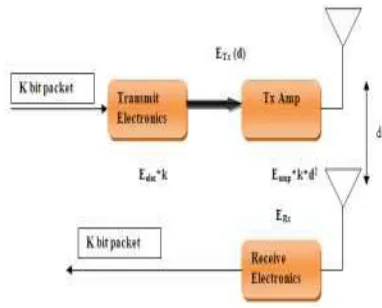
CALCULATION We use the first order radio model for wireless sensor networks [10] which is shown in Fig. 2. Here are some assumptions for these networks [11]. All sensors are within the wireless communication range when they communicate with each other or with the BS. Sensors should have homogeneous sensing, computing and communication capabilities. BS is located in the center of the sensor networks and BS has infinity energy resource. Both the energy dissipation of sensing data and the energy dissipation for clustering are neglected. We suppose that all the clustering algorithms are run on the BS. The energy dissipation of fusing one bit data is a constant value. Thus, to transmit a k-bit message a distance d, the radio uses:
Figure 2: First Order Radio Energy Model ETx( k,d ) = k*Eelec+k*Efs*d2 ! < !0
k*Eelec+k*Eamp*d4 !≥!0 (2)
The first term in (2) represents the energy consumption of radio dissipation, while the second represents the energy consumption for amplifying radio. The use of free space Efs and the multi-path fading Emp channel models depends
upon the transmission distance. When receiving this data, the radio expends:
ERx (k) = k*Eelec
(3)
Additionally, data aggregation operation will consume the energy EDA.
III. THENETWORKINITIALIZATIONOFLEACH
INHOMOGENEOUSSYSTEM
Fig. 3 demonstrates the wireless sensor network initialization for homogeneous system. Here all the available wireless sensor nodes are having equal amount of initial energy E0 = 0.5J. Here 100 nodes are distributed in
indicates Normal nodes and dark o indicates CHs. X indicates BS at (50, 50).
0 20 40 60 80 100
0 10 20 30 40 50 60 70 80 90 100
X Coordinate in Meters
Y
Co
or
di
nat
e i
n
M
e
te
rs
Homogeneous LEACH System
Figure 3: Initialization of the wireless sensor network
IV. PROPOSED LEACH PROTOCOL IN
HETEROGENEOUSSYSTEM
Here we have considered a heterogeneous network. A heterogeneous network is one in which all the nodes doesn’t have equal energy. Let us assume that the total number of nodes is n & m fraction of the nodes has α time more energy than the other nodes. They are called as advanced nodes. Therefore,
Number of normal nodes = (1-m) x n Energy per normal node = e0
Number of advanced nodes = m x n Energy per advanced node = e0 x (1 + α)
Hence the total energy of the network = ((1-m) x n) x e0 + (m x n) x (e0 x (1 + α)
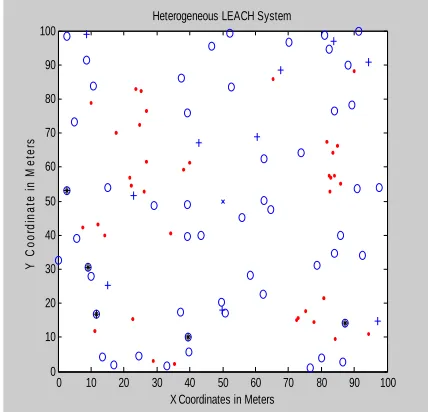
In this approach the same procedure as in the normal LEACH protocol is followed i.e., the formation of the clusters is same in this heterogeneous system and also the cluster head selection by comparing the residual energy of the individual in every round [12]. The structure of the proposed Leach-Heterogeneous system for wireless sensor networks is shown in Fig. 4.
In this Leach-Heterogeneous system 10% of nodes are having more initial energy than the other nodes in the wireless sensor networks. For this case of Leach-Heterogeneous system 10 nodes are having 1Joule of initial energy out of 100 nodes in the network. The remaining 90 nodes are having 0.5 joules of initial energy. Depending upon the application, the number of advanced nodes can be increased and the total system lifetime can be increased significantly.
0 10 20 30 40 50 60 70 80 90 100
0 10 20 30 40 50 60 70 80 90 100
X Coordinate in Meters
Y
C
o
or
di
n
a
te
i
n
M
e
ter
s
Heterogeneous LEACH System
Figure 4: Proposed Heterogeneous LEACH system. ‘+’ symbol indicates Advance Node.
V. SIMULATIONRESULTS
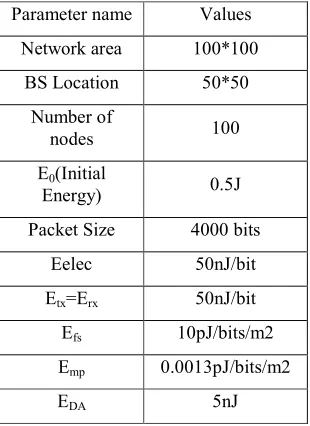
The LEACH-Homogeneous and LEACH-Heterogeneous routing protocols have been simulated using MATLAB. We compare the proposed Leach-Heterogeneous system with Leach-Homogeneous system. The simulation parameters used in the experiment is shown in Table I. The nodes are randomly distributed between x=0, y=0 and x=100, y=100 with the base station (BS) at location x=50, y=50. The number of nodes in each protocol is assumed to be 100. The Fig. 5 and Fig. 6 shows total number of nodes that remain alive over simulation time of 1200 rounds for LEACH under homogeneous and heterogeneous system.
Table 1: Parameters Detail Parameter name Values Network area 100*100
BS Location 50*50 Number of
nodes 100
E0(Initial
Energy) 0.5J
Packet Size 4000 bits
Eelec 50nJ/bit
Etx=Erx 50nJ/bit
Efs 10pJ/bits/m2
Emp 0.0013pJ/bits/m2
0 10 20 30 40 50 60 70 80 90 100 0
10 20 30 40 50 60 70 80 90 100
X Coordinate in Meters
Y
C
o
or
di
nat
e
in
M
e
te
rs
Homogeneous LEACH System
Figure 5: Simulation result after 1200 rounds in LEACH-Homogeneous System. (Nearly 50 nodes are died) After 3200 rounds only the proposed Leach-Heterogeneous System sensor nodes are under dead position, but in the case of normal Leach-Homogeneous System all the nodes are lost their energy nearly 1700 rounds itself.
0 10 20 30 40 50 60 70 80 90 100
0 10 20 30 40 50 60 70 80 90 100
X Coordinates in Meters
Y
C
oor
di
nat
e i
n
M
e
te
rs
Heterogeneous LEACH System
Figure 6: Simulation result after 1200 rounds in Proposed LEACH-Heterogeneous System. (Nearly 35 nodes are
died)
It can be seen that nodes remains alive for a longer time (rounds) in proposed Leach-Heterogeneous system than Leach- Homogeneous system. Fig. 7 describes the comparison between the Homogeneous and Leach-Heterogeneous System in terms of number of alive nodes. Here the total energy efficiency is increased nearly 40% than the Leach-Homogeneous system.
0 200 400 600 800 1000 1200
0 20 40 60 80 100 120
Number of Rounds
N
u
m
ber
of
A
liv
e
nodes
Homogeneous v/s Heterogeneous LEACH System
Homogeneous Heterogeneous
Figure 7: Number of Alive Nodes vs. Number of Rounds in LEACH Homogeneous & Heterogeneous System
VI. CONCLUSION
In this paper, the proposed Leach- heterogeneous system in the individual clustering of the whole network, which is energy efficient routing method for WSNs and compared it with the normal Leach-Homogeneous system. From the results it can be concluded that Leach Heterogeneous System provides better performance in energy efficiency and increasing level in lifetime of the wireless sensor networks.
References
[1] Akyildiz LF, Su W, Sankarasubramaniam Y, Cayirci E. “A survey on sensor networks. IEEE Communications Magazine, 40(8): 102~114.Vol.25, No.4, 2002, 114-124. [2] Sun Limin, Li Jianzhong, Chen Yu, “Wireless Sensor
Networks”, Tsinghua publishing company Beijing, 2005.
[3] Wendi Rabiner, Heinzelman, Anantha Chandrakasan, and Hari Balakrishnan, “Energy-efficient Communication Protocol for Wireless MicrosensorNetworks”,In: Proc. of 33rd Annual Hawaii Inter Cord on System Sciences, Hawaii, USA: IEEE Computer Society, 2000.
[4] Li Han, “LEACH-HPR: An Energy Efficient Routing Algorithm for heterogeneous WSN” IEEE 2010.
[5] Vivek Mhatre and Catherine Rosenberg, “Homogeneous Vs Heterogeneous Clustered Sensor Networks:A Comparative Study” In Proceeding of IEEE International Conference on Communications(ICC), 2004, PP. 3646-3651.
[6] Georgious Smaragdakis, Ibrahim Matta and Azer Bestavors, “SEP: A Stable Election Protocol for Clustered Heterogeneous Wireless Sensor Networks” In Proceding of the International Workshop on SANPA, 2004.
[8] J. Al-Karaki, and A. Kamal, Routing Techniques in Wireless Sensor Networks: A Survey., IEEE Commun-ications Magazine, vol 11, no. 6, Dec. 2004, pp. 6-28. [9] W.R. Heinzelman, A. Chandrakasan, and H.
Balakrishnan, An Application-Specific Protocol Architecture for Wireless Microsensor Networks. In IEEE Transactions on Wireless Communications vol. 1(4), 2002, pp. 660-670.
[10] Yan Li, Yan Zhong Li, Energy-Efficient clustering Routing algorithm based on LEACH, Journal of Computer Applications, 2007.
[11] Ben Alla Said, Ezzati Abdellah, Abderrahim Beni Hssane, Moulay Lahcen Hasnaoui, “Improved and Balanced LEACH for heterogeneous wireless sensor networks” (IJCSE) International Journal on Computer Science and Engineering Vol. 02, No. 08, 2010, 2633-2640
Authors Biography
Nishi Sharma received her B. Tech degree from Modi Institute of Technology, Kota. She is currently pursuing M. Tech. from the Department of Computer Science & Engineering, Rajasthan Technical University, Kota. Her research interests include energy efficient clustering of sensor networks.