Original Research Article
Exposure to early childhood development interventions and its
association with responsive feeding and nutritional status
of 6 to 35 months old children
Swati Jarole
1*, Subodh S. Gupta
2, Ashok M. Mehendale
2, Abhishek Raut
2INTRODUCTION
Child growth is multidimensional phenomenon and these dimensions are interdependent which includes social, emotional, cognitive and motor performance. Child growth may be defined as “a change in size,” whereas development may be seen as “Change in complexity and function”.1
Under nutrition is an important factor contributing to the death of young children. Recent evidences show that malnutrition is one of the major public health problems throughout the developing world and underlying cause for 60% of all the deaths among children under five years every year.2 Over two-thirds of these deaths are
associated with inappropriate feeding practices primarily during the first year of life.2
WHO joined with UNICEF to define 12 family care behaviours that were necessary for child survival, one of which was active feeding. Active feeding was subsequently broadened to responsive feeding.3 Various studies recognised responsive feeding for its role in nutrient intake, growth and also in child development. According to the studies responsive feeding is defined as feeding young infants requires active care and stimulation, where the caregiver is responsive to the child clues for hunger and also encourages the child to eat.4 In systematic review, Imdad et al demonstrated improvement in weight and linear growth of interventions
ABSTRACT
Background: The objective of the study was to study the association between exposure to early childhood development (ECD) interventions and responsive feeding and nutritional status among 6-35 months‟ children.
Methods: The present analytical cross-sectional study was conducted with 360 children from a primary health centre (PHC) area under the ECD project and 360 children from comparison PHC area. The anthropometric measurement and responsive feeding was assessed and compared among 6-35 months‟ children.
Results: There was significant difference in mean scores of ECD activity (p=0.001) and responsive feeding (p<0.001) in ECD area as to comparison area. In the ECD program area, the proportion of children who were malnourished (33.3%) were less as compared to control area (53.9%).
Conclusions: The present study shows ECD interventions at community level delivered through frontline workers resulted in improved responsive feeding practices better nutritional outcomes for children.
Keywords: Early childhood development, Responsive feeding, Malnutrition
Department of Community Medicine, 1Lady Hardinge Medical College, New Delhi, 2Mahatma Gandhi Institute of Medical Sciences Sewagram, Wardha, Maharashtra, India
Received: 04 October 2018
Accepted: 26 December 2018
*Correspondence:
Dr. Swati Jarole,
E-mail: [email protected]
Copyright: © the author(s), publisher and licensee Medip Academy. This is an open-access article distributed under the terms of the Creative Commons Attribution Non-Commercial License, which permits unrestricted non-commercial use, distribution, and reproduction in any medium, provided the original work is properly cited.
providing either responsive feeding or nutritional counseling.5
Evidence also shows that nutrition interventions and early childhood care and Development (ECCD) program have positive impacts on the physical growth and cognitive, motor, and behavioral development of young children.6
In India, problem of malnutrition is very big. India‟s main early child development intervention, the integrated child development service scheme, has not yet succeeded in making significant dent in child malnutrition. This is mostly due to priority the program has placed on food supplementation rather than on nutrition and health education and early childhood development interventions. A necessary further step is required to further develop and test a model that combines nutrition and psychosocial interventions.
Looking at the huge opportunities for early childhood development available through ICDS scheme and health sector, Project has been launched with the objective to develop, pilot and scale up an intervention to improve early development and care with focus on children 0-3 years at the Department of Community Medicine along with funding agency. The project was initiated with the broad objective to test the feasibility and effectiveness of „Care for Child Development‟ Package delivered utilizing the current opportunities available in India through ICDS, health sector and other service delivery channels.
This intervention was delivered through ASHA and Anganwadi worker at home and community level. Preliminary analysis of the study conducted within this project shows that the interventions aimed for improving the early childhood development activities through community workers appeared to be beneficial for the quality of mother-child interaction and it had a positive impact on child‟s physical growth also suggesting effective implementation of „adapted version of „care for child development package for India‟ through ICDS and health sector offer vital opportunities to address the problems of malnutrition and promote physical growth of children.
With this background in mind, it has been observed that there have been only a few studies in the past which have studied effect of early childhood development on nutritional status and responsive feeding. Hence conducted this study to assess the effects of early childhood development interventions on the family practices of improvement in responsive feeding and nutritional status among 6 months-35 months old children with early childhood interventions.
METHODS
It was an analytical cross-sectional observational study utilizing the setting of community-based ECD intervention delivered under a WHO-INTERVIDA
collaborative project which was carried out from August 2014 to July 2015. The study was carried in the two PHC areas of the district, one PHC was from the intervention area from setting of the ECD project, and another PHC from the same District where interventions of ECD project were not implemented was selected as the control PHC. Both the PHCs were selected considering the feasibility of carrying out this research work. There were 24 villages in the intervention PHC area and 25 villages in the control PHC area. Two villages were excluded from the control area because they come under suburban population. The population of intervention PHC was 34,986 and the population of control PHC was 42,863. Study subjects were children of age group 6 months to 35 months. Sample size was calculated for a difference in 20% in the proportion of mothers practicing responsive feeding with confidence of 95% and power of 80%. With this a sample size of 107 is required. With aim to have adequate sample size separately for age-group 6-11 months, 12-23 months and 24-35 months, it was decided to take 120 children in three age-groups from the PHC with (ECD) early childhood development intervention in place and same number of children from the PHC with no ECD intervention in place. Therefore a total of 360 children (in three groups) in the intervention and control area each was recruited in the study i.e. total of 720 children in both group. List of all children in the age-group 6 – 35 months was procured from Anganwadi center (AWC). Separate lists were created for the three age-groups for the two PHC areas.. The required sample size of children i.e. 120 children each in the three age-groups of 6-11 months, 12-23 months and 24-35 months - was selected using simple random sampling method from both the intervention PHC, where ECD intervention is going on and from control PHC where the ECD interventions were not being implemented. The study was initiated after taken approval from the Institutional Ethics Committee. Written Informed consent was obtained from the mothers/primary care given before enrolment in this study. Confidentiality of information was maintained.
Intervention
Early childhood development project was going on in the Department of Community Medicine. The interventions were implemented through accredited social health activist (ASHA) and anganwadi workers (AWW) at village and community level. Training was conducted and toys kit was given to each worker for the demonstration of play activities to the mothers. A Marathi version of care for child development package was given to them in form of counselling cards.
The interventions were as follows:
Home visits by ASHA workers
talk, to kiss, to copy the activities, to use home-made toys to play with their children in their daily routine. Mothers were encouraged to praise their child and were discouraged to use bad words, scolding and giving physical punishment to their child. They were also encouraged how to feed their child while talking, playing with the child. They also counsel fathers and other family members to provide quality time to their children and to support the primary caregiver.
Mother’s group meeting
Mother‟s groups were formed in every village. Meeting of the mother‟s group were conducted at the AWCs where AWWs acted as a facilitator and supported by ASHA. Facilitators provide information on age appropriate play, communication activities and feeding style. Facilitators demonstrated and facilitated the play interaction between child and caregiver
Parenting workshop
Parenting workshop aims to empower future/ new parents with appropriate knowledge and skills related to care for child development, to improve understanding between the mother and father on the issues related to care for child development and to provide a platform in the village where issues related to child care and development may be freely discussed.
Women’s self-help group meeting
SHG provided a mechanism to reach elderly women and those who are respected in the village. Thus, it is expected that this mechanism would help change the social norms at village level.
Data collection technique
For each study subject, the mother was interviewed using a pre-designed pre tested questionnaire. The information regarding socio-demographic characteristics of the child and frequency of play activities by mother regarding care of the baby was collected. Information was also collected about the age appropriate ECD activities done by the mother. Nutritional status was assessed with the help of anthropometric measurements using the newly developed WHO growth standards. Information on age was obtained from a written birth record maintained at Anganwadi center/ Gram Panchayat. If information was not available, then verbal information on date of birth was collected from Primary caregiver. If birth date was not known with certainty, then caregiver was asked about appropriate date of birth according to local calendar-related event. Age was calculated in months. For responsive feeding assessment a tool used in Bangladesh by Frances et al was adapted.8 The current tool includes information on who fed the child, child eats meal alone or together with someone, hand washing before the meal, talking to the child while feeding, refusal to eat, forced feeding, self-feeding and adult self-feeding.
Primary caregiver‟s attitude was measured in terms of ECD activity score. There were a set of questions for three types of ECD activity viz practices for expressing love and affection, practices for promotion of child learning through play and practices for promotion of child learning through communication. Scoring was done for Responsive feeding and ECD activity. According to these scores caregivers were divided into responsive and non-responsive caregivers.
Data entry and analysis
The data was entered using EPI-INFO program. Analysis was done using EPI-INFO version 7.1.3.10. Initially frequencies of all variables were taken to check the completeness of data. Chi square test was used to identify the difference between socio-demographic characteristics of two areas.
Scoring was done for ECD activity and responsive feeding.
Indices (weight for height, weight for age, height for age, BMI for age) of physical growth that describe the nutritional status of child were calculated.
WHO-ANTHRO software was used to calculate the Z score for weight for age, weight for height, height for age and BMI for age. Mean Z score were calculated WHZ, WAZ, HAZ and BMI for age and was analyzed by t test.
WHO global database format (Excel) in WHO-ANTHRO software was used to calculate the proportion of children with underweight, wasting, stunting, BMI for age <-2 SD (both moderate and severe) in both the areas.
RESULTS
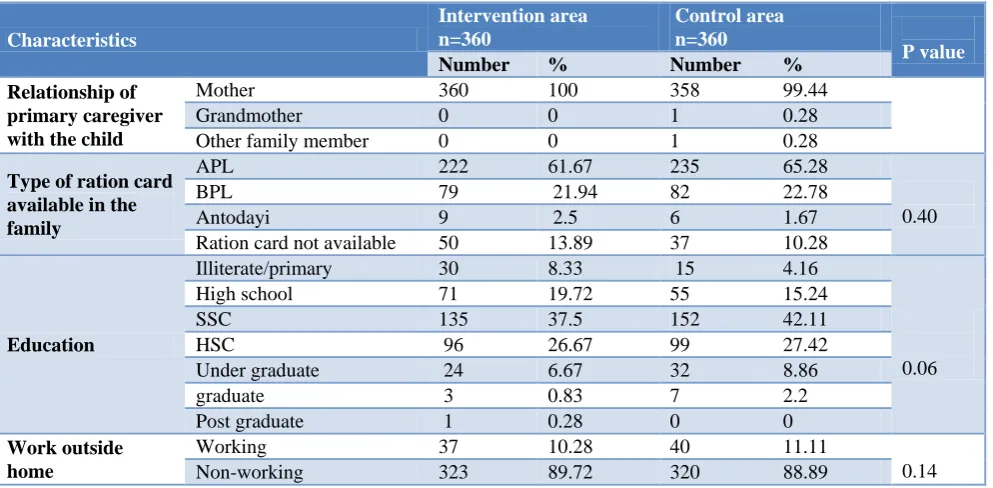
The socio- demographic characteristics were comparable in ECD program and comparison area (Table 1). The primary caregiver was mother in all cases in both groups and there was no significant difference between the education level of mother and work nature of mother. Table 2 shows the ECD activity score in intervention and control arm. It was found the proportion of cases with higher ECD score is more in intervention area compared to control area in all three age groups.
Table 2 shows mean scores of ECD activity in intervention and control arm. It was found that mean ECD activity score is more in intervention area in all age groups compared to control area and found to be statistically significant (p<0.001).
Table 1: Socio-demographic profile of study subjects in intervention and control area.
Characteristics
Intervention area n=360
Control area n=360
P value
Number % Number %
Relationship of primary caregiver with the child
Mother 360 100 358 99.44
Grandmother 0 0 1 0.28
Other family member 0 0 1 0.28
Type of ration card available in the family
APL 222 61.67 235 65.28
0.40
BPL 79 21.94 82 22.78
Antodayi 9 2.5 6 1.67
Ration card not available 50 13.89 37 10.28
Education
Illiterate/primary 30 8.33 15 4.16
0.06
High school 71 19.72 55 15.24
SSC 135 37.5 152 42.11
HSC 96 26.67 99 27.42
Under graduate 24 6.67 32 8.86
graduate 3 0.83 7 2.2
Post graduate 1 0.28 0 0
Work outside home
Working 37 10.28 40 11.11
0.14
Non-working 323 89.72 320 88.89
Table 2: Early child development activity score in intervention and control area and mean of scores of early child development activity in intervention and control area.
Characteristics
Interventio n area (n=360)
Control area (n=360)
Intervention area
Mean±SD
Control area
Mean±SD P value*
Age group ECD activity score
6-11 months (n=120)
Less than 10 15 (11.76) 71 (59.1)
12.05±1.58 9.25±2.18 0.0005 10-14 105 (88.24) 49 (40.83)
12-23 months (n=120)
Less than 10 23 (19.17) 72 (60)
12.04±1.77 8.46±2.4 0.001
10-14 97 (80.83) 48 (40)
24-35 months (n=120)
Less than 10 30 (25) 76 (63.33)
11.55±1.78 8.46±2.4 0.001
10-14 90 (70) 44 (36.67)
(Figures in parentheses denote percentage) (*P value was calculated for change in Z scores in intervention and control area).
Table 3: Proportion of responsive feeding in intervention and control area mean of responsive feeding score in intervention and control area.
Characteristics Intervention
area number of mother (%)
Control area Number of mothers (%)
Intervention area
Mean±SD
Control area
Mean±SD P value
Age group Responsive
feeding
6-11 months Responsive 62 (51.67) 45 (37.5) 19.3±3.19 17.44±4.07
(<0.001) Non responsive 58 (48.33) 75 (62.5)
12-23 months Responsive 74 (61.67) 55 (45.83) 20.7±3.86 18.8±3.5 Non-responsive 46 (38.33) 65 (54.17)
24-35 months Responsive 93 (77.5) 65 (54.17) 21.85±2.76 17.29±3.76 Non-responsive 27 (22.5) 55 (45.83)
(Figures in parentheses denote percentage) (*P value was calculated for change in Z scores in intervention and control area).
Table 3 shows mean responsive feeding score in intervention and control area. Mean responsive feeding score more in intervention area than control area and was found to be statistically significant (p<0.001).
Table 4: Nutritional status between intervention and control area.
Indicators of nutritional status Intervention area
Mean±SD
Control area
Mean ± SD P value*
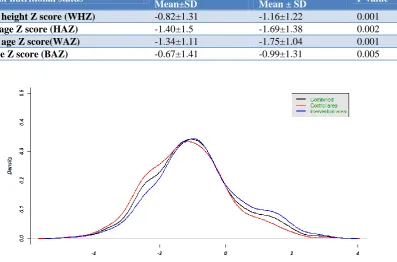
Weight for height Z score (WHZ) -0.82±1.31 -1.16±1.22 0.001
Height for age Z score (HAZ) -1.40±1.5 -1.69±1.38 0.002
Weight for age Z score(WAZ) -1.34±1.11 -1.75±1.04 0.001
BMI for age Z score (BAZ) -0.67±1.41 -0.99±1.31 0.005
Figure 1: Distribution of weight for height Z scores in intervention and control area.
Figure 2: Distribution of height for age Z scores in intervention and control area.
Table 5: Underweight, wasting, stunting and BMI for age in intervention and control area and proportion of malnourished children in intervention and control area.
Characteristics
(<- 3SD) (>-3SD) – (-2SD) (>-2SD) Malnourished Normal P value Weight for height
Intervention area 12 (3.3) 59 (16.4) 289 (80.3) 71 (19.7) 289 (80.3)
0.001 Control area 17 (4.7) 89 (24.8) 254 (70.5) 106 (29.5) 254 (70.5)
Height for age
Intervention area 50 (13.8) 124 (34.6) 186 (51.6) 174 (48.4) 186 (51.6)
0.001 Control area 58 (16) 156 (43.3) 146 (40.7) 214 (59.3) 146 (40.7)
Weight for age
Intervention area 23 (6.4) 97 (26.9) 240 (66.7) 120 (33.3) 240 (66.7)
<0.0001 Control area 32 (8.9) 162 (45) 166 (46.1) 194 (53.9) 166 (46.1)
BMI for Age
Intervention area 11 (3.3) 58 (16.1) 291 (80.6) 69 (19.4) 291 (80.6)
0.004 Control area 13 (3.6) 86 (23.8) 261 (72.6) 99 (27.4) 261 (72.6)
(Figures in parentheses denote percentage).
Figure 1, 2 and 3 shows the distribution of Z scores for weight for height, Height for age, Weight for age respectively. Shift of the curve towards right was observed in the intervention area.
In study area, proportion of children with severe wasting, stunting and BMI for age <-3SD were less compared to control area. This difference in intervention and control area for Weight for Height, Weight for age, Height for age and BMI for age was found to be statistically significant (p<0.001) (Table 5).
DISCUSSION
Survival, growth and development in the earliest years of life are fundamental for the future of every individual and future of societies into which those individuals were born.9 A remarkable degree of consensus is emerging on the essential requirements that positively influence a child‟s growth and development as well as on the ways that parents and others can provide our youngest children with healthy start.10 Strengthening and expanding existing strategies, and identifying and testing creative new approaches can help ensure that all children have access to the essential requirements for healthy growth and development.
The present study assessed the effect of ECD interventions on child feeding practices including responsive feeding and nutrition status of children. The socio-demographic characteristics of the children in the study were compared in intervention and control area at baseline which was comparable (Table 1). There was significant increase in early child development activity scores in intervention area as compared to control area (Table 2). There was significant difference in the mean scores of ECD activity in all age groups (p<0.001) (Table 2). It suggests that the intervention made the mother more responsive towards child care. The finding was supported by other studies.11-17 Cooper et al in his study “Impact of
a mother-infant intervention in an indigent peri-urban South African study” found that six months of home visits by trained non- professionals to encourage responsiveness increased the maternal sensitivity by three times.11 Super et al in his study found that three years of home visits for psychosocial stimulation increased responsiveness of mothers.13
In the present study it was observed that there was significant increase in responsive feeding score in intervention area as compared to control area (Table 3). There was significant difference in the mean scores of responsive feeding in all age groups (p<0.001) (Table 4). It suggests that the intervention made the mother more responsive towards child feeding. The finding was supported by other studies.7,12,18-21 Dettwyler in 1980 developed a rudimentary maternal scale and reported that children of attentive mothers had better growth than children of inattentive mothers suggesting that caregiver‟s practices are related to child‟s growth.22
Bhandari, Mazumder et alin their study found that at 9 months, 34.8% mothers in the intervention group reported that they actively encouraged their child to eat more compared with 7.7% in control group (p< 0.0001).7
In the present study, the proportion of children who had severe wasting, stunting and underweight were less in intervention area as compared to control area (Table 5). This difference in intervention and control area for Weight for Height, Weight for age, Height for age and BMI for age was found to be statistically significant (p <0.001) (Table 5). Ruel et al observed that there is strong association between care practices and child nutritional status.24 The prevalence of stunting and underweight was significantly smaller among children whose mothers scored in the highest tercile of care practices.
There are several limitations of the present study, first is we do not have a baseline survey to assess the ECD care, Responsive feeding as well as nutritional status of children. It is based on the assumption that the intervention and control area had similar characteristics to begin with, which may not be true. Second limitation is that the ECD scores and responsive feeding scores are as reported by the primary caregiver. It is well-known that parents may not report their behaviour correctly. Inaccurate self-reporting can be caused by recall bias, social desirability bias and errors in self-observation. Most important disadvantage of primary caregiver reported questionnaire is reference bias due to differing standards of comparison.
Irrespective of these limitations, the findings of the study are promising. The findings of the present study, supported by the findings of the other studies,suggest that the ECD interventions can help in improving the nutritional status of children in a community, especially wasting.11,12,23
CONCLUSION
The present study shows that the interventions aimed for improving the ECD activities through community workers appeared to be beneficial for the quality of mother child interaction and it had positive effect on child‟s growth and responsive feeding.
ACKNOWLEDGEMENTS
We are thankful to WHO-INTERVIDA collaborative project to provide the settings of ECD program area in which the present study has been conducted.
Funding: No funding sources Conflict of interest: None declared
Ethical approval: The study was approved by the Institutional Ethics Committee
REFERENCES
1. Meyers R. the Twelve Who Survive. Strengthening Programmes of Early Childhood Development in The Third World: Routledge. London: 1992
2. Ministry of women and child development. Gov. of India. nutritional guidelines of infant and young
child Available at: http://wcd.nic.in/fnb/fnb/ guidelines/nationalguidelines.pdf. Accessed on 3 June 2018.
3. WHO, UNICEF Infant young child feeding counselling: an integrated course. Geneva: WHO; 2000.
4. World Health Organization WHO nutrition, complementary feeding. Available at: http://www. who.int/nutrition/topics/complementary_feeding/en/ index.html. Accessed on 3 June 2018.
5. Imdad A, Yakoob MY, Bhutta ZA. Impact of maternal education about complementary feeding and provision of complementary foods on child growth in developing countries. BMC Public Health. 2011;11(3):25.
6. Black MM, Aboud FE. Responsive feeding is embedded in a theoretical framework of responsive parenting. J Nutr. 2011;141:490–4.
7. Bhandari N, Mazumder S, Bahl R, Martines J, Black RE, Bhan MK. An educational intervention to promote appropriate complementary feeding practices and physical growth in infants and young children in rural Haryana, India. J Nutr. 2004;134:2342–8.
8. Pattnaik J. Early childhood education in India: History, trends, issues, and achievements. Early Childhood Educ J. 1996;24(1):11-6.
9. World Health Organization. A Critical Link: Interventions for physical growth and psychosocial development. Geneva: WHO, 1999.
10. Carnegie Task Force on meeting the needs of Young Children. Staring Points: meeting the needs of our youngest children. New York: Carnegie Corporation of New York; 1994.
11. Cooper PJ, Landman M, Tomlinson M, Molteno C, Swartz L, Murray L. Impact of mother-infant intervention in an indigent periurban South African context: pilot study. Br J Psychiatry. 2002;180:76-81.
12. Nahar B, Hossain MD, Hamadani JD, Ahmed T, Mcgregor SG, Persson LA. Effects of psychosocial stimulation on improving home environment and child-rearing practices: results from community based trial among severely malnourished children in Bangladesh. BMC Public Health. 2012;12:622. 13. Super CM, Clement JR, Vuori-Christiansen L,
Christiansen NE, Mora JO, Herrera MG. Infant and caretaker behavior as mediators of nutritional and social interventions in the barrios of Bogota. In: Field TM, Sostek AM, Vietze P, Leiderman PH, editors. Culture and early interactions. Hillsdale, NJ: L. Erlbaum Associates; 1981:171-88.
14. Van den Boom DC. The influence of temperament and mothering on attachment and exploration: an experimental manipulation of sensitive responsiveness among lower-class mothers with irritable infants. Child Dev. 1994;65:1457-77. 15. Van den Boom DC. Do first-year intervention
sample of Dutch irritable infants. Child Dev. 1995;66:1798-816.
16. Gardner JM, Walker SP, Powell CA, Grantham-McGregor S. A randomized controlled trial of a home-visiting intervention on cognition and behavior in term low birth weight infants. J Pediatr. 2003;143:634-9.
17. Wendland-Carro J, Piccinini CA, Millar WS. The role of an early intervention on enhancing the quality of mother–infant interaction. Child Dev. 1999;70:713-21.
18. Aboud FE, Shafique S, Akhter S. A Responsive Feeding Intervention Increases Children‟s self-feeding and Maternal Responsiveness but Not Weight Gain. J Nutr. 2009;139:1738-43.
19. Vazir S, Engle P, Balakrishna N, Griffiths PL, Johnson SL, Creed-Kanashiro H, et al. Cluster-randomized trial on complementary and responsive feeding education to caregivers found improved dietary intake, growth and development among rural Indian toddlers. Matern Child Nutr. 2013;9:99-117. 20. Aboud FE, Moore AC, Akhter S. Effectiveness of
community- based responsive feeding programme in rural Bangladesh: a cluster randomized field trial. Matern Child Nutr. 2008;4:275-86.
21. Bentley ME, Wasser HM, Creed-Kanashiro HM. Responsive feeding and child undernutrition in
low-and middle-income countries. J Nutr. 2011;141(3):502-7.
22. Dettwyler KA. Infant feeding in Mali, West Africa: variations in belief and practice. Soc Sci Med. 1986;23:651-64.
23. Super CM, Herrera MG, Mora JO. Long term effects of Food supplementation and Psychosocial Intervention on the physical growth of Columbian infants at risk of malnutrition. Child Development. 1990;61:29-49.
24. Ruel MT, Levin CE, Klemesu MA, Maxmell D, Morris SS. Good care practices can mitigate the negative effects of poverty and low maternal schooling on children‟s nutritional status: Evidence from ACCRA. International Food Policy Research Institue. 2009. Available at: http://www.ifpri.org/ sites/default/files/pubs/divs/fcnd/dp/papers/dp62.pdf Accessed on 19 August 2015.
Cite this article as: Jarole S, Gupta SS, Mehendale AM, Raut A. Exposure to early childhood