Original Research Article
A KAP study on snakebite and its management among medical interns
in a tertiary care medical college and hospital in
Trivandrum district, Kerala
Amritesh Kumar, Soumya Gopakumar*, Sruthy Sathyan,
S. Blessed Singh, Beena Idicheriya Bhasy
INTRODUCTION
A Snake bite is considered as one of the most significant health related problems throughout the world. Globally, there are 5.4 million poisonous snake bites, of which around 2.5 million bites are fatal accountable for 1,25,000 deaths annually.1
According to the WHO, 81-95% of snake bites occur in tropical regions of South Asia, South-East Asia, Sub Saharan Africa and Latin America.2
Over years, this neglected tropical disease has emerged as an important established cause of morbidity and mortality among the poor, rural and Tropical population.3
ABSTRACT
Background: Snake bite is considered as one of the most significant health related problems throughout the world.
According to the WHO, a snake bite is an important medical problem. It has been a neglected extrinsic injury in tropical and sub-tropical developing countries including India. It has been estimated that every year there are almost 83,000 snake bites and 11,000 deaths due to snake bites in India. The Goal of this study is to access knowledge, attitude and practice (KAP) among interns so as to find out gaps in academics and bridge them. Findings of this study will benefit community at large.
Methods: An institutional based cross sectional study was conducted for the entire batch of interns in a tertiary care
center in Trivandrum, Kerala, South India during June–September 2018. A non-probability sampling was done. Data was collected by self-administered questionnaire.
Results: Among 100 students 48% had a score equal to and above 8 which was taken as good level of knowledge and
52% had poor level of knowledge. Attitude towards management of snake bite was 100% among study subjects. Only 35% of students had median score above 4 as good level of practice and remaining 65% had poor level of practice.
Conclusions: Respondents have adequate knowledge on snake bites. They discarded various prevailing myths in
society. Although study showed adequate attitude towards management, that was not reflected in practice. This gap can be overcome by teaching in simulated environment, so as to make them competent enough for managing snake bites.
Keywords: Snake Bite, First Aid, Knowledge, Attitude, Practice
Department of Community Medicine, Dr. Somervell Memorial Medical College and Hospital, Trivandrum, Kerala, India
Received: 13 January 2019
Accepted: 11 February 2019
*Correspondence: Dr. Soumya Gopakumar,
E-mail: [email protected]
Copyright: © the author(s), publisher and licensee Medip Academy. This is an open-access article distributed under
the terms of the Creative Commons Attribution Non-Commercial License, which permits unrestricted non-commercial use, distribution, and reproduction in any medium, provided the original work is properly cited.
India has 236 species of snakes, 13 of which are poisonous and home of the big 4”-The Indian cobra (Naja naja), the common Krait (Bungarus caerules), the Russel vipers (Daboa russelii) and the saw-scaled viper (Eichis carinatus) among the most deadliest.4
WHO has predicted around 83,000 snake bites and 11,000 deaths annually in India.5 In 2009, snakes bites were recognized as a neglected tropical disease by the World Health Organization.6
Indian population resides in rural areas with limited information. Unintentionally vital time of victim is wasted by seeking necessary help from traditional healers, instead of referring them to a hospital.7
A snake bite is an acute life-threatening medical emergency often faced by farmers, villagers, hunters, and a migrating population and has been listed as an occupational hazard.8,9
Clinical manifestations of snake bites are almost similar except for a few regional variations. Like Russells viper, found in the hills of H.P and Kochi areas shown neuro-paralysis in victims.10
Rationale
There is limited research on knowledge of inters in snake bite management. Thus this study was planned to determine the knowledge, attitude and practice on snake bites among medical students who have finished their MBBS final year and doing an internship in various departments.
Objectives
Primary objective was to determine the knowledge, attitude and practice on snake bites among the interns in a tertiary care hospital in Trivandrum district of Kerala, South India.
Secondary objective was to find out associated factors with good knowledge among interns.
METHODS
A cross-sectional study was conducted among MBBS interns who were posted in various departments of Dr. Somervell Memorial CSI medical college and hospital, a tertiary care center in South India during June to November 2018. Non-probability sampling technique was used and entire batch of 100 students were approached/considered for study with 100 response rate. Interns of both gender and those willing to participate were included. Those not willing to participate and could not be contacted/traced even after 2 attempts were excluded from study. A pre tested structured questionnaire consisting of 3 domains on knowledge, attitude and practice was used. The initial part of
questionnaire was framed to assess knowledge on snake bite and its management. The second part of questionnaire was framed to retrieve practices by them and final part to assess their attitude towards it. Data were collected using self-administered questionnaire.
Data analysis
Data was entered in MS Excel and analyzed in SPSS V-20.
Frequency and percentages were calculated for qualitative variables and median and IQR for quantitative variables. Total score was calculated for knowledge, attitude and practice domains and later were classified as good and bad based on median score. Attitude towards managing snake bites were expressed as %. Chi-square was done to find out association between good knowledge, practice and other selected variables. So as find out the level of knowledge and practice, scoring of questions were done. There were 12 questions in knowledge domain, 6 in practice domain. Each correct response was scored as 1, while for do not know and wrong responses zero mark was allotted. There were 3 questions on attitude; which were expressed as % in results.
Knowledge and practice were classified as good and bad based on median score.
Ethics
Approved by institutional ethics committee. Informed written consent from all study subjects was obtained and confidentiality was maintained.
After the data collection, a key with pictures of snakes, snake bites and answers was provided to enable the students for appropriate management. This will help to bridge the gaps in their academics that will ultimately be beneficial for community at large.
RESULTS
The age of respondents were calculated as mean and SD (23.93±1.15 years); with maximum age of 27 years and minimum 22 years. 52% of the respondents were females, as shown in Figure 1. In this study, only (21%) of respondents had ever managed/assisted snake bite case in hospital.
In the knowledge domain less than half i.e. (48%) of respondents had a median score above 8 with
inter-quartile range (Q1-7, Q3-9) as good knowledge as shown in Table 2.
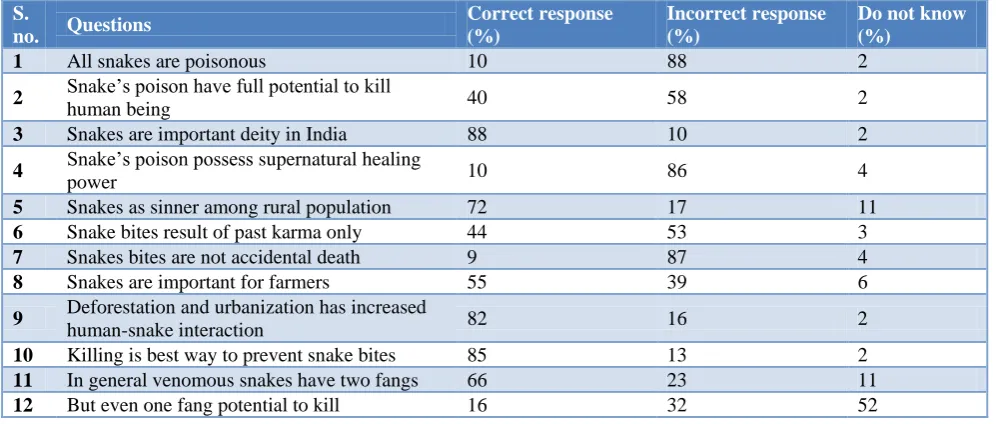
Table 1: Knowledge on snake bite among respondents.
S.
no. Questions
Correct response (%)
Incorrect response (%)
Do not know (%)
1 All snakes are poisonous 10 88 2
2 Snake’s poison have full potential to kill
human being 40 58 2
3 Snakes are important deity in India 88 10 2
4 Snake’s poison possess supernatural healing
power 10 86 4
5 Snakes as sinner among rural population 72 17 11
6 Snake bites result of past karma only 44 53 3
7 Snakes bites are not accidental death 9 87 4
8 Snakes are important for farmers 55 39 6
9 Deforestation and urbanization has increased
human-snake interaction 82 16 2
10 Killing is best way to prevent snake bites 85 13 2
11 In general venomous snakes have two fangs 66 23 11
12 But even one fang potential to kill 16 32 52
In Table 3 almost more than 90% of the interns turn down wrong attitude that snake bites were inspired from past karma and could be averted by pooja/offerings.
Table 2: Level of knowledge.
Level of knowledge Total score=12
(Good) score above median score of 8
( Poor) score below median score of 8
maximum scored
minimum score
48 % 52% 12 2
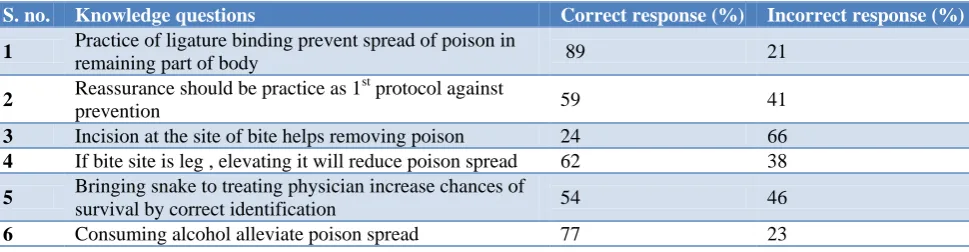
In practice domain 89% of inters responded correctly that ligature binding could not prevent spread of venom in body. More than half of interns i.e. (59%) responded that practice of reassurance as the first protocol in snake bite management. Bringing snakes to physician, helped in correct identification of species and better patient management were recommended by more than half i.e. 54% as shown in Table 4.
Table 3: Attitude regarding snake bite among respondents.
Si
no. Questions
Yes (%)
No (%)
1 Would you like to avert snake
bite by pooja and offering 9 91 2 Residing in cities is a protective
factor from snake bite 8 92 3
Snake bite is outcome of revenge inspired from past incidents
8 92
Figure 1: Sex distribution.
There was no significant association between gender and comparison of good knowledge as well as gender and comparison of good practice as described in Table 6 and 7 respectively.
The age of respondents were calculated as mean and SD (23.93±1.15 years); with maximum age of 27 years and minimum 22 years.
Median score for knowledge and practice was calculated; score above and equal to median was taken good and score below median as poor.
In the knowledge domain the median score was 8 with (IQR 7, 9).
52% 48%
FENALE
Table 4: Practice regarding snake bite among respondents.
S. no. Knowledge questions Correct response (%) Incorrect response (%)
1 Practice of ligature binding prevent spread of poison in
remaining part of body 89 21
2 Reassurance should be practice as 1
st
protocol against
prevention 59 41
3 Incision at the site of bite helps removing poison 24 66 4 If bite site is leg , elevating it will reduce poison spread 62 38 5 Bringing snake to treating physician increase chances of
survival by correct identification 54 46
6 Consuming alcohol alleviate poison spread 77 23
Table 5: Level of practice.
Level of practice Total score=6
(Good) score above median score of 4 ( Poor) score below median score of 4 maximum minimum
35 % 65% 6 0
Table 6: Gender wise comparison of knowledge.
S. no. Categories Good level (≥8) % Poor level (<8 ) % Crude OR (95% CI) P value
1. Male 34 (47.2) 13 (48.1)
0.96 (0.39-2.3) 0.9
2. Female 38 (52.8) 14 (51.9)
Table 7: Gender wise comparison of practice.
S. no. Categories Good level (≥4) % Poor level (<4 ) % Crude OR (95 %CI) P value
1. Male 27 (46.6) 20 (48.8)
0.9 (0.4–2.03) 0.8
2. Female 31 (53.4) 21 (51.2)
DISCUSSION
In a study conducted by Subedi et al among medical students 50.7% were males and 49.3% females.11 It was similar to this study with 52% males and 48% females respectively.
In a study conducted in Srilanka by Anjana et al, application of tight band (tourniquet) proximal to the site of bite was considered as an important first aid measure among 74.9% of cases where as it was higher (96%) in a study conducted by Kumar et al.12,13 Application of tourniquet was (89%) in present this study to preventive venom spread in body.
Knowledge in relation to the management of snake bite was only (54%) in a study conducted among health care workers in China.14 While it was lower to 48% in this study. A study conducted on snake bite in rural Loas et al found that 90% of study population had knowledge to identify snake, which is comparatively higher than our study, in which only 10% could tell that all snakes are not poisonous.14
CONCLUSION
In the present study more than half of respondents showed poor level of knowledge and practice on snake bite and its management. Although, they refute age old wrong concepts, misbelieves of past karma, supernatural healing power and others. Majority showed appropriate attitude by opting for right approach. Sex was not found to be significant factor in good knowledge and practice.
Recommendations
Above study deciphers, there is gap in knowledge and practice regarding snakebite management and treatment. Snake bite, being a neglected tropical disease of great importance country like India. Health professional should reinforcement management protocol on snake bites by demonstration on mannequins during clinical postings or during internship in a simulated environment.
Limitation
ACKNOWLEDGEMENTS
This study was supported by Dr. Somervell Memorail C.S.I medical college and hospital, Trivandrum, Kerala, India. The authors are grateful to the interns who participated in this study. Special thanks to Dr. Soumya Gopakumar, Dr. Blessed Singh, Miss Shruthy S and others for their time and efforts in guiding us through the data collection and statistical analysis.
Funding: No funding sources Conflict of interest: None declared
Ethical approval: The study was approved by the Institutional Ethics Committee
REFERENCES
1. Chippaux JP. Snake bites: appraisal of the global situation. Bull world health organ. 1998;(5):515-24. 2. Kasturiratne A, Wickremasinghe AR, de Silva N,
Gunawardena NK, Pathmeswaran A, Premaratna R, et al. The global burdedn of snake bite: a literature analysis and modeling based on regional estimates of envenoming and deaths. PloS Med. 2008;5:218. 3. Warrell DA. Snake Bite. lancet. 2010;375:77-88. 4. Saikia U, Sharma DK, Sharma RM. Checklist of the
reptililian fauna of himachal Pradesh, India. Reptile Rap Newsl SAsian Resptile Netw. 2007;8:6-9. 5. Warrelo DA. WHO/SEARO Guidelines for the
clinical management of snake bites in the Southeast Asian Region. SE Asian J Trop Med Pub Health.1999;30:1-85.
6. WHO. Snake bites. Available at: http//www.who.int.neglected_disease/diseases/snak esbites/en/index.html. Assessed on 7 August 2018. 7. Krishnaleela G, Meena SM, Praveena daya A. A
study on snake bites among the rural population in Tirunelveli district. Int J community med Public Health. 2018;5(5):1762-5.
8. Bawaskar HS, Bawaskar PH, Punde DP, Inamdar MK, Dongare RB. profile of snake bite envenoming in rural maharastra, India. J Assoc Physician India. 2008;56:88-95.
9. Bawaskar HS, Bawaskar PH. Call for global snake– bite control and procurement funding. Lancet. 2001;357:1132-3.
10. Raina R, Raina S, Chander V, Jaryal A. Snake bites profile from a medical college in rural setting in the hills of Himachal Pradesh, India. Indian J Cri Care Med. 2014;18:130-4.
11. Subedi N, Paudel IS, Khadka A, Shrestha U, Mallik VB, Ankur KC. Knowledge of first aid methods and attitude about snake bite among medical students: a cross sectional observational study. J Occup Med Toxicol. 2018;13:26.
12. Silva A, Marikar F, Murugananthan A, Agampodi S. Awareness and perception on prevention, first aid and treatment of snake bite among Srilankan farmers. J Occ Med Toxicol. 2014;9:20.
13. Kumar A, Dasgupta A, Biswas D, Sahoo SKS, Preeti PS. Knowledge regarding snake bite in snake bite in rural Bengal-Are they still lingering on yths and misconceptions? IAIM. 2015;2(7);36-41. 14. Inthanomchanh V, Reyer JA, Blessmen J,
Phrasisombath K, Yamamoto E, Hamajima N. Assessment of knowledge about snake bite management among health care providers in the province and two district hospital in Savannakhel province, lao PDR. Nagoya J Med Sci. 2017;79:299-311.
Cite this article as: Kumar A, Gopakumar S,