Original Research Article
A study on the awareness and practice of modern and traditional
methods for treatment of jaundice in an urban slum of
Jorhat town, Assam
Anoop Dev*, Anuradha Hazarika Medhi
INTRODUCTION
Man has been using plants in various ways since the beginning of human life for food, shelter and clothing. In search of food and the ways to cope up successfully with human suffering, primitive man began to distinguish those plants suitable for nutritional purpose from others with definitive pharmacological action. This relationship between plants and man has kept on growing and many plants are now being used as drugs.
Herbal medicine is currently experiencing a revival in the world, along with other complementary therapies such as traditional Chinese Medicines, Osteopathy and Homeopathy.1
People from all continents have used hundreds to thousands of indigenous plants for treatment of ailments since prehistoric times. Indigenous healers often claim to have learned by observing that sick animals change their food preferences to nibble at bitter herbs they would normally reject.1
ABSTRACT
Background: Jaundice is a term use for the condition in which yellow colouration of the skin and the sclera occurs and is caused by a raised level of bilirubin. There are a number of herbal medicines or self-remedy medications widely in use among the people especially in the rural areas and suburbs. Various study showed that people have also switched over to modern methods of treatment. The purpose of the study is to assess the awareness of people towards Jaundice and the methods of treatment they preferred and practiced.
Methods: The study was a community based cross-sectional study which was conducted amongst the people of an urban slum of Jorhat district of Assam, over a period of three months. A sample of 156 study participants of age group (21-60) was taken. Data were collected using a pre-designed and pre-tested proforma. MS excel and SPSS version-23were used to analyze the data.
Results: Majority (88.4%) of the study participants were aware of Jaundice while amongst them (89.6%) respondents were in the age group of (21-30) years. (56.5%) study subjects were aware of traditional methods of treatment whereas only (5.1%) were aware of modern methods. However (36.9%) were aware of both traditional and modern methods. (74.6%) preferred as well as practiced traditional methods of treatment .Majority of respondents 56 (54.4%) had influence of society for practicing traditional methods for treatment of Jaundice followed by belief 32 (31.1%).
Conclusions: Behaviour Change Communication (BCC) and Information Education Communication (IEC) activities regarding Jaundice should be promoted.
Keywords: Slum, Jaundice, Traditional, Modern, Treatment
Department ofCommunity Medicine, Jorhat Medical College and Hospital, Jorhat, Assam, India
Received: 20 December 2018
Accepted: 30 January 2019
*Correspondence:
Dr. Anoop Dev,
E-mail: [email protected]
Copyright: © the author(s), publisher and licensee Medip Academy. This is an open-access article distributed under the terms of the Creative Commons Attribution Non-Commercial License, which permits unrestricted non-commercial use, distribution, and reproduction in any medium, provided the original work is properly cited.
About 80% of world population nearly depends upon traditional system of health care.2 The art of herbal healing is deep rooted in Indian culture. The indigenous traditional knowledge of medicinal plants of various ethnic communities, where it has been transmitted orally for centuries is fast disappearing from the face of the earth due to the advent of modern technology and transformation of traditional culture.3
North East India is a rich diversified part of Indian subcontinent which is rich by its ethno-cultural diversity also. Various health care practices are very common among different tribes and communities of this region of India. The Indian medicinal heritage is very ancient. The earliest recorded evidence of use of herbal medicine in Indian, Chinese, Greek, Roman texts dates back to about 5000 years. The herbal medicinal tradition is very old which we find in classical Indian texts like- Rig-Veda, Atharva Veda, Charak Samhita and Sushrata Samhita. Globally there is a trend that in the recent years people are getting much interested in the traditional system of medicines. The World Health Organization (WHO) has listed 20,000 medicinal plants globally and India is having about (15-20%) of them. The WHO has estimated that about 80% population in the developing countries depends directly on plants for medicines. This holds good in tribal dominated North Eastern part of India where more particularly, people often use various herbs, flowers, fruits, leaves etc. as prevention or to cure various diseases or simply they take some recipes as tradition in different seasons which are found to have very strong scientific basis.4
This very old traditional Indian medicinal heritage flow in two streams- one is codified classical stream and the other one is the non-codified or the oral folk .The codified system is more institutionalized and is basically of four types-Ayurveda, Sidha, Unani and Gsorigpa. It is interesting that the non- codified systems are more popularly known as local health tradition (LHT). Thus the local health tradition, though it is informal, exists among various ethnic and traditional communities of India more particularly in North East India of which the study area being a part is found to be rich in such traditional herbal system of health care practices.4 In this report, an attempt has been made to analyze the awareness of people and the different type of practices they use to cure or to prevent one very frequent and dangerous disease that is jaundice.
Traditional systems of medicine followed by tribal/aborigines of different countries are important sources of information for modern science. In their system, the "medicine man" or the "doctor" of the tribe, who has the knowledge of treating diseases, keeps this knowledge as a closely guarded secret and passes it to the next generation by words of mouth.3
The treatment is often associated with lengthy and mystic rituals, in addition to prescription of drugs (decoctions,
pastes, powders, oils, ashen materials, etc.). Locally available natural materials are used for the preparation of drugs, which are not commercially made and marketed. The knowledge of the traditional systems is undergoing close scientific scrutiny and is being increasingly incorporated into the modern systems of medicine.3
Jaundice (icterus) is the yellowish discoloration of the skin and mucous membrane due to accumulation of bilirubin in the tissues. It is more of a symptom than a disease. Jaundice is sometimes called icterus, from a Greek word for the condition. As bilirubin has high affinity for the elastic tissue; jaundice is primarily noticeable in tissues rich in elastic content. Normal serum bilirubin level ranges from 0.3-1.3 mg/dl. Jaundice becomes clinically evident when total serum bilirubin exceeds 2 mg/dl. Jaundice may result from various diseases or conditions that affect the liver, like hepatitis A, hepatitis B, hepatitis C, hepatitis D, hepatitis E, autoimmune hepatitis, liver cirrhosis, liver cancer, hemolytic anaemia and malaria.5
There are a number of herbal medicines or self-remedy medications widely in use among the people especially in the rural areas and suburbs. In the recent years, people have also switched over to modern methods of treatment.
The efficacy of the traditional herbal medicines cannot be ruled out or undermined. It is the very root of modern medicine. Traditional healing is the oldest form of structured method of treatment that is based on an underlying philosophy and a set of principles by which it is practiced. The most common local medicinal plants used in treatment of Jaundice are Kardoi, Simolu, Bar Jamu, Jam Lakhuti, Dhan, Anarash and Bala.1
Owing to lack of medicinal equipments, scarcity of qualified physicians and lower infra structural facilities, benefits of modern healthcare system cannot be extended to rural areas and so the traditional mode of treatment appears to be the first choice of treatment to many.1 Nevertheless, there is a lot of speculation that administration of these local medicines does not make the condition better, rather makes it worse. On the other hand, many people are also under the impression that irrespective of modern methods of treatment, local traditional medicines must be administered for its complete cure.
The present study was conducted in an urban slum of Jorhat to assess the awareness of people towards Jaundice and the type of treatment they preferred and practiced.
METHODS
Sample size: Taking 73.28% as the prevalence (Chandrakumar et al.) along with relative error 10% and non-response rate of 10%, the sample size was calculated as 156.6
Sampling technique: A simple random sampling was done for the selection of the slum that represented the study population, i.e., out of the five registered urban slums in Jorhat town, Rajamaidam slum was selected at random by using lottery method. Individuals in the age group of (21-60) years in the selected slum were included and data were collected using consecutive sampling in the slum till the required sample size was obtained.
Study variables: Socio-demographic variables- age, sex, religion, type of family, socio-economic status of family (as per modified Kuppuswamy’s socio economic scale, 2017-Appendix 2). Causes of jaundice, manifestations of jaundice, types of treatment, modern methods, traditional methods, preference, reason for preference, treatment chosen were also considered.
Data collection: Informed consent was taken from the respondent before collection of data. Data were collected by personal interview and by house to house visit using a pre-designed and pre-tested proforma. The participation was voluntary and the personal details of the participants were kept confidential to encourage better participation in the study.
Statistical analysis: The collected data were tabulated and analyzed in MS Excel and SPSS-version 23. Chi square statistical test was used to determine the p-value for test of significance under 95% confidence interval.
RESULTS
Out of 156 people interviewed, majority of respondents belonged to age group of (21-30) years (49.3%) followed by (31.5%) who were in the age group of (31-40) years. Most of the respondents were male (62.8%). In our study, highest number of respondents were illiterate (37.1%) and only (5.7%) were graduates. It had also been observed that majority of the respondents were unemployed (42.6%) and highest number of respondents belonged to upper-lower class (41.6%). However, none of them belonged to upper socioeconomic class (Table 1).
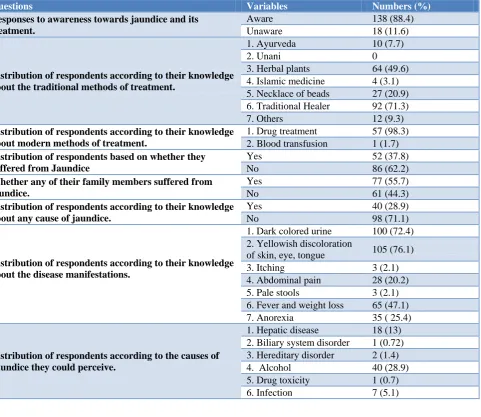
Table 2 reveals that majority of the respondents 138 (88.4%) were aware of Jaundice and amongst them 52 (37.8%) respondents suffered from Jaundice. Out of the 138 respondents who were aware of jaundice, family members of 77 (55.7%) respondents suffered from the disease.
Amongst those aware, (28.9%) named alcohol to be a cause of Jaundice while according to (13.0%) respondents, liver disease could be a cause of jaundice. 98 (71.0%) respondents could not name any cause of the disease.
Table 1: Socio- demographic characteristics in relation to jaundice.
Age (in years) Numbers Percentage
21-30 77 49.3
31-40 49 31.5
41-50 14 8.9
51-60 16 10.2
Total 156 100
Sex
Male 98 62.8
Female 58 37.2
Total 156 100
Education
Graduate or post
graduate 09 5.7
Post high school diploma 10 6.8
High-school 29 18.5
Middle school 24 15.3
Primary school 26 16.6
Illiterate 58 37.1
Total 156 100
Occupation
Semi-profession 02 1.2
Clerical, shop owner,
farmer 04 2.5
Skilled worker 06 3.8
Semi-skilled worker 15 9.6
Unskilled worker 63 40.3
Unemployed 66 42.6
Total 156 100
Socio economic class
Upper 0 0
Upper middle 07 4.4
Lower middle 22 14.3
Upper lower 65 41.6
Lower 62 39.7
Total 156 100
However, majority of the respondents who were aware about Jaundice, mentioned (76.1%) yellowish discoloration of skin, eye, tongue as the symptoms of jaundice. 72.4% of respondents mentioned dark colored urine, (47.1%) fever and weight loss, (25.4%) anorexia and (20.2%) mentioned abdominal pain as symptoms of jaundice.
Table 2: Result of questions that asses the awareness and knowledge about Jaundice.
Questions Variables Numbers (%)
Responses to awareness towards jaundice and its treatment.
Aware 138 (88.4) Unaware 18 (11.6)
Distribution of respondents according to their knowledge about the traditional methods of treatment.
1. Ayurveda 10 (7.7)
2. Unani 0
3. Herbal plants 64 (49.6)
4. Islamic medicine 4 (3.1) 5. Necklace of beads 27 (20.9) 6. Traditional Healer 92 (71.3) 7. Others 12 (9.3)
Distribution of respondents according to their knowledge about modern methods of treatment.
1. Drug treatment 57 (98.3) 2. Blood transfusion 1 (1.7)
Distribution of respondents based on whether they suffered from Jaundice
Yes 52 (37.8)
No 86 (62.2)
Whether any of their family members suffered from jaundice.
Yes 77 (55.7)
No 61 (44.3)
Distribution of respondents according to their knowledge about any cause of jaundice.
Yes 40 (28.9)
No 98 (71.1)
Distribution of respondents according to their knowledge about the disease manifestations.
1. Dark colored urine 100 (72.4) 2. Yellowish discoloration
of skin, eye, tongue 105 (76.1) 3. Itching 3 (2.1) 4. Abdominal pain 28 (20.2)
5. Pale stools 3 (2.1)
6. Fever and weight loss 65 (47.1)
7. Anorexia 35 ( 25.4)
Distribution of respondents according to the causes of Jaundice they could perceive.
1. Hepatic disease 18 (13) 2. Biliary system disorder 1 (0.72) 3. Hereditary disorder 2 (1.4)
4. Alcohol 40 (28.9)
5. Drug toxicity 1 (0.7)
6. Infection 7 (5.1)
Amongst the lower socioeconomic class, 52 (37.4%) were aware about Jaundice while 62 (44.9%) respondents in the upper lower class had awareness of jaundice. Among the lower middle class and upper middle class only 19 (13.8%) and 5 (3.6%) were aware about Jaundice.
Figure 1 shows that out of the 138 respondents who were aware about Jaundice, 78 (56.5%) of them knew traditional methods of treatment for jaundice, 7 (5.1%) knew about modern methods for the treatment of jaundice. 51 (36.96%) respondents had knowledge of both the types of treatment while only 2 (1.4%) did not know about any type of treatment.
Majority of respondents (74.6%) preferred and practiced traditional methods while (23.9%) respondents preferred as well as practiced modern methods of treatment. Only 2 (1.5%) respondents did not know any mode of treatment for jaundice (Figure 2).
Figure 1: Distribution of respondents according to the type of treatment they know.
Modern methods
Traditional methods
Both
None 56.5%
36.96%
5.1%
Table 4 reveals that, majority of respondents 56 (54.4%) had influence of society for practicing traditional methods for treatment of Jaundice followed by belief 32 (31.1%). Other reasons of preference as mentioned by the respondents include easy availability (9.7%) and lower socioeconomic class (4.8%).
On the other hand, (33.3%) of study participants preferred modern methods of treatment owing to their good socioeconomic condition followed by influence of society (24.2%). Moreover, (18.1%), (15.1%) and (9.1%) of the respondents specified ease of transportation, availability and belief as their reasons for preference respectively.
Table 3: Association of socio-demographic characteristics with awareness of jaundice.
Age (in years) Aware Unaware P value
N (%) N (%)
21-30 69 (50.0) 8 (44.4)
31-40 45 (32.6) 4 (22.2) 0.0024
41-50 12 (8.7) 2 (11.1)
51-60 12 (8.7) 4 (22.2)
Total 138 (100) 18 (11.5)
Education
Illiterate 53 (38.4) 5 (27.7)
Primary school 21 (15.2) 5 (27.7) 0.0014 Middle school 23 (16.7) 1 (5.6)
High school 22 (15.9) 7 (38.9) Post
high/intermediate 10 (7.2) 0 Graduate/post
graduate 9 (6.5) 0
Total 138 (100) 18 (100)
Socioeconomic status
Lower 52 (37.7) 10 (55.5)
Upper lower 62 (44.9) 3 (16.7) 0.0019 Lower middle 19 (13.8) 3 (16.7)
Upper middle 5 (3.6) 2 (11.1)
Upper 0 0
Total 138 (100) 18 (100)
Table 4: Distribution of respondents according to their reason of preference.
Response
Traditional methods of treatment
Modern methods of treatment
N (%) N (%)
Socioeconomic status 5 (4.8) 11 (33.3)
Availability 10 (9.7) 5 (15.1)
Ease of transportation 0 (0) 6 (18.1)
Influence of society 56 (54.4) 8 (24.2)
Belief 32 (31.1) 3 (9.1)
Total 103 (100) 33 (100)
Figure 2: Distribution of respondents according to the type of treatment preferred and practiced.
DISCUSSION
Present study reflects a good knowledge on the awareness, practice and preference for treatment of jaundice.
The study revealed that 88.4% were aware about jaundice which is similar to the findings in the study conducted by Palani (93.4%).7
Our study showed that the respondents, who knew about the traditional methods of treatment, most of them thought jaundice could be cured by the traditional healer (71.3%) in their locality which is at par with the study conducted by Karmakar in Bangladesh.8 Moreover, use of herbal plants (49.6%) for treatment of jaundice in our study was high in comparison to the study done in Bangladesh.8 Few of the respondents knew about the necklace of beads (20.9%) used in the treatment of jaundice.
In the present study (98.27%) knew that treatment with drugs was one of the modern methods for treatment of jaundice whereas only (1.73%) knew blood transfusion to be another modern mode of treatment.
According to their knowledge, majority of the respondents mentioned yellowish discoloration of skin, eye, tongue (76.08%) as signs of jaundice followed by other manifestations like dark coloured urine (72.40%), fever and weight loss (47.10%). In a study of Ethiopia (67.0%) said that yellowish discolouration of skin and eye as the one of the major manifestations of jaundice whereas only (4.3%) of the study subjects mentioned dark coloured urine to be the sign of jaundice.7
Among those aware of Jaundice, majority of them did not know about any cause of jaundice (71.0%). The remaining (28.9%) who were aware, mentioned alcohol (28.9%) and infection (5.1%) to be the cause of jaundice. In a study conducted by Almeu in Ethiopia.7 It was found
Traditional methods,
74.60%, 75% Modern
methods, 23.90%, 24%
that (71.4%) of the respondent mentioned liver disorder to be the cause of jaundice whereas in our study it was only (13.4%).
It was also seen that prevalence of awareness regarding Jaundice was greater among the lower age group as compared to higher. It may be due to their interest towards the modern medicines and its outcome in comparison.
Education and socioeconomic status significantly associated with the awareness of jaundice. More than half of the people who had awareness about jaundice, (56.5%) knew the traditional method as the treatment of this disease, while only (5.1%) knew about modern methods of treatment. However, (36.96%) respondents had the knowledge of both. The result is almost similar to the study of Bangladesh.8 They believed that traditional methods are available, free from any side effect and cheaper than modern methods.
The study revealed traditional medicines were frequently used by a large portion of the respondents. This may be due to lack of proper education, beliefs, long waiting hours in the health facility, low cost of treatment and easy availability of traditional medicines.6
CONCLUSION
Use of proper medication is considered to be of utmost importance in ensuring the physical well-being of the individual. The findings of the study are challenging due to majority of the people in the study area have shown preference and belief towards traditional treatment for jaundice. The belief towards traditional methods of treatment may be due to lack of proper education, long waiting hours in the health facility, low cost of treatment and easy availability of traditional medicines.
Appropriate health seeking behaviour and Information Education Communication (IEC) activities should be promoted. Health camps should be set up frequently in urban slums and health education regarding jaundice should be provided. Educational institutions should conduct more awareness programme on jaundice and should try to break the myths associated with the disease through Behaviour Change Communication (BCC).
Funding: No funding sources Conflict of interest: None declared
Ethical approval: The study was approved by the Institutional Ethics Committee
REFERENCES
1. Bora A, Devi P, Borthakur SK. Phyto-remedies of Jaundice, a traditional approach on Majuli, Special reference to Satra culture people, Assam. Asian J Plant Sci Res. 2012;2(6):664-9.
2. Rajudurai M. Ethnomedicinal plants used by the traditional healers of Pachamalai Hills, Tamilnadu, India. Studies of Ethno-Medicine. 2009;3(1):39-41. 3. Ganesan S. Ethnomedicinal survey of lower Palmi
Hills of Tamilnadu. Indian J Traditional Knowledge. 2004;(3):299-304.
4. Nath N, Borthakur, SK, Deka K. Some traditional Health Care Practices of Jaundice in parts of Western Assam (North East India). Int J Applied Biol Pharm Tech. 2013;4:333-9.
5. Arzumanyan A. Pathogenic mechanisms in HBV and HCV associated hepatocellular carcinoma. Nature Reviews Cancer. 2013;13:123-35.
6. Chandrakumar A, Xavier A, Xavier A, Manakkadiyil A, Reghu A, Thomas L. Implications of traditional medicine in the treatment of Hepatitis A in Kerala. J Tradition Complementary Med. 2016;6(3):316-20.
7. Alemu SF, Derbew B, Palani S, Joseph NM. Knowledge, attitude and perception towards Jaundice among Ayder Referral hospital worker. Int res J Pharm. 2011;2(12):191-5.
8. Karmakar P, Islam Mazharul M, Kibria G, Hossain Salim M, Sattar M. Prevalance, belief and awareness of preferring traditional health care system in urban and rural people of Noakhali district, Bangladesh. Int Current Pharm J. 2012;1(9):229-34.
9. Bhuyan A, Ethnomedicinal plant used by the Sonowal Kacharis of Dibrugarh District, Assam. Int J Applied Res. 2015;1(9):87-90.