* To whom all correspondence should be addressed. Fax: +98-21-6641-4213;
E-mail: [email protected]
A Study of the Wave Velocity in Granular Soils using
Discrete Element Method
Mohsen Emdadifardand S.M. Mir Mohammad Hosseini*
1Department of Civil Engineering, Amirkabir University of Technology, Tehran, Iran. doi: http://dx.doi.org/10.13005/bbra/1319
(Received: 15 June 2014; accepted: 08 August 2014)
In the present paper, discrete element method (DEM) is used to study wave propagation phenomenon in granular soils. The effect of factors such as coefficient of friction, frequency, normal stiffness and soil gradation on the wave speed is studied. Using the wall motion based on the sinusoidal function is the method of loading used in this simulation, through which the pressure wave is transferred to particles. Simulations results are well consistent with the results of experiments conducted by other researchers. In addition, the results obtained are shown as graphs to study the effectiveness of each parameter. According to the results, the coefficient of friction and normal stiffness have a greater effect on the wave speed.
Key words: Discrete Element Method, Wave Propagation, Granular Soils.
Wave propagation phenomenon plays a fundamental role in various dynamic issues such as seismic soil-structure interaction, liquefaction and foundation vibration1.
Mechanical response of granular materials is determined by inter-particle contact behavior among the particles. The distinct nature of such materials leads to a discontinuous behavior distinct from charge transfer. This can be due to the structure of micro-materials or their fabric. It is well proved that charge transfer in non-cohesive materials occurs in a complex network of distinct paths. Considering the wave propagation, granular materials create a structured wave conduction network transferring the mechanical energy. Along a given wave path, the dynamic charge transfer is
determined using the interaction among adjacent particles, the characteristics of propagated wave speed, damping range and dispersity of local fabric-related wave along the created wave paths. Over the years, researchers have combined the granular materials of micromechanical models including the local mechanics on the particles’ surface to predict the macro-structure response2-4.
It should be noted that the study of the correct nonlinear behavior of soil is still a controversial issue in the analysis of the dynamic behavior of soil. Distinct element method is known as a powerful tool to analyze the granular materials in small and large strains. This method is pioneered by Cundall and Strack15 and many researchers
have so far attempted to develop it5. DEM-based
scale using relatively simple assumptions and a few parameters. In addition, a typical simulation using DEM provides a large amount of data at both micro and macro scales. At any particular time of the simulation, we can retrieve these data and get full access to the results6-8, 16,-18.
Several experiments have been conducted in vitro to evaluate the wave propagation in granular materials. First experiments were conducted using the resonant column method to measure the wave speed. This method includes the excitation of a column of granular materials in a frequency. This method involves exciting a column of granular materials over a range of frequencies. A peak detected in the amplitude determines the resonant frequency. This frequency is combined with the sample length and leads to the wave speed. Duffy and Mindlin applied this method to a column formed from a ball packed into a cubic lattice. They showed that the wave speed scales with confining pressure to 1.4 power for both wet and dry sand9, 10.
Numerical and experimental studies conducted by Shukla et al. (1993) investigated the effect of particle shape and particle surface hardness on the inter-particle charge transfer, speed and length of a stress wave transferred through the granular medium under the impact loads. In this research, dynamic photoelastic test is used as a laboratory technique and the granular medium is composed of spherical and elliptical particles with different contact hardness to examine their effects. The results showed that the particle shape and the particle surface hardness affect the wave speed11.
Studies conducted by Thomas et al. (2009) evaluated dispersion in the resonant column test in granular soil. The analysis is performed in a time domain and two-dimensional way using PFC 2D. Voids ratios of 0.27, 0.1 and 0.65 were studied. This research investigated the effect of factors such as sample width, voids ratio, viscous damping and wavelength on the harmonic longitudinal wave propagation in a rectangular sample. Speed decreases with the decrease of the particle diameter. The increased viscosity and frequency and denser deposit will lead to the increased speed12.
In studies conducted by Zamani and Shamy, a three-dimensional cuboid model of granular soil was made. Simulation was performed to investigate the soil behavior under sinusoidal excitations with different amplitude and frequency
(shear wave). Three types of soils with porosities of 35.5 %, 36.5% and 38% and different boundary conditions were investigated on different beds including rigid rock bed, elastic bed and infinite medium. The analysis was performed in a time domain way to consider the effect of the nonlinear behavior of the soil. Dynamic characteristics of granular materials are affected by parameters such as confining pressure and porosity observed in the experimental results. Reduced shear modulus ratio increases with the increase of soil porosity at constant shear strain while damping ratio decreases. The reduced shear modulus ratio increases with the increase of confining pressure at constant shear strain while damping decreases. The soil response under different boundary conditions is well consistent with analytical results. The maximum and minimum ranges of motion belong to the rigid and infinite beds due to damping effect, respectively. The results are compared with the results of the equivalent linear method performed using SHAKE software. SHAKE and DEM are generally consistent except when the loading frequency is close to the resonant frequency13.
Studies conducted by Hostler (2005) investigated the wave propagation in granular materials using both experimental method and DEM. Simulation and wave propagation are two-dimensional and horizontal respectively. Boundary excitations are used to apply loading. Loading is applied in a sinusoidal and pulse form. The number of particles is 4000. The phenomena of dispersion and frequency-dependent wave speed are studied. The diameter of particles is 0.5-5 mm. Group and phase speeds are studied. The granular diameter is assumed almost identical. Factors affecting the speed including the particle diameter, the increased depth and frequency are investigated9.
The results showed that the wave speed is independent of the frequency. Particle size does not affect the wave speed. The increased depth slightly affects the wave speed9.
Modeling processes Particle Production
in this modeling. In this method, several spherical particles having no contact with each other will first be randomly produced in a specific space. Then, the particles will become enlarged enough to achieve the desired porosity. It is a trial and error process that will continue till achieving the desired porosity. Therefore, the particles will overlap and produce a great repulsive force. Consequently, the particles will have a high input speed removing even the particles from the boundary walls. In order to solve this problem, the kinetic energy is reduced to zero several times until the system reaches equilibrium. Table 1 shows the deposits after settling under gravity (1-170).
Wave propagation phenomenon plays a fundamental role in various dynamic issues such as seismic soil-structure interaction, liquefaction and foundation vibration1.
Mechanical response of granular materials is determined by inter-particle contact behavior among the particles. The distinct nature of such materials leads to a discontinuous behavior distinct from charge transfer. This can be due to the structure of micro-materials or their fabric. It is well proved that charge transfer in non-cohesive materials occurs in a complex network of distinct paths. Considering the wave propagation, granular materials create a structured wave conduction network transferring the mechanical energy. Along a given wave path, the dynamic charge transfer is determined using the interaction among adjacent particles, the characteristics of propagated wave speed, damping range and dispersity of local fabric-related wave along the created wave paths. Over the years, researchers have combined the granular materials of micromechanical models including the local mechanics on the particles’ surface to predict the macro-structure response2-4.
It should be noted that the study of the correct nonlinear behavior of soil is still a controversial issue in the analysis of the dynamic behavior of soil. Distinct element method is known as a powerful tool to analyze the granular materials in small and large strains. This method is pioneered by Cundall and Strack15 and many researchers
have so far attempted to develop it5. DEM-based
analysis is often used in qualitative analyses. The advantage of DEM-based analysis is that a set of discrete particles are capable of simulating the complex behavior of real materials at the micro
scale using relatively simple assumptions and a few parameters. In addition, a typical simulation using DEM provides a large amount of data at both micro and macro scales. At any particular time of the simulation, we can retrieve these data and get full access to the results6-8, 16-18.
Several experiments have been conducted in vitro to evaluate the wave propagation in granular materials. First experiments were conducted using the resonant column method to measure the wave speed. This method includes the excitation of a column of granular materials in a frequency. This method involves exciting a column of granular materials over a range of frequencies. A peak detected in the amplitude determines the resonant frequency. This frequency is combined with the sample length and leads to the wave speed. Duffy and Mindlin applied this method to a column formed from a ball packed into a cubic lattice. They showed that the wave speed scales with confining pressure to 1.4 power for both wet and dry sand9, 10.
Numerical and experimental studies conducted by Shukla et al. (1993) investigated the effect of particle shape and particle surface hardness on the inter-particle charge transfer, speed and length of a stress wave transferred through the granular medium under the impact loads. In this
Fig. 4. Changes in velocity resulted from normal stiffness
Fig. 2. Changes in velocity versus the coefficient of friction Fig. 3. Changes in velocity versus wave frequency
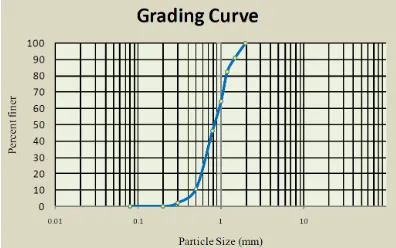
Fig. 5. Grading curve of soil A
Fig. 6. Grading curve of soil B Fig. 7. Grading curve of soil C
research, dynamic photoelastic test is used as a laboratory technique and the granular medium is composed of spherical and elliptical particles with different contact hardness to examine their effects. The results showed that the particle shape and the particle surface hardness affect the wave speed11.
Studies conducted by Thomas et al. (2009)
evaluated dispersion in the resonant column test in granular soil. The analysis is performed in a time domain and two-dimensional way using PFC 2D.
Voids ratios of 0.27, 0.1 and 0.65 were studied. This research investigated the effect of factors such as sample width, voids ratio, viscous damping and wavelength on the harmonic longitudinal wave propagation in a rectangular sample. Speed decreases with the decrease of the particle diameter. The increased viscosity and frequency and denser deposit will lead to the increased speed12.
granular soil was made. Simulation was performed to investigate the soil behavior under sinusoidal excitations with different amplitude and frequency (shear wave). Three types of soils with porosities of 35.5 %, 36.5% and 38% and different boundary conditions were investigated on different beds including rigid rock bed, elastic bed and infinite medium. The analysis was performed in a time domain way to consider the effect of the nonlinear behavior of the soil. Dynamic characteristics of granular materials are affected by parameters such as confining pressure and porosity observed in the experimental results. Reduced shear modulus ratio increases with the increase of soil porosity at constant shear strain while damping ratio decreases. The reduced shear modulus ratio increases with the increase of confining pressure at constant shear strain while damping decreases. The soil response under different boundary conditions is well consistent with analytical results. The maximum and minimum ranges of motion belong to the rigid and infinite beds due to damping effect, respectively. The results are compared with the results of the equivalent linear method performed using SHAKE software. SHAKE and DEM are generally consistent except when the loading frequency is close to the resonant frequency13.
Studies conducted by Hostler (2005) investigated the wave propagation in granular materials using both experimental method and DEM. Simulation and wave propagation are two-dimensional and horizontal respectively. Boundary excitations are used to apply loading. Loading is applied in a sinusoidal and pulse form. The number of particles is 4000. The phenomena of dispersion and frequency-dependent wave speed are studied. The diameter of particles is 0.5-5 mm. Group and phase speeds are studied. The granular diameter is assumed almost identical. Factors affecting the speed including the particle diameter, the increased depth and frequency are investigated9.
The results showed that the wave speed is independent of the frequency. Particle size does not affect the wave speed. The increased depth slightly affects the wave speed9.
Modeling Processes Particle Production
Creating a sample with the desired porosity and dimensions is the first step of modeling. There are several methods to produce
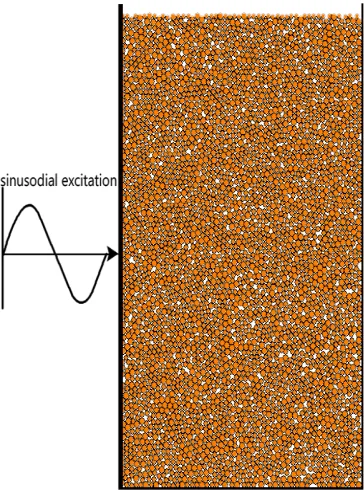
a deposit. The method of particle production through increasing the radius is the method used in this modeling. In this method, several spherical particles having no contact with each other will first be randomly produced in a specific space. Then, the particles will become enlarged enough to achieve the desired porosity. It is a trial and error process that will continue till achieving the desired porosity. Therefore, the particles will overlap and produce a great repulsive force. Consequently, the particles will have a high input speed removing even the particles from the boundary walls. In order to solve this problem, the kinetic energy is reduced to zero several times until the system reaches equilibrium. Table 1 shows the deposits after settling under gravity (1-170).
A Study of the Effect of Frequency on Wave Propagation Speed
This section investigates the effect of frequency on the wave speed. In this section, waves with four frequencies of 1000, 1500, 2000 and 2500 Hz are applied to the deposits. The results of the analyses are shown in Figure 3. As it can be observed, increase or decrease in the frequency does not significantly affect the wave speed. This result is consistent with the results of experiments conducted by Hostler.
A Study of the Effect of Normal Contact Stiffness on Wave Propagation Speed
Normal contact stiffness is one of the factors affecting the wave propagation speed. In this section, four deposits with normal stiffnesses of 1×10⁷, 5×10⁷, 1×10⁸ and 5×10⁸ are created to
investigate the effect of these factors. The results of these analyses are shown in Figure 4. As it can be observed, the wave speed increases with the increase of stiffness. This increase is expectable since normal stiffness is directly associated with
elastic modulus and the elastic modulus ( ρ
E C0=
) is directly associated with the wave speed in the particle and finally in the deposit. We conclude that the particles’ properties (type) are one of the most important parameters affecting the wave speed.
A Study of the Effect of Normal Contact Stiffness on Wave Propagation Speed
investigate the effect of these factors. The results of these analyses are shown in Figure 4. As it can be observed, the wave speed increases with the increase of stiffness. This increase is expectable since normal stiffness is directly associated with elastic modulus and the elastic modulus (
ρ
E
C
0=
) is directly associated with the wave speed in the particle and finally in the deposit. We conclude that the particles’ properties (type) are one of the most important parameters affecting the wave speed.
Figure 8 shows the wave speed obtained in the three soils. As it can be observed, the wave propagation speed in soil C is greater than that in soils B and C. Deposits of soil C enjoy an appropriate particle diameter and a suitable range of particle limits due to their good gradation. Therefore, settling and achieving a static equilibrium in deposits, more contacts occur among the particles leading to the increased wave speed.
CONCLUSION
Discrete element method (DEM) was used to investigate the factors affecting the wave speed in granular soils. The effect of factors such as coefficient of friction, porosity, particle diameter and dispersity on the wave speed was studied using the simulations performed.
Considering the results obtained, the wave propagation speed decreases with the increase of the coefficient of friction (particle surface stiffness). This may be due to the fragile nature of the particles’ jagged edges, since these edges are crushed when the wave passes the particles’ contact site and finally lead to the reduced stiffness in the
contact site leading to the reduced wave speed. Investigating the effect of the frequency showed that the increase or decrease in frequency does not significantly affect the wave speed.
The wave speed increases with the increase of stiffness. This increase is expectable since normal stiffness is directly associated with
elastic modulus and the elastic modulus ( ρ
E C0=
) is directly associated with the wave speed in the particle and finally in the deposit. We conclude that the particles’ properties (type) are one of the most important parameters affecting the wave speed.
The wave speed in well-graded soil is greater than that in poorly graded soil, since in the well-graded soil, more contacts occur among the particles after settling and achieving a static equilibrium in deposits leading to the increased wave speed.
REFERENCES
1. Semblata JF, Duvalb AM, Dangla P., Numerical analysis of seismic wave amplifcation in nice (France) and comparisons with experiments. Soil Dyn Earthquake Eng 2000; 19: 347–362. 2. M. Oda, S. Nemat-Nasser, M.M. Mehrabadi, A
statistical study of fabric in a random assembly of spherical granules, Int. J. Num. Anal. Meth. Geomech. 1982; 6: 77-94.
3. A. Shukla, C.Y. Zhu, M.H. Sadd, Angular dependence of dynamic load due to explosive loading in two dimensional granular aggregate, J. Strain Analysis 1988; 23: 121-127.
4. C.Y. Zhu, A. Shukla, M.H. Sadd, Prediction of dynamic contact loads in granular assemblies, J. Appl. Mech. 1991; 58: 341–346.
5. Cundall P, Strack ODL., A discrete numerical model for granular assemblies. Geotechnique 1979; 29(1): 47-65.
6. Dobry R, Ng T., Discrete modeling of stress-strain behavior of granular media at small and large strains. Eng Comput 1992; 9:129–143. 7. El Shamy U, Aydin F., Multi-scale modeling of
floodinduced piping in river levees. J Geotech Geoenviron Eng 2008; 134(9): 1385–1398. 8. El Shamy U, Zeghal M., A coupled
continuum-discrete model for saturated granular soils. J Eng Mech 2005; 131(4):413–426.
Granular Materials Thesis by California Institute of Technology. 2005; 3-4.
11. Arun Shukla, Martin H. Sadd, Rarnan Singh, Qiming Tai & S. Vishwanathan Role of Particle Shape and Contact Profile on the Dynamic Response of Particulate Materials. J Optics and Lasers in Engineering 1993; 99-100.
12. Constantine N.Thomas , SophiaPapargyri-Beskou, George Mylonakis, Wave dispersion in dry granular materials by the distinct element method, J. Soil Dynamics and Earthquake Engineering 2009; 888-889.
13. Natasha Zamani, Usama El Shamy, Analysis of wave propagation in dry granular soils using DEM simulations, J. Acta Geotechnica, 2011; 167-171.
14. M.H. Sadd, Q.M. Tai, A. Shukla, Contact law
effects on wave propagation in particulate materials using distinct element modeling, Int. J. Nonlinear Mech. 1993; 28: 251–265. 15. Cundall, P. A. & Strack, 0. D. L., A discrete
numerical model for granular assemblies. Geotechnique, 1979; 29: 47-65.
16. Sitharam TG, Vinod JS., Evaluation of shear modulus and damping ratio of granular materials using discrete element approach. Int J Geotech Geol Eng 2010; 28: 591-601.
17. Tsuji Y, Kawaguchi T, Tanaka T., Discrete particle simulation of two-dimensional fluidized bed. Powder Technol 1993; 77: 79-87.